
I could have titled it “Money is the root of all evil,” but I don’t believe that. Money is useful and a reasonable metric for many things. It is not proper to make it the nexus of all decisions.
“Anything that just costs money is cheap.” ― John Steinbeck
Today we are suffering from a crisis in leadership that is fundamentally driven by personal selfishness. Everywhere you look money is the dominant priority in decisions. It overwhelms almost everything else including many big items that transcend money in importance. If you want to see why a certain law or policy has come into effect the clearest path is to see who benefits from it, usually a financial benefit. There has almost become a mantra that if someone makes a lot of money it means that they are doing something right. Corruption is simply a means to the end where the end is enrichment. Little or no thought is given to long-term consequence or the moral and  ethical dimension. Money is the end product and ultimate measure of effectiveness. The societal toll of this approach to governance is profound.
Even the most casual observer of the United States today would notice the obsession with money, and its inherent distortion of the national priorities. This distortion is present at almost every corner of life whether in business, school or institutions that define our society. It has swallowed other sources of meaning and driven other forms of measuring value from the discussion. The obsession has gotten steadily worse over my adult life seemingly driven by the equating of money with value. By almost any measure the USA is in worse shape now than when I entered into adulthood. It isn’t like our Country has great inspiring objectives. For all that is being scarified at the altar of the almighty dollar precious little is being achieved. It seems likely that the wholesale worship of money is the direct cause of so little achievement. If we want to change our fortunes as a Nation changing this is at the heart of it.
It is time to chart a different course for measuring what we are doing. There are hopeful signs such as the view that business is about building and satisfying customers rather than enriching stockholders. This is an outcome-driven philosophy that presumes (rightly) that if the customers are there, the money will take care of itself. By the same token schools should focus on education and students with a keen eye toward societal service as its outcomes. Similarly for the sort of Labs where I work, we should look toward the combined outcomes of scientific progress applied toward societal needs. In each case these outcomes should also be the yardstick of measurement, not the money used. Too often with government funding, the money is looked at without examining what it is enabling. Money invested in something that has future value is far better than money spent on consumption. Thus every dollar in the budget is not equal even though the dialog seems to treat them as such.
There are several ways of defining a country’s innate nature all lacking in one way or another. The clearest distinguishing factor for a Nation is its people with their culture, motives and character. Today, unfortunately, Americans are most clearly defined as being obsessed with the superficial and money is at the core. Being incurious and simple-minded has become a badge of honor while curiosity and intellect are tagged as being sources of suspicion. While this part of the American character is timeless, the level of dismissal of intellect has grown during the same period as the obsession with money. Serious thought and motives deeper than the accumulation of money are similarly looked down upon.
None of this is serving the Nation or the World well. Objectively, today’s America is defined by the stress of increasing stratification in income and wealth and the diminishment of most people’s dreams. Gone are the middle class aspirations of the blue-collar masses that once defined the post WWII economy. This rather dismal view of the American soul is a direct product of a leadership that has made the stockpiling of money their principle life objective. These principles are infecting every corner of the American experience and have replaced many of central tenets of citizenship.
“Management is doing things right; leadership is doing the right things.” ― Peter F. Drucker
In the workplace the emphasis on money has a number of particularly pernicious impacts. Among the most prevalent is the loss of effective authority for those leading organizations. They are now “managers” instead, which is a much deeper change that is refreshingly reflected in the title. They now just manage the work and lead precious little. The consequence is the lack of self-direction or purpose in their oversight. This has been replaced by a set of directives coming from the customers paying bills. Increasingly the only thing that matters is whether someone will pay you to do something. What you do is of little importance, if you can get paid for it, its OK by definition. Organizations have effectively prostituted themselves to the highest bidder. The core of their being matters little in any conscious decision made.
 Like prostitution, the impact on the lives of the people is distressing. Without the anchor of direction and the application of abiding principles, people in the organizations never develop deep sustainable careers and simply settle into their roles as money spending cogs in a machine that has little or no purpose. People are busy and the more successful among them provide a key role as super-consumers with society. Gone is the distinct value in achieving something important or essential for society. It has been replaced with the value that being rich is equivalent to being a celebrity. This celebrity status along with its affluence is the highest aspiration of many.
The impact on the capability of organizations to innovate and build their future has been profound. The lack of certainty and effective authority over direction saps the ability of organizations to follow their own judgment for investing in anything. The consequence is the degradation of organizations into collections of projects and people with less and less of a reason to engage with anything other than the source of the money that funds them. Nothing binds them together with a common purpose or overarching reason other than weak bonds of shared interests. For this reason the management through money as the organizing principle is a cancer on our institutions and is slowly, but surely eating away at their future.
Many have responded to these stresses by blaming other people for the ills of the Nation; people of differing color, differing sexual orientation, differing values and these differences have manifested themselves as a virtual complete paralysis of our ability to govern ourselves. These stresses and scapegoats are used to drive wedges through the citizenry and power moneyed interests into power. At no time in our recent history has the United States been so sharply divided and our “leadership” so completely incapable of solving problems. Our untended problems have grown larger and more difficult to solve in the wake of this dysfunction. Increasingly the Nation has come to serve only the interests of those who pay for the cost of electing the politicians.
 A more dispassionate manner to look at what is happening is to measure the relative change in the quality of life and who is benefiting from the current milieu. The relative distance between the richest in society and the poorest has expanded dramatically over my adult life, as the ranks of those in poverty have swelled. The elderly used to be one of the poorest segments of society and now rank as the richest. Each of these trends is occurring with a diminishing value to the education being provided. What does work in government is structured to amplify and accelerate these trends beyond their current depressing state. For the young, the quality of the education available is crumbling while its cost is spiraling upward. Additionally the cost of the mediocre education is being funded by loans that act as another financial transfer mechanism from young to old and poor to rich (euphemistically called student aid). The rich and old have political power and have exercised it to enrich themselves at the cost of the National prosperity. No one is willing exercise any leadership to shift these priorities toward a healthy balance.
Why? What is driving this? Is it pure and unadulterated greed? Do the rich and elderly not care about the future of this country? Do they view the Nation through the prism of “values” and fail to see the economic havoc being committed? The conservative movement has transformed into a vehicle for greed where people are conned into trading the defense of their values for economic ruin. Worse yet, the Nation is accomplishing nothing of any gravity other than hollow out the future to fuel greed in the present.
I don’t know, but a large part of the reason for these trends is a tendency to see money and its acquisition as the raison d’être for all things. If you can make money or some one will pay you for something it must be OK. I see the corrosive effects of this philosophy all over the institutions I interact with daily, a government lab and universities where increasingly money is the sole barometer of success. Neither of these institutions used to function in this manner with missions that transcended money, but today these missions are footnotes. This is where the parallel is the strongest. The mission of an institution is very value loaded while money is simply a means to achieve the mission. Increasingly the institutions are signaling that the money is the only thing that matters, the mission success is completely optional.
“What’s measured improves” ― Peter F. Drucker
Another institution seems to be at the heart of the change in our society to a focus on money, the corporation. I’ve written before about the concept of maximizing shareholder value and its impact on transforming corporations into money making machines for their shareholders (and CEO’s, investors, banker…) often through savaging these companies. We see mass layoffs, plant closings, and a general failure to invest resources in the corporation’s future to improve today ’s balance sheet with the commensurate improvement in today’s stock price. The result is the mass of stresses on the larger body of the public all the while the shareholders are the sole beneficiaries. The same value system has been adopted by government institutions such as research labs, universities, and hospitals, to the detriment of the entire Nation. Money is not and should not be the core measure of any of these entities. To do so is deep malpractice and loss of any sense of truer purpose, yet this is clearly happening.
“Action express priorities” – Mahatma Gandhi
To make matter worse during the Reagan administration the philosophy of governance took hold that looked at business for the model of how to run government. Thus the short-term model focused on enriching the top end of society by literally cooking the books (legally or not) became the model for government. All the public institutions like schools, labs, universities, roads, bridges, etc, etc, adopted this model. Suddenly it was money that mattered, and the long-term principled goals were cast aside. Increasingly the annual or quarterly return on money was all that mattered. These practices do not benefit society as a whole whether practiced in business and certainly not for government; they only benefit the people at the top.
“If everything is mission, nothing is mission.” ― Stephen Neill
It wasn’t always like this. Corporations and other institutions used to have an almost explicit contract with the Nation that transcended financial gain. Money was always in the frame, but there were deep imperatives associated with the impact of the institution on society as a whole. Today Germany’s companies much more closely follow this model, and that nation benefits from the social compact. The corporation is a holistic part of society sharing the in the benefits of stability and success while responsibly providing part of the foundation for the same.
The impact of the change to a financial model of governance is evident in government-supported research whether it is at the Labs or universities. The former missions of these institutions are increasingly an afterthought. If you want tenure and success as a professor than bring in lots of grant money; whether you can teach is not important. The same increasingly measures success at the research labs where the ability to bring in money is the prime measure of value. More and more what you are being paid to do matters very little compared to whether you are being paid. The Labs and universities are well on their way to having the same value system as the (high end) call girl or gigolo. If you got the money, we got the time.
On the corporate side of things the philosophy has caused the destruction of the great research laboratories. They are gone. The quarterly balance sheet driven decision-making leaves little or no room for long-term research. We are all poorer for it, and the diminishment of progress will seed a lack of economic growth in its wake for decades. Money that should be applied to long-term research now lines the pockets of the rich who have earned their fortunes by creating absolutely nothing (except perhaps exotic investment vehicles that are basically Ponzi schemes). We have allowed ourselves to trade in real progress, real knowledge and real technology for the smoke and mirrors of the financial industry. The thing that is called investment is no longer “an investment,” it is an increasingly abstract gimmick solely existing to produce money for their architects. The future prospects of the company that the stock is supposed to support are an unfortunate detail that is dealt with through creative accounting.
“Don’t think money does everything or you are going to end up doing everything for money.” ― Voltaire
The situation is terrible, but having college age children makes it even more galling. The cost of a university education is becoming obscene especially when it is compared with times past. To compound matters Universities seem to have placed the actual teaching part of their mission as secondary with it being paid little more than lip service today. Bringing money to the university has become the primary drive and yardstick of success. While this compliments the other dysfunctions in our system well, the decay of education as a core enabler for societal success shows the depth of our depravity. We are savaging some of our most cherished institutions all in the pursuit of money.
The manifestation of this trend at the governmentally supported labs is a lack of any stewardship for the careers of those working at the labs. Increasingly it is only important that money is paid to work on something, what that something is does not matter. Whether the work leads anywhere meaningful or develops the people working is less than a concern, such concerns are a viewed as detriments. This leads to careers that are incoherent and aimless with an increasing emphasis on the ability to work on anything. We are destroying the ability to build deep sustained careers. Once upon a time these labs were treasure houses of knowledge and expertise. This knowledge and expertise enriched everyone and help spur economic growth as well as military might. It undergirded our National Security in irreplaceable ways; yet we have allowed this resource to be utterly decimated and again in the name of money.
Projects and new starts are dead. It is easier to syphon value from existing work. Risk is eschewed over making incremental improvements upon existing work. As a result technical debt is accumulating in ways we haven’t seen before. The long-term consequences of the current environment are likely to be the utter ruin of our formerly magnificent technological base. The same holds for the physical infrastructure upon which our prosperity rests. The same thing is happening for roads, bridges, airports, power plants, it is easier to simply patch things cheaply rather than build new better things. Corporate and societal inve stment in science or R&D is similarly stressed, and the resources devoted towards these efforts are deployed in a horribly inefficient manner. Succinctly put, I cost too much and don’t do nearly enough, and what I do isn’t nearly bold enough. All that said, I do more than many and I’m much bolder than most.
In a time when we should be deeply investing in the future with science as well as modern infrastructure instead we are doing the opposite. For example a nationwide broadband Internet with pervasive wireless would be a boon to the economy and the Nation in a myriad of ways. Instead we hold any hope of this sort of investment hostage to the baser needs of greedy monopolistic telecom companies who will never provide such a network. Our politicians make excuses that are nothing more demagoguery while accepting the effective bribes from the companies that benefit from their efforts. We have become a kleptocracy (i.e., a Banana Republic) where the government is run for the benefit of the rich and well connected without any concern for the average citizen or the overall well-being of the nation.
The current infatuation with vampires in the media is an apt reflection of what is happening in society. The vampires are a metaphor for the upper crust (i.e., the 1%) that simply exists to suck the life from the masses. Most people are simply cattle to be harvested. The vampires of “True Blood” might be the truest example of this trend with their glamorous and sexy personas parroting the same character as the rich on reality TV. Everyone wants to be these rich, beautiful, sexy people who live lives we can only imagine. It is a sales pitch for greed and the accumulation of wealth for the sole purpose of hedonistic excess.
What changes need to be made? Money can’t be ignored, but value of work and achievement can take more of a priority. Institutions should define themselves by achievement in their positive role in society instead of the balance sheet. This includes corporate interests as well as government-funded institutions. Our laws and funding should be crafted to reflect this objective by assuring that the achievement of these ends results in good financial outcomes. Ultimately the overall well-being and prosperity of every citizen should be the chief determining factor in governance.
 t for instance was born from a defense related research project designed to enable communication during and after a nuclear conflict. The United States appears to be smugly holding its lead almost as if it were part of the natural order. While all of this isn’t terribly arguable, the situation isn’t so rosy for the United States that it can lay back and assume this situation will persist indefinitely. This is exactly what is happening and it is an absolute risk to the Country.
 A large part of this is a lack of aggressive pursuit of R&D and a remarkably passive, fear-based approach to investment and management. The R&D goals of excellence, innovation and risk have been changed to acceptable mediocrity, incrementalism and safe bets. We have seen a wholesale change in the federal approach for supporting science. Almost without exception these changes have made the USA less competitive and actively worked toward destroying the systems that once led the World. This is true for research institutions such as federal laboratories and universities. Rather than improving the efficiency or effectiveness of our R&D foundation we have weakened them across the board. It is arguable that our political system has grown to take the USA’s supremacy completely for granted.
 Without reverting back to a fresh set of investments and a forward looking philosophy the United States can expect its superiority to fade in the next 20 years. It doesn’t have to happen, but it will if something doesn’t change. The issues have been brewing and building for my entire adult life. American’s have become literally and metaphorically fat and lazy with a sense of entitlement that will be overthrown in a manner that is likely to be profoundly disturbing to catastrophic. We have no one to blame other than ourselves. The best analogy to what is happening is a team that is looking to preserve its victory by sitting on the lead. We have gone into the prevent defense, which as the saying goes “only prevents you from winning” (if you like soccer we have gotten a lead and decided to “park the bus” hoping our opponents won’t score!).
 infrastructure (roads, bridges, power plants) is crumbling, and our new infrastructure is non-existent. Most other first World nations are investing (massively) in modern efficient Internet and telecommunications while we allow greedy, self-interested monopolies to starve our population of data. Our economy and ultimately our National defense will ultimately suffer from this oversight. All of these categories will provide the same outcome; we will have a weaker economy, weak inc
 Another key sign of our concern about holding onto our lead is the expansion in government secrecy and classification. The expansion of classification is a direct result of the post 9-11 World, but also fears of losing our advantage. Where science and technology are concerned, the approach depends upon the belief that hiding the secrets can keep the adversary from solving the same problems we have. In some cases this is a completely reasonable approach where elements in the secret make it unique; however in situations where the knowledge is more basic, the whole approach is foolhardy. Beyond the basic classification of things, there is an entire category of classification that is “off the books”. This is the designation of documents as “Official Use Only” which removes them from the consideration under the Freedom of Information Act. This designation is exploding in use. While it does have reasonable purpose quite often it is used as another defacto classification. It lacks the structure and accountability that formal classification has. It is unregulated and potentially very dangerous.
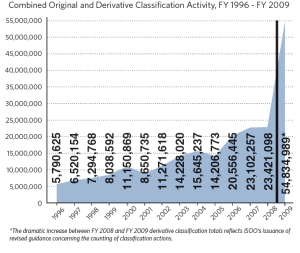 The one place where this has the greatest danger is the area of “export control” which is a form of Official Use Only”. In most cases standard classification is well controlled and highly technically prescribed. Export control has almost no guidance whatsoever. The information falling under export control is much less dangerous than classified info, yet the penalties for violating the regulations are much worse. Along with the more severe penalties comes almost no technical guidance for how to determine what is export controlled. Together it is the recipe for disaster. It is yet another area where our lawmakers are utterly failing the Nation.
 d perspective on how others live. Omaha offers me the chance to see a real sunrise that the Sandia Mountains deny me. Omaha also seems to eschew the practice of supplying sidewalks for its citizens. This is irritating given my newfound habit of walking every morning, and might explain part of the (big) red state propensity towards obesity.
 orkforce in science and technology. General Klotz described the NNSA support for re-capitalizing the facilities as central to this. He reiterated the importance of the workforce several times. From my perspective we are failing at this goal, and failing badly. The science that the United States is depending on is in virtual free fall. Our supremacy militarily is dependent of the science of 20-40 years ago, and the pipeline is increasingly empty. We have fallen behind Europe, and may fall behind China in the not too distant future. The entire scientific establishment is receding from prominence in large part to a complete lack of leadership and compelling mission as a Nation. It is a crisis. It is a massive threat to National security. The concept of deterrence by capability used to be important. It is now something that we cannot defend because our capabilities are in such massive decline. It needs to come back; it needs t
 o be addressed with an eye towards recapturing its importance. Facilities are no replacement for a vibrant scientific elite doing cutting edge work. Today, for some reason we seem to accept this as such.
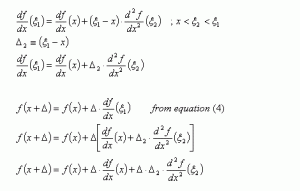 recede the math. The math provides rigor, explanation and bounds for applying techniques. This reflects upon our considerations of where the balance of effort should be placed in driving innovative solutions. Generally speaking, I would posit that the computational experimentation should come first, followed by mathematical rigor, followed by more experimentation, and so on… This structure is often hidden by the manner in which mathematics is presented in the literature.
 In developing the history of CFD I am trying to express a broader perspective than currently exists on the topic. Part of the perspective is defining the foundation that existed before computational science was even a conceptual leap in Von Neumann’s mind. I knew that a number of numerical methods existed including integration of ODE’s (the work of Runge, Kutta, Adams, Bashforth, etc…). One of Von Neumann’s great contributions to numerical methods was stability analysis, and now I’m convinced it was even greater than I had imagined.
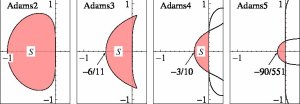 dies early (e.g. Von Neumann) no such retrospective is available.
 What is lost from the literary record is profound. Often the greatest discoveries in applied math come trying a well-crafted heuristic on a difficult problem and finding that it works far better than could be expected. The math then comes in to provide an ordered structural explanation for the empirical observation. Lost in the fray is the fact that the device was heuristic and perhaps a leap or inspiration from some other source. In other cases progress comes from a failure or problem with something that should work. We explain why it doesn’t in a rigorous fashion with a barrier theorem. These barrier theorems are essential to progress. The math then forms the foundation for the next leap. The problem is that the process is undocumented and this ill prepares the uninitiated for how to make the next leap. Experimentation and heuristic is key, and often the math only follows.
 now how to do. We need methods that work, and invent math that explains the things that work. A more fruitful path would involve working hard to solve problems that we don’t know how to attack, finding some fruitful avenues for progress, and then trying to systematically explain progress. Along the way we might try being a bit more honest about how the work was accomplished.
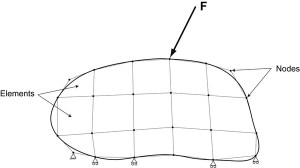 Sometimes this blog is about working stuff out that bugs me in a hopefully articulate way. I’ve spent most of the last month going to scientific meetings and seeing a lot of technical talks and one of the things that bugs me the most are finite element methods (FEM). More specifically the way FEM is presented. There really isn’t a lot wrong with FEM per se, it’s a fine methodology that might even be optimal for some problems. I can’t really say because its proponents so often do such an abysmal job of explaining what they are doing and why. That is the crux of the matter.
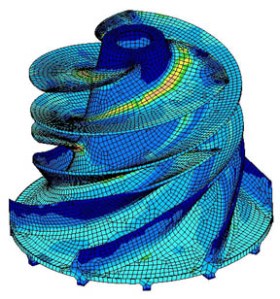 Scientific talks on the finite element method tend to be completely opaque and I walk out of them knowing less than I walked in. The talks are often given in a manner that seems to intentionally obscure the topic with the seeming objective of making the speaker seem much smarter than they actually are. I’m not fooled. The effect they have gotten is to piss me off, and cause me to think less of them. Presenting a simple problem in an intentionally abstract and obtuse way is simply a disservice to science. It serves no purpose, but to make the simple grandiose and distant. It ultimately hurts the field, deeply.
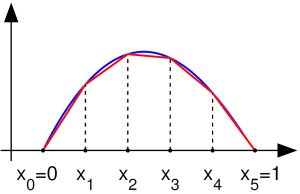 Instead FEM research is increasingly focused on elliptic PDE’s, which are probably the easiest thing to solve in the PDE world. In other words, if you can solve an elliptic PDE well I know very little about the ability of a methodology’s capacity to attack the really hard important problems. It is nice, but not very interesting (the very definition of necessary and insufficient). Frankly the desire and interest in taking a method designed for solving hyperbolic PDE’s such as discontinuous Galerkin and applying it to elliptic PDE’s is worthwhile, but should not receive anywhere near the attention I see. It is not important enough to get the copious attention it is getting.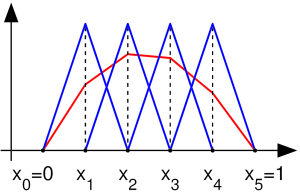
 Where FEM excels is the abstraction of geometry from the method and ability to include geometric detail in the simulation within a unified framework. This is extremely useful and explains the popularity of FEM for engineering analysis where geometric detail is important, or assumed to be important. Quite often the innovative methodology is shoehorned into FEM having been invented and perfected in the finite volume (or finite difference) world. Frequently the innovative devices have to be severely modified to fit into the FEM’s dictums. These modifications usually diminish the overall effectiveness of the innovations relative to their finite volume or difference forbearers. These innovative devices are necessary to solve the hard multiphysics problems often governed by highly nonlinear hyperbolic (conservation or evolution) equations. I personally would be more convinced by FEM if some of the innovation happened within the FEM framework instead of continually being imported.
 In a sense the divide is defined by whether you don’t assume regularity and add it back, or you assume it is there and take measures to deal with it when it’s not there. Another good example comes from the use of FEM for hyperbolic PDE’s where conservation form is important. Conservation is essential, and the weak form of the PDE should give conservation naturally. Instead with the most common Galerkin FEM if one isn’t careful the implementation can destroy conservation. This should not happen, conservation should be a constraint, an invariant that comes for free. It does with FVM, it doesn’t with FEM, and that is a problem. Simple mistakes should not cause conservation errors. In FVM this would have been structurally impossible because of how it was coded. The conservation form would have been built in. In FEM the conservation is a specially property, which is odd for something built on the weak form of the PDE. This goes directly to the continuous basis selected in the construction of the scheme.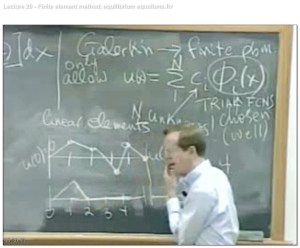
 The Regularized Singularity