“Grief is the price we pay for love.” – Queen Elizabeth II
Last Sunday night, a friend called me with tragic news. Our mutual friend Tim had passed away suddenly and unexpectedly, and I was absolutely shocked. Tim is about 10 years older than me, so his passing is at too young an age. It does beg the question of what age is not too young, 80? 85? Tim’s death leaves an enormous gulf in my life. His death is also one of several that have visited me in the past year or so.
“In the long run we are all dead.” – John Maynard Keynes
I’ve mentioned my father’s passing, but also my friend Jim, who I wrote about earlier. Jim’s death was more shocking, but also strange as the news came a couple of years after he was gone. Together, Jim and Tim are two of the most consequential people in my work life and had both become great friends. The difference with Tim is that he was still present. At this time, my friend Jim has been absent from my life for 10 years. Our final conversation was not good, as he was angry at seemingly everything. Tim and I were still talking as if we had all the time in the World.
“We are always getting ready to live but never living.” – Ralph Waldo Emerson
We didn’t. Our last conversation was simply a placeholder to be picked up.
For Tim, I was planning on meeting him this week for one of our usual brunches and amazing conversations. It would be the time to pick up the thread we left at. I will miss his generosity of spirit, intellect, his wisdom, and most of all, his friendship and warmth.
I had a plethora of things to talk about with Tim. A recap of the conference I attended in France, my talk, and the paper that was accepted for publication. The swift and sudden primacy of AI. AI and mathematics are an important topic. I had shared Terry Tao’s talk on the role of AI in math. This had been eclipsed by the OpenAI claim of solving the Navier-Stokes Millennium problem. This faded in the concept of the probability of human extinction from AI. My sense is the danger is different, but perhaps as dire. I was longing to share the idea and receive Tim’s wise and generous reaction. His knowledge and experience with Sandia was invaluable. There are still ideas and thoughts to explore there.
“Death ends a life, but it does not end a relationship, which struggles on in the survivor’s mind toward some resolution which it never finds.” – Robert Anderson
Two of Tim’s passions combined to produce a lasting impact on the security of the nation. For his entire career, Tim devoted himself to impacting national security. This was true particularly with respect to nuclear weapons. He made key contributions with computational modeling supporting these missions at Sandia. This started with analysis he personally conducted. This then seeded efforts that impacted our entire National effort. He was pivotal in establishing verification and validation for computations supporting our nuclear weapons stockpile.
Tim was also passionately concerned about the quality of these computations. When the nation stopped testing nuclear weapons in Nevada, we turned to computational modeling. Soon after, that program realized it needed better quality control. These processes are known as verification and validation. In 1999, this quality control aspect was added to our National program. Tim was central to driving this change, advising our National leaders. This element of the program remains essential today. Tim launched it and shaped it core ideas. The power of the ideas was deeply impacted by Tim’s efforts and genius.
“A teacher affects eternity; he can never tell where his influence stops.” – Henry Adams
His ideas are being adapted by colleagues for the future, where AI will have a bigger role in National security. The quality of the technical work supporting our National security owes a debt of gratitude to Tim. His pioneering vision for the quality of the work supporting it is due to his tireless efforts. Due to his passion and generosity, he was still shaping the key ideas. This effort was through his mentoring of important young people working in this area.
So the loss of Tim is more than personal. It is a loss for all of us. For me, it is another blow in a year that has had many. The message I have gotten is the transience of life. It is short and precious. We have less time than we think, and the important people can be taken without warning. There’s never a good way. My dad had too much warning, and that isn’t good either. Seeing him be fragile and on the edge of death for over a year was a horror. My conclusion is that it is all awful, but unavoidable. I need to come to terms with it.
My advice is that all of us need to wrap our heads around death. Our own is a huge lift. Before that eventuality, we all deal with loved ones dying. We will lose important people in our life. That process accelerates as we age. I have now graduated to the part of life where my peers begin to die. You are never ready for it. Those losses become an echo of your own mortality. It reminds you of your own fate.
“The bitterest tears shed over graves are for words left unsaid and deeds left undone.” – Harriet Beecher Stowe
The real lesson is to treasure your friends sooner. If you live long enough, you will lose friends. Eventually your death will be a loss to others. This is simply part of the price of life. If you live a life that matters, your death will hurt others. It is just as true that some deaths will hurt you. All of it is a small price to pay for the wonder and joy of life. Do more to lower the regrets of things not said. Say what you need to now and don’t wait. Do the right thing now.
“Do not act as if you had ten thousand years to live. Death hangs over you. While you live, while it is in your power, be good.” – Marcus Aurelius
“No man ever steps in the same river twice, for it is not the same river and he is not the same man.” – Heraclitus
I felt that my last post needed an addendum. In the meantime, other events have overtaken my mind. Things I will write about in the fullness of time. Now they are too new and sudden to have gotten the necessary consideration. Now back to the thoughts about the philosophy of simulations of physical systems, engineered or otherwise.
“To consult the statistician after an experiment is finished is often merely to ask him to conduct a post-mortem examination. He can perhaps say what the experiment died of.” – Ronald A. Fisher
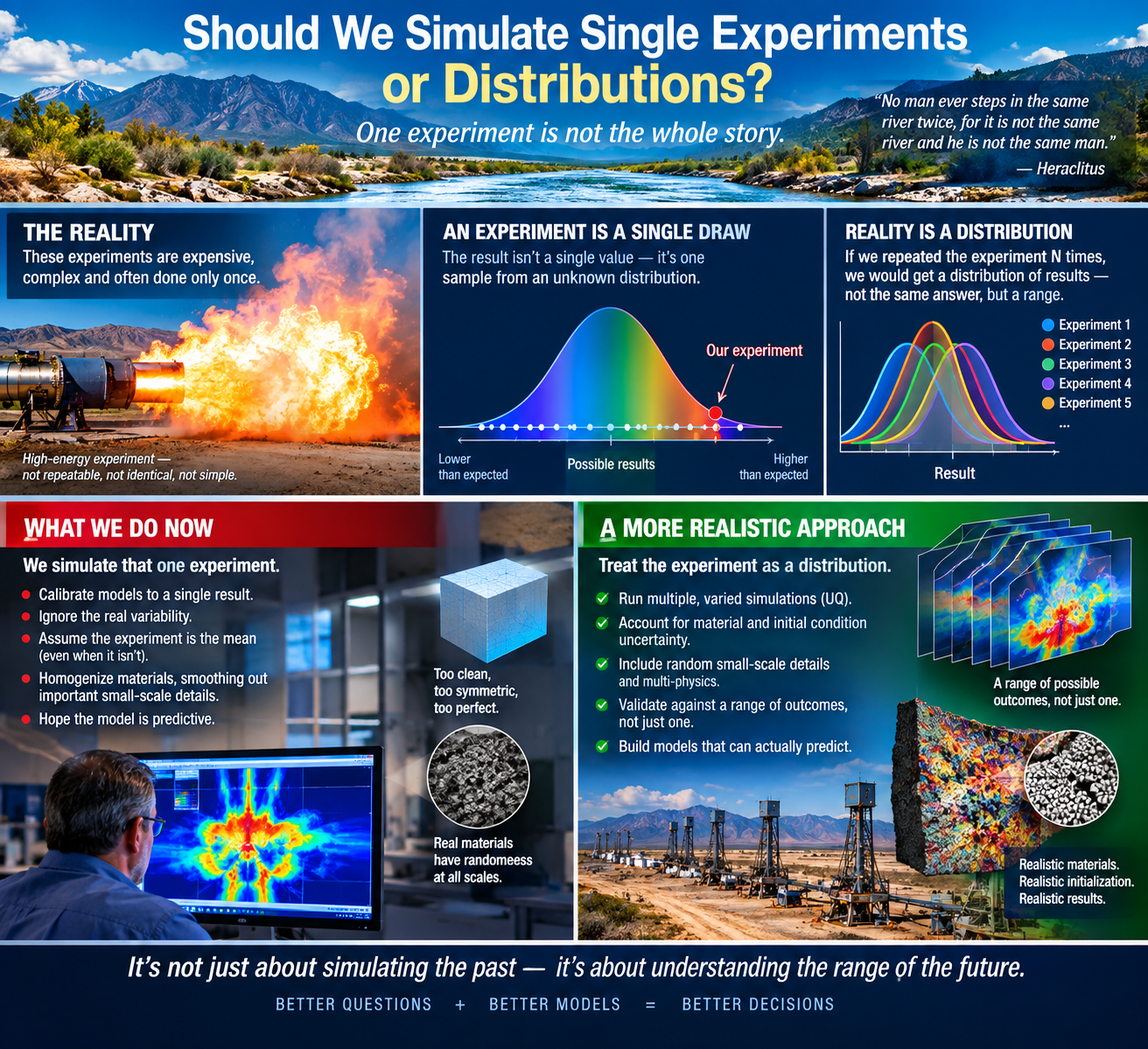
I’m constantly struck by the damaging role of wishful thinking in simulation and modeling. When we conduct very expensive experiments, we want to understand the results. Unfortunately, these expensive experiments are often done exactly once. Worse yet, these are often supposed to help characterize systems we want to make in large numbers. This can be especially bad when the experiment does not go well. We want to know why, and often we enlist simulations to understand it. This is where things start to go awry.
Most experiments and phenomena are not repeatable, especially as they become more complex and energetic. The complexity and energy often result in instabilities and turbulence. More generally, the physics travels through critical points where the evolution takes one route or another. More things are happening at the same time, which we call multi-physics. Together, these all mean the experiments will get different results every time, no matter how much we make things identical. This should be obvious. Yet most of the users of our codes (analysts and designers) want to treat every experiment like a one-off.
“Chance is only the measure of our ignorance.” – Henri Poincaré
Instead, the reality is that an experiment is a single draw from an unknown statistical distribution. Worse yet, we don’t know those statistics. We don’t know where on the distribution any given experiment is drawn unless we do many experiments. It could be in the tails or from the middle, or… The de facto assumption is that the experiment issimplythe mean of the distribution. Even worse, we do almost nothing to figure it out. We don’t repeat experiments or structure our models to do the same. The damage of this attitude is hard to fathom. It is vast.
“The most important questions of life are, for the most part, really only problems of probability.” – Pierre-Simon Laplace
This is one of the biggest gaps in our current scientific and engineering practice. I saw it at Los Alamos and Sandia. It is a common attitude and stood in the way of learning more. It compounds our broad societal tendency to misunderstand statistics. While this is tolerable for the layman, it is unforgivable from our highest-level institutions. Yet, even there, the attitude rules actions and fuels stagnation.
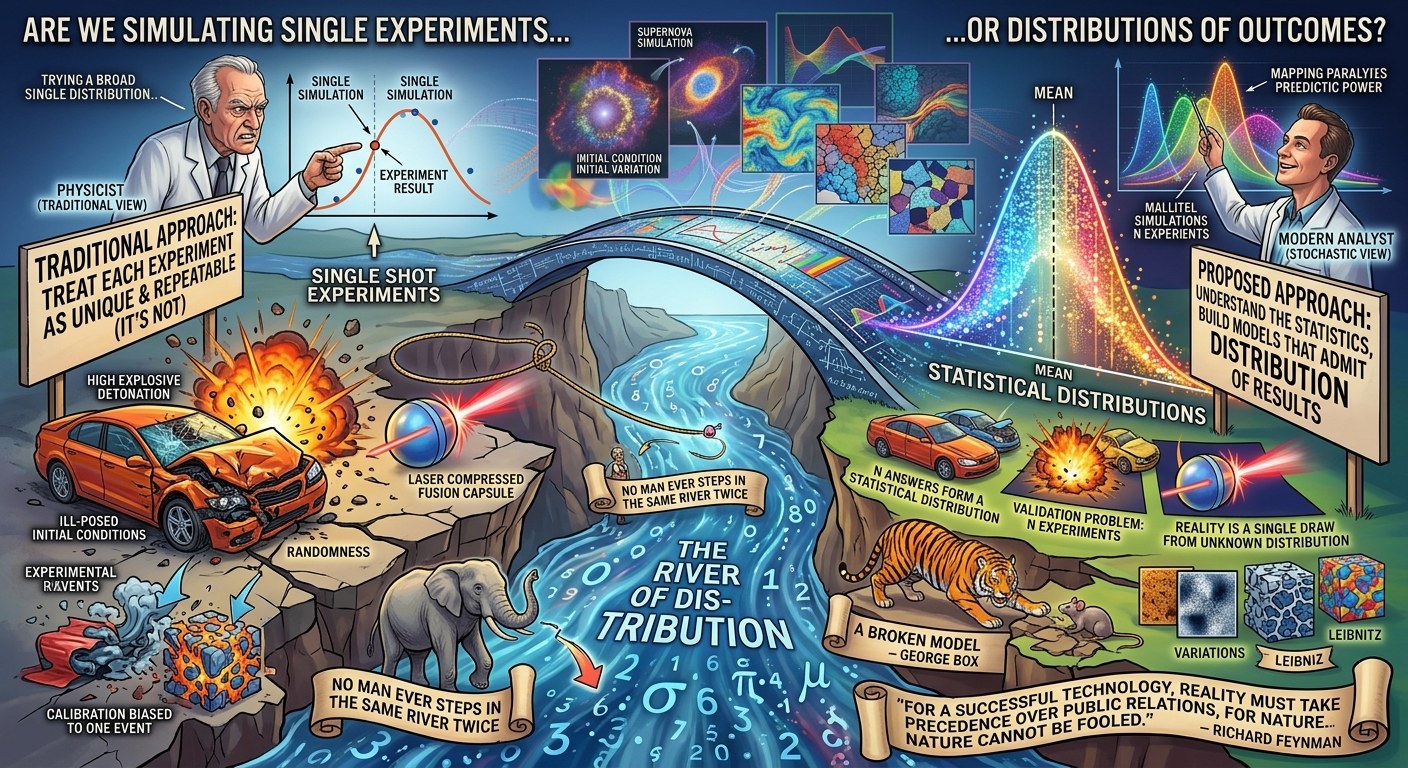
Most simulations of large-scale experiments try to replicate the result of that specific experiment. The problem is that these experiments are not repeatable. In a broad sense, this is always true. If we tried to do the same experiment N times, we would get N answers. The results would form a statistical distribution. The validation problem is that we do very few repeat experiments; most are single shots. Modelers try to simulate that precise experiment. The real impact is modelers calibrating the models on the basis of this single experiment. If the experiment is not the mean or median, the calibration may be extremely harmful.
“There are never two beings in nature that are perfectly alike.” – Gottfried Wilhelm Leibniz
Part of the issue what I last wrote about. We homogenize the materials, treating them the same without regard to scale. To me, this is obviously an approximation. It becomessystematicallyworse with grid refinement, not better. For some systems, it will neutralize the advantage of high-performance computing. The gross large-scale features are studied. The problem is that real materials encode some randomness into all problems. The hope is that these do not matter. The problem is that we do not verify that this is true. We have scant knowledge about how these random details drive variation in reality. We just assume it away. It is a if we learned nothing after Newton and still live in an assumed deterministic universe. We do not.
If the small-scale details impact the results critically, this is ill-posed and hopeless. If the results depend upon unstable phenomena, it can push the model through critical points. At those points, the model will turn to one major branch or another. We sometimes get good results by calibrating the simulation. This fails the desire to be predictive. The fault is largely philosophical. We are trying to solve a well-posed initial value problem that is not a well-posed initial value problem. There is a fundamental bias among physicists to view each experiment this way. Even when it is obviously not true.
The consequence of this cognitive dissonance is a lack of knowledge. Generally speaking, we have little or no idea of the distribution of results for these engineered objects. I saw this happen time and time again in my career. It was the primary philosophy of simulation at all the Labs. All of them, and for virtually any experiment of consequence. I’ll roll out a few examples of the sort of situations where it was obviously the wrong thing to do.
Most of what the analysts and designers do is quite defensible. Many experiments have gross large-scale features that lead to the unusual results. Sometimes the construction or manufacturing is flawed, or standard precision is off. All of these are common things to pursue. These studies are generally limited by the ability to input things into the model. The painting of materials upon initialization is one such limitation. To change this, the basic nature of material initialization would have to be modified. The materials would need to be measured and characterized at the scale of these details.
“With four parameters I can fit an elephant, and with five I can make him wiggle his trunk.” – John von Neumann
A canonical case where single experiments are terrible representatives of the mean is car crashes. Here solid mechanics is the ruling physics. It is obvious that each crash is different. This is ruled by the complexity of the engineered item, the car (or truck), combined with the complexity of material response. It is a place where the structural detail of the material should be added stochastically. The homogenized nature loses a key part of the response. In cases where the vehicle is very expensive, a single experiment could be extremely misleading. Yet in practice I have observed the analysts calibrate the entire population of vehicles to this single point. We nullify some of the most important powers of simulation by failing to understand the statistics of these events.
“Since all models are wrong the scientist must be alert to what is importantly wrong. It is inappropriate to be concerned about mice when there are tigers abroad.” – George Box
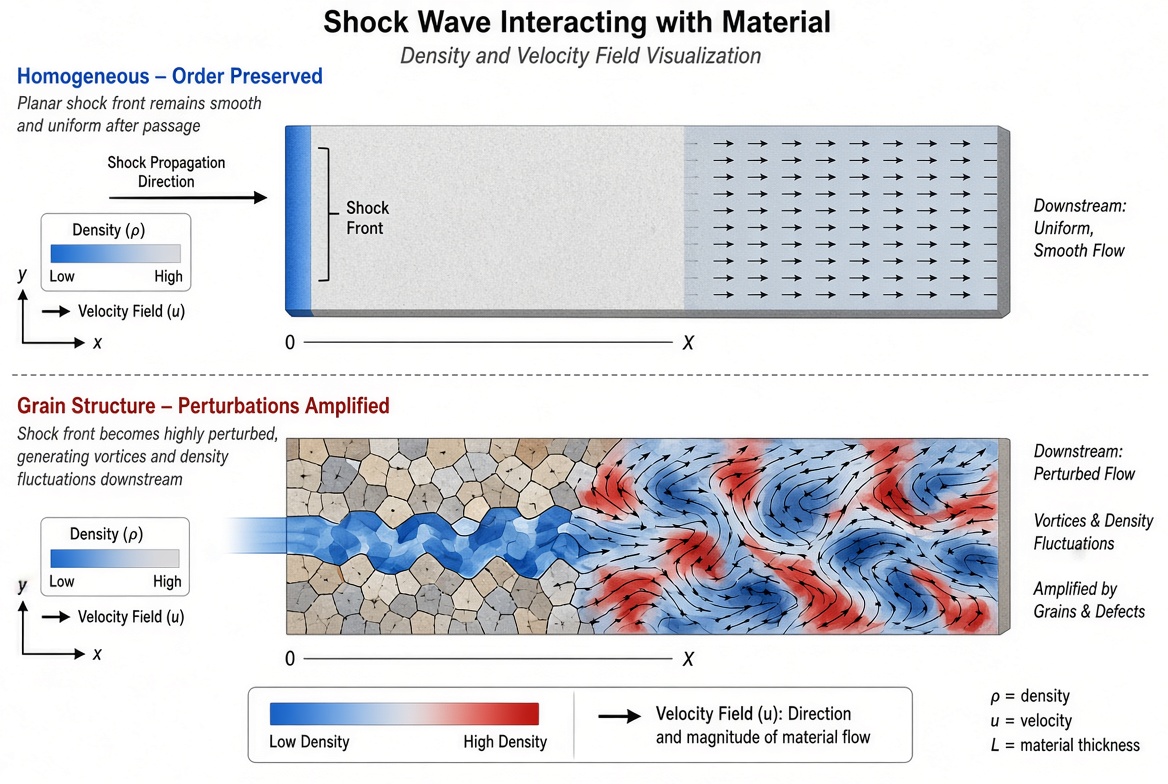
High explosives are very heterogeneous materials. They are typically composed of three components: energetic material, binder, and void. Thus, at a small scale, the shock wave produced is uneven and corrugated. Their representation as an ideal shock in homogeneous material only works at a macroscopic level. If these corrugated shock waves collide or converge, we can expect the variations to be amplified. Is this an effect we account for?Clearly, it canbe seenin images of explosions where large variations appear. Even more importantly, how do these variations impact technology and other materials combined with them? Again, this is a place where single experiments could be extremely misleading. The outcomes are likely to be highly statistical. Do we have any real understanding of this?
Fusion capsules are a third example. To achieve successful fusion. we need to compress the fuel to a massive degree. Anything non-homogeneous in the material or design is going to be amplified to the same degree. Thus, any material variation will alsobe amplified.How much of the ubiquitous mixing and turbulence arises from small heterogeneous bulk aspects of materials? Do we know? Again, this would be a place for proper simulations to shed light. Are we looking here, or is it a rock we refuse to turn over? My understanding is that the focus has been on things like surface finish and roughness. Materials are still painted homogeneously. It is also clear that the experiments are not repeatable and admit a statistical distribution of outcomes.
“Absence of evidence is not evidence of absence.” – Carl Sagan
There are many more examples out there. In a totally different vein, one can look at initial conditions for supernovae. The details of the star before it explodes are essential. Its structure and rotation, plus evolution, all imprint onto the details we can see. The cloud formed after the explosion and the radiation signature all indicate that these explosions are each unique to some degree. A companion star can also influence the outcome greatly. This would include the orbital mechanics at the precise moment of the explosion. The differences in the initial conditions mattergreatly. It is a natural place to look at the statistics of what can be measured. We should look for explanations in this, and simulation could be helpful.
The important thing is that codes need tobe structuredto allow such modeling. My last post on heterogeneous scale-dependent materials is an example of such. It would simply also be a more realistic representation of the problem being simulated.
“It is better to be vaguely right than exactly wrong.” – Carveth Read
In all these cases, the issue is really more deeply philosophical. When we observe an event or an experiment, the tendency is to look at it as a single thing. It is not viewed as a part of a distribution. The statistical nature of the results is not taken into account. In the parlance of physics, itis seenas a single well-posed initial value problem. It is not. Most of the important cases are not. We should expect the results to be variable. There should be a different outcome if the identical event or experiment were conducted. Real understanding would unveil this bit of knowledge. Even in cases where specific features caused the result, the statistical nature does not fade. The same maxim holds there too.
“For a successful technology, reality must take precedence over public relations, for Nature cannot be fooled.” – Richard Feynman
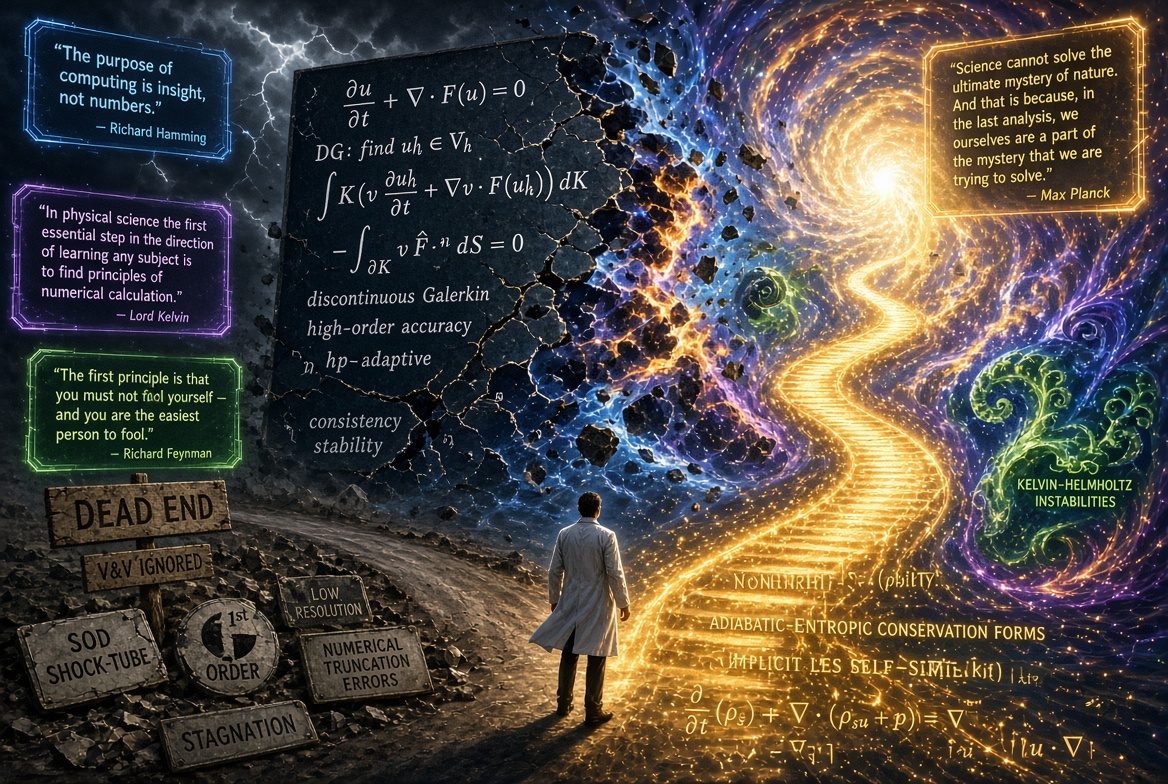
Excuse the clunky AI images, but they do show the ideas clearly and help visualize the main points.
“Clouds are not spheres, mountains are not cones, coastlines are not circles, and bark is not smooth, nor does lightning travel in a straight line.” – Benoit Mandelbrot
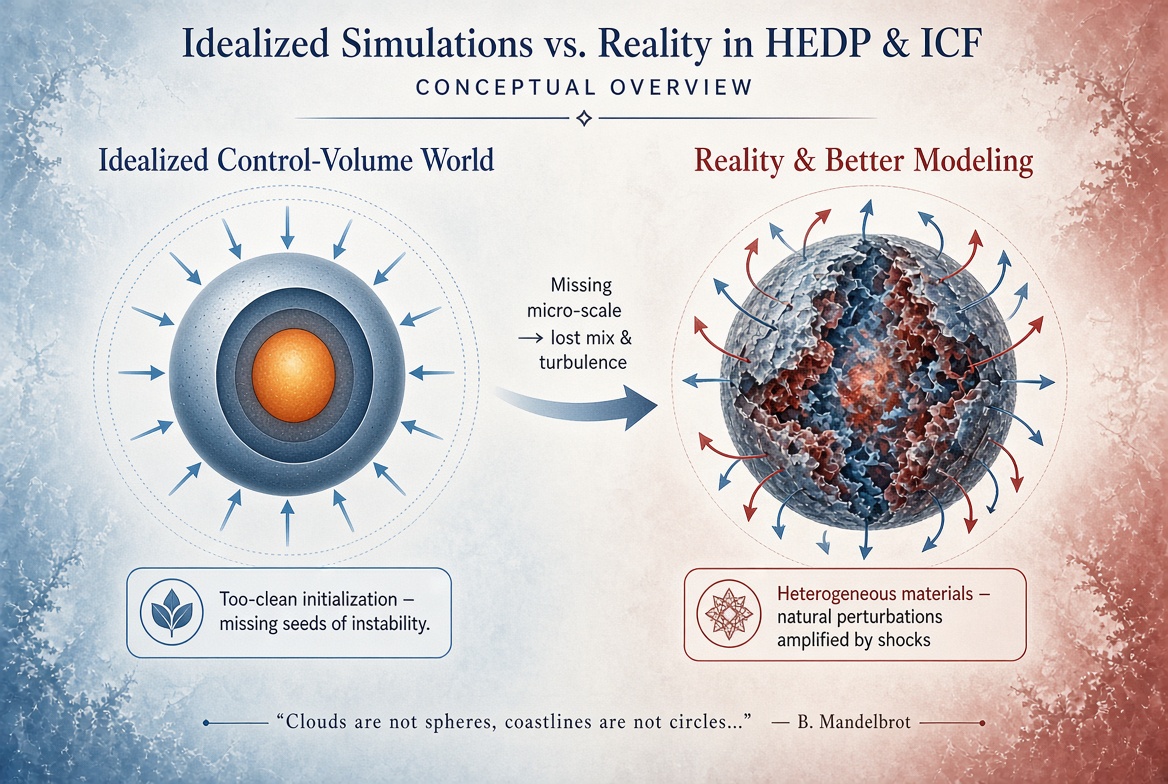
There is this problem with numerical simulation that has bothered me forever. The simulations are generally too clean, too symmetrical, and too perfect. For a while now, my judgment has been that the initialization of the codes is the problem. The initial conditions are generally too clean and perfect to represent reality. When we start a problem, we initialize it with material at a defined density, pressure, and temperature. This leads to over idealized unrealistic simulations. Usually, this is constant in regions occupied by a given material. In the parlance of the codes, the material is painted into these regions.
There are a couple of questions that come to mind:
What is the correct level of variability in these materials? How do we set this properly?
What sort of impact would this have on calculations? Where would it matter, and what calculations would change character in a fundamental manner?
When we construct our methods, we rightly desire them to retain ideal properties. We don’t want the methods tounphysicallyseed instability, break symmetries, or violate basic laws. An example of this I’ve hit upon before is perfect entropy conservation. A method can be designed to do a perfect job of not generating spurious entropy. Such a method would not perturb smooth conditions. When we see reality, this is not what is manifested. If I look at places where simulations are used heavily, have these ideals poisoned our success? Reality is rarely ideal, and simulations should model reality.
“The law that entropy always increases holds, I think, the supreme position among the laws of Nature.” – Arthur Eddington
For inertially confined fusion, the answer seems to be yes. The two things they need for success are entropy-conserving compression to very high densities and lack of mixing. If they could achieve both, fusion would be easy. Neither is present in reality.If the methods were more accepting of reality, could the fusion designs be more successful? I think so. Mixing and turbulence are ubiquitous. They should be accepted. The second law is also ubiquitous. Ideals should be a guide, but reality should be respected more. This would be a longer but truer path to success.
“Nature, to be commanded, must be obeyed.” – Francis Bacon
I’ll start with the clearest example of issues with painting homogeneous materials for initialization: solid materials with defined grain or crystalline structures that are subjected to high energy forcing. This can happen with explosives, lasers, or radiation that causes the material to flow hydrodynamically. In my view, painting these materials inhomogeneouslyissimplywrong. The thing that made me think about this was high-performance computing. We started to get to the point that we had control volumes close to the grain or crystal size. Clearly, as we refined the mesh, the initial conditions were getting less true to reality. The smaller the mesh cells became, the rougher the landscape should be. The smoothness of the properties is an illusion.
“Crystals are like people: it is the defects in them which tend to make them interesting.” – Colin Humphreys
The variations at that size would cause deviations in the material properties to grow. As you refined, the cell-to-cell variations would become more extreme. You would be losing connection with reality. The materials are defined by their macroscopic properties, which are frequently determined at a large scale. These properties would become less accurate under these conditions. This seems pretty fucking obvious, and yet nothing is done. We just keep painting macroscopic properties into smaller and smaller cells. This seems destructive and dumb.
We can see the impact of this in comparison with data. Whenever we have an image of one of these hydrodynamic flows, there are small-scale details missing. The simulations are far cleaner than measured reality. I’ve had a career of seeing this, yet we have done nothing. In some cases the simulations deviate in large ways. The small details scale up and change the large-scale flow. The simulations are not modeling reality. The source of the problem is not the equations or the numerical methods. The source is details missing in the initialization of the problems. It is an own goal caused by a deeper gap in our practice.
What is needed to deal with this is measurement and characterization of materials. One needs to determine the length scales and statistical properties of the materials. As the mesh is refined, the heterogeneous nature will be resolved. As itis coarsened, the material will be moreproperlyhomogeneous. Part of this is realizing that control volumes are integral averages. Integration smooths, and thus as the control volume is larger, the averaging is greater. It is appropriate to be homogeneous as the volume samples more. The inverse is true.
What is the potential impact of this? In very large part, the impact on any phenomenon where you have something like a hydrodynamic instability is going to be quite large. Something like a shock wave is an extremely energetic way to hit the material and produces amplification of these perturbations. When these perturbations at the mesh scale are missing, this amplification and feedthrough is lost. Some of the observed ubiquity of turbulence and mix canbe explained bythis. At small scales, there is always a high degree of perturbation needed to drive turbulence. The counterargument is that these all average out as the shock sweeps over. However, the size of the perturbations from a shocked material is going to be far larger than the perturbations as defined by the material. If there are orientation effects, these changes could be quite large indeed.
“It may happen that small differences in the initial conditions produce very great ones in the final phenomena.” – Henri Poincaré
Is painting in material and removing these small-scale features simply another form of wishful thinking? Wishful thinking that makes mixing phenomena subside? In fact, there is a lot of heterogeneity that would drive mixing. I’ve always felt that ICF pellets would be better designed if they gave in to the fact that mixing and turbulence will develop. It is going to happen. How do we design when we accept that reality rather than wishing it away? I wonder how many decades of progress were lost at the altar of wishful thinking. We wishfully treat entropy and turbulence away when simple observation of the universe say they are universal. Why should we believe that we can engineer these into submission?
“The first principle is that you must not fool yourself, and you are the easiest person to fool.” – Richard Feynman
No time like the present to do something different.
Perhaps part of the wishful thinking comes from this particular issue: the small-scale heterogeneity is removed, and a source of perturbations is basically excused from the problem. We believethat itis handled bysubgrid modeling. That also removes the natural formation of these instabilities from the passage of high-energy forcing through the body of materials that are treated too homogeneously. In spite of lots of knowledge, subgrid modeling is generally problematic. It is rarely first-principles. It is a computational band-aid. We do not know how to do this nearly as well as we say. Moreover, the subgrid modeling is not working on the same processes discussed here. Thus the modelingis divorcedfrom much of the cause for the effect.
Working on simulating reality with more fidelity should help. If we are modeling things with an eye on the wrong cause and effect, we should expect issues. It will be stubbornly unsuccessful. Modeling things from the right philosophical perspective should be better. It is worth a try.
“Far better an approximate answer to the right question, which is often vague, than an exact answer to the wrong question, which can alwaysbe madeprecise.” – John Tukey
“It is difficult to get a man to understand something, when his salary depends upon his not understanding it.” — Upton Sinclair
Lately I have been thinking about something an instructor of mine said back in graduate school. He was a staff member at Sandia. He was teaching the graduate reactor theory class, and we were learning how to analytically compute the criticality of reactor configurations. One day, class was more informal. A foot of snow had fallen overnight. The University was actually closed for the day. Our 7 am class started before that was known. It was the days when you needed a radio or TV to tell you about closures and delays. He made an offhand comment about the nature of employees at Sandia. He noted that he had met plenty of staff who came out of school with a 4.0 GPA and couldn’t find their ass with both hands. It took me a number of years at Sandia to process what that actually meant. I understand him clearly now.
What I came to understand is that Sandia is not an organization that wants outstanding researchers. It does not manage people to create the basic conditions for flourishing research. It wants outstanding homework doers, the people who are really good at completing assignments correctly. Those assignments don’trequireyou to think outside the box. If you think outside the box, you are exposed and vulnerable to attack. They require you to grind through and do what you’re told. This is the essence of what it takes to succeed there. Shut up and do what you are told to do. Anything extra will be used against you.
One of the ironies of the modern era is that AI is far more effective in an environment where doing the homework well is the standard. Sandia, then, stands to benefit from AI more than most. Yet its fear and control issues mean AI will actually be used less there. It willbe fencedin with controls and never explored asexpansivelyas it could be. The irony is thick. Where AI can open up vistas for human attention and creativity, it will be neutered. Creativity is not welcome in completing your homework. Fidelity to the task and correctness are the expectation.
“Drive out fear, so that everyone may work effectively for the company.” — W. Edwards Deming
So Sandia may suffer more in the current era precisely because of these issues, while places like Los Alamos and Livermore, where research matters far more, are helped. AI’s capacity to do the homework really well shores up a genuine weakness in those organizations and raises all of their work to a higher level. In the process, Sandia undermines its core advantage in the modern era. Ironic indeed.
In the environment that developed over the last quarter century, where money flowed into project work, Sandia had an advantage. Having employees chosen primarily for their ability to do homework worked out rather well. Project work is much like homework: well-defined, bounded, and carrying very little chance of failure. We are not doing research or finding breakthroughs. We are executing a project as defined, on schedule, against well-defined milestones and outcomes.
“Good ideas are not adopted automatically. They must be driven into practice with courageous impatience.” — Hyman G. Rickover
It is no wonder Sandia has grown so much larger in this period. Their approach is perfect for the modern era. The problem is that the modern era is one of a diminished United States. It is a country that has lost supremacy in scientific research and engineering and is ceding that crown to China. The USA hassimplycapitulated. China hassimplypulled ahead through dull competence. A system that is better designed for the high control of people. In the meantime, the USA is sabotaging its prime advantage. Freedom of thought and bold solutions. It has given in to fear and distrust of institutions. Fear kills freedom. Trust is needed for bold action.
That said, I strongly suspect China is very much in the homework mode as well. It is a very controlling environment. The difference is that the Chinese have numbers on their side: vastly more researchers at vastly lower cost, free of much of the regulation we have here. They can efficiently execute more and bigger projects, and ultimately consume the advantage the United States once had. The combination of Chinese efficiency and American incompetence has blunted one of our major advantages. I just happened to be in an organization perfectly suited to thriving in a declining America.
“Bad news isn’t wine. It doesn’t improve with age.” — Colin Powell
Control is an attempt to keep issues and problems from boiling over. But problems do not magically solve themselves. A problem you put a lid onjustgets worse and worse until it escapes containment. How many problems are we trying to control this way? The containment will fail. It always does. What will happen when they break free? Our current philosophy only ensures that the problems will be bigger and more damaging than necessary.
In the meantime, management acts out of fear and instills that fear in the people it manages. The fear revolves around control, around keeping everybody in line with the prime directive: keep the money flowing. It provides an element of stability to the labs, but it also saps them of inspiration and motivation, which are critical to executing the mission properly. In the process, we have no energy left to solve the major problems we face as a society. We are just allowed to nibble around the edges. The heart of the problems are never exposed.
Let me be perfectly clear about what this control sacrifices: the ability to confront and solve problems. Problems management doesn’t want to acknowledge won’t be solved, because they won’t be funded. The funding controls people, keeping them from doing what they think is right. This was the lesson of my last year at work. Instead, it focuses them on what they can be paid for. Management gets what it wants through power and force. Money is power today. It rules every decision. Right and wrong is measured in dollar signs.
“In any bureaucracy, the people devoted to the benefit of the bureaucracy itself always get in control, and those dedicated to the goals the bureaucracyis supposedtoaccomplishhave less and less influence.” — Jerry Pournelle
In the process, problems that need solving simply languish. The real loss is the creative work necessary to solve them. That work leads to breakthroughs, and it also leads to many failures, because these problems are difficult, bordering on intractable. In a controlled environment, the people working on them don’t have the leeway to try bold ideas. For people to be bold, safetyis needed. Control removes that safety. Without bold ideas, we are reduced to incrementalism at best and complete stagnation at worst. That is where we are today.
By failing to confront problems, we also fail to produce solutions. These solutions are the things that change the future, make it better. They are breakthroughs and discoveries. That is the other thing control denies us. Control is robbing us of progress and a more bountiful future. Fear does that. I will note that AI is a problem in need of vigorous and concerted effort. We need breakthroughs to help us navigate the perilous times ahead of us. Our control will deny us positive solutions.
“The prospect of domination of the nation’s scholars by Federal employment, project allocations, and the power of money is ever present — and isgravelytobe regarded.” — Dwight D. Eisenhower
I recently met a friend at a conference who is quite critical of my writing. He sees it as self-destructive. Perhaps it is, in this sense: by writing about what has actually happened at the labs and what their problems are, I have burned my bridges. The labs aren’t interested in solving their problems. Theyare interestedin hiding them. That is the essence of the control they seek. They are nervous about the future and about keeping their programs funded. They have concluded that the best way to manage that is to keep any problems under wraps.
I saw this in the messaging from leadership to the rank and file. Only success was talked about. Any issues or problems were only discussed in private. They could be mentioned in hushed tones without management acknowledgement. In public, everything was great. Success was the message. The organization is doing great, whatever the reality is. This is the nature of a toxic positivity that has taken root at the Labs. Maybe in the country as a whole. Problems lie festering in the shadows. They grow larger and more intractable in the fertile environment of enforced ignorance.
Control, and joining the project of power, brings money. I get several reactions to my writing. It is a service; it is self-destructive. It is patriotic; it is pointless. You give in so that you can have comfort. What I am describing is a low-key version of what is happening with Trump: power and money used to squash all resistance. That power and money is in service of decaying institutions and terrible outcomes. Trump’s version is over the top. Mine is quiet, but the mission is the same. People do shitty stuff to lead in a bad direction, and reward those who let them. It is self over community, self over the collective. It is dragging society down one capitulation at a time.
I burned those bridges by pointing out the problems, because pointing them out was the right thing to do. Being able to live with myself means doing the right thing instead of the easy thing. If I suffer for it, so be it. At least I have my integrity. Maybe at the end I can face myself and know that I did what the moment required.
“The day soldiers stop bringing you their problems is the day you have stopped leading them.” — Colin Powell
“For a successful technology, reality must take precedence over public relations, for nature cannot be fooled.” – Richard Feynman
I had the virtue of attending a scientific meeting when the news broke. There was a buzz when I arrived at the meeting. Since my morning routine was turned on its head, I had not digested the news before arriving. OpenAI claimed to have solved the Clay Prize Millennium Problem revolving around the existence of solutions to the Navier-Stokes equations. Parts of the entire story were the theater of the absurd. They used 10,000 agents working for nearly 90 hours to produce a 166-page proof that had been digested by another tool to confirm it. This is a big deal, and reactions from the scientific world were divergent.
I think it is important to step back first and put this whole thing into context. There are three major threads to consider:
1. OpenAI’s role and motivations are a basket of “red flags”.
2. The division of AI work and human labor is questionable.
3. The problem itself and the nature of the solution are questionable.
I will take these considerations one by one. Each of these is a different flavor of what the fuck?
“It’s a kind of scientific integrity, a principle of scientific thought that corresponds to a kind of utter honesty — a kind of leaning over backwards. For example, if you’re doing an experiment, you should report everything that you think might make it invalid — not only what you think is right about it.” – Richard Feynman
OpenAI’s Role and Character
Scientific discoveries do not happen in sync with the business or political cycle. This one did.
“What we are doing is finding ways for people to understand and think about mathematics.” – William Thurston
The fact that OpenAI was involved immediately projects a cloud of suspicion on the result. First and foremost is their leadership. Altman and Brockman are both extremely prone to lying and fabrication. They are leaders who shouldbe metwith vacant credibility. This issimplyan empirical observation. They are trying to pump up OpenAI before their upcoming IPO and undercut Anthropic before theirs. This news does exactly that. Everyone should see that Altman is a sketchy as fuck character.
Secondly, the announcement came in close proximity to the release of their latest model, Astra. Coincidence? This seems unlikely. The whole thing feels very staged to boost this release. Red flag number two achieved!
Thirdly, the news cycle has been rightfully brutal to OpenAI. The Hugging Face hack by rogue agents was alarming. It was scary and damning to a company that hadbeen devotedto AI safety. They appear to have lost that mission. There was another hack, and this news release successfully put a wet blanket on that report. Red flag number three is visible.
“If I have seen further it is by standing on the shoulders of Giants.” – Isaac Newton
Finally, the work is not intellectually separated from other efforts to solve this technical problem. There is not a clear separation from this other work, and OpenAI has been evasive. OpenAI tools were used to do some of this other work with genuine mathematicians. It is not clear that the information barriers are sharp. This would be some degree of plagiarism. The whole thing carries a stench of the shitty student cribbing an answer by peering over the shoulder of the smart student. Red flag number four is seen!
“The indiscriminate strip-mining of open problems for solutions may destroy the ecosystem from which the next generation of mathematical techniques, problems, and practitioners would have developed.” – Terence Tao
Each red flag needs tobe addressed. Only the last two can be successfully refuted with some transparency. Doing so might begin to help rescue Sam Altman’s reputation. Fat chance!
“I am not accusing anyone of anything. I am stating what I was told.” – Tristan Buckmaster
The Division of AI and Human Labor
I am a relatively avid user of AI. I should disclose that I pay to use Claude. I also use other models without paying. I find ChatGPT and Grok are good with image creation (seen here). I also want to keep my context window with Claude clean and focused on more professional activities. I use Claude as an assistant for doing research. It is extraordinarily good at detail work, which I am sort of bad at.
For example, I used it to check my work on a recent scientific article. We had reviews, and two of the authors (including myself) used it to digest and check progress on the revised manuscript. One of the reviewers did a very sharp initial review. AI helped us work through every objection and checked our work. It is extremely and inhumanly pedantic. It assisted in getting to a complete and comprehensive revision. The paper was accepted this week. AI helped us, but we did the work.
“To create consists precisely in not making useless combinations and in making those which are useful and which are only a small minority. Invention is discernment, choice.” – Henri Poincaré
This gets to the issue of credit for the proof OpenAI claimed. In general, LLMs are giant nonlinear interpolation machines. They take vast stores of human knowledge in the form of language and digest it. They take prompts, then produce a reply that is highly probable. Is this new? The replies are unique because of the vastness of the models and data. This is akin to discoveries where well-defined knowledge is merged together to create something new. This is separate from the generation of brand new creative ideas. Creative andtotallybrand new ideas are uncommon. Merged ideas are the vast majority of breakthroughs.
The solution to the Clay Prize should be a work of creative discovery. The OpenAI work is almost certainly the nonlinear interpolation of existing human work. This lends circumstantial evidence to the worry of copying existing work. Furthermore, the ability to clearly define its sources and reasoning is damning. This is not a take that says AI should notbe usedfor science or math. This is a take that says AI can and cannot do something. With the extreme complexity that this solution apparently has, disentangling this is itself a huge challenge.
“A mathematician, like a painter or a poet, is a maker of patterns. If his patterns are more permanent than theirs, it is because they are made with ideas.” – G. H. Hardy
This leaves the last consideration. Should we give a fuck about the result? Spoiler alert. Probably not.
“Standard methods from PDE appear inadequate to settle the problem.” – Charles Fefferman
The Question Itself
“There is a physical problem that is common to many fields, that is very old, and that has not been solved. It is not the problem of finding new fundamental particles, but something left over from a long time ago — over a hundred years. Nobody in physics has really been able to analyze it mathematically satisfactorily in spite of its importance to the sister sciences. It is the analysis of circulating or turbulent fluids.” – Richard Feynman
If you’re a regular reader, you know what I think. The Navier-Stokes Millennium problem is sort of stupid. It is not clear that it has anything to do with physical fluids. The rub is the incompressibility, which is unphysical. This causes the removal of sound waves, which now propagate at infinite (superluminal) speeds, violating causality. This is not to say that incompressible flows are not a useful approximation. It is. The question is whether it is useful for the nature of flows implied by the Clay Prize.
The prize revolves around finding out whether normal smooth solutions exist for all time. Why would we worry about this? Turbulence is the answer. A combination of theory due to Kolmogorov and observations indicates that turbulent fluids have singularities. This is the characteristic that the integrated rate of dissipation at large scales becomes independent of the value of viscosity. Viscous forces are the means of enforcing dissipation at small scales. It also keeps flows smooth at small scales.
The singularity that is implied is like a shock wave. You get a discontinuous jump in the fluid state. Shocks give the same character, where the large-scale structure and dissipation rate are independent of the exact value of viscosity. For turbulence, we are looking for something akin to this. The scaling in shocks and that posed by Kolmogorov are the same except for the leading constant, the jump in fluid state cubed. What I’ve questioned about incompressible flow is whether the connection to compressible (real) fluids retains this cubic behavior. It doesn’t.
“It is of some interest to note that in principle, turbulent dissipation as described could take place just as readily without the final assistance by viscosity.” – Lars Onsager
Now we get to the work here. The flows are driven by a source term that is apparently quite elaborate. It is likely that this source term is grossly unphysical. So we rightly ask whether this work with the source term actually solves the Clay Prize Problem at all. Full stop. Next we ask whether it has anything to do with turbulence. Unlikely. I don’t know the nature of the blow-up found. I hope it is a derivative singularity, as this would have some significance. If the blow-up is an infinite velocity, the result is truly not worthy of a single fuck. So the telltale sign of utility is the nature of the blow-up. If it is a derivative (or vorticity), it is worthwhile. If it is an infinite velocity, then the result is damning. The source term nature of the drive is discrediting a priori. At least with respect to physical fluids.
I look forward to learning more about all this in the coming weeks. The details matterimmensely, but some of the aspects are engraved in stone.
“I am an old man now, and when I die and go to heaven there are two matters on which I hope for enlightenment. One is quantum electrodynamics, and the other is the turbulent motion of fluids. And about the former I am rather optimistic.” – Horace Lamb
“Progress in science depends on new techniques, new discoveries and new ideas, probably in that order.” – Sydney Brenner
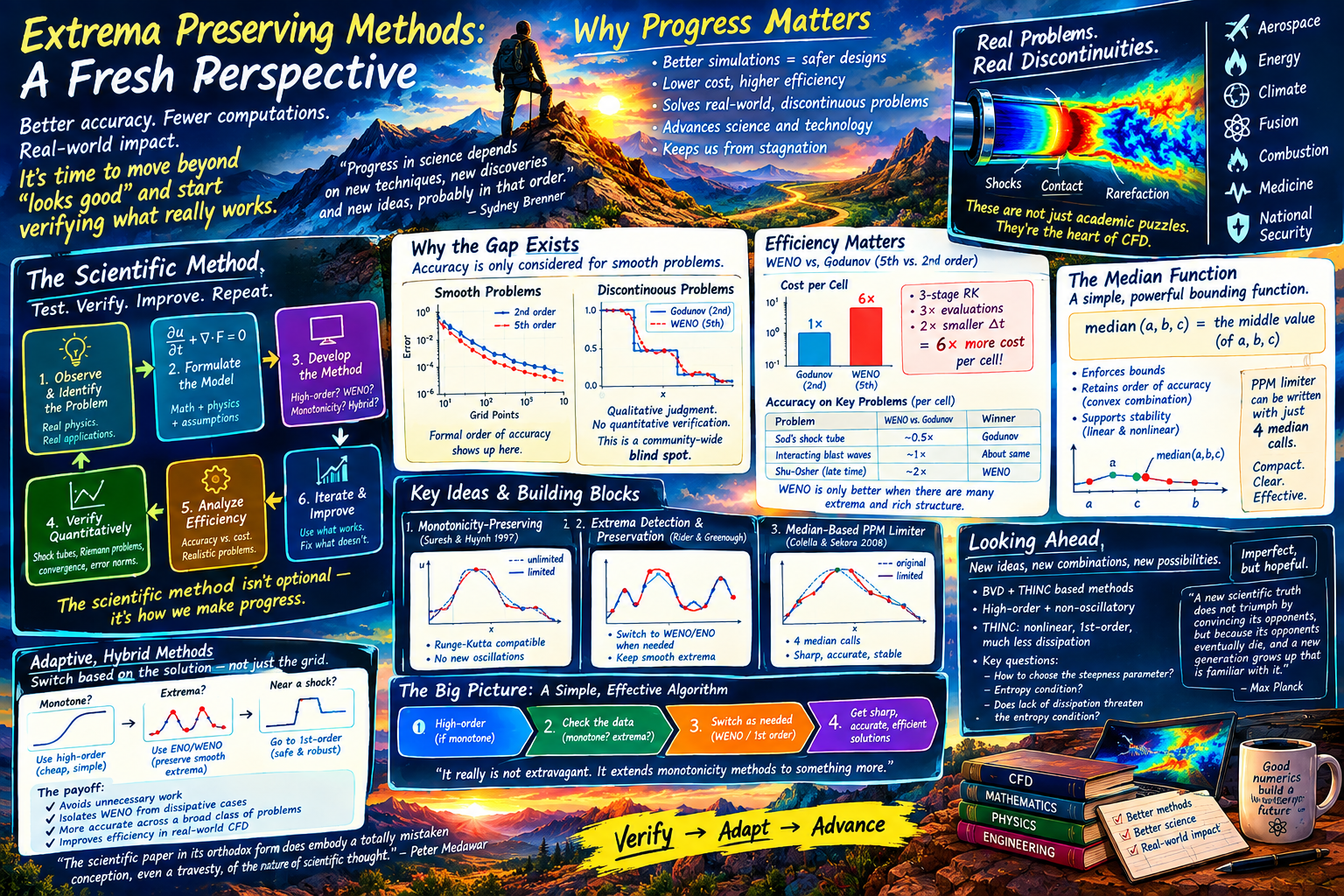
I’m going to revisit a paper that has a special place in my heart. It is a premature apex of a body of work terminated too early. A bit of the loss is my own fault as I moved to Sandia Labs. It was also fairly brutal to get published. It is a line of work that has potential, but the final development needs a boost. It is an investment in a stagnant area of research. There is also resistance from gatekeepers, who hold progress hostage. The important aspects of this are efficiency on realistic problems and selective preservation of extrema in the solution. The efficiency and verification aspects are progressing due to some recent effort.
I will elaborate on both below.
“You are more likely to be remembered by your expository work than by your original research.” – Gian-Carlo Rota,
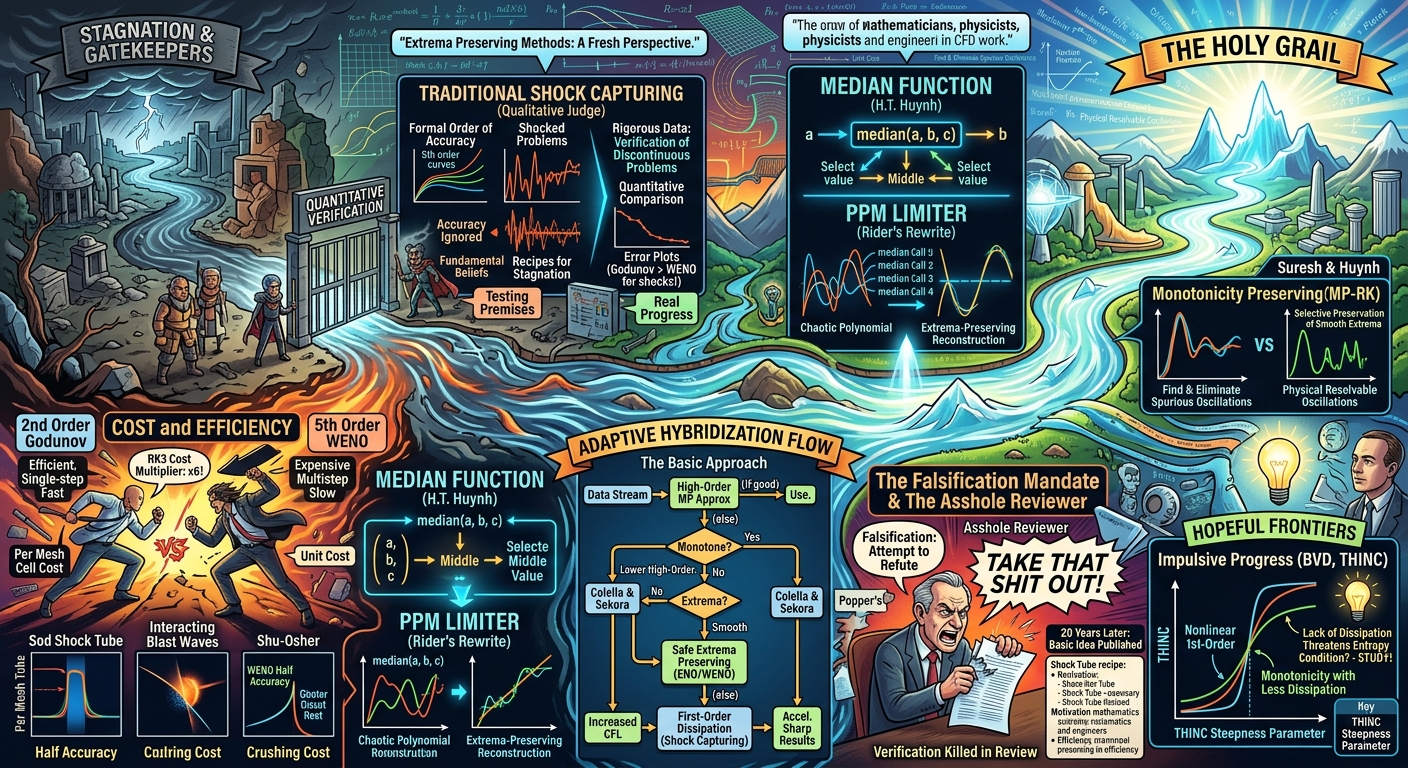
Simply publishing the paper took some of the wind out of the sails of the results. This is all related to what determines the effectiveness of the method. As one might guess, this comes down to verification of results on discontinuous problems. As noted before, the accuracy of shocked problems is rarely computed in results. The results arepurelyjudgedqualitatively. Thus, fundamental beliefs and premises are not subjected to testing via quantitative verification. This is a community-wide accepted practice.
“The scientific paper in its orthodox form does embody atotallymistaken conception, even a travesty, of the nature of scientific thought.” –Peter Medawar
Accuracy is only considered quantitatively for smooth problems. In this way, one can demonstrate the formal order of accuracy. This formal order of accuracy does not determine the accuracy on problems with discontinuities. The entire field is focused on producing methods that can practically solve problems with discontinuities. These are virtually all practical applications we design the method to solve. In my view, this is an enormous community-wide gap. We only measure accuracy on problems that are immaterial to the applications.
A recipe for lack of progress!
It should come as no surprise that this is what we have got. Gatekeepers are removing progress, and “barbaric” new ideas are kept outside the walls of the high-resolution castle. The gatekeepers have ensured their legacies for now.
This gap in measurement is the central focus of this line of research.In my opinion, this is also the source of stagnation in methods’ development and progress.
To see the origin of my thinking, one needs to go back a few years. A seminal effort of my own was a collaboration with Jeff Greenough from Livermore. We studied the relative accuracy of a fifth-order weighted ENO method compared to a high-quality second-order Godunov algorithm. The knee-jerk response is that this is a futile contest. How can a second-order method compete with a fifth-order method? For smooth problems, it cannot. For problems with discontinuities, the answer is different, and the second-order method crushes WENO. This is especially true when cost is taken into account. WENO only wins in efficiency at enormous resolutions for problems replete with structure.
“Simplicity is prerequisite for reliability.” –Edsger Dijkstra
Details matter a lot in explaining this rather curious result. WENO methods typically use multistep time integration. This has two clear effects that determine most of the cost. The standard is a three-stage third-order Runge-Kutta integrator. Thus, the space discretization must be evaluated three times. The second impact is a factor of two decrease in time step size for similar CFL constraints. These two elements combine for a factor of six multiplier in cost for WENO in unit cost per mesh cell. For the most part, the spatial discretization cost is about the same per evaluation. As I will discuss later, any advantage for WENO can be eliminated by developing an adaptive method. The adaptive method in principle combines the lower-order method with WENO selectively. WENO is overly dissipative and inaccurate in monotone regions of the flow.
Another key aspect of this study is the nature of the low-order method. In the case of the piecewise linear method, the linear profile is optimally fourth-order accurate for the slope. In a similar fashion, the base PPM method uses a fourth-order edge value for each cell. In each case, monotonicity is checked and the approximation is modified if problems are found. Nonetheless, the high-order initial approximation endows the method with accuracy. This makes these methods far more competitive than a fully second-order approximation like Van Leer introduced. It is a lesson to apply going forward.
Add to this the effective accuracy of the two methods. On simple problems like Sod’s shock tube, WENO is half the accuracy of the second-order method. For the interacting blast waves, the accuracies are about the same. Finally, for the Shu-Osher problem at very late time, WENO is twice as accurate on a per-mesh-cell basis. The lesson being that WENO is only better if the problem has a great deal of structure and many extrema. To be more efficient requiresextremelyfine meshes. This motivates the development of a more adaptive discretization that accounts for this behavior.
“Since all models are wrong the scientist must be alert to what is importantly wrong. It is inappropriate to be concerned about mice when there are tigers abroad.” – George Box
The basic idea is to move between discretizations that are best for discontinuous solutions and those best for smooth extrema. One still needs to find and eliminate spurious oscillations. Separate these from physically resolvable oscillations. Thisis sort ofa holy grail for numerical methods for hyperbolic PDEs. Some great work from the late 1990’s comes to the rescue. Two researchers from NASA Glenn (Suresh & Huynh) published a great paper on doing much of this work. First reproducing a monotonicity-preserving method and then added extrema detection and preservation to it. This was a great general-purpose approach that works for multistep methods like Runge-Kutta.
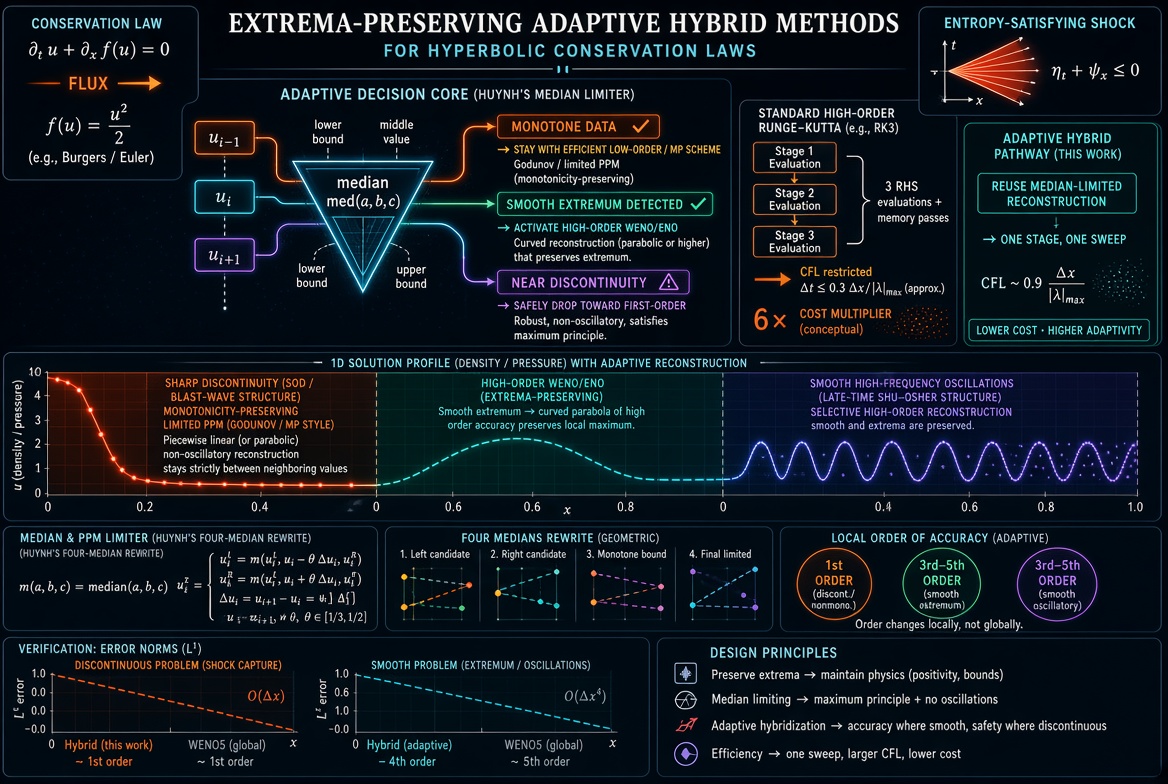
This work uses the median function developed and used by HT Huynh. In a sense, I fell in love with this function as a means of engineering methods. The method takes three arguments and returns the one bounded by the other two. Thus, it is great at enforcing bounds, which is the whole game for high-resolution methods. It also has the property that if two of the arguments are a certain order of accuracy, the output retains that order of accuracy. This is because the result is a convex combination of the other two, or one of those two. I have postulated that this result applies to linear and nonlinear stability properties too.
“Normal science, the activity in which most scientists inevitably spend almost all their time, is predicated on the assumption that the scientific community knows what the world is like… Normal science often suppresses fundamental novelties because they are necessarily subversive of its basic commitments.” – Thomas Kuhn
As a sidebar to the whole extrema preservation study, I rewrote the limiter for the PPM method using the median. Once the median is defined, the PPM limiter can be expressed in four median function calls. It is compact and IMHO far clearer than the classical PPM description, which is elaborate and somewhat non-intuitive. Looking at the (magical) median as a bounding function provides the necessary clarity of approach. Being parabolic in each cell, the PPM method could potentially support smooth extrema.
The simplest version of the basic idea is brutally simple. If the data is monotone and the approximation preserves this,simplyuse that. If it is not, then one can switch over to WENO, or some other extrema-preserving method. The cost of WENO is only taken where it matters. It also isolates WENO from the dissipative solution it gives for monotone circumstances. Under those conditions, WENO produces something akin to the dissipative minmod result. WENO is only superior with smooth extrema. This method improves on both methods. With PPM, I can make this a single-step method. It has a larger CFL and accelerates the WENO solution by a factor of six, plus sharpens the results in general.
“Perfection is achieved, not when there is nothing more to add, but when there is nothing left to take away.” – Antoine de Saint-Exupéry,
This unveils the basic approach for the advance. If some version of high-order works as a monotonicity-preserving approximation, use it. Do not do more work. If it does not, look at the data. Is it monotone or at an extremum? If it is monotone perhaps looks at other high-order, but lower than the initial attempt approximations. If one is at an extremum, determine if it is smooth and do something safe there. ENO or WENO are those sorts of approximations. If it is close to a shock, allow yourself to go to first-order. That’s it. It really is not that elaborate. It extends monotonicity methods to something more, and the verification work shows this. These methods are more accurate on a broad class of methods. In practice, this accuracy also makes them efficient. Colella and Sekora published a method with a lot in common with my ideas.
“My work always tried to unite the true with the beautiful; but when I had to choose one or the other, I usually chose the beautiful.” –Hermann Weyl
Now we get to the unfortunate part of the paper. The verification got removed in review. The associate editor demanded it rather bluntly: “If you want this published, take that shit out!” He and one of the reviewers, who is an asshole, killed this. I will note that the asshole reviewer is extremely good technically. Exceptional. Those are some of the most dangerous forms of assholes, by the way. I folded and removed the material. Now, 20 years later, I can finally get the basic idea of verifying shock tubes published. I can include a far better and more focused explanation and recipe for doing this. This includes a strong motivation in mathematics and efficiency from differences in accuracy.
I hope it helps alleviate the stagnation.
“Every genuine test of a theory is an attempt to falsify it, or to refute it.” – Karl Popper
The other idea that might have traction is the BVD and THINC-based methods. Combining this with high-order leads to impressive results. Imperfect, but hopeful. I was a reviewer of one of the articles, and felt like it was an arc of progress. I believe THINC might be the key here. It is a nonlinear first-order method that can deliver monotonicity with much less dissipation. The details are choosing the steepness parameter (and it having a parameter!). The other issue might be how the lack of first-order dissipation impacts the entropy condition. The question is whether the lack of dissipation in THINC ever threatens the entropy condition. It would be something good to study and put effort into.
“A new scientific truth does not triumph by convincing its opponents and making them see the light, but rather because its opponentseventuallydie, and a new generation grows up that is familiar with it.” –Max Planck
References
Rider, William J., Jeffrey A. Greenough, and James R. Kamm. “Accurate monotonicity-and extrema-preserving methods through adaptive nonlinear hybridizations.” Journal of Computational Physics 225, no. 2 (2007): 1827-1848. (105 Citations)
Greenough, J. A., and W. J. Rider. “A quantitative comparison of numerical methods for the compressible Euler equations: fifth-order WENO and piecewise-linear Godunov.” Journal of Computational Physics 196, no. 1 (2004): 259-281. (85 Citations)
Suresh, Ambady, and Hung T. Huynh. “Accurate monotonicity-preserving schemes with Runge–Kutta time stepping.” Journal of Computational Physics 136, no. 1 (1997): 83-99.
Huynh, Hung T. “Accurate upwind methods for the Euler equations.” SIAM Journal on Numerical Analysis 32, no. 5 (1995): 1565-1619.
Colella, Phillip, and Michael D. Sekora. “A limiter for PPM that preserves accuracy at smooth extrema.” Journal of Computational Physics 227, no. 15 (2008): 7069-7076.
Deng, Xi, Yuya Shimizu, and Feng Xiao. “A fifth-order shock capturing scheme with two-stage boundary variation diminishing algorithm.” Journal of Computational Physics 386 (2019): 323-349.
Deng, Xi, Yuya Shimizu, Bin Xie, and Feng Xiao. “Constructing higher order discontinuity-capturing schemes with upwind-biased interpolations and boundary variation diminishing algorithm.” Computers & Fluids 200 (2020): 104433.
Rider, W. J., J. A. Greenough, and J. R. Kamm. “Combining high-order accuracy with non-oscillatory methods through monotonicity preservation.” International journal for numerical methods in fluids 47, no. 10-11 (2005): 1253-1259.
Rider, William J., and James R. Kamm. “How effective are high-order approximations in shock-capturing methods? Is there a law of diminishing returns?.” In Computational Fluid Dynamics 2004: Proceedings of the Third International Conference on Computational Fluid Dynamics, ICCFD3, Toronto, 12–16 July 2004, pp. 401-405. Berlin, Heidelberg: Springer Berlin Heidelberg, 2006.
“Turbulence is the most important unsolved problem of classical physics.”– Richard Feynman
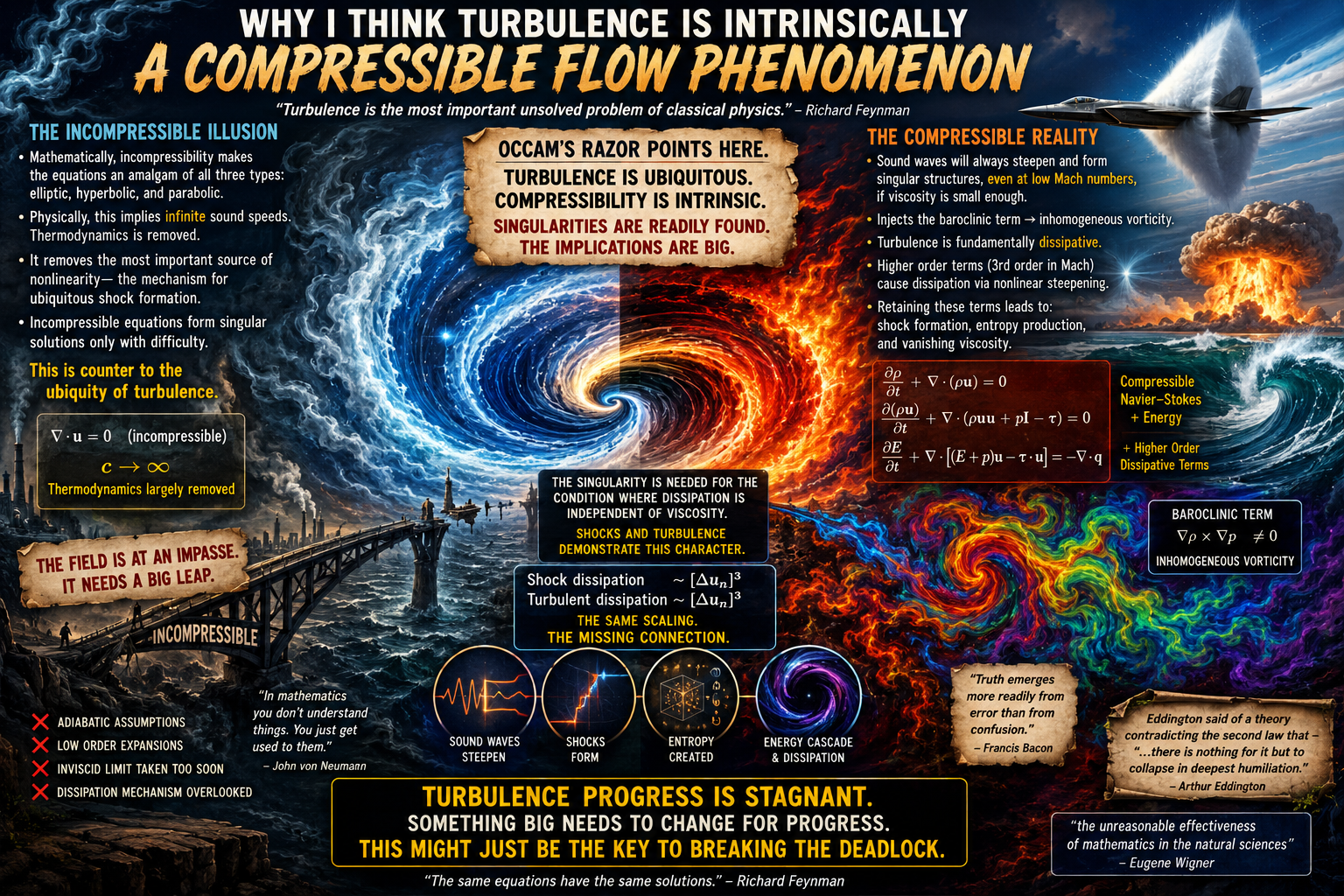
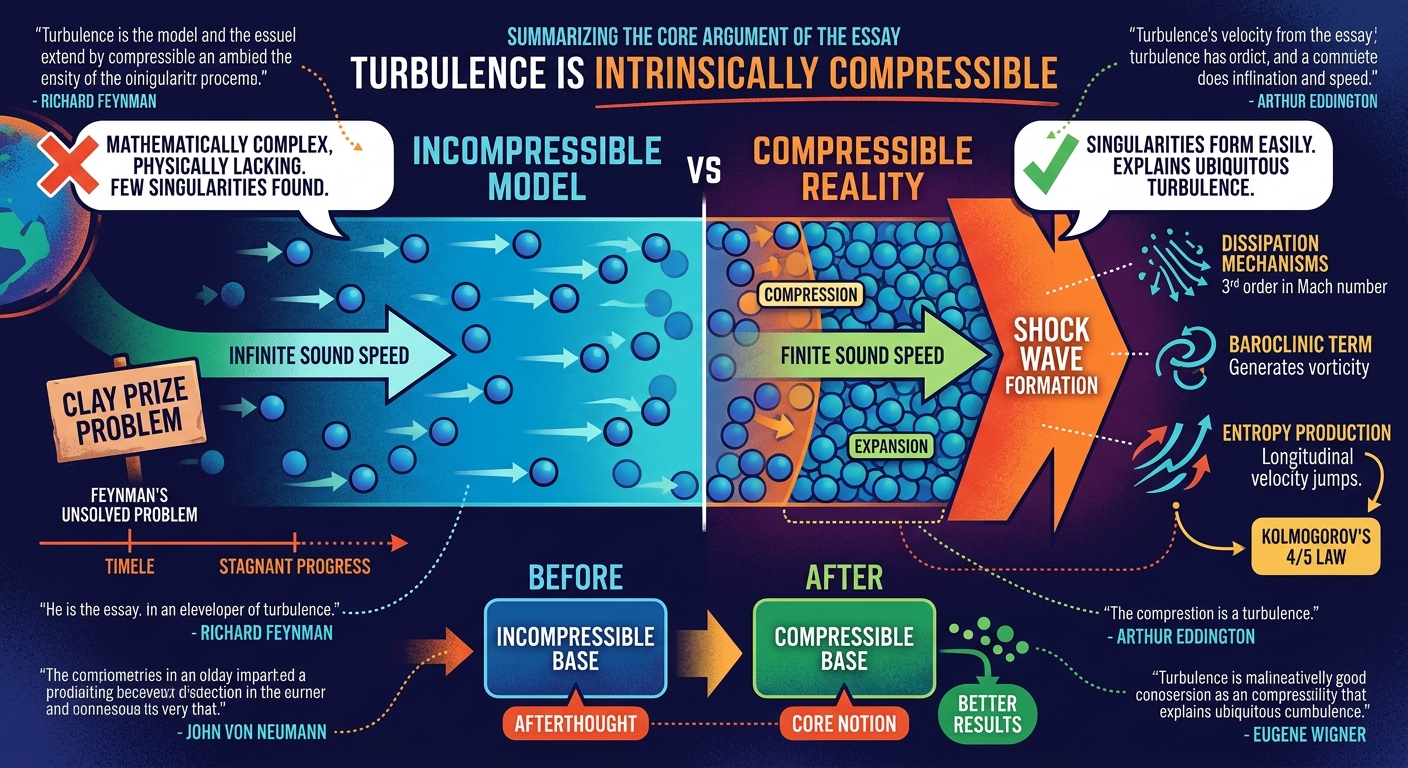
I’ve written several times about the lunacy of the incompressible Navier-Stokes Clay prize problem. Most of the issues relate back to incompressibility. I’ll summarize. Mathematically, incompressibility makes the equations an amalgam of all three types: elliptic, hyperbolic, and parabolic. With no viscosity, it is elliptic-hyperbolic. Physically, this implies infinite sound speeds. Thermodynamics islargelyremoved as well. It removes the most important source of nonlinearity from the equations — nominally, the mechanism for ubiquitous shock wave formation.
I will note that turbulence is utterly ubiquitous in science and technology. It is everywhere and happens quite naturally, being almost impossible to stop. The incompressible equations form singular solutions only with difficulty. Such solutions can be constructed, but it is hardly routine. This would be counter to the ubiquity of turbulence. Compressible equations, on the other hand, form them with ease. Here is the rub, and it is threefold:
Compressible flow is studied and focused on away from the zero Mach limit.
The behavior of compressible flow in that limit is poorly understood and poorly computed, especially for inviscid flows. Numerical solutions have deep pathologies.
The theory connecting incompressible and compressible flows is largely adiabatic and avoids key mechanisms.
“In mathematics you don’t understand things. You just get used to them.”– John von Neumann
Occam’s razor might take the ubiquity of turbulence to point to compressibility being intrinsic to turbulence. Singularities arereadilyfound. The implications are big. The singularity is needed for the condition where the dissipation in the system is independent of viscosity. Only the large-scale (inertial range) flow determines the rate of dissipation. Shock waves and turbulent flows demonstrate this character. We know of the shock singularity, while the turbulent singularity is elusive. What if it was always there staring at us?
“Truth emerges morereadilyfrom error than from confusion.”– Francis Bacon
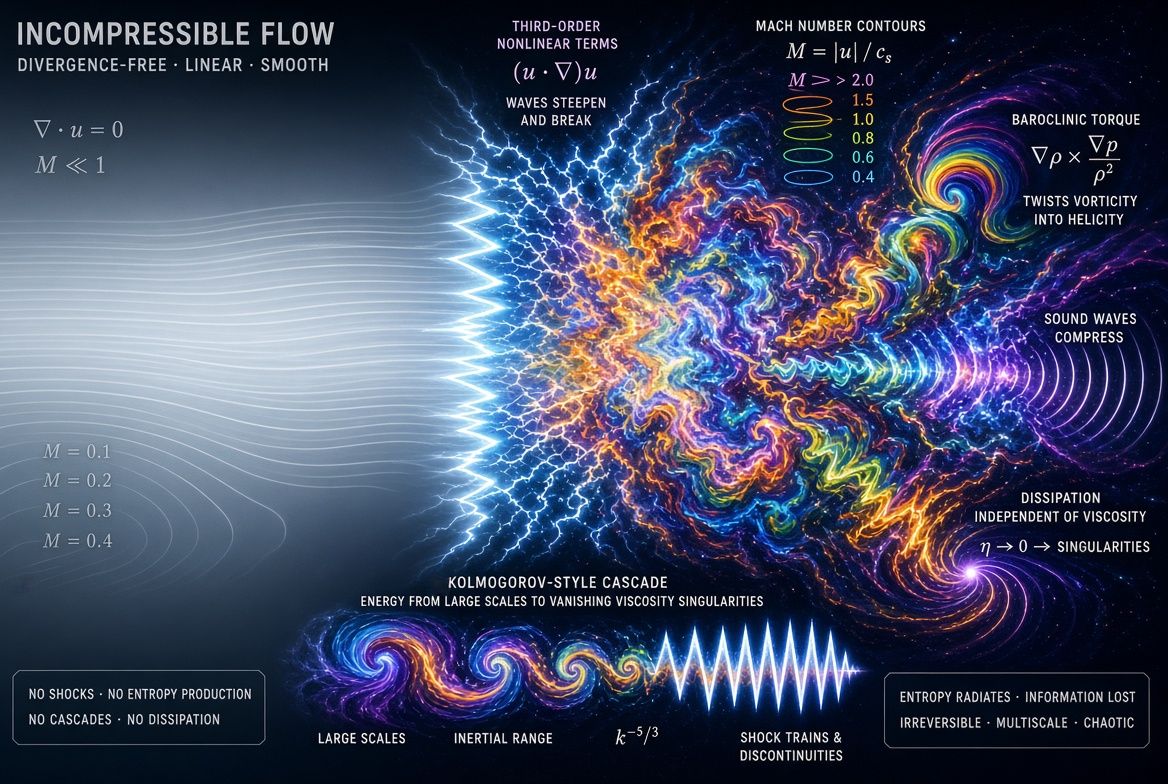
There have been studies of the mathematical link between compressible and incompressible flows. The key provision is the use of an adiabatic flow. The expansion is second-order in Mach number. The dissipation for turbulence and shocks is third-order. Thus, the flows are inviscid unless viscosity is explicitly included. This is a fatal flaw: the key inviscid mechanism leading to vanishing viscosity hasbeen overlookedand eliminated. This is an unfortunate oversight. I think this is a general misunderstanding. The mechanisms for dissipation around singularities are third-order in Mach number (which is vanishing).
First is the wealth of existing solutions and theory, all revolving around incompressible flow. This would need to be discarded in large part. Compressible flows are less amenable to analytics. This is particularly true for non-adiabatic flows. My view is that the field is at an impasse and needs to break it with a big leap. Compressible and thermodynamic ideas might just be that.
Compressible flows have different mechanisms built in. These are compatible with observations. Singularity formation is the key, and the part of turbulence that cannot be ignored. Sound waves will always steepen and form singular structures, even at low Mach numbers, if the viscosity is small enough.It also injects the baroclinic term into the analysis, which might produce inhomogeneous vorticity. This would potentially change the mechanisms for some turbulence.
Shock waves are principally understood as a supersonic phenomenon, at Mach numbers above 1. Sonic booms and explosions are a couple of canonical examples people are given. The mechanism for waves to steepen into shocks does not go away. It is equally present at low speeds. Analysis has always been tied to incompressibility, with acoustics added on. In general, this has been applied to adiabatic situations. Turbulence is not this. It isfundamentallydissipative. To model turbulence, these equation sets need additional terms to be retained. The dissipative terms are generally one order higher.
Eddington said of a theory contradicting the second law that — “…there is nothing for it but to collapse in deepest humiliation.” – Arthur Eddington
The equations would need to retain the higher-order terms that cause dissipation due to nonlinear steepening. These are purely terms found with the acoustic modes, but they modulate the wave structure. Gradients are enhanced or diminished depending on the sign, and shock formation cannot be denied. Without dissipation, the flow will shock. It is also likely to be extremely complex and tied directly to the perturbations from unstable shear waves. Together, these should be an adequate and powerful engine for turbulence phenomena.
Perhaps the biggest change would come to the modeling of compressible turbulence. Today it is an add-on to incompressible theory: compressibility is an afterthought instead of the core notion. Afullycompressible foundation would change this dynamic. It should lead to better results. It also makes more sense with the dynamics of implicit turbulence modeling. More importantly, it offers a new path for discovery and understanding. You have mathematics that supports a key mechanism for dissipation, the singularity formation.
“the unreasonable effectiveness of mathematics in the natural sciences”– Eugene Wigner
Researchers have nipped around the edges of this issue. The bridge that has failed is the direct connection. Shock dissipation is third order in velocity jump, leading to entropy creation. Turbulent dissipation is also third order in the velocity jump. This is called the longitudinal or normal velocity jump. This is the same scaling. Compressible shocks are one-dimensional. Kolmogorov’s results in the 4/5 law is three-dimensional. Connecting the two would marry this result to compressible flow and thermodynamics. Turbulence isperhapsthe most pervasive and common means of entropy production. This would be quite satisfying for physics. Breakthroughs await.
Turbulence progress is stagnant. Something big needs to change for progress. This mightjustbe the key to breaking the deadlock.
“Responsibility is a unique concept… You may share it with others, but your portion is not diminished. You may delegate it, but it is still with you… If responsibility is rightfully yours, no evasion, or ignorance, or passing the blame can shift the burden to someone else. Unless you can point your finger at the man who is responsible when something goes wrong, then you have never had anyone really responsible.” — Adm. Hyman Rickover
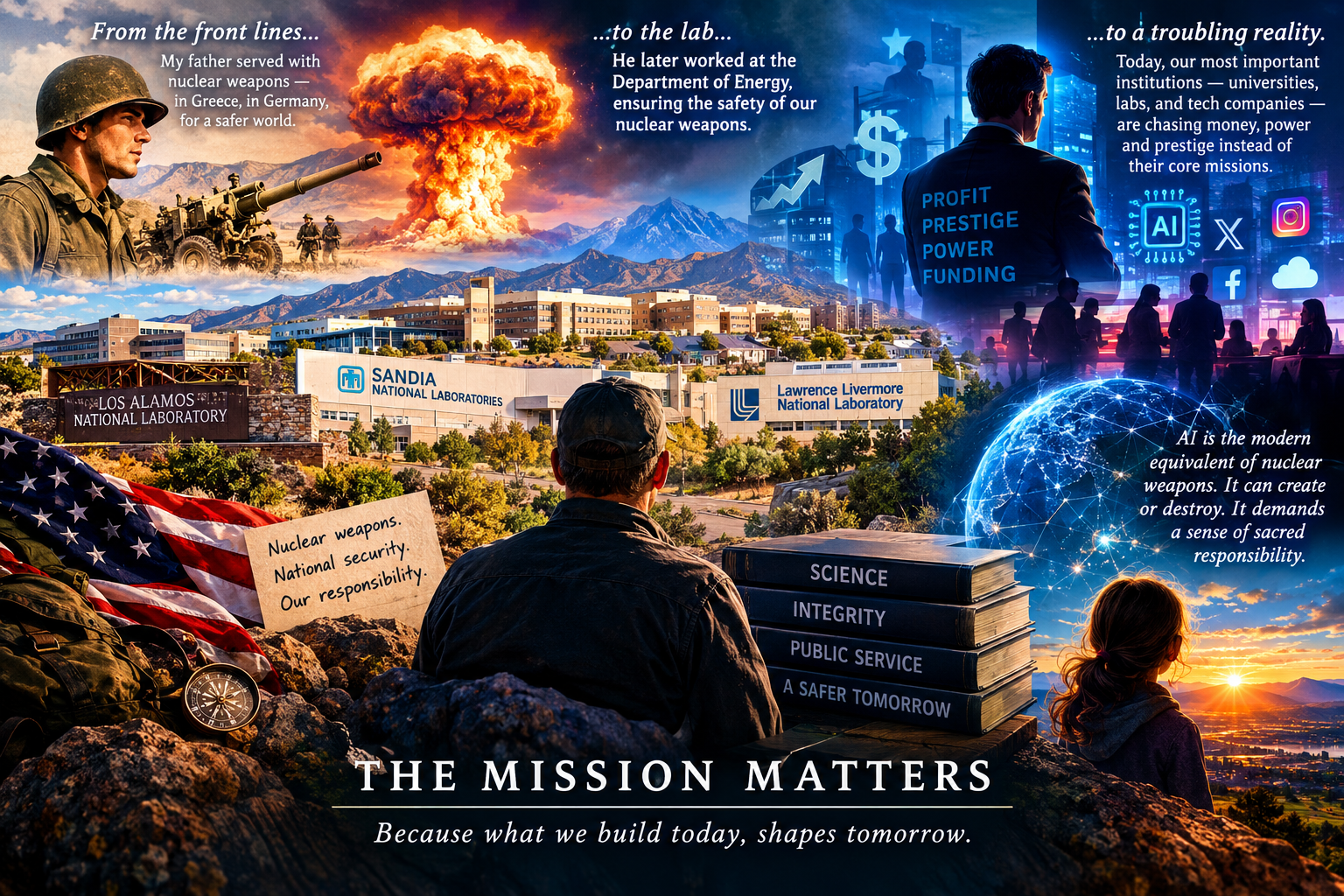
My father spent a career in the United States Army and then a second career at the Department of Energy, much of it working with nuclear weapons. When I was born, he was overseeing a battery of 8-inch howitzers armed with the W33 (or Mark 33 as my dad called it) projectile, which is a multi-kiloton-class nuclear weapon. He was stationed in Northern Greece, just south of Yugoslavia. My own conception was centered around the Cuban Missile Crisis. That event was our closest approach to Armageddon. Surviving it was the impetus for starting a family.
Later in his career, he was working with a Lance missile battalion for the Army in Germany. These were nuclear-tipped tactical weapons defending against a potential Soviet invasion of Western Europe. After he retired from the Army, he worked for the Department of Energy in a capacity to ensure the safety of our handling of the high explosives used in the nuclear weapons. He spent his life supporting the use and safety of these powerful weapons. It was noble service to a grateful nation. It shaped my own view of them.
“To be somebody or to do something. In life there is often a roll call. That’s when you will have to make a decision. To be or to do? Which way will you go?” — Col. John Boyd
His service on the use end of nuclear weapons had a deep impact on me. I joined the family business with a job at Los Alamos. I could see the production, the design, and the use of nuclear weapons vividly in my mind. When I began to work for the National Laboratories, I understood the mission, but I also held it as a sacred responsibility. I saw that fulfilled early in my career, but gradually, over time, after the turn of the 21st century, things began to change.
I am roughly six months into my retirement. As my more loyal readers might recognize, I left my career under rather distressing circumstances. I’ve been asked by friends, acquaintances, and family about the circumstances and the figure with which I write about that circumstance. I feel that it’s useful to articulate more about the foundation of these reasons. The same question from those who love me or those who know me. I hope the rest of you find it beneficial.
I am alarmist because the issues are alarming.
I spent nearly 40 years working at two national labs. Each has as its ostensible primary mission the care and performance of the nation’s nuclear weapons stockpile. This is a responsibility that I feltdeeplyandpersonallyfor most of my career. It is the advertised mission for both Los Alamos and Sandia National Laboratories, as well as Lawrence Livermore. These revered institutions no longer take this mission with the seriousness it deserves. During the Cold War, these Labs were founded and became amongst the best in the world. They no longer have that status. I’ve written about why.
“The prospect of domination of the nation’s scholars by Federal employment, project allocations, and the power of money is ever present and is gravely to be regarded.” — Dwight Eisenhower, Farewell Address (1961)
I have some deep personal reasons why it feels so important to me, perhaps more important than the average person. I believe that the circumstances of my departure speak volumes about the institutions that I worked for and their current status. Institutions of this sort, with other missions in the United States, are under continued assault and have lost the trust of the people. I believe the reasons for this are very clear. These institutions, including the ones I worked for, are only paying lip service to the very missions theyare supposedto be serving. This is true at the nuclear weapons laboratories where I worked, and it is a fact that should dismay the people of our country. It is not limited to the nuclear weapons laboratories.
My wife worked for the last 20 years of her career at a university. The university’s primary mission is education, and what she saw there was similar lip service to the mission and a change in the priorities of leadership. This change paralleled what I saw at the National Laboratories. In both cases, the primary mission of the institutions had become an afterthought and almost something that the leadership simply supposed was being supported. Instead, the leadershipwas focusedon a host of other things unrelated to the mission.
“In a fully developed bureaucracy there is nobody left with whom one can argue, to whom one can present grievances, on whom the pressures of power can be exerted… this is what the political jargon calls rule by Nobody.” — Hannah Arendt
Primarily, they all became obsessed with money and prestige, the prestige of power and the money that fed the institutions. Financial incentives had replaced the fundamental missions. The fundamental mission had become a second-rate, mildly unsupported activity at each of these places, universities and laboratories alike. The mission has become diluted by numerous objectives from the left and the right politically. All of them detract from the focus on the core mission.
I believe the same trends hold across our most important institutions, and also across our industries. No more so than our internet, social media, and artificial intelligence companies, which now only work to support profit and money objectives. They holdvirtuallyno adherence to the benefits and well-being of the society that they exist within. Care for societal well-being is essential. Artificial intelligence perhaps serves as the modern equivalent of nuclear weapons. Both artificial intelligence and nuclear weapons have the power to destroy as well as create good. They both need a sense of sacred responsibility from those who are charged with their development and use. This is the recipe for disaster.
“We must not allow Big Science to destroy the tradition of scholarship.” — Alvin Weinberg
The leadership began to fail in this duty. Over time, they gradually began to work in a way that did not serve the best interests of the nuclear weapons mission. They were instead focused on their own professional success, which revolved around funding and securing money. They would seek programs that adequately funded their organizations, whether or not those programs actually served the nuclear weapons mission. Perhaps no national program epitomized this change more than the Exascale program. The advanced computing program at the labs after the Cold War ended began on the wrong foot. They took a course correction after a few years and operated well for about a decade. Then it fell into the broader national decline.
We have a process of annual certification. I worry that it has stumbled into a box-checking exercise. We go through the motions, but the option of raising a red flag is missing. The Lab Directors have no option other than approving the status without regard to the evidence. Meanwhile, the evidence becomes thinner and thinner with each passing year. We are nearly 34 years since the last test of a weapon. Hopefully they are aging well and still safe and secure. I don’t know one way or the other. My concern is that the quality of work is in free fall. Those with responsibility for them act in ways that give me great pause. Are we really doing the hard work? It seems like we are just going through the motions, pretending everything is okay. Given the constraints of not testing, we are not doing the hard work necessary for confidence. I’ve seen this clearly.
I am fairly sure that if a Lab Director failed to certify the stockpile, they would be fired in short order. It would be career-ending. They would lose millions of dollars in compensation for that act. So given this, do they even have the choice?
“It would appear that, for whatever purpose, be it for internal or external consumption, the management of NASA exaggerates the reliability of its product, to the point of fantasy.” — Richard Feynman, Appendix F, Rogers Commission Report (1986)
This finally came to a head in my own career, in the events that unfolded right before I retired. This is the origin of the vigor with which I have pursued truth-telling. I see leaders who are using the secrecy necessary for nuclear weapons to defend their own incompetence and irresponsible actions. No oneis rewardedfor acknowledging problems. There are always problems. The actions that were taken that led to my retirement were modest. I know of other circumstances that are far worse, far more dangerous, and far more damaging to our national security. Nonetheless, in principle, the things they did do not serve the nation well in its ability to have a sufficient and usable nuclear stockpile. The consequences of this are profoundly disturbing.
“Secrecy is a mode of regulation. In truth, it is the ultimate mode, for the citizen does not even know that he or she is being regulated.” — Daniel Patrick Moynihan, Secrecy: The American Experience (1998)
A few notes about the nature of responsibility. Nuclear weapons writ large are the responsibility of the President. The military, like my father, is responsible for the care and use of the existing weapons. Scientists and engineers like myself are responsible for the design and analysis of them. We use our talents and work to make sure the military and the Nation can rely upon them. This is integrated into the Lab Directors and the annual certification. Part of my retirement decisionwas relatedto the evidence that my talents would notbe used. When my talents and experience were ignored, I knew that my own responsibilities would be neglected. I was wasting my precious life at the Lab. It was time to go.
If you take the events around my decision to retire into account, it informs the issue. The managers know they were in the wrong. They aren’t that stupid. Their actions were about power and control. Their actions were choosing money over responsibility. They are also reading the incentives we have put in place. You only do what you are explicitly paid to do. Bad news is to be squashed. Never admit fault or that a problem exists. You have the power to make the problem go away (until events overwhelm that). You have access to secrecy and information control to bury almost anything. Most of the time, no one will ever notice. The people above the managers are even more poorly motivated and less technically equipped. Most of those who lead us today are completely unfit to lead.
“The only people who should be allowed to govern countries with nuclear weapons are mothers, those who are still breast-feeding their babies.” — Harold Agnew, third director of Los Alamos
The question is: do I sit idly by and watch this happen, or do I continue to speak out? It became obvious to me before I retired that continued struggle within the labs was futile. It was clear that taking the responsible actions would only lead to me being punished. This is because it worked against the professional objectives of those that led me. I was wasting precious time in my life that could be spent enjoying my final years on Earth. Still, I hold on to the responsibilities that I felt sodeeplyand must speak out about this vital national interest. Perhaps my current actions are equally futile, but I must endeavor to do the right thing.
I only hope that someone will listen. We need reform and rebirth of these institutions. Nuclear weapons have the power to wipe out humanity. It would seem that AI may be as powerful and dangerous.
What motivates those responsible for them?
Today, it is not the well-being of humanity. Today, it is money. Personal wealth, power and enrichment are the drivers. This is a recipe for catastrophe. If we fail to recognize the warning signs, disaster awaits. The lights are all flashing red. There are many signs of impending danger. All these institutions are important. You might think nuclear weapons would be treated as a sacred responsibility. Today, they are not, and we all are in danger.
I hope someone stems this tide of incompetence before it drownsall ofus.
“The glitter of nuclear weapons. It is irresistible if you come to them as a scientist… it is something that gives people an illusion of illimitable power, and it is, in some ways, responsible for all our troubles.” — Freeman Dyson, in The Day After Trinity (1981)
“If you do not work on an important problem, it’s unlikely you’ll do important work.” — RichardHamming,
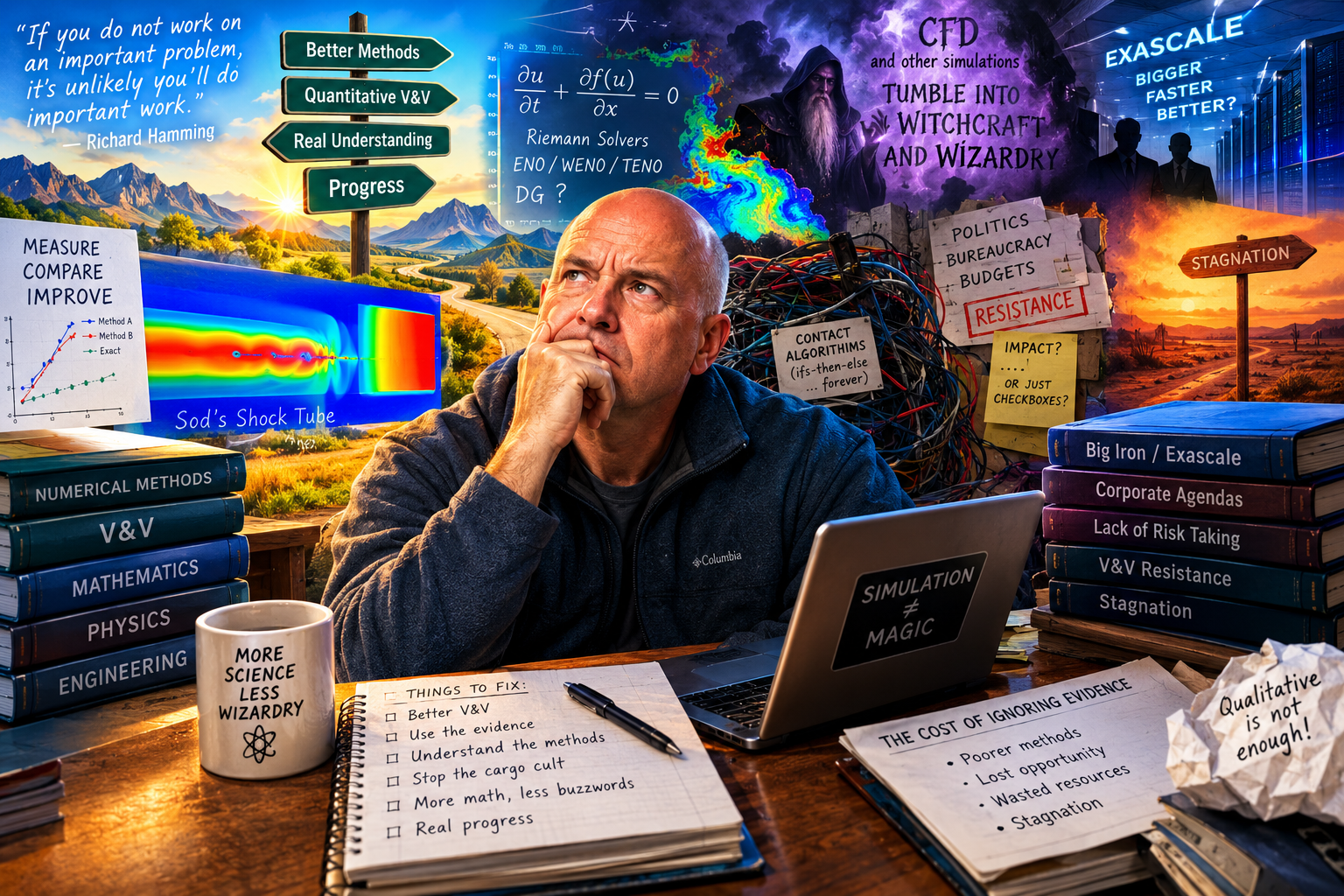
High-resolution methods are a bit stale these days (IMHO). I actually thought this 20 years ago, and little has changed. I’ve seen a little progress over time, but the deficiencies and lack of progress seem to be moving faster. Lots of high-order non-oscillatory methods, and DG without real improvement in capability. I have an explanation or two below. I’ve written about the reasons before. Lack of responsiveness to evidence or failing to get evidence. Sod’s shock tube results are a key bit of the problem. The practice of only applying qualitative comparison is pathological.
“When you can measure what you are speaking about, and express it in numbers, you know something about it; but when you cannot measure it, when you cannot express it in numbers, your knowledge is of a meagre and unsatisfactory kind.” —Lord Kelvin
I also need to remember why I started doing V&V in the first place. My primal interest was in numerical methods and improving them. I saw test problems with quantitative results as a means to improving methods. You would measure results and use the measurement to decide where progress was being made. This seemedutterlylogical and scientific. It was obvious. It is still not done today. Even with decades of expansion of V&V as a technical endeavor, evidence is poorly sought and even more poorly used. Progress in simply doing science for numerical methods is remarkably backwards.
We see multiple fields engaged at cross purposes in advancing the field. Mathematics is a key to progress. It is essential and also the root of the issue. Finding rigor and proof is amazing, as itis limited. Rigor comes with limits and assumptions that are restrictive. Real problems have discontinuities and chaotic-unstable results. Math is still rather limited there. This is a challenge, but also used to justify the lack of progress. For nonlinear, complex, and chaotic problems, there are still great gaps in our mathematical knowledge. It is work that is needed and necessary.
Physics and engineering tend to be somewhat application-focused on practical things. This leads to lots of corner-cutting. The lack of math rigor is then an excuse for this. Lots of things we do work well, but we don’t understand why. A subfield where I’ve actually worked shows this: implicit large eddy simulation. It remains an observation without a systematic explanation. I’ve contributed much of what passes as explanation. Too often we just need rules of thumb and utilization of common belief. There is not nearly enough effort in systematically understanding. This understanding is needed to reliably engineer things. Numerical methods remain too poorly understood.
V&V is thrust into these chasms. Verification interacts with the math deeply. It is largely an interface between math and numerics. It is supposed to be quantitative, and it is too rarely that. More frequently, it is only done in the ideal case. When things become difficult (Sod’s shock tube), we drop quantified results. Validation is the interaction with physics and engineering. Remarkably. the quantitative practice becomes even less common. In both cases the existing practice refuses to respond to evidence.
At least we are becoming more honest about how we ignore V&V. Recent trends simply reject V&V as a necessary part of simulation. It issimplytoo much bad news. It’s a bummer. Stagnation simply assures this.
This refusal is the origin of stagnation. CFD and other simulations tumble into witchcraft and wizardry. The path forward seems relatively obvious. It is difficult, but we’ve made it more so.
Things Aren’t Moving
“In science if you know what you are doing you should not be doing it. In engineering if you do not know what you are doing you should not be doing it.” — RichardHamming,
I have a list of issues to explore in my head. This post is a means to document this. I’ve touched on most of this before, but it makes sense to put it all together in one place. It would make for a great set of PhD theses or research programs. If V&V were healthy, we could provide evidence of stagnation and progress against that. Fat chance of either happening today. But a guy can dream, can’t he?
Many of these things were already in my mind 20 years ago as I left Los Alamos. I had put effort into a number of these during my time at LANL. Several came into my consciousness at Sandia. The key is the lack of time and resources to tackle these there. The same lack was growing at LANL. I don’t think staying there would fix this. The issues are things I’ve spilled so much ink about. The nature of V&V resistance. The national obsession with exascale computing and big iron over mathematics and algorithms. The lack of risk-taking and trust in research today. The retreat of applied mathematics from practical importance.
As an example, I’ll mention an idea that my friend Vince had. It plays a role later in this essay. If you look at contact algorithms that are used in solid-mechanics codes, there are usually giant heaps of cyclomatic complexity, with a whole bunch of nested if-then-else statements. These are a nightmare for V&V, reproducibility, and computation in general. Vince wanted to study taking all of those out and replacing them with a smooth sigmoidal function that would make the code continuously differentiable.
He put in a research proposal at Sandia or modern day America that never had a chance. The reason? It was pointed at a sacred cow. Never mind that it was an incredibly good idea that met all sorts of requirements for programmatic impact. Itsimplywas too different to support; it wasn’t HPC. There has been far too little emphasis on algorithms as a path to performance. In the process, progress has been lost, and performance has been hurt.
The major player in the long-term deficit in computational science is the multi-decade obsession with high-performance computing hardware. This hardware obsession has sapped the balance out of computational science and left a deficit. Almost everything I talk about here is dealing with the methods that, in one way or another, are at the foundation of many of our most important simulation tools. This is true for climate, astrophysics, nuclear weapons, nuclear reactors, clean energy, and on and on. If you’re generally solving any sort of multi-physics where hydrodynamics plays a major role, these methods are extremely important.
The cost of our failure to focus on these algorithms is probably most acutely measured in efficiency. The focus on high-performance computing is the most inefficient way to improve our simulation capacity. We’ve taken the same approach for artificial intelligence. Again, there are probably massive algorithmic efficiencies that should be explored with AI, but right now the focus is almost entirely on computing power.
“Numerical analysis is the study of algorithms for the problems of continuous mathematics.” —Nick Trefethen
So without further ado, let’s make a simple list of where I see some interesting issues to explore and improve upon:
1. What makes a real difference in accuracy on real problems
1a. What is the optimal mix of time and space accuracy in method design
2, What is the optimal mix of accuracy and efficiency on real problems
3. Computing nonlinearly stable time steps for nonlinear problems
4. Understanding nonlinear stability of solutions for space and time
4a. Exploring ideas around nonlinear stability for discretization
5. Combining adiabatic-entropic solutions with conservation. Why do solutions for very strong expansions not converge?
6. What are the right concepts for convergence in physical instabilities
7. Explaining implicit large eddy simulation’s effectiveness.
So, let’s dig into each.
1. What makes a real difference in accuracy on real problems
For real problems, accuracy is limited to first-order (or less) in almost every case. The lack of smoothness is the reason. High-order methods have value, but the great expense does not deliver commensurate with the effort. The question is what aspects of high-order methods deliver value in terms of accuracy. Evidence seems to point to some value being found with parts of high-order methods. There is definitely a huge leap from first to second-order, but the accuracy gains seem to saturate. How does one strike the balance? At the same time, high-order accuracy is more fragile and prone to failures.
To solve this issue, a number of things are needed. Rigorous guidance is a huge challenge for applied mathematics. Breakthroughs in math would be golden, but may not be possible. Instead of this guidance, we need to test methods and parts of discretization elements on real problems. Part of this is verification using analytical results. There is then the issue of how this transfers to validation problems. Right now, we are operating on a mix of blind faith and rules of thumb. We need to turn this toward science and real measurement. Examples abound, including shock wave problems and direct numerical simulations of turbulence. Neither is guided by genuine quantitative examination of results.
2. What is the optimal mix of accuracy and efficiency on real problems
This is a follow-on to the first issue. How does one balance accuracy and efficiency? The issue is that accuracy is expensive. Convergence rates are low. Accuracy is also found at the expense of robustness. This is a third issue to throw into the balance. Again, the vehicle is testing. It seems unlikely that mathematics adds as much as the first issue. The other major issue is the definition of efficiency. I’ve defined it as accuracy (fidelity) per unit cost. In a dull sense, given an accuracy of solution, the lowest cost is the most efficient. In the process, we can find the best ways to achieve accuracy (with robustness).
3. Computing nonlinearly stable time steps for nonlinear problems
For many problems the time step control is done via linearization. The dynamics of these initial value problem can contain much faster time scales. Hydrodynamics is a key example. The evolution of the problem can immediately include phenomena that is an order of magnitude faster. This is a relatively difficult problem to solve. One simple idea I had is to test a time step at the end of a cycle. Ask the question, was that time step stable given the dynamics at the end of the time step. If it was not stable, reject the time step and do it over with a smaller (stable) time step. This is simple and the main critique is the cost of storing another solution vector. It seems to me that the cost of an unstable calculation is vastly greater.
“Newton said, ‘If I have seen further than others, it is because I’ve stood on the shoulders of giants.’ These days we stand on each other’s feet.” — RichardHamming
4. Understanding nonlinear stability of solutions for space and time
I have written about this before in several posts.
“The first principle is that you must not fool yourself — and you are the easiest person to fool.” — RichardFeynman
6. What are the right concepts for convergence in physical instabilities
If one has a physical instability like those found in turbulence or material mixing solutions do not converge normally. The concepts of convergence for initial value problems do not apply. There is a huge leap of faith and confidence that finer meshes lead to better results. Still convergence as a notion ismostlya leap of faith. Many classical hydro problems show more and more structure with resolution.
In a sense the notion is that given two solutions of the Euler equations, a “swirlier” calculation is a better calculation. This is seen in classical Kelvin-Helmholtz instabilities. Applied math has been noodling on this via solutions as distributions, but progress has been spotty. This is both difficult hard work, and hugely necessary. For many essential initial value problems, the massive calculations are leaps of faith. This includes all of direct numerical simulation of turbulence. That said, ideas in turbulence are the best hope here.
“Since all models are wrong the scientist must be alert to what isimportantlywrong. It is inappropriate tobe concernedabout mice when there are tigers abroad.” —George Box
7. Explaining implicit large eddy simulation’s effectiveness.
This is finishing a project I gave up 20 years ago when I left Los Alamos. I had started looking at the modified equations for modern methods from MUSCL to WENO and many in between. Working closely with Len Margolin we identified some important parallels between LES modeling and the truncation error. In particular there is a term that shows up at second order with major significance. It comes from having a stable second-order method in conservation form. It looks much like the self-similarity model in LES. That model is notoriously unstable. With modern methods it appears and is selectively stabilized. I believe there is much more waiting to be found with ILES.
“A new scientific truth does not triumph by convincing its opponents and making them see the light, but rather because its opponentseventuallydie, and a new generation grows up that is familiar with it.” —Max Planck