
A pessimist sees the difficulty in every opportunity; an optimist sees the opportunity in every difficulty.
 There seems to be a pervasive attitude that difficult things should be avoided and any difficulty is treated as an approximation to failure. I have had this theme play out repeatedly this week where something difficult is ta ken as tantamount to failing. For someone looking to grow, and excel, difficult work is the chance to improve through stringent testing. Difficulty should stir one to the core and call them forward toward achievement. The worst thing is the inability to see the opportunity being granted, most of our best, strongest attributes were forged in our most difficult moments.
There is no failure except in no longer trying.
Of course, the prevailing culture today does little to help. The lack of faith in humanity exhibited by the implied lack of trust rewards the overly cautious with stability and comfort. We have gotten into a habit where the mediocre status quo is greeted as success. People are rewarded for not rocking the boat, not being critical and most of all not raising difficult issues. We are taught to get alone, kick the can down the road and not make waves. This approach will only assure that we as a nation become a monument to delusional success when we have become distinctly milquetoast.
 Problems are seen when work that should have done years ago is missing. Instead it is the opportunity to do meaningful, interesting and important work that fills in an essential gap. In another case a procedure was found to be lacking, which turned out to be embarrassing. Instead it is a reward of due diligence and points toward a higher future standard, but also toward important shortcomings in tools used. These tools will require substantial effort to make better. We see to have created a system that tells us that these cases should be avoided. Instead they need to be celebrated as opportunities for interesting and necessary work that will stretch the capabilities of the lucky people doing the work.
Our most significant opportunities will be found in times of greatest difficulty.
 This is quite sharply related to the absolute intolerance for anything that could be interpreted as failure. Failure brings the possibility of rebuke and scandal. The lessons of almost every success has been lost in the process, to achieve greatness, risk must be taken, and risk entails the possibility of failure. We are avoiding short-term pain and the cost of long-term success, which will manifest itself as a decline toward inevitable mediocrity.
What seems to us as bitter trials are often blessings in disguise

 In a similar vein we test our codes. For a good professional code there will be an immense number of tests executed and potentially a sizable team involved in testing the code. Nonetheless, the code will break with almost certainty because it will be used in innovative ways not foreseen by the developers or testers. The real test is when the code is used for something we didn’t anticipate. Then we find out how good it really is. As usual the problems that arise are usually viewed as failures rather than opportunities. We should endeavor to view this differently; these failures are the opportunity to take the code to the next level of performance.
 Simplicity is the ultimate sophistication.
 The heuristic of Occam’s razor comes in as a principle to clarify things. At its simplest it specifies a tendency for choosing between explanations based on their relative simplicity; if they are otherwise equal, the simplest explanation is preferred. One might be properly tempted to apply the same principle, but replace “simple” by “elegant,” “beautiful” or “graceful”. This gets to the core of the manner in which science takes on the mantle of an art; beauty, elegance and grace have a roll to play in shaping opinions.
 One could easily take the view that this is a bad thing, but the concepts of artistic opinion are useful. These concepts capture the deep essence of the subconscious. The subconscious is integrating many factors that hidden from the superficial thinking usually operating in people. We know beauty and elegance when we see it, and we naturally gravitate toward it. Unfortunately these also include bias and preconceptions that would tend to hold progress back. Given this possibility the whole artistic approach to science needs to be taken in a mindful fashion fully acknowledging the tendency to give into traditional bias and counter-balancing this trend with careful consideration of alternatives. This is where Occam’s razor and attractiveness of simplicity can play a deeply powerful roll in progress.
 profit. Americans have bought into the fear-based culture fully. Mass media and particularly the news media have learned that fear sells and drives profits. Industry plays upon peoples deepest fears to sell products whether the fear is cultural, physiological or subliminal it drives sales.
 based because nothing drives the people to the polls like fear. Fear of immigrants, loss of jobs, terrorism, Ebola, and most of all the loss of the America of memory is a reason to fear. The result is fear-driven policy. Our government is rife with fear-based, counter-productive laws and governance. Government institutions are driven by fear. As just one example air travel is teeming with stupid fear-based practices.
 Take the threat of ISIS (ISIL). Are they really a threat? Really? A bunch of poorly educated barbarians half a world away? No they aren’t. Man the hell up, what sort of wimps have Americans become? They are a bunch of idiotic zealots that represent no threat at all to our Country. They are bad people that the World needs to manage, but not an actual threat. The actual threat is to our tax dollars. ISIS is another convenient threat used by the politicians and the military-security-industrial complex to drive money into their pockets. Nothing more.
 This is just the tip of the iceberg in imaginary threats that Americans are allowing to rule their lives. Ebola is another great example. All we need is competence and it offers no threat. My only fear is that we can’t muster competence any more.
 rejection of rationality is not a left or right characteristic; it has become an American characteristic. Whether it is climate change, diseases (e.g., Ebola), nuclear power, vaccines, GMO and a host of other scientific or technological questions Americans are irrational. We have become governed by hoax and conspiracy rather than truth, trust and logic.
 Explosives Code Development Conference. I can’t make the usual sort of summary of a meeting that I’d ordinarily write about, but I will offer a few high level comments. There certainly were some memorable talks during the week. They offered some great new ideas in computational physics or a much needed progress report on important work.
 tidy package. Lawrence Livermore showed some really interesting efforts in several areas including advanced shock hydrodynamic methods using high order methods, and progress on an age old problem of combining particles with interface tracking. Despite these highlights among others, the best and most important thing about the meeting was what happened when talks were not being given.







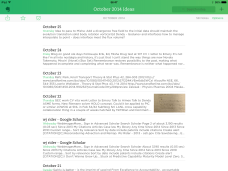 Evernote is an electronic filling cabinet. It ends up being the clearinghouse for information flowing from all these other apps and more. Evernote also runs on every platform (phone iPhone/Android, laptop, desktop, iPad, and web). You can always get your data. My wife uses it at her office as the common system for managing multiple accounts able to deal with data from many sources.
 I use it to jot down ideas, plan writing assignments, take notes at meetings, save articles, and keep a food, exercise, and personal journal. It can accept info in almost any format and allows you to write notes, and draw graphical comments inside most. It also has a fantastic web clipper that allows me to save web pages directly plus add comments. Another great thing to do is use Evernote to save business cards, travel cards, and other documents that pile up in wallets, or get easily lost. I’ve also used it for saving details of medical appointments, and repair/remodel work at home. It’s the place where I store the details of my referee assignments for soccer as well as notes on the games for future reference.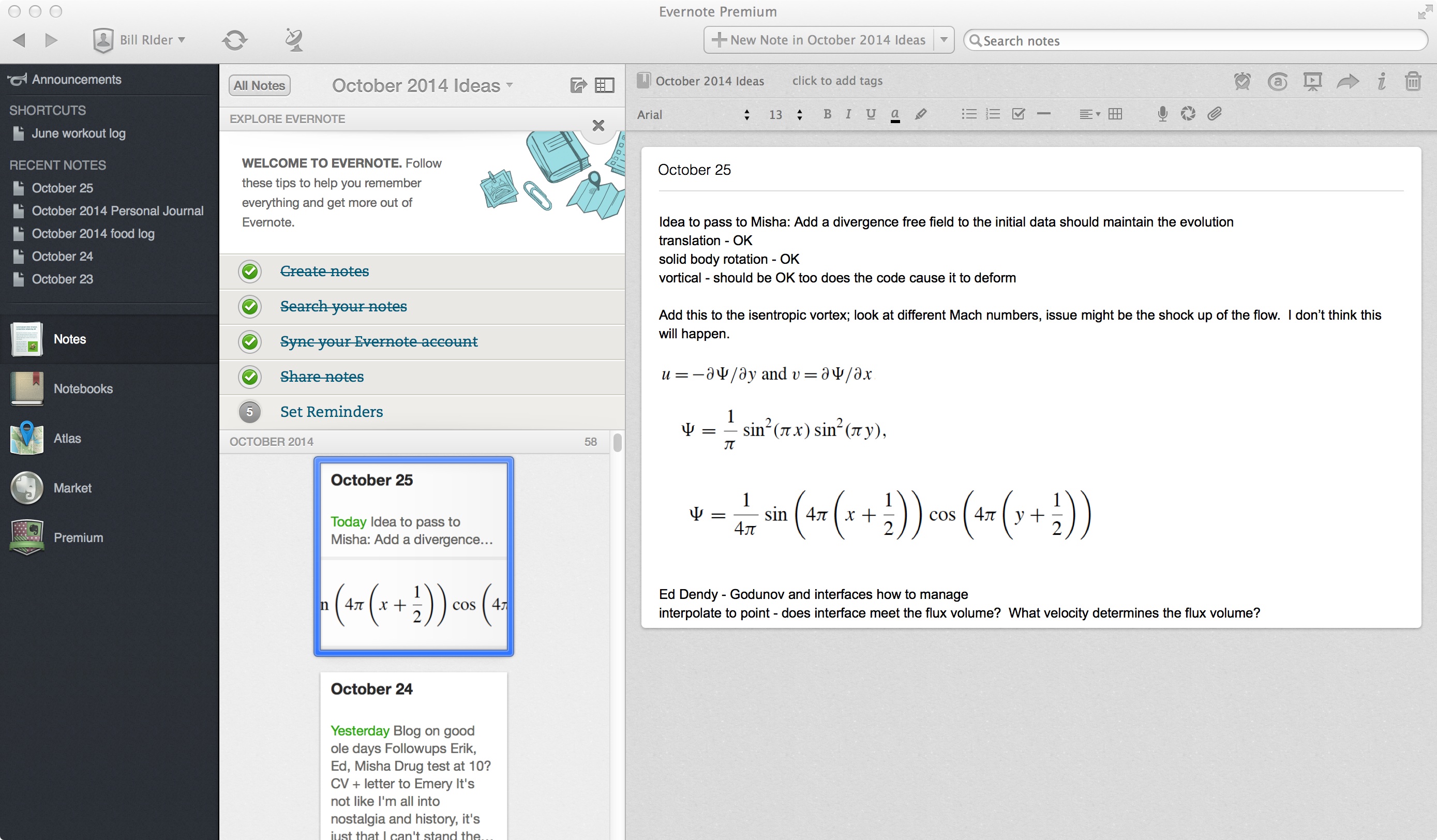
 Next is the most recent addition to my staple of mobile apps, Wunderlist. Wunderlist is a to do and task manager. I’ve added it because it is multiplatform. I can have a uniform and synched list across mobile, laptop and desktop apps. I have a set of things that I want to accomplish every day, which repeat along with a set of single use items. All of them can be tracked and dealt with. It is still being tried out, but it’s almost sure that it will be a keeper.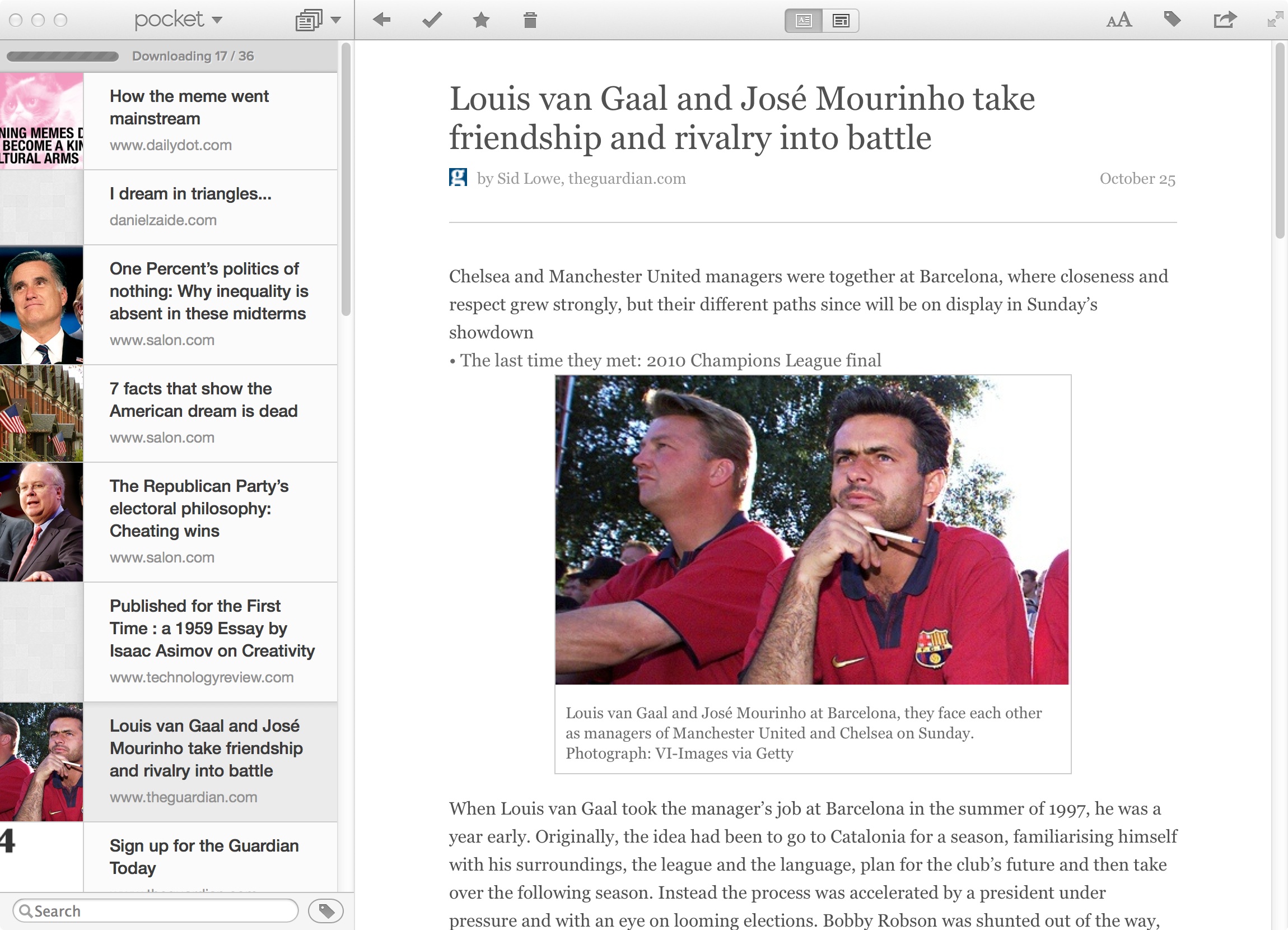
 conference in Los Alamos. It is difficult to not be nostalgic having worked there for 18 years. It harkens to the old saw that people tend to pull out, “those were the good ole days”. What if they were? Why aren’t things getting better?
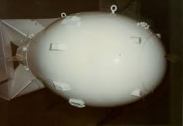 The Internet, Google, smartphones, instant messaging and a host of other miracles make our lives better in many ways. I used to spend hours in the Los Alamos Lab library doing research; copying papers where today I could do even more from home or my office with almost everything being available as a PDF. Some of the collateral consequences are problematic, but I have faith that a happy equilibrium will be achieved.
 dramatically better. The Lab was better, working conditions were better and the Lab’s work meant something to the Nation. With Los Alamos it is almost a fait accompli with its role in World history guaranteeing a downhill slide over time. Nonetheless, Los Alamos continued to make history for its first twenty years or so, before decay set in. Of course, its origin included a host of future Nobel Laureates, and a job of monumental gravity. The success played a key roll in shaping the remainder of the 20th Century.
 The issues dragging Los Alamos down go well beyond local conditions. Ultimately, with the end of the Cold War the Nation as well as Los Alamos has lost its bearings. We continue to move down a path where any sense of deeper meaning is hard to find in the lives we live. The almost systematic destruction of the middle class seems to go hand-in-hand. It is as if the powers that be were working to assure that most people’s lives are spent in pursuit of survival rather than the achievement of aspirational goals. Our systems are in deep decline and no one seems to be able to muster enough vision and leadership to see a way out.
 engineering. No more. Over time the Nation has demanded that the Labs become paragons of accountability. The over-emphasis on accountability has ironically worked to drive excellence from the Labs. In an accountability-driven culture if no one is accountable for excellence, excellence dies. This is a direct consequence of our current over-managed and under-led status both locally and nationally.
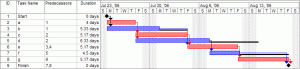 them. Continually the projects drive the staff to think only in a short-term tactical project-focused manner despite the damage done to their long-term development.
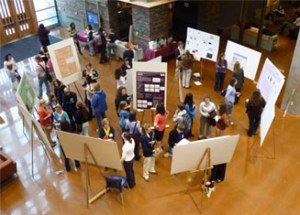 Almost any conference I attend is a broad-brushed opportunity to develop professionally across a suite of projects present and future. The accountability culture only cares about what I am presenting, but nothing about what is presented to me. In other words attending a conference is all about what is the attendee is presenting.
 he true irony is that no one is accountable for this act violence against our National security. In fact it is hidden behind a veil of accountability standards that provide the façade that everything is being done well. We only assure that the terrible things are done efficiently. A large part of the devotion to accountability is couched in fear and suspicion. Excellence is founded on hope and trust guided by principle.
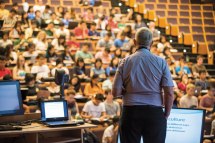 ng has less value than research. Our students are not simply burdened by student loans and the concomitant debt, but also by increasingly poor instruction. They are getting a worse education at a substantially higher price. At the core of the problem is money. Less societal support for education is driving universities to focus on research grants as a source for money along with the student loans. The grants drive emphasis from teaching and push a variety of inappropriate foci such as research associates, post-docs as labor, and adjunct professors as cheap teacher (adjuncts are another key measure of the value placed in teaching, which ain’t much!).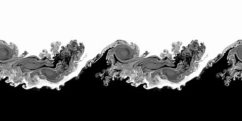
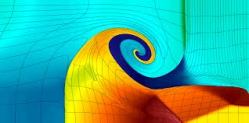
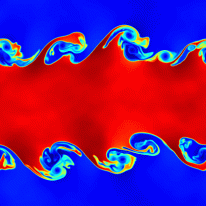 c manner that may not actually provide an accurate assessment of quality. At some point the disorder in the computation is too great and the quality is judged to be lower. This is done purely by expert judgment, not based on any sort of clear definitive measure or feature. The real issue is whether the computation is swirlier due to incipient errors that are on the verge of losing stability. This may inadvertently favor instability in the numerical method point-of-view (in fact, almost certainly).
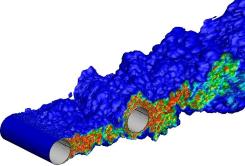 This topic involves deep-seated issues with each of these branches.
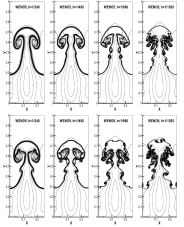 a standard applied, which amounts to “the more swirly the result, the better the method” (more swirly means more vorticity). An exemplar of this approach is the paper by Shi, Zhang and Shu in the Journal of Computational Physics, 186, pp. 690 (1993)
 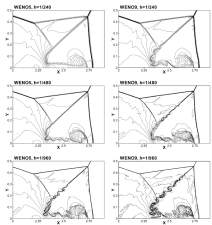 My concern about this issue is that the higher order methods also contain insidious and problematic numerical instabilities that could potentially contribute to physically incorrect solutions. The current “swirlier is better” standard yields little or no guidance towards improving the methods or uncovering their shortcomings. The problems with these methods can manifest themselves as entropy violating solutions, which are by definition unphysical. An unphysical solution will produce more vorticity, and hence be swirlier by the standard applied in the community; it would be viewed as better. In fact it would be worse and dangerously so.
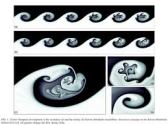 but also had large errors. These errors led to the destruction of vorticity, which made flows distinctly less swirly than reality. Modern methods provided the robustness of upwind methods with much smaller error, and much more realistic swirliness. The problem is that instabilities can lead to swirliness too and this standard leaves no room for determining the limits for methods. This is left for validation against experimental data. This is thoroughly unsatisfying because there is not a mathematical ground truth. Modeling and numerical effects are muddled together. Unfortunately, mathematics is not currently attacking this problem very aggressively (see my Applied Math critique
 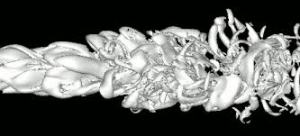 What can be done to improve matters? One way would be to rely upon experimental comparison to decide quality. This leaves little guidance for improving the methods based on mathematical principles. Insofar as applied mathematics is concerned, a better theory for the development of these instabilities would enable guidance toward better methods. This is lacking today rather seriously. It would be useful to have a refined understanding of what unphysical solutions look like for these cases. Today such a characterization is not available to be applied. We are left with experimental comparison and/or expert judgment.
 The Regularized Singularity