
I work wi th a lot of mathematicians, applied mathematicians to be precise. A lot of the time I ponder the point of their work. Is the importance of the work the beauty and knowledge of math itself, or the utility of the work for practical purposes? My sense is that the “applied” in applied math pushes the balance toward utility. Too often the utility in the work being sold as applied math
today is almost impossible to divine. This is the rub. It ends up being the same dynamic as pure versus applied research. How applied, does applied math need to be to be applied math?
Physicists have come to realize that mathematics, when used with sufficient care, is a proven pathway to truth.
― Brian Greene,
We had a talk at work earlier in the week that brought these issues into focus. A  relatively well-known and successful professor came for a visit and gave a research seminar on his work. On the face of it, the talk looked interesting and topical. This rapidly faded when the talk unfolded for a very simple reason. The professor was limiting discussion to where he could prove results. If the flow he was studying became too energetic (too high a Reynolds number, or its equivalent, the proofs couldn’t be constructed). As a result the work had limited applicability to investigations because results can’t be proven for most applied problems. Most applied problems
have too high a Reynolds number to be amenable to the techniques he was applying. Furthermore these higher Reynolds number flows are the challenge applications and computing is most paced by. Despite the importance of the applications, the applied math isn’t being applied. Arrrgggg!
Mathematics is the art of explanation.
Is it really applied math, if I can’t apply to the results to things we care about?
My attitude is that I will roll up my sleeves and work to understand the math if the results can be shown to apply to situations I care about. If the math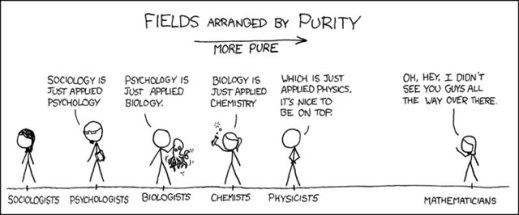 avoids the situations of interest, can’t be demonstrated, or simply doesn’t demonstrate itself, I won’t make the effort because the mathematician hasn’t done their part to meet me half way. What should happen when we have important applied cases where results can’t be proven? Should the effort in math be given to expand the grasp of mathematics to handle these cases? Or should mathematicians work on proving weaker bounds or results?
Deep in the human unconscious is a pervasive need for a logical universe that makes sense. But the real universe is always one step beyond logic.
My opinion is that proving results on simple problems of little relevance is basically useless insofar as applied math is concerned. Nothing is wrong with providing a sliding scale where the strength of the guarantees changes with problem difficulty. The important thing is to provide the proper mathematical grounding for the problems people solve. If the math simply doesn’t exist for important problems, then say so and set about to improve the capacity of math to provide results.
The important problems will continue to be solved. The issue is that applied math won’t be participating. The retreat of applied math from relevance has been palpable for the past two decades. Once upon a time applied math was a key partner in  computational, modeling and physics progress. This role has shrunk over time due to an unwillingness to get their hands dirty. There also seems to be a desire to look more like pure math, which leads to a lack of demonstration.
This leaves me with the question: if applied math can’t be applied? Is it really applied math?
I’m an easy sell for the community; I know that applied math can contribute mightily to progress. All that is needed is for the applied mathematicians to make an earnest effort to work on problems that matter. In other words solve the problems that are important, not the ones that are easy to solve. Demonstrate that your results actually mean something on real problems. Deal directly with problems that are “dirty” rather than simplify real problems until they lose connection with reality.
We all die. The goal isn’t to live forever, the goal is to create something that will.
Today applied math is optimized locally, but globally it is in crisis. This is yet another instance of “Worse is Better”: http://pchiusano.github.io/2014-10-13/worseisworse.html . We’ve allowed this to happen. The excuse that people need to publish for professional success is hurting the field, and is largely a self-imposed condition. What is the point of success if the publications mean little to the development of technology?
The question to ask is whether it is “the mathematics of applications” or the “using math on applications”. There is a difference. Today it is largely the later, instead it needs to be doing math that impacts applications.
Since the mathematicians have invaded the theory of relativity I do not understand it myself any more.
 The Regularized Singularity
Whiny
Trolly.
Try being constructive.
When an important field is systematically avoids doing useful work its worth calling out. Most of what’s going on is publishing for the sake of publishing, not pushing the boundaries of knowledge back. If you’re happy with the state of applied math, then state so and why.
Sorry. I was being whiny too. I don’t know your situation, but the applied math you describe is nothing like the applied math seminars I attended a few years back in grad school. Most were rather short on theory and long on actual application.
All fields are publishing for the sake of publication. That’s the currency in academics. But when I look through JCP, I see mathematics with real applications.
Much better! thanks.
Remarkably JCP comes closer to the way applied math should be than the applied math journals are. It might not be “physics-focused” enough. JCP is basically what some of the SIAM journals used to be. JCP on the other hand is less applied than it once was perhaps to the detriment of the community.
i agree that the entire publishing industry is itself a problem and the issues there are a topic for another day, but very important.
Pingback: The Regularized Singularity
Pingback: 11 Things in Computational Science that Sound Awesome, but are Actually Terrible | The Regularized Singularity