The purpose of computing is insight, not pictures.
– Nick Trefethen channeling his modern Richard Hamming
One of the most impressive achievements of computing is the stunning progress in simulating physical phenomena. Fluid mechanics holds a special place in the pantheon of scientific computing being among the first fields to see the achievements, and remains an exemplar of computing’s impact on science. The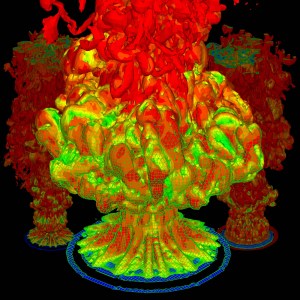 discipline of computational fluid dynamics (CFD) defines this capability being responsible for many of the most iconic uses of computing and the visual power available today. Often when the results are given more to satisfy the eye rather than the mind CFD gets rechristened “Colorful Fluid Dynamics” as a slam. This is a sharp poke in the eye to the well-intentioned scientist seeking to impress someone through glitz rather than though convincing intellectual arguments.
Or at least I thought as much.
Many in the CFD world seem to accept the label of colorful fluid dynamics as a compliment and without a hint of irony. The eye poking isn’t even noticed. It is so common now for results to be taken as accurate simply because the graphics look cool that many rarely bother to do any real scientific work examining the validity of their calculations. Has the vapid and vacuous nature of the modern celebrity driven culture infected science? I think it has and certainly to a degree that I’m not comfortable with. Even worse it’s the extent to which color fluid dynamics has become a veritable currency of discourse in engineering (and related areas such as computational continuum mechanics).
Marketing is what you do when your product is no good.
– Edwin H. Land
When I first did CFD 25 year ago it was the idea of computing something that matched reality that grabbed my imagination. Cool, realistic looking visuals are certainly part of this, but not a replacement for really computing things that truly match reality they are a bonus. The “colorful fluid dynamics” is a slam, not unlike the perspective on the world of reality TV shows. Reality TV is a contrived and unrealistic view  of people’s real lives with a great deal of flourish added for ratings because reality is actually grim, monotonous and boring most of the time. Simulation is similar in that most of the important stuff is boring, dull and utterly essential, cool visuals avoid all of the reality and replace it with an advertisement.
Fluid dynamics has the virtue of creating beautiful visuals through its natural nonlinear interactions. If simulated with even modest levels of fidelity fluid mechanics is stunning and beautiful. It grabs your attention and captures your im agination without the slightest difficulty. Nothing creates patterns that wow the senses like the vortical motions that drive turbulence. These features are prevalent and have exemplified scientific visuals for hundreds of years. Fluid phenomena have stirred the curiosity of the greats including De Vinci who famously sketched the turbulence in a fountain. Every year we have a contest to create the most stunning and scientific compelling visuals put on by the American Physical Society in their Gallery of Fluid Motion taking off from Van Dyke’s classic book of the same name.
 It should come as no surprise that computations of fluid dynamics have similarly stirred the artistic juices within modern science. The visuals arising from computation are compelling and seemingly reproduce the features seen in nature. Visualization software has become so good at creating beautiful images from computed data it actually works against aspects of science. In the sense of marketing the work of CFD, the visualization is the best advertising imaginable. Why rock the boat by asking whether the calculation is really mesh converged (what ever that means!), or whether the experimental data is modeling correctly? It just looks so damn cool! Our scientific management is simply so overworked and under-curious they are primed to accept the meager evidence offered by glimmering graphics as all the quality they need to see.
 This is the problem that the tag colorful fluid dynamics is designed to project, an interest in how the computation looks over how good it really is. The colorful fluid scientists often reject the notion of looking deeply at the quality of what they do. This shouldn’t happen, but very often it does. Far too often they are successful and rewarded for their lack of focus on scientific content by rewarding showmanship and sleight of hand. The quality of computations is very important especially as computation becomes a greater player in decision-making across a vast variety of fields. Looking good and realistic is important, but that is a standard for Hollywood, not science.
On the other hand computations that appear realistic provide an important element of confidence for those seeing it. In many cases the appearance of calculations is not congruent with the quantitative assessment. A prime example is turbulence. Turbulent computations do not look much like turbulence observed in nature. One of the largest elements in what does not appear turbulent in computation is the degree of 
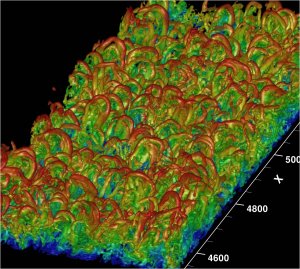 intermittency, the large deviations from mean behavior. For visual purposes like Hollywood’s CGI, the methods need to add significant high-energy, small-scale content to get realistic-looking turbulent flow. These same mechanisms are not utilized in the scientific computation of turbulence although there might be virtue in examining the deeper meaning.
Turbulence experiments are focused on mean flow especially for engineering purposes. The extremes and more esoteric aspects of the statistics of the flow are not typically important. For this reason flows that appear non-turbulent can meet quantitative criteria, but fail to look turbulent to the eye. On the other hand this is the essence of the difference between the judgments of the senses compared with the quest for scientific understanding. At some level the aspiration should be cast toward satisfying both goals.
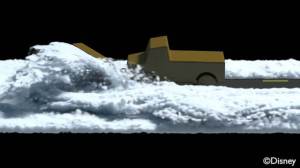 The bountiful success of CFD is do doubt in small part due to the appeal of visualizations. The problem comes when the use of computing becomes more about the appearance of the results than their scientific validity. In many cases the realistic appearance is all the proof needed to trust the results and little in depth analysis is done to establish the credibility of the calculations. This is a dangerous path to take especially as the role of computational simulation grows and the stake in its credibility similarly expands. The potential for misuse and disaster looms if the proper care and seriousness isn’t taken.
As technology advances, the ingenious ideas that make progress possible vanish into the inner workings of our machines, where only experts may be aware of their existence. Numerical algorithms, being exceptionally uninteresting and incomprehensible to the public, vanish exceptionally fast.
Nick Trefethen
While the beauty of the results has provided for easier and greater adoption of CFD as a stable of modern engineering, the lack of quantitative engagement with quality has left CFD stalled. The vast progress of the first couple of decades has been replaced with an acceptance of the status quo and a loss of innovation and improvement in capability. This process has in part 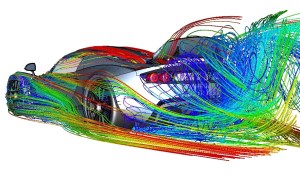 allowed the unhealthy obsession with computing hardware to take root, while starving the algorithm and method development of support. The bigger, faster computer has become the lynchpin to any ability to compute while other means to improvement have languished.
This approach is leading to a hollowing out of the field, as more people are merely practitioners of codes with little or no understanding of how the calculations are done. In many cases the CFD codes are run by hacks that understand frightfully little about how the calculations are done, and the various pitfalls that await them. At the same time relatively primitive algorithms and methods are powering the CFD particularly in the case of commercial products. Powerful visualization, bigger computers, graphic user interfaces and a lack of real standards for computational quality allow all of this. We also have a manage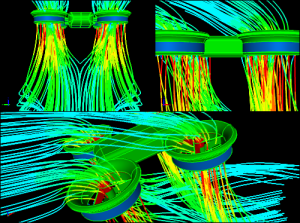 ment class who are susceptible to the shallow, deceitful
marketing practices and increasingly lack the technical knowledge and skill to even ask the right questions. We have allowed our scientific standards to slip dangerously low through the glossy seduction of colorful fluid dynamics.
Life is hard. It’s harder if you’re stupid.
John Wayne
At their core most commercial CFD codes are crap. I mean it; they are generally based on terrible methods. They have wonderful user interfaces, mesh generation and visualization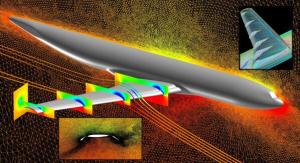 capability, but their solvers are mostly ancient garbage. Most of them rely upon methods that are more than two decades old. Even then the methods were not the best available then, but instead chosen for “robustness” rather than accuracy. One is fortunate if they can find a reliable second-order discretization and the standards for solving nonlinear systems of equations are pathetic (the community accepts a nonlinear residual that is enormous!). Turbulence is modeled using old antiquated methods of similar vintage. Of course, the acceptance of this ter
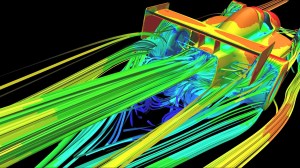 rible technology is aided by the relative lack of progress over the last couple of decades in no small part due to the shift in emphasis toward hardware and away from algorithms and methods. The real core of the problem is the willingness of the community to accept this crap as state of the art. Stunning visuals seal the deal and help craft the path toward mediocrity.
Without change something sleeps inside us, and seldom awakens. The sleeper must awaken.
― Frank Herbert
Colorful fluid dynamics should be an insult; instead it has become the path to professional success and stunted progress.

 that kept him employed into his 80’s and able to generously support his family.
 ch of these four categories. For example there might be a big difference between solutions that are wandering in phase space as opposed to one that is bouncing between several possible equilibrium points.
 he point is that if your calculation runs to completion it could be in one of three states. You should be quite interested in which one. Verification is the vehicle to help you figure this out. You can really only start to sleuth out what state the calculation is in by doing a sequence of nearby calculations using variations in the models and methods. If you run a family of problems you will generally find that the easier problems converge to the exact solution without problems (assuming you have an exact solution). You can only distinguish between 1 & 2 when you have an exact solution.
 As you raise the problem difficulty either by varying the parameters or geometry or materials, you will gradually get solutions that depart of the exact one, but converge to some solution. As the conditions for the problem become more extreme, the code will stop converging to a single answer, and ultimately encounter stability problems. For more complicated problems especially in multiple dimensions one may always be looking at problems that don’t converge to a single solution, nonetheless you should be asking these questions all the time.
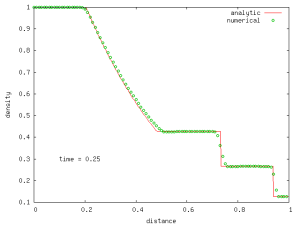 itute proof, it’s a rough check. Sometimes it is offered as evidence because the author doesn’t want to look to close either because they are lazy, or they know that the result won’t bear up under scrutiny.
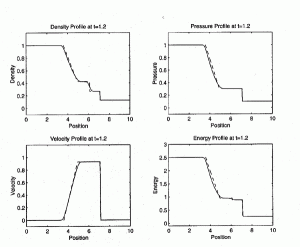 ctually is, the longer the speaker will leave the viewgraph up to be examined. If the result is poor, the viewgraph won’t be available for examination for more than a few seconds.
 rs of technology, as well as a metaphor for the dehumanizing effect of the modern world. The zombie lives the existence of the undead driven by an inhuman hunger for flesh (or brains!). It has no other purpose, but to mindlessly consume the living.
 sed. We don’t endeavor to have the World’s largest hammer or wrench; we recognize that these are tools whose function is essential. We don’t recognize this about computers, for some reason their status as tools has been lost. In this sense supercomputing research has become a bit of a fetish.
 This blog is intended primarily as a place for me to focus on positive habits like writing every day, and establishing more of an online presence. I think its working well, but I need change it up. I’ve decided to move to a daily blog post instead of the weekly one. The writing is usually related to something I’m working on, or thinking about, or ne
 The Regularized Singularity