To avoid criticism say nothing, do nothing, be nothing.
― Aristotle
Whenever I get a review of a paper or proposal, I feel some deep sense of trepidation upon receiving it. The first time I read one; the sense of dread permeates my thinking. Why? I like most others don’t like being criticized, and I’ve had some really awful reviews over the years. The worst have been the product of a single anonymous reviewer, who I happen to know the identity of.
If we had no faults we should not take so much pleasure in noting those of others.
― François de La Rochefoucauld
My very first “real” research article was never published. I had inadvertently stepped  into the middle of an extremely contentious topic (almost a religious war from what I found out later). Three famous scientists reviewed the paper; one of them identified himself to me via letter (the late Ami Harten). His review was quite cursory, simply “accept, and publish immediately.” I was beside myself with joy. That emotion was short-lived.
It’s easy to attack and destroy an act of creation. It’s a lot more difficult to perform one.
― Chuck Palahniuk
The second review was the complete opposite. It was technically supremely well accomplished. As professional as the technical content was, the writing was beautiful, but horribly unprofessional. It was venomous and full of ad hominem attacks. Due to an editorial mistake I found the reviewer’s identity (perhaps it was even semi-intentional).
The pleasure of criticizing takes away from us the pleasure of being moved by some very fine things.
― Jean de La Bruyère
A few years later I got another review from the same person. It was stunning in exactly the same way as the first review. I figured out who it was because the figures included in the review were identical to those in an article I was reading. Given this evidence and the style of the review, I knew who it was. I’ve met this person and he is brilliant, and quite friendly and kind in person, yet under the cloak of anonymity he is an awful person. His venom tipped writing blunts the extraordinary technical quality of the work he puts into the review.
I should keep this experience in mind because I review papers all the time. I turned in one review last Thursday and have four more in my queue. To be honest I rarely return reviews of the technical quality of the ones I mention above. I hope and pray that I never match the above-stated level of unprofessional and personal venom toward any author. It should be something that I keep in the back of my mind. A couple of events in the last week put this front and center in my thoughts.
Critics are our friends, they show us our faults.
― Benjamin Franklin
Yesterday I was doing a different sort of refereeing, soccer games. I had a couple of very competitive youth games. I also work with a gifted an extremely successful young referee who is half my age, but much more highly ranked. At the end of my match as the main, center referee, he gave me a critique of my performance.  I certainly didn’t have my best game, but it wasn’t bad either. His feedback to me felt extraordinarily harsh, and even a bit personal. He has been reviewed by the very top referees in the United States (i.e., assessed). I took his comments with the utmost seriousness, but still his style made me feel awful, and undermined the effectiveness of the comments.
 This young man has as you might expect a very serious style, which is keenly reflected in his success and personal style. Plus critiquing someone twice your age can’t be easy. So, I will take his feedback to heart, and make efforts to improve my performance (work on positioning, signaling advantage and style in man-management). In addition I need to reflect upon the dynamic of critique in every part of my life.
A coach is someone who can give correction without causing resentment.
― John Wooden
Work provided yet another situation that connects with each of these instances. It also reflects deeply on why V&V so often generates such negativity. I reviewed some very good work in analysis by a couple of younger staff. The issue is that the standard practice in analysis is lacking in a rather critical way in one respect. The key to the problem is that the young staff followed, standard accepted practice, yet failed to examine and recognize a critical source of error. In a sense the real core of the problem lies with their seniors, who have mentored the younger staff and set the standard they follow.
Often those that criticize others reveal what he himself lacks.
― Shannon L. Alder
I won’t get into the specifics, but it goes directly at uncertainty quantification and setting quantities of interest. Both issues set the stage for the problem that arose. In doing analysis the quantity of interest is often set by the application and defined by worst-case issues. Unfortunately, these worst cases quantities are horribly behaved numerically. They put the numerical methods under enormous pressure, and show them at their very worst. Uncertainty quantification is a big deal these days, and expected from first-class analysis. The combination of the awful quantity of interest and requisite poor numerical behavior, the analysts have shied away from examining numerical convergence and estimating numerical error.
The trouble with most of us is that we’d rather be ruined by praise than saved by criticism.
― Norman Vincent Peale
Instead the standard practice is conducting mesh sensitivity, but not verification analysis. Mesh sensitivity usually looks at the change in a quantity of interest across several meshes. If it is small, then the mesh is assumed to be adequate. This is the heart of the problem. If the convergence rate is low, the mesh sensitivity can be very small, and the numerical error can be very large. In the case I examined this was the case. In the final analysis the numerical error that had been assumed to be small was almost as large as all the other uncertainties. The convergence rate was so low that the numerical uncertainty was about 10 times larger than the mesh sensitivity would have indicated.
I communicated these results to the younger staff, who thanked me, but I fear did nothing else. We have to provide highlights of our work each quarter, and this work was written up as my contribution. Some of these reports get kicked up the chain, and this one was chosen. Ultimately a few of these reports get sent to Washington, and this one made the cut.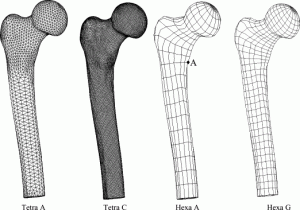
Getting chosen is a two-edged sword, it is good to be recognized, but given the critical nature of the work, it hurt feelings too. This is an unintended consequence of being critical. This is the heart of why V&V is so often reviled.
A critic must be knowledgeable in several fields, practices, and mediums. Brushing off art that they personally don’t understand, is not a critique.
― Justin K. McFarlane Beau

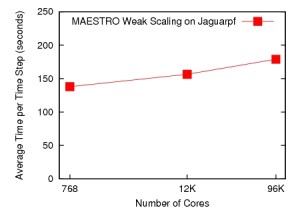 The question is of supreme importance moving forward with supercomputing. The Drucker quote fairly well captures both the importance of answering the metrics question moving forward, but also consideration of what happened in the recent path. I’ve come to the conclusion that the devotion to “weak scaling” is probably doing a lot of damage to high performance computing.
 solution verification/error estimation, validation, and uncertainty quantification are a good place to start, but inadequate for many projects. An example might be weather or climate modeling where data assimilation is important enough to warrant its own category. In computation of social science, the geometry is irrelevant and needs to be replaced with an appropriate description of the environment things like agents are placed in. In other cases the experimental work is sufficiently complex
  and focused that it should be expanded into far greater detail included a data focus. The point is that PCMM is not a fixed framework, but an idea of how to organize your activity as to not leave important things out.
 How might I use PCMM to do something that isn’t V&V related first? Say, like writing a new code?
 I would consider what the application of the code is intended to be and how much further than the original intent might be supported? How essential is the geometric fidelity to the quality of simulations? How well are the basic physical models, and supporting constitutive relations established? Is the numerical method and the equations supported by mathematical rigor? Are numerical errors well understood where the equations and method are to be applied? What experiment exist for validation, and will new validation experiments be conducted? What sort of quantities of interest are needed and how will their uncertainty be assessed? For every question how critical is the quality of the answer, and what is the level of decision to be made with the results? Might any of this change over time, and can those changes be accommodated in the desired code?

 The national security-industrial complex. This is the new and improved version of the original complex. Where the military-industrial complex is sold through nationalism and the ability to exercise raw power, this complex has the selling point of irrational fear. Make no mistake; this one is coupled to the other. The activities of this complex are cloaked in secrecy and a vast unspecified (black) budget that is completely justified in the eyes of the cowering-terrified masses of voters. Americans have agreed in overwhelming numbers to part with liberty and a great deal of money in service of this complex. The true aim of this complex is control by the powerful as well as profit. Again, the threats we are facing are vastly overblown.
 I would argue that the security state we are creating is more of a threat to our way of life than any of the enemies they are “protecting” us from. We have allowed ourselves to become fearful as a Nation and we will suffer a fate befitting this trend. Recently and increasingly this complex is supporting the militarized and aggressive police.
 The financial-investment-industrial complex. You know who these guys are. This is the industry that almost melted down the economy five years ago. Bailouts happened and the incomes of most of the guilty were saved (if temporarily diminished slightly). Reform was promised and never delivered upon. Almost none of the shady, sleazy or corrupt practices that enriched the financial managers and preyed upon common citizens resulted in any legal action. New financial vehicles have been created to prey on the citizenry (e.g., student loans). More than nuclear weapons, this vehicle of mass destruction looms over the economy waiting for the next bubble to burst. The national-security-police apparatus was used to crust any resistence and treated the Occupy Wall Street movement like domestic terrorists. So much for democracy.
 This complex has the money to buy immense favor, does almost nothing for society, and unlike the others produces only rich people. Somehow they have conned to electorate into believing that they create economic opportunity. Once finance did this, now all the opportunity is in the hands of the “shareholders” who are mostly financial managers. Increasingly business interests is just code for ability for executives to be compensated in repugnantly extravagant ways. Much of the deplorable situation with education can be traced to student loans as investment vehicles along with the concentration of wealth cascading to enhanced support of a cadre of private universities that serve the rich. No other complex is so singularly responsible for the erosion of the middle class as this one.
 The medical-industrial complex. This complex is the two-edged sword of overwhelming good on one side and horrific greed on the other. Medicine does enormous good and healing people is a worthy profession. Too bad it has become the cover for a massive plundering operation. Medicine in the USA consumes nearly to over twice the amount of GDP than it does in other comparable Nations. In return for this massive cost we get substandard care. Our health outcomes and quality of care is actually lower than comparable nations. We get a lousy deal and the medical industry makes even more money.
 The criminal-justice-prison-industrial complex. The embarrassment we should be feeling over the incarnation rate of our citizens is absent. Do we really feel that the American public is so awful that they should be imprisoned at a rate two to ten times larger than comparable countries? Are Americans inherently violent and criminal in our conduct? Is that the way we are exceptional? The answer to all these questions is no. The problem is that power and money flow from locking up Americans. It has also become a convenient way of reinstituting “Jim Crow” laws.
 This all began with the failed war on drugs. Ultimately this produced a bunch of people to imprison. Eventually the prisons became privatized and a way to make money. Prisons had a lobby. At the same time law enforcement found ways of increasing their power through the same war. Increased weaponry, increased surveillance, increased powers of seizure. All of this coupled together to produce an orgy of imprisonment, and a deluge of cash to industry. This has been amplified by the rise of the national security industrial complex that provides an additional source of enhanced power.
 Today and tomorrow I am visiting the University of Notre Dame for the purpose of reviewing and advising a DOE sponsored research center (CSWARM). The project combines material science, computation and computer science as the scientific world struggles toward the next generation of computing. Given today’s work, my
 background and my son’s entry into science and engineering education next year, the topic of college and its health is keenly in my focus. Universities are perhaps one of the most important institutions in our society. They should be emblematic of the best we have to offer and a shining example of what we aspire to be. So what do university’s have to say about us today?
 projects do not get the full brunt of government management, but enough of their guidance is the sort of “do not ever fail” category to run afoul of educational optimality. Research if done properly will fail, and fail a lot. It is research because we don’t know exactly what we are doing. If it isn’t failing a great deal it probably isn’t good research. Too much of what I work on is under a no-failure edict. This creates an environment that largely runs counter to the capability to create of good educational setting. Given that the current nature of the educational setting is itself a problem, we may not be doing too much extra harm.
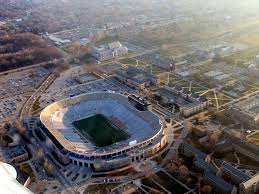 stadium looms over the campus like the shrine to modern gladiatorial combat that football is. It is a semi-pro team in every respect except paying the players and name. Its impact and importance at an educational institution is both unsettling and all too common. The opulence of the setting is somewhat out of character with ought to be the priorities.
 All of this is merely a backdrop to an educational setting where research is also happening. Research in and of itself has become a similar obsession for universities because of its place as a source of money. This has in turn driven resources and focus away from education as the principal focus for universities. At least research can serve a proper place in education. If done with the proper balance research can be a powerful for educating the participants and continuing the development of the senior people involved. I wonder whether in some places the focus is even further removed from education by rich alumni, and massive athletics. Is this really what we need from these institutions? Is this really in service of the best interests of society as a whole, or are these institutions being highjacked to entertain the wealthy while giving substandard educations to the less fortunate?
 gave a talk on my experiences and any wisdom gained through 15 years of effort in the largest scientific software project ever. Afterward, I participated in a panel discussion of the topic and the prospects for crafting a path forward.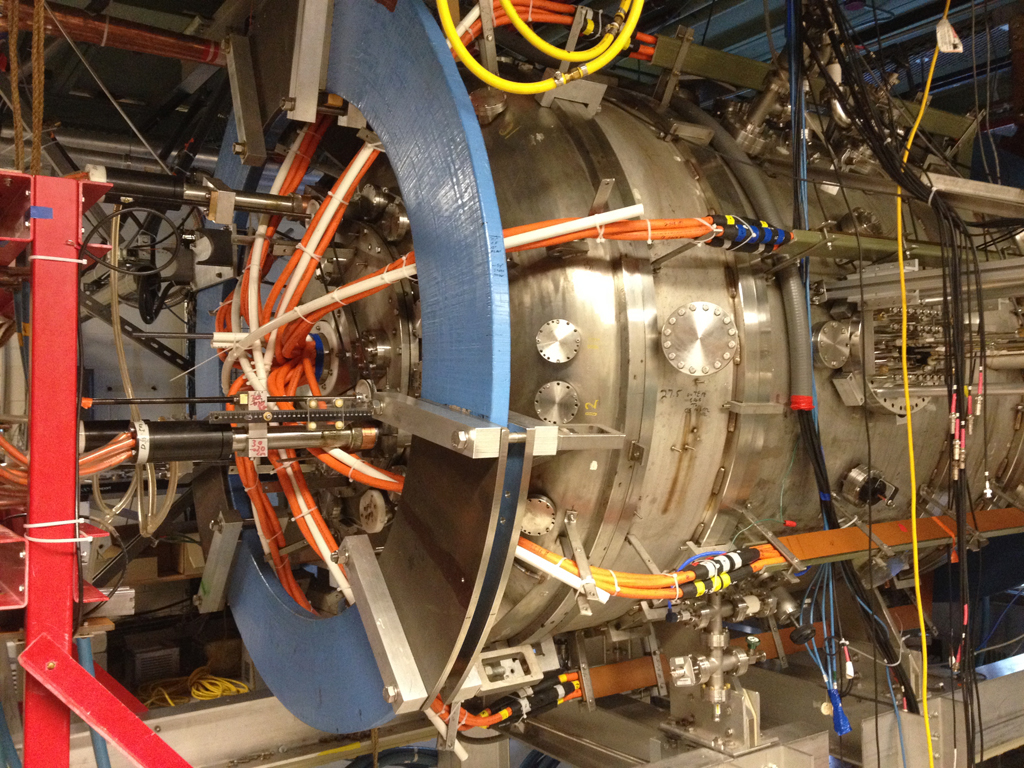
 The people I was speaking to are working with vastly less. Who was I to be giving them advice? It was like the rich guy rolling down the window of his limo to encourage the homeless person to “get a job, you bum!”
 purposes. Without a common axis to orient their efforts, the efforts are horribly fragmented, and naturally incoherent. I think about my situation and think, “holy shit! I do have it easy!”
 have left their community with too little to build on. In many respects the plasma physics community has lagged behind in some significant ways. It felt good to admit to the audience yesterday that in many respects plasma physics is the whipping boy in some V&V circles for how NOT to do things. I asked this in providing the audience with a compliment that they were doing something to change this. It was also a question to them about how the broader plasma physics community feels about V&V and what their collective concerns are.
 ability to advance as a society because so many are left behind without any capacity to fully contribute to the success of the whole. A large part of the reason for the deficit of capacity for contribution is the lack of meaningful outlet when society as a whole is organized to funnel the product of societal efforts into the hands of precious few. We are not organized to maximize the efforts of our citizens, but rather maximize the wealth of a select few.
 The inequality is society is impacting science massively. Money has become the barometer by which all things are measured. It is seemingly the one size fits all metric for the value of all things. It is driving the short-term thinking permeating business thinking today. The reasoning for the short-term thinking is its ability to maximize the flow of resources into the hands of the already rich in the credit and investment markets; it is not because it maximizes the aggregate benefit to society or even the long-term benefit to business. The policies governing our World today are for the benefit of the few, not the many.
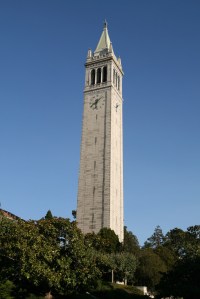 principled approach of education. This is driven by and justified by the lack of societal investment in higher education. The research focus of universities is being driven toward the “publish or perish” philosophy that hollows out the depth of the research while draining away the critical training of the next generation of researchers. The consequences are grim. We are producing much more work, with much less quality and impact.
 The Regularized Singularity