
Combinatory play seems to be the essential feature in productive thought.
― Albert Einstein
My wife and I take part in a discussion group twice a month at our church. We get an innocuous sounding word to focus upon and set about answering deep questions about it. Everyone gets a chance to speak without interruption and everyone else focuses on listening. It’s hard (I’m really bad at listening), and it’s rewarding. Last week the word was “play”. In talking about what the concept of play means to me first in the context of childhood then adulthood I had several epiphanies about the health and vitality of our current society and workplaces. Basically, the concept of play is under siege by forces that find it too frivolous to be supported. Societally we have destroyed play as a free wheeling unstructured activity for children, and crushed the freedom to play at work under the banner of accountability. We are poorer and more unhappy as a result and it is yet another manifestation of unremitting fear governing our behaviors.
We are never more fully alive, more completely ourselves, or more deeply engrossed in anything, than when we are at play.
― Charles E. Schaefer
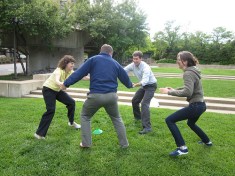 The greatest realization in the dialog came when I took note of how I used to play at work and all the good that came from it. The times when I have been the most productive, creative and happy with work have all been associated with being allowed to play at work. By play I mean allowed to experiment, test, and create new ideas in an environment allowing for failure and risk (essentially by placing very few constraints and limitations on what I was doing). The key was the creation and commitment to very high level goals and the freedom to pursue these goals in a relatively free way. The key is the pursuit of the broad objectives using methods that are not strongly prescribed a priori.
Work and play is the same thing just with a different perspective.
― Debasish Mridha
When I was a child, I had immense freedom to play. I would ride bikes around the neighborhood and play at the creek. My parents had a general idea where I was, but not specifically. This level of independence and freedom is almost impossible to imagine today. Children have scheduled and scripted lives where parents know their precise location at almost any time. Instead of learning to manage their lives with a high degree of independence, we teach our children to always be in control. Most of what is being controlled is a set of highly improbable risks that should not warrant such a high degree of control. We are subverting so much of the positive influence that comes from independence to control exotic and tiny probabilities. Societally, the overall impact is counter-productive and hurts us far more than protects us. The treatment of our children is good training for their lives as adults.
The same basic dynamic is working in the adult world of work. We spend an immense amount of time and effort controlling a host of miniscule risks and dangers. The feeling for children and adults alike is that controlling potential bad outcomes is worth the effort. People say things like “if we can prevent just one needless death…” which sounds compelling, but is stupid and inane. Bad things happen all the time, bad things are supposed to happen and the amount of effort spent preventing them is immense. How many lives worth of effort are spent to prevent a single death? No one ever asks if the steps being taken actually have an overall balanced positive effect pro and con.
You cannot build character and courage by taking away people’s initiative and independence
― Abraham Lincoln

A Transportation Security Administration (TSA) officer pats down Elliott Erwitt as he works his way through security at San Francisco International Airport in San Francisco, Wednesday, Nov. 24, 2010. (AP Photo/Jeff Chiu)
The TSA and airline screening is a good example. What is the cost in number of lives wasted going through their idiotic screening procedures to prevent problems. We also appear not to be able to control our reaction to bad things either. A terrorist act unleashes an avalanche of reaction that magnifies any harm the terrorists intends by orders of magnitude. Yet we continue to act the same without any realization that our fear is in fact the greatest weapon the terrorist possess. Terrorism is quite effective because the public is afraid and the societal response to terror will assist the aims of the terrorists. We have given up an incredible amount of resources, freedom and independence to protect ourselves from minuscule threats. There is a lot of evidence that we will continue to empower terrorists through our fearful responses.
Of course these trends are not solely limited to our response to terrorism. Terrorism simply amplifies the generic response of society. These trends in response occur in a variety of settings and drive short-term, low-risk behavior almost across the board. We typically encourage adults to focus on very short-term goals and take very few risks in working. The result is a loss of long-term goals and objectives in almost all settings in work. In addition the goals and objectives that do exist almost always entail little or no risk. The impact of the environment we have created is a systematic undermining of achievement, innovation and creativity in work. One way to capture this outcome is the recognition that play is not encouraged; it is actively discouraged.
We are being overwhelmed in the workplace, in the schoolroom and in every aspect of life with the concept of accountability. Accountability is one of those things that sounds uniformly good and no one can argue that it’s bad. Unfortunately I have come to the conclusion that the form of accountability we are subjecting our selves to is damaging and destructive. Accountability is used to control people and their activities. It is used to make sure people are doing what they are supposed to be doing. These days we are supposed to be doing what we are told to do. We are not supposed to be creative or innovative and do something that is unpredictable. Accountability is the box we are all being put in, which limits what we can do.
 We end up working extremely hard across everything in society to make sure that bad things don’t ever happen. We put all sorts of measures in place to prevent bad things. We don’t seem to have the capacity to realize that bad things just happen and it’s a fact of life. We spend so much effort trying to manage all the risks that life is just passing us by. This manifests itself with the destructive belief that the government’s job is to protect all of us from bad things (like terrorism). We are willing to give up freedom, accomplishment and productivity to assure a slight increase in safety. Often the risks we are sacrificing so much to diminish are vanishingly small and trivial (like terrorism), yet we are making this trade over and over again. We are allowing ourselves to drown in a sea of safety measures against risks that are inconsequential. The aggregate cost of all of these risk control measures exceeds the value of almost any of the measures. It represents the true threat to our future.
In today’s world, we are in the box all the time whether as children, or as adults. Children’s playtime used to be unscripted and free more often than not. Today it is highly scripted and controlled. Uncontrolled children are viewed quite unfavorably by society as a whole. As adults the exact same thing is happening. Life and work is to be highly scripted and controlled. Anything off script or uncontrolled is considered to be dangerous and highly suspect. The desired result of this scripting and control is predictivity and reliability without risks and failure. The other impact is less happiness and less creativity, less innovation and generally worse outcomes.
Another thread to this thought process is the avoidance of passion in my work. Increasingly I find that expressing any passion or commitment at work is viewed negatively. Work is being driven to be dispassionate and free of deep of emotional connection. In the past when play was very deep part of my productive work life, I also felt great passion for what I did. That passion was tied to the entire way that I worked, and included commitments of quality and learning. More and more today such passion seems to bring nothing but condemnation and seems to be unwelcome. I don’t think that this is disconnected from the issue of play and its diminished role too.
Men do not quit playing because they grow old; they grow old because they quit playing.
― Oliver Wendell Holmes Sr.
 In economic policy it is well known that monopolies are bad. They are bad for everyone except the people who own and control those monopolies (who invest a lot in retaining their power!). They are drags on growth, innovation and progress. They are the essence of the too big to fail problem. In a very real sense the same thing is happening in science. We are being swallowed by monopolistic ideas. We are too invested in a variety of traditional solutions to problem (which solve traditional problems). Innovation, invention and progress are falling victim to this seemingly societal-wide trend.
 Looking at our soon to be, if not already ancient codes based on ancient technology I asked how often did we build a new code in the old days? Sure as could be the answer was radically different than today’s world, we build new codes every five to seven years. FIVE TO SEVEN YEARS!!!! Today we are sheparding codes that are at least a quarter of a century old, and nothing new is in sight. We just continue to accrete capability on to these old codes horribly constrained by sets of decisions increasingly divorced from today’s reality, technology and problems. It is a recipe for failure, but not the good kind of failure, the kind of failure that crushes the future slowly and painlessly like the hardening of the arteries.
 Perhaps no greater emblem of our addiction to shortsightedness exists than the crumbling infrastructure. The roads, bridges, electrical grids, airports, sewers, water systems, power plants,… that our core economy depend upon are in horrible shape and no will exists to support them. We can’t even conjure up the vision to create the infrastructure for the new century and leave it to privatized interests that will never deliver it. We are setting ourselves up to be permanently behind the rest of the World. We have no pride as a nation, no leadership and no vision of anything different. We just have short-term narcissistic self-interest embodied by the low tax, low service mentality. The same dynamic is happening at work.
 undations, we have stale old codes, models, methods and algorithms that ill-serve our potential. The application of too big to fail to our codes is creating a slow-motion failure of epic proportions. The basis for the failure is the loss of innovation and a sense that we are creating the future. Instead we simply curate the past. Our best should be ahead of us and any leadership worth its salt would demand that we work steadfastly to seize greatness. In modeling and simulation the creation of new codes should be an energizing factor creating effective laboratories for innovation, invention and creativity providing new avenues for progress.


 more apt description. There is frightfully little investigation or intellectual engagement
 Societally, the concept of too big to fail applies to the banking and financial institutions that almost destroyed the World economy eight years ago. We demonstrated that they were both too big to fail and too big and too powerful to change thus remaining a ticking time bomb. It is only a matter of time before the same issues present in 2007 erupt again and wreck havoc on the World economy. All the evidence needed to energize real change is available, but there is simply too much money to be made, and greed is more powerful than common sense. I realized that our application codes and computers probably properly deserve to be thought of in exactly the same light, they are too big to fail too. This character is slowly and steadily poisoning the environment we live in and any discussion of different intellectual paths is simply forbidden.
 As I said, the depth of intellectual ownership of these very codes is diminishing with each passing day. The essential aspects of these code’s utility and success in our application areas is based on deep knowledge and intense focus of talented individuals. The talent and skills leading to successful codes are difficult to develop and maintain; the skills must be developed by simultaneously pushing several envelopes: the applications, the models, methods to solve models, and computer science-programming. Today we really only focus on the computer science-programming and simply sort all the other details. Rather than continually reinvest in people and science, we are creating an environment where codes are curated. This state is actually a recipe for catastrophic failure rather than glorious success. The path forward should be adaptive, flexible and agile; instead the path is a lumbering goliath and viewed as a fait accompli.
 humans who understand the basis of models and how these models are solved. When we curate code this key connection is lost. We lose the fundamental nature of the model as our impression of nature, rather than its direct image. We use models as a way of explaining nature rather than a substitute for the natural World. This tie is being systematically undermined by the way we compute today and results in a potentially catastrophic loss of humility. Such loses of humility ultimately produce reactions that are unpleasant and damaging.
 We are creating a program that will collide with reality leaving a broken and limping community in its wake. It has a demonstrated track record of not learning from past mistakes, producing a plan for moving ahead that is devoid of innovation and deep thought. Today’s path forward is solely predicated on the idea that we must have the fastest computer rather than the best computing. It is the epitome of bigger and more expensive is better, rather than faster, smarter and more agile. Perhaps more damaging is a perspective that the problems we face are already solved save the availability of more computer power. We will end up eviscerating the very communities of scientists that are the lifeblood of modeling and simulation. The program may be a massive mistake and no one is questioning any of it.
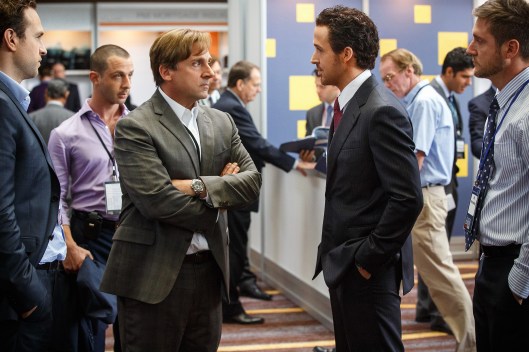
 One scene in “The Big Short” stands out as helping define the depth of the dysfunction in the system, the trip to Moody’s, the rating agency for the securities. The securities created by the banks were incredibly unstable and literally junk, yet the ratings agencies kept putting their top seal of approval on them, AAA. When pressed on the matter, the woman representing Moody’s said, “if we don’t give them the rating they want, the guy down the street will, we want the business.” The people watching the system for fraud were completely in bed with the crooks. The reality is that this practice and problem are everywhere. It is true where I’ve worked, it is obviously true in politics, and sports, and education, and… Our whole nation is living in the Golden Age of Bullshit. This serves no purpose but perpetuating the existing structures of power at the cost of progress, quality and ethical behavior.
 cause being responsible will just get you replaced by a more corrupt or corruptible irresponsible person. The sorts of peer reviews that we see at work are the same thing. Everything is graded on a curve, and a bad failing grade is never allowed. Failure isn’t allowed, if it comes up the messenger is “shot” (usually by being dismissed from the peer review). We never confront any problems until they blow up in our faces. This tendency basically allows progress to grind to a proverbial halt. Failures are the fuel for progress and when you disallow failure, you disallow progress.
 of bullshit responses that hamper us today. If everyone is an expert then no one is an expert. If people don’t like the information they get, they find someone else who gives them a different answer. As a result science in our society is in decline. Actual science is being hurt, and science’s role in society is similarly degrading. Look at the whole anti-vaxxer movement, which has absolutely no basis, but lots of proponents. We get ideas where any risk at all is unacceptable and we allow progress to grind to a complete halt. Failure, problems and the identification of things that need to be improved creates the basis of valuable work. We have structurally destroyed mechanisms for doing this by our addiction to praise and inability to identify and confront problems while they are small.
 management provides. Progress often comes from applying new thinking to old problems. One of the key things to do is identify and take on unsolved problems, another name for failures. Making progress is often the antithesis of things that can be managed in today’s common fashion, so progress makes way for management satisfaction. The key is the project management is simply a tool, and a useful one at that. It is not a recipe for success or an alternative to thinking deeply and differently.
 The Regularized Singularity