
Change almost never fails because it’s too early. It almost always fails because it’s too late.
– Seth Godin
I read a lot including books, papers, articles, online content, and whatever else I can get my hands on. My interests are wide and varied including everything from deep technical science articles to more intellectual takes on popular culture. Among my interests are business or management articles. These speak about various ways of getting the best results from employees using largely positive and empowering techniques. Somehow I never see the techniques espoused in these articles in practice. Increasingly, the articles I read about management and business are science fiction with an ever-widening gap between reality and the ideal. The same gap is present in the realm of politics and public policy. Many bi-partisan forces threaten to push us into an authoritarian future that crushes human spirit challenge the ideal and progressive changes needed to make society function better. Inside and outside of work we see the potential of people constricted to produce predictable results that comply with a sense of order and safety.
When I read articles on excellence in management and business a big part of the message is employee empowerment and motivation. Empowered and motivated employees can be a huge benefit for a company (or by extension Lab, University, organization,…). Another way of expressing this common message is the encouragement of innovation and problem solving as a route to added value and high performance. Usually this is articulated as out of the box thinking, work and performance. Yet when I return to my reality, the writing seems dramatically out of touch and impossible to imagine being implemented where I work. Almost every thing my management does, and our “corporate” governance strives for is compliance, subservience, and in the box thinking. We are pushed to be predictable and downright pedestrian in everything we do. A large part of the ability to tolerate this environment is the articulation of standards of performance. Today standards of performance are defined not by excellence and achievement, but compliance and predictability. The result is the illusion of excellence and achievement when the reality is exactly the opposite. Remarkably like cattle moving to slaughter, we go along with it.
The greatest irony of the current era is the need to keep out of the box thinking under control, effectively putting it in the box. You can only be out of the box within strictly defined boundaries lest you create a situation that might not be completely under control. Of course this is a complete oxymoron and leads to the sort of ridiculous outcomes at work we all recognize. We are encouraged to be bold at work as long as we comply with all the rules and regulations. We can be bold in our thinking as long as no risks are taken. It is the theatre of the absurd. We can magically manage our way to getting all the reward without any of the risk. Bold outcomes automatically come with risk, and usually unpredictable results and unintended consequences. All of these things are completely outside the realm of the acceptable today. Our governance is all about predictably intended consequences and the entire system is devoted to control and safety. The bottom line is you can’t have the fruits of boldness, innovation and discovery without risking something and potentially courting disaster. If you don’t take risks, you don’t get the rewards, a maxim that our leaders don’t seem to understand.
One of the great sources for business articles is the well-written and respected Harva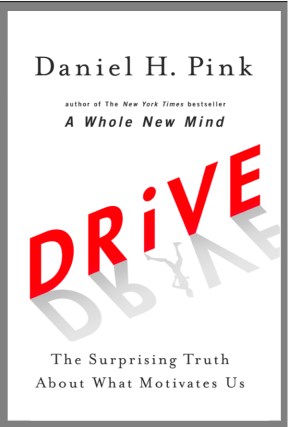 rd Business Review (HBR). I know my managers read many of the same things I do. They also read business books, sometimes in a faddish manner. Among these is Daniel Pink’s excellent “Drive”. When I read HBR I feel inspired, and hopeful (Seth Godin’s books are another source of frustration and inspiration). When I read Drive I was left yearning for a workplace that operated on the principles expressed there. Yet when I return to the reality of work these pieces of literature seem fictional, even more like science fiction. The reality of work today is almost completely orthogonal to these aspirational writings. How can my managers read these things, then turn around and operate the way they do? No one seems to actually think through what implementation of these ideas would look like in the workplace. With each passing year we fall further from the ideal, more toward a workplace that crushes dreams, and simply drives people into some sort of cardboard cutout variety of behavior without any real soul.
 While work is the focus of my adult world, similar trends are at work on our children. School has become a similarly structured training ground for compliance and squalid mediocrity. Standardized testing is one route to this outcome where children are trained to take tests and no solve problems. Standardized testing becomes the perfect rubric for the soulless workplace that awaits them in the adult world. The rejection of fact and science by society as a whole is another way. We have a large segment of society who is suspicious of intellect. Too many people now view educated intellectuals as dangerous and their knowledge and facts are rejected whenever they disagree with the politically chosen philosophy. This attitude is a direct threat to the value of an educated populace. Under a system where intellect is devalued, education transforms into a means of training the population to obey authority and fall into line. The workplace is subject to the same trends, compliance and authority is prized along with predictability of results. The lack of value for intellect is also present within the sort of research institutions I work at. This is because it threatens predictability of results. As a result out of the box thinking is discouraged, and the entire system is geared to keep everyone in the box. We create systems oriented toward control and safety without realizing the price paid for rejecting exploration and risk. We all live a life less rich and less rewarding as a result, and by accumulating this over society, a broad-based diminishment of results.
Be genuine. Be remarkable. Be worth connecting with.
– Seth Godin
When I see my managers reading things like HBR or Drive, I’m left wondering about how they can square their actions with the distance from what they read? My wife likes to promote “Reality-based Management,” the practical application of principles within a pragmatic approach to achievement. This is good advice that I strive to apply. There is a limit to pragmatism when the forces within society continually push us away from every ideal. Pragmatism is a force for survival and making the best of a bad situation, but there is a breaking point. When does reality become so problematic that something must change? When does the disempowering force become so great that change must occur? Perhaps we are at this point. I find myself hoping for a wholesale rejection of the forces of compliance that enslave us. Unfortunately we have rejected progressive forces nationally, and embraced the slaveholders who seek to exploit and disempower us. We have accepted being disempowered in trade for safety. Make no mistake, we have handed those who abuse the populace with a yoke and whip, and a “mandate” to turn the screws on all of us. In return we all get to be safe, and live a less rich life through the controls such safety requires.
I have to admit to myself that many people prize control and safety above all else. They are willing to reject freedom and rewards if safety can be assured. This is exactly the trade that many Americans have made. Bold, exciting and rewarding lives are traded for safety and predictable outcomes. The same thing is happening for many companies and organizations and infests work with compliance through rules and regulations. We see this play out with the reactions to terrorism. Terrorism has paved the way t o massive structures of control and societal safety. It also creates an apparatus for big brother to come to fruition in a way that makes Orwell more prescient than ever. The counter to such widespread safety and control is the diminished richness of life that is sacrificed to achieve it. Lives well-lived and bold outcomes are reduced in achieving safety. I’ve gotten to the point where this trade no longer seems worth it. What am I staying safe for? I am risking living a pathetic and empty life in trade for safety and security, so that I can die quietly. This is life in the box, and I want to live out of the box. I want to work out of the box too.
The core message of my work is get in the box and don’t make waves, just do what you’re told. The message from society as a whole may be exactly the same with order, structure and compliance being prized by a large portion of the population. Be happy with what you’ve got, everything is fine. I suspect that my management is just as disempowered as I am. More deeply the issues surrounding this problem are societal. Americans are epically disempowered with many people expressing this dysfunction politically. The horror show is playing out Nationally with the election of a historically unpopular and unqualified President simply because he isn’t part of the system. The population as a whole thinks things are a mess. For roughly half the people electing an unqualified, politically incorrect, outsider seems like the appropriate response. The deeper problem is that the sort of in the box forces are not partisan at all, the right does its thing and the left does another thing, but both seek to disempower the population as a whole.
Change almost never fails because it’s too early. It almost always fails because it’s too late.
– Seth Godin
Some part of Trump’s support comes from people who just want to burn the system to the ground. Another group of people exist on the left who want the same outcome, destroy the current system. Maybe Trump will destroy the system and create a future, but I seriously doubt it. I’m guessing more of a transition to kleptocratic rule where the government actively works to loot the country for the purpose of enriching a select few. I’d prefer a much more constructive and progressive path to the future where human potential is unleashed and unlocked. Ultimately a lack of progress in fixing the system will eventually lead to something extreme and potentially violent. The bottom line is that the forces enslaving us are driven by the sort of people represented by the leadership of both political parties. The ruling class has power and money with the intent of holding and expanding it and personal empowerment of common citizens is a threat to their  authority. The ruling business class and wealthy elite enjoy power through subtle subjugation of the vast populace. The populace accepts their subjugation in trade for promises of safety and security through the control of risk and danger.
For now, the message at work is get in the box by complying while not making waves and simply doing what you are told to do. No amount of reading about employee empowerment can fix the reality until there is a commitment to a different path. The management can talk till they are blue in the face about their principles, diversity, excellence, teamwork and the power of innovative out of the box thinking, but the reality is the opposite. The national reality is the same, bullshit about everyone mattering, and a truth where very few matter at all. We have handed the reins of power to those who put us in bondage, and we would have done the same if the democrats had won too. There will be real differences in what the bondage looks like, but the result is largely the same. Rather than breaking our chains, we have decided to make the bonds stronger. We can hope that people recognize the error and change course sooner rather  than later. As long as we continue to prize safety and security over possibility and potential, we can expect to be disempowered.
We have so much potential waiting to be unleashed by rejecting in the box thinking. To get there we need to reject over-whelming safety, control and compliance. We need to embrace risk and possibility with the faith that our talents can lead us to a greater future powered by innovative, inspired thinking and lives well lived by empowering everyone to get out of the box.
The best way to be missed when you’re gone is to stand for something when you’re here.
– Seth Godin
 of science differently. First and foremost modeling and simulation enhances our ability to make predictions and test theories. As with any tool, it needs to be used with care and skill. My proposition is that the modeling and simulation practice of verification and validation combined with uncertainty quantification (VVUQ) defines this care and skill. Moreover VVUQ provides an instantiation of the scientific method for modeling and simulation. An absence of emphasis on VVUQ in modeling and simulation programs should bring doubt and scrutiny on the level of scientific discourse involved. In order to see this one needs to examine the scientific method in a bit more detail.
 ce elaborate and complex mathematical models, which are difficult to solve and inhibit the effective scope of predictions. Scientific computing relaxes this limitations significantly, but only if sufficient care is taken with assuring the credibility of the simulations. The entire process of VVUQ serves to provide the assessment of the simulation so that they may confidently be used in the scientific process. Nothing about modeling and simulation changes the process of posing questions and accumulating evidence in favor of a hypothesis. It does change how that relaxing limitations on the testing of theory arrives at evidence. Theories that were not fully testable are now open to far more complete examination as they now may make broader predictions than classical approaches allowed.
 nd simulation where the degree of approximate accuracy is rarely included in the overall assessment. In many cases the level of error is never addressed and studied as part of the uncertainty assessment. Thus verification plays two key roles in the scientific study using modeling and simulation. Verification acts to define the credibility of the approximate solution to the theory being tested, and an estimation of the approximation quality. Without an estimate of the numerical approximation, we possibly suffer from conflating this error with modeling imperfections, and obscuring the assessment of the validity of the model. One should be aware of the pernicious practice of simply avoiding error estimation by declarative statements of being mesh-converged. This declaration should be coupled with direct evidence of mesh convergence, and the explicit capacity to provide estimates of actual numerical error. Without such evidence the declaration should be rejected.
 experiments or observation of the natural world. In keeping with the theme an important element of the data in the context of validation is its quality and a proper uncertainty assessment. Again this assessment is vital for its ability to put the whole comparison with simulations in context, and help define what a good or bad comparison might be. Data with small uncertainty demands a completely different comparison than large uncertainty. Similarly for the simulations where the level of uncertainty has a large impact on how to view results. When the uncertainty is unspecified either data or simulation are untethered and scientific conclusions or engineering judgments are threatened.
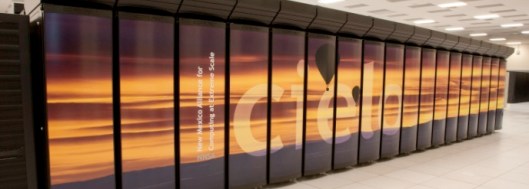 It is no understatement to note that this perspective is utterly missing from the high performance computing world today and the foolish drive to exascale we find ourselves on. Current exascale programs are almost completely lacking any emphasis on VVUQ. This highlights the lack of science in our current exascale programs. They are rather naked and direct hardware-centric programs that show little or no interest in actual science, or applications. The whole program is completely hardware-focused. The holistic nature of modeling and simulation is ignored and the activities connecting modeling and simulation with reality are systematically starved of resources, focus and attention. It is not too hyperbolic to declare that our exascale programs are not about science.
 perceived as vulnerability. Stating weaknesses or limitations to anything cannot be tolerated in today’s political environment, and risks project existence because it is perceived as failure. Instead of an honest assessment of the state of knowledge and level of theoretical predictivity, today’s science prefers to make over-inflated claims and publish via press release. VVUQ runs counter to this practice if done correctly. Done properly VVUQ provides people using modeling and simulation for scientific or engineering work with a detailed assessment of credibility and fitness for purpose.
 claration of intent by the program to seek results associated with spin and BS instead of a serious scientific or engineering effort. This end state is signaled by far more than merely a lack of VVUQ, but also the lack of serious application and modeling support. This simply compounds the lack of method and algorithm support that also plagues the program. The most cynical part of all of this is the centrality of application impact to the case made for the HPC programs. The pitch to the nation or the World is the utility of modeling and simulation to economic or physical security, yet the programs are structured to make sure this cannot happen, and will not be a viable outcome.
 of a solid from a molecular dynamics simulation.
 om using applications to superficially market the computers, the efforts are proportional to their proximity to the computer hardware. As a result large parts of the vital middle ground are languishing without effective support. Again we lose the middle ground that is the source of efficiency and enables the quality of the overall modeling and simulation. The creation of powerful models, solution methods, algorithms, and their instantiation in software all lack sufficient support. Each of these activities has vastly more potential than hardware to unleash capability, yet it remains without effective support. When one makes are careful examination of the program all the complexity and sophistication is centered on the hardware. The result has a simpler is better philosophy for the entire middle ground and those applications drawn into the marketing ploy.
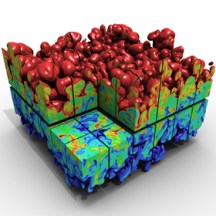 l and complicated numerical method run with relatively simple models and simple meshes. DNS uses vast amounts of computer power on leading edge machines, but uses no model at all aside from the governing equations and very simple (albeit high-order) methods. As demands for credible simulations grow we need to embrace complexity in several directions for progress to be made.
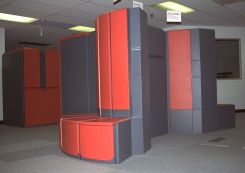 modeling and simulation. For the sophisticated and knowledgeable person, the computer is merely a tool, and the real product is the complete and assessed calculation tied to a full V&V pedigree.
 I’m an unrelenting progressive. This holds true for politics, work and science where I always see a way for things to get better. I’m very uncomfortable with just sitting back and appreciating how things are. Many who I encounter see this as a degree of pessimism since I see the shortcomings in almost everything. I keenly disagree with this assessment. I see my point-of-view as optimism. It is optimism because I know things can always get better, always improve and constantly achieve a better end state. The people who I rub the wrong way are the proponents of the status quo, who see the current state of affairs as just fine. The difference in worldview is really between my deep reaching desires for a better world versus a world that is good enough already. Often the greatest enemy of getting to a better world is a culture that is a key element of the world, as it exists. Change comes whether culture wants it or not, and problems arise when the prevailing culture is unfit for these changes. Overcoming culture is the hardest part of change, and even when the culture is utterly toxic, it opposes changes that would make things better.


 failed presidency because of the toxic political culture in general. We have reaped this entire legacy by allowing the public and political institutions to whither for decades. It is arguable that this erosion is the willful effort of those charged by the public with governing us. Among the institutions that are under siege and damaged in our current era are the research institutions where I work. These institutions have cultures from a bygone era, completely unfit for the modern world yet unmoving and not evolved in the face of new challenges.
 disempowerment of employees. Increasingly the people working in the trenches are merely cannon fodder, and everything important to work happens with managers. Where I work the toxicity of the workplace and politics collide to produce a double whammy. We are under siege from a political climate that undermines institutions and a business-management culture that undermines the power of the worker.
 ng the barriers to their actual reality would be a welcome remedy to the normal cynical response. Instead the reality is completely ignored and the fantasy of living to such values is promoted. It is not clear whether the manager knows the promoted values are fiction, or simply exists in a disconnected fantasy world. Either situation is utterly damning. The manager either knows the values are fiction, or they are so disconnected from reality that they believe the fiction. The end result is the same, no actions to remove the toxic culture are ever taken and the culture’s role in undermining values is not acknowledged.
 es resulting directly from the toxic culture playing out. The election of a thoroughly toxic human being as President is a great exemplar of the degree of dysfunction today. Our toxic culture is spilling over into societal decisions that may have grave implications for our combined future. One outcome of the toxic societal choice could be a sequence of events that will induce a crisis of monumental proportions. Such crises can be useful in fixing problems and destroying the toxic culture, and allowing its replacement by something better. Unfortunately such crises are painful, destructive and expensive. People are killed. Lives are ruined and pain is inflicted broadly. Perhaps this is the cost we must bear in the wake of allowing a toxic culture to fester and grow in our midst.
 t of challenges for older cultures, which these older cultures are unfit to manage. Seemingly we are being plunged headlong toward a crisis necessary to resolve the cultural inadequacies. The problem is that the crisis will be an immensely painful and horrible circumstance. We may simply have no choice, but to go through it, and hope we have the wisdom and strength to get to the other side of the abyss.
 reatures whose success has been predicated on the toxic culture. These people are almost completely incapable of making the necessary decisions for avoiding the sorts of disasters that characterize a crisis. The toxic culture and those who succeed in them are unfit to resolve crises successfully. Our leaders are the most successful people in the toxic culture and act to defend such cultures in the face of overwhelming evidence that the culture is toxic. As such they do nothing to avoid the crisis even when it is obvious and make the eventual disaster inevitable.
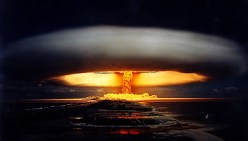 eries of basic scientific principles combined with overwhelming need in the socio-political worlds. At the end of the 19th century and beginning of the 20th century a massive revolution occurred in physics fundamentally changing our knowledge of the universe. The needs of global conflict pushed us to harness this knowledge to unleash the power of the atom. Ultimately the technology of atomic energy became a transformative political force probably stabilizing the world against massive conflict. More recently, computer technology has seen a similar set of events play out in a transformative way first scientifically, then in engineering and finally in profound societal impact we are just beginning to see unfold.
 If we pull our focus into the ability of computational power to transform science, we can easily see the failure to recognize these elements in current ideas. We remain utterly tied to the pursuit of Moore’s law even as it lies in the morgue. Rather than examine the needs of progress, we remain tied to the route taken in the past. The focus of work has become ever more computer (machine) directed, and other more important and beneficial activities have withered from lack of attention. In the past I’ve pointed out the greater importance of modeling, methods, and algorithms in comparison to machines. Today we can look at another angle on this, the time it takes to produce useful computational results, or workflow.
 be the simplest and clearest example of the overwhelmingly transparent superficiality of current research. Visualization is useful for marketing science, but produces stunningly little actual science or engineering. We are more interested in funding tools for marketing work than actually doing work. Tools for extracting useful engineering or scientific data from calculation usually languish. They have little “sex appeal” compared to flashy visualization, but carry all the impact on the results that matter. If one is really serious about V&V all of these issues are compounded dramatically. For doing hard-nosed V&V visualization has almost no value whatsoever.
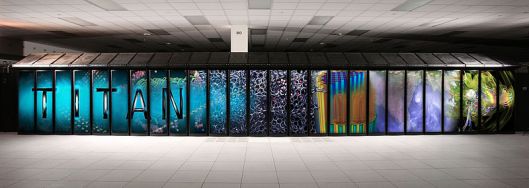 In the end all of this is evidence that current high performance computing programs have little interest in actual science or engineering. They are hardware focused because the people leading them like hardware; don’t care or understand science and engineering. The people running the show are little more than hardware-obsessed “fan boys” who care little about science. They succeed because of a track record of selling hardware-focused programs, not because it is the right thing to do. The role of computation is science should be central to our endeavor instead of a sideshow that receives little attention and less funding. Real leadership would provide a strong focus on completing important work that could impact the bottom line, doing better science with computational tools.
 The Regularized Singularity