Judge a man by his questions rather than by his answers.
― Voltaire
In thinking about what makes work good for me, I explored an element of the creative process for me revolving around answering questions. If one doesn’t have the right question, the work isn’t framed correctly and progress will stall. A thing to consider in this frame of reference is what makes a good question? This itself is an excellent question! The quality of the question makes a great difference in framing the whole scientific enterprise, and can either lead to bad places of “knowledge cul-de-sacs” or open stunning vistas of understanding. Where you end up depends on the quality of the question you answer. Success depends far more on asking the right question than answering the question originally put to you (or you put to yourself).
truth, like gold, is to be obtained not by its growth, but by washing away from it all that is not gold.
― Leo Tolstoy
 A great question is an achievement in itself although rarely viewed as such. More often than not little of the process of work goes into asking the right question. Often the questions we ask are highly dependent upon foundational assumptions that are never questioned. While assumptions about existing knowledge are essential, finding the weak or invalid assumptions is often the key to progress. These assumptions are wonderful for simplifying work, but also inhibit progress. Challenging assumptions is one of the most valuable things to do. Heretical ideas are fundamental to progress; all orthodoxy began as heresy. If the existing assumptions hold up under the fire of intense scrutiny they gain greater credibility and value. If they fall, new horizons are opened up to active exploration.
If we have no heretics we must invent them, for heresy is essential to health and growth.
― Yevgeny Zamyatin
It goes without saying that important questions are good ones. Defining importance is tricky business. There are plenty of important questions that lead nowhere “what’s the meaning of life?” or we simply can’t answer using existing knowledge, “is faster than light travel possible?” On the other hand we might do well to break these questions down to something more manageable that might be attacked, “is the second law of thermodynamics responsible for life?” or “what do subatomic particles tell us about the speed of light?” Part of the key to good scientific progress is threading the proverbial needle of important, worthy and possible to answer. When we manage to ask an important, but manageable question, we serve progress well. Easy questions are not valuable, but are attractive due to their lack of risk and susceptibility to management and planning. Sometimes the hardest part of the process is asking the question, and a well-defined and chosen problem can be amenable to trivial resolution. It turns out to be an immensely difficult task with lots of hard work to get to that point.
I have benefited mightily from asking some really great questions in the past. These 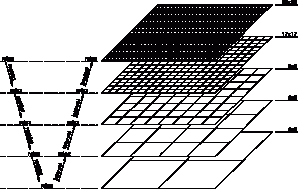 questions have led to the best research, and most satisfying professional work I’ve done. I would love to recapture this spirit of work again, with good questioning work feeling almost quaint in today’s highly over-managed climate. One simple question occurred in my study of efficient methods for solving the equations of incompressible flow. I was using a pressure projection scheme, which involves solving a Poisson equation at least once, if not more than once a time step. The most efficient way to do this involved using the multigrid method because of its algorithmic scaling being linear. The Poisson equation involves solving a large sparse system of linear equations, and the solution of linear equations scales with powers of the number of equations. Multigrid methods have the best scaling thought to be possible (I’d love to see this assumption challenged and sublinear methods discovered, I think they might well be possible).
As problems with incompressible flows become more challenging such as involving large density jumps, the multigrid method begins to become fragile. Sometimes the optimal scaling breaks down, or the method fails altogether. I encountered these problems, but found that other methods like conjugate gradient could still solve the problems. The issue is that the conjugate gradient method is less efficient in its scaling than multigrid.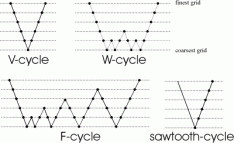 As a result as problems become larger, the proportion of the solution time spent solving linear equations grows ever larger (the same thing is happening now to multigrid because of the cost of communication on modern computers). I posed the question of whether I could get the best of both methods, the efficiency with the robustness? Others were working on the same class of problems, and all of us found the solution. Combine the two methods together, effectively using a multigrid method to precondition the conjugate gradient method. It worked like a charm; it was both simple and stunningly effective. This approach has become so standard now that people don’t even think about it, its just the status quo.
At this point it is useful to back up and discuss a key aspect of the question-making process essential to refining a question into something productive. My original question was much different, “how can I fix multigrid?” was the starting point. I was working from the premise that multigrid was optimal and fast for easier problems, and conjugate gradient was robust, but slower. A key part of the process was a reframing the question. The question I ended up attacking was “can I get the positive attributes of both algorithms?” This changed the entire approach to solving the problem. At first, I tried switching between the two methods depending on the nature of the linear problem. This was difficult to achieve because the issues with the linear system are not apparent under inspection.
The key was moving from considering the algorithms as different options whole cloth, to combining them. The solution involved putting one algorithm inside the other. As it turns out the most reasonable and powerful way to do this is make multigrid a preconditioner for conjugate gradient. The success of the method is fully dependent on the characteristics of both algorithms. When multigrid is effective by itself, the conjugate gradient method is effectively innocuous. When multigrid breaks down, the conjugate gradient method picks up the pieces, and delivers robustness along with the linear scaling of multigrid. A key aspect of the whole development is embracing an assault on a philosophical constraint in solving linear systems. At the outset of this work these two methods were viewed as competitors. One worked on one or the other, and the two communities do not collaborate, or even talk to each other. They don’t like each other. They have different meetings, or different sessions at the same meeting. Changing the question allows progress, and is predicated on changing assumptions. Ultimately, the results win and the former feud fades into memory. In the process I helped create something wonderful and useful plus learned a huge amount of numerical (and analytical) linear algebra.
 The second great question I’ll point to involved the study of modeling turbulent flows with what has become known as implicit large eddy simulation. Starting in the early 1990’s there was a stunning proposition that certain numerical methods seem to automatically (auto-magically) model aspects of turbulent flows. While working at Los Alamos and learning all about a broad class of nonlinearly stable methods, the claim that they could model turbulence caught my eye (I digested it, but fled in terror from turbulence!). Fast forward a few years and combine this observation with a new found interest in modeling turbulence, and a question begins to form. In learning about turbulence I digested a huge amount of theory regarding the physics, and our approaches to modeling it. I found large eddy simulation to be extremely interesting although aspects of the modeling were distressing. The models that worked well were performed poorly on the structural details of turbulence, and the models that matched the structure of turbulence were generally unstable. Numerical methods for solving large eddy simulation were generally based on principles vastly different than those I worked on, which were useful for solving Los Alamos’ problems.
Having methods I worked on for codes that do solve our problems also model turbulence is tremendously attractive. The problem is the seemingly magical nature of this modeling. Being magical does not endow the modeling with confidence. The question that we constructed a research program around was “can we explain the magical capability of numerical methods with nonlinear stability to model turbulence?” We combined the observation that a broad class of methods seemed to provide effective turbulence modeling (or the universal inertial range physics). Basically the aspects of turbulence associated with the large-scale hyperbolic parts of the physics were captured. We found that it is useful to think of this as physics-capturing as an extension of shock-capturing. The explanation is technical, but astoundingly simple.
Upon study of the origins of large eddy simulation we discovered that the origins of the method were the same as shock capturing methods. Once the method was developed it evolved into its own subfield with its own distinct philosophy, and underlying assumptions. These assumptions had become limiting and predicated on a certain point-of-view. Shock capturing had also evolved in a different direction. Each field focused on different foundational principles and philosophy becoming significantly differentiated. For the most part they spoke different scientific languages. It was important to realize that their origins were identical with the first shock capturing method being precisely the first subgrid model for large eddy simulation. A big part of our research was bridging the divides that had developed over almost five decades and learn to translate from one language to the other.
We performed basic numerical analysis of nonlinearly stable schemes using a technique that produced the nonlinear truncation error. A nonlinear analysis is vital here. This uses a technique known as modified equation analysis. The core property of the methods empirically known to be successful in capturing the physics of turbulence is conservation (control volume schemes). It turns out that the nonlinear truncation error for a control volume method for a quadratic nonlinearity produces the fundamental scaling seen in turbulent flows (and shocks for that matter). This truncation error can be destabilizing for certain flow configurations, effectively being anti-dissipative. The nonlinear stability method keeps the anti-dissipative terms under control, producing physically relevant solutions (e.g., entropy-solutions).
A key observation makes this process more reasoned and connected to the traditional large eddy simulation community. The control volume term matches the large eddy simulation models that produce good structural simulations of turbulence (the so-called scale similarity model). The scale similarity model is unstable with classical numerical methods. Nonlinear stability fixes this problem with aplomb. We use as much scale similarity as possible without producing unphysical or unstable results. This helps explain why a disparate set of principles used to produce nonlinear stability provides effective turbulence modeling. Our analysis also shows why some methods are ineffective for turbulence modeling. If the dissipative stabilizing effects are too large and competitive with the scale similarity term, the nonlinear stability is ineffective as a turbulence model.
It is dangerous to be right in matters on which the established authorities are wrong.
― Voltaire
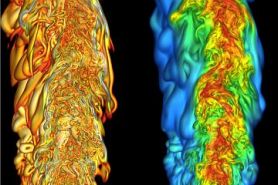 I should spend some time on some bad questions as examples of what shouldn’t be pursued. One prime example is offered as a seemingly wonderful question, the existence of solutions to the incompressible Navier-Stokes equations. The impetus for this question is the bigger question of can we explain, predict or understand fluid turbulence? This problem is touted as a fundamental building block in this noble endeavor. The problem is the almost axiomatic belief that turbulence is contained within this model. The key term is incompressible, which renders the equations unphysical on several key accounts: it gives the system infinite speed of propagation, and divorces the equations from thermodynamics. Both features sever the ties of the equations from the physical universe. The arguing point is whether these two aspects disqualify it from addressing turbulence. I believe the answer is yes.
In my opinion this question should have been rejected long ago based on the available evidence. Given that our turbulence theory is predicated on the existence of singularities in ideal flows, and the clear absence of such singularities in the incompressible Navier-Stokes equations, we should reject the notion that turbulence is contained in them. Despite this evidence, the notion that turbulence is contained whole cloth in these unphysical equations remains unabated. It is treated as axiomatic. This is an example of an assumption that has out lived its usefulness. It will eventually be tossed out, and progress will bloom the path of its departure. One of the key things missing from turbulence is a connection to thermodynamics. Thermodynamics is such a powerful scientific concept and for it to be so absent from turbulence is a huge gap. Turbulence is a fundamental dissipative process and the second law is grounded on dissipation. The two should be joined into a coherent whole allowing unity and understanding to reign where confusion is supreme today.
 Another poorly crafted question revolves around the current efforts for exascale class computers for scientific computing. There is little doubt that an exascale computer would be useful for scientific computing. A better question is what is the most beneficial way to push scientific computing forward? How can we make scientific computing more impactful in the real world? Can the revolution of mobile computing be brought to science? How can we make computing (really modeling and simulation) more effective in impacting scientific progress? Our current direction is an example of crafting an obvious question, with an obvious answer, but failing to ask a more cutting and discerning question. The consequence of our unquestioning approach to science will be wasted money and stunted progress.
Trust is equal parts character and competence… You can look at any leadership failure, and it’s always a failure of one or the other.
― Stephen M.R. Covey
This gets at a core issue with how science is managed today. Science has never been managed more tightly and becoming more structurally mismanaged. The tight management of science as exemplified by the exascale computing efforts is driven by an overwhelming lack of trust in those doing science. Rather than ask people open-ended questions subject to refinement through learning, we ask scientists to work on narrowly defined programs with preconceived outcomes. The reality is that any breakthrough, or progress for that matter will take a form not envisioned at the outset of the work. Any work that pushes mankind forward will take a form not foreseeable. By managing so tightly and constraining work, we are predestining the outcomes to be stunted and generally unworthy of the effort put into them.
Whether you’re on a sports team, in an office or a member of a family, if you can’t trust one another there’s going to be trouble.
― Stephen M.R. Covey
This is seeded by an overwhelming lack of t rust in people and science. Trust is a powerful concept and its departure from science has been disruptive and expensive. Today’s scientists are every bit as talented and capable as those of past generations, but society has withdrawn its faith in science. Science was once seen as a noble endeavor that embodied the best in humanity, but generally not so today. Progress in the state of human knowledge produced vast benefits for everyone and created the foundation for a better future. There was a sense of an endless frontier constantly pushing out and providing wonder and potential for everyone. This view was a bit naïve and overlooked the maxim that human endeavors in science are neither good or bad, producing outcomes dependent upon the manner of their use. For a variety of reasons, some embedded within the scientific community, the view of society changed and the empowering trust was withdrawn. It has been replaced with suspicion and stultifying oversight.
When I take a look at the emphasis in currently funded work, we see narrow vistas. There is a generally myopic and tactical view of everything. Long-term prospects, career development and broad objectives are obscured by management discipline and formality. Any sense of investment in the long-term is counter to the current climate. Nothing speaks more greatly to the overwhelming myopia is the attitude toward learning and personal development. It is only upon realizing that learning and research are essentially the same thing does it start to become clear how deeply we are hurting the scientific community. We have embraced a culture that is largely unquestioning with a well-scripted orthodoxy. Questions are seen as heresy against the established powers and punished. For most, learning is the acquisition of existing knowledge and skills. Research is learning new knowledge and skills. Generally speaking, those who have achieved mastery of their fields execute research. Since learning and deep career development is so hamstrung by our lack of trust, fewer people actually achieve the sort of mastery needed for research. The consequences for society are profound because we can expect progress to be thwarted.
Curiosity is more important than knowledge.
― Albert Einstein
One clear way to energize learning, and research is encouraging questioning. After encouraging a questioning attitude and approach to conducting work, we need to teach people to ask good questions, going back and refining questions, as better understanding is available. We need to identify and overcome assumptions subjecting them to unyielding scrutiny. The learning, research and development environment is equivalent to a questioning environment. By creating an unquestioning environment we short-circuit everything leading to progress, and ultimately cause much of the creative engine of humanity to stall. We would be well served by embracing the fundamental character of humanity as a creative, progressive and questioning species. These characteristics are parts of the best that people have to offer and allow each of us to contribute to the arc of history productively.
Curiosity is the engine of achievement.
― Ken Robinson
Brandt, Achi. “Multi-level adaptive solutions to boundary-value problems.” Mathematics of computation 31, no. 138 (1977): 333-390.
Briggs, William L., Van Emden Henson, and Steve F. McCormick. A multigrid tutorial. Society for Industrial and Applied Mathematics, 2000.
Kershaw, David S. “The incomplete Cholesky—conjugate gradient method for the iterative solution of systems of linear equations.” Journal of Computational Physics 26, no. 1 (1978): 43-65.
Melson, N. Duane, T. A. Manteuffel, and S. F. Mccormick. “The Sixth Copper Mountain Conference on Multigrid Methods, part 1.” (1993).
Puckett, Elbridge Gerry, Ann S. Almgren, John B. Bell, Daniel L. Marcus, and William J. Rider. “A high-order projection method for tracking fluid interfaces in variable density incompressible flows.” Journal of Computational Physics130, no. 2 (1997): 269-282.
Boris, J. P., F. F. Grinstein, E. S. Oran, and R. L. Kolbe. “New insights into large eddy simulation.” Fluid dynamics research 10, no. 4-6 (1992): 199-228.
Porter, David H., Paul R. Woodward, and Annick Pouquet. “Inertial range structures in decaying compressible turbulent flows.” Physics of Fluids 10, no. 1 (1998): 237-245.
Margolin, Len G., and William J. Rider. “A rationale for implicit turbulence modelling.” International Journal for Numerical Methods in Fluids 39, no. 9 (2002): 821-841.
Grinstein, Fernando F., Len G. Margolin, and William J. Rider, eds. Implicit large eddy simulation: computing turbulent fluid dynamics. Cambridge university press, 2007.
Fefferman, Charles L. “Existence and smoothness of the Navier-Stokes equation.” The millennium prize problems (2006): 57-67.

 n. Are things worse where I am, or better than the average? For most of my adult life, I’ve had far better conditions than average, and been able to find great meaning in my work. Is the steady erosion of the quality of the work environment a consequence of issues local to my institution or organization? Or is it part of the massive systemic dysfunction our society is experiencing?
 government, led by an incompetent narcissistic conman without a perceptible moral compass. Racial tensions, and a variety of white supremacist/right wing ultra-Nationalists are walking the streets. Left wing and anarchist groups are waking up as well. Open warfare may soon be upon us making us long for the days where sporadic terrorist attacks were our biggest worry. A shit storm is actually a severe understatement; this is a fucking waking nightmare. I hope this is wrong and I could simply find a better place to work at and feel value in my labors. I wish the problem was simple and local with a simple job change fixing things.
 Work is an important part of life for a variety of reasons. It is how we spend a substantial portion of our time, and much of our efforts go into it. In work we contribute to society and assist in the collective efforts of mankind. As I noted earlier, I’ve been fortunate for most of my life, but things have changed. Part of the issue is a relative change in the degree of self-determination in work. The degree of self-determination has decreased over time. An aspect of this is the natural growth in scope of work as a person matures. As a person grows in work and is promoted, the scope of the work increases, and the degree of freedom in work decreases. Again this is only a part of the problem as the system is working to strangle the self-determination out of people. This is control, fear of failure and generic lack of trust in people. In this environment work isn’t satisfying because the system is falling apart, and the easiest way to resist this is controlling the little guy. My work becomes more of a job and a route to a paycheck every day. Earning a living and supporting your family is a noble achievement these days, and aspiring to more simply a waking dream contracting in the rear view mirror of life.


 t can unleash people’s full potential through allowing them to fail spectacularly and then fully support the next step forward. Today, cowardice and mistrust dominate and even marginal failure results in punishment. It is corroding the foundation of achievement. It makes work simply a job and life more survival than living.
 comfortable and automatic. In many cases culture is the permanent habits of our social constructs, and often defines practices that impede progress. Accepted cultural practices are usually done without thinking and applied almost mindlessly. If these practices are wrong, they are difficult to dislodge or improve upon.
 or fundamental human needs, but most are constructs to help regulate the structures that our collective actions are organized about. The fundamental values, moral code and behaviors of people are heavily defined by culture. If the culture is positive, the effect is resonant and amplifies the actions of people toward much greater achievements. If the culture is negative, the effect can undo and overwhelm much of the best that people are capable of. Invariably cultures are a mixture of positive and negative. Cultures persist for extremely long times and outlive those who set the cultural tone for groups. Cultures are set or can change slowly unless the group is subjected to an existential crisis. When a crisis is successfully navigated the culture that arose in its resolution is enshrined, and tends to persist without change until a new crisis is engaged.
 We see all sorts of examples of the persistence of culture. The United States is still defined by the North-South divide that fractured during the Civil War. The same friction and hate that defined that war 150 years ago dominate our politics today. The culture of slavery persists in systematic racism and oppression. The white and black divide remains unhealed even though none of the people who enslaved or who were enslaved are still alive with many generations having passed. The United States is still defined by the Anglo-Saxon Protestant beliefs of the founding fathers. Their culture is dominant even after being overwhelmed in numbers of people and centuries of history. The dominant culture was formed in the crucible of history by the originating crisis for the Nation, the Revolutionary war. Companies and Laboratories are shaped by their original cultures and these habits and practices persist long after their originators have left, retired or died.
 (earthquakes, floods, hurricanes, famines, …). These events can stress people and existing cultures providing the sorts of crises that shape the future to be more resilient to future disasters. Human events such as wars, trade, and general political events provide both the impact of culture in causing or navigating events, as well as producing crises that shape cultural responses and evolution. We can continue down this line of thinking to ever-smaller cultures such as organizations and businesses are influenced by crises induced by the larger systems (natural or political). This web of culture continues to smaller and smaller scale all the way to communities (towns, regions, schools, families) each having a culture shaped heavily by other cultures or events. In every case a crisis is almost invariably necessary to induce change, cultures are resistant to change unless something painful provides direct evidence of the incapacity of existing culture to succeed.
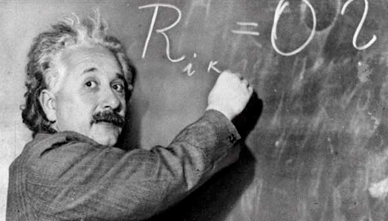 culture of the broader scientific community. This culture exists within the broader network of cultures in society with give-and-take between them. In the past science has provided deep challenges to prevailing culture, and induced changes societal culture. Today the changes in main societal culture are challenging science. One key aspect of today’s culture wars is lack of support for expertise. One of the key rifts in society is mistrust of the elite and educated. The broader society is attacking and undermining educational institutions across the board. Scientific laboratories are similar in makeup and similarly under assault. Much of this broader assault is related to a general lack of trust. Some of this is a reaction to the surplus of trust granted science in the wake of its massive contributions to the resolution of World War 2 and the Cold War. These successes are waning in memory and science is now contracting for a distinguished role societally.


 ns suffers a bit relative to the other Labs, as does the rigor of computed results. Los Alamos was the birthplace of all three labs and computational work, but always puts computation in a subservient role compared to experiments. This leads to a mighty struggle between validation and calibration. Often calibration wins out so that computed results are sufficiently close to experiment. Sandia excels at process and rigor in the conduct of calculations, but struggles at other aspects (at least in a relative sense). The whole verification and validation approach to simulation quality comes from Sandia reflecting the rigor. At the same time institutional support and emphasis are weaker leading to long-term effects.
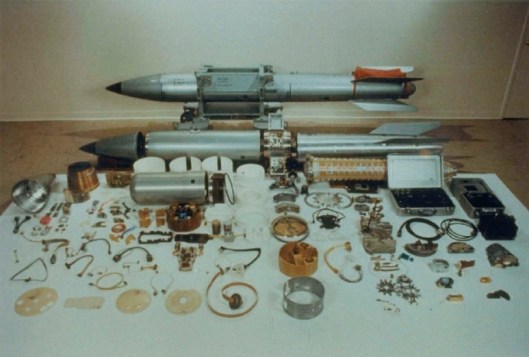 All this texture is useful to think about because it manifests itself in every place computational science is done today. The scientific culture of any institution is reflected in its emphasis, and approach to the conduct of science. The culture produces a natural set of priorities that define investments and acceptable quality. We can speak volumes about how computational work should be done, but the specific acuity to the message is related to preconceived notions about the aspects. For example, some places are more prone to focus on computing hardware as an investment. In terms of the competition for resources, the purchase of hardware is a priority, and a typical route for enhancement. This becomes important when trying to move into new “hot” areas. If the opportunity falls in line with the culture, investments flow and if it is out of line the institution will miss it.
 omputational science is a relatively new area of endeavor. It is at most 70 years old as practiced at Los Alamos; it is a new area of focus in most places. Sometime it is practiced at an institution and added to the repertoire as a new innovative way of doing work. In all these cases the computational work adopts the basic culture of the institution it exists within. It then differentiates based on the local conditions usually dominated by whatever the first acknowledged success is. One of the key aspects of a culture is origin stories or mythological achievements. Origins are almost invariably fraught situations with elements of crisis. These stories pervade the culture and define what success looks like and how investments in the future are focused.
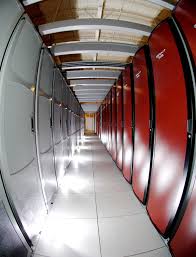 Where I work at Sandia, the origin story is dominated by early success with massively parallel computers. The greatest success was the delivery of a computer, Red Storm. As a result the culture is obsessed with computer hardware. The path to glory and success runs through hardware; a focus on hardware is culturally accepted and natural for the organization. It is a strong predisposition. At Lawrence Livermore the early stages of the Laboratory were full of danger and uncertainty. Early in the history of the Lab there was a huge breakthrough in weapons design. It used computational modeling, and the lead person in the work went on to huge professional success (Lab Director). This early success became a blueprint for others and an expected myth to be repeated. A computational study and focus was always expected and accepted by the Lab. At Los Alamos all roads culturally lead to the Manhattan Project. The success in that endeavor has defined the Laboratory ever since. The manner of operation and approach to science adopted then is blueprint for success at that Laboratory. The multitude of crises starting with the end of the Cold War, spying, fires, and scandal have all weakened the prevailing culture, and undermined the future.


 and knowledge. This always manifests itself with a lack of questioning in the execution of work. Both of these issues are profoundly difficult to deal with and potentially fatal to meaningful impact of modeling and simulation. These issues are seen quite frequently. Environments with weak peer review contribute to allowing confidence with credibility to persist. The biggest part of the problem is a lack of pragmatic acceptance of modeling and simulation’s intrinsic limitations. Instead we have inflated promises and expectations delivered by over confidence and personality rather than hard nosed technical work.
 When confidence and credibility are both in evidence, modeling and simulation is empowered to be impactful. It will be used appropriately with deference to what is and is not possible and known. When modeling and simulation is executed with excellence and professionalism along with hard-nosed assessment of uncertainties, using comprehensive verification and validation, the confidence is well grounded in evidence. If someone questions a simulations result, answers can be provided with well-vetted evidence. This produces confidence in the results because questions are engaged actively. In addition the limitations of the credibility are well established, and confidently be explained. Ultimately, credibility is a deeply evidence-based exercise. Properly executed and delivered, the degree of credibility depends on honest assessment and complete articulation of the basis and limits of the modeling.
 One of the major sins of over-confidence is flawed or unexamined assumptions. This can be articulated as “unknown knowns” in the famously incomplete taxonomy forwarded by Donald Rumsfeld in his infamous quote. He didn’t state this part of the issue even though it was the fatal flaw in the logic of the Iraqi war in the aftermath of 9/11. There were basic assumptions about Hussein’s regime in Iraq that were utterly false, and these skewed the intelligence assessment leading to war. They only looked at information that supported the conclusions they had already drawn or wanted to be true. The same faulty assumptions are always present in modeling. Far too many simulation professionals ignore the foundational and unfounded assumptions in their work. In many cases assumptions are employed without thought or question. They are assumptions that the community has made for as long as anyone can remember and simply cannot be questioned. This can include anything from the equations solved, to the various modeling paradigms applied as a matter of course. Usually these are unquestioned and completely unexamined for validity in most credibility assessments.
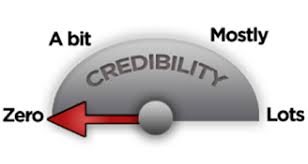 stay the course and make standard assumptions. In many cases the models have been significantly calibrated to match existing data, and new experiments or significantly more accurate measurements are needed to overturn or expose modeling limitations. Moreover the standard assumptions are usually unquestioned by peers. Questions are often met with ridicule. A deeply questioning assessment requires bravery and fortitude usually completely lacking from working scientists and utterly unsupported by our institutions.
 personality. This proof by authority is incredibly common and troubling to dislodge. In many cases personal relationships to consumers of simulations are used to provide confidence. People are entrusted with the credibility and learn how to give their customer what they want. Credibility by personality is cheap and requires so much less work plus it doesn’t raise any pesky doubts. This circumstance creates an equilibrium that is often immune to scientific examination. It is easier to bullshit the consumers of modeling and simulation results than level with them about the true quality of the work.
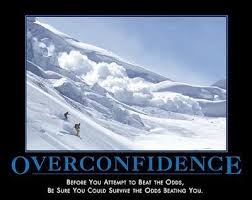 One of the biggest threats to credibility is the generation of the lack of confidence honesty has. Engaging deeply and honestly in assessment of credibility is excellent at undermining confidence. Almost invariably the accumulation of evidence regarding credibility endows the recipients of this knowledge with doubt. These doubts are healthy and often the most confident people are utterly ignorant of the shortcomings. The accumulation of evidence regarding the credibility should have a benefit for the confidence in how simulation is used. This is a problem when those selling simulation oversell what it can do. The promise of simulation has been touted widely as transformative. The problem with modeling and simulation is its tangency to reality. The credibility of simulations is grounded by reality, but the uncertainty comes from both modeling, but also the measured and sensed uncertainty with our knowledge of reality.
 n oversold and any assessment will provide bad news. In today’s World we see a lot of bad news rejected, or repackaged (spun) to sound like good news. We are in the midst of a broader crisis of credibility with respect to information (i.e. fake news), so the issues with modeling and simulation shouldn’t be too surprising. We would all be well served by a different perspective and approach to this. The starting point is a re-centering of expectations, but so much money has been spent using grossly inflated claims.
 limitations. The difference that simulation makes is the ability to remove the limitations of analytical model solution. Far more elaborate and accurate modeling decisions are available, but carry other difficulties due to the approximate nature of numerical solutions. The tug-of-war intellectually is the balance between modeling flexibility, nonlinearity and generality with effects of numerical solution. The bottom line is the necessity of assessing the uncertainties that arise from these realities. Nothing releases the modeling from its fundamental connection to validity grounded in real world observations. One of the key things to recognize is that models are limited and approximate in and of themselves. Models are wrong, and under a sufficiently resolved examination will be invalid. For this reason an infinitely powerful computer will ultimately be useless because the model will become invalid at some resolution. Ultimately progress in modeling and simulation is based on improving the model. This fact is ignored by computational science today and will result wasting valuable time, effort and money chasing quality that is impossible to achieve.
 This is a nice way of saying this is usually a sign that the quality is actually complete bullshit! We can move a long way toward better practice by simply recalibrating our expectations about what we can and can’t predict. We should be in a state where greater knowledge about the quality, errors and uncertainty in modeling and simulation work improves our confidence.
 One of the issues of increasing gravity in this entire enterprise is the consumption of results using modeling and simulation by people unqualified to judge the quality of the work. The whole enterprise is judged to be extremely technical and complex. This inhibits those using the results from asking key questions regarding the quality of the work. With the people producing modeling and simulation results largely driven by money rather than technical excellence, we have the recipe for disaster. Increasingly, false confidence accompanies results and snows the naïve consumers into accepting the work. Often the consumers of computational results don’t know what questions to ask. We are left with quality being determined more by flashy graphics and claims about massive computer use than any evidence of prediction. This whole cycle perpetuates an attitude that starts to allow viewing reality as more of a video game and less like a valid scientific enterprise. Over inflated claims of capability are met with money to provide more flashy graphics and quality without evidence. We are left with a field that has vastly over-promised and provided the recipe for disaster.
 The Regularized Singularity