• About The Regularized Singularity

The Regularized Singularity

~ The Eyes of a citizen; the voice of the silent

The Regularized Singularity

Monthly Archives: December 2024

If Failure Isn’t an Option, Neither is Success

30 Monday Dec 2024

Posted by Bill Rider in Uncategorized

≈ Leave a comment

Tags

failure, mindset, motivation, resilience, success

tl;dr

Nobody enjoys failure. It is generally not celebrated. In fact, it is generally feared and reviled. It is rarely seen as the origin of true success, but that is what it is. Innovation and creation often come from failure. Yet, we see a lack of encouragement to allow failure. Instead, it is feared by most. Instead of harnessing failure, we tend to hide it. In doing so we miss the opportunities for amazing progress. If used properly, failure is the path to learning and growth. In it, we can find rebirth and redemption. Without it, we sink into stagnation and mediocrity.

Like many posts of the past, I am returning to writing about a talk that I am to be giving. The issue is that it is a five-minute talk. What I have here is not five minutes of content. So, I need to boil it down to the essence that’ll be work for later. For now, enjoy the full treatment this topic deserves. At the end of the new material is a reprint of a blog post written for Sandia Labs internally.

Fear of Failure

“Only those who will risk going too far can possibly find out how far one can go.” ― T.S. Eliot

Failure is bad.

Failure is embarrassing.

Failure should be avoided.

Failure is to be feared.

If we listen to our leaders at work and in politics we hear celebrations of success. Our meetings are full of stories of accomplishments and victory. When someone does something well it is promoted as the thing for others to follow. If you want to be that person you should do everything possible to succeed. Our leaders are selling us a lie, and to succeed you should first fail instead. Successes like we hear about are usually half the story or less. Our leaders are telling us half-truths that make success seem like a simple story. It is not. More often than not, success, true success is built upon failure.

If the story of success does not include failure as an integral part of it, that success is likely hollow. If there is not an element of failure, the success is likely the product of low expectations. Rather than aim high and try to succeed greatly, we choose easy expectations. Very rarely does great success come without difficulty. Those difficulties are numerous failures. Yet when we listen to what our managers say and do, failure is to be avoided. Failure is a source of shame. Failure is to be feared. This is management malpractice. We are missing any opportunity for greatness in the process.

“life is truly known only to those who suffer, lose, endure adversity, & stumble from defeat to defeat.” ― Anaïs Nin

I wrote a blog post for Sandia recently on the subject (the November ND Post). It was a nice piece although the ground rules for writing at Sandia are different than here. It was far more vanilla and bland than what I’d normally write (because Sandia requires dull flavorless prose). Of course, this is actually part of the problem with the institution. Part of failure is taking risks, and in writing maybe offending someone is a risk. Fuck people like that! I’m going to be a lot spicer here. I will also include the actual post at the end of this one along with links to earlier takes on this important, timely, and timeless topic.
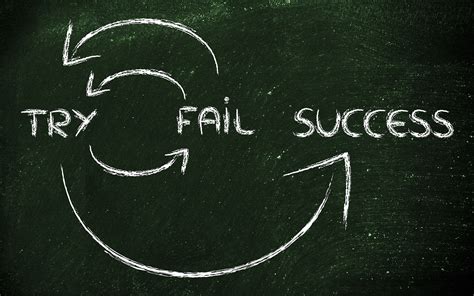
Failure is the Route to Success

“Victory has a hundred fathers and defeat is an orphan.” ― John F. Kennedy

If we could get our managers to talk about failure, it would be a breakthrough. I’ll not hold my breath on this happening. Managers are much better at pretending everything is great. They like to believe that success can happen without difficulty. Yet difficulties and failures are usually essential to any story of success. These failures are actually the interesting part of the story too. The result is a far more boring version of what we do.

Failure is essential to learning. Research is learning. So the obvious conclusion is that if we want to have research success and learn more, we need to fail. Part of embracing failure is pushing the boundaries of what you know, or what you can do. The key is to learn from those failures. The key is to use failure to build yourself. I can provide a few lessons from my own life as object lessons in failure.

“In any case you mustn’t confuse a single failure with a final defeat.” ― F. Scott Fitzgerald, Tender Is the Night

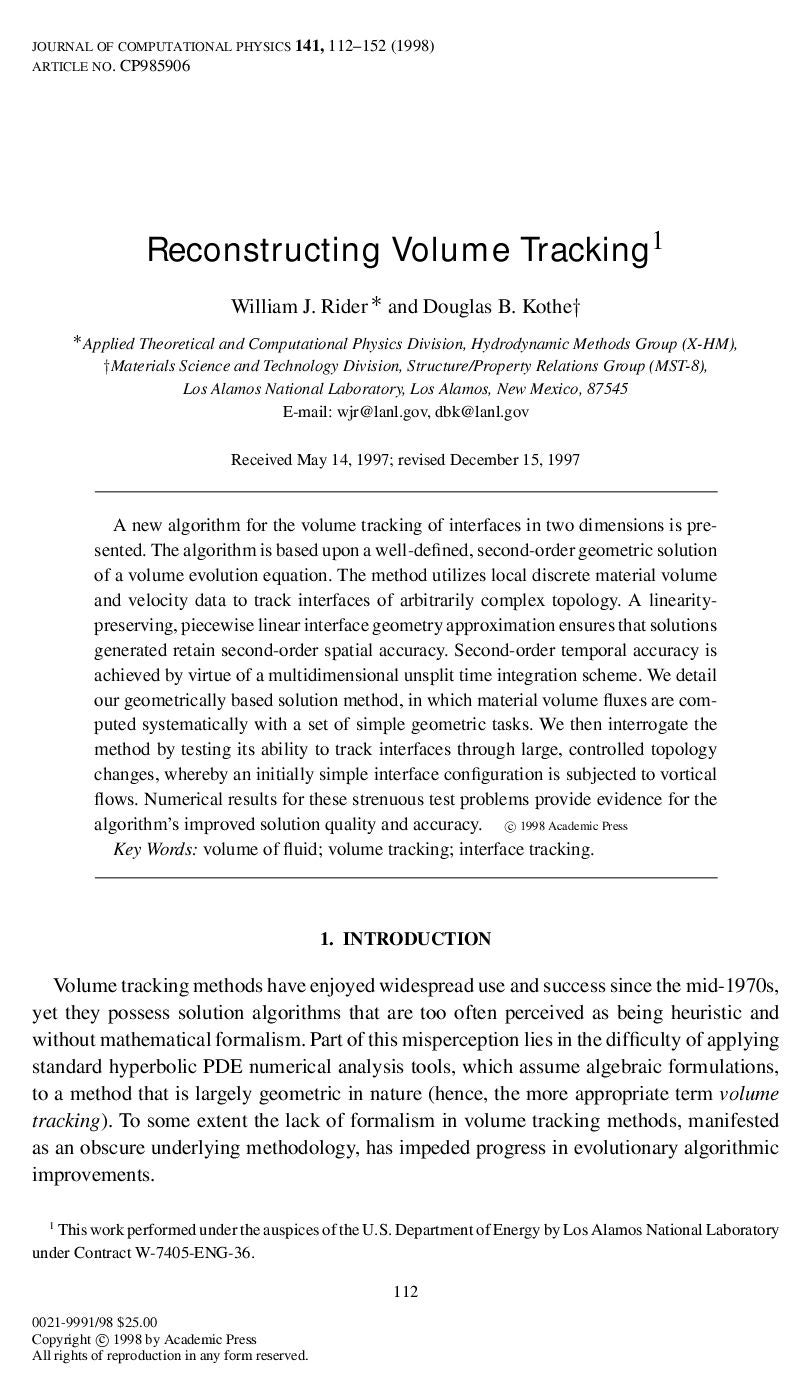
I’ve written several times about the failure at the heart of one of my greater achievements professionally. My most cited paper is on a numerical method called volume tracking. At the weapons labs, this is a very important method. In the 1980’s David Youngs from AWE introduced a new way to do this that was quickly adopted in the USA too. In the early 1990’s I became interested in this method at Los Alamos. It was essential to how our weapon’s codes simulated multiple material hydrodynamics. This was the thing I wanted to do and become an expert at. I’d already contacted Doug Kothe in the Theoretical Division and started building a collaboration. The way I approached learning about it was the tried and true method of first reproducing the state of the art. Once you can reproduce the state of the art, you then try to advance it. This is the way expertise is gained. You are not an expert by knowing the state of the art; you are an expert when you can advance it.

I had seen how Youngs’ method was coded up at Los Alamos, and I worked to independently implement it myself. I did this successfully and set about testing the method using verification problems. These included some new problems I had adapted to testing volume tracking more strenuously (my first advance of the state of the art). Everything was working as desired. Then I tried to improve the method and everything went awry. Suddenly my attempt was a failure! I could never debug it properly. The way the method was written at Los Alamos had too much cyclomatic complexity (which is logical intensity). I needed to go back to the drawing board. I went back to the origins of the method and decided to try something new. I would compose the method through computational geometry operations. Suddenly the implementation was tractable and successfully debugged. We published the method along with our new tests. This paper now has more than 2000 citations. Even better the actual code I wrote is still being used by Los Alamos in one of its mainstream codes.

All of this success is founded on a failure. Without the failure, the success would have been less.
“Better a cruel truth than a comfortable delusion.” ― Edward Abbey

In a greater sense, the greatest successes of my life are all founded on huge failures. Each of these failures was heavy and inescapable. Each pushed me back to the drawing board to reimplement part of my life. Each time I needed to rethink something essential to how I lived. My life today is almost entirely shaped by these three episodes. Without the failures, I would be someone different, far less successful, or happy.

I’ve talked about the end of my first year of grad school. I dropped a class and did poorly in another during the Spring Semester. Each class was essential to how I wanted my future to play out. Together these failures showed me that my dreams were dying. If I didn’t change I wouldn’t accomplish my goals. I had to completely rethink my approach to school. The way I had succeeded as an undergrad or high school student did not work. I needed to be mre serious and put much more effort into my studies. I made a huge investment in time and effort to become a different student. I changed how I approached learning and acting in a school setting. I became completely different in academics. This change laid the groundwork for success at Los Alamos too.

“Everything tells me that I am about to make a wrong decision, but making mistakes is just part of life. What does the world want of me? Does it want me to take no risks, to go back to where I came from because I didn’t have the courage to say “yes” to life?” ― Paulo Coelho

Later on in my time at Los Alamos, I had a string of panic attacks. My work-life balance was completely out of whack. I was working way too hard and sacrificing too much as a husband and parent. I needed to rebalance my life. The way I approached my early career was no longer working for the full breadth of my life. In that decision, I gave up on my imposter syndrome and accepted my success. I walked away as a better husband, better father, and a confident (perhaps even imposing) scientist. I changed myself from the man who had nearly fallen apart. A truism learned through the pain of this failure is that it is the source of wisdom.

Later on, as I approached midlife, I found that I was not happy hiding myself at work. The result was tattoos and a more open self away from work. I also found that my marriage was not monogamous. In the wake of that I discovered my natural tendency toward open love and non-monogamy. In the failure of my traditional monogamous marriage, a new relationship was born. I became a new version of myself with a new marriage. I’ve often said that I have had three different marriages to the same woman. Each rebirth had us growing together instead of apart. Every time I failed, I stepped up to rebuild my life from the ground up. I needed to change and all my success is found by learning from those failures. Everything I value today comes from the fountain of growth that are failures.

“Confusing monogamy with morality has done more to destroy the conscience of the human race than any other error.” ― George Bernard Shaw

Barriers to Progress

The verification and validation (V&V) program offers a unique window into attitudes toward failure. If functioning properly V&V would find failures all the time. In fact, it does, but usually, the response is to paper over or cover up the failure. Rarely, if ever, does the failure result in an appropriate action to fix the underlying problem. There seems to be an attitude that everything should be working now. We should just be able to model and simulate everything perfectly. An honest assessment of validation would tell us that our models are deeply imperfect. We resort to calibration of virtually every serious model. Yet we sell it as the epitome of success. Instead, it is a failure we haven’t learned from.

“The only way to find true happiness is to risk being completely cut open.” ― Chuck Palahniuk
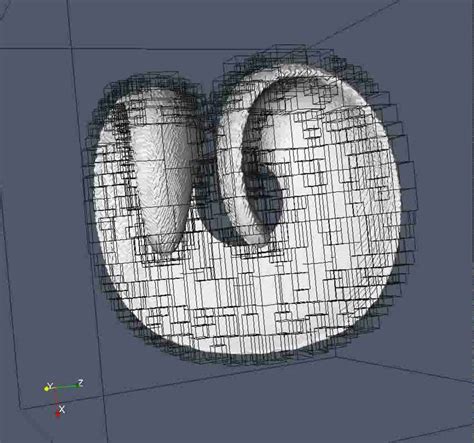
With the practice of verification, this tendency is even worse. Part of it is how verification is packaged. Code verification is about finding bugs. A code bug is just wrong and simple to fix. Solution verification is just an exercise in numerical error and after the exascale program that should be a thing of the past too. Both of these viewpoints are utterly wrong-headed. Verification can find fundamental issues with a code. These are places where the code simply does not work at all. Our shock codes offer a perfect example of this, yet our managers ignore these problems. They make excuses to justify their inattention to serious issues. This is the wrong sort of failure and they desire to not even admit it. Numerical errors still vex our calculations even with our limitless computing power (especially compared to 30 years ago). Instead, we embrace the view of success and push failure away.

Almost nothing we do spells out our unhealthy view of failure like V&V does. It holds a mirror up to our capabilities and often shows our faults. Most of the time is a response that screams “our shit doesn’t stink!” After ignoring the evidence you are not better, and your shit still stinks.

“The purpose of life is to be defeated by greater and greater things.” ― Rainer Maria Rilke

It might be very good to look in the mirror. Are you an “A” student always chasing the top grade in a class? This might describe a lot of you, and it might be the thing holding you back. If you end up afraid to fail, your growth will end. All you’ll be good at is what others created. You will never create anything of your own. Creation is an act of destruction too. You are destroying barriers and creating new paths where none existed before. Sometimes the limits you learned of need to be unlearned. This is the art of failure in the right way. Too many great students cannot throw off the limits of being right and let themselves be wrong. Only through being wrong can a new path be crafted leading to genuine innovation.
Our expectations of ourselves are often our worst enemy. Sometimes we avoid failure because of shame. We see failure reflecting on our qualities. The right way to see failure is feedback. We are being offered a chance to learn about what is needed for success. The variable is the extent of our grasp for success. This is a key point: if you never fail, you aren’t trying. You very clearly are not performing anywhere close to your potential. Lack of failure is actually a red flag. The only way to grow and learn is to fail. Having a distinct fear of failure is a fear of growth and change. Failure is about defining your limits and working past them.

“Life is to be lived, not controlled; and humanity is won by continuing to play in face of certain defeat.” ― Ralph Ellison, Invisible Man

A great way of seeing this is through the concept of flow. Flow is where you become fully enveloped in a task with time melting away. One of the most common ways to experience flow is play. If you are playing and fully enjoying yourself with a pure focus, you are in the flow. The key to being in flow is a degree of challenge that requires you to be fully engaged. Challenge means failure is always a possibility. Success is important too. Flow comes from being close to the edge of your competence. Results are a mix of success and failure. You have mostly success keeping you encouraged, but enough failure to grow, learn, and require full attention. A great question is what gets you to flow? Does work ever put you in this state? If not, how can it?

What gets me into a state of flow? At work, I get into the analysis of numerical methods either deriving them or finding their stability or accuracy. My tool of choice is Mathematica. I used to get into flow while running especially in Los Alamos as my mind would wander and free associate. Running is one of the things I really miss about getting older. I also got into flow while refereeing soccer. I had limits to my competence as a ref, and it always pulled me into full attention. Really great sex can produce a flow state too. Part of this admission is the connection of sex to play along with the possibility of failure. A flow state is one of the greatest feelings in life.

What really stands in the way of success. Fear! So many of us are afraid of failing because somehow it will reflect on our worth. There is a sense of shame that powers a lot of this fear. This is hopelessly a misguided principle to adopt. Sacrificing greater success to avoid the fear of failing is worse than cowardice. It is a denial of the potential for growth and the expansion of knowledge. Life is about learning, growing and changing. As always this is a voyage into the unknown, and unknown is where fear lives. Only through the encouragement and trust of our fellow travelers can this voyage be safely taken. Unfortunately in recent times the fear of failure is real. It is real because those in positions of power will attack it as if it was a personal failing. This is simply abuse of power in the worst sense. It is outright incompetence and an invitation to mediocrity. My greatest fear is that we’ve already embraced mediocrity fully and our failure is complete.

“Forget safety. Live where you fear to live. Destroy your reputation. Be notorious.” ― Rumi

Take the Leap

“You cannot swim for new horizons until you have courage to lose sight of the shore.” ― William Faulkner

Honestly when I think of today’s labs, I rarely think of failure. We have a bunch of employees who may have never failed, or at least admitted to it. If they did fail they might try to hide it from view. We need some fucking leadership with balls to break the mold. Let’s talk about how to fuck up well. The way to really kick ass is to fuck up, admit it, learn a thing or two, and try again, try better. Take a chance and risk it all for a bigger reward. What I see instead is extremely competent mediocrity. Taking a risk recognizes the virtuous cycle of failing, with learning and growing from the experience. The need to get out of our collective comfort zones and push the boundaries. We need to trust ourselves and each other and embrace failure.

Failure is good.

Failure is necessary.

Failure should be sought.

Only fear the failure that you don’t learn from.

I’ve been writing about this for years with themes on failure, risk and trust part of this witch’s brew of dysfunction. The problems I discuss here have been on my mind for years.

https://williamjrider.wordpress.com/2016/05/27/failure-is-not-a-bad-thing/
https://williamjrider.wordpress.com/2015/10/23/we-want-no-risk-and-complete-safety-we-get-mediocrity-and-decline/
https://williamjrider.wordpress.com/2014/12/05/is-risk-aversion-killing-innovation/
https://williamjrider.wordpress.com/2013/11/27/trust/

My post for Sandia National Labs’ ND Blog

Failing as a Path to Success

November 4, 2024 | Published by ndcomms admin

by Bill Rider

“I’ve missed more than 9,000 shots in my career. I’ve lost almost 300 games. 26 times, I’ve been trusted to take the game winning shot and missed. I’ve failed over and over and over again in my life. And that is why I succeed.” – Michael Jordan, American businessman and former basketball player. Widely considered one of the best basketball players of all time

If you know anything about basketball, you know that Michael Jordan (MJ) is the Greatest Of All Time (GOAT). Even after the storied careers of LeBron James and Kobe Bryant, MJ still holds that title. His highlight reels are jaw-dropping even now, twenty years after he last played. Jordan knows a thing or two about success and greatness: he won six NBA championships and an Olympic gold medal. And one thing that MJ understands better than anyone is that all success is built on failure. He is the epitome of Nike’s slogan, “Just Do It.”

The foundation of excellence and success is failure

MJ was a master of being in the zone and teams were constantly struggling to pause his pace of play. Maybe you, too, have been doing something and suddenly realized hours have melted away. If so, you’ve experienced something called “being in a state of flow.” I experienced flow when I started writing this first draft: the words just effortlessly appeared on the page. This “flow” concept was discovered by psychologist Mihaly Csikszentmihalyi, who found that to achieve this state, one must be challenged by the task. He stated that one should be failing at a task between 20-30 percent of the time. Fail too much, and you’ll be discouraged; fail too infrequently, and you’ll be bored. One needs a delicate balance between those extremes. People who achieve excellence in all forms of endeavor experience flow in the process. The lesson is that failure is necessary to achieve optimal performance. 

Failure’s role in success

Speaking of optimal performance, I’m sure we can all be proud of the United States’ moon landing in 1969. But did you know this massive success was built on numerous spectacular failures? Early on, the American rocket program experienced repeated launch pad explosions and other mishaps. During the height of the Cold War, the United States was in a neck-and-neck battle for scientific superiority with the Soviet Union, and they already beat us into space with Sputnik 1 and sending the first human into orbit around the Earth. Yet we persisted. Even with further setbacks, such as the disastrous Apollo 1 fire that tragically killed three astronauts, we persevered and became the first to put man on the moon. This event stands as a pinnacle of American achievement.

Our nuclear weapons program is also filled with stories of failure paving the way to success. In 1944, the Manhattan Project was in the midst of developing the first atomic bomb, and Sandia was just a division of Los Alamos National Laboratory (LANL). Part of the Manhattan Project involved having two physicists (Hans Bethe and Richard Feynman, both of whom later won Nobel Prizes in Physics in consecutive years in the 1960s) simulate an implosion on a computer using two separate algorithms: one developed by physicist Tony Skryme and the other by another brilliant mind of the 20th century, John von Neumann. Notably, Bethe and Feynman had spectacular failures in their attempts when using Von Neumann’s algorithm. They did have success in the spring of 1944 when using a completely different method developed by Skryme.

However, the algorithm developed by von Neumann was considered more critical to advancing nuclear weapons. So, after WWII, failure did not deter LANL from pursuing improvements to von Neumann’s method. Another enterprising genius, Richard Richtmyer, found a way to make von Neumann’s method work, and this has since become the absolute workhorse of nuclear weapons design. In fact, the failure of the original method and the ability to learn from it paved the way for a technique still in use today. This method has been used to design the entire stockpile, save for those first couple of designs. (See: Morgan, Nathaniel R., and Billy J. Archer. “On the origins of Lagrangian hydrodynamic methods.” Nuclear Technology 207, no. sup1 (2021): S147-S175.)

Failure as a vehicle for greater discovery and success

In the mid 1990s when I was working at LANL, I wrote a paper with colleague Doug Kothe (our current Division 1000 Associate Laboratories Director), and this paper has now been cited over 2,000 times (See: Reconstructing Volume Tracking). The computer code we described is still being used in one of the main stockpile analysis codes at LANL. This is a story of success, but it didn’t start that way; it was failure that laid the foundation.

One of the key methodologies in weapons’ codes at LANL is interface tracking, and a specific method used in many of these codes was developed by British scientist David Youngs, MBE. I knew mastering this code was important to the Lab’s mission, so I set about to implement the code from scratch and then improve it. To my delight, I succeeded and then went about creating necessary improvements. At this point, unfortunately, everything fell apart. My implementation was too complex and ultimately proved impossible to debug.

I went back to the drawing board. First, I needed to learn a totally new field of computational geometry. Next, I devised a way to implement the method that was simple and easy to debug. Now I could improve the method without issues, and all because I had gone through an earlier disaster. Without my failure, the creation of something better would never have happened. Looking at these codes today, one can see they are implemented as I discovered them. I crucially changed a fundamental method and contributed to an important methodology for simulating our stockpile, and all of this success was based on a failure.

Failure as a goal

I leave you with some words of wisdom: embrace your failures. Sandians aren’t going to fill out our annual goals with all the failures we hope to make this year, but maybe we should! Ironically, we might succeed more and more grandly if we failed more and more consistently. This is only true if we fail the right way – if we learn from our failures and use them to fuel something greater. Failure is the lifeblood of all success. We should embrace it.

“I know fear is an obstacle for some people, but it’s an illusion to me. Failure always made me try harder next time.” 

Michael Jordan, GOAT

Nuance is the Way Forward

15 Sunday Dec 2024

Posted by Bill Rider in Uncategorized

≈ Leave a comment

Tags

donald-trump, innovation, leadership, news, politics

tl;dr

In debates around almost anything today, extremes rule. When extreme views are taken it always favors the conservative/status quo side. The progressive’s more extreme views are a loser. To provide progressive views that will win the day, nuance and subtlety need to be embraced. This means letting go of dogmatic ideology and making compromises. Simple extreme views are rarely fit for progress only playing into the conservative’s hands. Reasonable and moderate positions can offer progress in a manner that more people are comfortable with. This is the path to genuine progress.

“Tyranny is the deliberate removal of nuance” ― Albert Maysles

The extremes are ruining today

We are witnessing the broad consequences of extremes ruling the political dynamic. The conversations nationally are dominated by extreme views on the left and the right. One of the prevailing issues is that conservative extremes are more acceptable to broad swaths of the population. Why? Conservative ideas are familiar while progressive ideas are not. Thus progressive ideas carry a burden conservative ideas are free of. This is especially true of cultural topics but carries over to economics and foreign affairs. I’ve also seen this apply in the scientific and technical realms.

In my professional life I work with computer codes that simulate things in the national security world. I am paid to work on things that are very energetic and either lead to or cause explosions. These problems are extremely challenging and always push the limits of technology. Nonetheless, these problems have been successfully solved. Moreover, the codes solving them have been around for decades. At Los Alamos, the first calculations started during the Manhattan Project. At Sandia, the calculations began in the late 1960’s. As such in either place there is a successful status quo. At every juncture, smart people got the job done and successfully simulated stuff. This utility preserved the continued use of simulation and its support institutionally.

“Simplicity is the ultimate sophistication.” ― Clare Boothe Luce

The rub is that the first way to do things is crude and clumsy. This produces a status quo that many practical people hold onto. Once simulation became commonplace and powerful, the way it is done became entrenched. The users of the results started to become invested in maintaining the status quo. They would resist changes to how things were done. This produced what was called legacy codes. Through huge efforts, the legacy codes were replaced with modern codes on modern computers. Now the replacement codes are the status quo. Improving or changing them is resisted as were the original legacy codes.

The same thing happens in politics and culture. Change requires massive effort, and once the change sets in, resistance builds as it becomes the status quo. The way to see the 2024 election is through the lens of resistance to change. Conservative politics is driven by resistance and reaction to change. They are the counter to progress and the discomfort with it. The same thing happens in science and technology. The key is that the status quo always has the advantage of simplicity. Change is always really hard and resisted by those who believe things are good enough..

“Our lives begin to end the day we become silent about things that matter.” ― Martin Luther King Jr.

We need real answers

In science, we have Occam’s razor where the simplest solution is favored. Invariably, the existing practice or solution is seen as simple. It exists and works for all, but the most keen observers. This is true for public policy or science. In my life, we see this with computer codes and simulation. The status quo says “The current stuff is getting the job done, why change? plus it’s expensive and difficult, it could fail too.” All of this forms the natural resistance to change. It’s easier to simply stick with the status quo. I’ve seen this time and time again at work. Right now, the status quo is winning. Like our political world, science where I am is conservative and progress is resisted.

“It pays to be obvious, especially if you have a reputation for subtlety.” ― Isaac Asimov, Foundation

With little modification, this dynamic applies to politics. The basic principles I’ve seen at work apply broadly to policy. Take economic policy where unbridled capitalism is status quo. The issues it causes are profound, but change is scary. Plus capitalism has immense power available to maintain itself through propaganda. In cultural affairs, traditional relationships are the most common and have the advantage. The simple message of two biological sexes or a simple monogamous marriage of a man and woman is seen as settled. Any change feels uncomfortable for a majority of people and even downright scary. All of this powers the conservatives to use this fear to their advantage.

“If you can’t explain it to a six year old, you don’t understand it yourself.” ― Albert Einstein

When doing scientific work, the arguments for changing status quo practices are deep and nuanced. The status quo already works and always has the advantage. Any progress is difficult and has an uphill battle. In science, we have the scientific method to level the playing field. Even then the status quo has an advantage over better solutions. The spirit of science is very much focused on progress. In engineering the balance is far more tilted toward conservatism.

Sometimes the advantage of progress needs to be so strong that the improvement is obvious. Progress happens only when it is demonstrated. This looks like a revolution, but really it is a long process where someone takes a chance and shows the status quo what it is missing. This process is behind the time lag between discovery and broad acceptance of new ideas. There is a large bit of chance to this. This is also incredibly frustrating to us scientific progressives.

To look at this in public policy there are many examples. No single example may be more instructive than marriage equality. In a very short time, the idea of gay people marrying moved from unthinkable to broad acceptance. How did this happen?

“It was a defeat, resorting to crude threats in a game of subtlety, but sometimes one must sacrifice a battle to win the war.” ― Mark Lawrence, Prince of Thorns

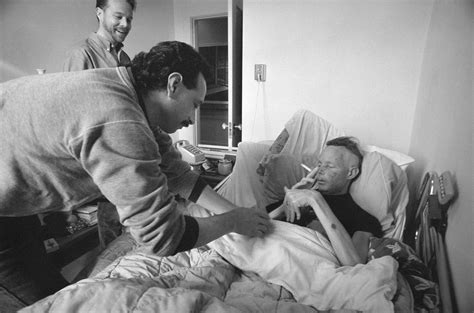
I think the reasons for success go back to tragedy. The plague of AIDS struck the gay community hard ravaging and killing broadly. On the one hand, it galvanized the gay community toward action. Their activism fell short of moving the public until the illness began to appear in the broader public. Ryan White was a child who got AIDS through the blood supply. Suddenly AIDS was more than just a gay disease. The tide turned with treatments and medicine coming eventually to subdue the disease.

The activism left a deeper mark on society. The gay community was drawn together and part of their activism was “coming out”. All of a sudden many gay people were known to broad swaths of society. They were present as coworkers, neighbors, and friends. Someone being gay suddenly became normal and commonplace. This created the necessary empathy and compassion to make marriage equality sensible. It went from unthinkable to the law of the land in a flash.

“When you dig just the tiniest bit beneath the surface, everyone’s love life is original and interesting and nuanced and defies any easy definition.” ― Taylor Jenkins Reid, The Seven Husbands of Evelyn Hugo

In my opinion, this should be the model for the progressives. The way marriage equality went from unthinkable to acceptable should be studied and deconstructed. Progressives need to apply these lessons to their causes. This requires a level of nuance and subtle action rather than what is seen as extreme and fear-causing. Simplicity always favors the status quo. Progressives, however right they are about a subject should avoid simplicity and embrace nuance.

“Everyone thinks of changing the world, but no one thinks of changing himself.” ― Leo Tolstoy

A Requiem for a Career (Part 3)

03 Tuesday Dec 2024

Posted by Bill Rider in Uncategorized

≈ Leave a comment

tl;dr

I’m getting close to the decision to retire. I’m looking back at my career, trying to put things in perspective. By most accounts, it has been a great career, but it is also short of what it could have been. I have some genuine disappointments. I’ve seen a lot and accomplished some great things. In this Requiem, I’ve talked about my young life. I expanded and looked back at the heart of my professional career in Los Alamos, the apex of my career. Those years made me who I am as a scientist.

Now I am at the closing chapter of my career, the time I have spent at Sandia National Labs. It is too close to have a full perspective, and I cannot offer full disclosure either. I can offer a deep sense of disappointment and sadness about how it has worked out. It has not been a place to fulfill my potential, and, in retrospect, never could have. I made my choices and the results are a wonderful full life, but a loss of professional success in trade.

A Change is Needed

“Things change. And friends leave. Life doesn’t stop for anybody.”― Stephen Chbosky, The Perks of Being a Wallflower

It was October 2006, and I was convinced that things were not going to get better at Los Alamos. The new management team was awful. The new corporate partners were corrupting the essence of the Lab. My oldest child was in middle school, and I was concerned he wouldn’t do well as a teen in Los Alamos. The small-town nature of Los Alamos was starting to get under our skin too. You often would know people three or four or five ways. Work lives and personal lives were not separate, they were completely intertwined. Los Alamos was closing in on us and we needed space.

During that October, I went to a biannual conference put on by the nuclear weapons community focused on computational modeling. This time it was held in Los Alamos. The nuclear weapons world of the USA and the UK joined to talk about computers, modeling, and computational physics. It is totally my jam. Sandia National Labs sent a contingent, including my friend Tim Trucano. I approached him and a Sandia manager there (Randy Summers) with the potential of moving. They were very excited, and before long, I had an interview and shortly thereafter a job offer.

I left Los Alamos Lab on February 16, 2007, and began at Sandia the following Monday. It was MLK day, which Sandia unwisely doesn’t take as a holiday, but Los Alamos does. Maybe this little detail was a sign, and in retrospect, one I should have heeded. I was going to work in Computer Research Institute (“1400” in Sandia’s annoying schema for organizational names… no names, just numbers). My job was to work on a code development team for the MHD code “Alegra”. Alegra is a magneto-hydrodynamic code developed originally under the ASCI program. Another harbinger of issues was its lack of support from ASCI (not ASC, because a permanent program can be an initiative for so long). Alegra was then mostly supported by the US Army for analyzing things like advanced armor concepts. The reality was that I was wildly overqualified for the job. The funding and the code were horrendously constrained, and the code base was around 15 years old and all in C++.

It was a good team with good people. I let myself focus on that and approached the job with optimism and an open mind. Again, with the benefit of time, this was a naive approach. I should have been far more guarded. A big piece of this statement is that the forces that fucked up Los Alamos were present at Sandia. Sandia had always been a little corporate-managed originally by Bell Labs. In 1994 the management changed to Lockheed-Martin. The low-trust corporate management approach was firmly entrenched at Sandia.

The decline in the quality of work, science, and culture at Los Alamos was actually a national problem. Sandia was also in decline. Los Alamos took the blow of being corporately managed; Sandia was already a corporation. The management was terrible for science, but great at giving the government what it asked for. The National Labs were being pulled down by the same forces making the United States awful. The same forces we’ve seen unleashed over the past 10 years with toxic political effects. There is no escaping the decline we found ourselves in. Professionally, I should have been more pragmatic and less hopeful with my new circumstances.

A few things stand out about that time. My move got swallowed by the housing crisis of 2007 and we lost our shirt in real estate selling in Los Alamos. If we’d been three months earlier, we would have escaped, and been about $100,000 better off.

The director of our Center at Sandia also moved from Los Alamos almost at the same time as me. James Peery had started at Sandia then moved to Los Alamos for a time to run the ASC program. He was also on a corporate bid team to manage Los Alamos that did not get the job. He moved to a job managing the Center where he had started at Sandia. Unlike me, Sandia was perfectly suited for him. James is now the Laboratory Director at Sandia, retiring soon.

A few things were evident upon my arrival. A lot of administrative details were immensely better at Sandia. For example, one of the worst things about Los Alamos was travel reimbursement. At Sandia, this process was fast and seamless. The timecard application was great, too. It would have been great, except Sandia is a complete asshole to employees about some auxiliary regulations around the travel credit card. Sandians are obsessive followers of rules and regulations. It is an engineering lab and small “c” conservative organization from top to bottom.

Another difficult thing is Sandia’s devotion to information control and the practice of “need-to-know”. This is baked into their culture. Stepping back from this, one can see that Sandia was corporate in every way, and did mundane bullshit far better than Los Alamos. Thus, in every way that does not matter to National Security Science, it was an improvement. The engineering at Sandia is repressively backward and grounded in the past. Science at Sandia is peripheral and always counterculture. I have learned that culture is almost immutable, and Sandia’s culture does not fit me at all.

My take on Sandia is going to be quite harsh, so I’ll disarm this assessment a bit. On a broader scale, Sandia is a great employer. Most people would be lucky to work there. The reasons for this are twofold: First, most employers in the USA are terrible to employees, and I had been gifted an incredible experience at Los Alamos to start my career. The current Los Alamos and Sandia never stood a chance at living up to that start of my career. Secondly, the Labs have declined greatly largely due to the forces that are sieging America at large. These forces are bipartisan. Distrust and bullshit are coming from both the left and the right. Therefore, a significant drop in workplace satisfaction occurred when I left Los Alamos. Another drop would await me at Sandia. The thing that meant the most about Los Alamos was the culture. I fit into Los Alamos culture, and Sandia’s culture is unnatural for me.

Another red flag with my hire at Sandia was my ranking as a staff member. There were limits in the level I could be hired. These limits existed because they’d been abused in the past with a political hire. I would have to wait a few years to be promoted. Still, there are shades of lack of recognition professionally by Sandia. This theme is still rife today. Back in 2007, I was approaching the job with possibility and generosity. That spirit was not returned by Sandia. Sandia’s ethos was far different from Los Alamos. This was a foreign culture and not one that I was suited for.

A couple years ago, I had an epiphany about this contrast. I was at a conference. There was a contingent of Los Alamos staff there along with my coworkers at Sandia. During the meeting, I noticed that my behavior around the Los Alamos people was completely different than the Sandia ones. The people from Los Alamos were not old friends or people I knew well. In reality, I knew the Sandians better. I realized that I was “code-switching.” It made me realize that the culture and environment at Sandia were oppressive to me. The self I was with Los Alamos staff was far closer to the real me. With Sandia’s staff, I buried and censored myself. This was an absolutely jarring realization. The conclusion was that at Sandia, I could not be myself, either personally or professionally.

So as 2007 sped along, I worked to fit in and do my work. I wanted to make this succeed and I gave Sandia a lot of space. I gave it a lot more space and the benefit of the doubt than it deserved.

On the Alegra team, we did some good work despite all of this. We did run into a crisis early in my Sandia career. The ASC funding was being dropped even further, and the Army sponsorship was at risk. We needed to produce a code that was more robust and handled difficult situations better. The gauntlet was thrown down: either we improve, or Army funding would shrink until it was gone. The project would die. I immediately set about to devise a strategy to solve the problem. It was all hands on deck. No solution was off the table. In the end, we fixed the code with success that exceeded our wildest expectations. This effort remains today as the highlight of my time at Sandia. This was as good as Sandia would ever get for me. It was some really great work.

When I compare this with what I did at Los Alamos, this makes that highlight almost seem tragic. It barely held a candle to what I achieved in Los Alamos.

“Here’s to the crazy ones. The misfits. The rebels. The troublemakers. The round pegs in the square holes. The ones who see things differently. They’re not fond of rules. And they have no respect for the status quo. You can quote them, disagree with them, glorify or vilify them. About the only thing you can’t do is ignore them. Because they change things. They push the human race forward. And while some may see them as the crazy ones, we see genius. Because the people who are crazy enough to think they can change the world, are the ones who do.” ― Steve Jobs

This quote is from an Apple marketing pitch. It describes the best of Los Alamos and captures the ideals of that Lab. If I took the quote and wrote the exact opposite, it would capture the worst of Sandia (albeit slightly unfairly).

This is Not the Right Place for Me

“An eye for an eye, and the whole world would be blind.” ― Kahlil Gibran

Recently, the focus of how much tragedy has become evident. In many respects, what stands out at Sandia is a lack of respect and use of expertise. Throughout my career, I have developed extensive expertise and Sandia simply ignores it. That expertise is one of the most important parts of Stockpile Stewardship. I have a unique knowledge of modeling and simulation—specifically the codes, methods and models used to do it. Part of this can easily be seen in how retirees are treated by the Labs. At Sandia, the prevailing attitude is “Don’t let the door hit you on the way out.” This contrasts with Los Alamos, where retirees and their knowledge are welcome and ever-present. Right now, it is these aspects that exemplify how I see Sandia. The core of my professional identity and accomplishments are not valuable to the institution. I do not feel welcome or even useful when it is obvious I should be.

There is so much more that feels bad. I put a great deal of goodwill into my first few years at Sandia. My inability to bring my real self to work began to get under my skin. (Actually, it influenced what I got on my skin too; more on that later.) The underlying Sandia culture is buttoned up and uptight as hell. It is not a place where free thought and debate happen. Even worse, it is a place that does not feel accepting of differences. While I am a middle-aged cis-gendered white man, I am not typical in many ways. None of those differences feel accepted openly. The workplace feels confined and truly limited in acceptance. I can’t bring either my personal or professional self to work. I am careful to see this feeling as a balance of intrinsic cultural differences from the shitshow of today’s America. I am sure it is a mix of innate culture and current trends.

One of the hardest aspects of working at Sandia was determining a professional development path. Why work hard at developing myself when Sandia already could not use my skills? When I walked in the door in 2007, my skills already exceeded what Sandia could use. In retrospect, I could have worked harder and hid myself at work. It would have been valuable at the office, but harmful to my being. Thus, a plan was hatched to work on my writing with focus.

This was the genesis of my blog. I would write regularly and publish the writing to be seen by others. Writing to be read by others is essential. In retrospect, the blog was one of the best things I did while at Sandia. It also made me a better scientist. Writing is thinking deeply. I would write about presentations I would give, and I approached those talks having thought deeply about the topics. In the end, thinking deeply was viewed as counter-productive unless those thoughts aligned with Sandia’s views.

Unfortunately, the blog ended up being the worst thing that happened to me at Sandia, too. The way I stopped writing exemplified the worst of the Lab but aligned perfectly with its culture. In a way, I should have seen this outcome coming at me clearly. Instead, I was optimistic and trusting. That trust was never returned. I hate saying this, but events clearly point to the worst possible reading of how the blog ended.

This Will Not End Well

In 2013, I turned 50 and started to exhibit many signs of the canonical midlife crisis. Today I see it differently, but one of the signs of the crisis was getting my first tattoo in October. Since then, I’ve gotten 25 more. They fall into some general themes: my science, primal imagery, and philosophical expressions of love and freedom. I’ve come to realize that the tattoos were a personal expression in the environment that limited it. The tattoos were also very essentially modern and fit to Albuquerque culture. The irony is that Sandia culture is orthogonal to Albuquerque culture. I was not going to be stuck into the Sandia straightjacket. I wanted to express myself freely and fully. By putting the expression on my body, I would not be silenced. I don’t think it was a conscious thought, but rather a reaction to the day job with my real self. As the past decade has unfolded, my true self and my work self have diverged rather precipitously. The subtle differences I expressed moved toward a primal scream.

I wrote this blog consistently from 2014-2018. I stopped writing it because I was given no choice in 2018. In a culturally consistent passive-aggressive manner, I was forced to stop. The form of this force was a Sandia ethics investigation. It came from an anonymous source (although I am relatively certain of the identity of the source). The investigation and charges were absurd. The entire blog was done in plain view and as a part of my professional development plan. It was done with permission. I would give the link to my blog at the end of my professional talks. The blog was good for my professional skills and performance. It was only bad for professional success where blind obedience to power is demanded. In a healthy culture, it would have been celebrated. In an unhealthy culture, the blog was a threat.

The problem was that I expressed views that were not the same as my management. I was part of a rather ill-conceived national program that was contributing to the decline in American scientific supremacy. I said as much in the blog. Worse yet, I had an audience of peers, thus I was dangerous. I could be shut up through force—and I was. This program was big money, and in today’s world is all about money. Money is power and truth is determined by power. Opposing the monied interests is dangerous.

I stood down so I could continue to support my family and my life. Intellectual honesty and debate about what are best are not on the menu today. The people in charge of the Labs and our science funding are not open to questioning their priorities. This lack of debate is part of what is fueling the decline of American supremacy in science.

I licked my wounds. The ethics investigation is the worst blight in my entire professional life. It may be the worst thing of my entire adult life, but I’ll admit this means I have a charmed life.

As I attempted to recover, the pandemic arose. The country and the world shut down. We all worked from home for months as most of my work went online. I discovered a massive relief in this arrangement. Even in this lockdown, I felt freedom. I did not have to go to work and put on a disingenuous mask every day. It made me realize how incredibly unhappy Sandia had made me. In the past couple of years, the depth of my dismay professionally has deepened. It has transitioned to a mourning of opportunity lost and disappointment.

“The wound is the place where the Light enters you.”— Jalal ad-Din Muhammad ar-Rumi

Prospectus and Path Ahead

Hindsight is usually a biased way to look at things. The reasons for my move to Sandia and Albuquerque were varied. The professional reasons were naive and quixotic. I approached the new Lab with optimism and hope that was not grounded in actual possibility. I pushed away many obvious signs of disaster for years. I should have been more guarded and far less trusting. That said, I moved for reasons in my personal life. I moved for my family. It was better professionally for my wife and offered better opportunities for my children. We had aging parents to care for.

Each of these concerns played out differently, but all were valid. For my own part, I have changed over these years in many interesting and exciting ways. In sum, I would not trade the benefits and advances in myself and my personal life for professional success. Nonetheless, professional success was sacrificed in the move.

Professionally, Sandia has been just okay. By my own standards, my professional accomplishments have been a severe disappointment. The way my blog was treated figures heavily into my assessment. It was a huge insult and attack on me personally. The lack of professional respect is palpable. The lack of use for my vast professional knowledge and skills is appalling.

This is not to say one cannot be successful at Sandia. It is to say that *I* would never succeed at Sandia. It is not the right place for me to succeed. In the same breath, I can succeed as a person, where I am now. It could also be true that Los Alamos might have been a worse place for that personal success. You really can’t have it all.

Today, I feel like my work has mostly been a waste of my time. It is easy to see how I could have used my skills and knowledge better than they were at Sandia. Perhaps in closing, this is my challenge for the future: to find a valuable path for contribution suitable for my precious time left. I did give Sandia a chance, and that effort was not met nor rewarded in kind.

I have not decided when to retire, or what I will do after retirement. What will happen is taking shape. Felicia is retired and I’m learning from her experience. It is just clear to me that it is around the corner. While my professional life at Sandia was substandard, my life is good. I would not trade the success in my personal life for the sort of professional success I would aspire toward. Perhaps the lesson is a sort of balance to life. Maybe you simply can’t have it all and choices are made. I made mine. I stand by the outcomes.

Finally, I want to give endless love and gratitude to those who have enriched my life and been my friends. I have known many wonderful people who have made my time at work vastly better. Each of them has helped me be a better person and taught me so much. Nothing would have been as good without them. I greatly appreciate Meera Collier for graciously editing my writing, and helping to make it better than I could manage myself.

“Yesterday I was clever, so I wanted to change the world. Today I am wise, so I am changing myself.”— Jalal ad-Din Muhammad ar-Rumi

Important Papers Written While At Sandia

Banks, Jeffrey W., T. Aslam, and William J. Rider. “On sub-linear convergence for linearly degenerate waves in capturing schemes.” Journal of Computational Physics 227, no. 14 (2008): 6985-7002.

Mattsson, Ann E., and William J. Rider. “Artificial viscosity: back to the basics.” International Journal for Numerical Methods in Fluids 77, no. 7 (2015): 400-417.

Rider, W. J., E. Love, M. K. Wong, O. E. Strack, S. V. Petney, and D. A. Labreche. “Adaptive methods for multi‐material ALE hydrodynamics.” International Journal for Numerical Methods in Fluids 65, no. 11‐12 (2011): 1325-1337.

Robinson, Allen, Thomas Brunner, Susan Carroll, Richard Drake, Christopher Garasi, Thomas Gardiner, Thomas Haill et al. “ALEGRA: An arbitrary Lagrangian-Eulerian multimaterial, multiphysics code.” In 46th aiaa aerospace sciences meeting and exhibit, p. 1235. 2008.

Rider, William, Walt Witkowski, James R. Kamm, and Tim Wildey. “Robust verification analysis.” Journal of Computational Physics 307 (2016): 146-163.

Rider, William J. “Reconsidering remap methods.” International Journal for Numerical Methods in Fluids 76, no. 9 (2014): 587-610.

Love, E., William J. Rider, and Guglielmo Scovazzi. “Stability analysis of a predictor/multi-corrector method for staggered-grid Lagrangian shock hydrodynamics.” Journal of Computational Physics 228, no. 20 (2009): 7543-7564.

Hills, Richard Guy, Walter R. Witkowski, Angel Urbina, William J. Rider, and Timothy Guy Trucano. Development of a fourth generation predictive capability maturity model. No. SAND2013-8051. Sandia National Lab.(SNL-NM), Albuquerque, NM (United States), 2013.

Barlow, Andrew J., Pierre-Henri Maire, William J. Rider, Robert N. Rieben, and Mikhail J. Shashkov. “Arbitrary Lagrangian–Eulerian methods for modeling high-speed compressible multimaterial flows.” Journal of Computational Physics 322 (2016): 603-665.

Alexander, Francis, Ann Almgren, John Bell, Amitava Bhattacharjee, Jacqueline Chen, Phil Colella, David Daniel et al. “Exascale applications: skin in the game.” Philosophical Transactions of the Royal Society A 378, no. 2166 (2020): 20190056.

Kamm, James R., Jerry S. Brock, Scott T. Brandon, David L. Cotrell, Bryan Johnson, Patrick Knupp, William J. Rider, Timothy G. Trucano, and V. Gregory Weirs. Enhanced verification test suite for physics simulation codes. No. LA-14379. Los Alamos National Laboratory (LANL), Los Alamos, NM (United States), 2008.

Yanilkin, Yury V., Evgeny A. Goncharov, Vadim Yu Kolobyanin, Vitaly V. Sadchikov, James R. Kamm, Mikhail J. Shashkov, and William J. Rider. “Multi-material pressure relaxation methods for Lagrangian hydrodynamics.” Computers & Fluids83 (2013): 137-143.

Weirs, V. Gregory, James R. Kamm, Laura P. Swiler, Stefano Tarantola, Marco Ratto, Brian M. Adams, William J. Rider, and Michael S. Eldred. “Sensitivity analysis techniques applied to a system of hyperbolic conservation laws.”

Subscribe

  • Entries (RSS)
  • Comments (RSS)

Archives

  • February 2026
  • August 2025
  • July 2025
  • June 2025
  • May 2025
  • April 2025
  • March 2025
  • February 2025
  • January 2025
  • December 2024
  • November 2024
  • October 2024
  • September 2024
  • August 2024
  • July 2024
  • June 2024
  • May 2018
  • April 2018
  • March 2018
  • February 2018
  • January 2018
  • December 2017
  • November 2017
  • October 2017
  • September 2017
  • August 2017
  • July 2017
  • June 2017
  • May 2017
  • April 2017
  • March 2017
  • February 2017
  • January 2017
  • December 2016
  • November 2016
  • October 2016
  • September 2016
  • August 2016
  • July 2016
  • June 2016
  • May 2016
  • April 2016
  • March 2016
  • February 2016
  • January 2016
  • December 2015
  • November 2015
  • October 2015
  • September 2015
  • August 2015
  • July 2015
  • June 2015
  • May 2015
  • April 2015
  • March 2015
  • February 2015
  • January 2015
  • December 2014
  • November 2014
  • October 2014
  • September 2014
  • August 2014
  • July 2014
  • June 2014
  • May 2014
  • April 2014
  • March 2014
  • February 2014
  • January 2014
  • December 2013
  • November 2013
  • October 2013
  • September 2013

Categories

  • Uncategorized

Meta

  • Create account
  • Log in

Blog at WordPress.com.

  • Subscribe Subscribed
    • The Regularized Singularity
    • Join 55 other subscribers
    • Already have a WordPress.com account? Log in now.
    • The Regularized Singularity
    • Subscribe Subscribed
    • Sign up
    • Log in
    • Report this content
    • View site in Reader
    • Manage subscriptions
    • Collapse this bar
 

Loading Comments...