
You are not special. You’re not a beautiful and unique snowflake. You’re the same decaying organic matter as everything else. We’re all part of the same compost heap. We’re all singing, all dancing crap of the world.
– Chuck Palahniuk
This post was inspired by twin events: a comment from a dear friend, and watching the  movie “Fight Club” again. This is my 300th blog post here. Its been an amazing experience thanks for reading.
If you consider the prospect of retirement and you feel that your place of work does not need you and would not suffer from you departure, you aren’t alone. This is an increasing trend for work today. You are an imminently replaceable cog in the machine, which can be interchanged with another person without any loss to the workplace. Your personal imprint on the products of work is not essential and someone else could do exactly what you do. If you work in one of the many service industry jobs, or provide the basic execution of tasks, the work is highly prescribed and you versus someone else doesn’t matter much. If you are reliable, show up and work hard, you are a good worker, but someone else with all the same characteristics is just as good.
What’s measured improves
–Peter F. Drucker
I didn’t used to feel this way, but times have changed. I felt this way when I worked at  McDonalds for my first job. I was a hard worker, and a kick ass grill man, opener, closer, and whatever else I did. I became a manager and ultimately the #2 man at a store. Still I was 100% replaceable and in no way essential, the store worked just fine without me. I was interchangeable with another hard working person. It isn’t really the best feeling; you’d like to be a person whose imprint on the World means something. This is an aspiration worth having, and when your work is truly creative, you add value in a way that no one else can replicate.
When I started working almost 30 years ago at Los Alamos, this dynamic felt a lot different. People mattered a lot, and an individual was important. Every individual was important, unique and worth the effort. As a person you felt the warm embrace  of an incubator for aspiring scientists. You were encouraged to think of the big picture, and the long term while learning and growing. The Lab was a warm and welcoming place where people were generous with knowledge, expertise and time. It was still hard work and incredibly demanding, but all in the spirit of service and work with value. I repaid the generosity through learning and growing as a professional. It was an amazing place to work, an incredible place to be, an environment to be treasured, and made me who I am today.
Never attribute to malevolence what is merely due to incompetence
–Arthur C. Clark
It was also a place that was out of time. It was a relic. The modern World came to Los Alamos and destroyed it, creating a shadow of its former greatness. The sort of values that made it such a National treasure and one of the greatest institutions could not coexist with today’s culture. The individuals so treasured and empowered by th e scientific culture there were relabeled as “butthead cowboys,” troublemakers, and failures. The culture that was generous, long term in thought, viewing the big picture and focused on National service was haphazardly dismantled. Empowerment was ripped away from the scientists and replaced with control. Caution replaced boldness, management removed generosity, all in the name of formality of operations that removes anything unforeseen in outcomes. The modern world wants assured performance. Today Los Alamos is mere shadow of itself, stumbling forward toward the abyss of mediocrity. Witnessing this happen was one of the greatest tragedies of my life.
People who don’t take risks generally make about two big mistakes a year. People who do take risks generally make about two big mistakes a year.
–Peter F. Drucker
Along with assured performance we lose serendipity and discovery. We lose learning and surprises, good and bad. We lose the value in the individual, and the ability to have one person make a positive difference. All of this is to keep one person from making a negative difference or to avoid mistakes and failures. The removal of mistakes and failures removes the engine of learning and real scientific discovery from table as well. Each and every one of these steps is directly related to the fear of the bad things happening. Every good is a flip side of a bad thing, and when you can’t accept the bad, you can’t have the good either. In the process the individual has been removed from  importance. Everything is process today and anything bad can be managed out of existence. No one looks at the downside to this, and the downside is sinister to the quality of the workplace.
Let’s be clear about what I’m talking about. This isn’t about being cavalier and careless. It isn’t an invitation to be dangerous or thoughtless. This is about making a best earnest effort at something, and still failing. This is about doing difficult things that may not succeed, putting your best effort forward even if it falls short. In many ways we have lost the ability to distinguish between the good and bad failure with all failure viewed as bad, and punished. We have made the workplace an obsessively cautious and risk adverse place that lacks the soul it once embraced. We have lost the wonder and power of the supremely talented person in the prime of their creative powers to create game changing things or knowledge.
The core problem is the willingness to deal with the inevitable risks and failures with empowering people. Instead of seeing the risks and failures and a necessary element in enabling success, we have fallen victim to the fiction that we can manage the risk and failure out of existence, all while assuring productivity. This is utterly foolish and antithetical to reality. The risks are necessary to strive to achieve difficult and potentially great things. If one is working at the limit of their capability the result is frequently failure, and the ensemble of failures paves the way for success. It tells us clearly what does not work, and provides the hard lessons that educate us. Somehow we have allowed the delusion that achievement can be had without risk and failure to creep into our collective consciousness.
 Instead of encouraging and empowering our people to take risks while tolerating and learning from failure, we do the opposite. We steer people away from doing risky work, punish failure and discourage lesson learning. It is as if we had suddenly become believers in the “free lunch”. True achievement is extremely difficult, and true achievement is powered by the ability to try to do risky almost impossible things. If failure is not used as an opportunity to learn, people will become disempowered and avoid the risks. This in turn will kill achievement before it can even be thought of. The entire system would seem to be designed to disempower people, and lower their potential for achievement.
The other aspect of this truly viscous cycle is the dismantling of expertise. Expertise is built on the back of years and years of failure. Of course this happens only if the failures are actively engaged as educational opportunities that empower the expert to engage in more thoughtful risks. These thoughtfully engaged in risks still need to fail and perhaps fail most of the time. Gradually the failures of today begin to look like the achievements of yesterday. What we see as a failure today would be a monumental achievement a decade ago. This is completely built on the back of seeing the failures of yesterday in the right light, and learning the lessons available from the experience.
When we empower people to take risks and grow them into experts, they also provide  the knowledge necessary to mentor others. This was a key aspect of my early career experience at Los Alamos. At that time the Lab was teeming with experts who were generous with their time and knowledge. All you had to do was reach out and ask, and people helped you. The experts were eager to share their experience and knowledge with others in a spirit of collective generosity. Today we are managed to completely avoid this with managed time and managed focus. We are trained to not be generous because that generosity would rob our “customers” of our effort and time. The flywheel of the experts of today helping to create the experts of tomorrow is being undone. People are trained to neither ask, nor provide expertise freely.
What we are moving toward is a system that is less than the sum of its parts. What I started with was a system that added great value to every person, and effectively was far greater than the sum of its parts. The generosity that characterized my early career added immense value to every hour spent at work. Today this entire way of working is being torn apart by how we are managed. People can’t be generous if they have to account for all their time and charge it to a specific customer. The room for serendipity, discovery and the addition of personal value to activities is being removed to satisfy bean counters and small-mined people. We have allowed an irrational fear of one misspent dollar to waste billions of dollars and the productive potential of people’s lives. Worse yet, the whole apparatus erected to produce formal operations are ripping the creative force from the workplace and replacing it with soulless conformity. It matters less and less who we are each day; we are simply replaceable parts in a mindless machine.
I might be temped to simply end the discussion here, but this conclusion is rather dismal.  It is where we find ourselves today. We also know that the state of affairs can be significantly better. How can we get there from here? The first step would be some sort of collective decision that the current system isn’t working. From my perspective, the malaise and lack effectiveness of our current system is so pervasive and evident that action to correct it is overdue. On the other hand, the current system serves the purposes of those in control quite well, and they are not predisposed to be agents of change. As such, the impetus for change is almost invariably external. It is usually extremely painful because the status quo does not want to be rooted out unless it is forced to. The circumstances need to demand performance that current system cannot produce, and as systems degrade this becomes ever more likely.
At the time, my life just seemed too complete, and maybe we have to break everything to make something better out of ourselves.
–Chuck Palahniuk
The current system is thoroughly disempowering and oriented toward explicit control of people’s actions. Keeping order and people in line while avoiding risk and failure are the core principles. The key to any change is enabling trust for the individual to move to centrality in the system. The upside to the trust is the degree of efficiency and effectiveness that is born from trust; the downside is the possibility of failure, poor performance and various human failings. The system needs to be resilient to these inevitable problems with people. The negative impact of trying to control and manage these failings results in destroying most of the positive things individuals can provide. Empowerment needs to trump control and allow people’s natural inclination toward success to be central to organizational design.
In most cases being a good boss means hiring talented people and then getting out of their way.
–Tina Fey
We need to completely let go of the belief that we can manage all the bad things away  and not lose all the good things in the process. Bad things, bad outcomes and bad behavior happen, and perhaps need to happen to have all the good (in other words “shit happens”). Today we are gripped with a belief that negative outcomes can be managed away. In the process of managing away bad outcomes, we destroy the foundation of everything good. To put it differently we need to value the good and accept the bad as a necessary condition for enabling good outcomes. If one looks at failure as the engine of learning, we begin to realize that the bad is the foundation of the good. If we do not allow the bad things to happen, let people fuck things up, we can’t have really good things either. One requires the other and our attempts to control bad outcomes, removes a lot of good or even great outcomes at the same time.
An expert is someone who knows some of the worst mistakes that can be made in his subject, and how to avoid them.
– Werner Heisenberg
So to sum up, let’s trust people again. Let’s let them fail, fuck up and do bad things. Let’s let people learn from these failures, fuck up’s and painful experiences. These people will learn a lot, including very painful lessons and get hurt deeply in the process. They will become wise, strong, and truly experts at things. People who are entrusted are empowered and love their work. They are efficient, productive and effective. They have passion for what they do, and give their work great loyalty. They will take risks in a fearless manner. They will be allowed to fail spectacularly because spectacular success and breakthroughs only come from these fearlessly taken risks.
May I never be complete. May I never be content. May I never be perfect.
–Chuck Palahniuk
 The reasons for not estimating uncertainties are legion. Sometimes it is just too hard (or people are lazy). Sometimes the way of examining a problem is constructed to ignore the uncertainty by construction (a common route to ignore experimental variability and numerical error). In other cases the uncertainty is large and it is far more comfortable to be delusional about its size. Smaller uncertainty is comforting and implies a level of mastery that exudes confidence. Large uncertainty is worrying and implies a lack of control. For this reason getting away with choosing a zero uncertainty is a source of false confidence and unfounded comfort, but a deeply common human trait.
 If we can manage to overcome the multitude of human failings underpinning the choice of the default zero uncertainty, we are still left with the task of doing something better. To be clear, the major impediment is recognizing that the zero estimate of uncertainty is not acceptable (most “customers” like the zero estimate because it seems better even though its assuredly not!). Most of the time we have a complete absence of information to base uncertainty estimates upon. In some cases we can avoid zero uncertainty estimates by being more disciplined and industrious, in other cases we can think about the estimation from the beginning of the study and build the estimation into the work. In many cases we only have expert judgment to rely upon for estimation. In this case we need to employ a very simple and well-defined technique to providing an estimate.
 speaking, there will be a worst case to consider or something more severe than the scenario at hand. Such large uncertainties are likely to be quite uncomfortable to those engaging in the work. This should be uncomfortable if we are doing things right. The goal of this exercise is not to minimize uncertainties, but get things right. If such bounding uncertainties are unavailable, one does not have the right to do high consequence decision-making with results. This is the unpleasant aspect of the process; this needs to be the delivery of the worst case. To be more concrete in the need for this part of the bounding exercise, if you don’t know how bad the uncertainty is you have no business using the results for anything serious. As stated before the bounding process needs to be evidence based, the assignment of lower and upper bounds for uncertainty should have a specific and defensible basis.
 To some extent this is a rather easy lift intellectually. Cultural difficulty is another thing altogether. The indefensible optimism associated with the default zero uncertainty is extremely appealing. It provides the user with a feeling that the results are good. People tend to feel that there is a single correct answer. The smaller the uncertainty is the better they feel about the answer. Large uncertainty is associated with lack of knowledge and associated with low achievement. The precision usually communicated with the default, standard approach is highly seductive. It takes a great deal of courage to take on the full depth of uncertainty along with the honest admission of how much is not known. It is far easier to simply do nothing and assert far greater knowledge while providing no evidence for the assertion.
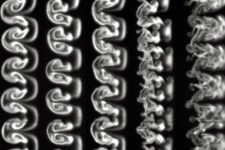 consider this experiment to be a completely determined event with no uncertainty at all. This is the knee jerk response of people is the consideration of this single event as being utterly and completely deterministic with no variation at all. If the experiment were repeated with every attempt to make it as perfect as possible, it would turn out slightly differently. This comes from the myriad of details associated with the experiment that determine the outcome. Generally the more complex and energetic the phenomenon of being examined is, the greater the variation (unless there are powerful forces attracting a very specific solution). There is always a variation, the only question is how large it is; it is never, ever identically zero. The choice to view the experiment as perfectly repeatable is usually an unconscious choice that has no credible basis. It is an incorrect and unjustified assumption that is usually made without a second thought. As such the choice is unquestionably bad for science or engineering. In many cases this unconscious choice is dangerous, and represents nothing more than wishful thinking.
 n. Are things worse where I am, or better than the average? For most of my adult life, I’ve had far better conditions than average, and been able to find great meaning in my work. Is the steady erosion of the quality of the work environment a consequence of issues local to my institution or organization? Or is it part of the massive systemic dysfunction our society is experiencing?
 government, led by an incompetent narcissistic conman without a perceptible moral compass. Racial tensions, and a variety of white supremacist/right wing ultra-Nationalists are walking the streets. Left wing and anarchist groups are waking up as well. Open warfare may soon be upon us making us long for the days where sporadic terrorist attacks were our biggest worry. A shit storm is actually a severe understatement; this is a fucking waking nightmare. I hope this is wrong and I could simply find a better place to work at and feel value in my labors. I wish the problem was simple and local with a simple job change fixing things.
 Work is an important part of life for a variety of reasons. It is how we spend a substantial portion of our time, and much of our efforts go into it. In work we contribute to society and assist in the collective efforts of mankind. As I noted earlier, I’ve been fortunate for most of my life, but things have changed. Part of the issue is a relative change in the degree of self-determination in work. The degree of self-determination has decreased over time. An aspect of this is the natural growth in scope of work as a person matures. As a person grows in work and is promoted, the scope of the work increases, and the degree of freedom in work decreases. Again this is only a part of the problem as the system is working to strangle the self-determination out of people. This is control, fear of failure and generic lack of trust in people. In this environment work isn’t satisfying because the system is falling apart, and the easiest way to resist this is controlling the little guy. My work becomes more of a job and a route to a paycheck every day. Earning a living and supporting your family is a noble achievement these days, and aspiring to more simply a waking dream contracting in the rear view mirror of life.


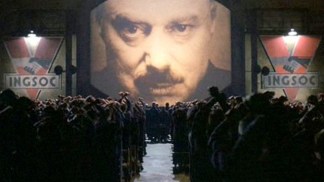 t can unleash people’s full potential through allowing them to fail spectacularly and then fully support the next step forward. Today, cowardice and mistrust dominate and even marginal failure results in punishment. It is corroding the foundation of achievement. It makes work simply a job and life more survival than living.
 comfortable and automatic. In many cases culture is the permanent habits of our social constructs, and often defines practices that impede progress. Accepted cultural practices are usually done without thinking and applied almost mindlessly. If these practices are wrong, they are difficult to dislodge or improve upon.
 or fundamental human needs, but most are constructs to help regulate the structures that our collective actions are organized about. The fundamental values, moral code and behaviors of people are heavily defined by culture. If the culture is positive, the effect is resonant and amplifies the actions of people toward much greater achievements. If the culture is negative, the effect can undo and overwhelm much of the best that people are capable of. Invariably cultures are a mixture of positive and negative. Cultures persist for extremely long times and outlive those who set the cultural tone for groups. Cultures are set or can change slowly unless the group is subjected to an existential crisis. When a crisis is successfully navigated the culture that arose in its resolution is enshrined, and tends to persist without change until a new crisis is engaged.
 We see all sorts of examples of the persistence of culture. The United States is still defined by the North-South divide that fractured during the Civil War. The same friction and hate that defined that war 150 years ago dominate our politics today. The culture of slavery persists in systematic racism and oppression. The white and black divide remains unhealed even though none of the people who enslaved or who were enslaved are still alive with many generations having passed. The United States is still defined by the Anglo-Saxon Protestant beliefs of the founding fathers. Their culture is dominant even after being overwhelmed in numbers of people and centuries of history. The dominant culture was formed in the crucible of history by the originating crisis for the Nation, the Revolutionary war. Companies and Laboratories are shaped by their original cultures and these habits and practices persist long after their originators have left, retired or died.
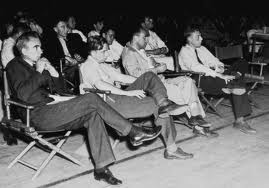 (earthquakes, floods, hurricanes, famines, …). These events can stress people and existing cultures providing the sorts of crises that shape the future to be more resilient to future disasters. Human events such as wars, trade, and general political events provide both the impact of culture in causing or navigating events, as well as producing crises that shape cultural responses and evolution. We can continue down this line of thinking to ever-smaller cultures such as organizations and businesses are influenced by crises induced by the larger systems (natural or political). This web of culture continues to smaller and smaller scale all the way to communities (towns, regions, schools, families) each having a culture shaped heavily by other cultures or events. In every case a crisis is almost invariably necessary to induce change, cultures are resistant to change unless something painful provides direct evidence of the incapacity of existing culture to succeed.
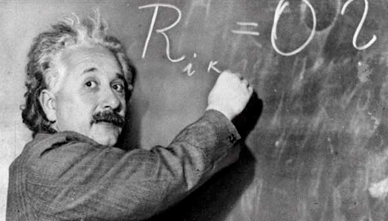 culture of the broader scientific community. This culture exists within the broader network of cultures in society with give-and-take between them. In the past science has provided deep challenges to prevailing culture, and induced changes societal culture. Today the changes in main societal culture are challenging science. One key aspect of today’s culture wars is lack of support for expertise. One of the key rifts in society is mistrust of the elite and educated. The broader society is attacking and undermining educational institutions across the board. Scientific laboratories are similar in makeup and similarly under assault. Much of this broader assault is related to a general lack of trust. Some of this is a reaction to the surplus of trust granted science in the wake of its massive contributions to the resolution of World War 2 and the Cold War. These successes are waning in memory and science is now contracting for a distinguished role societally.


 ns suffers a bit relative to the other Labs, as does the rigor of computed results. Los Alamos was the birthplace of all three labs and computational work, but always puts computation in a subservient role compared to experiments. This leads to a mighty struggle between validation and calibration. Often calibration wins out so that computed results are sufficiently close to experiment. Sandia excels at process and rigor in the conduct of calculations, but struggles at other aspects (at least in a relative sense). The whole verification and validation approach to simulation quality comes from Sandia reflecting the rigor. At the same time institutional support and emphasis are weaker leading to long-term effects.
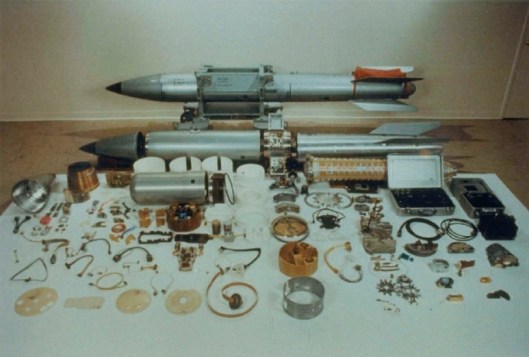 All this texture is useful to think about because it manifests itself in every place computational science is done today. The scientific culture of any institution is reflected in its emphasis, and approach to the conduct of science. The culture produces a natural set of priorities that define investments and acceptable quality. We can speak volumes about how computational work should be done, but the specific acuity to the message is related to preconceived notions about the aspects. For example, some places are more prone to focus on computing hardware as an investment. In terms of the competition for resources, the purchase of hardware is a priority, and a typical route for enhancement. This becomes important when trying to move into new “hot” areas. If the opportunity falls in line with the culture, investments flow and if it is out of line the institution will miss it.
 omputational science is a relatively new area of endeavor. It is at most 70 years old as practiced at Los Alamos; it is a new area of focus in most places. Sometime it is practiced at an institution and added to the repertoire as a new innovative way of doing work. In all these cases the computational work adopts the basic culture of the institution it exists within. It then differentiates based on the local conditions usually dominated by whatever the first acknowledged success is. One of the key aspects of a culture is origin stories or mythological achievements. Origins are almost invariably fraught situations with elements of crisis. These stories pervade the culture and define what success looks like and how investments in the future are focused.
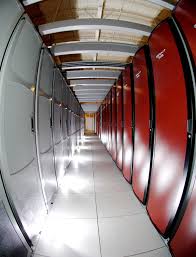 Where I work at Sandia, the origin story is dominated by early success with massively parallel computers. The greatest success was the delivery of a computer, Red Storm. As a result the culture is obsessed with computer hardware. The path to glory and success runs through hardware; a focus on hardware is culturally accepted and natural for the organization. It is a strong predisposition. At Lawrence Livermore the early stages of the Laboratory were full of danger and uncertainty. Early in the history of the Lab there was a huge breakthrough in weapons design. It used computational modeling, and the lead person in the work went on to huge professional success (Lab Director). This early success became a blueprint for others and an expected myth to be repeated. A computational study and focus was always expected and accepted by the Lab. At Los Alamos all roads culturally lead to the Manhattan Project. The success in that endeavor has defined the Laboratory ever since. The manner of operation and approach to science adopted then is blueprint for success at that Laboratory. The multitude of crises starting with the end of the Cold War, spying, fires, and scandal have all weakened the prevailing culture, and undermined the future.


 and knowledge. This always manifests itself with a lack of questioning in the execution of work. Both of these issues are profoundly difficult to deal with and potentially fatal to meaningful impact of modeling and simulation. These issues are seen quite frequently. Environments with weak peer review contribute to allowing confidence with credibility to persist. The biggest part of the problem is a lack of pragmatic acceptance of modeling and simulation’s intrinsic limitations. Instead we have inflated promises and expectations delivered by over confidence and personality rather than hard nosed technical work.
 When confidence and credibility are both in evidence, modeling and simulation is empowered to be impactful. It will be used appropriately with deference to what is and is not possible and known. When modeling and simulation is executed with excellence and professionalism along with hard-nosed assessment of uncertainties, using comprehensive verification and validation, the confidence is well grounded in evidence. If someone questions a simulations result, answers can be provided with well-vetted evidence. This produces confidence in the results because questions are engaged actively. In addition the limitations of the credibility are well established, and confidently be explained. Ultimately, credibility is a deeply evidence-based exercise. Properly executed and delivered, the degree of credibility depends on honest assessment and complete articulation of the basis and limits of the modeling.
 One of the major sins of over-confidence is flawed or unexamined assumptions. This can be articulated as “unknown knowns” in the famously incomplete taxonomy forwarded by Donald Rumsfeld in his infamous quote. He didn’t state this part of the issue even though it was the fatal flaw in the logic of the Iraqi war in the aftermath of 9/11. There were basic assumptions about Hussein’s regime in Iraq that were utterly false, and these skewed the intelligence assessment leading to war. They only looked at information that supported the conclusions they had already drawn or wanted to be true. The same faulty assumptions are always present in modeling. Far too many simulation professionals ignore the foundational and unfounded assumptions in their work. In many cases assumptions are employed without thought or question. They are assumptions that the community has made for as long as anyone can remember and simply cannot be questioned. This can include anything from the equations solved, to the various modeling paradigms applied as a matter of course. Usually these are unquestioned and completely unexamined for validity in most credibility assessments.
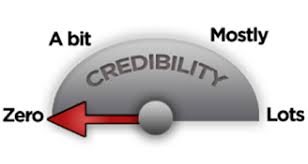 stay the course and make standard assumptions. In many cases the models have been significantly calibrated to match existing data, and new experiments or significantly more accurate measurements are needed to overturn or expose modeling limitations. Moreover the standard assumptions are usually unquestioned by peers. Questions are often met with ridicule. A deeply questioning assessment requires bravery and fortitude usually completely lacking from working scientists and utterly unsupported by our institutions.
 personality. This proof by authority is incredibly common and troubling to dislodge. In many cases personal relationships to consumers of simulations are used to provide confidence. People are entrusted with the credibility and learn how to give their customer what they want. Credibility by personality is cheap and requires so much less work plus it doesn’t raise any pesky doubts. This circumstance creates an equilibrium that is often immune to scientific examination. It is easier to bullshit the consumers of modeling and simulation results than level with them about the true quality of the work.
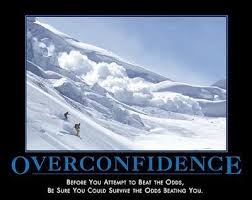 One of the biggest threats to credibility is the generation of the lack of confidence honesty has. Engaging deeply and honestly in assessment of credibility is excellent at undermining confidence. Almost invariably the accumulation of evidence regarding credibility endows the recipients of this knowledge with doubt. These doubts are healthy and often the most confident people are utterly ignorant of the shortcomings. The accumulation of evidence regarding the credibility should have a benefit for the confidence in how simulation is used. This is a problem when those selling simulation oversell what it can do. The promise of simulation has been touted widely as transformative. The problem with modeling and simulation is its tangency to reality. The credibility of simulations is grounded by reality, but the uncertainty comes from both modeling, but also the measured and sensed uncertainty with our knowledge of reality.
 n oversold and any assessment will provide bad news. In today’s World we see a lot of bad news rejected, or repackaged (spun) to sound like good news. We are in the midst of a broader crisis of credibility with respect to information (i.e. fake news), so the issues with modeling and simulation shouldn’t be too surprising. We would all be well served by a different perspective and approach to this. The starting point is a re-centering of expectations, but so much money has been spent using grossly inflated claims.
 limitations. The difference that simulation makes is the ability to remove the limitations of analytical model solution. Far more elaborate and accurate modeling decisions are available, but carry other difficulties due to the approximate nature of numerical solutions. The tug-of-war intellectually is the balance between modeling flexibility, nonlinearity and generality with effects of numerical solution. The bottom line is the necessity of assessing the uncertainties that arise from these realities. Nothing releases the modeling from its fundamental connection to validity grounded in real world observations. One of the key things to recognize is that models are limited and approximate in and of themselves. Models are wrong, and under a sufficiently resolved examination will be invalid. For this reason an infinitely powerful computer will ultimately be useless because the model will become invalid at some resolution. Ultimately progress in modeling and simulation is based on improving the model. This fact is ignored by computational science today and will result wasting valuable time, effort and money chasing quality that is impossible to achieve.
 This is a nice way of saying this is usually a sign that the quality is actually complete bullshit! We can move a long way toward better practice by simply recalibrating our expectations about what we can and can’t predict. We should be in a state where greater knowledge about the quality, errors and uncertainty in modeling and simulation work improves our confidence.
 One of the issues of increasing gravity in this entire enterprise is the consumption of results using modeling and simulation by people unqualified to judge the quality of the work. The whole enterprise is judged to be extremely technical and complex. This inhibits those using the results from asking key questions regarding the quality of the work. With the people producing modeling and simulation results largely driven by money rather than technical excellence, we have the recipe for disaster. Increasingly, false confidence accompanies results and snows the naïve consumers into accepting the work. Often the consumers of computational results don’t know what questions to ask. We are left with quality being determined more by flashy graphics and claims about massive computer use than any evidence of prediction. This whole cycle perpetuates an attitude that starts to allow viewing reality as more of a video game and less like a valid scientific enterprise. Over inflated claims of capability are met with money to provide more flashy graphics and quality without evidence. We are left with a field that has vastly over-promised and provided the recipe for disaster.
 A great question is an achievement in itself although rarely viewed as such. More often than not little of the process of work goes into asking the right question. Often the questions we ask are highly dependent upon foundational assumptions that are never questioned. While assumptions about existing knowledge are essential, finding the weak or invalid assumptions is often the key to progress. These assumptions are wonderful for simplifying work, but also inhibit progress. Challenging assumptions is one of the most valuable things to do. Heretical ideas are fundamental to progress; all orthodoxy began as heresy. If the existing assumptions hold up under the fire of intense scrutiny they gain greater credibility and value. If they fall, new horizons are opened up to active exploration.
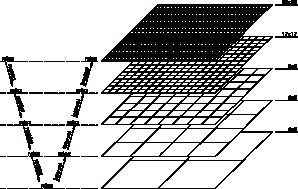 questions have led to the best research, and most satisfying professional work I’ve done. I would love to recapture this spirit of work again, with good questioning work feeling almost quaint in today’s highly over-managed climate. One simple question occurred in my study of efficient methods for solving the equations of incompressible flow. I was using a pressure projection scheme, which involves solving a Poisson equation at least once, if not more than once a time step. The most efficient way to do this involved using the multigrid method because of its algorithmic scaling being linear. The Poisson equation involves solving a large sparse system of linear equations, and the solution of linear equations scales with powers of the number of equations. Multigrid methods have the best scaling thought to be possible (I’d love to see this assumption challenged and sublinear methods discovered, I think they might well be possible).
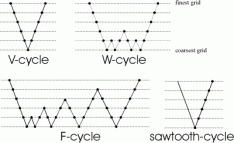 As a result as problems become larger, the proportion of the solution time spent solving linear equations grows ever larger (the same thing is happening now to multigrid because of the cost of communication on modern computers). I posed the question of whether I could get the best of both methods, the efficiency with the robustness? Others were working on the same class of problems, and all of us found the solution. Combine the two methods together, effectively using a multigrid method to precondition the conjugate gradient method. It worked like a charm; it was both simple and stunningly effective. This approach has become so standard now that people don’t even think about it, its just the status quo.
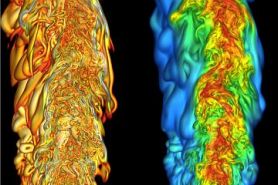
 The second great question I’ll point to involved the study of modeling turbulent flows with what has become known as implicit large eddy simulation. Starting in the early 1990’s there was a stunning proposition that certain numerical methods seem to automatically (auto-magically) model aspects of turbulent flows. While working at Los Alamos and learning all about a broad class of nonlinearly stable methods, the claim that they could model turbulence caught my eye (I digested it, but fled in terror from turbulence!). Fast forward a few years and combine this observation with a new found interest in modeling turbulence, and a question begins to form. In learning about turbulence I digested a huge amount of theory regarding the physics, and our approaches to modeling it. I found large eddy simulation to be extremely interesting although aspects of the modeling were distressing. The models that worked well were performed poorly on the structural details of turbulence, and the models that matched the structure of turbulence were generally unstable. Numerical methods for solving large eddy simulation were generally based on principles vastly different than those I worked on, which were useful for solving Los Alamos’ problems.
 I should spend some time on some bad questions as examples of what shouldn’t be pursued. One prime example is offered as a seemingly wonderful question, the existence of solutions to the incompressible Navier-Stokes equations. The impetus for this question is the bigger question of can we explain, predict or understand fluid turbulence? This problem is touted as a fundamental building block in this noble endeavor. The problem is the almost axiomatic belief that turbulence is contained within this model. The key term is incompressible, which renders the equations unphysical on several key accounts: it gives the system infinite speed of propagation, and divorces the equations from thermodynamics. Both features sever the ties of the equations from the physical universe. The arguing point is whether these two aspects disqualify it from addressing turbulence. I believe the answer is yes.
 Another poorly crafted question revolves around the current efforts for exascale class computers for scientific computing. There is little doubt that an exascale computer would be useful for scientific computing. A better question is what is the most beneficial way to push scientific computing forward? How can we make scientific computing more impactful in the real world? Can the revolution of mobile computing be brought to science? How can we make computing (really modeling and simulation) more effective in impacting scientific progress? Our current direction is an example of crafting an obvious question, with an obvious answer, but failing to ask a more cutting and discerning question. The consequence of our unquestioning approach to science will be wasted money and stunted progress.
 rust in people and science. Trust is a powerful concept and its departure from science has been disruptive and expensive. Today’s scientists are every bit as talented and capable as those of past generations, but society has withdrawn its faith in science. Science was once seen as a noble endeavor that embodied the best in humanity, but generally not so today. Progress in the state of human knowledge produced vast benefits for everyone and created the foundation for a better future. There was a sense of an endless frontier constantly pushing out and providing wonder and potential for everyone. This view was a bit naïve and overlooked the maxim that human endeavors in science are neither good or bad, producing outcomes dependent upon the manner of their use. For a variety of reasons, some embedded within the scientific community, the view of society changed and the empowering trust was withdrawn. It has been replaced with suspicion and stultifying oversight.


 The largest portion and most important part of this process is the analysis that allows us to answer the question. Often the question needs to be broken down into a series of simpler questions some of which are amenable to easier solution. This process is hierarchical and cyclical. Sometimes the process forces us to step back and requires us to ask an even better or more proper question. In sense this is the process working in full with the better and more proper question being an act of creation and understanding. The analysis requires deep work and often study, research and educating oneself. A new question will force one to take the knowledge one has and combine it with new techniques producing enhanced capabilities. This process is on the job education, and fuels personal growth and personal growth fuels excellence. When you are answering a completely new question, you are doing research and helping to push the frontiers of science forward. When you are answering an old question, you are learning and you might answer the question in a new way yielding new understanding. At worst, you are growing as a person and professional.
 Once this creation is available, new questions can be posed and solved. These creations allow new questions to be asked answered. This is the way of progress where technology and knowledge builds the bridge something better. If we support excellence and a process like this, we will progress. Without support for this process, we simply stagnate and whither away. The choice is simple either embrace excellence by loosening control, or chain people to mediocrity.
 exact solution. This makes it a more difficult task than code verification where an exact solution is known removing a major uncertainty. A secondary issue associated with not knowing the exact solution is the implications on the nature of the solution itself. With an exact solution, a mathematical structure exists allowing the solution to be achievable analytically. Furthermore, exact solutions are limited to relatively simple models that often cannot model reality. Thus, the modeling approach to which solution verification is applied is necessarily more complex. All of these factors are confounding and produce a more perilous environment to conduct verification. The key product of solution verification is an estimate of numerical error and the secondary product is the rate of convergence. Both of these quantities are important to consider in the analysis.
 where the new unknown is the obstensible estimate of the exact solution
  that is the solution where
  . The solutions used to determine this estimate are
  the solutions found with
  . We notice that we have
  meaning the well-determined solution requires three pieces of determined data,
  is constant. In this case we can write the solution in closed form
  , where
  . More generally we need to attack this with a coupled nonlinear solve. If we deal with an over-determined version of the problem we will use a nonlinear least squares solver (or this is the knee-jerk response). As we discuss next, thinking about this decision opens the door to some more interesting and robust choices.
 There are several practical issues related to this whole thread of discussion. One often encountered and extremely problematic issue is insanely high convergence rates. After one has been doing verification or seeing others do verification for a while, the analysis will sometimes provide an extremely high convergence rate. For example a second order method used to solve a problem will produce a sequence that produces a seeming 15th order solution (this example is given later). This is a ridiculous and results in woeful estimates of numerical error. A result like this usually indicates a solution on a tremendously unresolved mesh, and a generally unreliable simulation. This is one of those things that analysts should be mindful of. Constrained solution of the nonlinear equations can mitigate this possibility and exclude it a priori. This general approach including the solution with other norms, constraints and other aspects is explored in the paper on Robust Verification. The key concept is the solution to the error estimation problem is not unique and highly dependent upon assumptions. Different assumptions lead to different results to the problem and can be harnessed to make the analysis more robust and impervious to issues that might derail it.
 ) are closer to the exact solution, and this data is more prominent in the solution. The end result of the analysis is a multitude of estimates of the numerical error and convergence. These results are then subjected to robust statistical examination using median statistics. We report the median of the estimates as the error and convergence rate. The median deviation is used to place and uncertainty on this estimate. One of the key benefits of this estimation is its lack of susceptibility to corruption by outliers in the analysis. Outliers are further suppressed in the analysis by the use of expert judgment as constraints. For example, the absurdly large convergence rates are removed by the constraints if the rate of convergence is constrained to be below a given value.
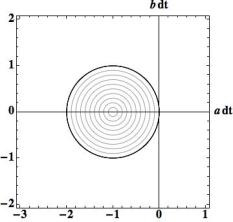 Before moving to examples of solution verification we will show how robust verification can be used for code verification work. Since the error is known, the only uncertainty in the analysis is the rate of convergence. As we can immediately notice that this technique will get rid of a crucial ambiguity in the analysis. In standard code verification analysis, the rate of convergence is never the exact formal order, and expert judgment is used to determine if the results is close enough. With robust verification, the convergence rate has an uncertainty and the question of whether the exact value is included in the uncertainty band can be asked. Before showing the results for this application of robust verification, we need to note that the exact rate of verification is only the asymptotic rate in the limit of
  . For a finite step size the rate of convergence should deviate from this value and for simple cases the value can be derived using a modified version of classical numerical analysis.
 . The error bars do not take us to the theoretical convergence rate of one. The data is consistent with the rate being above one (and this is analytically expected). Using this same data for solution verification yields the following model,
  . Close examination shows that this solution is quite close to the exact solution 0.0001 and within the error bars. If we use the standard techniques of simply least square fitting the data we get the following model,
  . The error estimate here is 0.0017, which ends up being rather over generous when the standard safety factor of 1.25 is applied. Using the robust verification technique we get a better estimate of the exact solution, the actual convergence rate and a tighter error bound.
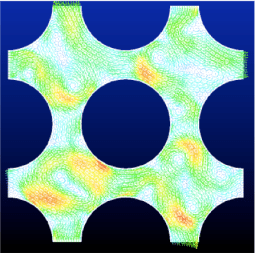 s study using some initial grids that were known to be inadequate. One of the codes was relatively well trusted for this class of applications and produced three solutions that for all appearances appeared reasonable. One of the key parameters is the pressure drop through the test section. Using grids 664K, 1224K and 1934K elements we got pressure drops of 31.8 kPa, 24.6 kPa and 24.4 kPa respectively. Using a standard curve fitting for the effective mesh resolution gave an estimate of 24.3 kPa±0.0080 kPa for the resolved pressure drop and a convergence rate of 15.84. This is an absurd result and needs to simply be rejected immediately. Using the robust verification methodology on the same data set, gives a pressure drop of 16.1 kPa±13.5 kPa with a convergence rate of 1.23, which is reasonable. Subsequent calculations on refined grids produced results that were remarkably close to this estimate confirming the power of the technique even when given data that was substantially corrupted.
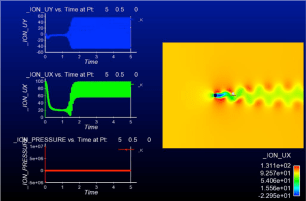 Our final example is a simple case of validation using the classical phenomena of vortex shedding over a cylinder at a relatively small Reynolds number. This is part of a reasonable effort to validate a research code before using in on more serious problems. The key experimental value to examine is the Stouhal number defined,
  the shedding frequency normalized by the size of cylinder and the velocity, which has the value experimentally of
  for a flow of Reynolds number 100 (the Reynolds number is the non-dimensional ratio of inertial to viscous force in a flow).

 . Including error bars recovers the experimental value. This can be regarded as a modest success for the code’s ability to be considered for more complex flows.
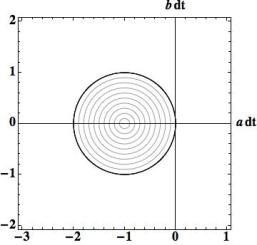 using a single discretization parameter only two discretizations are needed for verification (two equations to solve for two unknowns). For code verification the model for error is simple, generally a power law,
  where the error is proportional to the discretization parameter
  . There is also a constant of proportionality. The order,
  . This is quite difficult to achieve practically.
 coded up in Mathematica. We could solve this problem in a spreadsheet (like MS Excel), python, or a standard programming language. The example will look at two first order methods, forwards
 and backwards
  Euler methods. Both of these methods produce leading first order errors in an asymptotic sense,
  . If
. If  and we can solve the problem to two stopping times of
  ,
,  and
and  . The analytical solution is always,
  . We can solve this problem using a set of step sizes,
  .
.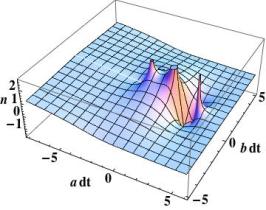 of accumulated error (since I’m using Mathematica so aspects of round-off error are pushed aside). In these cases round-off error would be another complication. Furthermore the backward Euler method for multiple equations would involve a linear (or nonlinear) solution that itself has an error tolerance that may significantly impact verification results. We see good results for
  the quality of the solution that can be obtained. These two concepts go hand-in-hand. As simple closed form solution is easy to obtain and evaluation. Conversely, a numerical solution of partial differential equations is difficult and carries a number of serious issues regarding its quality and trustworthiness. These issues are addressed by an increased level of scrutiny on evidence provided by associated data. Each of benchmark is not necessarily analytical in nature, and the solutions are each constructed in different means with different expected levels of quality and accompanying data. This necessitates the differences in level of required documentation and accompanying supporting material to assure the user of its quality.
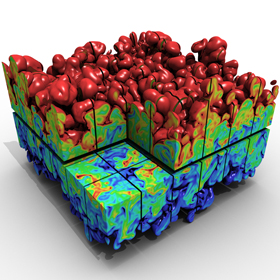 The use of DNS as a surrogate for experimental data has received significant attention. This practice violates the fundamental definition of validation we have adopted because no observation of the physical world is used to define the data. This practice also raises other difficulties, which we will elaborate upon. First the DNS code itself requires that the verification basis further augmented by a validation basis for its application. This includes all the activities that would define a validation study including experimental uncertainty analysis numerical and physical equation based error analysis. Most commonly, the DNS serves to provide validation, but the DNS contains approximation errors that must be estimated as part of the “error bars” for the data. Furthermore, the code must have documented credibility beyond the details of the calculation used as data. This level of documentation again takes the form of the last form of verification benchmark introduced above because of the nature of DNS codes. For this reason we include DNS as a member of this family of benchmarks.
 achieve a degree of access to resources that raise their access to a good life. With more resources the citizens can aspire toward a better, easier more fulfilled life. In essence the security of a Nation can allow people to exist higher on Maslow’s hierarchy needs. In the United States this is commonly expressed as “freedom”. Freedom is a rather superficial thing when used as a slogan. The needs of the citizens begin with having food and shelter than allow them to aspire toward a sense of personal safety. Societal safety is one means of achieving this (not that safety and security are pretty low on the hierarchy). With these in hand, the sense of community can be pursued and then sense of an esteemed self. Finally we get to the peak and the ability to pursue ones full personal potential.
 . If one exists at this level, life isn’t very good, but its achievement is necessary for a better life. Gradually one moves up the hierarchy requiring greater access to resources and ease of maintaining the lower positions on the hierarchy. A vibrant National Security should allow this to happen, the richer a Nation becomes the higher on the hierarchy of needs its citizens reside. It is with some recognition of irony that my efforts and the Nation is stuck at such a low level on the hierarchy. Efforts toward bolstering the community the Nation forms seem to be too difficult to achieve today. We seem to be regressing from being a community or achieving personal fulfillment. We are stuck trying to be safe and secure. The question is whether those in the Nation can effectively provide the basis for existing high on the hierarchy of needs without being there themselves?
 The Regularized Singularity