Reviews are for readers, not writers. If I get a bad one, I shrug it off. If I get a good one, I don’t believe it
― William Meikle
 A week ago I received bad news, the review for a paper were back. One might think that getting a review back would be good, but it rarely is. These reviews are too often a horrible soul-crushing experience. In this case I had reports from two reviewers, and one of them delivered the ego thrashing I’ve come to fear.
I’ve found the best way to revise your own work is to pretend that somebody else wrote it and then to rip the living shit out of it.
― Don Roff
 In total the two reviews were generally consistent on the details of the paper, and the sorts of suggestions for bringing the paper into the condition needed to allow publication. The difference was the tone of the reviews. One of the reviews was completely constructive and detailed in its critique. Each and every critique was offered in a positive light even when the error was pure carelessness.
The other review couldn’t be more different in tone. From the outset it felt like an attack on me. It took me until several days until I could read it in a manner that allowed me to take constructive action. For example including a comment that says “the writing is terrible” is basically an attack on the authors (yes it feels personal). This could be stated much more effectively, “I believe that you have something important to say here, but the ideas do not come across clearly.” Both things say the same thing, but one of them invites a positive and constructive response. I invite the readers to endeavor to write your own reviews in a manner to invite authors to improve. One of my co-authors who has a somewhat more unbiased eye noted that the referee’s report seemed a bit defensive.
So now I’m taking the path of revising the paper. A visceral report makes this much more difficult to accomplish. The constructive review is relatively easy to accommodate, and makes for a good blueprint for progress. The nasty review is much harder to employ in the same fashion. I feel that I’m finally on the path to do this, but  it could have been much easier. There is nothing wrong with being critical, but the way its done matters a lot.
That’s the magic of revisions – every cut is necessary, and every cut hurts, but something new always grows.
― Kelly Barnhill
Just for the record the paper is titled “Robust Verification Analysis” by myself, Jim Kamm (Los Alamos), Walt Witkowski and Tim Wildey (Sandia), it was submitted to the Journal of Computational Physics. As part of the revision I’ve taken the liberty of rewriting the abstract:
We introduce a new methodology for inferring the accuracy of computational simulations through the practice of solution verification. Our methodology is well suited to both well- and ill-behaved sequences of simulations. Our approach to the analysis of these sequences of simulations incorporates expert judgment into the process directly via a powerful optimization framework, and the application of robust statistics. The expert judgment is systematically applied as constraints to the analysis, and together with the robust statistics guards against over-emphasis on anomalous analysis results. We have named our methodology Robust Verification Analysis.
The practice of verification is a key aspect for determining the correctness of computer codes and their respective computational simulations. In practice verification is conducted through repeating simulations with varying discrete resolution and conducting a systematic analysis of the results. The accuracy of the calculation is computed directly against an exact solution, or inferred by the behavior of the sequence of calculations.
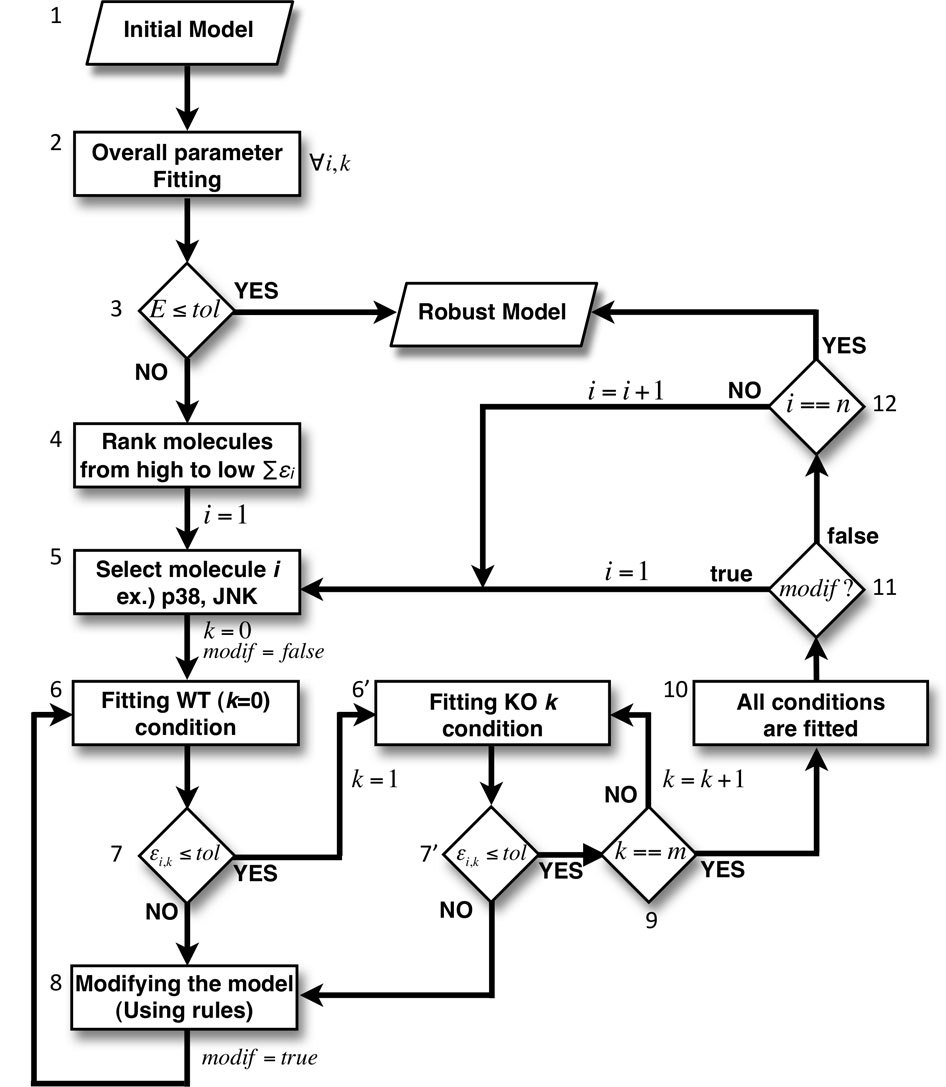
Nonlinear regression is a standard approach to producing the analysis necessary for verification results. We note that nonlinear regression is equivalent to solving a nonlinear optimization problem. Our methodology is based on utilizing multiple constrained optimization problems to solve the verification model in a manner that varies the solutions underlying assumptions. Constraints applied in the solution can include expert judgment regarding convergence rates (bounds and expectations) as well as bounding values for physical quantities (e.g., positivity of energy or density). This approach then produces a number of error models, which are then analyzed through robust statistical techniques (median instead of mean statistics).
This provides self-contained, data driven error estimation including uncertainties for both the solution and order of convergence. Our method will produce high quality results for the well-behaved cases consistent with existing practice. The methodology will also produce reliable results for ill-behaved circumstance. We demonstrate the method and compare the results with standard approaches used for both code and solution verification on well-behaved and more challenging simulations. We pay particular attention to the case where few calculations are available and these calculations are conducted on coarse meshes. These are compared to analytical solutions, or calculations on highly refined meshes.
Here is abstract from the the original submission:
Code and solution verification are key aspects for determining the quality of computer codes and their respective computational simulations. We introduce a verification method that can produce quality results more generally with less well-behaved calculations. We have named this methodology Robust Verification Analysis. Nonlinear regression is a standard approach to producing the analysis necessary for verification results. Nonlinear regression is equivalent to solving a nonlinear optimization problem. We base our methodology on utilizing multiple constrained optimizations to solve the verification model. Constraints can include expert judgment regarding convergence rates and bounding values for physical quantities. This approach then produces a number of error models, which are then analyzed through robust statistical techniques (e.g., median instead of mean statistics). This provides self-contained, data driven error estimation including uncertainties for both the solution and order of convergence. Our method will produce high quality results for the well-behaved cases consistent with existing practice as well. We demonstrate the method and compare the results with standard approaches used for both code and solution verification on well-behaved and challenging data sets.
There is a saying: Genius is perseverance. While genius does not consist entirely of editing, without editing it’s pretty useless.
― Susan Bell
When you print out your manuscript and read it, marking up with a pen, it sometimes feels like a criminal returning to the scene of a crime.
― Don Roff






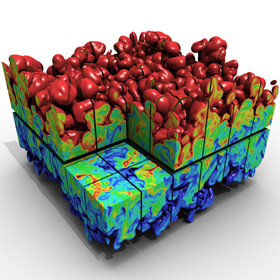
 Scientific computing is still dominated by the same two big uses that existed at the beginning. Recently data analysis has reasserted itself as the big “new” thing. This is mostly the consequence of the deluge of data coming from the Internet, and the impending Internet of things. For mainstream science, the initial value problem still holds sway for a broader set of activities although data is big in astronomy, geophysics and social sciences.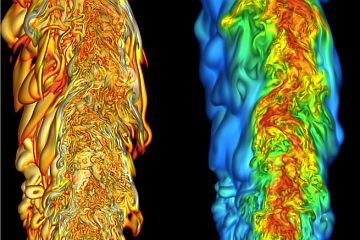



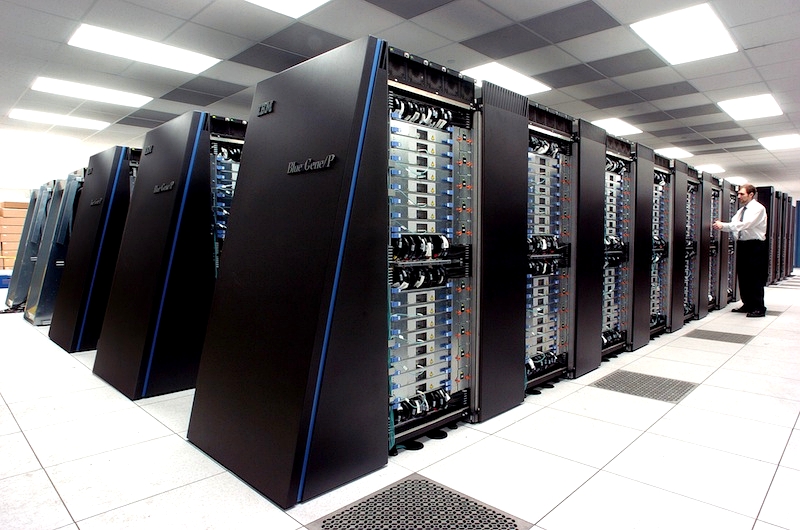






 I don’t think software gets the support or respect it deserves particularly in scientific computing. It is simply too important to treat it the way we do. It should be regarded as an essential professional contribution and supported as such. Software shouldn’t be a one-time investment either; it requires upkeep and constant rebuilding to be healthy. Too often we pay for the first version of the code then do everything else on the cheap. The code decays and ultimately is overcome by technical debt. The final danger with code is the loss of the knowledge basis for the code itself. Too much scientific software is “magic” code that no one understands. If no one understands the code, the code is probably dangerous to use.
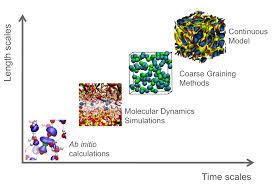
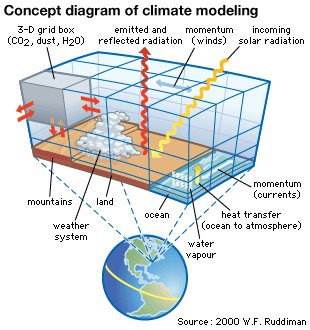
 computing. The connection to work of importance and value is essential to understand, and the lack of such understanding explains why our current trajectory is so problematic. Just to reiterate, the value of computing, or scientific computing is found in the real world. The real world is studied through the use of models in scientific computing that are most often differential equations. Using algorithms or methods we then solve these models. These models as interpreted by their solution methods or algorithms are expressed in computer code, which in turn runs on a computer.
 More importantly software often outlives the people responsible for the intellectual capital represented in it. A real danger is the loss of expertise in what the software is actually doing. There is a specific and real danger in using software that isn’t understood. Many times the software is used as a library and not explicitly understood by the user. The software is treated as a storehouse of ideas, but if those ideas are not fully understood there is danger. It is important that the ideas in software be alive and fully comprehended.

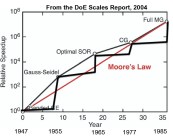
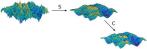
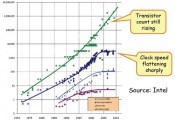
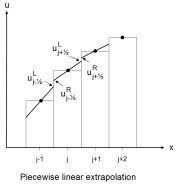

 In watching the ongoing discussions regarding the National Exascale initiative many observations can be made. I happen to think the program is woefully out of balance, and focused on the wrong side of the value proposition for computing. In a nutshell it is stuck in the past.
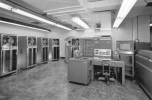 to hardware. As the software gets closer to the application, the focus starts to drift. As the application gets closer and modeling is approached, the focus is non-existent. It is simply assumed that the modeling just needs a really huge computer and the waters will magically part and the path the promised land of predictive simulation will just appear. Science doesn’t work this way, or more correctly well functioning science doesn’t work like this. Science works with a push-pull relationship between theory, experiment and tools. Sometimes theory is pushing experiments to catch up. Sometimes tools are finding new things for theory to answer. Computing is such a tool, but it isn’t be allowed to push theory, or more properly theory should be changing to accommodate what the tools show us.
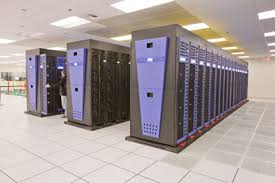
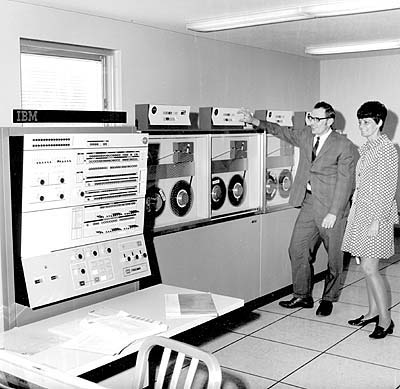
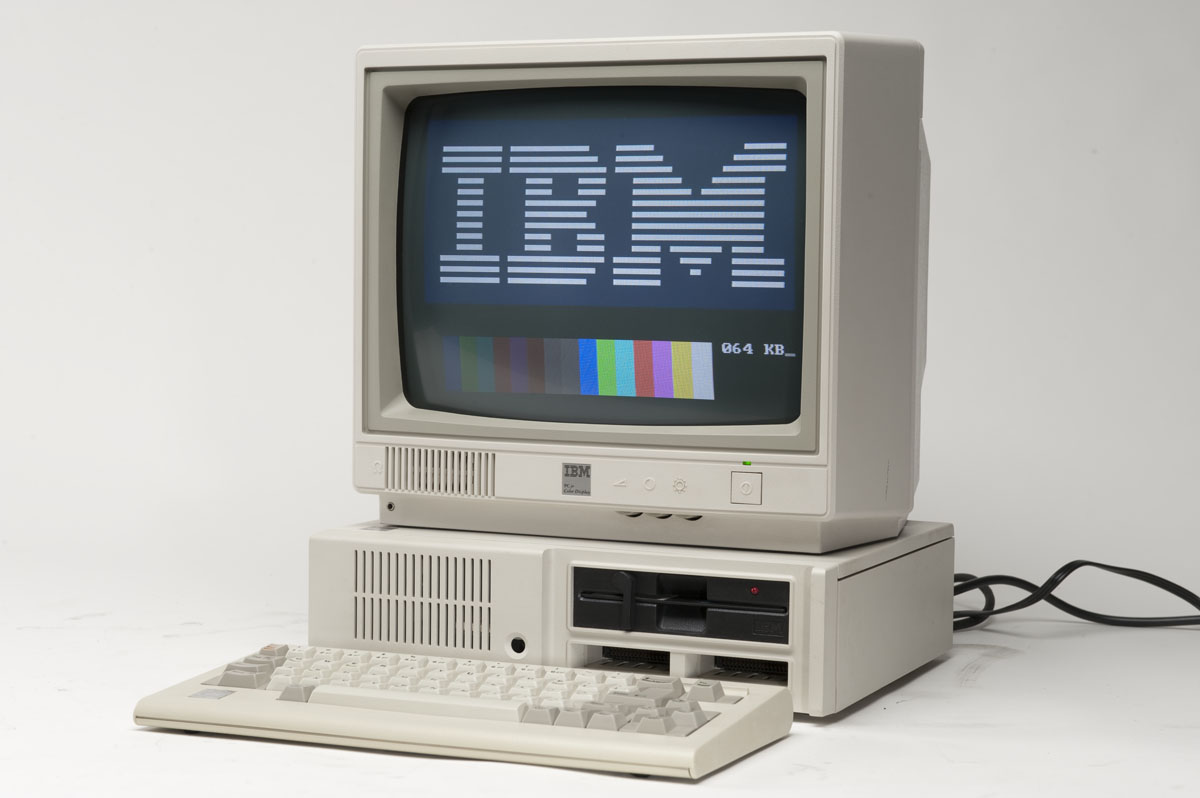
 The question is whether there is some way to learn from everyone else. How can this centralized supercomputing be broken down in a way to help the productivity of the scientist. One of the things that happened when mainframes went away was an explosion of productivity. The centralized computing is quite unproductive and constrained. Computing today is the opposite, unconstrained and completely productive. It is completely integrated into the very fabric of our lives. Work and play are integrated too. Everything happens all the time at the same time. Instead of maintaining the old-fashioned model we should be looking into harvesting the best of modern computing to overthrow the old model.
 drowning in data whether we are talking about the Internet in general, the coming “Internet of things” or the scientific use of computing. The future is going to be much worse and we are already overwhelmed. If we try to deal with every single detail, we are destined to fail.
 in all the noise and represent this importance compactly and optimally. This class of ideas will be important in managing the Tsunami of data that awaits us.
 be solved by exotic methods and algorithms. Ultimately, these methods and algorithms must be expressed as computer code before the computers can be turned loose on their approximate solution. These models are relics. The whole enterprise of describing the real world through these models arose from the efforts of intellectual giants starting with Newton and continuing with Leibnitz, Euler, and a host of brilliant 17th, 18th and 19th Century scientists. Eventually, if not almost immediately, models became virtually impossible to solve via available (analytical) methods except for a
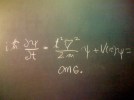 handful of special cases.
 When computing came into use in the middle of the 20th Century some of these limitations could be lifted. As computing matured fewer and fewer limitations remained, and the models of the past 300 years became accessible to solution albeit through approximate means. The success has been stunning as the combination of intellectual labor on methods and algorithms along with computer code, and massive gains in hardware capability have transformed our view of these models. Along the way new phenomena have been recognized including dynamical systems or chaos opening doors to understanding the World. Despite the progress I believe we have much more to achieve.
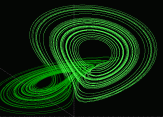 Today we are largely holding to the models of reality developed prior to the advent of computing as a means of solution. The availability of solution has not yielded the balanced examination of the models themselves. These models are
 effectively. This gets to the core of studying uncertainty in physical systems. We need to overhaul our approach of reality to really come to grips with this. Computers, code and algorithms are probably at or beyond the point where this can be tackled.
 Here is the problem. Despite the need for this sort of modeling, the efforts in computing are focused at the opposite end of the spectrum. Current funding and focus is aimed at the computing hardware, and code with little effort being applied to algorithms, methods and models. The entire enterprise needs a serious injection of intellectual energy in the proper side of the value proposition.
 The Regularized Singularity