• About The Regularized Singularity

The Regularized Singularity

~ The Eyes of a citizen; the voice of the silent

The Regularized Singularity

Author Archives: Bill Rider

Stumbling Into Mediocrity

12 Saturday Apr 2025

Posted by Bill Rider in Uncategorized

≈ 2 Comments

tl;dr

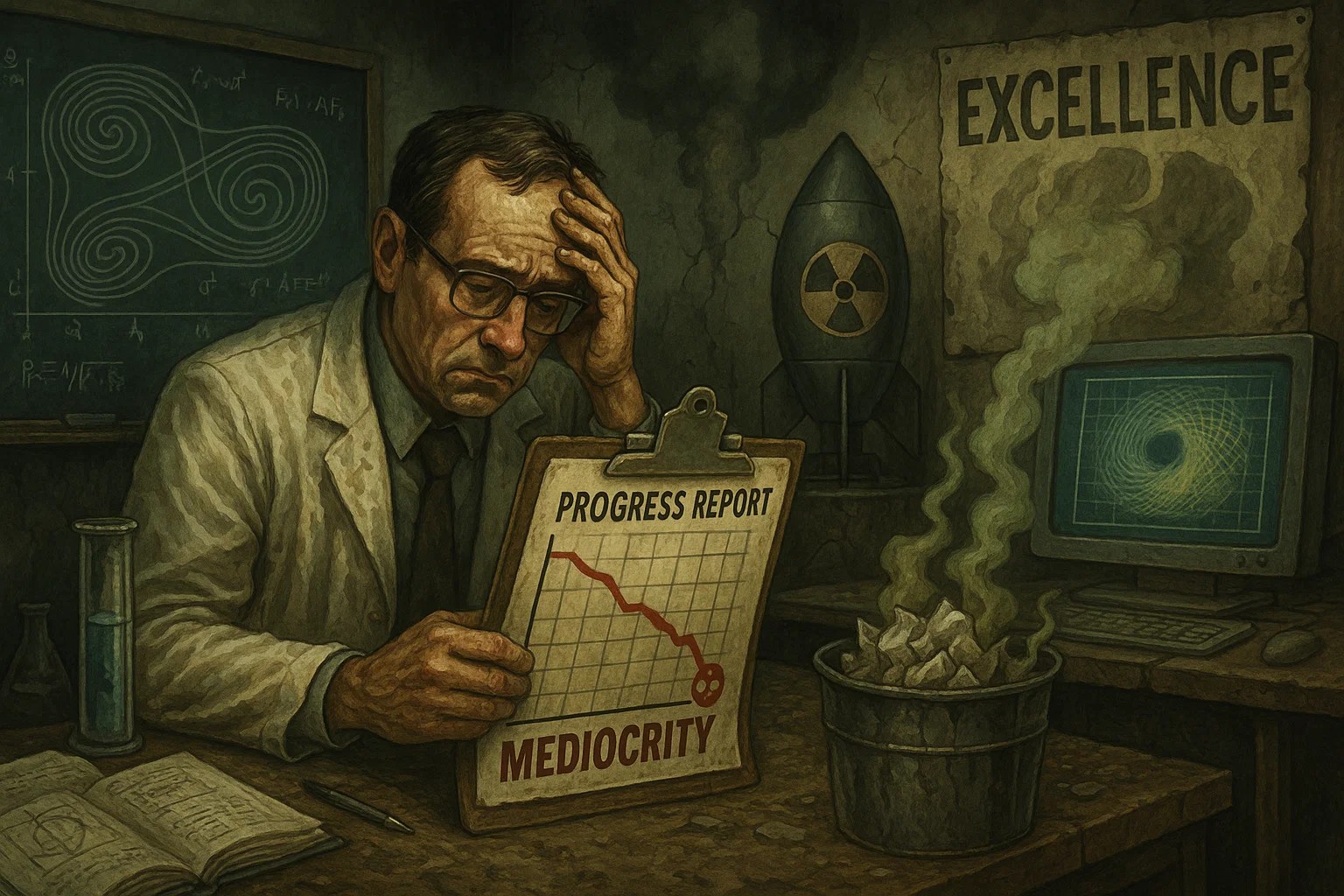
My early adult life was marked by a vigorous pursuit of excellence. My time in Los Alamos provided the example, path, and environment for it. There I started to achieve it. At the same time, everything around me was decaying. Excellence is under siege in the USA. Eventually, the loss of excellence was too great and overtook the positive. The societal undertow has grown into a vortex of sprawling disappointment. Mediocrity lurks around every corner, and it’s swallowing excellence everywhere. Make no mistake, expanding mediocrity is the hallmark of our time. Excellence is in the past and receding. How deep into incompetence will we go?

“Some men are born mediocre, some men achieve mediocrity, and some men have mediocrity thrust upon them.” ― Joseph Heller

A Rant About Mediocrity

I’m going to start with a rant including a lot of cursing. So if you’re not down for that, stop reading now!. Frankly, if you can’t take some cursing, you’re not my people anyway. The situation we are in should make all of us very fucking angry.

I am really pissed off by this topic. I’m pissed off by the state of my country and the places I work. I’m following the mantra of writing what disturbs you, and this topic fills me with incandescent rage. In summary, we had greatness and excellence once upon a time. We have collectively managed to completely and totally fuck this up. While I will get to the reasons for the descent into incompetence, first and foremost I’m angry. Really deeply fucking angry at how we lost our edge. I’ll just note that I’ve spent a career developing expertise and accumulating knowledge professionally. What does this mean today? Fuck all the fuckwits they’ve put in charge.

I say this knowing many of the leaders at the Labs. Somehow we have a system that takes competent talented people and turns them into idiots. Great people are brought low instead of lifted up. Sometimes the result is pure incompetence or decisional paralysis. In other cases, they become unethical assholes, or the asshole becomes a monster. Societal forces seem to generate incoherence and destroy rationality. Our collective competence is far less than the sum of the parts. This is why I wrote the rest of this. Something about our system and society today is destroying everything good. It does seem to be the pathos of the current age that social stupidity is scheming to demolish any sense of excellence. Just look at our National leaders. Otherwise, talented smart, and successful people suck up ignorance and stupidity. They completely reject their own competence because the system can’t deal with it.

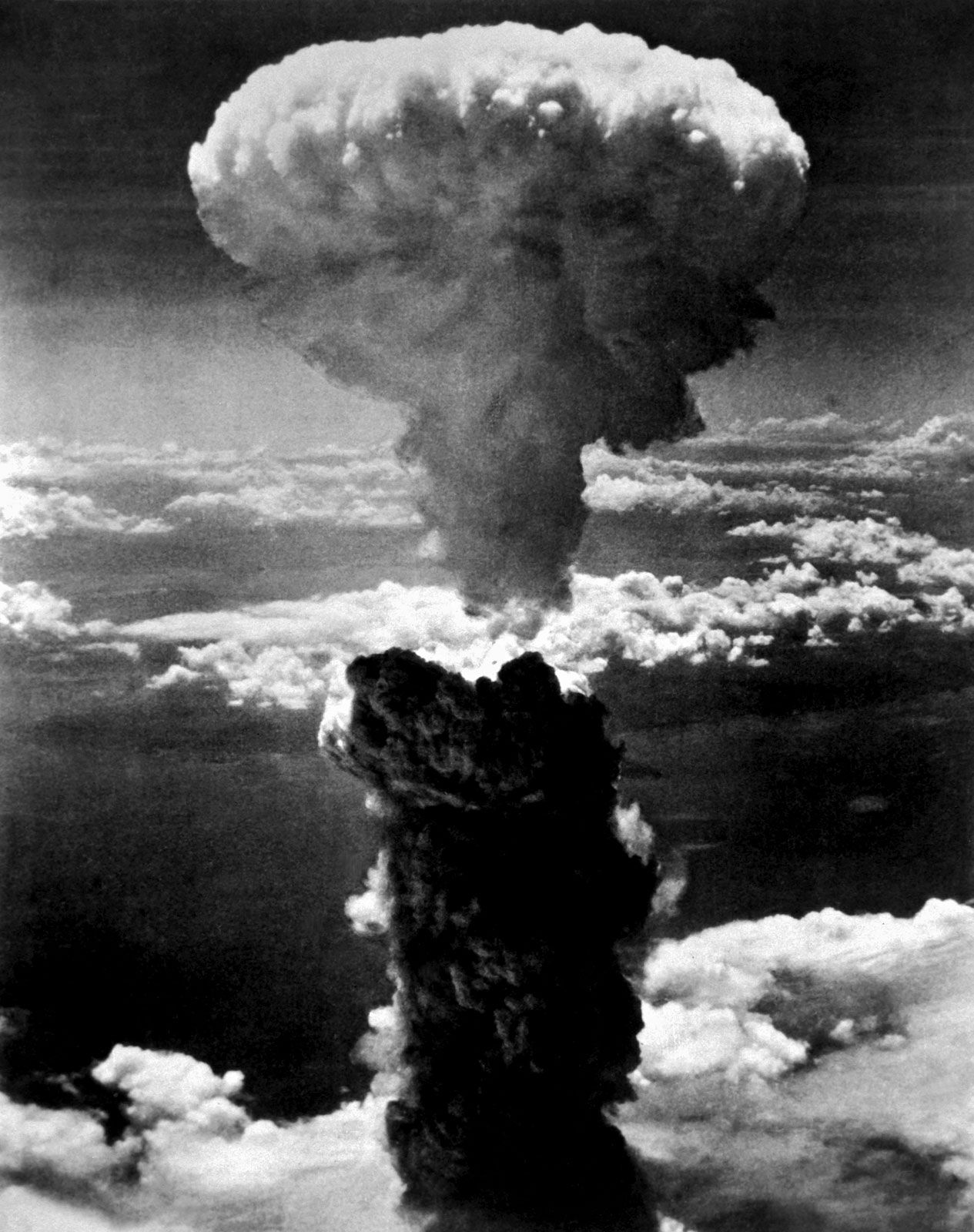
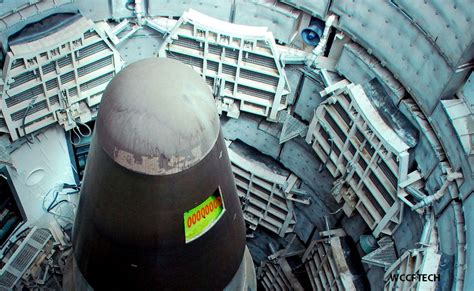
I see this directly at the labs every single day. You would think the importance of nuclear weapons might matter enough. It doesn’t.

What could possibly go wrong? Oh yeah, we aren’t testing these weapons and asserting they work via scientific prowess. Excellence at the Labs matters a lot, or it should. That fact is that it doesn’t really matter today. The approach is that Nuclear Weapons excellence can just be messaged. Except it can’t and I’m sure our adversaries in Beijing or Moscow can see through the bullshit. They know the truth. Our prowess has been in freefall for decades under the yoke of the same elements seen broadly in Washington today. These elements are the hegemonic power of money, lack of trust, and soul-crushing process. The entirety of politics and society bears responsibility. Politics on the left and the right have eroded excellence. One shouldn’t make the mistake of blaming Trump or Obama, Biden or Bush. The problem is all of us.

The path out of this is similarly society-wide. All of us need to find the way out.

“Mediocrity is contextual.” ― David Foster Wallace

The Pursuit of Excellence

When I step back and look at my personal history, I am so fucking lucky to be where I am. I had a solid middle-class upbringing and had a reasonable academic record prior to college. Frankly, I was skating by on my brains and putting little effort into academics. I did just enough so that my parents wouldn’t get wise to my habit of fucking off. I went to college and had an unremarkable record as an undergrad at a third-tier university (New Mexico). Granted, I got married early and worked full-time for most of that time, but my grades we just barely okay. I got my bachelor of science at a shit time to get a job in Nuclear Engineering. So I applied for jobs and didn’t even get a single interview.

“A life of mediocrity is a waste of a life.” ― Colleen Hoover

So, I defaulted into grad school at New Mexico. By the end of my first year, I managed to even disappoint myself. I saw my professional dreams dying due to my own self-imposed mediocrity. I made a pact with myself to get my shit together and start living up to my potential. I spent an entire summer relearning all my undergrad knowledge and skills. I entered the next year as a totally different student. From then on, I kicked ass as a student. I was the stud I could have always been. In short order, I realized my major professor was a complete asshole and I needed to escape from him. Note that I had a fully funded PhD project from NASA at that point that I was rejecting.

I broke from the professor in an epic meltdown. I thought of going to another school and found that between money and my grades; it was impossible. It was time to get a job. This was the best and luckiest decision of my professional life. I was looking for a job at the perfect time. I had everything needed to get a job: the right degree, an MS in Nuclear Engineering, USA citizenship, and a pulse. I had six interviews and six job offers. A couple of the jobs were horrible and non-starters (the interviews are entertaining and great stories though). Two were from local Beltway bandits (or Mesa bandits in New Mexico). They were okay. The last two were from National Labs including Los Alamos. The Los Alamos job was the best by a huge margin. After an urgent call to LANL, I got an offer and I took it.

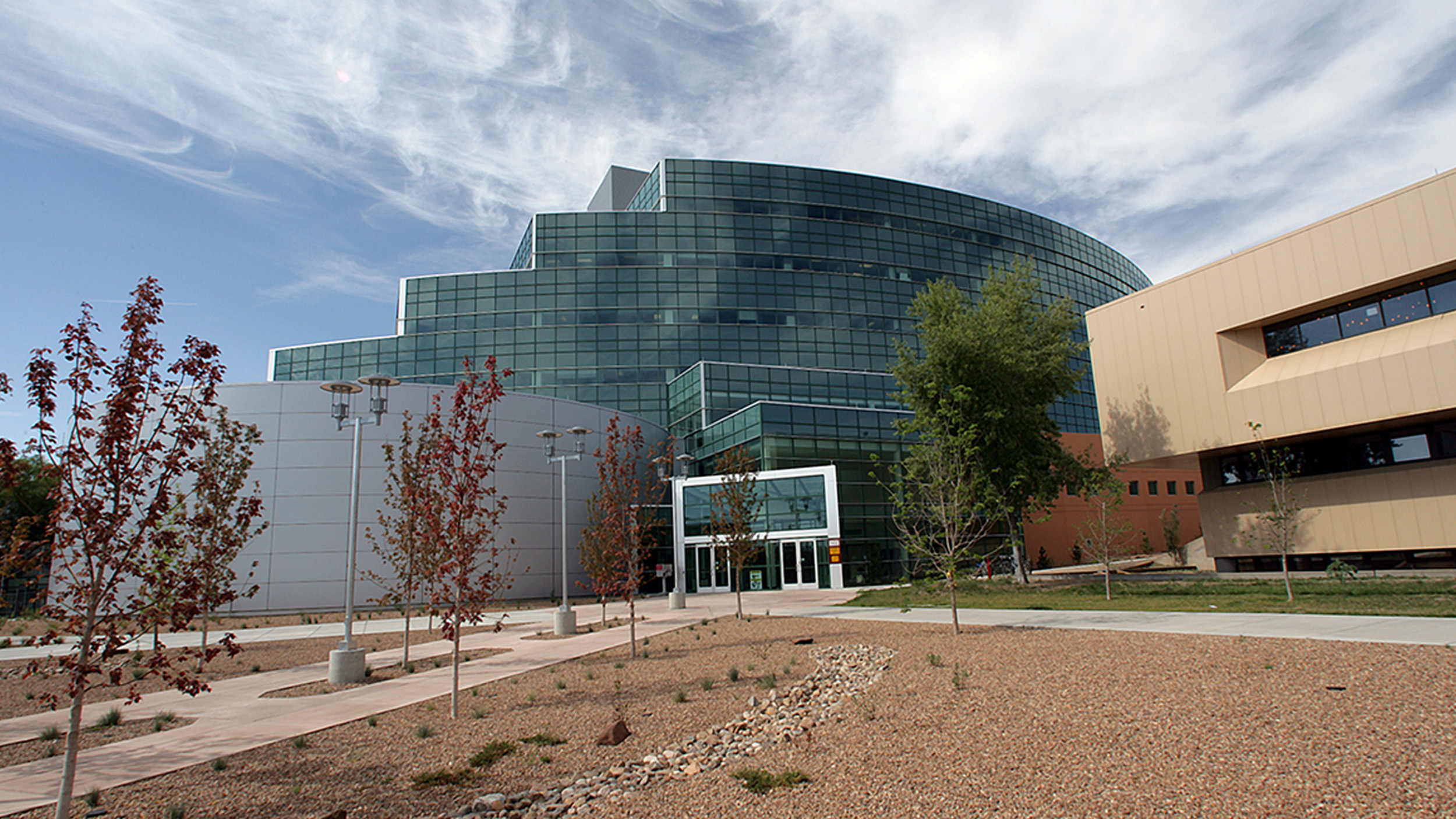
Los Alamos was perfect; well close to perfect compared to elsewhere. For a student who had gotten their shit together, gaining huge ambition, it was a great environment. It was well beyond what a mediocre student from a third-rate university could hope to expect. I jumped in and immediately felt well out of my depth. I loved it and I was bathed in the excellence that defined Los Alamos. Better yet, the culture of Los Alamos was generous to a fault. I could tap into many people who were smarter than anyone I’d ever known. They would share their knowledge willingly and I grew. My work and colleagues were challenging and brilliant. I got better each and every day.

Los Alamos supported me in getting my PhD. The environment made me grow in ways I’d never anticipated. I finished my degree and continued to grow. Los Alamos was like the greatest grad school imaginable. Gradually, I started to feel that I was in my depth. I began to fit in. I began to meet my actual potential. Suddenly, the imposter syndrome that overcame me at Los Alamos disappeared. I was capable and I was an expert now. The excellence of Los Alamos had rubbed off on me. I had imbibed the culture of this magical place, and it transformed me. I had become a Los Alamos scientist and I belonged.

Little did I know that all of this was going to be destroyed by a tidal wave of idiocy and ignorance. The same idiocy and ignorance laying siege to all of us today. What I’ve come to realize the forces were already destroying Los Alamos and places like it for years before. The difference is that the storm was about to turn itself up to gale force. The terrifying fact is that the storm may be about to crank up to catastrophic hurricane force as you read this. Landfall is imminent if not already upon us.If we aren’t careful it will sweep everything good away. The danger is real. Mediocrity will be our legacy.

“The only sin is mediocrity.” ― Martha Graham

Money over Principles; Regulated to Death

“Ignore the critics… Only mediocrity is safe from ridicule. Dare to be different!” ― Dita Von Teese

How did we get to this point? We need to look back in history to the presidency of Ronald Reagan. The generally acknowledged wisdom at Los Alamos is that the Lab peaked in 1980. That was the year that Harold Agnew stepped down as Lab Director. Harold was a key person in the Manhattan Project and witness to major events in that age. Los Alamos went through forgettable leadership while government stewardship passed from the Atomic Energy Commission to the Department of Energy. This was a pure downgrade. The real corrosive influence was the attitudes of the government toward governance. Reagan represented a lack of trust and opposition to all things government. These forces unleashed by Reagan have grown and metastasized into a vile destructive force.

One of the major things coming from this period is a business principle. Milton Friedman’s approach to the business of maximizing shareholder value has become ever-present. It has become an engine of capitalism run amok. Businesses must always grow akin to a cancerous tumor. Sustainable business has gone out of fashion. The thing that matters to science and the Labs is the view that business principles became a one-size-fits-all all-cure to all things. By the mid-2000s this attitude would fully infect the Labs and reap destructive results for these paragons of science. We changed the social contract with the Labs from stewardship for the public good to corporate management. Somehow we thought a guiding principle to serve the Nation was bad. It needed to be replaced by a for-profit business. This change has only brought destruction.

The other force at work and in tandem is the regulation of every risk in sight. This regulation is dual in approach. On the one hand, it is an attempt to manage every single risk possible. It seeks to ensure that bsd things don’t happen. The other purpose is a general lack of trust for each other and institutions. Both of these desires are extremely expensive. Additionally, they are a bizarre way to provide accountability. Rather than leadership being accountable, the blame is projected onto everyone. Ultimately, the regulation ends up standing in the way of accomplishing things while driving up costs. It is inefficient and disempowering. It also speaks to a desire to control outcomes irrationally. The micromanagement of finances is driven by a lack of trust too. It amplifies all our leadership issues. Accomplishment becomes impossible.

The Nation only suffers and the benefits are illusions. The most corrosive influences of shareholder value are two-fold: money as a measure and short-term focus. The end of the Cold War brought the end of generous and necessary funding to the Labs. Congress now deemed it necessary to micromanage the Lab’s work and research. Over the preceding decades the micromanagement has grown to infect every detail of the Lab’s work Congress defines priorities rather than trust the experts. The overhead and intrusion have only powered a continuous lowering of standards and sapping of intellectual vigor. We now have little flexibility and massive oversight of all activities. The result has been continually lowering standards of work along with risk aversion. All of this is in service of controlling work and deflecting blame.

This influence has been modest in comparison to business-inspired management. The shareholder value-driven management philosophy is completely inappropriate for the Lab’s work. The real core of the problem is the lack of trust associated with how the Labs are managed. We have seen an explosion of oversight driven by suspicion and scandal avoidance. Technical work is graded by people who effectively have no independence. The management’s bonuses are dependent on good grades, and the reviewers know it. If you don’t give good grades you aren’t asked to review again. That paycheck is gone for the reviewer. In this way, duty fades away, and money corrupts the process. The Labs continue to be excellent, but it’s all smoke and mirrors. The truth on the ground is decline. Continuous, profound, and sclerotic decline over decades spreads like a cancer choking the Labs.

The problems with the shareholder value philosophy are becoming obvious at a societal level. In business, the approach can be applied to some significant benefit. With limits, this is where the approach has some virtue. It also has limits, such as supercharging inequality as an acute example. Its problems show up in producing sustainable businesses where growth isn’t an objective. This portends a conclusion that for managing science for National Security at the Labs, the idea is absolute lunacy. There is no profit to be had. The short-term focus that the stock market thrives on makes no sense. The result of the management is the destruction of any long-term health. Science at the Labs is withering under the yoke.

“The key to pursuing excellence is to embrace an organic, long-term learning process, and not to live in a shell of static, safe mediocrity. Usually, growth comes at the expense of previous comfort or safety.” ― Josh Waitzkin

Excellence is Hard; Mediocrity is Easy

“Caution is the path to mediocrity. Gliding, passionless mediocrity is all that most people think they can achieve.” ― Frank Herbert

There is little doubt that the Labs used to be great. The apex of this fulcrum is 1980. Los Alamos has faded; Livermore has faded; Sandia has faded too. The USA and the World are poorer for it. The excellence was supported and needed during the Cold War. The stakes of the work happening at the Lab demanded excellence and the Nation allowed it. Just as the USA grabbed victory in the Cold War, the support went. Part of the end of the Cold War was the hubris of “Star Wars”. The whole SDI idea was bullshit, but the excellence of the Labs sold the idea. The lie was huge and the Soviets believed it. The cost was destroying the trust of the Nation in the process. Relying on a bullshit idea like SDI played into the growing anti-government lack of trust.

Part of the issue is the use of financial incentives in management. For example, money can easily corrupt peer review. If it becomes clear that the reviewers are dependent on giving good grades to get a paycheck, the good grades come without the work. This is where the Labs are at. External reviews help determine the executive pay. The end result is that the reviews are always good. A bad review will lead to the reviewers not getting invited. It also projects onto the regulatory impulses where contracts falsely try to control management via regulated peer review. Leaders aren’t empowered and then held accountable simply. The cumulative result is a neutering of feedback. The reviews turn into admiration societies and increasingly have no value at all. For the Lab organizations, the alarm bell never rings, and quality simply degrades year after year.

The root of the issue then becomes the path of least resistance. Excellence is a hard thing to manage and requires focused attention. Mediocrity on the other hand is simple. Especially when all that really matters is the marketing of the work. It is easier to focus on perceptions of the work. Even this becomes simple as it is clear that standards are actually non-existent. You end up focusing on the work that is politically hot and leads to funding. You also focus on work that is flashy or presents well. More toxically, you simply know that the work is “world-class by definition” and the review has baked in results. All of this snowballs into a steady march toward mediocrity. There ends up being very little incentive for excellence to counteract these forces.

“It is difficult to get a man to understand something, when his salary depends on his not understanding it.” ― Upton Sinclair,

The Path Out

How do we get out of this?

While I can retire, I care about these topics deeply. The devolution of the Labs has been painful to watch and makes me seethe with anger. I am saddened for the Nation. These institutions are (or were) National treasures that have been squandered. The combination of mismanagement and lack of trust has wreaked havoc with the quality of the work. In many ways, the things that have hurt the Labs simply parallel the broader ills of society. The way out is similar to how the Country must heal from its downward spiral.

“Bullshit is truly the American soundtrack.” ― George Carlin

Appropriate and excellence-focused management is needed. We need to reorient the incentive structure and objectives for the Labs. The big issues are societal. There needs to be principles and values that transcend money. Excellence needs to have value for its own sake. There should be explicit empowerment to pursue excellence. Excellence needs to be recognized and bullshit needs to be called out. This will be painful. There is a lot of bullshit out there that managers think is great. We also need to take risks and allow failures. Without big risks and failures, excellence cannot grow. Risk and failure need to come from trying to achieve big things. This needs to be recognized for what it is and not punished or mislabeled as incompetence. This is a difficult thing to do. It is especially difficult in a time when bullshit is so regularly accepted.

The Labs need trust. We all need more trust. Trust is empowering. One of the key aspects of the environment that chokes excellence is an obsession with process. Most of this process is the result of mistrust. When there is mistrust there cannot be true excellence. The temptation or suspicion of bullshit is always present. Failure isn’t tolerated and punished. Rather than fail and learn, we fail and lie. Risks aren’t taken either because the downside is too extreme. We exist in an environment where every mistake is punished. The process is there to keep mistakes from happening. The result is no risk. Without risk, there is no progress or innovation. When it is all summed up, we can see that trust is a superpower.

At a deeper level, the difficulty of excellence can be seen to be one of lack of vulnerability. This is reflected in the humility needed for learning and the proper lessons from failures. Failures require trust and fuel the accumulation of expertise. Accepting all of these mishaps requires courage of vulnerability. We all of course see how today’s World chafes against this. Hubris, falsehoods as truths, and outright shameless bullshit are all expected. Vulnerability and failures are met with attacks, punishments, and reprisals. In these vile habits, excellence is snuffed out, and the tumble to mediocrity is catalyzed and becomes inevitable. When bullshit is as respected as truth, knowledge becomes negotiable. Then mediocrity cannot be separated from excellence. This is the state of things today.

“When an honest man speaks, he says only what he believes to be true; and for the liar, it is correspondingly indispensable that he considers his statements to be false. For the bullshitter, however, all these bets are off: he is neither on the side of the truth nor on the side of the false. His eye is not on the facts at all, as the eyes of the honest man and of the liar are, except insofar as they may be pertinent to his interest in getting away with what he says. He does not care whether the things he says describe reality correctly. He just picks them out, or makes them up, to suit his purpose.” ― Harry G. Frankfurt

How V&V Fits Into My Career

05 Saturday Apr 2025

Posted by Bill Rider in Uncategorized

≈ Leave a comment

tl;dr

My career is drawing to a close. In looking back it is obvious that V&V played a crucial role. This was never intended, but rather an outgrowth of other goals. The main driver was numerical methods research. V&V assisted my research and became a secondary focus. Along the way, I encountered remarkable resistance to V&V. This is because V&V challenges expert-based gatekeeping. It replaces their judgment with evidence and metrics. The response from V&V should be transformed into something supported. This is a connection to the classical scientific method applied to computations.

How did V&V intersect my Career?

“What’s measured improves” ― Peter Drucker

I am at a point personally where reflection on the past is quite natural. My professional time at revered institutions is drawing to its natural end. At the same time, my father is nearing death in a slow painful decline. My scientific career seems to be undergoing a parallel decline. It feels like it is crawling to the grave ushered by a lack of vision and strategy everywhere. Science and research options are under siege. Rather than being repaired, the decline is accelerating. Our science and engineering is in deep decline. Money is the ruling principle while quality is ignored. The result is an expanding mediocrity.

I have seen a host of significant events during my career that shaped and framed the World. The Cold War ended at the beginning marked by the Berlin Wall coming down in 1989. Working closely within the institutions that oversee nuclear weapons means that politics matter. World events are never far from shaping the work while providing emphasis to our responsibility. The technical work and its quality have always mattered. The stakes are huge. Events today may dwarf anything else from the span of my career. We shall see. I hope this is hyperbolic, but I fear not.

The quality of our work matters. It should matter more greatly if you are working on nuclear weapons. It is what I believe with all my heart. I’ve always embraced this as a primal responsibility. Verification and validation (V&V) is fundamentally about quality. This is why I got involved with it. The core aspect of V&V is measurement and evidence. It is a way of seeing the details of your work without appealing to expert judgment. It was a reaction to science that is ruled by expert gatekeepers.

Being an expert gatekeeper is a great gig. Usually that gatekeeper role is earned through accomplishments. Once the gatekeeper makes progress they often stand in the way of it. The gatekeepers then oppose anyone who disagrees with them. The gatekeepers are often journal editors and common reviewers. Too often they use this position to act as resistance to change and new ideas. These days the gatekeeper role is supercharged by how funding flows. In a day of science contracting, the money has even more power to strangle progress.

“If you thought that science was certain – well, that is just an error on your part.” ― Richard P. Feynman

How V&V Became a Thing for Me?

When I got started in science I wasn’t doing V&V. I was doing a little V&V, but didn’t know it. Like most of you I copied what I saw in the literature. I found ideas that I gravitated towards and then wrote papers like those scientists. Their papers were the roadmap for how I did my work. You adopt the accepted practices of others Eventually as you find success, you start to adapt. I was fortunate enough to get to work with some big names on a large research project. The tendency of youth is to listen with rapt attention to the experts. Over time, I grew tired of simply trusting experts; I wanted to see the receipts. I trusted and respected their work and judgment, but I also needed evidence.

Version 1.0.0

I started to see the cracks in their story. We were working with a couple of big names in computational physics and applied math. They were some of the scientists whose work I’d loved early on. Every couple of months they would travel to Los Alamos, or we’d travel to California for a project meeting. At these project meetings, we would be lectured on the “gospel” of the work. The issue was that the “gospel” changed a little bit each time. Eventually, I found that I needed to start doing everything myself. I needed to understand in detail of the “gospel”. I needed to see the evidence and verify what I heard.

“In questions of science, the authority of a thousand is not worth the humble reasoning of a single individual.” ― Galileo Galilei

This process was my real transformation into a V&V person. I created an independent implementation of everything including testing. I would reproduce tests done by others and then create my own tests. During this time I documented everything and began to adopt my basic mantra of code testing. This mantra is “always know the limits of your code, and how to break it.” This meant I understood where the code worked well and where it fell apart. It tells you where you can safely use the code.

It also tells you where the code falls apart. This is where you should do work to make things better. This should set the research agenda. I have always seen V&V as a route to progress instead of simply measuring capability. V&V should provide evidence to support expanding capabilities. Today, the route to progress via V&V is weak to non-existent.

One of the lessons I learned was the separation between robustness and accuracy tests. Progress happens through transitioning robustness tests into accuracy tests. A robustness test is basically “Can the code survive this and give any answer?”. The accuracy test is “Can the code give an accurate answer?” This was useful then and continues to be a maxim today. We should always be pushing this boundary outward. This is a mechanism to raise capability and do better.

“We learn wisdom from failure much more than from success. We often discover what will do, by finding out what will not do; and probably he who never made a mistake never made a discovery.” ―Samuel Smiles

The Problem with V&V

“There’s nothing quite as frightening as someone who knows they are right.” ― Michael Faraday

In short order, I moved to the Weapons Physics Division in Los Alamos (the infamous X-Division). X-Division was ramping up development efforts to support Stockpile Stewardship. This was the ASCI program. The initial ASCI program was basically writing codes for brand-new supercomputers. The focus was on the computers first and foremost, but the codes were needed to connect to nuclear weapons. The progress was the desire to change from existing codes denoted as “legacy” to new codes. New codes were mostly needed because of the change in computers. This was not about writing better codes, but just using better computers.

The rub was that the legacy codes were trusted by the people who designed weapons. They were the simulation tools used to design weapons in the era when we tested these more fully. This trust was essential to the results of the codes. The new codes were not trusted. To replace the legacy codes this trust needed to be built. One of the mechanisms to build trust was defined as the processes known as V&V. The key part of the trust was validation. Validation is the comparison of simulations with experimental data. The problem with V&V is a certain emotionless approach to science. V&V is process-heavy and emotionless.

“The measure of intelligence is the ability to change.” ― Albert Einstein

Why is the process a problem?

The trust and utility of the legacy codes were mostly granted by experts. The people who designed weapons were the experts! “Designers”. They took an adversarial view of V&V and its process. This process is not expert-based, but rational and metric-based. What I have seen over and over in my career is tension between experts and process. V&V is rejected because of its non-expert rational approach. It was also rather dry and dull compared to the magic of modeling nature on computers. My original love of modeling on the computer was the embrace of its “magic.” It’s fair to say this same magic enchanted others.

I believe that the biggest problem for V&V is the dullness and process. V&V needs to capture more of the magic of modeling. The whole attraction of science is the ability of theory to explain reality. Computation is the way to solve complex models. This is part of the very essence of the scientific method.

“Any sufficiently advanced technology is indistinguishable from magic.” ― Arthur C. Clarke

Seeing V&V Clearly

The V&V program was added to the ASCI program in 1998. It tried to fill the gap of rational process in adopting the new codes. This rational process was supposed to build trust in these codes. Implicitly this put it into direct conflict with the power of experts. Nonetheless, V&V grew and adapted to the environment gaining adherents and mindshare. We can see V&V growing in other parts of the computational modeling world. In broad terms, V&V grew in importance through the period of 2000-2010. After this, it peaked and now has started to decay in interest and importance. IMHO the reason for this is how dull and process-oriented V&V tends to be.

“Magic’s just science that we don’t understand yet.” ― Arthur C. Clarke

A big part of this decay is the continued resistance by experts to the process aspects of V&V. I experienced it directly with my own work. I had the journal editor tell me to “get that shit out of the paper.” While the resistance to V&V at Los Alamos was driven by designer culture. Resistance to V&V was far less at Sandia, but still present. Engineers love processes, but physicists don’t. Still, V&V gets in the middle of processes engineering analysts like. For example, both designers and analysts like to calibrate results.

“The most serious mistakes are not being made as a result of wrong answers. The true dangerous thing is asking the wrong question.” ― Peter Drucker

They like to calibrate to data so that the simulations match experiments well. Worse yet they like to calibrate in ways that are not physically defensible. I’ve seen it over and over at Los Alamos (Livermore too) and Sandia. V&V stands in opposition to this. The common perspective is that V&V is accepted only so long as the results rubber stamp the designer-analyst views. If V&V is more critical, the V&V is attacked. The cumulative effect is for V&V to wane. We see V&V get hollowed out as a discipline.

“We may not yet know the right way to go, but we should at least stop going in the wrong direction.” ― Stefan Molyneux

Another program added to V&V’s waning influence. The exascale program spun up around 2015. In many respects, this program was a redux of the original ASCI with a pure focus on supercomputing. Moore’s law was dying and the USA doubled down on supercomputing research. This program was far more computer-focused than ASCI ever was. It also didn’t try to replace legacy code but rather focused on rewriting the legacy codes. This reduced resistance. It also reduced progress. At least the original ASCI program wrote new codes, which energized modernizing codes. The exascale program lacked this virtue almost entirely. Hand-in-hand with the lack of modernization was a lack of V&V. There was no V&V focus in the exascale. The exascale view was simply that legacy methods are great and just need faster computers. To say this was intellectually shallow is an understatement of extreme degree.

“Management is doing things right; leadership is doing the right things.” ― Peter Drucker

My own theory was that V&V needed to move past its focus on process. V&V needed to be seen differently. My observation was that V&V was really just the scientific method for computational modeling. Verification is a confirmation of solving the theory correctly. Validation is the comparison of theory with experiments (or observation). The real desire here is to connect V&V to the magic of modeling. I wanted to make V&V more smoothly part of the things I love about science and attracted me to this career in the first place.

What Can We Learn?

“Men of science have made abundant mistakes of every kind; their knowledge has improved only because of their gradual abandonment of ancient errors, poor approximations, and premature conclusions.” ―George Sarton

If I look back across my career a few things stick out. One is how the programs rhyme with each other. The original ASCI program was much like the Exascale program. We learned how to fund a focus on big hardware purchases, but not the science parts. In almost every respect the Exascale program was worse than ASCI. It was much less science and much more computers. The way this happened reflects greatly on the forces undermining science more broadly. Computers get interest from Congress, but science and ideas don’t. That interest creates the funding needed, and everything runs on money. Money has become the measure of value for everything today.

“People who don’t take risks generally make about two big mistakes a year. People who do take risks generally make about two big mistakes a year.” ― Peter F. Drucker

The biggest lesson is how irrational science is. Emotions matter a lot in how things play out. We would like to think science is rational, but it’s not. Experts are gatekeepers and they like their power. Rational thought and process are the expert’s enemy. V&V is unrelentingly rational and process-based. Thus the expert will fight V&V. Experts also tend to be supremely confident. This is the uphill climb for V&V and the basis of its decline. The other piece of this is money and its power. Money is not terribly rational, and very emotional. It is the opposite of principle and rationality. This combines to sap the support for V&V.

None of this changes the need for V&V. The thing needed more than anything is a devotion to progress. V&V is a tool for measuring progress and optimizing the targeting of progress. The narrative of V&V as the scientific method also connects better with emotion. In the long run a better narrative and devotion to progress will rule and V&V should play its role.

“The best way to predict your future is to create it” ― Peter Drucker

“The only way of discovering the limits of the possible is to venture a little way past them into the impossible.” ― Arthur C. Clarke

Rider, W. J. “Approximate projection methods for incompressible flow: implementation, variants and robustness.” LANL UNCLASSIFIED REPORT LA-UR-94-2000, LOS ALAMOS NATIONAL LABORATORY. (1995).

Puckett, Elbridge Gerry, Ann S. Almgren, John B. Bell, Daniel L. Marcus, and William J. Rider. “A high-order projection method for tracking fluid interfaces in variable density incompressible flows.” Journal of computational physics 130, no. 2 (1997): 269-282.

Drikakis, Dimitris, and William Rider. High-resolution methods for incompressible and low-speed flows. Springer Science & Business Media, 2005.

Rider, William J., and Douglas B. Kothe. “Reconstructing volume tracking.” Journal of computational physics 141, no. 2 (1998): 112-152.

Greenough, J. A., and W. J. Rider. “A quantitative comparison of numerical methods for the compressible Euler equations: fifth-order WENO and piecewise-linear Godunov.” Journal of Computational Physics 196, no. 1 (2004): 259-281.

Rider, William J., Jeffrey A. Greenough, and James R. Kamm. “Accurate monotonicity-and extrema-preserving methods through adaptive nonlinear hybridizations.” Journal of Computational Physics 225, no. 2 (2007): 1827-1848.

Verification Is Essential; Verification is Broken

23 Sunday Mar 2025

Posted by Bill Rider in Uncategorized

≈ 2 Comments

tl;dr

The practice of verification is absolutely essential for modeling and simulation quality. Yet, verification is not a priority; quality is not a priority. It is ignored by scientific research. This is because verification is disconnected from modeling. Also, it is not a part of active research. The true value of verification is far greater than simple code correctness. With verification, you can measure the error in the solution with precision. Given this, the efficiency of simulations can be measured accurately (efficiency equaling effort for given accuracy). Additionally, the resolution required for computing features can be estimated. Both of these additions to verification connect to the broader scientific enterprise of simulation and modeling. This can revitalize verification as a valued scientific activity.

“Never underestimate the big importance of small things” ― Matt Haig

The Value of Verification

“Two wrongs don’t make a right, but they make a good excuse.” ― Thomas Szasz

Conceptually, verification is a simple prospect. It has two parts; is a model correct in code and how correct is it? Verification is structured to answer this question. Part one about model correctness is called code verification. Part two is about accuracy called solution verification. This structure is simple and unfortunately lacks practical priority. This leads to the activity being largely ignored by science and engineering. It shouldn’t be, but it is. I’ve seen the evidence in scientific proposals. V&V is about evidence and paying attention to it. There is a need to change the underlying narrative around verification.

Under the current definition, code verification relies upon determining the order of accuracy for correctness. There is nothing wrong with this. The order of accuracy should match the design of the code (method) for correctness. This is connected to the fundamental premise of advanced computers. More computing leads to better answers, This is the process of convergence where solutions get closer to exact. This produces better accuracy. Today this premise is simply assumed and evidence of it is not sought. Reality is rarely that simple. Solution verification happens when you are modeling and do not have access to an exact solution. It is a process to estimate the numerical error. These two things complement each other.

“The body of science is not, as it is sometimes thought, a huge coherent mass of facts, neatly arranged in sequence, each one attached to the next by a logical string. In truth, whenever we discover a new fact it involves the elimination of old ones. We are always, as it turns out, fundamentally in error.” — Lewis Thomas

In code verification, you can also computer the error precisely. The focus on the order of convergence dims the attention to error. Yet the issue of error in science is primal. Conversely, the focus on errors in solution verification dims the order of convergence there. In doing work with verification both metrics need to be focused upon equally. Ultimately, the order of accuracy and diminishing of error should be emphasized.

As will be discussed later, the order of accuracy influences the efficiency mightily. A broad observation from my practical experience is that the order of accuracy in application modeling is low. It is lower than expected in theory. It is lower than the method designed going into codes. Thus, the order of convergence actually governs the efficiency of numerical modeling. This is combined with the error to determine the efficiency of the simulation.

“The game of science is, in principle, without end. He who decides one day that scientific statements do not call for any further test and that they can be regarded as finally verified, retires from the game.” — Karl Popper

Why Verification is Broken?

Verification is broken because it is disconnected from science. It has been structured to be irrelevant. In reviewing more than 100 proposals in modeling and simulation over a few years this is obvious. Verification as an activity is beneath mentioning. When it is mentioned it is out of duty. It is simply in the proposal call and mentioned because it is expected. There is little or no earnest interest or effort. Thus the view of the broader community is that verification is an empty activity, not worth doing. It is done out of duty, but not out of free will.

I should have seen this coming.

“True ignorance is not the absence of knowledge, but the refusal to acquire it.” — Karl Popper

Back in the mid-oughts (like saying that!) I was trying to advance methods for solving hyperbolic conservation laws. I had some ideas about overcoming the limitations of existing methods. In doing this work it was important to precisely measure the impact of my methods compared with existing methods. Verification is the way to do this. I highlighted this in the paper. The response to the community via the review process was negative,… very negative,… very fucking negative.

In the end, I had to remove the material to get the paper published. I got a blunt message from an associate editor, “if you want the paper published, get that shit out of your paper”. By “shit” they meant the content related to verification. I’ll also say this is someone I know personally, so the familiarity in the conversation is normal. Even worse this comes from someone with a distinguished applied math background with a great record of achievement. You find that most of the community despises verification.

I will note in passing that this person’s work actually does very well in verification. In another paper, I confirmed this. For more practical realistic problems it does far better than a more popular method. It would actually benefit greatly from what I propose below. What had become the publication standard was a purely qualitative measure of accuracy for the calculations that matter. Honestly, this attitude is stupid and shameful. It is also the standard that exists. As I will elaborate shortly, this is a massive missed opportunity. It is counter-productive to progress and adoption of better methods.

I found this situation to be utterly infuriating. It was deeply troubling to me too. When I stepped back to look at my own career path I realized the nexus of the problem. Back in the 1990’s I got into verification. I used verification to check the correctness of the code I wrote, but it was not the real value. I used verification to measure the efficiency and errors in the methods I developed. I used it to measure the error in the modeling I pursued. The direct measure of error and its comparison to alternatives was the reason I did it. It provides direct and immediate feedback on method development. These notions are absent from the verification narrative. Measuring and reducing errors is one of the core activities of science. It is the right way to conduct science.

Verification needs to embrace this narrative for it to have an impact.

How to Fix Verification?

“I ask you to believe nothing that you cannot verify for yourself.” — G.I. Gurdjieff

As noted above, the key to fixing verification is to keep both orders of accuracy and numerical accuracy in mind. This is true for both code and solution verification. The second part of the fix is expanding the utility of verification. Verification can measure the efficiency of methods. What I mean by efficiency requires a bit of explanation. The first thing is to define efficiency.

Simply put, efficiency is the amount of computational resources used to achieve a certain degree of accuracy. The resource would be defined by mesh size and number of time steps (degrees of freedom). The algorithm used to solve the problem would combine to define the amount of computer memory and a number of operations to use. Less is obviously better. Runtime for a code is a good proxy for this. Lower accuracy is also better. The convergence rate defines the relationship between the amount of effort and accuracy. The product of these two defines the efficiency. Lower is better for this composite metric.

The first time I published something that exposed this was with Jeff Greenough. We compared two popular methods on a set of problems. One was the piecewise linear method using Colella’s improvements (fourth-order slopes). It was a second-order method. The second method is the very popular Weighted ENO method, which is fifth-oder in space and third-order in time. Both of these methods are designed to solve shock wave problems. One might think that the fifth-order method should win every time. This is true if you’re solving a problem where this accuracy matters. The issue is that all the applications of these methods are limited to first-order at best.

“Science replaces private prejudice with public, verifiable evidence.” — Richard Dawkins

This is where the accepted practice breaks down. When Gary Sod published his test problem and method comparison the only metric was runtime. Despite having an analytical solution, no error was measured. Results for the Sod shock tube problem are always qualitative. Early on, results were bad enough that qualitative mattered. Today all the results are qualitatively good and vastly better than nearly 50 years ago. This is accepted practice and implies that there is no difference quantitively. This is objectively false. At a given mesh resolution the error differences are significant. I showed this with Jeff for two “good” methods. As I will further amplify in what follows, at the lower convergence rates in shocks the level of error means vast differences in efficiency. This is true in 1-D and becomes massive in 3-D (really 2-D and 4-D when you add in time).

“The first principle is that you must not fool yourself and you are the easiest person to fool.” — Richard P. Feynman

It turns out that the 5th-order WENO method is about six times as expensive as the 2nd-order PLM scheme. This was true of the desktop computers of 2004. It is close to the same now. The WENO method might have better computational intensity and have advantages on modern GPUs. What we discovered was that the second-order method produced half the error of the WENO method on simple problems (Sod’s shock tube). Thus the WENO method didn’t really pay off. At first-order convergence, this would mean that WENO would need about 24 times the effort to match the accuracy of PLM. For problems with more structure, the situation gets marginally better for WENO. In terms of efficiency, WENO never catches up with PLM, ever. As we will shortly see in 3-D the comparison is even worse. The cost of refining the mesh is much more costly and the accuracy advantage grows.

“Whatever you do will be insignificant, but it is very important that you do it.” ― Mahatma Gandhi

If This is Done, Verification’s Value Skyrockets

“The truth is rarely pure and never simple.” ― Oscar Wilde

Let’s consider a simple example to explain. Consider a method that is twice as expensive and twice as accurate as another method. The methods produce the same order of convergence. The order of convergence matters a great deal in determining efficiency. Consider three-dimensional time-dependent calculations. If the methods are fourth-order accuracy there is a break even. For any lower order of convergence the higher cost, more accurate method wins. The lower the order of convergence the greater the difference. For first-order the advantage is a factor of eight. By the time you drop to half-order convergence, the advantage grows to 128 times.

This example provides a powerful punchline to efficiency. If the order of accuracy is fixed, the level of accuracy makes a huge difference in efficiency. This points to the power of both algorithms and verification in demonstrating the metrics. It is absolutely essential for verification to amplify its impact on science.

“It’s easy to attack and destroy an act of creation. It’s a lot more difficult to perform one.” — Chuck Palahniuk

For problems solving hyperbolic PDEs, the convergence rates are well defined by theory. For the nonlinear compressible structures, the rate is defined as first-order. For linear waves (that Lax defined as linearly degenerate) the convergence rate is less than one. Thus the impact of accuracy is greater. In my experience, first-order accuracy is optimistic for practical application problems. Invariably the accuracy for practical problems codes are applied to are low order. Thus the accuracy for smooth problems where code verification is done has little relevance. This can show that the method is correct as derived, but not relate to the method’s use.

Code verification needs to focus on results that relate more directly to how methods are used practically. This is a challenge that needs focused research. Rather than a check done before use practically, code verification needs utility in the practical use. Today this is largely absent. This must change.

The other great use is the study of efficiency. With Moore’s law, dead and buried algorithms are the path to computational progress. In addition, the use of verification is needed for the expanding use of machine learning (ML, the techniques used for artificial intelligence). The greatest gaps for ML are the absence of theory to support verification. This is closely followed by a lack of accepted practice. Again, this supports algorithm development, which is the path to progress when computing and data are limited.

“The important thing is not to stop questioning. Curiosity has its own reason for existing.” ― Albert Einstein

Greenough, J. A., and W. J. Rider. “A quantitative comparison of numerical methods for the compressible Euler equations: fifth-order WENO and piecewise-linear Godunov.” Journal of Computational Physics 196, no. 1 (2004): 259-281.

Rider, William J., Jeffrey A. Greenough, and James R. Kamm. “Accurate monotonicity-and extrema-preserving methods through adaptive nonlinear hybridizations.” Journal of Computational Physics 225, no. 2 (2007): 1827-1848.

Sod, Gary A. “A survey of several finite difference methods for systems of nonlinear hyperbolic conservation laws.” Journal of computational physics 27, no. 1 (1978): 1-31.

Colella, Phillip. “A direct Eulerian MUSCL scheme for gas dynamics.” SIAM Journal on Scientific and Statistical Computing 6, no. 1 (1985): 104-117.

Jiang, Guang-Shan, and Chi-Wang Shu. “Efficient implementation of weighted ENO schemes.” Journal of computational physics 126, no. 1 (1996): 202-228.

Majda, Andrew, and Stanley Osher. “Propagation of error into regions of smoothness for accurate difference approximations to hyperbolic equations.” Communications on Pure and Applied Mathematics 30, no. 6 (1977): 671-705.

Banks, Jeffrey W., T. Aslam, and William J. Rider. “On sub-linear convergence for linearly degenerate waves in capturing schemes.” Journal of Computational Physics 227, no. 14 (2008): 6985-7002.

Trust, But Verify (for Computing)

14 Friday Mar 2025

Posted by Bill Rider in Uncategorized

≈ Leave a comment

tl;dr

A faster computer is always a good thing. It is not the best way to get faster or better results. A better program (or method or algorithm) is as important, if not more so. A new algorithm can be transformational and create new value. The faster computer also depends on a correct program, which isn’t a foregone conclusion. Demonstrating that things are done right is also difficult. Technically, this is called verification. Here, we get at the challenges of doing verification across the computing landscape. This is especially true as machine learning (AI) grows in importance where verification is not possible today.

“The man of science has learned to believe in justification, not by faith, but by verification.” ― Thomas H. Huxley

The Basic Premise of Better Computing

All of us have experienced the joy of a faster computer. We buy a new laptop and it responds far better than the old one. Faster internet is similar and all of a sudden streaming is routine and painless. If your phone has more memory you can more freely shoot pictures and video at the highest resolution. At the same time, the new computer can bring problems we all recognize. Often our software does not move smoothly over to the new computer. Sometimes a beloved program is incompatible with the new computer and a new one must be adopted. This sort of change is difficult whenever it is encountered.

Each of these commonplace things has a parallel issue in the more technical professional computing world. There are places where proving the improvement from the new computer is difficult. In some cases, it is so difficult that it is actually an article of faith, not science. It is in these areas where science needs to step up and provide means to prove. My broad observation that the faster, bigger computer as a good thing is largely an article of faith. Without the means to prove it, we are left to believe. Belief is not science or reliable. By and large, we are not doing the necessary work to make this a fact. This means recognizing where the gaps result in the faith is being applied dangerously.

A more critical issue is the recession of algorithmic progress. As we struggle to have faster computers as in the past, algorithms are the means to progress. Instead, we have doubled down on computers as they become worse paths to progress. This is just plain stupid. Algorithmic progress requires different strategies for adopting risky failure-prone research. Progress in algorithms occurs in leaps and bounds after long fallow periods. It also requires investments in thinking particularly in mathematics.

“If I had asked people what they wanted, they would have said faster horses.” ― Henry Ford

Verification in Classical Computational Science

“Trust, but verify.” ― Felix Edmundovich Dzerzhinsky

Where this situation is the clearest is traditional computational science. In areas where computers are employed to solve science problems classically, the issues are well known. To a large extent, mathematical foundations are firmly established and employed. The math is a springboard for progress. A long and storied track record of achievement exists to provide examples. For the most part, this area drove early advances in computing and laid the groundwork for today’s computational wonders. For most of the history of computing, scientific computing drove all the advances. All of it is built on a solid foundation of mathematics and domain science. Today progress lacks these advantages.

In no area was the advance more powerful than the solution of (partial) differential equations. This was the original killer app. Computers were employed to design nuclear weapons, understand the weather, simulate complex materials, and more. These tasks produced the will to create generations of supercomputers. It also drove the creation of programming languages and operating systems. Eventually, computers leaked out to be used for business purposes. Tasks such as accounting were obvious along with related business systems. Still scientific computing was the vanguard. It is useful to examine its foundations. More importantly, it is useful to see where the foundations in other areas are weak. We have a history of success to guide our path ahead.

The impact of computing on society today is huge and powerful It forms the basis of powerful businesses. The incredible run-up of the stock market is all computing. The promise of artificial intelligence is driving recent advances. Most of this is built on a solid technical foundation. In key areas of progress, the objective truth of improvements is flimsy. This is not good. We are ignoring history. In the long run, we are threatening the sustainability of progress and economic success. We need sustained strategic investment in mathematical foundations and algorithmic research. If not, we put the entire field at extreme risk.

If one goes back to the origins of computational science, the use of it showed promise first. First in application to nuclear weapons then rapidly with weather and climate. Based on this success the computers were advanced as the technology was refined. As these efforts began to yield progress mathematics joined. One of the key bits of theoretical work was conditions for proper numerical solutions of models. Chief among this theory was the equivalence theorem by Peter Lax (along with Robert Richymyer). This theorem established conditions for the convergence of solutions to the exact solution of models. Convergence means that as more computing is applied, the solution gets closer to exact.

This is the theoretical justification for more computing. More computing power produces more accuracy. This is a pretty basic assumption made with computing, but it does not come for free. To get convergence the methods must do things correctly. In the same breath, the theory of how to do things better as well. Just as importantly, the theorem gives us guidance on how to check for correctness. This is the foundation for the practice of verification.

In verification, we can do many things. In its simplest form, we get evidence of the correctness of the method. We can get evidence that the method is implemented and provides the accuracy advertised. This is essential for trustworthy, credible computational results. With these guarantees in place, the work done with computational science can be used with confidence. This confidence then allows it to be invested in and trusted. The verification and theory provided confident means to improve methods and measure the impact. For 70 years this has been a guiding light for computational science.

We should be paying attention to its importance moving forward. We are not.

Machine Learning and Artificial Intelligence Are An Issue

“If people do not believe that mathematics is simple, it is only because they do not realize how complicated life is.” ― John von Neumann

More recently, the promise of artificial intelligence (AI) has grabbed the headlines. Actually, the technical foundation for AI is machine learning (ML). The breakthrough of generative AI with Large Language Models (LLMs) has rightly captured the world’s imagination and interest. A combination of algorithm (method) advances with high-end computing, powers LLMs. These LLMs are one of the strongest driving forces in the World economically. Their power is founded partly on the fruits of computational science discussed above. This includes computers, software, and algorithms. Unfortunately, the history of success is not being paid sufficient attention to.

The current developments and investments in AI/ML are focused on computers (Big Iron following the exascale program’s emphasis). Secondarily software is given much attention. Missing investments and attention are algorithms and applied math. We seem to have lost the ability to provide focus and attention on laying the ground for algorithm advances. A key driver for algorithmic advances is applied mathematics where the theory guides practice.

For the formative years of computational science applied math gave key guidance. Theoretical advances and knowledge are essential to progress. Today that experience seems to be on the verge of being forgotten. The irony is that the LLM breakthrough in the past few years was dominated by algorithmic innovation. This is the transformer architecture. The attention mechanism is responsible for the phase transition in performance. It is what produced the amazing LLM results that grabbed everyone’s notice. Investments in mathematics could provide avenues for the next advance.

What is missing today is much of the mathematical theory driving credibility and trustworthy methods.

One of the essential aspects of computational science is the concept of convergence. Convergence means more computation yields better results. Mathematics provides the theory underpinning this idea. The process to demonstrate this is known as verification. In verification, convergence is used to prove the correctness and accuracy of algorithms. One of the biggest problems for AI/ML is the lack of theory. This problem is a lack of rigor. Thus the process of verification is not available. Furthermore, the understanding of accuracy for AI/ML is similarly threadbare. Investments and focus to fill these gaps is needed and long overdue.

One of the problems is that this research is extremely difficult and success is not guaranteed. It is likely to be failure-prone and takes some time. Nonetheless, the stakes of not having such a theory are growing. Moreover, success would likely provide pathways for improving algorithms. Many essential ML methods are ill-behaved and perform erratically. Better mathematical theory involving convergence could pave the way for better ML. The theory tells us what works and how to structurally improve techniques. This is what happened in computational science. We should expect the same for AI/ML. Likely, this work would significantly improve trust in systems as well. The combination of trust, efficiency, and accuracy should sufficiently inspire investments. This is if a logical-rational policy was in place.

It is not. Either by the government or the private enterprise. We will all suffer for this lack of foresight.

“Today’s scientists have substituted mathematics for experiments, and they wander off through equation after equation, and eventually build a structure which has no relation to reality. ” ― Nikola Tesla

Algorithms Win and Verification Matters

Anyone who has read my writing knows that algorithms are a clear winning path for computing. Verification is the testing and measurement of algorithmic performance. If one is interested in better computing algorithmic verification is a vehicle for progress. Verification is about producing evidence of correctness and performance. This provides a concrete measurement of algorithmic performance, which can be an engine for progress. In a future without Moore’s law algorithms are the path to improvement.

“Pure mathematics is in its way the poetry of logical ideas.” ― Albert Einstein

As I’ve written before, algorithmic improvement is currently hampered by a lack of support. Some of this is funding and the rest is risk aversion. Algorithmic research is highly failure prone and progress is episodic. A great deal of tolerance for risk and failure is necessary for algorithm advances. All of this can benefit from a focused verification effort. This can measure the impact of work and provide immediate feedback. The mathematical expectations underpinning verification can also provide the basis for improvements. This math provides focus and inspiration for work.

“We can only see a short distance ahead, but we can see plenty there that needs to be done.” ― Alan Turing

Who is Leading?

22 Saturday Feb 2025

Posted by Bill Rider in Uncategorized

≈ Leave a comment

tl;dr

There is a fundamental problem with leadership in the USA. They don’t seem to exist. The supposed national leaders like Trump and Musk aren’t. They destroy in the name of greed and corruption. They pose as leaders. Our supposed leaders aren’t honest or direct with people. In their own way, all of them lie to us. It is time to have leaders who deal with objective reality and fix problems. People are hungry for real leaders, and current events will only fuel that hunger.

“The challenge of leadership is to be strong, but not rude; be kind, but not weak; be bold, but not bully; be thoughtful, but not lazy; be humble, but not timid; be proud, but not arrogant; have humor, but without folly.” ― Jim Rohn

The Problem

I had an entirely different topic teed up for the week. I was thinking about the balance between nostalgia and progress. Then the week happened. I needed to address the rampaging elephant in the room. We have a “leader” who is destroying our Nation through an avalanche of stupidity, raw power, and greed. On the other hand, I was locally offered an example of how current leadership fails. We get more toxic positivity and failure to directly address reality. Instead, we get a filter where only positive things are spoken openly.


“He who cannot be a good follower cannot be a good leader.” ― Aristotle

I always worry when I’m writing from the heart and my heart is angry. I am definitely angry these days. This anger comes from the event we all see unfolding in the news. Trump and Musk are trampling the Constitution with impunity. The USA may not be a democracy in weeks if it still is. Our government is being fed into the chipper shredder. Cruelty, stupidity, ignorance, and incompetence are on display almost beyond bounds. I am also angry at the impotence of the Democrats in the face of this. I am angry at the cowardice and meekness of my work leaders. How anyone with a working brain can see business as usual today is beyond imagination. Yet, this is what I see. Work is just business as usual while a Category 5 Political-Hurricane is making landfall. Disaster and catastrophe are upon us.

It is very clear that most voters are fed up with the Nation’s direction. A clear majority thinks things are broken. I am among them. The whole secret to Trump’s success is that he is different. To many he seems strong and challenges all our norms. This is less about Trump’s qualities than the failures of existing leadership. Enough voters simply ignored his legion of faults and put him in charge. They ignored his endless lies and corruption along with a lifetime of criminal behavior. The reason they did this is a scathing indictment of our pathetic leadership class. A reality TV show star is seen as being better.

“Never confuse movement with action.” ― Ernest Hemingway

The Problem Up Close

“Failure doesn’t define you. It’s what you do after you fail that determines whether you are a leader or a waste of perfectly good air.” ― Sabaa Tahir

I got to see another example of how pathetic our institution’s leaders are recently. We had a great internal workshop that brought together one of our big programs. It was great to see the work and all the people. The program has many wonderful, smart, and talented people. The problem is that our leadership is pretty standard these days. Therefore they are shitty and weak. There is little honesty or courage to be seen. It mirrors all the issues responsible for putting Trump in office. It is worth taking a look at why. Once the carnage that Trump and Musk transpires we might get to rebuild something to be proud of. That is if we have leaders worth a shit.

Why is the leadership so shitty? One way of pointing to it is a habit of practicing toxic positivity. Basically, profound and obvious problems are simply ignored in public. The public face is unremittingly positive and any voice that speaks reality is refuted. You cannot talk about problems openly. If you do, you are criticized. The end result is a lack of credibility for the leadership. Whenever they talk about something you really know about, you see the lies. You see the omissions of problems. If you know the ground truth, the gaps with reality are vast. I remember talking to someone at a class I took who told me a story. They had an all-hands meeting where a certain program was lauded. In the afternoon that program was cancelled. Management credibility was too.

They are bullshitting people or they aren’t competent enough to see actual problems. I’m not sure what is worse?

I asked a specific question about an important topic, artificial intelligence. I pointed out that security issues have undermined all the greatest breakthroughs in information technology locally. Search is the primal example from the late 90’s. When Google came out and introduced it, their search was an epiphany. The internet opened up and became something magical. Conversely, our internal search sucks. It sucks because it can’t see the data that would make it work well. We’ve also blown the benefits of smartphones and social media. I wondered “Are we going to blow it with AI too?” It is a reasonable question. Given their track record, we should assume they will fuck this up too. They will certainly fuck this up if they don’t admit the faults of the past.

Yes, I politely asked this without any expletives. I’ll note in passing that this is another way Trump’s norm-breaking signals that he’s different.

Our leader’s response was “Well that was harsh”.

It’s amazing how incapable of taking any critique they are. If they were actual leaders this wouldn’t happen. Rather than welcome someone being honest and direct, they deflect. These “leaders” are more interested in making everything sound good and in control. This was followed by the usual chickenshit bullshit answer too. They’re always on top of things, yet things never get fixed. So, it was another plea for new leadership. It is another reason to think they’ll never make things better. In summary, these attitudes render capable people completely incompetent and unfit to lead. Our culture is prizing toxic positivity, and the comfort of institutions over actual leadership.

Suddenly, I looked at what was happening to the Nation and it became clear. The absolute failure of our usual leaders paved the way for our budding dictatorship. It is on the verge of triggering a Constitutional crisis that will end the USA as a functioning democracy. All because our leaders won’t lead and won’t deal with a reality teeming with problems.

The Solution is a Bigger Problem

“The reasonable man adapts himself to the world: the unreasonable one persists in trying to adapt the world to himself. Therefore all progress depends on the unreasonable man.” ― George Bernard Shaw

Because we have lived with these pathetic leaders for decades, we now sit at the edge of catastrophe. For years people have increasingly hungered for change and actual leaders. This has laid the groundwork for the horrible choice Americans made recently. People are so hungry for leadership that they chose a fake reality show CEO as President. Worse yet, someone devoid of deep ideas with an endless appetite for corruption, law-breaking, and cruelty. Instead of finding brave competent leaders who set an example and solve problems, we have the opposite. The cure is almost certain to be worse. We sit at the precipice of a catastrophe that may effectively destroy a nation.

This seems to be the desire for action and movement of any sort. Most of the leaders today simply cannot deal with the balance between good and bad news. Their collective approach of highlighting the good while ignoring the bad has fueled a slow steady decline. Problems are allowed to fester and grow without relief year after year. In my own institutions, I have witnessed the constant erosion year after year. People across the country see the same as a slow decline. We see the decline in our institutions and feel a growing malaise. It is this feeling and lack of action by traditional leaders that has brought us to the brink of disaster. It has become a habit and is accepted without complaint.

We have the problem of growing inequality and our leadership is drawn from those benefiting from it. They do not feel the weight of our collective problems. Their world is different from those they lead. The additional complication is that fixing things is really hard. The status quo is easy. Destroying things is also very easy. Since lazy greedy people have been in charge they take the easy route. The new easy route is destruction. Destruction is what we are going to get. For many Americans this destruction is going to look like action. This action will ultimately meet reality and that reality is going to be brutal.

Americans are well-to-do and generally prosperous. A big component of this is delivered by the stability of the governance. Without this stability we will start to see economic shocks and prosperity will begin to suffer. The tech base of the country is driven by science funded by the government. This is true of our computer-based tech and medical treatments. Without stability, the economic engines created will start to unravel. Without the government and stable infrastructure, the economy will begin to sputter. National security and defense provide safety and protection. This will begin to crumble too. All of this will begin to hurt people and support for the destruction will end. The better option would be to address problems carefully keeping stability and safety intact while fixes are pursued.

Reality-Based Leadership

What is the change in leadership needed?

We need leadership that deals squarely with objective reality. They need to stop thinking that they can wish cast reality into existence. Instead, they should step up and confront reality and challenge us to fix problems directly. This is the change we need. People are sick and tired of leaders who try to message success and the reality they want. Leaders should be honest and direct asking people to do the hard work and sacrifices to implement genuine repairs. For too long our leaders have pretended that things can fixed easily with minimal effort.

These leaders are rejected by institutions. They challenge the status quo and produce discomfort. For too long this has been rejected as unacceptable. Instead, the institutions should adopt a spirit of continuous improvement. Do not rest on past accomplishments, but seek new advances. If we were always seeking to be better, we might have avoided today’s crisis. Ultimately the thing missing is the sense of progress. The stagnation and decline are the seeds of destruction now being harvested. We need to have the opposite. If people know that things are being fixed and improvement is afoot they will go with that. Ignoring reality and wish casting success is not the path to stability.

“Management is doing things right; leadership is doing the right things.” ― Peter Drucker

The Real Path To An Efficient Government?

07 Friday Feb 2025

Posted by Bill Rider in Uncategorized

≈ Leave a comment

tl;dr

There is no doubt that our government is wildly inefficient. The USA could benefit greatly from dramatic improvement. At the same time, virtually every function of government is necessary and desired. The government is the large-scale structure of order for humanity. Our government is inefficient primarily due to a lack of trust. This leads to many expensive checks on everything done. Changes by untrustworthy corrupt leadership will do little to fix anything. It will just make the underlying problems worse. In addition, the destruction of the government yields chaos and suffering. Instead, we need to fix government by getting at the core of mistrust.

The State of Things Today

“Efficiency is doing the thing right. Effectiveness is doing the right thing.” ― Peter F. Drucker

I work for the government and I can see gross inefficiency everywhere I look. The situation is dire and needs to be addressed. The work I do is itself inefficient and my support has a vast overhead that does little or nothing productive. Nothing would make me happier than seeing this improve dramatically.

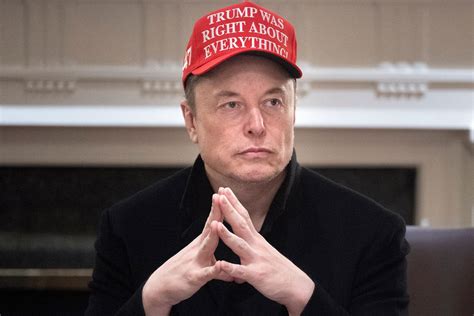
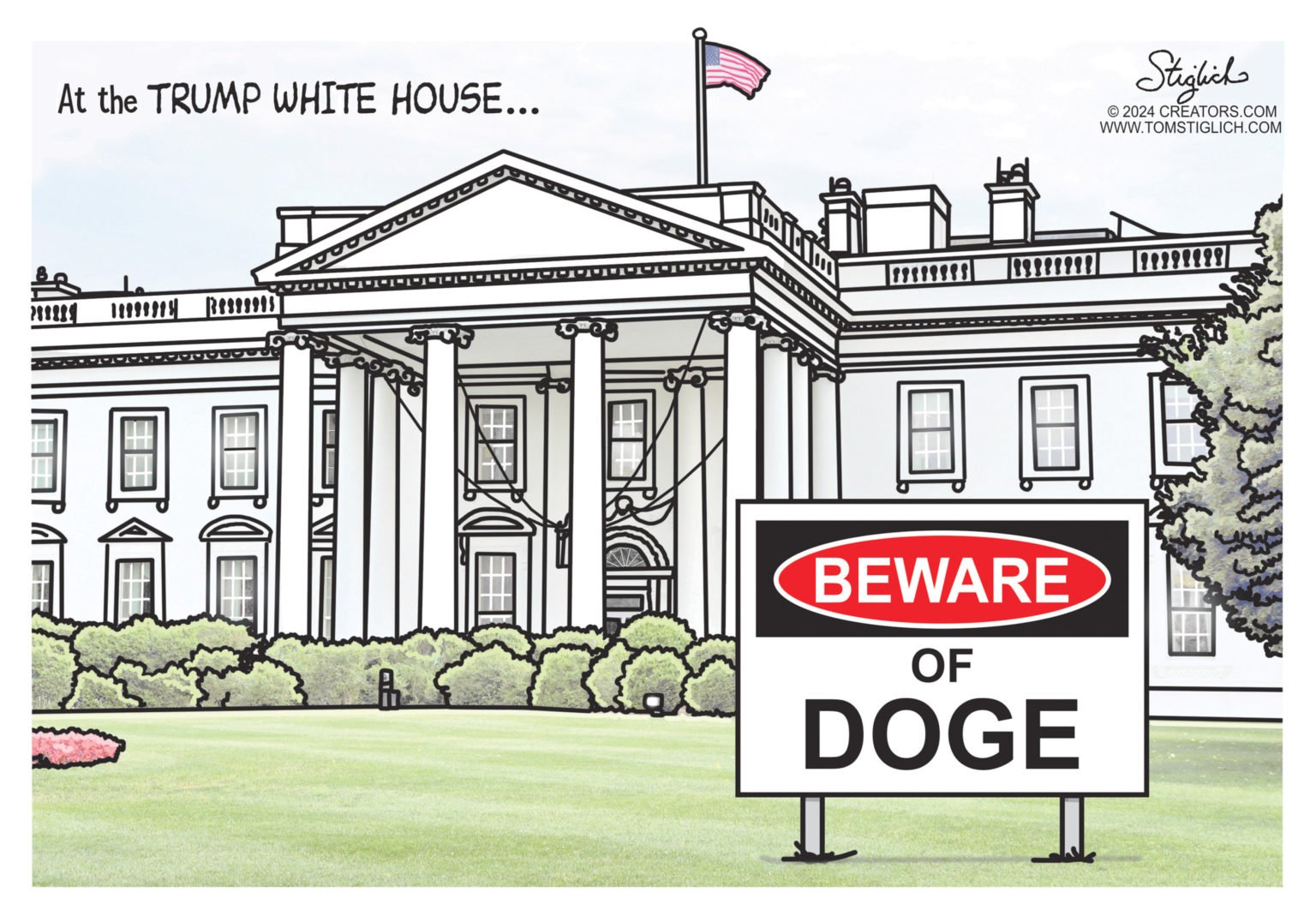
Right now, the fight for government efficiency is being taken up by DOGE led by Elon Musk. I have no doubt that it will be a complete failure and disaster.

The reason why DOGE will fail is twofold. People like Trump and Musk are part of the reason the government is so inefficient. Much of what we do is related to corruption and greed. The second reason is their desire to simply remove government from business’ way. Regulation and government are a societal hedge against business irresponsibility toward society when profit is at stake. This will simply create destruction and in the long run power the very reasons government is so inefficient to new heights. We will just see the government gutted with corruption and greed supercharged. Of course, it is most likely that DOGE is a trojan horse for a huge executive power grab and assault on the separation of powers. Efficiency is simply a marketing label to make DOGE seem like a good idea to people who aren’t paying attention.

I work for a contractor doing government work supporting our National defense. We are a GOCO, government-owned contractor operated. As such we have to comply with all sorts of regulations, directives, and laws. We are incredibly inefficient. Many of our employees spend their effort executing low-value work defined by the government’s directives. Those directives are usually a combination of executive and legislative actions. In that sense, it is the will of the American people. A good bit of these directives directly impact me and the time I spend at work. These are a whole bunch of no-value actions that you must do. They add nothing to the science-engineering product I work for.

The key question is why do I have to do all this shit? Most of this shit has low value and detracts from my real efforts. In addition, this all costs a lot of money to pay “support” people. Time away from being productive is another drain on money. Together it equals government waste and lack of efficiency. Moreover, these burdens of time and money have grown without bound my entire career. When I examine the underlying reasons for virtually every inefficiency there is a common thread. All of this stuff is related to trust; or more specifically, a lack of it.

One of the big drains on my time is mandatory training. All the training is based on executing various regulations to show compliance. The training is generically horrible and takes a lot of energy to pay attention to. We have other processes like our timecard, our accounting, document control, and information classification that all cost a lot of time and money. Our purchasing process is extremely time and documentation-heavy. This costs extra money. When you examine the underlying thought process it all equals a lack of trust. It requires a mentality that anything we do needs to be checked. We need to make sure I don’t fuck up or do something wrong. My professional experience, judgment, and knowledge are suspect and useless. It is really simply a vast statement of lack of respect too.

I cannot be trusted to make decisions.

What is Government For?

Humans are social animals. Groups of humans working together is the sole reason for our success. Physically, humans are truly weak. Yes, we have great intellect, but most of it is useless without other people. If humans were just individuals they would be food, and likely gone extinct. At the largest scale, the ability for humans to cooperate is government. It is essential for a town, state, or nation. The government is the very identity of our collective groups. The USA is defined by the government. This makes the hate of the government by so many, basically self-hatred.

Humans have a distinct limit on their capability to interact with others deeply. Evidence is that the limit is on the order of 100-150 people. The success of humanity is operating at the level of thousands or millions of people. To do this we need systems and institutions we all can coordinate our actions through. The assemblage of these systems and institutions is government. The government operates through a rulebook we know as the law. Thus the government coordinates the actions of the entire population. It cannot be distinguished from the people themself. The government is us. All of this should run on faith in the institutions. This is trust. What we really have in the United States today is a complete lack of trust.

Ideally, the government should be working for the best outcomes for the population. This is not happening. The way this has occurred is a draining of societal trust. It is a combination of social media, wealth inequality, corruption, and change that’s undermined it. The reaction to all of this is regulation. Every break in trust is met with regulation and regulation is expensive. A big part of this is the behavior of corporations. Basically corporate interest is now purely greed. That greed is not moderated by ethics or social cost. If they can make more money they will lie, cheat and steal. They will discriminate or pollute without any limits. Because of this we regulate and use that as the hedge to unbridled greed. The problem is that regulation is a very inefficient way to achieve the necessary limits.

“A nation of sheep will beget a government of wolves.” ― Edward R. Murrow

Breaking the System

“Democracy must be something more than two wolves and a sheep voting on what to have for dinner.” ― James Bovard

In all likelihood what the Trump administration will do is destroy much of our system. We can expect much of government to be shattered and broken in a couple years. The function of everything broken will simply drop. The need for these functions will not disappear. Every part of our current government is built to solve a societal problem. The inefficiency of the delivery is a completely different issue. If the government function is destroyed the problem will assert itself anew. It will not be efficient; it simply won’t be there.

Ein Stapel Akten liegt auf einem Schreibtisch in einer Behörde in Frankfurt (Oder), aufgenommen am 06.09.2007 (Symbolbild zum Thema Börokratie). Foto: Patrick Pleul +++(c) dpa – Report+++ | usage worldwide

We do need to recognize that our current inefficiency is the product of largess. After World War 2 the USA stood atop the world economically with wealth and power unrivaled. The only hedge against this supremacy was worry about the threat of the Soviet Union and nuclear armageddon. This allowed the USA to be extremely inefficient and get away with it. Those days are gone now. The USA is extremely rich, but also extremely unequal. The wealth is concentrated amongst a very small group. This state is corrosive to social trust and the seeds of revolution. It leads to instability that either leads to chaos or authoritarian rule. Neither outcome is good for a Nation.

“A really efficient totalitarian state would be one in which the all-powerful executive of political bosses and their army of managers control a population of slaves who do not have to be coerced, because they love their servitude.” ― Aldous Huxley

How a grifter like Trump or a greedy oligarch like Musk can fix this defies logic. People like them are the very reason the inefficient system exists. At the end of their destruction of government, the likely response is even less trust. That lack of trust will yield even less efficiency. The outcome will be chaos and suffering followed by even less trust and greater needless cost. Their efforts will not end well. Because the real root of the inefficiency is not addressed, the problem will simply compound. In the end, the population as a whole will suffer.

“People shouldn’t be afraid of their government. Governments should be afraid of their people.” ― Alan Moore

Fixing the System

“The best way to find out if you can trust somebody is to trust them.” ― Ernest Hemingway

Americans would be far better off if we fixed the system by repairing it. As always to fix something, you need to know what is wrong with it. Fortunately, the root cause of government inefficiency is simple. A lack of trust. Or more to the point the lack of trust. The thing to realize is that failure of trust is extremely expensive. The government red tape is mostly related to not trusting our fellow Americans. We waste most of our money making sure other Americans aren’t wasting or stealing money.

“Government has three primary functions. It should provide for military defense of the nation. It should enforce contracts between individuals. It should protect citizens from crimes against themselves or their property. When government– in pursuit of good intentions tries to rearrange the economy, legislate morality, or help special interests, the cost come in inefficiency, lack of motivation, and loss of freedom. Government should be a referee, not an active player.” ― Milton Friedman

Milton Friedman is the architect of shareholder value being the sole purpose of business. He is the founder of the level of inequality we see today. One of his mistakes was that wealth provides a way to pay off the ref. Today, the refs are owned by the business. His perspective like almost all extreme points of view is out of balance. Today, we are living with the consequences of this oversight and mistake. It is important to see how this mistake contributes to government being inefficient. Government becomes the friction society needs to control excesses of greed and power.

There are a bunch of steps we should be taking (and won’t any time soon). Chief among these is corporate governance. We would be far better off if corporate interests were aligned with the population’s interests. If greed was tempered with social and societal good, regulation could be moderated. Instead, we exist in a world where corporate decision-making is pure greed. Shareholder value is their North Star. Regulation is the only thing standing between them and ethical and moral crimes. Now corporate interests and oligarchs can buy the law. If the regulatory environment (the administrative state) is wrecked they will run wild. A catastrophe will follow at some point. Trust will plummet further and the reaction will end up being opposite to the intent. Society will be harmed and the population will suffer. This will not end well at all.

“None of us knows what might happen even the next minute, yet still we go forward. Because we trust. Because we have faith.” ― Paulo Coelho

Watching Regression of Progress Live

30 Thursday Jan 2025

Posted by Bill Rider in Uncategorized

≈ Leave a comment

Tags

ai, artificial-intelligence, machine-learning, tech, technology

tl;dr

When I examine the arc of my career I see a repeated over-emphasis on focusing on computers instead of balanced progress. The first epoch happened in the mid-1990’s where buying fast computers was sold to replace nuclear testing. We are in the midst of a longer period of only focusing on computers (the Exascale project). This is a simple narrative and sells. It is also wrong. Progress depends on support for broader activities. The result is a diminished level of progress. We are witnessing this again with AI via DeepSeek’s revelations this week.

“Don’t let the noise of others’ opinions drown out your own inner voice.” ― Steve Jobs

Progress is not Guaranteed

I’ve devoted my life to science and its progress. The promise of doing exactly this was the reason I joined Los Alamos back in 1989. Their track record in science was stellar, powered by a pantheon of science superstars. I was honored and lucky to join them. At that time Los Alamos still had a marvelous spirit of discovery. I benefited from a fantastic sense of generosity from my fellow scientists who shared their knowledge with me. It made me who I am, and shaped my career. The other thing that has been a centerpiece of my career there and later is stockpile stewardship. This program is the care and understanding of the nuclear weapons stockpile using science and engineering. A big part of this program is the use of modeling and simulation as a tool so that testing the nukes is unnecessary.

A big part of modeling and simulation is computers. The truth is that the bigger the computer the better. Well, not necessarily big, but faster computers are “always” better. There is a caveat to the “always” that needs deep consideration. Faster and bigger is always better comes with caveats and those conditions are subtle and complex. Being subtle and complex they are ignored. Ignored at our peril. Even science has succumbed to the superficial nature of today’s society. In a nutshell, many technical fundamentals need to be in place for the bigger and faster is better to hold. Today those fundamentals are at risk. The risk comes from them being ignored with astounding regularity.

To review, one of the key aspects of stockpile stewardship when it was initiated in the mid-1990s was simulating nuclear weapons. The original approach was basically to put computer codes on the fastest computers in the World. The program happened exactly at the time that the basic approach to high-performance computing changed from Cray vector computers to massively parallel computing. This meant rewriting the codes to use this new type of computer. The process of replacing the old codes (deemed legacy codes) was difficult. This was because the legacy codes were used to design and analyze weapons during the test era. So the legacy codes were subjected to repeated testing against difficult experiments. Thus legacy codes were trusted and ably used. Therefore they were held onto and revered almost as sacred. It took more than a decade to replace them and it was a mighty struggle.

The program did not explicitly want to produce better codes with better methods or algorithms or physics. Nonetheless, some of this happened because methods, algorithms, and physics make a big difference in modeling quality. This almost happened in a subrosa fashion as modernized codes only really meant codes running on modern computers.

Simple Narratives Win

“Physics is to math what sex is to masturbation.” ― Richard Feynman

The reason for this is easy to see. A faster computer is obviously better than a slower computer. The speed makes for an easy narrative about improvement. We live in an age where simple narratives rule. The public and politicians alike seem to recoil from complex and subtle explanations or solutions. In the wake of this trend, we see a loss of effectiveness and a massive waste of resources. The constant din of a simple solution to progress is reliance on computing power to solely carry progress. This did not make sense in the era when Moore’s law was in effect. It makes even less sense with Moore’s law being dead.

Moore’s law was an empirical law about the growth of power in computing over a long period. It was first observed by Gordon Moore in 1965 and held until around 2015. It was a powerful exponential law that had computer power doubling every 18 months to 2 years. If one does the math over that 50-year period (a factor of about a million). This yields phenomenal speed-ups in computing. Physical limits of computing hardware basically led to the slowing down and end of Moore’s law. Computers are speeding up, but much more slowly now. The response to the government funding was to then focus on computing, which is mind-blowing. The money was applied to try to bring the dead patient to life. This produced the National Exascale program with its focus on computing hardware.

Why is this so dumb?

Over the long history of computational science other advances have been as beneficial as computing power. In a nutshell, algorithmic advances have led to more improvements than computing. In the modern era, the focus and support for algorithmic advances have slowed to a trickle. Even in the early years the algorithmic advances received less support but had an equal or greater impact on computing capability. Nonetheless, the support never reflected the value of the approach. The reasons will be explored next.

“Creativity is intelligence having fun.” ― Albert Einstein

Algorithmic advances never created the sort of steady improvement of Moore’s law. They tend to be episodic and unpredictable. Modern project management is not suitable for such things. Progress is often fallow for long periods with a sudden advance. In a low-trust environment, this is unacceptable. Algorithmic research is extremely risky. Again, the risk is something that low trust annihilates. The long-term impact of the failure to invest in algorithmic work is a profound and massive reduction in computing benefits. I would argue that we have lost orders of magnitude of computing ability through a lack of investment in algorithms alone.

Reality is Complex

As I was writing the news broke of DeepSeek, the Chinese AI Chatbot that shattered the narratives around LLMs. The assumptions that American companies and the government had about advancing AI were overturned.

Why did this happen?

Our actions as a nation forced the Chinese to adapt and innovate. American companies were following the path of brute force. This was exactly like the computational science’s exascale program. The warning signs have been brewing for a while. The LLMs are running out of data to scale. We are running out of computer power too. The energy demands were huge and excessive. We are starting to see AI as a threat to the environment. The training of LLM models is inefficient and very expensive. In a nutshell, the brute force approach was about to collapse as a source of progress. This was predictable.

This problem was ripe for disruption and a bolt from the blue. DeepSeek looks like that bolt.

I will return to this. The narrative applies to our approach to computational science more broadly. We have an overreliance on brute force while discounting and ignoring the power of innovation and efficiency. We can all see the lessons embedded in the DeepSeek episode unfolding have been present and obvious for years. Obvious does not mean that they are acknowledged. Obvious does not compel our leaders to action. The overreliance on computing power is a simple narrative that is hard to dislodge unless is smacks us in the face.

Here is the truth and a lesson worth holding close. Reality is a real motherfucker. Reality is complex and dangerous. Reality will eventually win every battle. Reality is undefeated. Reality will fuck you up. This is the maxim of “fuck around and find out.”

There are many paths to progress. As exemplified by the DeepSeek example when we are denied the obvious path, people innovate. In computational science in the USA, we have made computer power the obvious choice. At the same time, other paths are ignored and systematically divested from. In some cases, paths to progress are explicitly removed from possibility. This looks like a doubling down on the focus on the approach being taken even as evidence piles up that it’s stupid. The worst part of this is the outright ignorance and avoidance of learning from the past. We ought to know better because the evidence is overwhelming.

Balance and Opportunity

“The formulation of the problem is often more essential than its solution, which may be merely a matter of mathematical or experimental skill.” ― Albert Einstein

Over the long time computational science has progressed on many fronts. There is no doubt that raw computing power is part of the reason. Computers are tangible and obvious signposts to progress. Various eras of computational science are clearly marked by the computers used to do the science. Early computers are far different than vector crays, or massively parallel computers. Today’s massive GPU computers and data centers are emblematic of today. Models, algorithms, and computer codes are far more abstract and less obvious to the casual observer. Nonetheless, the abstract aspects of progress are essential, and perhaps more important.

The models produced by the codes are solved using algorithms that harness computer power. The computers are useless without them. A bad algorithm assures that the computer itself is used ineffectively and wastes time and energy. Almost the entire utility of modeling and simulation is bound to modeling, thus its importance. Computer code has become an important part of modern life with an entire discipline devoted to it. At least the code is somewhat paid attention to.

The problem with models and algorithms is twofold. Above I focused upon the abstract nature of them as a problem. Being abstract they are difficult to understand. They have a second more difficult issue surrounding their progress. This is the episodic nature of progress. Both models and algorithms require difficult theoretical work highly prone to failure for progress. Often improvements are many years apart with extensive failure. At the same time when modeling or algorithms do improve, the leap in performance is large and essentially discontinuous. It looks like a quantum leap as opposed to the incremental steady climb of Moore’s law. Risk-averse program managers wanting predictable outcomes recoil from this. As a result, the work in this area is not favored. Years of failure are punished rather than seen as laying the ground for glorious success. All of this equals the choking off of progress in these areas.

The damage to the potential progress is massive. Rather than seeing a balanced approach to progress, we put all our effort into incremental computing growth. The equal or greater source of progress is ignored because we don’t know how to manage it. Computer codes move along being adapted to new computers, but encoding old models and algorithms. These new codes would nominally be perfect vehicles for introducing new algorithms and models. More often than not the codes simply move along reimplementing old models and algorithms. In many cases, we simply get the same wrong answers with poor efficiency for a greater cost. This is nothing short of a tragedy.

On occasion, we get a peek at these things. The example of DeepSeek is one such view and it was a shock. Suddenly we saw that everything we thought and had been told about LLMs was suspect. The reason for this is the acceptance of the narrative that the quality of LLMs is built on massive data and computing. The breakthrough we saw a couple years ago was powered by an algorithm (ChatGPT and LLMs were enabled by the “Transformer” algorithm). After this, we were lulled into just seeing it deriving from raw computational power. Plus it was great for NVIDIA stock and our 401Ks. It did not spur and investment into what actually drove the progress.

The algorithm was the actual “secret sauce.”

“The measure of intelligence is the ability to change.” ― Albert Einstein

Why are we such idiots? Why do we make the same mistakes over and over? Seeing the rise of computing focus while everything else fades. We learn nothing from the past. Reality is coming for us again.

“We can only see a short distance ahead, but we can see plenty there that needs to be done.” ― Alan Turing

Fundamental American Decency

20 Monday Jan 2025

Posted by Bill Rider in Uncategorized

≈ Leave a comment

Tags

decency, ethics, news, politics, writing

tl;dr

Recently, I took a trip with my elderly father. What stood out to me was the kindness, generosity and decency of everyone we encountered. This contrasts with the general discourse highlighted every day online, or in politics. This seems to say that in person we are better. Somehow we need to get our true selves engaged more and our online avatars less. If we don’t things are going to go to shit.

“I’m inspired by the people I meet in my travels–hearing their stories, seeing the hardships they overcome, their fundamental optimism and decency.” ― Barack Obama

Common Decency

Recently, I took a trip with my dad. We flew from Albuquerque to Minneapolis via a connection in Denver. The purpose was a visit to the Mayo Clinic for treatment. My brother and his wife both work at Mayo and have access to care there for my dad. It was an extremely difficult trip because of my dad’s condition. He is 87, and has multiple medical issues including near blindness. He is quite weak and needs a wheelchair in the airport. Just for reference, I am 61 and while I am fit, strong, and vibrant; I’m not a young man. This was one of the hardest flights I’ve ever taken. By the time I handed my dad off to my brother, I was exhausted emotionally and tired physically.

When I reflected upon the day traveling, one thing stood out to me. Everyone we encountered was great. People were helpful. People were generous. People were kind. At every juncture, the airport employees, the airline employees, and our fellow passengers treated us wonderfully. People observed the situation and gave my dad deference and care. People helped us and stepped aside. Flight attendants were so helpful, ingenious, and kind. I saw lots of extra effort to help us and make the best of a very difficult situation. What I saw was Americans being the best versions of themselves and it was phenomenal. It was a tonic after the recent months of horror.

With everything else going on in the USA, it also made me say “What the fuck?”

Uncommon Indecency

“A saint is a person who behaves decently in a shockingly indecent society.” ― Kurt Vonnegut

The entire experience of this flight is in direct conflict with what we see elsewhere in American society. All the evidence would point to Americans being mean, cruel, and thoughtless. We see anger and ignorance everywhere. We just elected a petty, cruel, and selfish man as President. The incoming President displays these characteristics all the time. Somehow Americans overlooked his obvious shortcomings, and appalling character when voting. We are about to be led by someone who is the worst of us.

In person, I saw Americans who were the complete opposite. I saw people who exemplified the care and love of their common man. I saw something that gave me pride and hope. Yet in the engagement and discourse we see every day in the news and online, Americans are horrendous to others. We can all ask why? and examine the causes for this dissonance. One would think we want to be our best selves rather than our worst.

So WTF?

I think the key difference is the prevalence of our online self and remote discourse. The online world seems to encourage a level of vitriol and negativity commonly called trolling. Social media platforms like X (Twitter) and FaceBook thrive on this sort of awful dialog. We all say and talk to people in ways that we’d never do in person. Somehow society has transformed into a reflection of this dynamic more broadly. Our politics has become like social media and unremittingly ugly. We have decided to elect the trolls to run the country. Instead of the common decency I saw in person, we see ugliness and hate. A government is the reflection of its people. Rather than good and decency like we are in person, we have chosen evil and indecency.

In every respect our lives would be better off if Americans treated each other better. Having seen what is possible on this trip this much is obvious. People can be good to each other. They can act with kindness, love, and respect to their fellow man. This stands in stark and genuine contrast to the dynamic seen every day in the news and online. People have it in them to be better. I fear that we need to be led to do good. Right now, we are being led to be the opposite. I hope we do not lose sight of what is possible.

“For the powerful, crimes are those that others commit.” ― Noam Chomsky,

Goodbye Jim with Love and Gratitude

12 Sunday Jan 2025

Posted by Bill Rider in Uncategorized

≈ Leave a comment

Tags

death, faith, love, writing

tl;dr

I recently discovered that one of my best friends had died. Jim was one of the most important people in my life. But I only discovered his death 21 months after it happened. There are reasons for this. To put this in context, I’ll talk about the death of three people who have touched my life for good and ill. There are lessons to learn from each of them. Among these lessons are what people mean and how I should leave life myself when my time comes.

This essay will be about death and life. It will be a little raw. If that’s not what you’re prepared for don’t read on, or come back later when you are.

“A purpose of human life, no matter who is controlling it, is to love whoever is around to be loved.” ― Kurt Vonnegut

How to Say Goodbye

A few weeks ago, my week started off wondering about a friend, wondering if that friend was still alive. She wasn’t. It was the week after Thanksgiving, and work was spinning up anew after the holiday. The day before Thanksgiving, my friend, Sandy, sent me a brief text: “Thank you for being a good friend and lover.” Sandy had been sick for over a year, afflicted with cancer. Later in the morning, my worry was confirmed. Sandy had passed away that morning. Her kids posted the news on her Facebook profile. The message the previous Wednesday was goodbye, and a heartfelt thanks.

I hadn’t seen her since the previous February when she told me of being worried about the cancer. Her brother had died from cancer, and it seemed to run in the family. We kept in touch through texting, and I knew generally how she was doing. Her treatments worked for a bit until they didn’t. I knew she had a PET scan. I also know how that can work. I remember the moment of seeing my father-in-law’s PET scan and knowing then that the end was near. It is a test that can be a release or a death sentence. I suspect this was what happened to Sandy. She was a lovely lady who loved heavy metal. We shared an enjoyment of Alice in Chains quite often when we got together. She was a casual friend, what someone would call a “FWB”. Still, she said goodbye and left me a thank you for the time we had.

We had closure.

“The fear of death follows from the fear of life. A man who lives fully is prepared to die at any time.” ― Mark Twain

A photo of Jim from 2013 at a Mathematical Workshop he helped organize.

How Not to Say Goodbye

Sandy’s death filled me with a modest melancholy, but it was also expected. I had time to prepare and understand the context of our friendship. The very next day, I awoke to find a Facebook message that hit me hard. The previous evening, I posted the last of my series on my career, the Requiem series, with its focus this time on my time at Sandia. My friend Peter, who is a Mechanical Engineering Professor, asked about Jim. The three of us worked together in Los Alamos during Peter’s postdoc there.

About once every two or three months for the past eight years someone asks me about Jim: how can I get in touch with him? The presumption is that I will know how to contact him. I don’t, as I will explain shortly. When I woke the next morning another friend, Raphael, who is a Professor in France, notified me about Jim’s status.

My friend Jim was dead.

He had died the previous March (March 1, 2023, which I discovered via internet searches) and had managed to donate his math books to the University. He had time and knew he was going to die. He lived in a very small village in France with his wife. It was beautifully decorated in the fashion of New Mexico houses, too. That was it. I knew nothing else. Jim was gone. Worse yet, there was no closure, and there would be none.

For most of us who knew him, Jim disappeared in August 2016. I remember well our final conversation over lunch at Hot Rocks in Los Alamos a few months prior. I remember a somewhat contentious and heated discussion of the state of the Country and Lab. My own life was unsettled at that time. Jim was upset at the United States and the possibility of Trump being elected. Los Alamos had lost its luster and was disappointing him. Maybe he was disappointed with me, too. I’d been getting tattooed and had an open marriage. Maybe I wasn’t the person he thought I was. Who knows? It was a final conversation unfit for two people who had experienced so much life together. It was not a worthy goodbye to someone so important to me.

When I say Jim “disappeared”, I mean it. Aside from Raphael, no one had heard from him. Every friend I contacted since informing them that Jim had died knew nothing about his fate. I spent much of the next week contacting people who worked with Jim via e-mail and Facebook. In every case I got a note of sadness and surprise, but never anyone who said, “Yes, I had heard.” As this sank in, I felt a little bit of relief in the feeling that Jim left everyone behind. I wasn’t singled out either for good or ill. He ghosted everyone. A few friends talked about other people who disappeared suddenly, too. In every case, the disappearance of a friend is a source of pain.

“The opposite of love is not hate, it’s indifference. The opposite of art is not ugliness, it’s indifference. The opposite of faith is not heresy, it’s indifference. And the opposite of life is not death, it’s indifference.” ― Elie Wiesel

Closure and Perspective

One of the things that lingers with me with Jim’s death is the lack of closure. Closure as a process is a precarious and challenging concept. My wife has struggled with it as a relationship she had ended without any closure. Later over time, she got some closure, but it was deeply unsatisfying, too. It did not meet expectations at all. With Jim, nothing ever came, and he approached death without any attempt to close the door with me, or anyone else. So, it is left to the living to find a way to close this chapter of our continuing lives.

Someone else I knew died without giving me any closure. Unlike Jim, this person had a horrible influence on my life. Sam was one of the most toxic people I have ever met. The fact that he was placed in a position of leadership was an indictment of people’s judgment. He was disingenuous to his core; he was also manipulative and vindictive. He abused power. All of this is generally ignorable except the fact that I was the object of this abuse. He was behind one of the worst things in my adult life. With his death, the minute chance of apology was gone.

Any closure or forgiveness on my part was purely one-sided. I need this, too. I need to forgive Sam for his horrible behavior. I need to move on. It is a work in progress. Sam’s death was a genuine tragedy. In addition to the personal side of it, Sam never had a chance to be a better person. He never could heal from whatever demons drove him to such monstrous behavior. I can give myself some closure in that he was a victim of an environment that created his dysfunction, and a system that rewarded him for it. He hurt me badly and likely didn’t care at all. He didn’t care about the well-being of others in his charge. He acted with cowardice and dishonestly toward me. This is a sad way for someone to live. I can learn from this and work toward being a better human from the lesson.

I can also take this lack of closure forward to putting Jim’s life in perspective and how he impacted my life.

“Closure is just as delusive-it is the false hope that we can deaden our living grief.” ― Stephen Grosz

A Life Well-Lived

“Death ends a life, not a relationship.” ― Mitch Albom, Tuesdays with Morrie

Jim was a great influence on my life. He was a good man, and I am richer for knowing him. I have worked with many great and wonderful people during my career, but Jim stands out. We had a great bond of friendship and shared numerous battles and adventures in an exciting time. For this reason, the way Jim deserted me hurt especially deeply. Anyone who knew us would have assumed Jim would stay in touch with me. His abandonment of me and all things American was painful. It is worth some deeper consideration. Perhaps, for Jim, it was simply too painful to continue engaging with all of us.

I met Jim in 1996 as we joined the hydrodynamics group in X-Division. The burgeoning ASCI program was injecting life into a weapon’s program that had been in freefall since the end of the Cold War. Our group leader, Len, had the wisdom to introduce Jim and I, seeing we might work well together. It was a stroke of genius by Len. Jim and I shared basic ethics and goals in work but also complimented each other almost perfectly. I was creative and free-thinking but lacked attention to detail at times. Jim was more confined in thinking but had meticulous attention to detail. We helped each other with our differing strengths coupled with a common vision. Together we began to sketch out a collaboration that would stretch into the next 20 years. A fast friendship made the work even better.

I had a crisis that left me with a better workplace balance. Gone was my sense of imposter syndrome, replaced with confidence. I was now imbued with the sort of scientific superiority and spirit that made Los Alamos special. Both of us inserted ourselves into the sense of possibility that ASCI gave us. We had freedom and could explore modeling nuclear weapons with computers. Together, we understood that scientific credibility in the simulations relied upon evidence. That evidence was found in verification and validation. Verification is the proof that a simulation is mathematically correct. Validation is evidence that the simulation models something close to objective physical reality.

Jim was blessed with mathematical skill and precision. He also had attention to detail that powered him to a PhD from Caltech. My pedestrian education from the University of New Mexico felt like an anchor. I graduated with a doctorate from Los Alamos. It was far greater and broader than any university could have given me. I had creativity and big ideas with an ability to dream big. Together, we were far better than either of us could be, separately. Jim was also generous and connected well with people. Both of us grew as scientists and our statures grew. We were a great team.

We were a dynamic duo with an eager energy. Ideas would bounce from each other. Throughout our time working together, the friendship grew. We also pushed each other to new heights. We hosted the first TriLab V&V workshop, and Jim’s ideas gave my own extra bite and swag. He came up with the idea of the seven deadly sins slide with the imagery of Hieronymus Bosch to spice it up. We crafted proposals together to work on the most difficult validation problems—images of turbulent chaotic flows central to our mission. Together, we joined the trips to Russia in scientific diplomacy that were part of the hope for lasting peace after the Cold War.

These trips to Russia opened a new level of connection. Jim took the hardest part of the travel and built a level of trust with the Russians. His encouragement brought me along for trips there. I went on seven international trips for this program. Two of these trips were to Vienna for a conference we hosted that included the Russians. One trip was to Ekaterinburg, 12 time zones away in January. Temperatures were as cold as –10°F. The other four trips were to Moscow, and then a train ride to Sarov. Sarov is the place where the Soviet nuclear program was born.

These trips were long and intense. It was the hardest travel I’ve ever done. Jim was a consummate traveler, always ready for every problem. On one particularly difficult trip, we ended up with nicknames. Jim’s was “Candyman”, because of his perpetual supply of homeopathic remedies. He was like a little pharmacy away from home. I remember needing stool softeners halfway into a trip and Jim having them at the ready. My nickname was “Gutterball”, characterizing my own tendency to see the dirty in everything. I could propel any conversation into the gutter in short order.

I remember one of the funniest things Jim ever said. It was 2005 and we were walking past the new NSSB building at LANL. I asked, “When will it be completed?” being completely serious for once.

Jim replied in a completely deadpan way, “When the flaming eye of Sauron is placed on top of it!”

We erupted in gut-wrenching laughter. It also tells you how Jim felt about the new Los Alamos management. This was also a harbinger of disappointments to come.

Right before I left Los Alamos, I was a manager. Jim was one of my employees. Jim was a model employee, being the best in a group full of stars. I can’t think of someone easier to manage. When I left Los Alamos in 2007, Jim followed me to Sandia shortly thereafter. The changes in Los Alamos didn’t sit well with him either.

In retrospect, I think Jim’s movement to Sandia was a twofold break from his past. On the one hand, he was searching for work that felt good. Los Alamos’ decline was stark and heartbreaking. I was providing a naive sunny-side-up view of Sandia. I suspect he never forgave me for that. Jim’s time at Sandia was unhappy. He saw it far clearer than I did. I worry that he blamed me for it and the lack of disclosure of Sandia’s faults and shortcomings. We continued to work together at Sandia, doing some great work. Nothing we did at Sandia could hit the heights Los Alamos gave us.

“To say goodbye is to die a little.” ― Raymond Chandler

With time, Sandia wore out its welcome with Jim. He still lived near Santa Fe with his wife Celine. Celine was French and a nurse. It was clear that Jim’s plan upon retirement was to live in France with its public single-provider health care. France also had a better lifestyle and attitudes than America’s nasty dog-eat-dog culture. Gradually—and then suddenly—Sandia became harder for Jim to integrate his life with. Jim left Sandia and went back to Los Alamos. He and I stayed in touch, but a space had opened. Los Alamos had also declined and was disappointing. The United States felt increasingly foreign too. In August 2016, Jim left the United States without any notice, or information about where he was. I never saw him again.

“How lucky I am to have known somebody and something that saying goodbye to is so damned awful.” ― Evans G. Valens

I will never know the answers. I can just look at the evidence. Jim had lost faith in Los Alamos, Sandia, and the United States. I was seemingly included in his condemnations, or not. It was and remains heartbreaking to me. Jim was as close to a brother as I had at work. We fostered a deep friendship of immense value to me. I won’t ever lose that. I am eternally grateful for knowing him and having him as a friend. I hope Jim felt the same way. I simply don’t know the answers.

It tells me that I need to work on forgiveness and connection. I want to feel the love and gratitude for Jim. I hope others feel the same for me when the time comes.

“Time doesn’t heal all wounds, only distance can lessen the sting of them.” ― Shannon Alder

What is Expertise? How does one get it?

07 Tuesday Jan 2025

Posted by Bill Rider in Uncategorized

≈ Leave a comment

Tags

education, expertise, mental-health, perfectionism, personal-growth

tl;dr

Most of us would be love to be recognized as an expert at something. One would think it is a way to be professionally successful. The path to expertise runs through skills and experience, but takes a bit more to actually achieve. An expert sees what can’t be taught, and has the ability to move past current knowledge and practice. The expert can solve novel problems and adapt the state of the art. Expertise is earned through hard lessons that include many mistakes and failures. It also needs to be valued and respected to be born. It is an uneven and long journey guided by grit, determination and talent. Today, the expert is also the subject of critique. Expertise is under attack. Thus, expertise today is a dangerous and perilous endeavor.

“An expert is someone who knows some of the worst mistakes that can be made in his subject, and how to avoid them.” ― Werner Heisenberg

The Path of Expertise

“We need to be willing to risk embarrassment, ask silly questions, surround ourselves with people who don’t know what we’re talking about. We need to leave behind the safety of our expertise.” ― Jonah Lehrer

The start of expertise is always the same. You learn the basics and fundamentals of a field. First, the foundational principles are imparted to the burgeoning expert. With the foundation in place, the student turns to a focus in a given area. This follows a similar path with the knowledge be found in textbooks, or the literature. Ultimately, the student needs to begin to start the process of reproducing the state of the art independently. This means known results are recreated and compared with the standard. In this process, the student begins to pick up and demonstrate competence. In that competence gradually confidence is established. At this point the student is still not an expert. The student is a skilled practitioner. Most stop there and go no further.

Along the way important milestones occur that begin to lay the groundwork for expertise. Key among these are beginning to make the same mistakes as the preceding experts. This gets to a feature of the existing literature and knowledge for a field, mistakes and traps are not reported. Success is usually the only thing published. Often a mentorship can be established with an existing expert who provides the growing expert with guidance. Through the mistakes, guidance and lessons learned, the skilled novice inches their way toward expertise. At this point the novice is on the precipice of expertise. There is one more critical step forward to complete.

“This is a fundamental truth about any sort of practice: If you never push yourself beyond your comfort zone, you will never improve.” ― Anders Ericsson

Raw talent and ability is part of the picture, but offers traps that many fall into. There are many very talented students who basically become skilled technicians. The example of the perfect student who’s perfectionism rules their life. The valedictorian from high school is often the epitome of this person. A great student to be sure, but trapped by perfectionism. To become an expert you need the talent and grit, but you have to step into the unknown to risk and experience failure. Often as I’ve seen the perfectionist can’t break from the mold that created the success as a student. They never become an expert.

Being a perfectionist is antithetical to expertise. Given that many gifted and excellent students are perfectionists this might be counter-intuitive. A perfectionism will push a person away from failure and failing is a key part of becoming an expert. Perfectionists often stay within the boundaries of the known, and the boundaries of the known do not contain expertise. Doing what is needed to be an expert requires courage. The perfectionist is skilled, but their excellence in tinged with mediocrity. If you see someone who never fails and always does great work that person is almost certainly not an expert. Expertise is born from pushing hard past limits into the unknown, which invariably leads to mistakes and failure. The perfectionist must cast off their tendencies and the courage to take a leap into the unknown.

“Enthusiasm is more important than innate ability, it turns out, because the single more important element in developing an expertise is your willingness to practice.” ― Gretchen Rubin

Experts Matter?

I’ve always operated under the assumption that expertise is both good and matters. Experts can produce results that mere technicians cannot produce. They solve problems that were unforeseen and unexpected. There is a distinct and substantial difference between competence and expertise.

It has been recognized that experts are treated with distrust and suspicion today. This is a consequence of the unfortunate value system in the current world. There is very little doubt that expertise is under attack from all quarters. There is an entire political movement that is devoted to ignoring expertise. They are in power and operate under the premise that reality can be messaged. We see business interests built on expertise that have shed experts because they are too expensive. Boeing is a prime example. The reality is that Boeing likely a reflection of the danger rather than being an outlier.

If you want results for the long term, experts are essential. In the short term experts are terrible for the balance sheet. This is where politics and business intersect. Current trends are focused intently on the short term. Quarterly results are all that matter. Experts are simply lots of difficult reality that is cheaper to ignore. Until it isn’t. Reality will eventually assert itself. Planes crash or doors fall off. Hurricanes happen and make landfall. Reality will eventually win, and the hedge that experts represent need to be present. Then the experts are be worth every penny spent on them. Today, I wonder, will they be present to step up when needed?

I see this at work. You would think that at a National Laboratory experts would rule. They do not. Experts are a pain in the ass. When reality bites, and it will, the expert will save your ass. In these days it would seem that the message matters and reality is at bay. It is simply a matter of time, reality cannot be denied. That said, we saw experts being repudiated during Covid. More than a million people died and experts were continually beaten down or ignored. One needs to wonder, what sort of disaster would it take for the experts to be valued?

When we look at the consequences of rejection of expertise, Boeing looks like an herald of the future. I remember 20 years ago at Los Alamos taking a meeting with a Boeing engineer. He told us that Boeing eviscerated its work on turbulence getting rid of almost everyone working in the field. Only the expert who “solved” the problem was retained (Spalart) , and no more progress was needed. They had declared the problem to be solved. An absolutely ridiculous notion on the face of it. It turns out that the repudiation of expertise was even broader at Boeing. Then starting with the building of the 787 then the 737 Max, the problems started to manifest in reality. Delays and quality control problems plagued the 787. Then the actual engineering work created flaws that crashed two 737 Max planes by foreign airlines. The problems continued with a door flying off a plane more recently.

All of this seeded by the removal and rejection of expertise by the company. All of this done to improve the bottom line and the short-term financial health of the Company. Reality hit hard and now Boeing is in free fall. A sterling reputation built over decades was destroyed by cheapness and greed. The same motivations and drives are present all across the business world, and replicated at places I work. I see financial factors treated as essential and primal to success. Expertise and technical quality are afterthoughts and simply assumed to be in place.

The result is mismanagement of technical work and a collapse of expertise. The lack of trust present across society results in a fear of failure. This in turn becomes management malpractice. We are graded on how we perform on key milestones. We are basically told that these milestones cannot fail. Thus we create milestones that are too easy and can’t fail. The result being a systematic dumbing down of the most important work we do to avoid the possibility of failure. It is also the highest profile work we do, which ironically is engineered to be mediocre.

This gets to some factors in the creation of experts which are cultural and emotional. The culture of the organization needs to support the expert in several key ways. First the activities needed to develop and maintain expertise must be encouraged and resources be provided. Secondly, the expert needs to be respected and valued. The novice can easily observe whether expertise is encouraged by the management. More importantly they can see whether being an expert matters and their views are respected.

We can ask some key questions about the culture. Is being an expert a path to professional success? Does the organization provide opportunities to experts? Is being an expert a path to being supported with ease? If these questions are answered affirmatively, experts are a natural outcome.

The answer to each of these questions is now in the negative. In the business world (e.g., Boeing) and the Labs we can see this. Its consequences are starting to become obvious.

When I look at my career the answers to these questions provide a guide. When the answers were affirmative, the expertise was built and grew. When the answers were negative, expertise retreated and languished. Experts are not free, nor does their quality and availability come without broader implications. If the evidence is that expertise is not valued, one won’t put effort into being one. Without experts we cannot meet our greatest challenges with solutions that work. In the long run we can expect reality to ultimately expose our short-term strategy as flawed. It will be a failure in the bad sense of it.

Expertise is Dangerous and Expensive

“The death of expertise is not just a rejection of existing knowledge. It is fundamentally a rejection of science and dispassionate rationality, which are the foundations of modern civilization.” ― Thomas M. Nichols

In an environment that prioritizes perfectionism and allows for few or no mistakes, an expert is seen as the problem. The expert sees past the trivial and looks deeper. The perfect rarely survives past the superficial observation. The short-term management solution is to get rid of and ignore the experts. We are seeing how that worked out for Boeing. Reality bites and bites hard. What I suspect is that Boeing is simply the most evident example of a broader war on experts. Reality will show itself and expose the gaps in our strategy.

The Covid Pandemic was another example of how experts are not listened to or respected today. If the expert provides something that is uncomfortable or difficult, the current response is to ignore them. Even worse, the response is to make them a villain. The best example is the vitriol directed toward Anthony Fauci. The same is directed toward experts far and wide in less obvious ways. We simply see managers penalize and punish experts for providing a preview of reality. Usually you get the feedback that you need to work on your messaging. Be more positive and stop being a “negative Nelly.” The only good news message is broad and clear across society at large. The National Labs are no different and its hollowing them out.

“Often a sign of expertise is noticing what doesn’t happen.” ― Malcolm Gladwell

One can see the retreat of verification and validation in this light. If one is focused on perfect success V&V is the enemy. V&V is all about finding the problems with a body of work. If one looks carefully at virtually any work with V&V, problems are found. These problems are a direct assault on perfectionism. Accepting V&V examinations and evidence usually chafes the perfectionist. The simplest way for the perfectionist to survive the examination is reject it, or not do it all. This explains the retreat of V&V and the decline in the quality of the work done.

The recent death Jimmy Carter offers a window into some of the systemic problems underlying the death of expertise. While so laudable as a former President, Carter is derided for his time in office. Front and center in this assessment is the infamous “malaise” speech. It is seen as the end of the success in office as Carter called out the public in ways that ring true then and today. He was replaced in office by Reagan who foreshadowed the feel good form of communication we see replicated today. He was also an actor and public figure who mastered media. This episode also coincides with the demise of expertise as essential to success. It does not seem that these events are independent, but rather part of the same problem.

“These are dangerous times. Never have so many people had so much access to so much knowledge and yet have been so resistant to learning anything” ― Thomas M. Nichols

← Older posts
Newer posts →

Subscribe

  • Entries (RSS)
  • Comments (RSS)

Archives

  • February 2026
  • August 2025
  • July 2025
  • June 2025
  • May 2025
  • April 2025
  • March 2025
  • February 2025
  • January 2025
  • December 2024
  • November 2024
  • October 2024
  • September 2024
  • August 2024
  • July 2024
  • June 2024
  • May 2018
  • April 2018
  • March 2018
  • February 2018
  • January 2018
  • December 2017
  • November 2017
  • October 2017
  • September 2017
  • August 2017
  • July 2017
  • June 2017
  • May 2017
  • April 2017
  • March 2017
  • February 2017
  • January 2017
  • December 2016
  • November 2016
  • October 2016
  • September 2016
  • August 2016
  • July 2016
  • June 2016
  • May 2016
  • April 2016
  • March 2016
  • February 2016
  • January 2016
  • December 2015
  • November 2015
  • October 2015
  • September 2015
  • August 2015
  • July 2015
  • June 2015
  • May 2015
  • April 2015
  • March 2015
  • February 2015
  • January 2015
  • December 2014
  • November 2014
  • October 2014
  • September 2014
  • August 2014
  • July 2014
  • June 2014
  • May 2014
  • April 2014
  • March 2014
  • February 2014
  • January 2014
  • December 2013
  • November 2013
  • October 2013
  • September 2013

Categories

  • Uncategorized

Meta

  • Create account
  • Log in

Blog at WordPress.com.

  • Subscribe Subscribed
    • The Regularized Singularity
    • Join 55 other subscribers
    • Already have a WordPress.com account? Log in now.
    • The Regularized Singularity
    • Subscribe Subscribed
    • Sign up
    • Log in
    • Report this content
    • View site in Reader
    • Manage subscriptions
    • Collapse this bar
 

Loading Comments...