Some people see the glass half full. Others see it half empty.
I see a glass that’s twice as big as it needs to be.
― George Carlin
Here, I will provide some concepts that may spur further development through attacking each of these three shortcomings in newer methods. Part of the route to analysis is utilization of evolution equations and the analysis of numerical methods using modified equation analysis. These concepts were essential in ideas that were key in the formulation of the original generation of (linear) monotone methods [HHL76] and revisiting these concepts should provide impetus for new advances. The approach is two-fold: explain why current methods are favored and provide a catalog of characteristics for new methods to follow.
In the past, I have used modified equation analysis in the past to unveil the form of the subgrid modeling provided by high-resolution methods for large eddy simulation (the so-called MILES or Implicit LES approach). This approach has provided a systematic approach to providing explanations for the effectiveness of high-resolution methods for modeling turbulence by revealing the implied subgrid model in implicit in the methods.
In solving hyperbolic conservation laws the work of Lax [Lax73] is preeminent. Lax identified the centrality of conservation form to computing weak solutions (along with Wendroff) [LW60]. Once weak solutions are achieved, it is essential to produce physically admissible solutions, which the concept of vanishing viscosity provides. Harten, Hyman and Lax [HHL76] provided the critical connection to numerical methods by showing that upwind differencing provided physically admissible solutions utilizing the method of modified equations to the analysis of the numerical method (the same can be shown for Lax-Friedrichs-based methods). These methods form the foundation upon which high-resolution methods are based.
Of course while these theoretical developments were made parallel discoveries were happening in the first high-resolution methods. Independently three different researchers discovered the basic principle of high-resolution methods, nonlinear selection of computational stencils so that the method becomes nonlinear even for linear problems [Boris71,VanLeer72,Kolgan72]. Each method allowed the barrier theorem of Godunov [God59] to be overcome and paved the way for further developments. Ultimately, Harten provided the work to tie these streams of work together by introducing the total variation concepts to formalize the mathematics [Harten83]. These methods form a foundation for a renaissance in numerical hyperbolic conservation laws.
Subsequently, there have been several attempts to move beyond the first generation of high resolution methods, but each has met with limited success [HEOC87,Shu87]. While this work has yielded some practical methods, none has shared the extreme success of the initial set of methods and their basis in mathematics. These methods have not yielded the same quantum leap in performance as the original methods, and not met the same success in being ubiquitous in applications. The reasons for this practical failure are multiple chiefly being cost, fragility, and failure of formal high-order accuracy to yield practical accuracy. I studied some of these basic tradeoffs with Jeff Greenough [GR04] between archetypical methods PLM [CG85] and fifth-order WENO [JS95].
The trick to forgetting the big picture is to look at everything close up.
I am proposing revisiting the foundational aspects of high-resolution methods by returning to modified equation analysis of numerical methods and providing connections to providing proof of physically admissible solutions, and their control of variation in the solution (i.e., connecting to variation-diminishing properties). To conduct such analysis I am suggesting the study of the energy evolution of equations, and/or the continuous variation evolution. Each equation will admit a vanishing viscosity solution, and the modified equation analysis can provide a connection of the numerical method to admissibility. The properties of the vanishing viscosity solution define the nature of desirable results. For a simple hyperbolic PDE,  , the basic physical admissibility condition can be given
  . For higher order methods, the viscosity must be nonlinear and a function of the solution itself. Similarly the variation evolution may be derived and its vanishing viscosity solution can be similarly stated. In the rest of the discussion here, we will focus on the linear version of the equation for simplicity,
  .
.
When modified equation analysis is applied to upwind differencing, the classical result can be easily derived for the numerical viscosity,  . For the variation equation the result is similar, but informative,
  . We can see that the term proportional to
  is positive negative and will reduce the variation where ever the sign of variation changes.
If we analyze classical TVD method using the minmod limiter, the connection to physical admissibility becomes clear for the kinetic energy evolution,  . Similarly the variation evolution provides a similar connection with more texture on the nature of the solution with the leading truncation error term being a flux
  . When expanding the flux in the modified differential equation, two terms emerge as being non-conservative of variation,
  . The second term is negative definite while the first term could be either positive or negative. We would categorize the scheme as being quite likely to be variation diminishing, but not absolutely. Discretely, we know that the method is TVD. Note that the viscosity coefficient,
  , is now a nonlinear function of the solution itself and could be called a “hyper-viscosity”. It is important that the actual discrete scheme limits the magnitude of this ratio to one, so the ratio does not blow up in practice.
We can apply the same technique to ENO or WENO methods and see the nature of its regularization at least for smooth solutions. For the famous fifth-order WENO we can derive the modified equation for the kinetic energy and find the leading order viscosity coefficient  , a nonlinear and linear hyper-viscous regularization. For the variation evolution the variation changing terms are
  . The middle term is negative definite, but the first and third terms will be ambiguous for variation diminishment. This sort of behavior is observed for this scheme with the variation both shrinking and growing as time advances. Perhaps more importantly, the fully discrete method does not limit the size of the hyper-viscosity and it could blow up. The nonlinear hyperviscosity is itself ambiguous in terms of its variation diminishing character, which is distinctly different than the TVD scheme.
For the classical ENO scheme the result is quite similar. In the classical ENO scheme, the smoothest stencil is chosen hierarchically starting with first-order upwind. In other words the second order scheme is chosen to be the closest to the first-order scheme and the third-order stencil is chosen that is closest to the second-order stencil. We can analyze the third-order version using modified equation analysis. The effective numerical viscosity is a combination on linear and nonlinear hyperviscosity,  . This can be analyzed for the variation equation and produces ambiguously signed non-conservative terms,
  . We find that ENO is quite similar to WENO, and the hyperviscosity magnitude is not controlled by the nonlinearity in the method. Practically speaking this is a deep concern when considering the robustness of the method.
The last method we analyze is one that I have suggested as a path forward. In a nutshell it is the high order method that is closest to a certain TVD method in some sense (I use the value of edge fluxes). Importantly, this method can still degenerate to the first-order upwind scheme while being formally third-order accurate. If the TVD method is chosen to be the first-order upwind method, we can analyze the result. The nonlinear dissipative flux is a third-order method,  . For the variation equation we get a remarkably simple non-conservative term that is negative definite,
  . This is an extremely hopeful form indicating excellent variation properties while retaining high order.
The modified equation analysis is enabled by a combination of symbolic algebra (Mathematica) and certain transformations formerly utilized to analyze implicit large eddy simulation [MR02,RM05,GMR07].
 Finally, we can utilize these methods to produce a new class of methods that offer the promise of greater resolution and more provable connections to physical admissibility. The basic concept is to use TVD methods (and their close relatives) to ground high-order discretizations. The higher order approximations will be chosen to be closest to the TVD method is a well-defined sense. Through these means we can assure that the high-order method simultaneously provides accuracy and variation control by analyzing the resulting schemes via modified equation analysis. These methods will typically have similar regularizations to the WENO methods and provide high resolution results that are both formally accurate when appropriate and higher resolution than the TVD methods they are grounded by. For a third-order method the analysis of this method provides the following results for the kinetic energy equation, and the variation evolution. I believe this approach will provide a beneficial path for method development and analysis.
Out of clutter, find simplicity.
― Albert Einstein
If you’re not confused, you’re not paying attention.
― Tom Peters
[Harten83] Harten, Ami. “High resolution schemes for hyperbolic conservation laws.”Journal of computational physics 49, no. 3 (1983): 357-393.
[HEOC87] Harten, Ami, Bjorn Engquist, Stanley Osher, and Sukumar R. Chakravarthy. “Uniformly high order accurate essentially non-oscillatory schemes, III.” Journal of computational physics 71, no. 2 (1987): 231-303.
[HHL76] Harten, Amiram, James M. Hyman, Peter D. Lax, and Barbara Keyfitz. “On finite‐difference approximations and entropy conditions for shocks.”Communications on pure and applied mathematics 29, no. 3 (1976): 297-322.
[LW60] Lax, Peter, and Burton Wendroff. “Systems of conservation laws.”Communications on Pure and Applied mathematics 13, no. 2 (1960): 217-237.
[Lax73] Lax, Peter D. Hyperbolic systems of conservation laws and the mathematical theory of shock waves. Vol. 11. SIAM, 1973.
[Boris71] Boris, Jay P., and David L. Book. “Flux-corrected transport. I. SHASTA, A fluid transport algorithm that works.” Journal of computational physics 11, no. 1 (1973): 38-69.
(Boris, Jay P. A Fluid Transport Algorithm that Works. No. NRL-MR-2357. NAVAL RESEARCH LAB WASHINGTON DC, 1971.)
[VanLeer73] van Leer, Bram. “Towards the ultimate conservative difference scheme I. The quest of monotonicity.” In Proceedings of the Third International Conference on Numerical Methods in Fluid Mechanics, pp. 163-168. Springer Berlin Heidelberg, 1973.
[Kolgan72] Kolgan, V. P. “Application of the minimum-derivative principle in the construction of finite-difference schemes for numerical analysis of discontinuous solutions in gas dynamics.” Uchenye Zapiski TsaGI [Sci. Notes Central Inst. Aerodyn] 3, no. 6 (1972): 68-77.
(van Leer, Bram. “A historical oversight: Vladimir P. Kolgan and his high-resolution scheme.” Journal of Computational Physics 230, no. 7 (2011): 2378-2383.)
[God59] Godunov, Sergei Konstantinovich. “A difference method for numerical calculation of discontinuous solutions of the equations of hydrodynamics.”Matematicheskii Sbornik 89, no. 3 (1959): 271-306.
[Shu87] Shu, Chi-Wang. “TVB uniformly high-order schemes for conservation laws.”Mathematics of Computation 49, no. 179 (1987): 105-121.
[GR04] Greenough, J. A., and W. J. Rider. “A quantitative comparison of numerical methods for the compressible Euler equations: fifth-order WENO and piecewise-linear Godunov.” Journal of Computational Physics 196.1 (2004): 259-281.
[CG85] Colella, Phillip, and Harland M. Glaz. “Efficient solution algorithms for the Riemann problem for real gases.” Journal of Computational Physics 59.2 (1985): 264-289. & Colella, Phillip. “A direct Eulerian MUSCL scheme for gas dynamics.” SIAM Journal on Scientific and Statistical Computing 6.1 (1985): 104-117.
[JS95] Jiang, Guang-Shan, and Chi-Wang Shu. “Efficient Implementation of Weighted ENO Schemes.” Journal of Computational Physics 1.126 (1996): 202-228.
[GLR07] Grinstein, Fernando F., Len G. Margolin, and William J. Rider, eds. Implicit large eddy simulation: computing turbulent fluid dynamics. Cambridge university press, 2007.
[RM05] Margolin, L. G., and W. J. Rider. “The design and construction of implicit LES models.” International journal for numerical methods in fluids 47, no. 10‐11 (2005): 1173-1179.
[MR02] Margolin, Len G., and William J. Rider. “A rationale for implicit turbulence modelling.” International Journal for Numerical Methods in Fluids 39, no. 9 (2002): 821-841.

 The place to start is writing down the governing (usually differential) equations. If your problem is geometrically complex, finite element methods have a distinct appeal. The finite element method has a certain “turn the crank” approach that takes away much of the explicit decision-making in discretization, but the decision and choices are so much deeper than this if you really care about the answer.


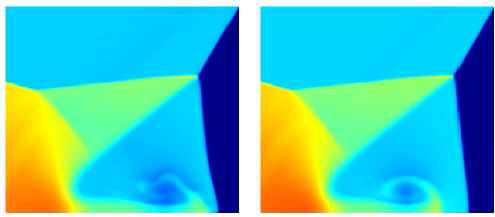
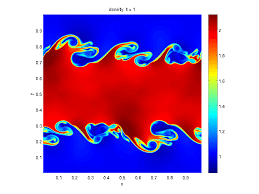


 ws has been an outstanding achievement for computational physics. These methods have provided an essential balance of accuracy (fidelity or resolution) with physical admissibility with computational tractability. While these methods were a tremendous achievement, their progress has stalled in several respects. After a flurry of development, the pace has slowed and adoption of new methods into “production” codes has come to a halt. There are good reasons for this worth exploring if we wish to see if progress can be restarted. This post builds upon the two posts from last week, which describes tools that may be used to develop methods.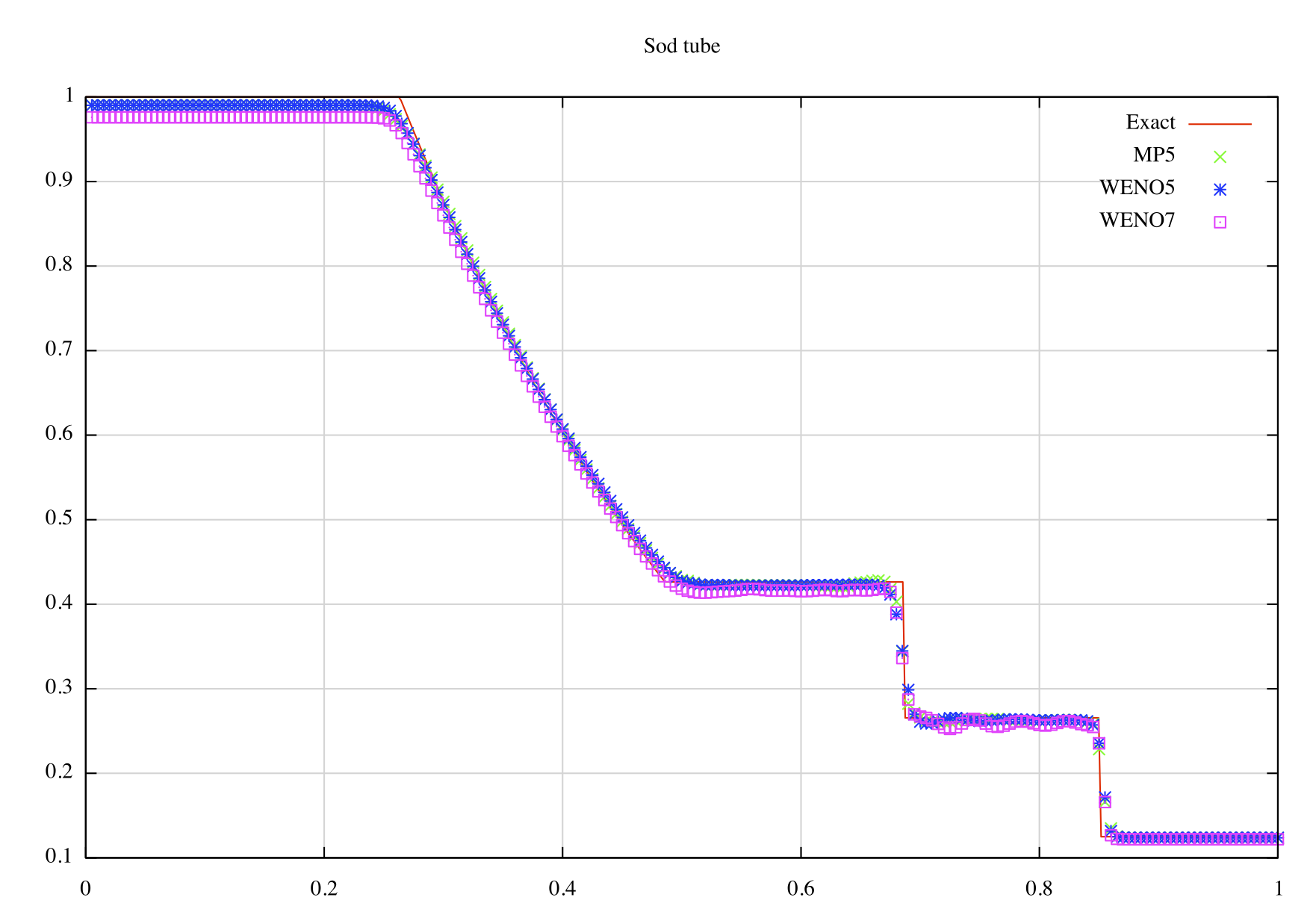
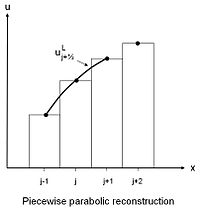
 . For methods of this type the reconstruction is important because it defines the value of the function where there is not data, at cell-edges or faces where fluxes are computed,
  . For a method in conservation form the edge-face values are essential to updating the solution. As I will discuss the value of these values and mindful modifications of the values are severely under-utilized in implementing methods. Various methods can be improved in terms of accuracy, resolution, dissipation and stability through the techniques discussed in this post.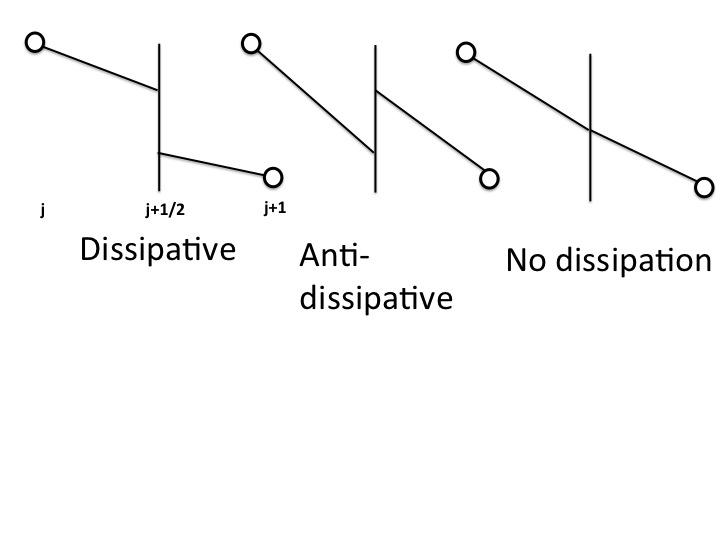
 that can (usually) be two values with a reconstruction being applied to $p\left(\theta_j \right)$ and $ p\left(\theta_{j+1} \right)$. If both reconstructions have equal accuracy we could trade these values, or replace one value by the other without impacting accuracy. Other properties like stability, dissipation or phase error are effected by this change, but formal accuracy is preserved.
 where upwinding will be applied to the edge values from two neighboring cells to determine the physically admissible flux,
  . An upwind approximation will use edge values from cells
  and
and  . The simplest and most useful approximation of the flux is

 where
where  is an eigen-decomposition of the flux Jacobian. The numerical dissipation is proportional to the eigenvalues
  and the jump at the cell edge
  . Generally speaking the physical direction of dissipation is defined by the jump from the cell-center (average) values,
  $latex– u_j $. The extrapolated edge values can (often) change the sign of the jump meaning that the approximation is locally anti-diffusive. A picture of faces is worth showing so one can understand what each swap looks like and envision the impact.
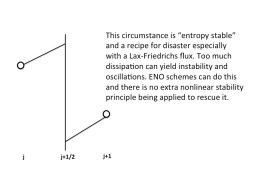 as “entropy stable”. The condition can be computed by checking whether the jump in edge values
 has the same sign as the jump in cell-centered values
  . This should be particularly important in stably and physically moving nonlinear structures on the grid. A concern is that too much dissipation is created as the figure shows. In this case the jump is entropy stable, but larger than the first-order method. This could actually be unstable especially if a Lax-Friedrichs flux is used because it is more dissipative than upwinding.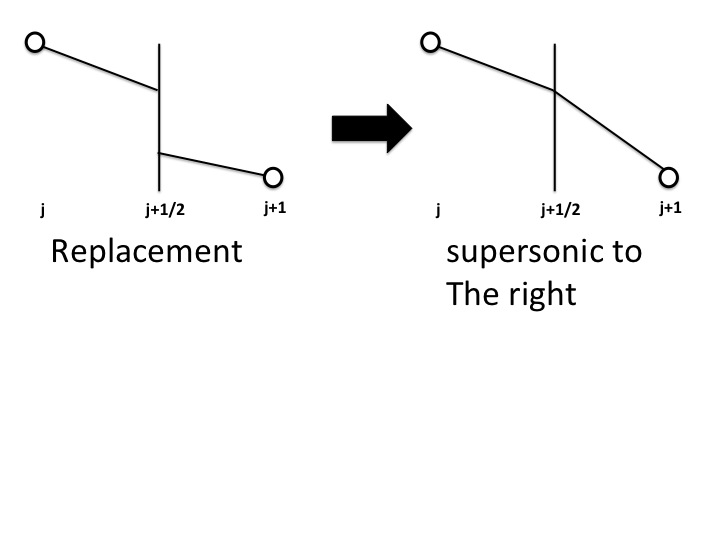
 where
where  , the limiter is implemented as
  ,
,  is the general limiter and
  . The limiter has a general form,
  . The “Standard” is the test that defines the nonlinear control of the solution while “Reconstruction Choice” is the feature being controlled. I will give some examples below. It is important to note that
  is the reconstruction that produces an upwind scheme that is the canonical linear monotonicity preserving (positive) method, but only first-order accurate. Higher order polynomials can be defined for higher accuracy, but without the limiter they are invariably oscillatory.
 where
where  is the lowest value of
 ![\mbox{Reconstruction Choice} = u_j -\min\left[p\left(\theta\right)\right]](https://s0.wp.com/latex.php?latex=%5Cmbox%7BReconstruction+Choice%7D+%3D+u_j+-%5Cmin%5Cleft%5Bp%5Cleft%28%5Ctheta%5Cright%29%5Cright%5D&bg=ffffff&fg=000&s=0&c=20201002) .
. here
here  is the famous minimum modulus function that returns the smallest magnitude argument if the arguments have the same sign.
  where
where  is the “high-order” slope that you desire to use and control the stability of.
 ,
,  and everything else follows. The parts of the limiter are
  with
with  being the monotonicity preserving edge value,
  is the high-order edge values and
  is the WENO edge value. Next, the limiter is completed with
  . Part of the key idea is to use two complimentary nonlinear stability properties from monotonicity preservation and WENO to assure the stability of the method should the high-order method be chosen. In this case the high-order method is bounded by two nonlinearly stable approximation choices. I thought it actually worked pretty well.
 . In this case the specifics of the limiter are
  where
where  is the classical second derivative on the mesh and
  . The choice of method to define the denominator in the limiter is
  . The resulting limiter can either be applied to the edge values or equivalently to the reconstructing polynomial.

 with
with  being a constant. At its core is the imposition of reality on idealized math to describe reality, and provide a useful, utilitarian description of mathematically singular structures. This character is present in turbulence as well. Both have basically the same scaling law and deep philosophical implications.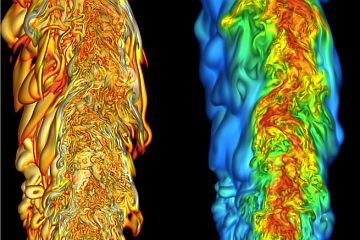










 wheelhouse (along with all the hijinks that the child movie viewers will enjoy).


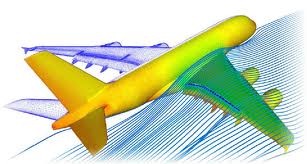
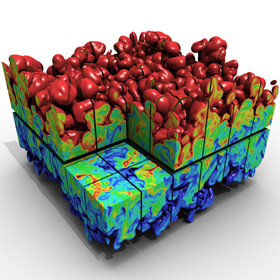
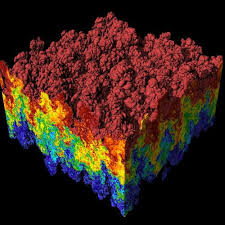
 methods in CFD codes. Methods that were introduced at that time remain at the core of CFD codes today. The reason was the development of new methods that were so unambiguously better than the previous alternatives that the change was a fait accompli. Codes produced results with the new methods that were impossible to achieve with previous methods. At that time a broad and important class of physical problems in fluid dynamics were suddenly open to successful simulation. Simulation results were more realistic and physically appealing and the artificial and unphysical results of the past were no longer a limitation.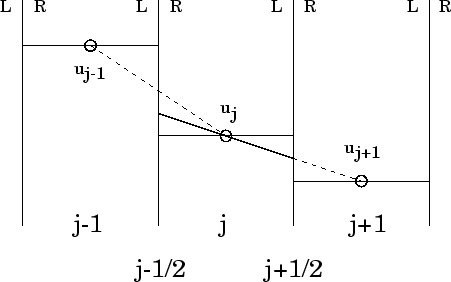
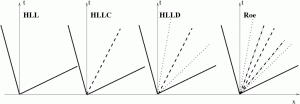 virtually any conceivable standard. In addition, the new methods were not either overly complex or expensive to use. The principles associated with their approach to solving the equations combined the best, most appealing aspects of previous methods in a novel fashion. They became the standard method almost overnight.
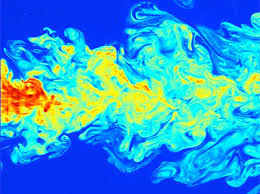
 This was accomplished because the methods were nonlinear even for linear equations meaning that the domain of dependence for the approximation is a function of the solution itself. Earlier methods were linear meaning that the approximation was the same without regard for the solution. Before the high-resolution methods you had two choices either a low-order method that would wash out the solution, or a high-order solution that would have unphysical solutions. Theoretically the low-order solution is superior in a sense because the solution could be guaranteed to be physical. This happened because the solution was found using a great deal of numerical or artificial viscosity. The solutions were effectively laminar (meaning viscously dominated) thus not having energetic structures that make fluid dynamics so exciting, useful and beautiful.
 safe to do so), and only use the lower accuracy, dissipative method when absolutely necessary. Making these choices on the fly is the core of the magic of these methods. The new methods alleviated the bulk of this viscosity, but did not entirely remove it. This is good and important because some viscosity in the solution is essential to connect the results to the real world. Real world flows all have some amount of viscous dissipation. This fact is essential for success in computing shock waves where having dissipation allows the selection of the correct solution.
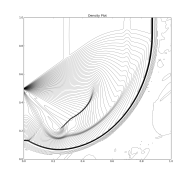 In the case of simple hyperbolic conservation laws that define the inertial part of fluid dynamics, the low order accuracy methods solve an equation with classical viscous terms that match those seen in reality although generally the magnitude of viscosity is much larger than the real world. Thus these methods produce laminar (syrupy) flows as a matter of course. This makes these methods unsuitable for simulating most conditions of interest to engineering and science. It also makes these methods very safe to use and virtually guarantee a physically reasonable (if inaccurate) solution.
 The new methods get rid of these large viscous terms and replace it with a smaller viscosity that depends on the structure of the solution. The results with the new methods are stunningly different and produce the sort of rich nonlinear structures found in nature (or something closely related). Suddenly codes produced solutions that matched reality far more closely. It was a night and day difference in method performance, once you tried the new methods there was no going back.