
I have always found it quaint and rather touching that there is a movement [Libertarians] in the US that thinks Americans are not yet selfish enough.
The irrational fear of Ebola has thrust the competence of our government into the  spotlight. While some conservative voices would point at the failing of government, I believe their aim is both spot on, and completely wrong. We don’t have a failure of government, we have a failing of governance both private and public. The problems with Ebola are exemplars of incompetence from both government and business with both contributing greatly to the debacle in Dallas.
 The greater issue is the general crisis in governance in our country. No one seems to be able to do anything right. Government is ineffective and wasteful. Business is amoral and unethical. Neither should be acceptable. The only thing we are doing with any competence is directing more and more of our societal wealth into the hands of a very select few. This is being done in an intrinsically amoral and unethical manner despite its explicit legality since the laws are basically for sale.
It might be nice if the key issue in politics were associated with fixing our so ciety-wide incompetence. We need competence and effective governance from both private and public entities. I would argue that the problem is an unhealthy focus on the individual rather than the overall society. The narrow definition of success associated with the combination of short-term gains and organizational locality are making every decision tactical. This tactical decision-making benefits very few and leads to outcomes that hurt society at the large scale.
In business this produces choices that give shareholders the option of cashing out while destroying jobs, and the future of companies. In government this looks like buck passing and the CYA culture. Together they equal the web of mistakes that made the Dallas Ebola case so much worse. Make no mistake this case is the combination of profit focused medicine coupled with a lack of proper government execution. For example the profit motive is one of the main reasons we don’t have more effective medicines for treating diseases like Ebola. There is little or no profit to made there despite its potential importance to society or its destructive potential. The core problem is a lack of outrage about the overall lack of competence in governance. This is the thing we should be fixing and it is a completely bipartisan problem.
We should be demand competent thoughtful governance from both the private and public sectors. The outcomes need to balance the good of the individual and society as a whole. We need to explicitly reject the governance that only benefits a precious few. In the long run a more balanced approach will lead to a far better future for everyone including those few who take nearly all the benefits today.
Selfishness and greed, individual or national, cause most of our troubles.

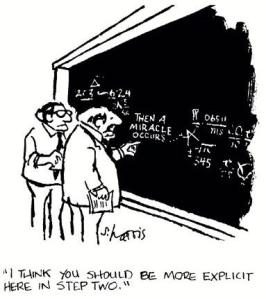 relatively well-known and successful professor came for a visit and gave a research seminar on his work. On the face of it, the talk looked interesting and topical. This rapidly faded when the talk unfolded for a very simple reason. The professor was limiting discussion to where he could prove results. If the flow he was studying became too energetic (too high a Reynolds number, or its equivalent, the proofs couldn’t be constructed). As a result the work had limited applicability to investigations because results can’t be proven for most applied problems. Most applied problems
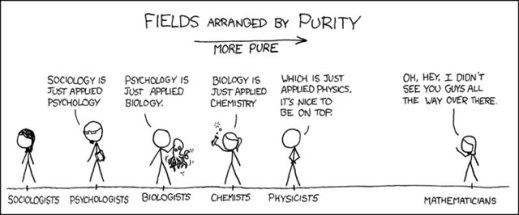 avoids the situations of interest, can’t be demonstrated, or simply doesn’t demonstrate itself, I won’t make the effort because the mathematician hasn’t done their part to meet me half way. What should happen when we have important applied cases where results can’t be proven? Should the effort in math be given to expand the grasp of mathematics to handle these cases? Or should mathematicians work on proving weaker bounds or results?
 computational, modeling and physics progress. This role has shrunk over time due to an unwillingness to get their hands dirty. There also seems to be a desire to look more like pure math, which leads to a lack of demonstration.
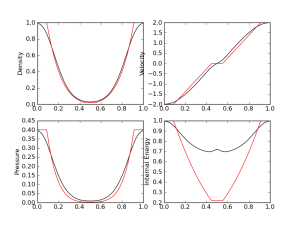
 I have always found that the best way to make methods better is to continually break them. I will routinely torture methods to the breaking point fully knowing that “breaking” is itself complex. Methods break in many ways starting with a failure to converge to the “right” solution, or converge at the right rate, followed by a failure to converge to a solution, followed by a loss of stability. The improvement comes from understanding the cause of the failure, and changing the method to expand the range where a better outcome can be achieved. The process of failure is often demonstrably Edisonian, and the challenge is to provide the scientific, structural explanation for the failure to blunt the purely empirical edge. This tension is how progress and knowledge grow, and failure is the engine.
 despite this failure is not encouraged because of superficial fears regarding perception. As a result we have come to accept mediocrity as success, losing almost any conception of what true success looks like. Our success is almost by fiat rather than achievement. We will ultimately pay the price of this orgy of over-evaluation unless something changes in how we view things.
 I wrote this in a notebook a few weeks ago and it would be a good idea to explain myself. The lack of certainty and chaos in the Universe is obvious, yet so much of our modeling is based on deterministic thinking. This legacy of Newton pollutes so much of
 ―
―  It is the enshrinement of mathematics as divorced from reality. The reason is several fold: the equations as given are patently unphysical, and singularities are a relic of the same Newtonian thinking that defines the Universe as a clock simply moving forward with complete determinism.
 This is only one instance where determinism is hurting science. In general the modeling of the World or Universe proceeds along lines that implicitly expect determinism despite all the evidence to the contrary. A lot of the time the variation in behavior of a system is relatively small, or the nature of variability is reliable and can be captured in the constitutive laws. A problem that we are increasingly facing is the solution of systems where length and time scales where the variability exists are coming into the resolution of our codes. Continuing to promote the fallacy that the system is deterministic is simply wrong on the face of it.
 to avoid answering a question. It has been a source of much discussion, a recent documentary
 So what our some of the unknown knowns for that I deal with?
 egions and apply homogeneous properties even though the materials are definitely heterogeneous at the scale of the mesh. Generally speaking, the changes necessary to model things correctly is barely on the technical agenda. These features are more prevalent in
 wn known. It has become the prevalent way of managing complexity and simply assuming the answer is easier than thinking about the inherent complexity of things. This thought process is the heart of racism, sexism, gay bashing and a host of societies greatest ills. By simply assuming certain things to be true without question makes life easy, but it also allows people to do terrible things with complete justification. This brings us back to Rumsfeld.
 In today’s America it is axiomatic that the concept that applying corporate principles to organizational governance is good and appropriate. It is applied without question and used to justify all manner of mismanagement. The reality is that corporate governance principles are somewhere between inappropriate to completely incompetent for managing research institutions. I’d argue that they are ruining the economy itself because the current “principles” are oriented toward the benefit of the few people at the top of the food chain.
 onflict of interest, and society as a whole is paying the price. The business principles being used are bad for the businesses as they are used as sources of money that is systematically siphoned off to compensate “shareholders”.
 with disaster. Our dominance of science and research is ending. Europe and China are overtaking the United States. Our government seems to be in denial of this, but it is more obvious all the time. A large part of the blame can be laid at the feet of the misapplication of corporate governance to research institutions.
 that kept him employed into his 80’s and able to generously support his family.
 The Regularized Singularity