
tl;dr
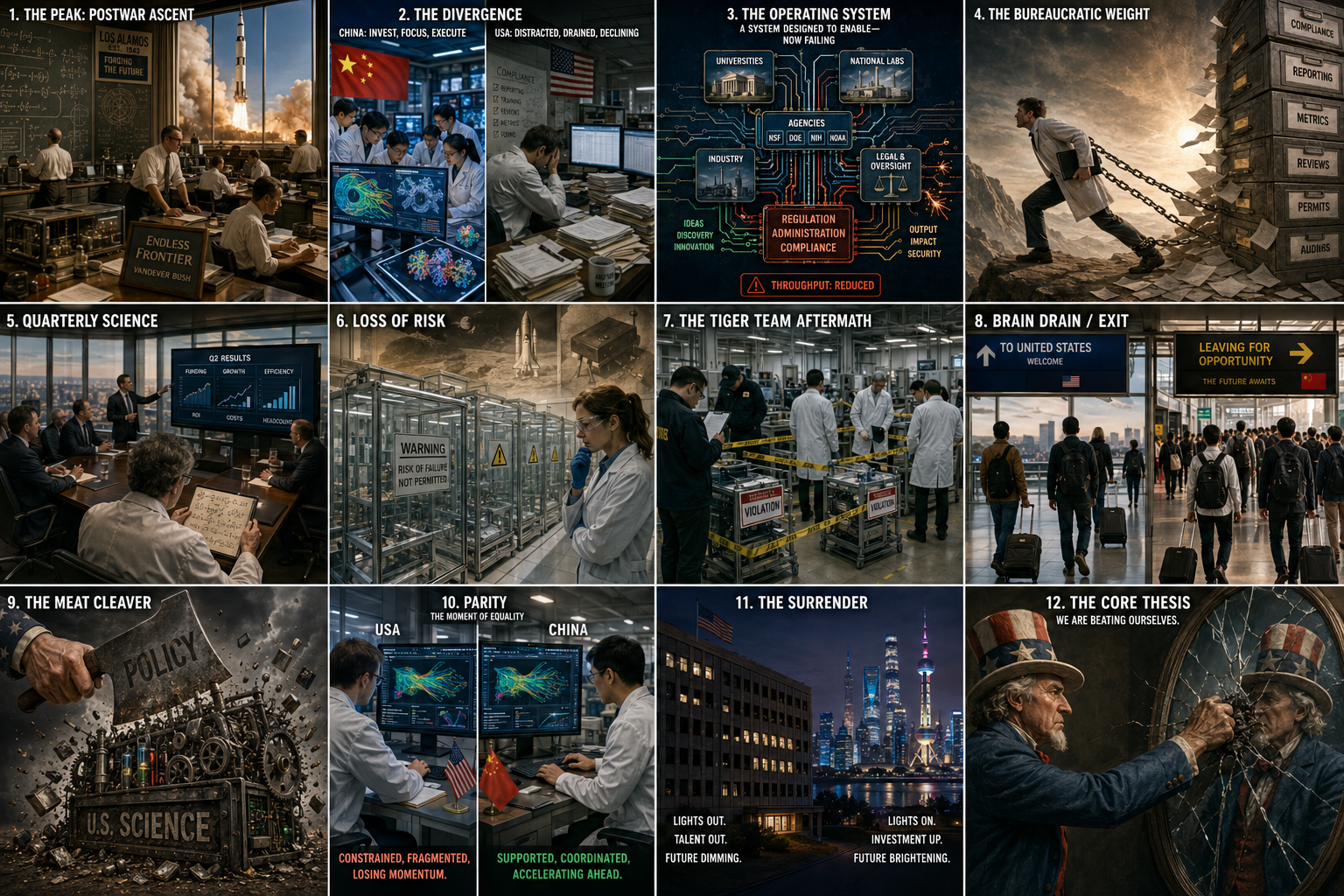
For most of the period of time after World War II, the United States has been the unrivaled superpower economically, militarily, and scientifically. American science has been the foundation of much of the military and economic might. It was a virtuous cycle and engine. This is not true today. The USA is losing its grip on all of this. Over the past 40 years, this supremacy has declined in every respect, including science. The decline of scientific supremacy arose from a sense of hubris and false security. There was a belief that we could focus on a host of other things. The efficiency and effectiveness of our scientific enterprise were unimportant. I witnessed this first-hand during my career at two national laboratories. In the past few years, it has become a question as to whether the United States has been surpassed by China. I believe that it has. Now, under the second Trump administration, it has turned into a surrender. American science is in full retreat. All its institutions are being destroyed.
“A great civilization is not conquered from without until it has destroyed itself from within.” — Will Durant
Seeing this in Personally
Over the span of my own career, I have seen this change dramatically. When I started my career, the Chinese were definitely far behind the USA. There were relatively few Chinese scientists who were leaders in the field. Moreover, when I did encounter them, the work was quite pedestrian and ordinary. By and large, the papers were on par with mediocre American science. Over the past decade, this has completely changed. More and more, the quality of papers has started to rival the best in the West. I started to see a unique capability across a host of CFD endeavors. I saw the Chinese work draw to parity with the USA. This is paired with the degradation in American quality and quantity of science in my area. The Chinese had radically improved. The USA had allowed itself to get worse.
I remember meeting a chemist who had given a distinguished lecture at our local University. He was a well-known chemist from another National Lab. In our conversation, he reported exactly the same pattern I had seen in CFD. The same blueprint. The Chinese had radically grown their science, in this case, chemistry. The USA had allowed our work to stagnate or decline. Suddenly the Chinese were every bit as good at the USA. How widespread is this? I will mention a study below that indicates that it is a broad pattern.
The clincher to my tale is the reaction from my leaders. For the leaders at the Lab, the reaction ranged from inaction to complete disinterest. Even though this is a serious National security issue, there is no reaction or response. I raised the topic with our National program manager from the agency supporting Lab computational work. The reaction was complete disinterest. There was no reaction or care concerned. Our leaders simply don’t give one single fuck about it; none at at all.
So we’re cooked, right?
“Every nation has the government it deserves.” — Joseph de Maistre

Scientific Operating Systems
American science is constructed out of a series of institutions. Science happens a universities and National labs. It used to happen in industry, but this is mostly gone except perhaps medicine. A host of federal departments and agencies fund science and manage it. Many others also regulate the science done everywhere. The oversight and regulation interacts with the legal profession to keep science inside the law. All of these working together define the Nation’ productions of science. This is the operating system for American science.
“Research is what I’m doing when I don’t know what I’m doing.” — Wernher von Braun
It is malfunctioning. It is now mostly stopping and harming science.
This is not to say that all the institutions that are being attacked are not in need of massive overhaul and rebuilding. They are. All of them need it. The problem is that this is not what the Trump administration is engaged in. They are engaged in wanton destruction. This was true with Elon Musk’s DOGE. It continues to be true today with the broad attacks on the federal infrastructure, dominated by the OMB head Russell Vought. None of what they are doing is creating any sort change needed in these institutions. The institutions are not becoming more efficient or better. They are all becoming worse. Worse yet, political litmus tests have started to be issued forth on a variety of scientific enterprises. None more so than weather and climate research.
There’s a lot of discussion these days about the Chinese reaching supremacy in science and engineering in the world. I tend to believe this is true. My evidence comes not from the United States but from an Australian study (Austrailian Strategic Policy Institute) that looked at this in a less biased way. The Austrailians have a balanced concern about understanding the pros and cons of the two superpowers. They are not prone to account for either nation’s preconceptions. They see China dominating globally and the USA second. This is before the damage caused by Trump since 2025.
“Basic research is what I’m doing when I don’t know what I’m doing.” — Wernher von Braun
The deeper issue is that the truth is that the United States is basically ceding science to the Chinese. We have torn down our institutions, reduced our investment, and the investment that is left is spent very inefficiently. This is all on top of the broad decline giving up the lead. The current administration has done nothing to stop this but rather accelerate the whole process. They’ve nibbled around the edges of the inefficiency but attacked the funding and institutions mercilessly. Before the Trump administration, we were already losing to China. Now we’ve basically given up. We will be second if not lower.
“Far too many managers are short-term, horizon-less decision makers.” — W. Edwards Deming
What was already killing science was a host of misteps. Quarterly profits killed industrial research. The payoff for research simply is too far in the future. The same mentality has taken hold across the federal government. Long-term investments have decreased, and short-term focus has taken over everywhere. None of this is sustainable, and none of this can take the United States anywhere good in the long term. The short-term-ism is one of the biggest issues.
The other major issue at work is the lack of trust. The lack of trust is predominantly from the Left. This is shown in terms of regulation and various initiatives that all take an immense amount of effort. There no trust is held and in its place bureaucracy is created. This is to make sure that the initiatives are met. The fact is that most of these initiatives have proven poor and play out through metrics that can easily be cooked into seeming compliance. Thus we get failure at a huge cost.
“Trust is the lubrication that makes it possible for organizations to work.” — Warren Bennis
The other big thing that lack of trust harms is risk taking. In the current environment risk unacceptable. Without risk innovation and progress are nearly impossible. The impact is a loss of innovation in every institution. Progress is grinding to a halt. The lack of trust then generates fear and caution. Both fear and caution produce an augmented effect. Innovation became impossible. Over time we will see the movement of discovery and awards move away from the USA.
Nothing that the Trump administration has done has improved anything. They are just meat cleaver cuts in funding and aimless directives towards overhead. This needs to be thoughtful and strategic, not simply wishful thinking. We need all our scinece funding and generate efficinecy to spend it better. Innovation and progress is vital and trust is needed for that. With trust the fear and caution can lower. All their steps are moving the trust lower and fear higher. All of these institutions are in need of deeper forms that focus on the needs of the country in the long term . There should be focus on reinvigorating the quality, focus, and adventure in science. The loss of any ability to take risk has only accelerated under this leadership, Where more trust, adventure, and risk-taking are needed. Instead there is less. Much less.
The American system should be vastly better than the Chinese system for science. The real truth is we’ve managed to attack and destroy almost all of our advantages in science. In spite of our advantages culturally we have managed to poison them all.
“When a measure becomes a target, it ceases to be a good measure.” — Charles Goodhart
The Period of American Science Supremacy
“Plans are useless, but planning is indispensable.” — Dwight D. Eisenhower
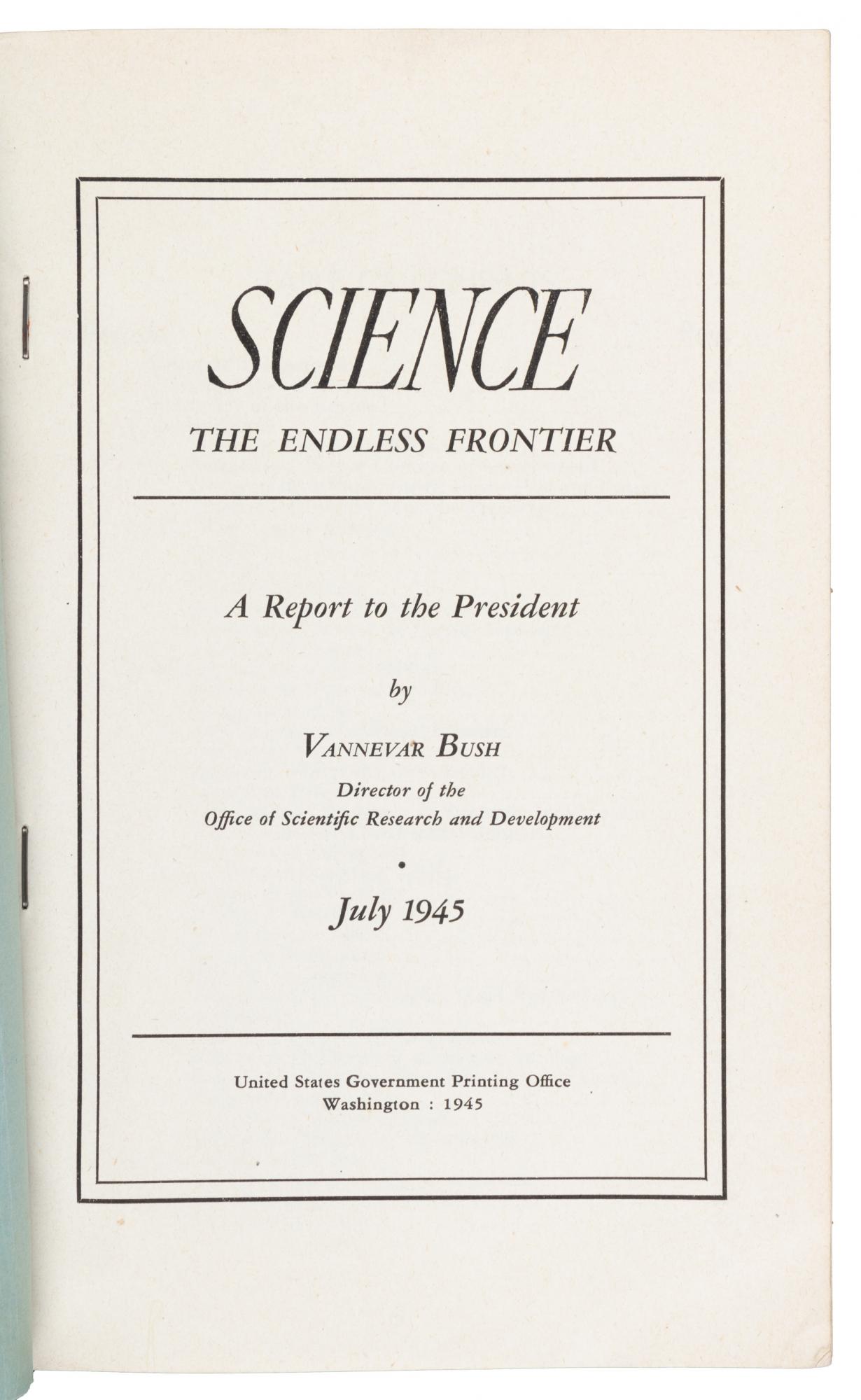

We should talk about the period of unrivaled and unquestioned superiority of American science. This arose out of the ruins of World War II, in large part because most of the rest of the world had been seriously destroyed and damaged by the war. The United States remained relatively unscathed. In addition, the scientific enterprise in the United States had a huge achievement and had leapt to the forefront of human thought with the development of the atomic bomb. This produced a sort of commitment to science as the foundation of national security in Vandever Bush’s Endless Frontier. The American government began to strategically invest and create scientific institutions that could wanage science. There was huge support for science across the federal enterprise. This includes many national and defense laboratories. There was support for university science, and various government organizations to support the broad scientific enterprise. Chief among these were the National Science Foundation and the National Institutes of Health, which provided a large amount of funding. Moreover, U.S. industries provided a scientific enterprise, perhaps none more evident than Bell Labs. There was a huge investment and spirit of forward progress in the United States. The United States also had vast economic power that was enhanced by this science and technological investment. It also provided a large amount of funding for that.

“Scientific research is one of the most important keys to our future national security.” — Vannevar Bush
The scientific successes from World War II provided the start of this. The continued energy for scientific advancement was created by the competition with the Soviet Union. When support for science began to lag, the Soviet Union pushed ahead with Sputnik and the Space Program. This reinvigorated American science and included a desire to leap ahead of the Russians in space. This produced vast support for NASA and the Apollo Program, with the apex event of the moon landing in 1969. Throughout this time, the American scientific enterprise provided a large amount of technological advances that fed U.S. industry. It allowed also the mighty armed forces of the United States.
This situation continued unabated until around about 1980. This was marked by the Reagan Revolution politically. This would become the beginning of the end for American scientific supremacy.
“A nation which depends upon others for its basic science is a nation which will be slow in its industrial progress and weak in its competitive position.” — Vannevar Bush
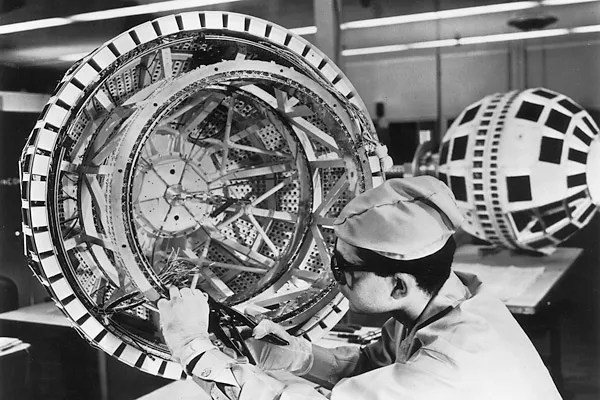

The Decline of American Science
“The nine most terrifying words in the English language are “I’m from the government, and I’m here to help.” – Ronald Reagan
The real root of the beginning of the decline of American science preceded Reagan. There was a series of events that occurred in the mid to late 1970s that began to undermine the trust and ability of the government to support science. Trust in the government failed. Much of this can be traced back to the actions of Richard Nixon and Watergate. There was also the overreach of the Vietnam War. In the wake of the Apollo program and the collapse of Soviet space exploration, the withdrawal from government investment in space. All of this conspired to create the environment for the beginning of the end for American science supremacy. Reagan, when he was elected, ushered in a period of distrust and hate for the government. Part of that government that was being attacked was the scientific enterprise. This is not to say that all of the problems with science came from the conservative side of the political spectrum. There was plenty from the liberal side as well.
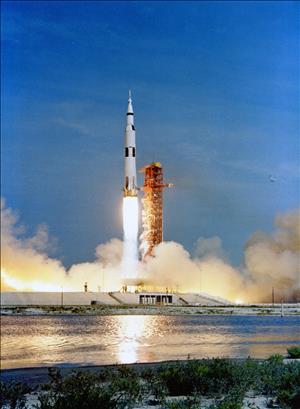
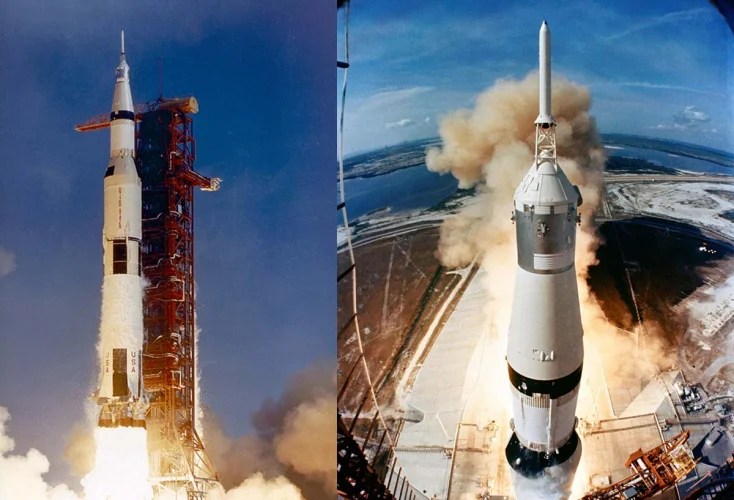
The lack of trust in technology had started to become manifest in the desire for regulation of all things. The lack of trust in industry and technology and the desire to create a framework of safety. This overall framework of safety is one of the major forces that has sapped vitality out of science, as more and more resources went to regulating and administering science. Less of it went to exploration and creation; energy and focus moved.
“Government does not solve problems; it subsidizes them.” – Ronald Reagan
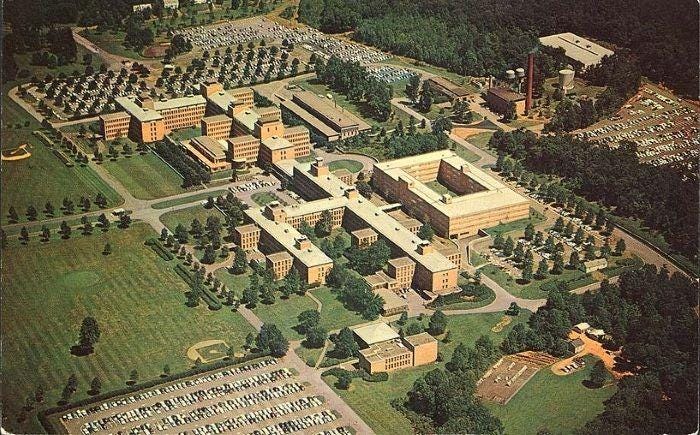
These checks and balances were created to deal with a variety of missteps and mistakes. Plus the belief that the American society was rich enough and powerful enough that it could easily afford these sorts of steps. This belief has ended up being quite foolhardy and has acted as a continual friction and drag on the scientific enterprise. By the time that I started my work in Los Alamos in 1989, the effects were already clear. The general belief is that the lab peaked in 1980 and was marked by the departure of Harold Agnew as laboratory director.
In the few years that I was at the lab, I saw a huge change. This was the end of the Cold War. With the end of the Cold War, there was a huge withdrawal of trust and resources from the National Labs. There was also a very sharp focus on cleaning up the environmental harm that the nuclear weapons program had done. This took the form of the Tiger Teams sent to find problems. This unleashed a huge amount of administrative and bureaucratic energy at the labs that was all detracting from the conduct of science. When I first got to the Lab I would see my Division leader once a quarter or so. It was great. After the Tiger Teams hit the Lab I wouldn’t see a Division Leader in my office til 2005.
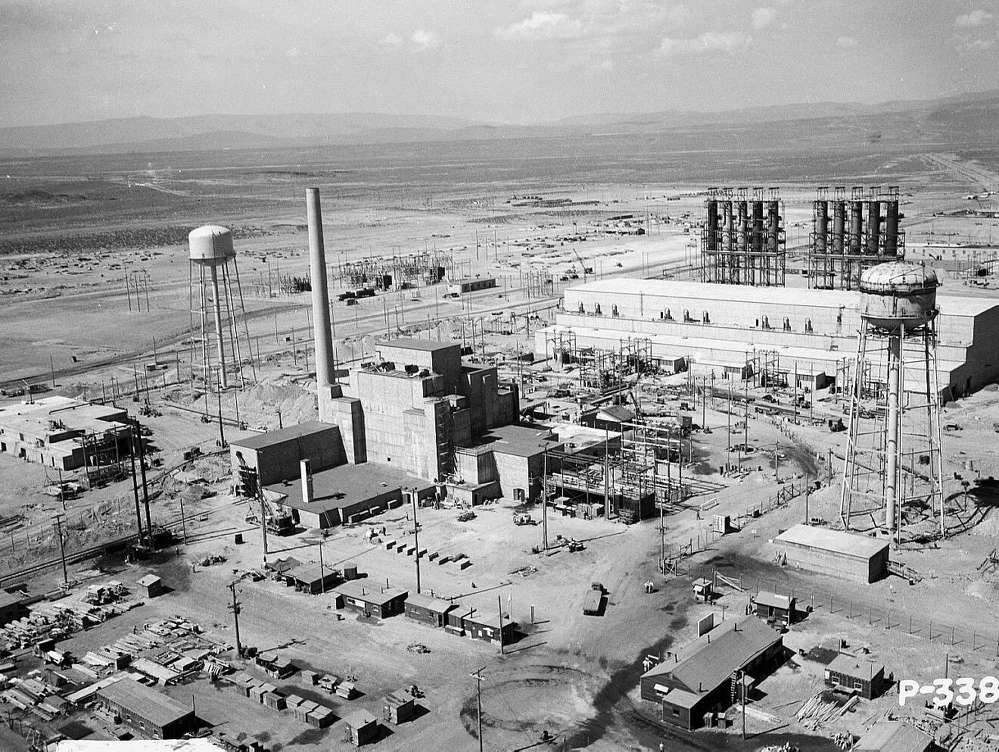
In this time, we saw the first changes in the leadership of the lab. The original servant leadership model that the lab had worked for a while, as managers worked to protect and try to keep as much science going as possible. Over time, this eroded, and gradually there was also a change to a more competitive environment for funding and resources. This environment created a drive for money as the chief measure of laboratory strength. With this came the era of the Empire Builders and a distinct change in the tenor of management. The money also brought a short term quarterly report mentality. The standards started to become different and technical quality dropped.
The final blow at the laboratories was the corporate takeover of laboratory management. This came from this misbegotten belief that industrial and business management ideas were the best way to run the lab. The quarterly profit, shareholder value philosophy that had taken hold across the corporate world was injected into the management of laboratories. All of this, combined with the regulatory environment, acted as a huge drag on the laboratories and science in general in this country. The labs became shadows of their former glory.
Places like universities were not immune from this. Part of the forces of change in the university were the same bureaucratic and administrative additions. Everything from environmental regulation to workplace regulation to DEI became the priority. With this came an enormous growth of the administrative staff at the universities, and the cost of the universities exploded. States removed much of the funding support as well. The same mentality about money and empire building took over at the universities. The ability of professors to bring in money began to become far more important than their ability to teach the next generation. The money replaced research quality as the principle measure. Education of the next generation was almost an after thought.

Surrender and Retreat
“The best way to predict the future is to invent it.” — Alan Kay
All these forces are still active today. They have worked to continually drag American science down and erode the supremacy. The fact of American supremacy in science is now an issue of debate. Studies have started to speak, as the various sources around the world have begun to see that China has replaced the United States as the top country in science.
“In any bureaucracy, there’s a natural tendency to let the system become an excuse for inaction.” — Chris Argyris
The conclusion that I would like to draw attention to is that the Chinese did not beat Americans in science so much as Americans beat themselves. The Chinese system is not superior to the American system in terms of innovation and freedom. In the face of all that the American system has done to undermine itself, the Chinese have surpassed it. One of the reasons is a genuine strategy. This is somewhat a function of their leadership, which is dominated by people with engineering backgrounds. In the United States is dominated by people with legal or business backgrounds. This difference is key. The Chinese have a national strategy and execute; the Americans have no strategy at all. American science is simply chaos and greed and professional drive. There is little or no coherence. Intellectual thought going into scientific direction has been replaced by focus on money.
“Culture eats strategy for breakfast.” — Peter Drucker
All of this was in place before we got to the current day. There was genuine damage to science that was done during the first Trump administration. The Biden administration, which was a continuation of the trends of the last 40 years. The real difference is that when we got to the second Trump administration there are attacks against the institutions of science. Coming out of the administration are both huge budget cuts and attacks on fundamental science across the board. There is the broad personal departure of experts and people who offer genuine professional expertise in a variety of scientific fields. These are replaced by people who are chosen for their loyalty politically. The combination of personal selections and huge resource cuts means that what was a decline in American science has turned into a surrender.
“Success breeds complacency. Complacency breeds failure.” — Andrew Grove

 The Regularized Singularity