tl;dr
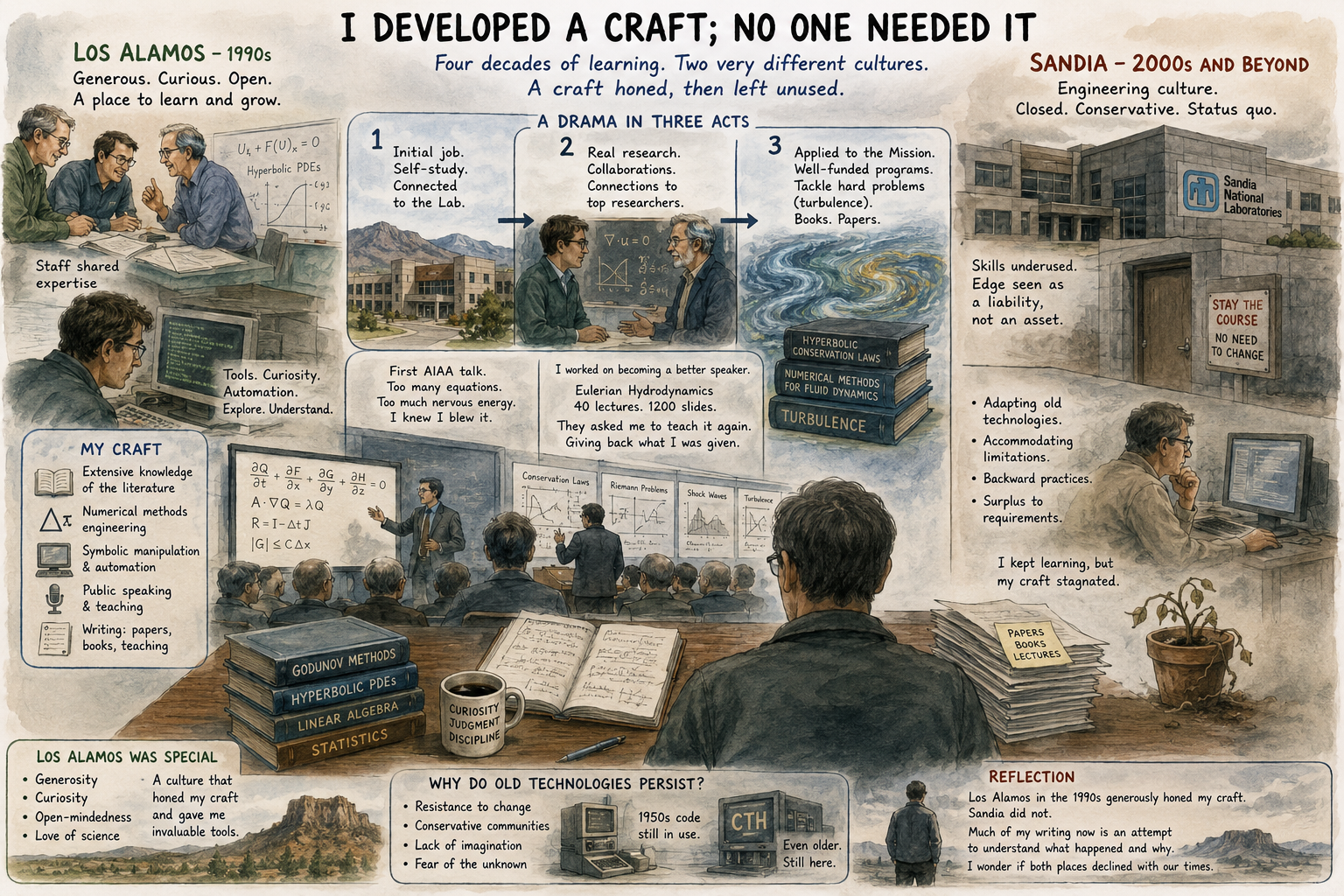
I built a craft over four decades. I found deep knowledge of the literature, numerical methods, tools, public speaking, and the discipline of writing. Most of it went unused in the second half of my career. Los Alamos in the 1990s was generous, curious, and open enough to hone that craft. Senior staff would give you their expertise if you showed up with intellect and judgment. Sandia was an engineering culture that valued maintaining the status quo over advancing science. The edge I had developed was treated as a liability rather than an asset. My craft stagnated. Much of my writing now is an attempt to understand what happened and why.
“I had to learn quickly, for the work was hard and the demands real, but no one could have asked for a better apprenticeship.” — Bertrand Russell
My Hard-Won Craft, Its Use, and Its Ultimate Lack of Utility
The things you know how to do make a huge difference in work. They define what you can technically achieve and provide to where you work. Success, it turns out, depends on things like personality, culture, and interpersonal skills. Usually, one thinks about education as happening at school. I think this is short-sighted and too narrow. I went to a second- or third-rate university. The skills I left school with were modest and ordinary. These basic skills did provide me with a foundation that was ready for something extraordinary.
“Life can only be understood backwards; but it must be lived forwards.” — Søren Kierkegaard
I would say that I have extensive knowledge of the literature in my field. I read widely and absorbed an immense amount of knowledge. In addition, I have learned much about the history of my field, and this is hard-won because it is hidden. Scientists are not terribly good historians.
At school, I did a Master’s thesis. It was pretty much shit and mostly a waste of time. I did learn a bunch of things not to do. I learned who not to work with, and what attitudes and relationships at work are unacceptable. In a deep sense, I found the same thing at the end of my career at Sandia. What was unacceptable when I was 24 was even worse at 62. When it happened again, I retired and left. Ironically, I did the same thing at school. I lucked out and got a job at the best possible place. So many other jobs would have been horrible, and my craft would have been frozen in place.
“If I have seen further, it is by standing on the shoulders of giants.” — Isaac Newton
I had the great luck of working at Los Alamos in a period when you could learn a great deal. The staff at Los Alamos were generous and full of curiosity and love of science. If you showed a decent intellect and judgment, you could tap into their expertise. This is exactly what I did. If I look at the structure of this, I see a drama happening in three acts at Los Alamos.
- My initial job provided modest education, but support for education and my PhD. This was mostly individual self-study. The main thing the job did was connect me to the rest of the Lab and set the stage for the next stage.
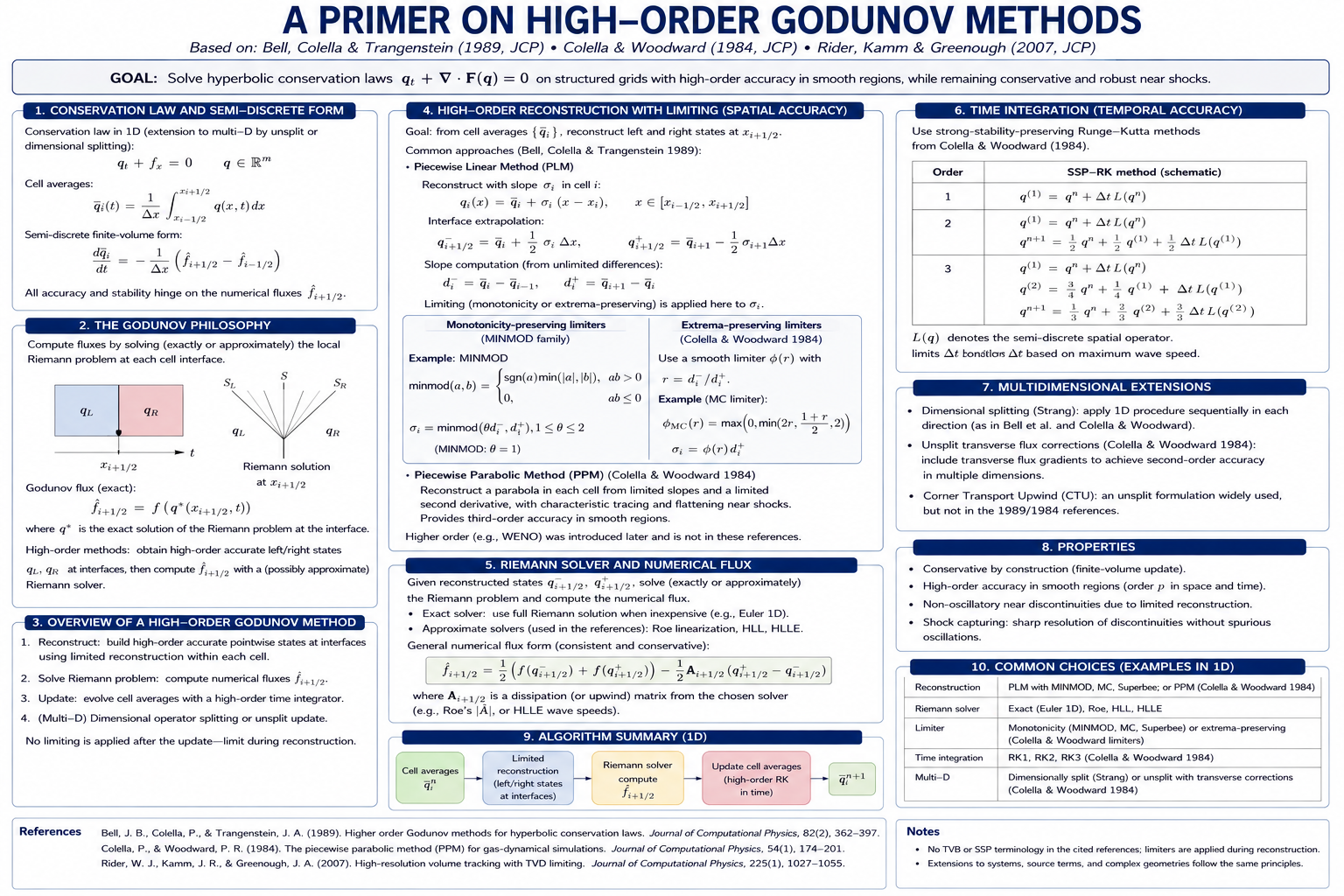
- I worked on a real research project and started to connect with the rest of the Lab. There was a collaboration with Doug Kothe. Also, what effectively became a Habilitation-style thesis with that Project. The project also connected me to high-level researchers like Phil Colella and John Bell.
- I moved to the Applied Theoretical Physics Division (X) and started to apply my skills to the Mission. There was a well-funded program (ASC) with lots of energy. I also executed a very successful research project on turbulence. The mission work motivated me to do a bunch of really hard things (like turbulence). This really matured me. I wrote a couple of books and a shitload (or is that a fuckton) of papers.
“What we have to learn to do, we learn by doing.” — Aristotle
In addition to my extensive knowledge of the literature, I had a bunch of practical skills. Early on, I started using symbolic manipulation software (Mathematica, Maple, Macsyma). I learned how to do everything by hand, but found complex analysis could be automated. Using software like this is informative about how to think and use AI. This included many forms of stability analysis, derivation of methods, and other forms. This automation allowed me to attack a variety of methods and explore things efficiently. I also began to catalog problems and pathologies to combat. I explored ways to mitigate them.
I remember a quip Phil Colella threw at me: “You’re a really good method engineer.” I think it was meant as an insult, but eventually I took it to be true and a modest compliment. Yes, I became a “numerical methods engineer.” I had a great set of skills and knowledge to tackle all kinds of problems. I learned a great deal about hyperbolic conservation laws, multiphysics, numerical linear algebra, and turbulence. I combined these, mixing and matching to great effect.
“We do not remember days, we remember moments.” — Cesare Pavese
I remember when I gave my first talk on hyperbolic PDE solvers at the AIAA CFD conference. Phil was in the audience. I gave a really shitty talk. Too many equations and too much nervous energy all put together into a blur. At the end, I knew that I had fucked that up. After that, I worked diligently on becoming a better public speaker. Today, I feel like I am a very good speaker. Along the way, I gave a class on “Eulerian Hydrodynamics” at Los Alamos with 40 lectures and 1200 slides. They asked me to give the class again. In a sense, this was the capstone of my career there. I was giving back to the Los Alamos staff what I had been given by others before. I was giving my experience and knowledge as a reflection of my growth there.
My time at Sandia was a way for me to apply my skills, but the work I was assigned did not require the skills I developed later, after 2000. Everything I learned beyond that was surplus to requirements. I kept learning while I was there, but the environment was much more closed off and conservative, and it lacked generosity. It is hard to say whether that was a feature of Sandia culture or just the passage of time, but it was probably a combination of both.
“It is difficult to get a man to understand something when his salary depends upon his not understanding it.” — Upton Sinclair
I still learned a lot, especially through statistics and how to apply them, and the job was difficult. Much of what I did at Sandia involved adapting well-established technologies to the limitations and constraints we faced there. It also meant accommodating the relatively backward practices and less-than-optimal problem-solving approaches that seemed standard there.
In the end, my craft stagnated and did not grow during my time at Sandia. I feel some regret and a sense of loss about that. A lot of my recent writing has been an effort to understand and explain what happened. I think the simplest explanation is that Los Alamos was special and different from most places. Sandia was ordinary and lacked that special something: curiosity and open-mindedness. One reason for this is culture; another is the particular pace of our modernity. Sandia is fundamentally an engineering culture, with interesting local cultures surrounding it (next post). Those cultures tend to be more focused on maintaining the status quo than on advancing the state of science.
The unexamined life is not worth living.” — Socrates
That is not to say Los Alamos has all of this figured out. When I got there in 1996, they were still using code written in the 1950s for some of their most important analysis. The same attitude is present at Sandia with their famous code, CTH. It is even older now than that LANL code in a comparative sense. Both cultures tolerated unacceptably old technology for essential work. Why do places like these hold onto technologies that are obviously past their sell-by date? It seems to be a matter of resistance to change. The active choice of very conservative communities of practice. They lack the imagination and bold resolve to do anything different.
I’ll close by saying that I’m sure Los Alamos is a shadow of what it was in the 1990s, when it generously honed my craft and gave me a set of tools I’m proud of. That makes me wonder whether Sandia also declined during that era. In my experience, there isn’t much reflection of that decline at the lab itself. I see the deep-seated issues in the United States as a whole.
“Mastery is not a function of genius or talent. It is a function of time and intense focus applied to a particular field of knowledge.” — Robert Greene