
Education is the most powerful weapon which you can use to change the world.
― Nelson Mandela
 Today and tomorrow I am visiting the University of Notre Dame for the purpose of reviewing and advising a DOE sponsored research center (CSWARM). The project combines material science, computation and computer science as the scientific world struggles toward the next generation of computing. Given today’s work, my
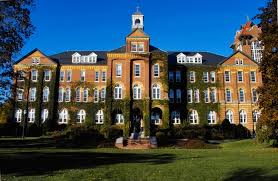 background and my son’s entry into science and engineering education next year, the topic of college and its health is keenly in my focus. Universities are perhaps one of the most important institutions in our society. They should be emblematic of the best we have to offer and a shining example of what we aspire to be. So what do university’s have to say about us today?
Anyone who stops learning is old, whether at twenty or eighty. Anyone who keeps learning stays young.
In all respects the visit didn’t disappoint me. The research project while centered at Notre Dame spans two other universities (Indiana and Purdue) and involves computer science, computational science, experiment, and theory. Each topic was present and the work of melding the usually independent university research agendas into a single multidisciplinary center has begun. This is hard work that is firmly against the grain of university dynamics. We were presented with a plethora of results, wowed by their progress, but saw many areas where suggestions could profitably be made. All-in-all a good showing and a great start at a great research project.
We are all failures- at least the best of us are.
Before going on to the things that bothered me about the visit, I will freely admit that some aspects of interaction with the universities give me pause. The current style of program management for research is not congruent with educational objectives. These 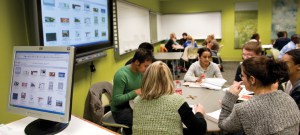 projects do not get the full brunt of government management, but enough of their guidance is the sort of “do not ever fail” category to run afoul of educational optimality. Research if done properly will fail, and fail a lot. It is research because we don’t know exactly what we are doing. If it isn’t failing a great deal it probably isn’t good research. Too much of what I work on is under a no-failure edict. This creates an environment that largely runs counter to the capability to create of good educational setting. Given that the current nature of the educational setting is itself a problem, we may not be doing too much extra harm.
Children must be taught how to think, not what to think.
The less favorable side of college is also evident. Notre Dame oozes with money, in an almost overwhelming way. Given the tuition it demands, it must, but clearly wealthy donors are at work too. The university is also taken with their pride and joy, the football team and its effects are profound. Events must be scheduled around the home games, which impact everything in town making anything else impossible. The  stadium looms over the campus like the shrine to modern gladiatorial combat that football is. It is a semi-pro team in every respect except paying the players and name. Its impact and importance at an educational institution is both unsettling and all too common. The opulence of the setting is somewhat out of character with ought to be the priorities.
Like so much with higher education there is a lot to be said about these trappings and their seeming importance, none of it good. We are not emphasizing the educational aspects, nor celebrating its achievements like the sporting face of the university. Similarly and complementary, money is being celebrated as important in equal measure. This too is a problem because all of this is being done under the watchful eye of the generation being educated. What message are we projecting through this? What impact do the obvious priorities have on the perceptions and thoughts of the youth?
Tell me and I forget, teach me and I may remember, involve me and I learn.
 All of this is merely a backdrop to an educational setting where research is also happening. Research in and of itself has become a similar obsession for universities because of its place as a source of money. This has in turn driven resources and focus away from education as the principal focus for universities. At least research can serve a proper place in education. If done with the proper balance research can be a powerful for educating the participants and continuing the development of the senior people involved. I wonder whether in some places the focus is even further removed from education by rich alumni, and massive athletics. Is this really what we need from these institutions? Is this really in service of the best interests of society as a whole, or are these institutions being highjacked to entertain the wealthy while giving substandard educations to the less fortunate?
Wisdom is not a product of schooling but of the lifelong attempt to acquire it.
 gave a talk on my experiences and any wisdom gained through 15 years of effort in the largest scientific software project ever. Afterward, I participated in a panel discussion of the topic and the prospects for crafting a path forward.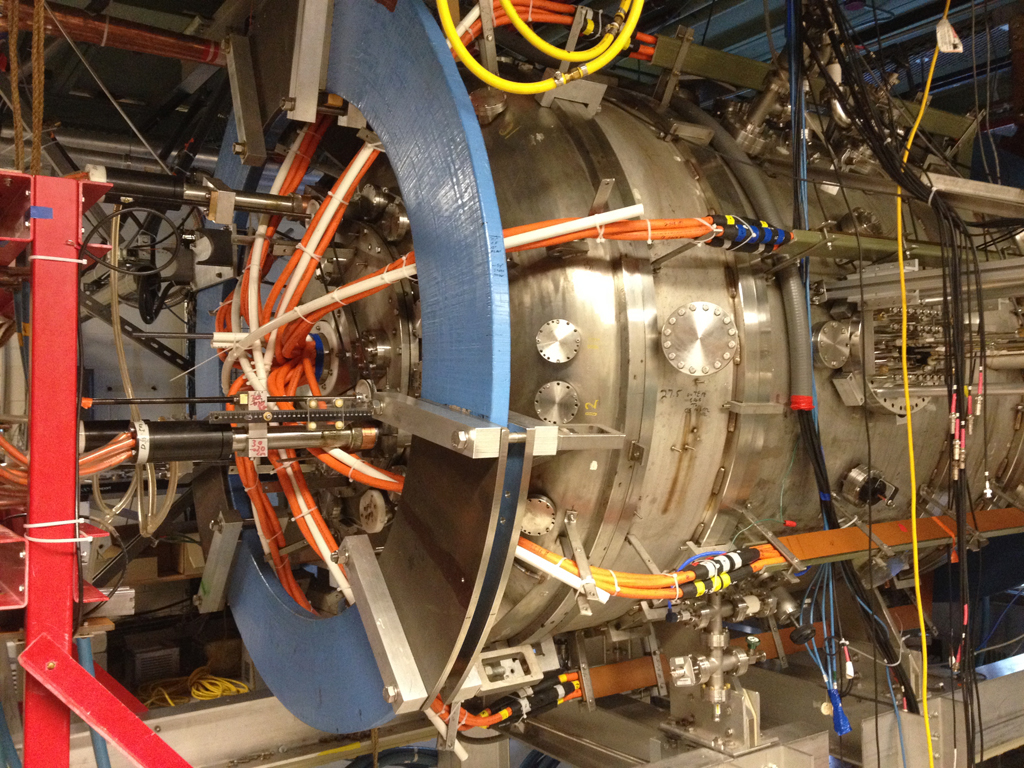
 The people I was speaking to are working with vastly less. Who was I to be giving them advice? It was like the rich guy rolling down the window of his limo to encourage the homeless person to “get a job, you bum!”
 purposes. Without a common axis to orient their efforts, the efforts are horribly fragmented, and naturally incoherent. I think about my situation and think, “holy shit! I do have it easy!”
 have left their community with too little to build on. In many respects the plasma physics community has lagged behind in some significant ways. It felt good to admit to the audience yesterday that in many respects plasma physics is the whipping boy in some V&V circles for how NOT to do things. I asked this in providing the audience with a compliment that they were doing something to change this. It was also a question to them about how the broader plasma physics community feels about V&V and what their collective concerns are.
 ability to advance as a society because so many are left behind without any capacity to fully contribute to the success of the whole. A large part of the reason for the deficit of capacity for contribution is the lack of meaningful outlet when society as a whole is organized to funnel the product of societal efforts into the hands of precious few. We are not organized to maximize the efforts of our citizens, but rather maximize the wealth of a select few.
 The inequality is society is impacting science massively. Money has become the barometer by which all things are measured. It is seemingly the one size fits all metric for the value of all things. It is driving the short-term thinking permeating business thinking today. The reasoning for the short-term thinking is its ability to maximize the flow of resources into the hands of the already rich in the credit and investment markets; it is not because it maximizes the aggregate benefit to society or even the long-term benefit to business. The policies governing our World today are for the benefit of the few, not the many.
 principled approach of education. This is driven by and justified by the lack of societal investment in higher education. The research focus of universities is being driven toward the “publish or perish” philosophy that hollows out the depth of the research while draining away the critical training of the next generation of researchers. The consequences are grim. We are producing much more work, with much less quality and impact.
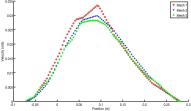 into the middle of an extremely contentious topic (almost a religious war from what I found out later). Three famous scientists reviewed the paper; one of them identified himself to me via letter (the late Ami Harten). His review was quite cursory, simply “accept, and publish immediately.” I was beside myself with joy. That emotion was short-lived.
 I certainly didn’t have my best game, but it wasn’t bad either. His feedback to me felt extraordinarily harsh, and even a bit personal. He has been reviewed by the very top referees in the United States (i.e., assessed). I took his comments with the utmost seriousness, but still his style made me feel awful, and undermined the effectiveness of the comments.
 This young man has as you might expect a very serious style, which is keenly reflected in his success and personal style. Plus critiquing someone twice your age can’t be easy. So, I will take his feedback to heart, and make efforts to improve my performance (work on positioning, signaling advantage and style in man-management). In addition I need to reflect upon the dynamic of critique in every part of my life.
 There seems to be a pervasive attitude that difficult things should be avoided and any difficulty is treated as an approximation to failure. I have had this theme play out repeatedly this week where something difficult is ta ken as tantamount to failing. For someone looking to grow, and excel, difficult work is the chance to improve through stringent testing. Difficulty should stir one to the core and call them forward toward achievement. The worst thing is the inability to see the opportunity being granted, most of our best, strongest attributes were forged in our most difficult moments.
 Problems are seen when work that should have done years ago is missing. Instead it is the opportunity to do meaningful, interesting and important work that fills in an essential gap. In another case a procedure was found to be lacking, which turned out to be embarrassing. Instead it is a reward of due diligence and points toward a higher future standard, but also toward important shortcomings in tools used. These tools will require substantial effort to make better. We see to have created a system that tells us that these cases should be avoided. Instead they need to be celebrated as opportunities for interesting and necessary work that will stretch the capabilities of the lucky people doing the work.
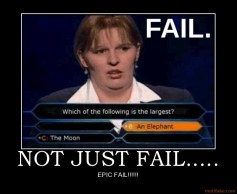
 This is quite sharply related to the absolute intolerance for anything that could be interpreted as failure. Failure brings the possibility of rebuke and scandal. The lessons of almost every success has been lost in the process, to achieve greatness, risk must be taken, and risk entails the possibility of failure. We are avoiding short-term pain and the cost of long-term success, which will manifest itself as a decline toward inevitable mediocrity.
 In a similar vein we test our codes. For a good professional code there will be an immense number of tests executed and potentially a sizable team involved in testing the code. Nonetheless, the code will break with almost certainty because it will be used in innovative ways not foreseen by the developers or testers. The real test is when the code is used for something we didn’t anticipate. Then we find out how good it really is. As usual the problems that arise are usually viewed as failures rather than opportunities. We should endeavor to view this differently; these failures are the opportunity to take the code to the next level of performance.
 Simplicity is the ultimate sophistication.
 The heuristic of Occam’s razor comes in as a principle to clarify things. At its simplest it specifies a tendency for choosing between explanations based on their relative simplicity; if they are otherwise equal, the simplest explanation is preferred. One might be properly tempted to apply the same principle, but replace “simple” by “elegant,” “beautiful” or “graceful”. This gets to the core of the manner in which science takes on the mantle of an art; beauty, elegance and grace have a roll to play in shaping opinions.
 One could easily take the view that this is a bad thing, but the concepts of artistic opinion are useful. These concepts capture the deep essence of the subconscious. The subconscious is integrating many factors that hidden from the superficial thinking usually operating in people. We know beauty and elegance when we see it, and we naturally gravitate toward it. Unfortunately these also include bias and preconceptions that would tend to hold progress back. Given this possibility the whole artistic approach to science needs to be taken in a mindful fashion fully acknowledging the tendency to give into traditional bias and counter-balancing this trend with careful consideration of alternatives. This is where Occam’s razor and attractiveness of simplicity can play a deeply powerful roll in progress.
 profit. Americans have bought into the fear-based culture fully. Mass media and particularly the news media have learned that fear sells and drives profits. Industry plays upon peoples deepest fears to sell products whether the fear is cultural, physiological or subliminal it drives sales.
 based because nothing drives the people to the polls like fear. Fear of immigrants, loss of jobs, terrorism, Ebola, and most of all the loss of the America of memory is a reason to fear. The result is fear-driven policy. Our government is rife with fear-based, counter-productive laws and governance. Government institutions are driven by fear. As just one example air travel is teeming with stupid fear-based practices.
 Take the threat of ISIS (ISIL). Are they really a threat? Really? A bunch of poorly educated barbarians half a world away? No they aren’t. Man the hell up, what sort of wimps have Americans become? They are a bunch of idiotic zealots that represent no threat at all to our Country. They are bad people that the World needs to manage, but not an actual threat. The actual threat is to our tax dollars. ISIS is another convenient threat used by the politicians and the military-security-industrial complex to drive money into their pockets. Nothing more.
 This is just the tip of the iceberg in imaginary threats that Americans are allowing to rule their lives. Ebola is another great example. All we need is competence and it offers no threat. My only fear is that we can’t muster competence any more.
 rejection of rationality is not a left or right characteristic; it has become an American characteristic. Whether it is climate change, diseases (e.g., Ebola), nuclear power, vaccines, GMO and a host of other scientific or technological questions Americans are irrational. We have become governed by hoax and conspiracy rather than truth, trust and logic.
 Explosives Code Development Conference. I can’t make the usual sort of summary of a meeting that I’d ordinarily write about, but I will offer a few high level comments. There certainly were some memorable talks during the week. They offered some great new ideas in computational physics or a much needed progress report on important work.
 tidy package. Lawrence Livermore showed some really interesting efforts in several areas including advanced shock hydrodynamic methods using high order methods, and progress on an age old problem of combining particles with interface tracking. Despite these highlights among others, the best and most important thing about the meeting was what happened when talks were not being given.







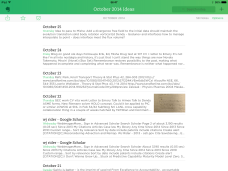 Evernote is an electronic filling cabinet. It ends up being the clearinghouse for information flowing from all these other apps and more. Evernote also runs on every platform (phone iPhone/Android, laptop, desktop, iPad, and web). You can always get your data. My wife uses it at her office as the common system for managing multiple accounts able to deal with data from many sources.
 I use it to jot down ideas, plan writing assignments, take notes at meetings, save articles, and keep a food, exercise, and personal journal. It can accept info in almost any format and allows you to write notes, and draw graphical comments inside most. It also has a fantastic web clipper that allows me to save web pages directly plus add comments. Another great thing to do is use Evernote to save business cards, travel cards, and other documents that pile up in wallets, or get easily lost. I’ve also used it for saving details of medical appointments, and repair/remodel work at home. It’s the place where I store the details of my referee assignments for soccer as well as notes on the games for future reference.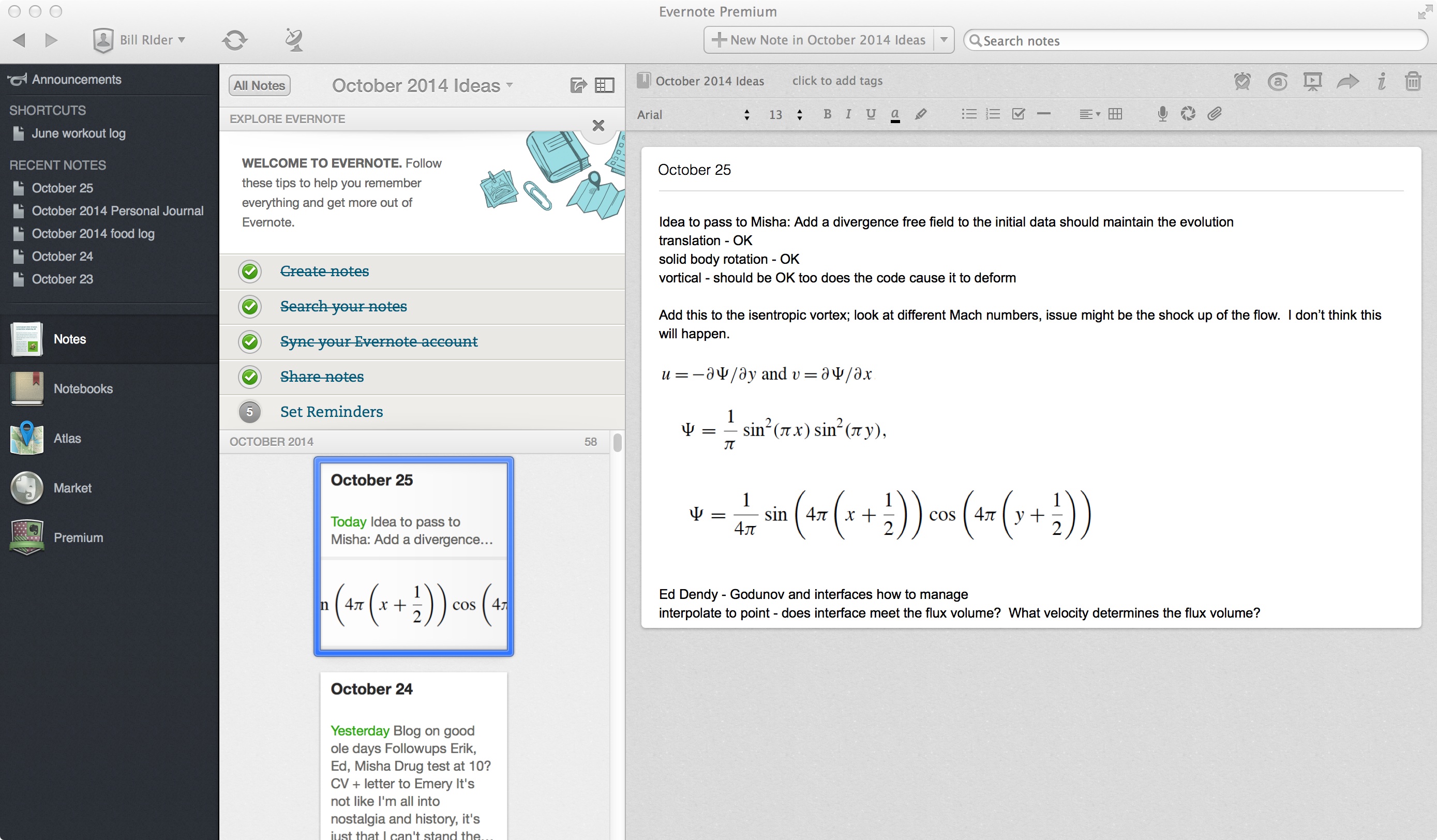
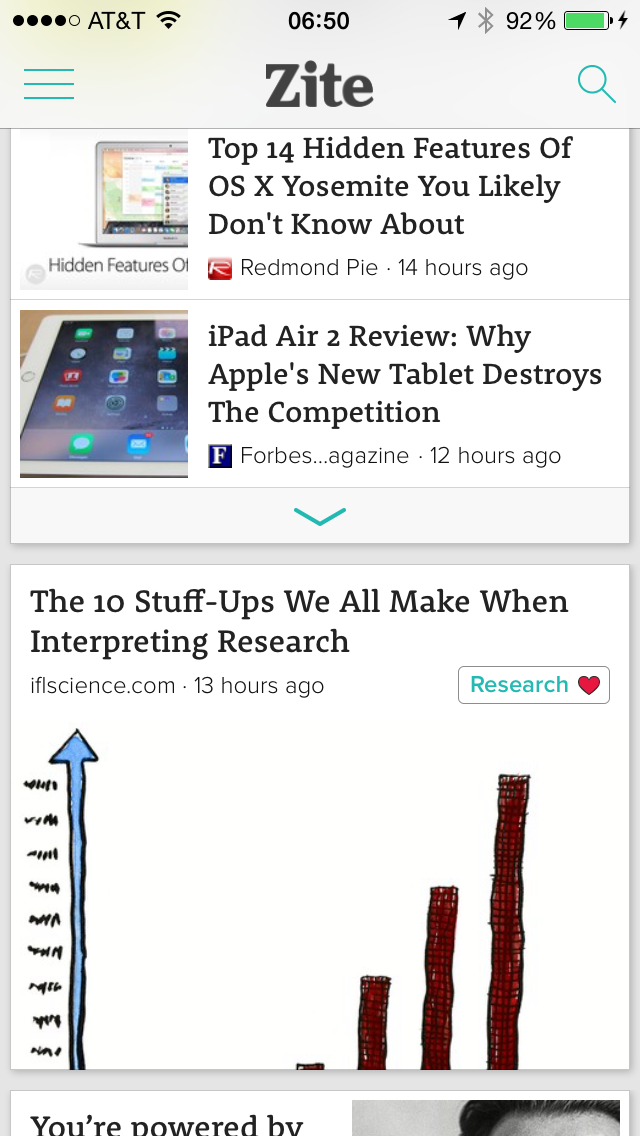
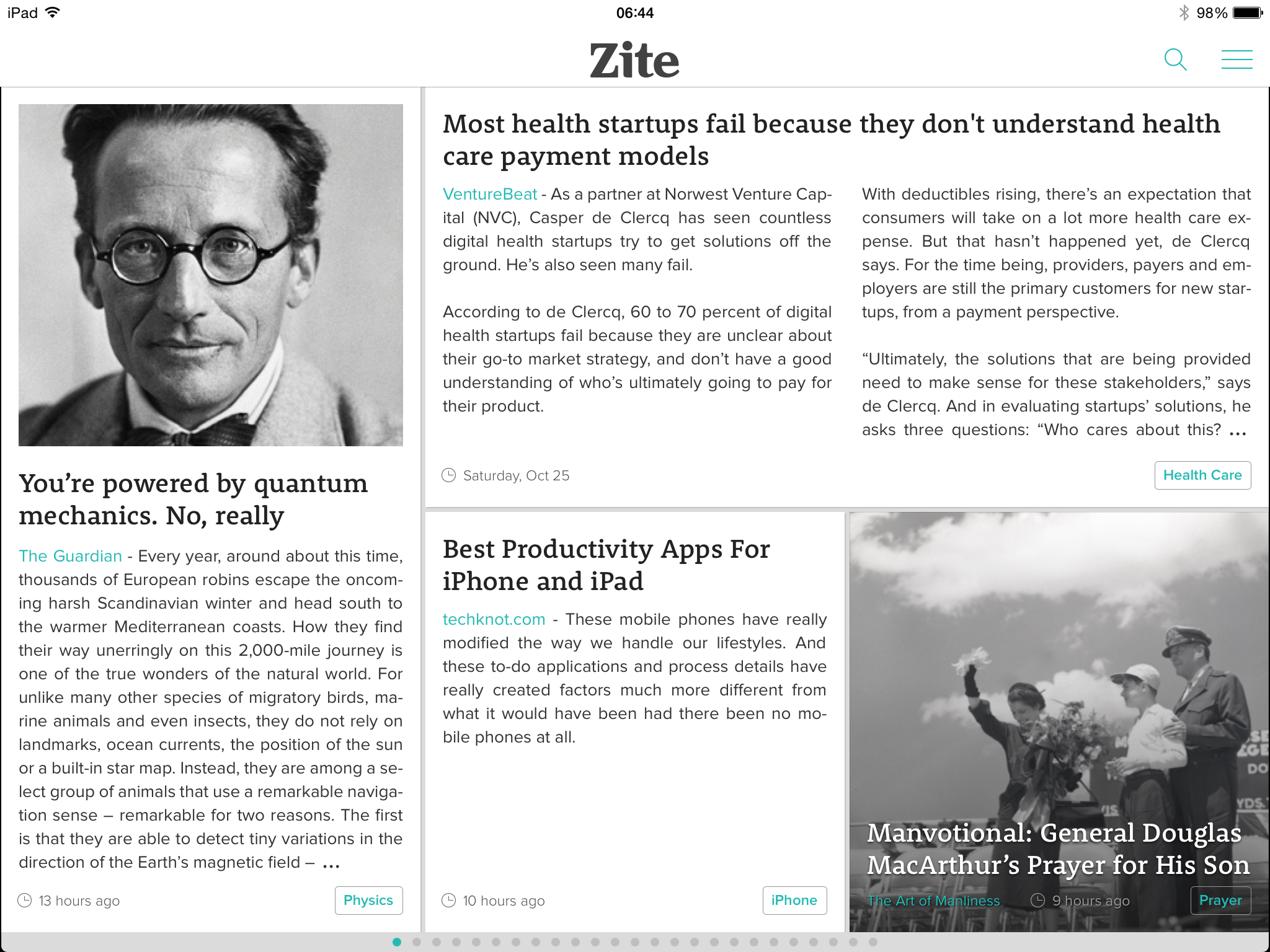
 Next is the most recent addition to my staple of mobile apps, Wunderlist. Wunderlist is a to do and task manager. I’ve added it because it is multiplatform. I can have a uniform and synched list across mobile, laptop and desktop apps. I have a set of things that I want to accomplish every day, which repeat along with a set of single use items. All of them can be tracked and dealt with. It is still being tried out, but it’s almost sure that it will be a keeper.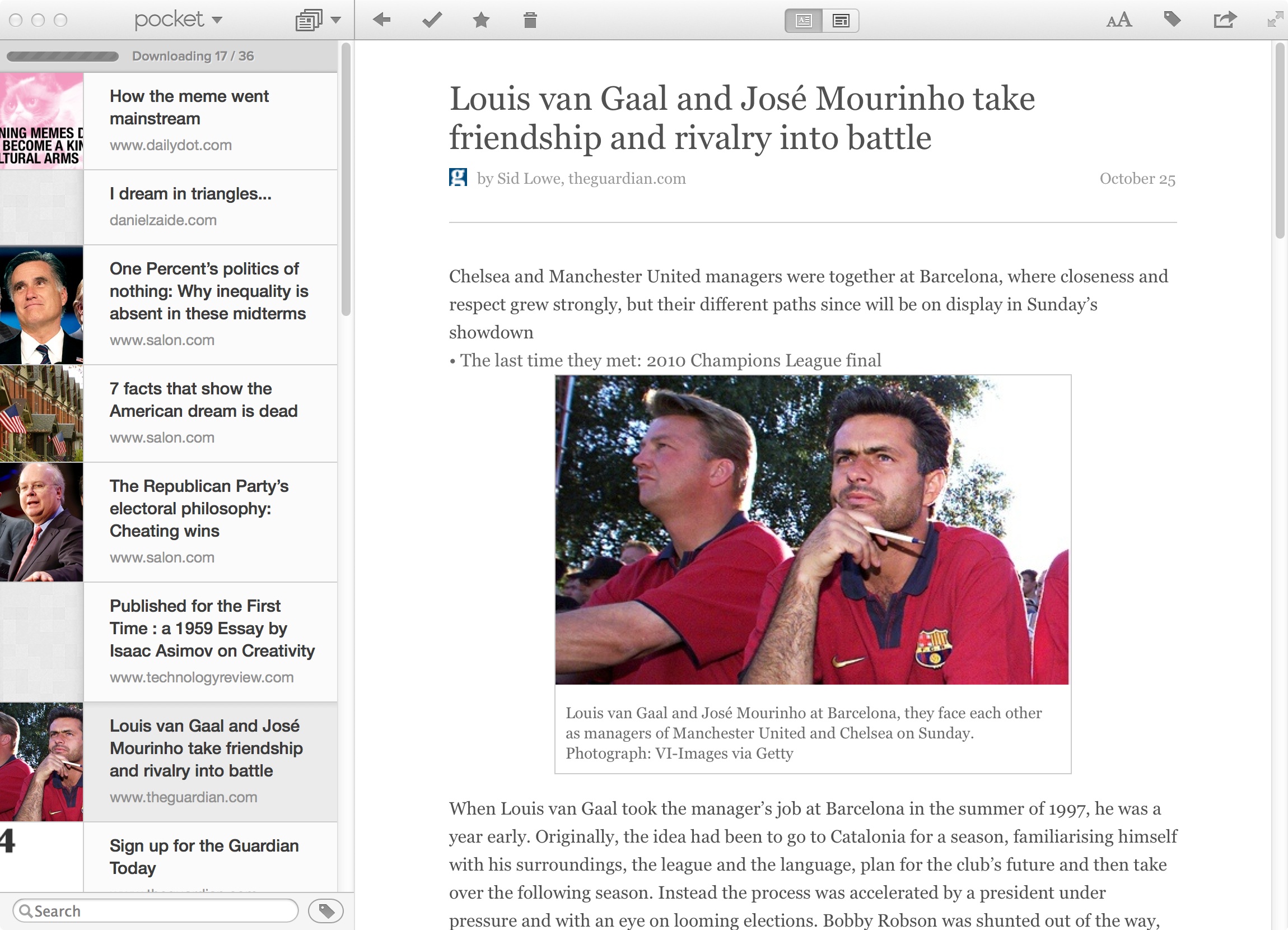
 The Regularized Singularity