Recently, I wrote about the priorities in code development putting accuracy and efficiency last in the list of priorities (https://williamjrider.wordpress.com/2014/11/21/robust-physical-flexible-accurate-and-efficient/). Part of the not very implied critique associated with this is that the relative emphasis in development is very close to the opposite of my list. High performance computing and applied mathematics today is mostly concerned with efficiency (first) and accuracy (second). I believe these priorities do us a disservice, represent a surplus of hubris and fail to recognize some rather bold unfinished business with respect to stability theory.
All that it is reasonable to ask for in a scientific calculation is stability, not accuracy.
–Nick Trefethen
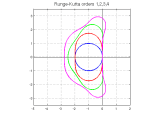 I thought about what I wrote a few weeks ago, and realized that when I state robust, I mean almost the same thing as stable. Well almost the same is not the same. Robust is actually a stronger statement since it implies that the answer is useful in a sense. A stable calculation can certainly produce utter and complete gibberish (it may be even more dangerous to produce realistic-looking, but qualitatively/quantitatively useless results). I might posit that robustness could be viewed as a stronger form of stability that provides a guarantee that the result should not be regarded as bullshit.
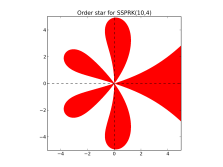 Perhaps this is the path forward I’m suggesting. The theory of PDE stability is rather sparse and barren compared to ODE theory. PDE stability is really quite simple conceptually, while ODE stability theory is rich with detail and nuance. One has useful and important concepts such as A-stability, L-stability and so on. There are appealing concepts such as relative-stability and order stars, which have no parallel in PDE stability. I might be so bold as to suggest that PDE stability theory is incomplete and unfinished. We have moved toward accuracy and efficiency and never returned to finish the foundation they should be built upon. We are left with a field that has serious problems with determining quality and correctness of solutions (https://williamjrider.wordpress.com/2014/10/15/make-methods-better-by-breaking-them/, https://williamjrider.wordpress.com/2014/10/22/821/).
Maybe a useful concept would be robust stability. What are the conditions where we can expect the results to be physical and nonlinearly stable? Instead the concept of robustness often gets a bad name because it implies tricks and artifices used to produce results securely. A key point is that robustness is necessary for codes to do useful work, yet doing the work of making methods robust is looked down upon. Doing this sort of work successfully resulted in the backhanded compliment/slight being thrown my way:
you’re really good at engineering methods.
Thanks, I think. It sounds a lot like,
you’re a really good liar
In thinking about numerical methods perhaps the preeminent consideration is stability. As I stated, it is foundational for everything. Despite its centrality to the discussion today, stability is a rather later comer to the basic repertoire of the numerical analyst only being invented in 1947 while many basic concepts and methods precede it. Moreover its invention in numerical analysis is extremely revealing about the fundamental nature of computational methods. Having computers and problems to solve with them drives the development of methods.
Recently I gave a talk on the early history of CFD (https://williamjrider.wordpress.com/2014/05/30/lessons-from-the-history-of-cfd-computational-fluid-dynamics/) and did a bit of research on the origin of some basic concepts. One of my suppositions was that numerical stability theory for ODEs must have preceded that for PDEs. Instead this was not true! PDEs came first. The reason for this is the availability and use of automatic computation (i.e., computers). Because of the applications of PDEs to important defense work during and after World War 2, the problem of stability was confronted. Large-scale use of computers for integrating ODEs didn’t come along until a few years later. The origins of stability theory and its recognition are related in a marvelous paper by Dahlquist [Dahlquist], which I wrote about earlier (https://williamjrider.wordpress.com/2014/08/08/what-came-first-the-method-or-the-math/). There I expressed my annoyance at the style of mathematics papers that obscures the necessary human element in science in what I believe to be a harmful manner. The lack of proper narrative allows the history and impact of applied math to be lost in the sands of time.
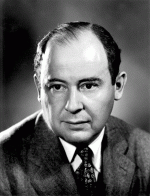 The PDE stability theory was first, and clearly articulated by John Von Neumann and first communicated during lectures in February 1947, and in a report that same year [VNR47]. These same concepts appeared in print albeit obliquely in Von Neumann and Goldstine [VNG47], and Crank-Nicholson’s classic [CN47]. Joe Grcar gives a stunning and full accounting of the work of Von Neumann and Goldstine and its impact on applied mathematics and computing in SIAM Review [Grcar]. Since Von Neumann had access to and saw the power of computing, he saw stability issues first hand, and tackled them. He had to, it bit him hard in 1944 [MR14]. His stability analysis methodology is still the gold standard for PDEs (https://williamjrider.wordpress.com/2014/07/15/conducting-von-neumann-stability-analysis/).
Another theme worth restating is the roll of (mis-)classification of the early reports had on muddying the history. LA-657, which was the report on the first mention of stability in numerical analysis was classified until 1993 even though the report is clearly unclassified (https://williamjrider.wordpress.com/2014/11/20/the-seven-deadly-sins-of-secrecy/). As it turned out the official unveiling of the ideas regarding stability of PDEs came out in two papers in 1950 [VNR50,CFVN50].
 As Dahlquist relays the PDE world had a head start, and other important work was conducted perhaps most significantly the equivalence theorem of Lax [LaxEquiv]. This theorem was largely recreated independently by Dahlquist two or three years later (he reports that Lax gave the theory in a seminar in 1953). The equivalence theorem states that the combination of stability and consistency is equivalent to convergence. Being rather flip about this stability means getting an answer and consistency means solving the right problem.
From there the ODE theory flowered and grew to the impressive tapestry we have today. A meaningful observation is that we have a grasp of the analytical theory for the solution of ODEs that eludes us today with PDEs. Perhaps the PDE theory would flow like water from a breaking dam were such an analytical theory available. I’m not so sure. Maybe the ODE theory is more of the consequence of the efforts a few people or a culture that was different from the culture responsible for PDEs. Its worth thought and discussion.
The investigator should have a robust faith – and yet not believe.
Claude Bernard
[LaxEquiv] Lax, Peter D., and Robert D. Richtmyer. “Survey of the stability of linear finite difference equations.” Communications on Pure and Applied Mathematics 9, no. 2 (1956): 267-293.
[VNG] Von Neumann, John, and Herman H. Goldstine. “Numerical inverting of matrices of high order.” Bulletin of the American Mathematical Society 53, no. 11 (1947): 1021-1099.
[Dahlquist] Dahlquist, Germund. “33 years of numerical instability, Part I.” BIT Numerical Mathematics 25, no. 1 (1985): 188-204.
[CN47] Crank, John, and Phyllis Nicolson. “A practical method for numerical evaluation of solutions of partial differential equations of the heat-conduction type.” In Mathematical Proceedings of the Cambridge Philosophical Society, vol. 43, no. 01, pp. 50-67. Cambridge University Press, 1947.
[CFVN50] Charney, Jules G., Ragnar Fjörtoft, and J. von Neumann. “Numerical integration of the barotropic vorticity equation.” Tellus 2, no. 4 (1950): 237-254.
[VNR50] VonNeumann, John, and Robert D. Richtmyer. “A method for the numerical calculation of hydrodynamic shocks.” Journal of applied physics 21, no. 3 (1950): 232-237.
[VNR47] VonNeumann, John, and Robert D. Richtmyer. “On the numerical solution of partial differential equations of parabolic type.” Los Alamos Scientific Laboratory Report, LA-657, December 1947.
[Grcar] Grcar, Joseph F. “John von Neumann’s analysis of Gaussian elimination and the origins of modern Numerical Analysis.” SIAM review 53, no. 4 (2011): 607-682.
[MR14] Mattsson, Ann E., and William J. Rider. “Artificial viscosity: back to the basics.” International Journal for Numerical Methods in Fluids (2014). DOI 10.1002/fld.3981
 Life comes with many choices regarding what to do, what to eat, buy, watch, listen to and so on. Depending on your personal tastes these choices are wonderful or a burden. If you really care about something quite often you demand choices to be happy. You won’t be pleased with limited options when you know something better isn’t even being offered. In other cases where you aren’t emotionally invested, too many choices can be a burden, and unwelcome. You just need something functional and aren’t willing to expend the effort to sift through a bunch of alternatives. This distinction happens over and over across our lives both personal and professional.
 What one person demands as a phalanx of options is a crushing affront to another. The demands of choice come from the aficionado who sees the texture and variation among the choices. When no options are available it can be greeted as the acceptance of something awful. This could even be true for the single option, which is acknowledged as the best and would be chosen from many options. On the other hand for someone who doesn’t care about the details, the mediocre is just fine. It isn’t that they wouldn’t like something better; it is that they can’t tell the difference or don’t care. This sort of dichotomy exists with everyone and varies topic to topic. It plays a huge role in science and engineering. I am certainly guilty of this, and I suspect all of you are too.
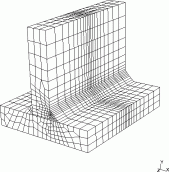
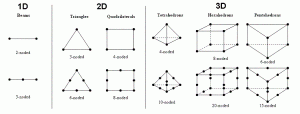
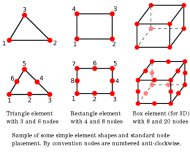 A while back I wrote about what I don’t like about the finite element method (FEM) (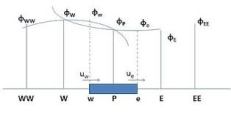
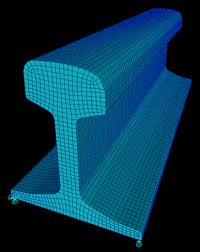 Working at Sandia one thing is always true; the code you write will implement the FEM. With a new project and generally it would be very beneficial to have multiple valid discretizations on the same mesh. This would enable a number of things such as error estimation, resilience against hardware errors, and more robust overall algorithms. The problem is that the FEM generally offers a single preferred discretization once the mesh and associated elements are chosen.
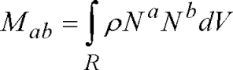 under-integrate, lump the mass matrix or apply a stabilization method. Even then, the available options for discretizing are rather barren compared with finite volume or finite difference methods. It feels like a straightjacket by contrast to relative unconstrained freedom. Even the options I once worked with were too constrained compared with the universe of possibilities offered as I discovered in my most recent paper (“Revisiting Remap Methods” DOI 10.1002/fld.3950).
 For me this is a particular issue in the area of shock physics. Most of the users of shock physics codes are completely happy with their options. For some, the code simply needs to run to completion and produce something that looks plausibly realistic. For me this seems like a god-awfully low standard, and I see methods that are antiquated and backwards. The code users usually only notice new methods when something bad happens, the code runs slower, the answer changes from the ones they’ve grown accustomed to, or the code crashes. It is a rarity for the new method to be greeted as a benefit. The result is stagnation and a dearth of progress.
 We have become a community that sees options as a burden. Other burdens such as changes in computers are swallowing the appetite for the options that exist. As time goes by, the blessings seem more and more distant and foreign to the thought process. Moreover the users of codes don’t see the effort put into better methods as a virtue and want to see focus on improving the capacity to model the physical systems they are interested with. Part of this relates strongly to the missing elements in the education of people engaged in modeling and simulation. The impact of numerical methods on the modeling of physical systems is grossly under-appreciated, and leads to a loss of
  perspective. Methods in codes are extremely important and impactful (artificial, numerical and shock dissipation anyone?). Users tend to come close to completely ignoring this aspect of their modeling due to the esoteric nature of its impact.
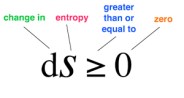
 Time is relentless. As an opponent it is unbeatable and can only be temporarily held at bay. We all lose to it, with death being the inevitable outcome. Science uses the second law of Thermodynamics as the lord of time. It establishes a direction defined by the creation of greater disorder. In many ways the second law stands apart from other physical laws in its fundamental nature. It describes the basic character of change, but not its details.
 Change is constant and must be responded to. The challenge of the continual flow of
 These tendencies are seen in differing taste for the arts. Take music where oldies are the staple of conservatives who don’t warm to the newer ideas. The old standards of their childhood and teen years make for a calming influence and sentimental listening. The progressive ear looks for new combinations rather than the familiar. Invention and improvisation are greeted warmly as a new challenge to one’s tastes. For example rap is viewed as not being music of any sort by the conservative ear, and greeted as stunningly original by the liberal ear. On the one hand the past is viewed as a template for the future, and on the other changes are seen as the opportunity for improvement. This tension is at the core of humanity’s struggle for mastery over time.
 The horror of 9/11 started with the rise of Islam 1400 years ago, continuing with the Crusades, European colonialism, the oil crisis of the 70’s, American support for the Shah and his fall with rise of Islamic fundamentalism, the Soviet invasion of
 advance. The day-in, day-out work of science is left to the conservative side of things.
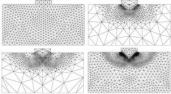
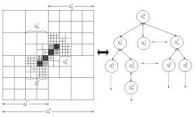 The types of adaptivity most commonly seen are associated with adaptive grids (or “h” refinement). Grids lend themselves to straightforward understanding and impressive visualization. Even with its common presence, even this form of adaptivity is seen far less than one might have thought looking forward twenty years ago. Adaptivity takes other forms far less common than h-refinement such as p-adaptivity where the order of an algorithm is adjusted locally. A third classical form is r-adaptivity where the mesh is moved locally to improve solutions. This is the second most common approach in the guise of remesh-remap methods (or ALE codes). I’d like to chat about a handful of other approaches that could be big winners in the future especially if combined with the
  classical approaches.
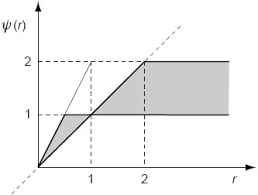 These are relatively simple ideas. More complex adaptation in algorithms can be associated with methods that use nonlinear stencils usually defined by limiters. These methods use a solution quality principle (typically monotonicity or positivity) to define how a computational stencil is chosen (FCT, MUSCL, and TVD are good examples). More advanced methods such as essentially non-oscillatory (ENO) or the elegant Weighted ENO (WENO) method take this adaptivity up a notch. While algorithms like FCT and TVD are common in codes, ENO hasn’t caught on in serious codes largely due to complexity and lack of overall robustness. The robustness problems are probably due to the overall focus on accuracy over robustness as the key principle in stencil selection.
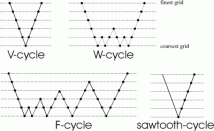 One area where the adaptivity may be extremely useful is the construction of composite algorithms. The stencil selection in ENO or TVD is a good example as each individual stencil is a consistent discretization itself. It is made more effective and higher quality through the nonlinear procedure used for selecting. Another good example of this principle is the compositing of multigrid methods with Krylov iterations. Neither method is as effective on its own. They either suffer from robustness (multigrid) or suboptimal scaling (Krylov). Together the methods have become the standard. Part of the key to a good composite is the complementarity of the properties. In the above case multigrid can provide optimal scaling and Krylov offers stability. This isn’t entirely unlike TVD methods where upwinding offers the stability, and one of the candidate stencils offers optimal accuracy.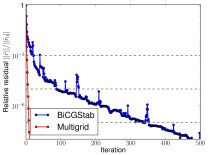
 My job. All in all I’m pretty lucky. Beyond having enough money to have a comfortable life with food to eat, comfortable shelter and a few luxuries, I get to do what I love a little bit each week. I’ll save my concerns that the Labs where I work are a shadow of their former selves compared to the rest of the World, I’m doing great.
 Modeling and simulation. The use of computers to solve problems in physics and engineering has become commonplace. Its common nature shouldn’t detract from the wonder we should feel. Our ability to construct virtual versions of reality is both wonderful for exploration, discovery and utility. The only thing that gives me pause is a bit of hubris regarding the scope of our mastery.
 gorithms. Systematic ways of solving problems that are amenable to computing fill me with wonder. The only regret is that we don’t rely upon this approach enough. An accurate, elegant and efficient algorithm is a thing of beauty. Couple the algorithm with mathematical theory and it is breathtaking.
 The end of Moore’s law. This is a great opportunity for science to quit being lazy. If we had relied upon more than raw power for improving computing, our ability to use computers today would be so much more awesome. Perhaps now, we will focus on thinking about how we use computers rather than simply focus on building bigger ones.
 The Internet and the World Wide Web. We are living through a great transformation in human society. The Internet is changing our society, our governance, our entertainment, and almost anything else you can imagine. The core is it changes the way we talk, and the way we get and share information. It makes each day interesting and is the spoon that stirs the proverbial pot.
 Nuclear weapons. We owe the relative piece that the World has experienced since World War II to this horrible weapon. As long as they aren’t used they save lives and keep the great powers in check.
 Big data and statistics. Computers, sensors, drones and the internet of things is helping to drive the acquisition of data at levels unimaginable only a few years ago. With computers and software that can do something with it, we have a revolution in science. Statistics has become sexy and add statistics to sports and you combine two things that I love.
 Genetics. The wonders of our knowledge of the genome seem boundless and shape knowledge gathering across many fields. Its impact on social science, archeology, paleontology to name a few is stunning. We have made incredible discoveries that expand the knowledge of humanity and provide wonder for all.
 Albuquerque sunsets. The coming together of optics, meteorology, and astronomy, the sunsets here are epically good. Add the color other the mountains opposite the setting sun and inspiration is never more than the end of the day away.
 sunset, it looks like home.
 and the energy flux is
  where
where  ,
,  and
and  are the density, total energy and the pressure. If the velocity always has a sign in the Riemann solution, the resulting flux inherits that sign convention.
 ;
;  –
– ;
; 


 ;
;  where
where  and
and  . If
. If  we can have problems. This is particularly true is
  –
– is large.
 where
where  and
and  are the Lagrangian wave speeds. If
  ,
,  and
and  all have the same sign, the flux will have that sign. Given this background I test the HLL flux for compatibility with the established sign convention. If the sign convention is violated I do one of a couple of things: set
  or
or  if
if  and
and  if
if  . Then I test it.
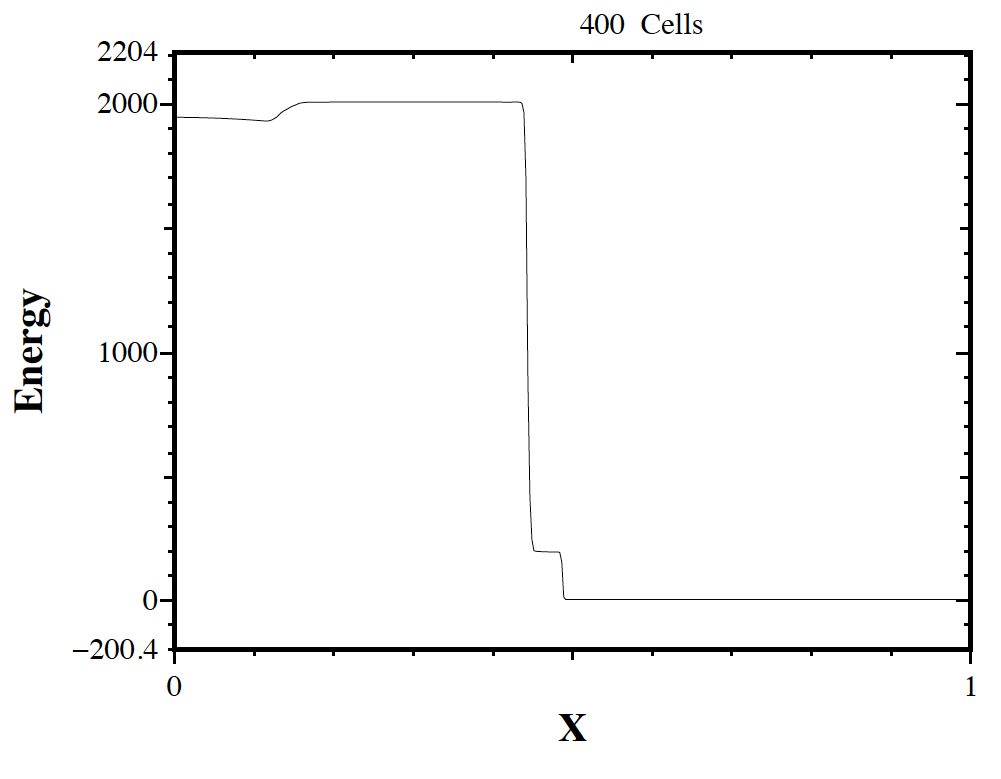
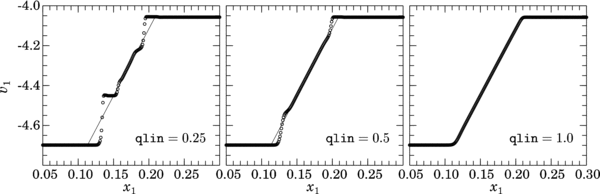
 ). The HLL tends to smear the contact very strongly, and this is where the flux sign convention is violated.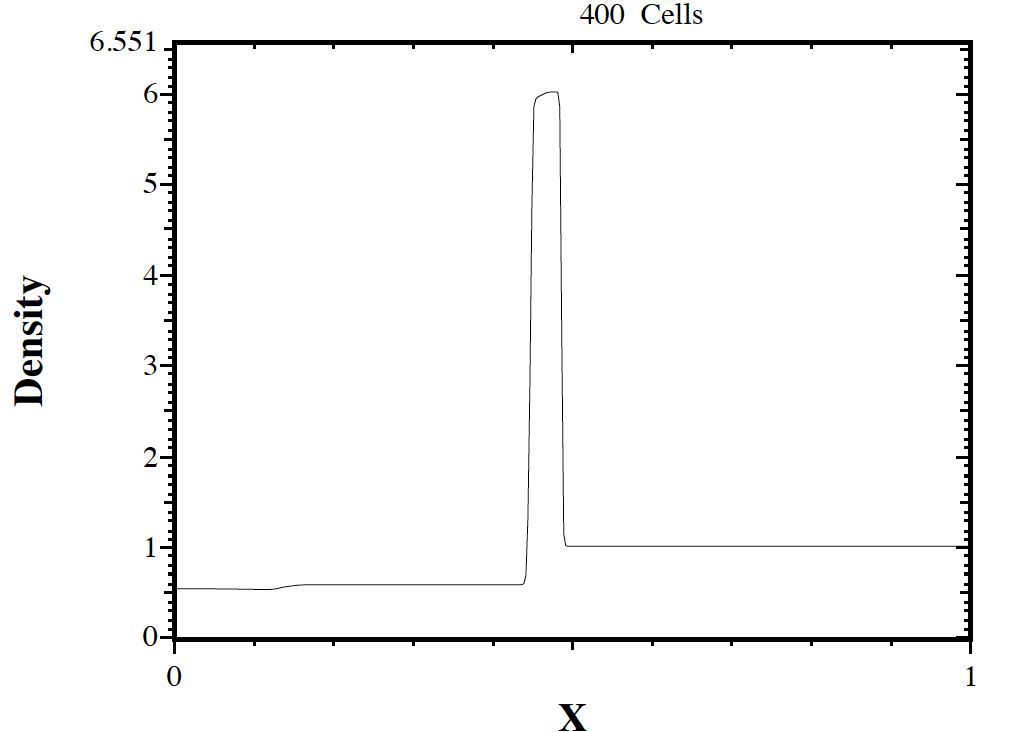
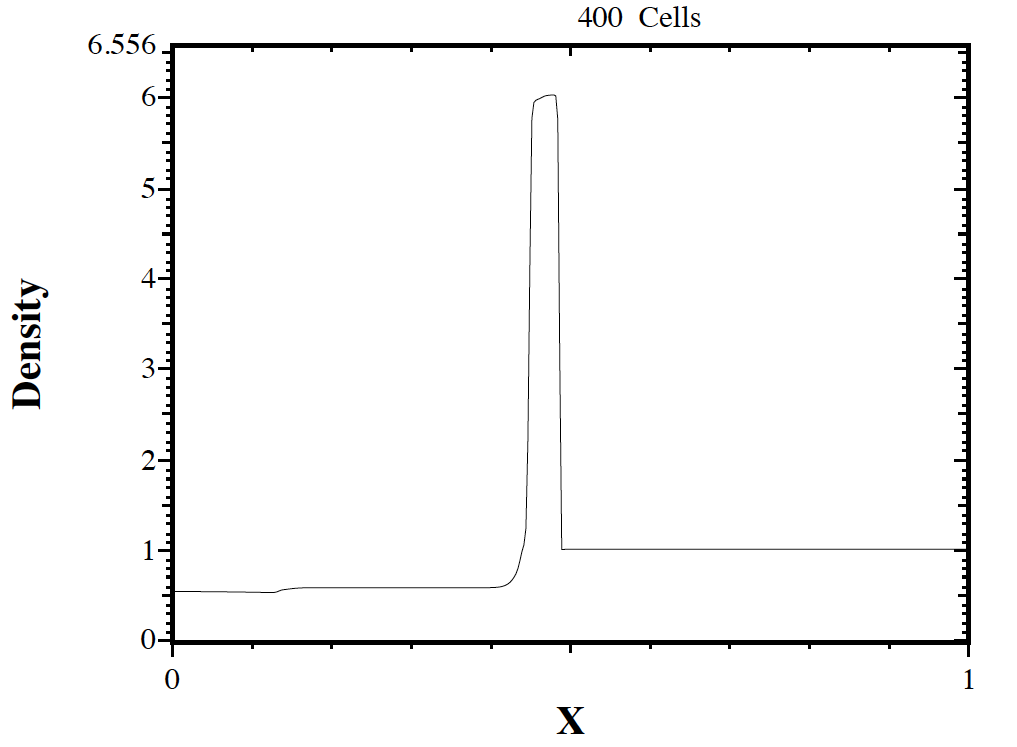
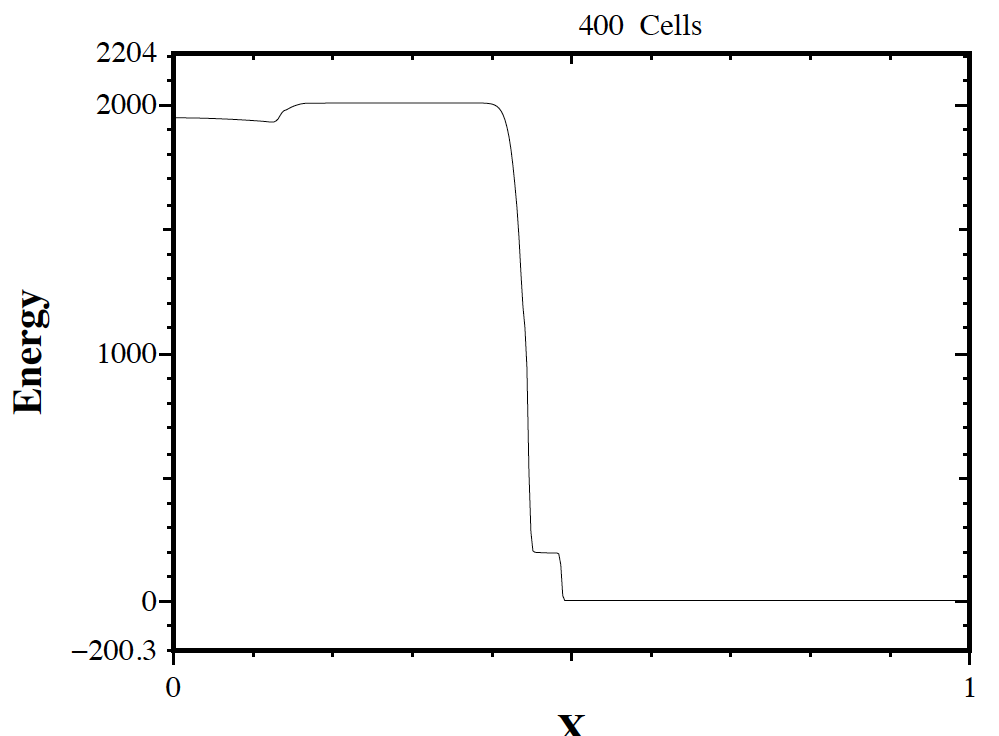
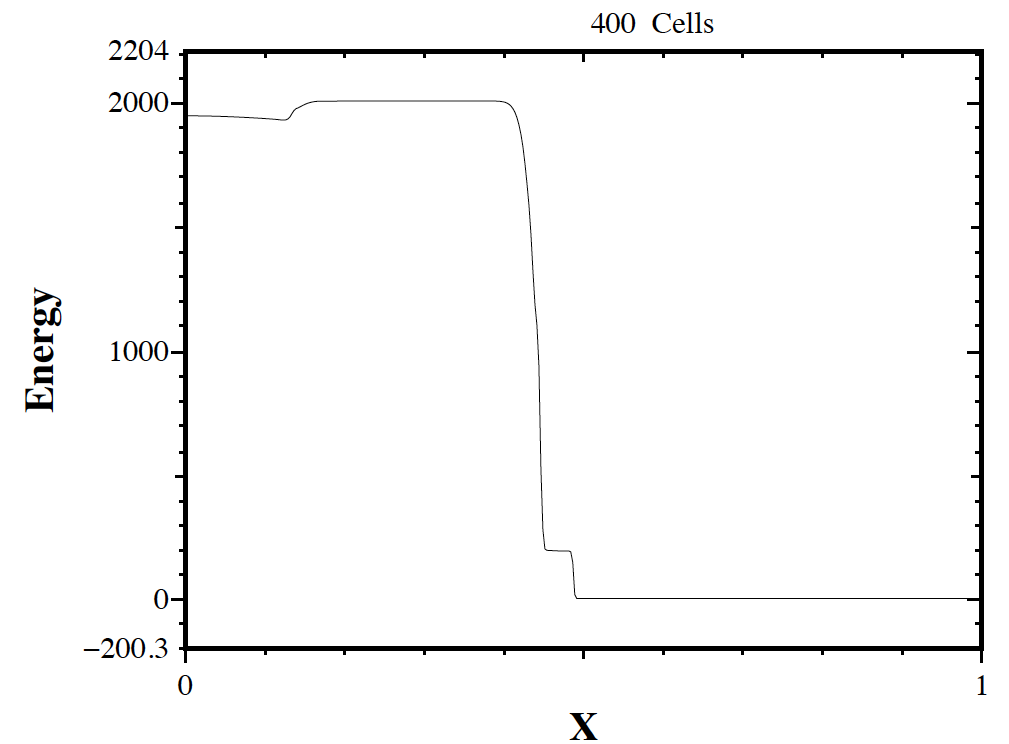
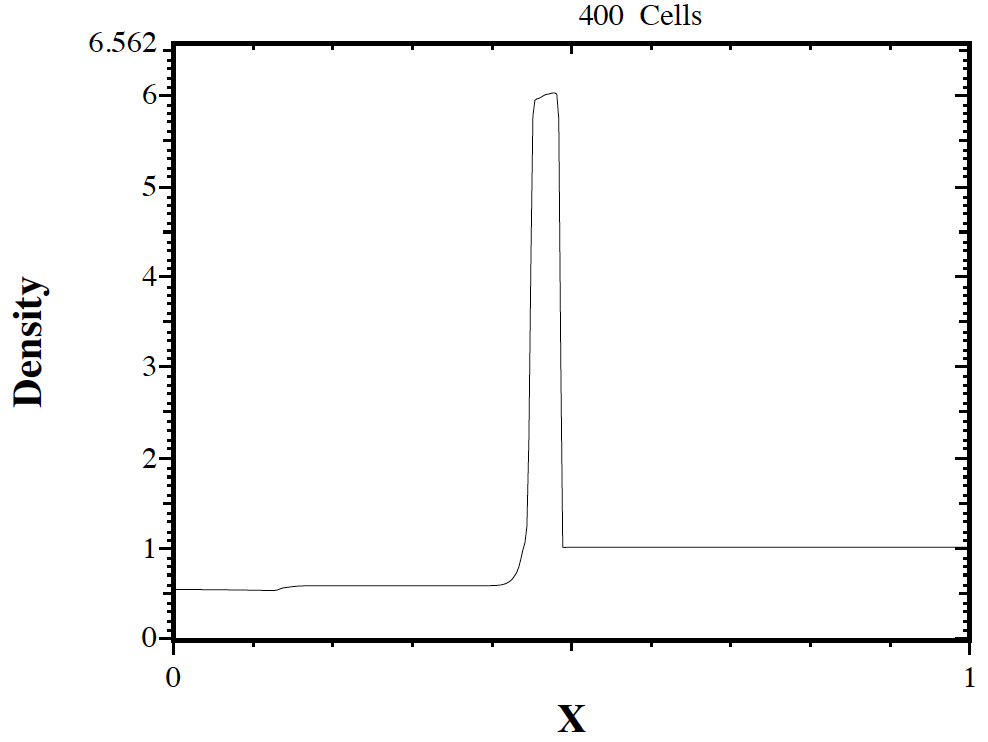
 .
.


 . We use the upwind approximation
  . We plug all of this into the equations and expand
  in a Taylor series,
  .
.![\partial_x f(u) \approx \partial_x\left[ f(u) +\frac{\Delta x}{2}\left| \partial_u f\right| \partial_x u +\frac{(\Delta x)^2}{6}\left( \partial_{uu}f (u_x)^2 + \partial_u f u_{xx}\right)\right]](https://s0.wp.com/latex.php?latex=%5Cpartial_x+f%28u%29+%5Capprox+%5Cpartial_x%5Cleft%5B+f%28u%29+%2B%5Cfrac%7B%5CDelta+x%7D%7B2%7D%5Cleft%7C+%5Cpartial_u+f%5Cright%7C+%5Cpartial_x+u+%2B%5Cfrac%7B%28%5CDelta+x%29%5E2%7D%7B6%7D%5Cleft%28+%5Cpartial_%7Buu%7Df+%28u_x%29%5E2+%2B+%5Cpartial_u+f+u_%7Bxx%7D%5Cright%29%5Cright%5D&bg=ffffff&fg=000&s=0&c=20201002) . Here is the key to rarefaction shocks; when the wavespeed,
. Here is the key to rarefaction shocks; when the wavespeed,  is near zero, the dissipation is actually governed by a higher order term,
  .It is also notable that the dissipation aids the upwind dissipation for compressions, and thus shock waves. Anti-dissipation is a shock wave would be utterly catastrophic.
 thus when
  the term in question is anti-dissipative. This is intrinsically unphysical. The dissipation from upwinding from the lower order term proportional to
  is not large enough to offset the anti-dissipation. This produces the conditions needed for a rarefactions shock wave. I’ve worried that these effects can consistently cause problems in solutions and undermine the entropy satisfying solutions. These terms were not considered in the basic theory of upwinding introduced by Harten, Hyman and Lax using modified equation analysis [HHL]. What makes matters worse is that the anti-dissipative terms will dominate in expansions when we take the upwind approximation to second-order.
 should be positive definite always (at least for gas dynamics). The density,
  where
where  –
–  ,
,  ,
,  is negative definite, and
  is positive definite bounding wave speeds. The subscripts
  and
and  refer to the states to the left and right of the interface where the Riemann solution is sought. For the Euler equations these are always the acoustic eigenvalues associated with shocks and rarefactions in the solution. We can choose these so that
  and
and  are as large as possible for the initial data. If all the wave speeds are moving to the left or right, the HLL formula simplifies quite readily to the “proper” upwinding, which is the selection of
  for rightward waves, and
  for leftward. Care must be taken to assure that any internal waves aren’t created in the Riemann solution that changes the directionality of the waves. If this is true, these changes must be incorporated in the estimates for
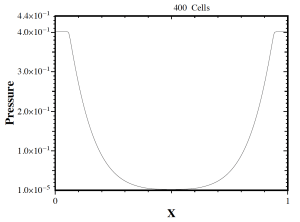
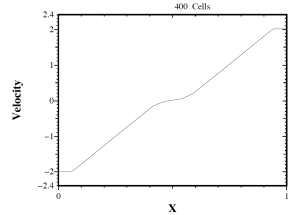
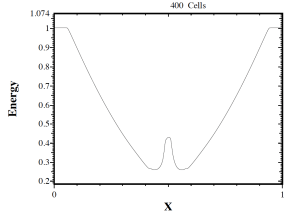
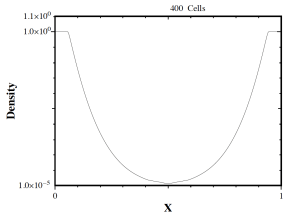
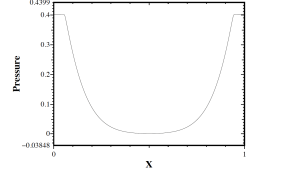
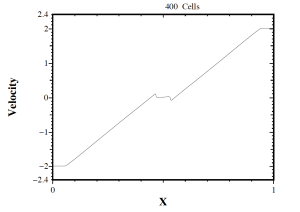
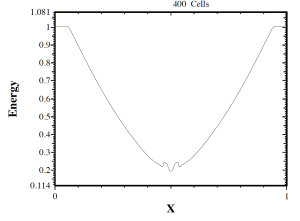
  is too large it may overwhelm the fluxes resulting in a negative value. For the case of the momentum flux this will happen in strong rarefactions where the velocities are opposite in sign. There is a common problem to solve that test this known colloquially as the “1-1-1” problem. Here the density and energy are set to one and the velocities are equal and opposite. This creates a strong rarefaction that nearly creates a vacuum.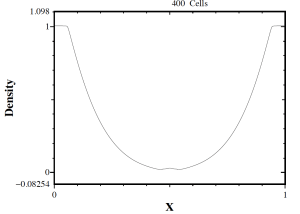
 For supercomputing to provide the value it promises for simulating phenomena, the methods in the codes must be convergent. The metric of weak scaling is utterly predicated on this being true. Despite its intrinsic importance to the actual relevance of high performance computing relatively little effort has been applied to making sure convergence is being achieved by codes. As such the work on supercomputing simply assumes that it happens, but does little to assure it. Actual convergence is largely an afterthought and receives little attention or work.
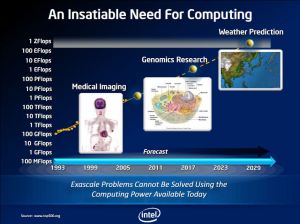 Thus the necessary and sufficient conditions are basically ignored. This is one of the simplest examples of the lack of balance I experience every day. In modern computational science the belief that faster supercomputers are better and valuable has become closer to an article of religious faith than a well-crafted scientific endeavor. The sort of balanced, well-rounded efforts that brought scientific computing to maturity have been sacrificed for an orgy of self-importance. China has the world’s fastest computer and reflexively we think there is a problem.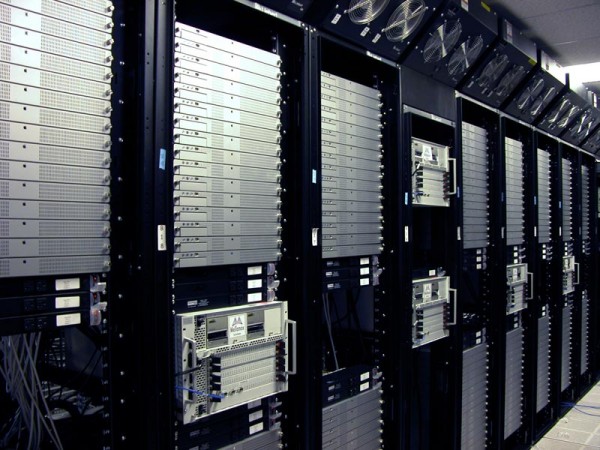

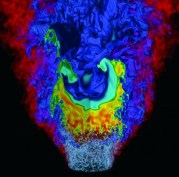 While necessary applied math isn’t sufficient. Sufficiency is achieved when the elements are applied together with science. The science of computing cannot remain fixed because computing is changing the physical scales we can access, and the fundamental nature of the questions we ask. The codes of twenty years ago can’t simply be used in the same way. It is much more than rewriting them or just refining a mesh. The physics in the codes needs to change to reflect the differences.
 A chief culprit is the combination of the industry and its government partners who remain tied to the same stale model for two or three decades. At the core the cost has been intellectual vitality. The implicit assumption of convergence, and the lack of deeper intellectual investment in new ideas has conspired to strand the community in the past. The annual Supercomputing conference is a monument to this self-imposed mediocrity. It’s a trade show through and through, and in terms of technical content a truly terrible meeting (I remember pissing the Livermore CTO off when pointing this out).
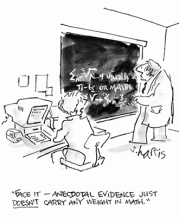 One of the big issues is the proper role of math in the computational projects. The more applied the project gets, the less capacity math has to impact it. Things simply shouldn’t be this way. Math should always be able to compliment a project.
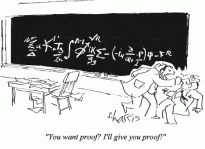 A proof that is explanatory gives conditions that describe the results achieved in computation. Convergence rates observed in computations are often well described by mathematical theory. When a code gives results of a certain convergence rate, a mathematical proof that explains why is welcome and beneficial. It is even better if it gives conditions where things break down, or get better. The key is we see something in actual computations, and math provides a structured, logical and defensible explanation of what we see.
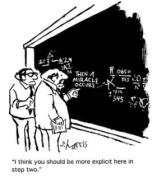 Too often mathematics is done that simply assumes that others are “smart” enough to squeeze utility from the work. A darker interpretation of this attitude is that people who don’t care if it is useful, or used. I can’t tolerate that attitude. This isn’t to say that math without application shouldn’t be done, but rather it shouldn’t seek support from computational science.
 The Regularized Singularity