
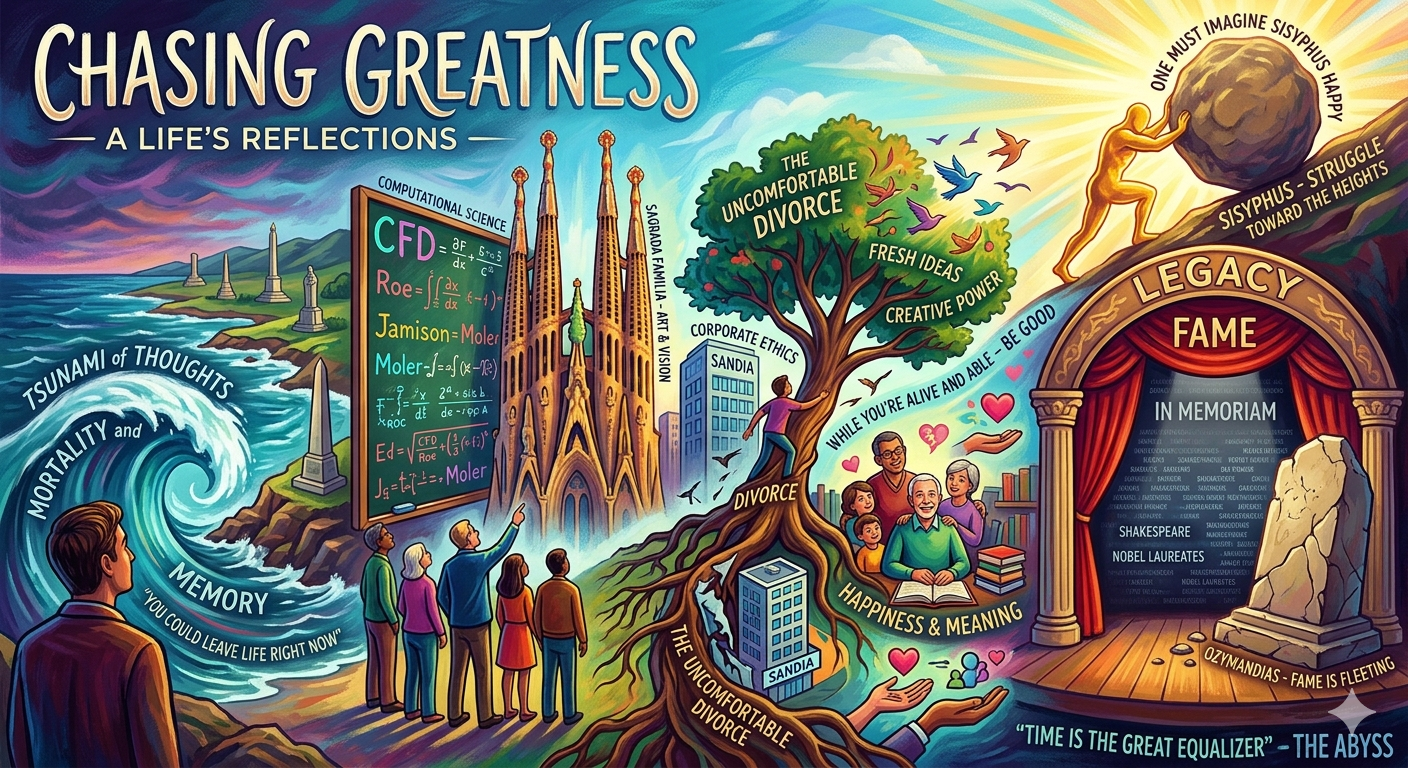
“You could leave life right now. Let that determine what you do and say and think.” – Marcus Aurelius
The last month has been a tsunami of thought-provoking events for me. The most obvious is the death of my father, my last parent. His decline had prepared me for the psychological impact, or so I thought, but it still surprised me. Mortality is a hard concept to wrap my head around. It keeps intruding into my thoughts, conscious and subconscious, with startling regularity. There is much to consider and take forward into my remaining life.
Thoughts about the meaning and value of life are profound, and they lead naturally to questions about work. I have been thinking deeply about work since retiring earlier this year, weighing what it means for me. All of this feels important to write about, even if it is uncomfortable for most people. If you are not up for it, stop reading here. I think it is something we all need to confront. head on
With mortality comes what I believe is the foolhardy belief in an afterlife. I find myself envying those who have faith and take comfort in it, even though I do not believe it exists. I wrestle with this almost daily, trying to work out what a more reasonable version of an afterlife might look like if one did exist. What kind of supreme being would be consistent with it. It all feels like comforting lies we tell ourselves to keep away from the abyss.
That abyss is why I titled this essay “Chasing Greatness.”
“It is not that we have a short time to live, but that we waste a great deal of it.” — Seneca
Around the time my dad passed away, a group of giants in computational science and CFD also died. Phil Roe, Cleve Moler, and Tony Jemeson were all about my dad’s age. Each of them achieved greatness in their careers, which is why we remember their names. I still remember giving a talk at the JRV Symposium in 2013 to honor Tony, Phil, and Bram Van Leer. I was added to the program at the end, after the presentations. I spoke right after Bram. It was an honor, but it also felt, in some ways, exceedingly uncomfortable. To some extent, Bram’s talk shocked the audience.
In retrospect, I look back at that almost wistfully, but also with caution. Bram announced that this would be his final talk. He was going blind due to the effects of his time in a Japanese concentration camp as an infant during World War II. By the time my dad died, he was blind. I suffer from the same disease he did, so I am not completely sure I will not experience blindness myself. My feelings about it go beyond simple empathy for what it does to these men, both of whom I care about in different ways. It is very personal and real to me, and frankly, a prospect that scares me deeply. Honestly, I realize now that any ambition I might have had for fame is foolish, and my time has passed. Any fame on my part was always a long shot. It is for anyone.
I don’t need to sell the fact that my father’s death was existential in profound ways. What I do need to say is that my retirement felt like a kind of death and a reminder of mortality. What comes after retirement in one’s Life? The answer, of course, is your own death. One of the most striking things about my retirement is that it felt more like a divorce than a departure from work. I still have passion, love, and even a sense of responsibility for what I do. I hope it’s obvious to my readers that I still care, have fresh ideas, and want to contribute. My retirement was more of a feeling that I needed to leave an organization and institution whose values were at odds with my fundamental values. Its morals and ethics were incompatible with my own. If I had continued, I would only feel pain and struggle, with no chance of success. I saw my managers with contempt, with all respect drained away.
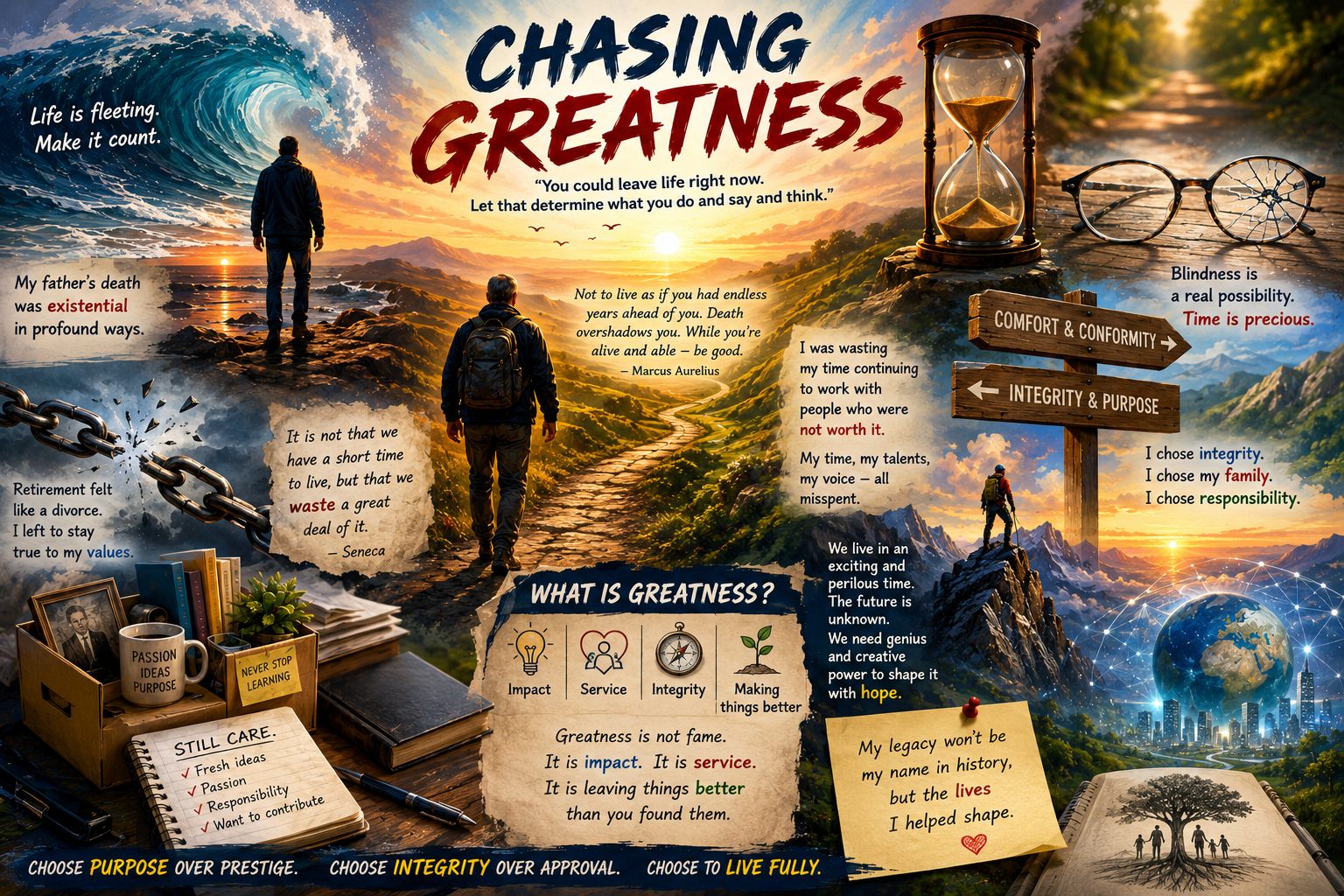
“Not to live as if you had endless years ahead of you. Death overshadows you. While you’re alive and able – be good.” – Marcus Aurelius
In short, I was wasting my time continuing to work with these people. I had already realized how precious that time was, and they were not worth it. I needed to leave. I still think there is much to do, and we live in both an exciting and perilous time. The future is taking shape before us, but its fate is still unknown. We need people of genius and creative power to shape it into something we can look to with hope and the promise of positive progress. I had come to the conclusion that progress at Sandia was impossible, and it was pointless to continue tilting at that windmill. My voice, my talents, and my time were all misspent there, and each of those things would only do less with more time.
The quest for immortality is driven in part by the desire to achieve greatness in life. This is to become someone who shapes history and writes their name indelibly into the record of mankind. The desire is fleeting, but it is common. In a world of billions of people, trying to achieve greatness is utterly foolhardy. As a life objective, it is not a sign of success, but a “stretch goal.”
There is also the question of what defines “great,” which I will get to, and the role luck plays in achieving it. In a sense, I spent a great deal of my personal luck early, by getting my first professional job at Los Alamos. Los Alamos would turn out to be as close to greatness as I would ever get. I met and worked with many people there, some of whom were great, a few of them even uppercase-G Great. I am grateful for that. My own chance at greatness was probably gone from the very beginning. I am simply not lucky or talented enough.
Before I turn to the definitions of greatness and what it takes to achieve it, I want to acknowledge what I deliberately chose when I gave up any of my own pursuit of it. When I left Los Alamos in 2007, I chose a better life for the people I cherish most, and the chance to meet my responsibilities as a man, a father, and a husband. If greatness had still been my goal, I would have stayed. I would have left Sandia in 2013, around the time I turned 50, when it became clear that Sandia was not a place where anything of true value would be achieved. I made the choice for my loved ones again and again. It was simply the wrong place for me.
Greatness comes in many forms, and it is usually a mix of talent and luck. You can be great in a good way by making humanity’s future better. The examples are everywhere: Nobel laureates, inspiring leaders, writers, artists. I was particularly struck by the vision of Antoni Gaudí highlighted during the Pope’s recent visit to Spain. Gaudí’s motivations mean little to me, but his art is inspired, unique, and incredible. Visiting the Sagrada Familia was a highlight of my return to Spain last year. It was the most wonderful birthday present to share with my wife.
At Los Alamos I met a couple of Nobel laureates. I had the briefest interaction with Hans Bethe, who is surely the greatest person I have ever met in person. I also had a mostly funny exchange with Murray Gell-Mann. Arriving at work before dawn one morning, I noticed an older gentleman having trouble getting into the Theoretical Division building, so I offered to help. He handed me his badge, and when I read the name I knew he was trying to get into the right place. I badged him in, he went inside, and that was that. A humorous way to brush up against greatness in science.
More meaningfully, I connected with people who would be seen as great by most standards, if in a slightly narrower way. Frank Harlow was foremost among them. He was one of the true pioneers of CFD and someone I could count as a friend while. Frank had the virtue of entering the field early, and he used his considerable talent and artistry to create new methods. Methods still in broad use today. Methods that are the foundation of the field of CFD. He built on John von Neumann’s work, armed with the knowledge that simulating fluids was a concept that could work. It was just a matter of working out the details. Frank may be the greatest person I have ever counted as a friend.
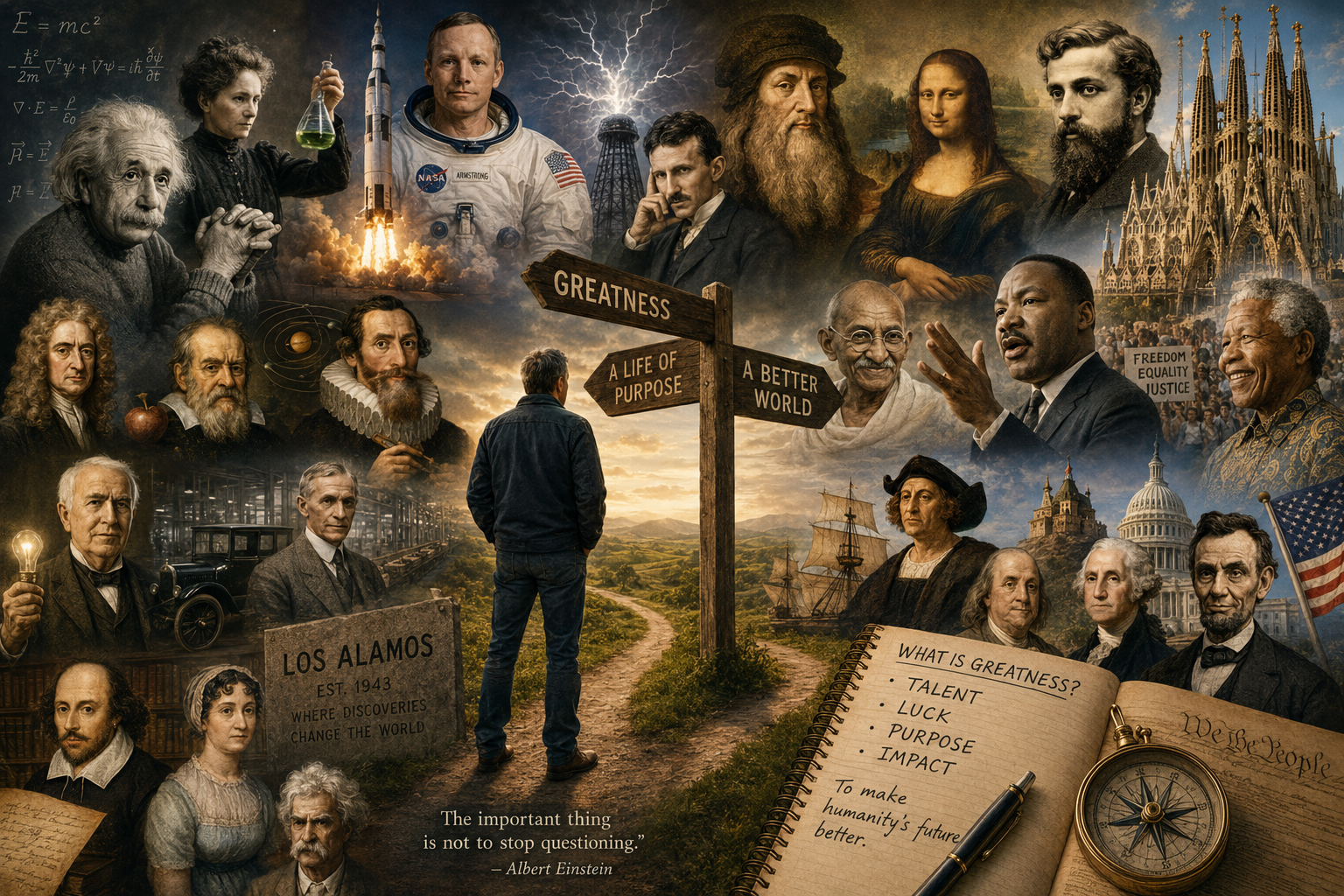
I met many of the other greats of CFD through Los Alamos. Bram van Leer was a friend’s advisor, and I got to meet and interact with him on a few occasions. I truly enjoyed it included that JRV symposium. Also at JRV I asked Bram about the history of CFD. He had a talk called the History of CFD Part 2. I asked about Part 1. Bram quipped to me, “that’s something for you to do.” Indeed I have done this. I also co-authored some work that included Jay Boris. Both men were key figures in my essay about limiters. At conferences I had the chance to meet Sergei Godunov as well, though language and demeanor kept that meeting about as deep as the one with Bethe.
The contrast between the two laboratories in this framing is striking. Los Alamos pursues the idea of greatness, largely because of its legacy. With so many great scientists present during the Manhattan Project, it was almost inevitable that Los Alamos would become a mecca for greatness. It makes celebrating it part of its core identity. Sandia, on the other hand, is a place of teamwork and the overall effort. Greatness is submerged there. If anything, Los Alamos tries too hard at greatness and Sandia not hard enough. Neither lab has it right.
The ability to pursue greatness is, moreover, as much a matter of luck as anything else. It includes having the talent and being in the right time and place to apply it to something new and different. The opportunity for greatness usually arises when a field is being born, not after it has reached maturity.
Greatness can also come from being terrible. Hitler is great in a horrible way. He destroyed lives and killed millions, and he stands as one of the worst people in history. Jeffrey Dahmer is great in the horror, violence, and perverse deaths he inflicted on his victims. He still lives in our imagination as a great in the most awful way.
The theme of “making America great again” is true in this sense. The President is famous and memorable. In all likelyhood he will be rememberd albeit for negative reasons. He is talented in the ways of manufacturing fame. In all likelyhood he is leading the United States into a precipitous decline. Is it good to be remembered for being horrible? He will achieve greatness. People in the future will know his name. Like Lincoln and Washington, he will be remembered, but for completely different reasons.
Alexander the Great and his mule driver both died, and the same thing happened to both.” — Marcus Aurelius
It begs the question of what leads to a good life? The obvious answers run along the axes of happiness and meaning. Greatness as a concept attaches itself to meaning, not necessarily to happiness. In fact, greatness and the meaning in a life can be at odds with happiness.
When I think about myself, I choose happiness. I am a pretty happy person. I have a life full of friends, love, and meaning, and I have a great deal of respect from the people who matter to me, which means a lot. I strive to be better, but I do not let any quest for greatness undermine all those other things. Some of the great people I named above were surely happy as well. Not all of them. For some, the quest for greatness undermined their happiness. For most of them, I never knew them well enough to sort it out.
The idea of greatness and fame is all around us. I was reminded of it again by the new Marc Maron film, In Memoriam, in which a man with a terminal diagnosis becomes fixated on appearing in the Oscars In Memoriam montage. The detail that stays with me is how much fame you would actually need to be remembered ten, twenty, fifty, or several hundred years after you are gone. The amount is, frankly, ridiculous. Go far enough into the future and no one will remember or appreciate that you existed at all. All the knowledge, memory, and importance of you happen in the here and now. What happens now is what really matters. Fame is fleeting.
“Time is the great equalizer; it will claim us all.” – Shelley, Ozymandias
Knowing this is both terrifying and freeing. The terror comes from realizing that mortality is unavoidable, which means what you do with your life right now is all that really matters, and that pursuing any kind of legacy starts to feel foolish and wasteful. The freedom comes from the same fact. If the legacy is an illusion, you are released to live for the present instead of for a monument no one will visit. I try to be a good person, especially to the people I love, and to meet my responsibilities. I also try to enjoy and appreciate what I have right now.
Be not afraid of greatness: some are born great, some achieve greatness, and some have greatness thrust upon ’em.” — Shakespeare
If you want proof of how short a human life is, count how many people from five hundred years ago are still remembered. The number is very small, and those who made the list relied on luck as much as on talent. Names like William Shakespeare and Christopher Columbus come easily to mind, and that ease is exactly the point. It shows how much fame and greatness it takes to reach that kind of immortality, and how few ever do.
“To be remembered is sweet; to be forgotten is fate’s decree.” – Shelley, Ozymandias.
Children are another route people hope to take, and I am here to burst that bubble too. When I think about my own family, I know only three of my great-grandparents, and even then I know little more than their names. I know the great-grandmother from whom my middle name, Jackson, is taken, and I know of two others who emigrated from Norway and homesteaded in the western United States. That is all. Nothing further, and that thin thread of memory reaches back at most a hundred and fifty years. If I cannot hold on to my own great-grandparents, I should not expect my great-grandchildren to hold on to me.
“So many who were remembered already forgotten, and those who remembered them long gone.” – Marcus Aurelius
The deeper truth is that chasing greatness or fame head-on is usually the worst way to find it. The fame worth having tends to arrive sideways. You pour your passion and talent into making something, and then luck decides the rest: the timing, and whether the world happens to be ready for what you made. That part is not up to you. It belongs to the world and to the long odds of fame and fortune. For every famous name, there are people of greater talent who gave everything and got nothing, working in obscurity until the end. And there are lesser talents who rose simply because the draw fell their way.
“The struggle itself toward the heights is enough to fill a man’s heart. One must imagine Sisyphus happy.” — Albert Camus, The Myth of Sisyphus


Dear Bill,
You’ve covered much important ground in this post, and your introspections resonated with me.
Of the many points you covered, I wanted to comment on one you made implicitly: that having faith translates to believing in an afterlife (and a supreme being, etc.). In this regard, eastern faith systems, which are really more philosophies than theistic faiths, offer alternatives that are profound.
Personally, I’m of a Buddhist persuasion, which dispenses away with concepts such as a god, a soul, afterlife etc. (“grand abstractions” as one thinker put it). This might sound a little surprising; Buddhism is intimately tied to karma in popular consciousness, and rebirth and such (and in a way it is, but not as widely understood). It manages to offer a model for a good life, without tying it to the incentive (threat) of an afterlife.
Just thought of sharing.
Best.
Thank you for sharing as well. Something to consider and I wrestle with such ideas. I was sharing my current confused state. My father was a committed athiest for years, but as the end approached that wavered. I had my own experience recently that really burrowed into doubt. I’m still processing that for meaning. You’ve given me a different avenue to look down.
Hi, Bill. What’s a good email address to reach you at these days? I’d like to get your thoughts on today’s opportunities to do transformative work in CFD. (You can reach me at rjmurray@berkeley.edu, if you’d prefer to answer that way.)
-Riley