“I may be wrong and you may be right, and by an effort, we may get nearer to the truth.” — Karl Popper
Assessment and Analysis
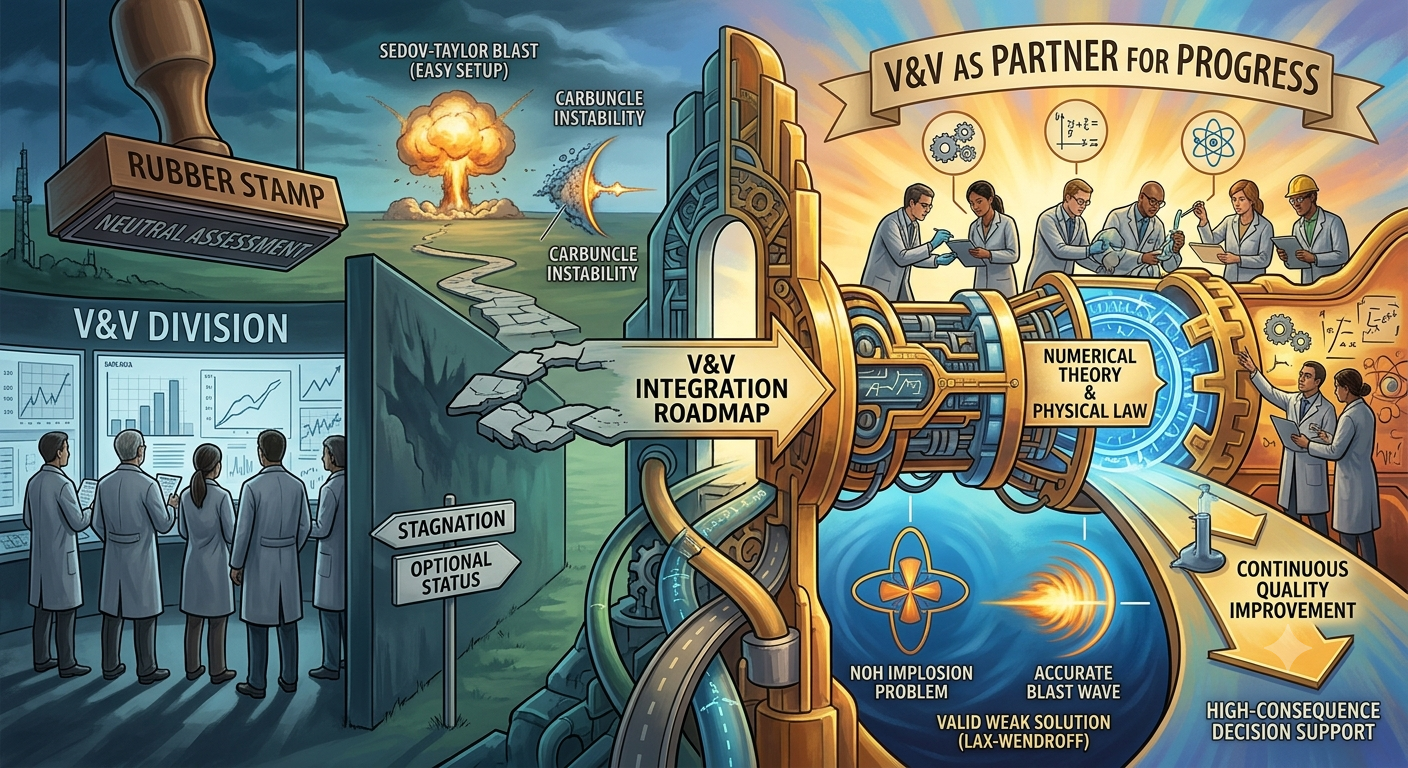
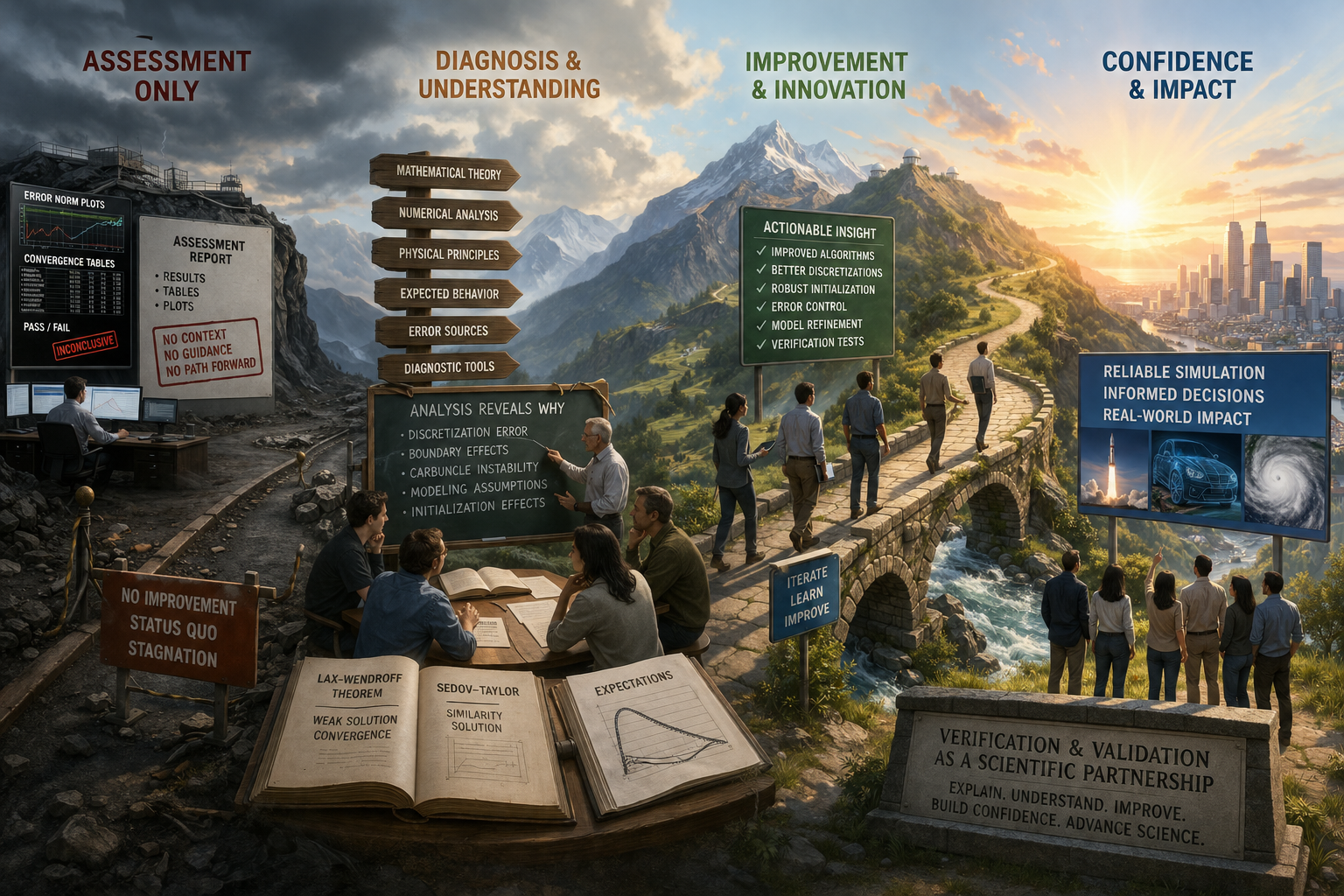
There is a problem with how verification and validation (V&V) are presented. Too often today, V&V is simply an assessment, divorced from the numerical methods, theory, and physics it examines. The result is a hollowed-out version of V&V. There, an assessment proceeds without deep analysis. This isn’t any connection to a synthesis of expectations from theory or the gaps in that theory. Assessments conducted this way offer no path forward to improving anything. Thus, the assessment mentality is a threat to progress. It is also a threat to taking V&V seriously. It is just bad.
The question is whether the goal of V&V is assessment, plain and simple, or the definition of a path to a better product. In practice, the assessment becomes nothing more than a measure of what a given code or model does. It becomes value-neutral and passive. It typically doesn’t spell out what’s right or wrong. It just is. As such, it becomes entirely optional. Missing entirely are the partnership and the underlying purpose. To understand the proper use or limitations of a code or model. No longer finding the road to a better product: making the errors intrinsic to solving these difficult problems smaller. Gone is driving greater accuracy and fidelity in the code and its models.
This is a genuine obstacle to energizing V&V as a means of continuous quality improvement. Instead of a partner, V&V becomes an enemy. It is either a neutral rubber stamp for whatever is already being done, or a damning indictment of a code. The partnership is never evident, and neither is the connection to improvement. Moreover, the laboratories are at their best when they are multidisciplinary, and the assessment model reduces V&V to a one-dimensional activity. It loses being a multidisciplinary vehicle for excellent work.
The question to wrestle with is this: How did V&V fall into the assessment-only model and the trap that it became?
Part of the answer is the growth in depth of V&V work as it became a separate discipline. This separation was always a possibility as the field matured. It is also a trap because it sidelines V&V into a mode where it offers criticism without support. The pattern settles around a point of view where problems are found but never resourced in a way that allows them to be addressed and solved. Using V&V to improve codes and models becomes absent.
“It is not the critic who counts; not the man who points out how the strong man stumbles…” – Theodore Roosevelt
An Illustrative Example
This was a large part of the issue with the shock verification report that instigated my departure from Sandia. That report was a V&V assessment that only showed results. Any problems were merely weakly implied. The report offers no opinions and has no perspective. There was no route offered to answers, solutions, or improvements. Moreover, there was no charter to provide one; funding applied only to code maintenance and support of the user base. Improving the code in some cases is an unwanted nuisance. The entire notion of quality was presumed, and when the report spelled out that the quality wasn’t there while offering no path toward improvement, the experience turned decidedly negative.
“When you can measure what you are speaking about, and express it in numbers, you know something about it; but when you cannot measure it… your knowledge is of a meagre and unsatisfactory kind.” – Lord Kelvin
The report that was the focal point of the conflict around my termination is a good example of the problem with assessment only. It was, simply put, a verification assessment of a set of codes used by Sandia for shock problems. The assessment was conducted on two classical analytic problems:
- The Sedov-Taylor blast wave, where energy is deposited at a point, and a shock wave emanates from the deposition. This is an analytical solution for an explosion, an important use case.
- The Noh implosion problem, which supplies the solution to an idealized implosion.
Both of these problems are standard at Weapon’s Labs across the World. They are part of a standard test suite for the NNSA Labs. There use goes back far into the past with the code development community at these labs.
The Sedov-Taylor blast wave has a rather complex analytical solution dependent on integral equations and delicate integration. The Noh problem has a simple algebraic form. Both problems are extremely difficult for hydro codes to compute. Their analytical solutions exist by virtue of the infinitely strong shocks they produce. In general, they are challenging for codes, and in particular for codes written in the classical ways of weapons labs across the world. As such, they are important verification problems to complete successfully, because success provides confidence in the code. A lack of success is a flashing warning sign.
The assessment itself was done well within standard practices for verification, with some important caveats. One of my chief criticisms of the report was the lack of deeper mathematical and numerical analysis of the results. In the mathematical sense, there are very distinct expectations that come with solving these problems. I have elaborated on these before in previous posts. These expectations are well defined, and a handful of essential theoretical papers in the literature establish what one should expect from a successful method.
By the same token, the numerical expectations are well defined, chiefly the expectation of obtaining a valid weak solution, as the Lax-Wendroff theorem establishes. In short, the codes tested do not all adhere to the precepts of the Lax-Wendroff theorem, and thus convergence to a weak solution cannot be guaranteed. In other words, they might give wrong solutions that are not valid weak solutions. Thus, the results, although produced classically and competently, are not tethered to any expectations. They simply lie there without context or predictions.
Furthermore, the results show the presence of the infamous carbuncle instability, which has plagued codes for decades. In the aerospace literature, the carbuncle is well understood. It is not so well understood in the context of the sort of codes tested here. Nonetheless, the way to cure the carbuncle is well established, though the cure would need to be adapted artfully to these particular codes. I have faith this is possible, but the report offers little or no discussion of the nature of the problem, let alone a route to its cure.
“When a measure becomes a target, it ceases to be a good measure.” – Marilyn Strathern
A second critique I raised was that the setup of the Sedov-Taylor blast wave was chosen improperly, in two regards:
- The energy was initialized on the grid within a finite-size region. This introduces a length scale into the problem, and the absence of a length scale is the entire reason an analytical solution exists in the first place. Under mesh refinement, the calculation then converges toward the regularized problem rather than the Sedov-Taylor solution the assessment claims to test against. One cannot solve the problem in a manner that annihilates the conditions for solution. Yet, this is done.
- The second effect is more pernicious and, in many ways, worse: it makes the problem easier to solve and less challenging for the codes. A choice was willfully made to lessen the challenge that a difficult problem poses, and this only partners with the stagnation of methods and codes, doing a disservice to the entire community. Quality demands that challenges be met, not shirked.
This points to what I believe would be a better way to execute these assessments: combine the assessment with the mathematical, physical, and numerical theories needed to improve results. At a minimum, place the results in the context of what would be technically expected from a correct code and model. It should define why a code or model can be trusted. Rather than a closed and bounded exercise, assessment should be a step. It should define a path for understanding current use and applicability. It should also define the trajectory for improvements.
Why We Need to Integrate V&V
“Cease dependence on inspection to achieve quality. Eliminate the need for inspection on a mass basis by building quality into the product in the first place.” – W. Edwards Deming
There is a useful analogy for how to view V&V if we see it as a measurement (assessment) methodology.
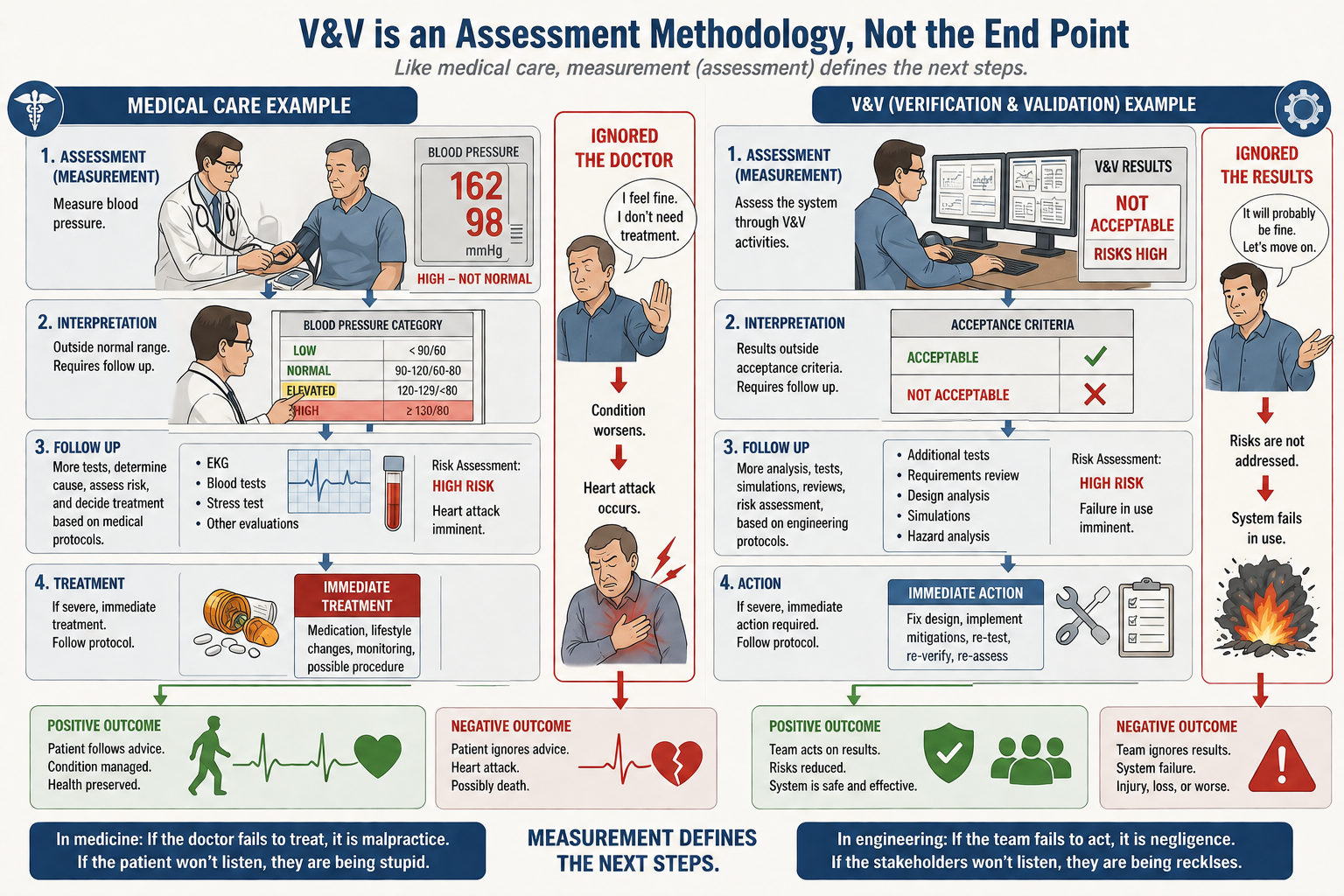
In medical care, we do not stop at measuring blood pressure unless it indicates good health. If the blood pressure is higher or lower than normal, it requires follow-up. That follow-up means more tests and potentially treatment. The measurement (assessment) is essential, but it defines the next steps. These steps follow a protocol based on the current understanding of medicine. If the measurement is bad enough, the treatment is immediate. In the case of the report, I focused on “a heart attack was imminent.” Rather than treat the problem, the patient decided to ignore the doctor. We all know how this approach works out. If the doctor fails to treat, it is malpractice. If the patient won’t listen, they are being stupid.
“Inspection does not improve the quality, nor guarantee quality. Inspection is too late. The quality, good or bad, is already in the product.” – W. Edwards Deming
This brings me to the primary objective of this essay. Rather than simply providing an assessment, the practice of V&V needs to connect results to the appropriate theories. In verification, these are mathematical and numerical results; in validation, physical theory relevant to the exercise is added to the mathematical and numerical foundation. All of this needs to be spelled out in detail, providing both context and meaning. It empowers the reader of the report to take the assessment and find a roadmap to improved results. V&V should not simply be an assessment but a partner in the progress and improvement of computations.
The assessment role for V&V may seem neutral, but it is not. It is a way of neutering V&V. It aids the stagnation of progress and provides cover for codes that refuse to change and improve over time. This does a disservice to the entire community. V&V not only serves the use of the code and model; it serves progress. V&V is used to document and provide evidence for progress. Codes and models should not be static, but should look to be constantly improving in quality. This spirit is on life support.
Verification asks “Am I building the product right?” while validation asks “Am I building the right product?” — Barry Boehm
V&V should be a way of measuring progress and a vehicle for establishing where progress is needed or possible. To identify this, V&V needs to include the relevant mathematical and numerical information for verification as a service to code development. Physical theory was added to establish the same conditions for improving modeling. Together, it becomes the lexicon for establishing capability assessment and identifying needs and opportunities.
The validation work links directly to application work and ultimately supports it in two ways: assessing the suitability of the modeling for a given physical application, and determining whether or not the code is sufficient. It is important to establish where improvements are needed in order to improve that sufficiency. In addition to narrowing the uncertainties inherent in any modeling exercise. This matters for any decision-making attached to the use of modeling and simulation in high-consequence decisions.
Today, this entire standard has become extremely tenuous, and it undermines the role of modeling and simulation. It almost invites unprincipled calibration of results and helps attack the legitimacy of modeling and simulation as a partner in high-consequence decision-making. Assessment only works to neuter V&V and enable stagnation. It only supports the status quo, and the status quo sucks.
Far better an approximate answer to the right question, which is often vague, than an exact answer to the wrong question, which can always be made precise.” – John Tukey