“The most important figures that one needs for management are unknown or unknowable.” — W. Edwards Deming, Out of the Crisis (1986)
tl;dr
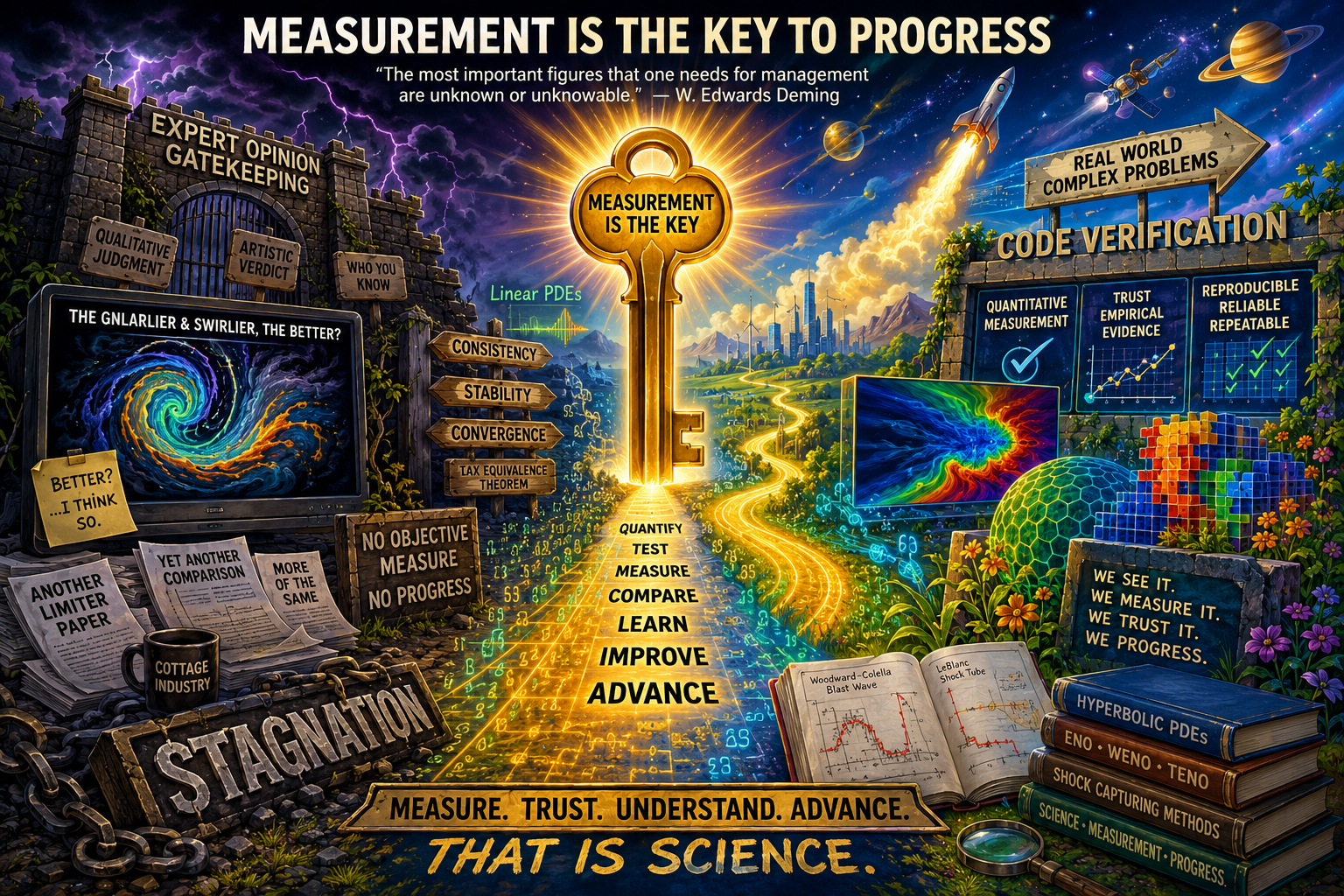
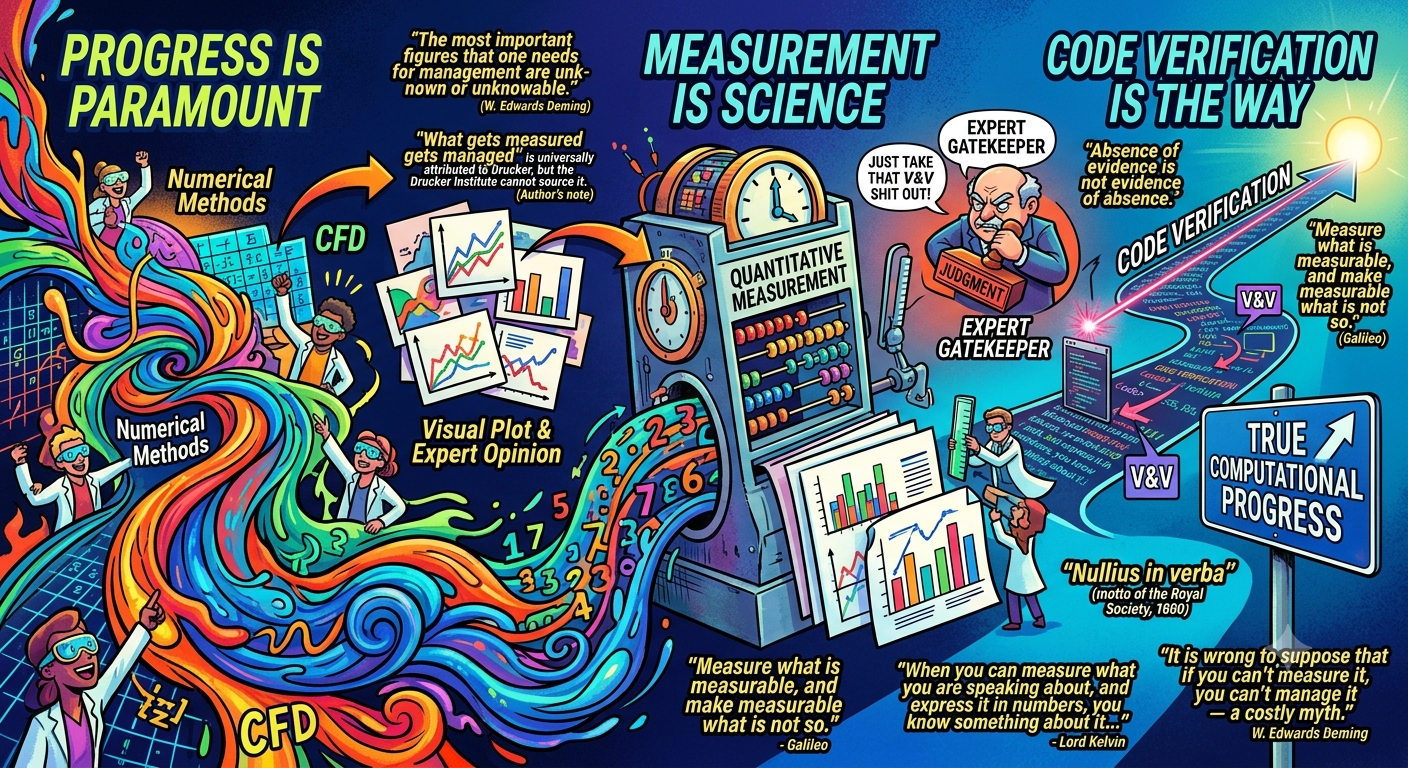
The miraculous nature of today’s world owes its existence to human progress. Some of that progress is serendipity. Some is targeted and guided. In science, measurement is the key both to inspiring progress and to recognizing it. For algorithms, methods, and computing, code verification is how we measure. The alternative to measurement is expert judgment. Both have value. But when you find a field that has stopped progressing, you will usually find too little measurement and too much expert judgment. If we want computational progress, measurement is our friend.
Progress Is Paramount
When I started graduate school, I worked on nuclear energy — specifically the more exotic aspects of it, in support of space exploration. As exciting as that might sound, I never developed any passion for it. It was a reaction to my professor, or perhaps just the topic.
When I started learning numerical methods for differential equations, though, I was full of excitement. The idea that you could simulate the real world on a computer fascinated me. I enjoyed the power and beauty of hyperbolic PDEs and their solution, especially the nonlinear methods that had recently come into vogue. I ate it up.
I learned numerical method after numerical method, gradually narrowing my focus to monotone shock-capturing schemes. FCT and TVD methods were in vogue then, and ENO methods were just being created. I was enchanted by the rapid progress of the previous decade and read paper after paper as the methods were developed and tested. I also grew fond of the associated mathematical literature, finding real beauty and elegance in how that mathematics supported both the methods and our understanding of them. As I devoured the literature, I began to study something else: how these methods were tested and demonstrated, and what the standard was for claiming one method was better than another.
What stands out in retrospect is that the prevailing view of “better” rested on a qualitative metric. The measure was the expert’s opinion about the vagaries and nuances of a visual plot. The judgment seemed defensible enough in one dimension. In two and three dimensions, acceptance of results was essentially an artistic verdict.
A few years later, after I had moved to Los Alamos, I noticed the working version of this standard: the gnarlier and swirlier the vorticity in a problem, the better the method was considered. And yet the progress made in these methods over a short period was astounding. As readers who know my general tendencies will guess, progress is something I care about deeply. Progress is what we should always be seeking.
“Working on the right things is what makes knowledge work effective. This is not capable of being measured by any of the yardsticks for manual work.” — Peter F. Drucker, The Effective Executive (1967)
Measurement Is Science
As this body of work became more familiar to me, the reliance on qualitative examination and expert opinion became more and more distasteful. I met a number of people who were genuine experts and who sat in judgment over methods and progress. Eventually I saw them for what they had become: gatekeepers. There was noobjectivemeasure of what was better.There was only expert opinion, and expert opinion favored those who already held power.
The problem with this status quo is that progress has screeched to a halt. Journal editors are thoroughly fed up with yet another paper developing and comparing limiters — and I am responsible for a couple of those myself. It became a cottage industry. Meanwhile, the standard of measurement for the problems that actually matter is nonexistent. This is the recipe for a stalled science. The key thing to recognize is the centrality of measurement to science. Unmeasured qualitative assessment is not science. The stagnation of progress is therefore no mystery — the two are correlated. Progress requires measurement.
This gets at the real tension over results and standards. The mathematics supporting this area is quite limited. Rigor comes with caveats and serious restrictions. Relatively few practical results carry any assurance from the theoretical foundations of the field. Into that vacuum steps qualitative gatekeeping, and the consequence is stagnation.
To overcome this, we need to measure results quantitatively. We also need a leap of faith: we must be willing to trust what we seeempirically, in the places where theory cannot follow. We know qualitatively that modern methods were a quantum leap in capability. They let computations attempt problems that had been impossible, and they rapidly became standard. The problem is the threadbare theory. Consider the Lax equivalence theorem, which establishes that consistency plus stability is equivalent to convergence — but only for linear PDEs. All our experience says the theorem describes the utility of computing for nonlinear and far more complex problems. What we lack is the rigor to prove it. Stagnation has festered in exactly that gap.
“Absence of evidence is not evidence of absence.” — commonly associated with Carl Sagan
Methods, Algorithms, and Codes Need Metrics
As I matured as a scientist, I came to understand that measurement is feedback. Measurement is science, and method development needed it to flourish. This view generated a great deal of friction with the existing community — friction I found inside the Lab’s computational physics community as well as outside it. It came to a head in an exchange with an editor who demanded that I “just take that V&V shit out of the paper.” Gatekeeping at its finest.
That paper was the culmination of work at Los Alamos; it died on the vine at Sandia. In it I was looking for methods that could deliver quantitatively better solutions to discontinuous problems at an attractive cost — efficiency, in a word. Doing that requires unraveling which elements of method design actually contribute to better solutions, balanced against computational cost. The work grew out of an observation: WENO methods buy formal accuracy at high cost and fail to deliver practical accuracy. Jeff Greenough and I published that failure.
The next step was to turn that knowledge into a better method, which I believe we accomplished in the paper with Jeff and Jim Kamm. Code verification was central to demonstrating the progress, and that is precisely where we ran headlong into the gatekeeping. Results for problems with discontinuous initial conditions and shocks are evaluated qualitatively, full stop. Measurement and quantitative measures need not apply. We measure only for smooth problems, and only to confirm formal high-order convergence rates. That is the standard practice.
No wonder we are stagnating. No wonder there are thousands of papers tweaking limiters and WENO variants. Without measurement, progress is a random walk. I am still pushing this effort forward because I remain convinced it is necessary. Progress depends on aligning our approach with best practice; verification is part of that practice, and V&V must be quantitative. I got into V&V because it is how you do science correctly. The irony is hard to miss: engineers have embraced V&V while scientists and mathematicians treat it with genuine animosity. The problem is that engineers see V&V as a process and a check, not a fuel for progress.
“When you can measure what you are speaking about, and express it in numbers, you know something about it; but when you cannot measure it… your knowledge is of a meagre and unsatisfactory kind.” — Lord Kelvin, Popular Lectures and Addresses (1883)
Code Verification Is the Way
“Measure what is measurable, and make measurable what is not so.” — attributed to Galileo
Once I understood modern methods, I started to see the cracks in practice, and working alongside some of the leaders in the field amplified the view rather than softening it. In everything I did, I looked to measure the connection between theory and observed results. Not only comparisons against analytical solutions, but all results.
Analytical comparisons carry the great power of objective truth. Without them, you can estimate error, but you cannot know it. Given how soft the theoretical results are, comparison against analytic solutions deserves a spotlight. The catch is that the problems with analytic solutions are the ones furthest from application.
I had discovered that V&V was essential. V&V provides feedback on your code and your model, and that feedback is actionable. Qualitative comparison is actionable too, but the variations it suggests come from expert judgment — and experts have bias. That bias usually takes the form of projecting one’s own philosophy of algorithm design onto the results. I preferred something less prone to it. Code verification became my instrument for measuring progress, and the arc of my work through the late 1990s and 2000s reflects that. Along the way, I became more knowledgeable about code verification and more engaged with it broadly.
What is worth acknowledging is that my position runs counter to both communities. The algorithms and methods people carry animosity toward quantitative verification. The verification community that came out of engineering has its own bias: it adopts relatively simple practices and tends to ignore most of the mathematical expectations. Its members are dismissive of the equivalence theorem while adhering to its precepts far beyond the range where it rigorously applies. So I stood out as an outsider. This is a role I have grown comfortable with, and even proud of. The quantitative comparison of results gave me constant feedback and guided my work.
“Nullius in verba” (“Take nobody’s word for it”) — motto of the Royal Society, 1660
Why Is Code Verification Despised?
The logic of quantifying error and using it as feedback is clear enough. So why is the practice resisted so hard? Why the animosity?
The answer is the power bound up in gatekeeping. Experts who hold power in their own right have that power amplified by serving as the judges of progress. They ensure their own work remains the cornerstone. Their judgments involve a great deal of handwaving: the reading of solution structure and oscillations is judgment, and judgment can be made to serve its holder’s ends. Quantitative verification is a different animal, because numbers cannotbe wavedaway — they still require expert interpretation, but they constrain it.
The animosity, then, is largely gatekeepers defending their hold on a field. They decide who publishes and who gets credit, and they reject those they dislike or who fail to reinforce their standing. This behavior is hardly confined to computational fluid dynamics. The turbulence community is equally stagnant, if not more so, and for the same reason: persistent gatekeeping throttling progress.
I saw gatekeeping at Los Alamos as well, where the nuclear weapons designers held the role. They were quantitative about validation results, but they achieved those results through extensive calibration. In particular, they would quite cavalierly calibrate away numerical error using physics submodels. This is a common practice as weather and climate modeling does the same basic thing.
The hostility toward quantitative measurement of code performance is deep and profound, and together with the CFD gatekeepers, it has blunted progress for decades. The result is a hegemony of older methods still in use long after they should have been replaced. It limits what modern computing can contribute to genuinely important problems. This remains a force that saps some of the value we should be enjoying from computing. Over the history of the computational age, methods and algorithms have provided efficiency equal to or greater than computing itself.
The case for being quantitative about practical problems is, in some ways, simple. Practical problems haveextremelylow convergence rates — first order is typically the best you can achieve, because the dynamics of numerical methods change considerably in the presence of discontinuities. Under those conditions you should care far more about producing small errors than about high convergence rates. Highly accurate, high-convergence-rate methods simply don’t pay off, particularly when they are expensive.
The real question is how to deliberately produce methods that achieve small error, remain robust, and selectively preserve the solution structures that matter. That is afundamentallydifferent design problem than chasing formal order of accuracy. Pursuing high-order methods formally can produce more error on practical problems. They only show their benefit when the problem becomes complex enough to contain a great deal of intricate structure. This points toward greater adaptivity to tie the two uses together cleverly. Quantitative assessment is key to success.
“It is wrong to suppose that if you can’t measure it, you can’t manage it — a costly myth.” — W. Edwards Deming, The New Economics (1993)
References
Sod, Gary A. “A survey of several finite difference methods for systems of nonlinear hyperbolic conservation laws.” Journal of computational physics 27, no. 1 (1978): 1-31.
Boris, Jay P., and David L. Book. “Flux-corrected transport. I. SHASTA, a fluid transport algorithm that works.” Journal of computational physics 11, no. 1 (1973): 38-69.
Harten, Ami. “High resolution schemes for hyperbolic conservation laws.” Journal of computational physics 49, no. 3 (1983): 357-393.
Jiang, Guang-Shan, and Chi-Wang Shu. “Efficient implementation of weighted ENO schemes.” Journal of computational physics 126, no. 1 (1996): 202-228.
Rider, William J., and Douglas B. Kothe. “Reconstructing volume tracking.” Journal of computational physics 141, no. 2 (1998): 112-152.
Rider, William J. “Revisiting wall heating.” Journal of Computational Physics 162, no. 2 (2000): 395-410.
Rider, William J., and Len G. Margolin. “Simple modifications of monotonicity-preserving limiter.” Journal of Computational Physics 174, no. 1 (2001): 473-488.
Greenough, J. A., and W. J. Rider. “A quantitative comparison of numerical methods for the compressible Euler equations: fifth-order WENO and piecewise-linear Godunov.” Journal of Computational Physics 196, no. 1 (2004): 259-281.
Rider, William J., Jeffrey A. Greenough, and James R. Kamm. “Accurate monotonicity-and extrema-preserving methods through adaptive nonlinear hybridizations.” Journal of Computational Physics 225, no. 2 (2007): 1827-1848.
Banks, Jeffrey W., T. Aslam, and William J. Rider. “On sub-linear convergence for linearly degenerate waves in capturing schemes.” Journal of Computational Physics 227, no. 14 (2008): 6985-7002.
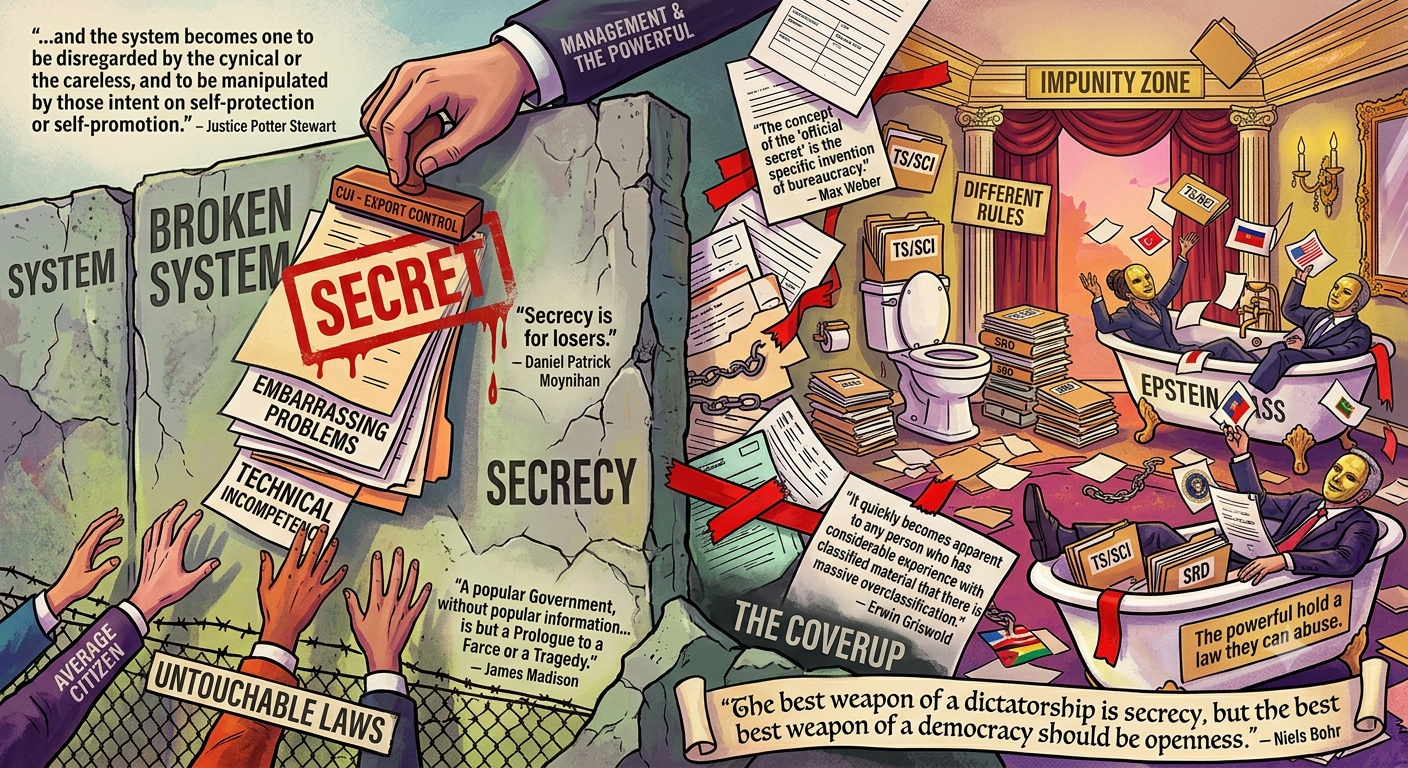
I worked with classified documents almost my whole career. This isn’t odd when you work at two nuclear weapons labs. Classification is important and essential for security. The law and practice of it is a fucking mess, none more so than export control. There are huge loopholes, and the powerful flout the rules with impunity. Corrupt managers abuse the law for their own ends. Those in power ignore the law regularly. Today it is simply another way power and inequality asserts itself.
For when everything is classified, then nothing is classified, and the system becomes one to be disregarded by the cynical or the careless, and to be manipulated by those intent on self-protection or self-promotion.”– Justice Potter Stewart
The fundamental issue
A couple of years ago we discovered that the former (and current) President had hundreds of classified documents in his residence. They were stored in ballrooms and bathrooms. He shared the information with various people, foreign and American, as he wished. Among these documents were some of the country’s most essential secrets, far beyond anything I ever saw or had access to. Had I done what he did, I would expect tobe imprisonedfor the rest of my life.
The President suffered no consequences for this extreme violation of trust. It was also an abdication of responsibility. I took it as a personal insult. It is also a pattern I had already seen over and over, and it inserted itself into my life again this week. Rather than protecting important information, classification issimplyanother way for the powerful to fuck with the rest of us. These violations are common and committed with utter impunity by those in power. The danger from this is real.
Identifying and managing classified information is very important. The protections and the secrets are essential. This information falls into broad categories. Secret Restricted Data (SRD) is the material associated with nuclear weapons. I dealt with this a lot; I even held a position of responsibility for identifying it. National Security Information (NSI) covers other timely information about things like spying and defense. These are the categories the President stole and misused. Finally, there is Controlled Unclassified Information (CUI), formerly Official Use Only (OUO). Export-controlled information falls under this umbrella. CUI is the mostcommonlyandbroadlyabused category, and coverups and information hiding are rampant under it. I’ll get into this below.
“Secrecy is for losers. For people who do not know how important the information really is.” —Daniel Patrick Moynihan
This function of government is absolutely essential, and it must be wielded responsibly. Instead, the powerful often use it cynically and selectively for their own ends. The result is abuse of power. It is another way that the law applies only to the little guy. Another manifestation of the Epstein Class, who follow completely different rules than the rest of us. The result is a set of essential laws that simply become another way to tell the average citizen to fuck off.
First, let’s get to a few basics of the law and practice. Then I will elaborate on some of the abuse of power I witnessed over my time at the Labs. Some of this has parallels in the news (Trump, Clinton, Biden, John Deutch, …) worth mentioning. If you’re powerful, the law isjustnotional.
Classified material
When most of us think about classification, the thing that comes to mind is SRD, the category used to classify material related to nuclear weapons. It has been a major focus in my life.
When I worked at Los Alamos, I became an authorized derivative classifier. This job involved reviewing documents, presentations, and emails for the presence of classified information. There are many subtleties in all this, and I came to understand the area quite well, particularly in my specific expertise, which spanned various parts of computational science.
The real focus of all this classified work is always on the applications and how the workis reflectedin technology. This is generally true for this type of classification, and it shows up again in export control. It is central to understanding the whole topic.
This form of classification is defined by statute. When you’re doing classification work, detailed technical guides define whatis classifiedand provide a rubric to work with. Violations of this classification law carry penalties that can be quite severe. I had many interactions with violations and security issues, but generally speaking, my personal record was quite good.
When I transitioned to Sandia, it would have made sense for me to continue as a derivative classifier. My experience with the professionalism and competence of the Sandia classification office quickly convinced me this was a risk exposure I couldn’t tolerate. The classification office at Los Alamos was my partner and peer; the classification office at Sandia was adversarial and struck me as outright incompetent. The institution took a negative, adversarial approach toward employees and made me feel like I was the one at significant risk all the time. They also provided far less support for anything related to classified documents and pulled that support away from any sort of local control. In short, the overall attitude made me extremely uncomfortable having anything to do with classified work at that laboratory, so I declined the responsibility.
“The concept of the ‘official secret’ is the specific invention of bureaucracy.” — Max Weber
Export control law
The second place classification shows up is export control policy. Export control deals with information that is less sensitive and less damaging than nuclear weapons material. The lawwas writtenafter the statutes governing nuclear weapons information, andironicallythe statutory penalties are far worse. Compounding things, the law is much vaguer and written with a fear-based approach, with little to no technical guidance for determining whether something is export-controlled.
As I will elaborate, this makes the policy more arbitrary to adjudicate. It also makes it more prone to abuse and outright violations of the spirit and letter of the law. That led to my retirement, and to the episode this last week.
All of this matters a lot. When I look at the issue around my retirement, its sensitivity designation is central. I can say unequivocally that the document this all revolves around was not export-controlled. Yet, it was declared as such. It was not information sensitive in any way and should not have had any of these controls attached to it. The declaration that it was export-controlled was a pure abuse of power. Knowing the objections of the managers makes it corrupt on its face. Itwas declaredexport-controlled only because the contents of that report were bad for the laboratory and exposed problems. The designation was done purely to protect the outright incompetence and unwillingness of the managers to address the problems the report identified.
The applications of this work have nothing to do with the report or the material contained in it. These are solutions to hydrodynamic test problems with analytic solutions, used for code verification. The code verification results are clear and unambiguous: the code cannot solve these problemscorrectly. The reasons are simple and easy to explain. Unfortunately, they are not articulated in the report, and the institutional approach is to simply hide the report and assert that the results of these test problems are immaterial to the problems the code solves. Nothing could be further from the truth.
“It quickly becomes apparent to any person who has considerable experience with classified material that there is massive overclassification.” — Erwin Griswold
Abuse and violation are common
I wish I could say that abuse of power and violations of these laws were uncommon. The inverse is true. I mentioned the President’s hoarding of classified documents as a prime example. By the same token, Hillary Clinton used a private email system for classified work, which was a violation. John Deutch, the former CIA director, took classified material home. Former President Biden had a handful at home by mistake.
I saw two instances at Los Alamos where lab directors committedfairlyserious security violations and wereessentiallylet off the hookentirely. They suffered no consequences.
In one case, a lab director spelled out details of a security investigation in a public meeting. The classification level of a security investigation is the same as the material being investigated. He wassimplylet off the hook as they declared the material hadsuddenlybecome declassified.
Another lab director read aloud a passage written by the head of the NNSA that contained classified material. This was a subtle violation, but one common in the area where I worked. I immediately knew that what was read was classified. When I took it to the classification office, based on their previous experience, they felt it wasn’t worth touching. Again, because of the power of the individuals involved, they were off the hook. I don’t think they even had any idea they had committed a violation.
Given this experience, it comes as no surprise that managers believe they can get away with things. The CUI designation is not supposed tobe usedto hide embarrassments or problems, yet itis usedthat way over and over. Moreover, the institutions are making more and more information CUI, precisely because of the lax, undefined nature of the technical designation.
The case relevant to me now highlights this. They see something they don’t like, and rather than dealing with it and taking responsibility, theysimplydesignateit as controlled information. Prying eyes can’t see it. This is done over and over, and because of the lax nature of the law, they act with impunity.
For genuinely classified information, there are supposed to be penalties and admonishments for using classification to hide information through overclassification. In export control law,justas there is no technical specificity, there is no such rule. In no case are these enforced actively. These managers get to do this with impunity. Nothing stops them. It’s simply something they’ve gotten used to doing. So we have a situation where the powerful hold a law they can abuse. They can hide their problems, hide their issues, hide anything embarrassing, and they just get away with it.
To put a point on this whole shitty situation: this harkens back to the same attitude we see with the Epstein class. Rich, powerful people flout the law, violate it with impunity, and let their power shield them. Granted, the things I’m talking about here aren’t nearly as horrible and disgusting as the crimes Epstein committed, but the abuse of power and privilege is exactly the same. Theyroutinelyuse these laws to punish the little guy while violating them themselves. This is exactly what happened in my case, and I suspect it happens over and over across the entire federal establishment.
Institutional corrosion
“A popular Government, without popular information, or the means of acquiring it, is but a Prologue to a Farce or a Tragedy; or, perhaps both.” — James Madison
Moreover, this is a bipartisan issue. These actions are committed by everyone in a position of power, and they are among the most corrosive forces eroding trust in our leaders and our institutions. It needs to be fixed. Fixing it would be a major step toward re-establishing the trust and confidence we need in our leadership for a better future.
A position of leadership should be the opportunity to set the best example. Instead, in our current society, leaders regularly flout the rules and receive exceptional treatment. Rather than being examples for those they lead, they act with a sense of impunity and entitlement, and that entitlement amplifies the sense that the rules are different for them. The laws and regulations are merely suggestions; their position allows them to violate them without consequence. They do not have to abide by the same constraints, rules, and principles thatall ofusare requiredto follow. It is no small statement to say that this is a recipe for disaster, but this is where we are. I can see examples of this in action from the bottom of leadership to the top. Rather than setting an example to follow, they provide proof that power endows you with special privileges and little responsibility, while the serfs toil below.
The fact that these abuses are commonplace and practiced at every level of leadership is not an excuse. Rather, it is a test of the basic values and ethics those leaderspossess. If a leader violates the rules or abuses their power, they have failed a fundamental test of character. In each of the examples above, those leaders failed that test. They have shown they are unfit for the positions they hold.
In their hands, the rules and regulations are simply tools of power, instruments for taking retribution against those they don’t like. Secrecy is important, but it is also a reliable engine of distrust, and that distrust is a threat to effective leadership. Our leaders amplify this threat by abusing people with the very rules and regulations they refuse to follow.
“The best weapon of a dictatorship is secrecy, but the best weapon of a democracy should be openness.” — Niels Bohr
“When someone shows you who they are, believe them the first time.” – Maya Angelou
I deleted a couple of posts today (the previous footnote). I had no choice. I received a threatening letter from Sandia that left me no recourse. I’m not going to relitigate the whole episode. It confirms that I worked for unethical and corrupt managers there. It simply amplifies the point. These people have absolutely no business managing anything, much less nuclear weapons. Their professional success indicts the institution.
I had downloaded an unclassified document from the OSTI website. It was marked as such, with a Sandia release number indicating it had gone through information release control (SAND2026-20700). These are designated “UUR,” meaning Unclassified Unlimited Release. I treated it as such. Moreover, the document was indeed completely unclassified. I’m an SME in every topic it contains. In fact, the whole reason I was hired by Sandia in the first place was this very expertise. The report was in the bullseye of my professional expertise.
It holds no sensitive information either — that is, unless you’re sensitive to bad results. Until I received the letter, I had no reason to believe otherwise. Any other designation of the document is complete bullshit. Yes, I was a derivative classifier in a previous life, and I take this shit seriously. Classification at Sandia is far more political than technical. The law has massive gaps in it that empower the management to systematically over-classify. They are using it to bury bad results. Rather than fix the problems, they hide them. In the long run, this will come to no good.
What I can share is an episode that defines the character of the person I believe is at the center of this. He’s only the third-worst person I met at Sandia, mind you. Let’s call him “Cilantro” because he leaves a bad taste in some people’s mouths. It’s a worthy nickname for this piece of shit, and feel free to use it if you have the misfortune of interacting with him.
A while back, Cilantro was a group leader overseeing some nuclear weapons work. I was asked to lead a peer review of an important body of work. Red flag number one appeared almost immediately: the review was held at a very high level of security inappropriate for the work. The extra security was immaterial to the work itself, but it reduced the pool of people available to see the work or judge it. My mentor, for example, was excluded as a result.
During the review, the material driving the designation was shown. It was completely immaterial to the presentation. At the end of the day, the work was reasonable in terms of quality and completeness. But the team presenting it was unnecessarily avoidant and belligerent toward the review team and our questions. They continually pointed to a huge stack of documents for answers, basically refusing to provide any detailed ones. I was genuinely perplexed. The work was good, so why the animosity?
What became clear was that they expected a rubber stamp instead of a review. They were arrogant, and it showed. Cilantro was their group leader. Ironically, the material that drove the designation wasn’t even classified — it was export-controlled. When I wrote the report, I had to classify it at the level of the presentation (SRD Sigma 14). I asked for the report to be declassified to the level appropriate for the information. The person responsible failed to do so despite my repeated prompting. I will note that there are rules against over-classification, and I was endeavoring to follow them.
Eventually, time ran out, and all I had was my first draft of the review. They passed, but the unprofessional and belligerent behavior was noted. I found it counterproductive and antagonistic. The memo went out, and I got it declassified at the last minute. It had not gone to the rest of the review team either.
Then Cilantro called me to his office. He didn’t like the memo. When I got there, unbeknownst to me, another manager was waiting. They ambushed and attacked me. How dare I criticize their people? I should have realized then that Cilantro doesn’t like critique unless it says he’s amazing. He refuses to see problems or do anything about them. He just wanted to berate me, and brought along someone else to make sure it was two on one.
So when Cilantro became a manager above me, I should have known to get the fuck out.
“He who decides one day that scientific statements do not call for any further test, and that they can be regarded as finally verified, retires from the game.”– Karl Popper
When we last spoke, I was reacting to reviews on a paper. It is a paper that touches on Peter Lax’s contributions to modern computational science. Our angle is the practice of code verification, with two main points: the equivalence theorem and shock tube calculations. There the focus is analysis and accuracy measurement. I’ve writtenpreviouslyabout how important and valuable this is. We’ve started addressing the reviews and revising the manuscript accordingly. One point in the review prompted this essay. I’ll get to it in a moment.
I had gotten myself into a good rhythm of writing. That has been derailed. The reviews are actually a minor part of this. My writing energy is going into the revision, a more formal and professional modality. The big thing that has gotten in the way is life. At home we had a water leak in the foundation. This is an emergency and really bad. I’m also in the midst of selling my parents’ home, with an inspection and a title company to deal with. All of this is on a timeline that doesn’t move, especially the leak, which is a “drop everything, fix it now” emergency.
Now back to the task at hand!
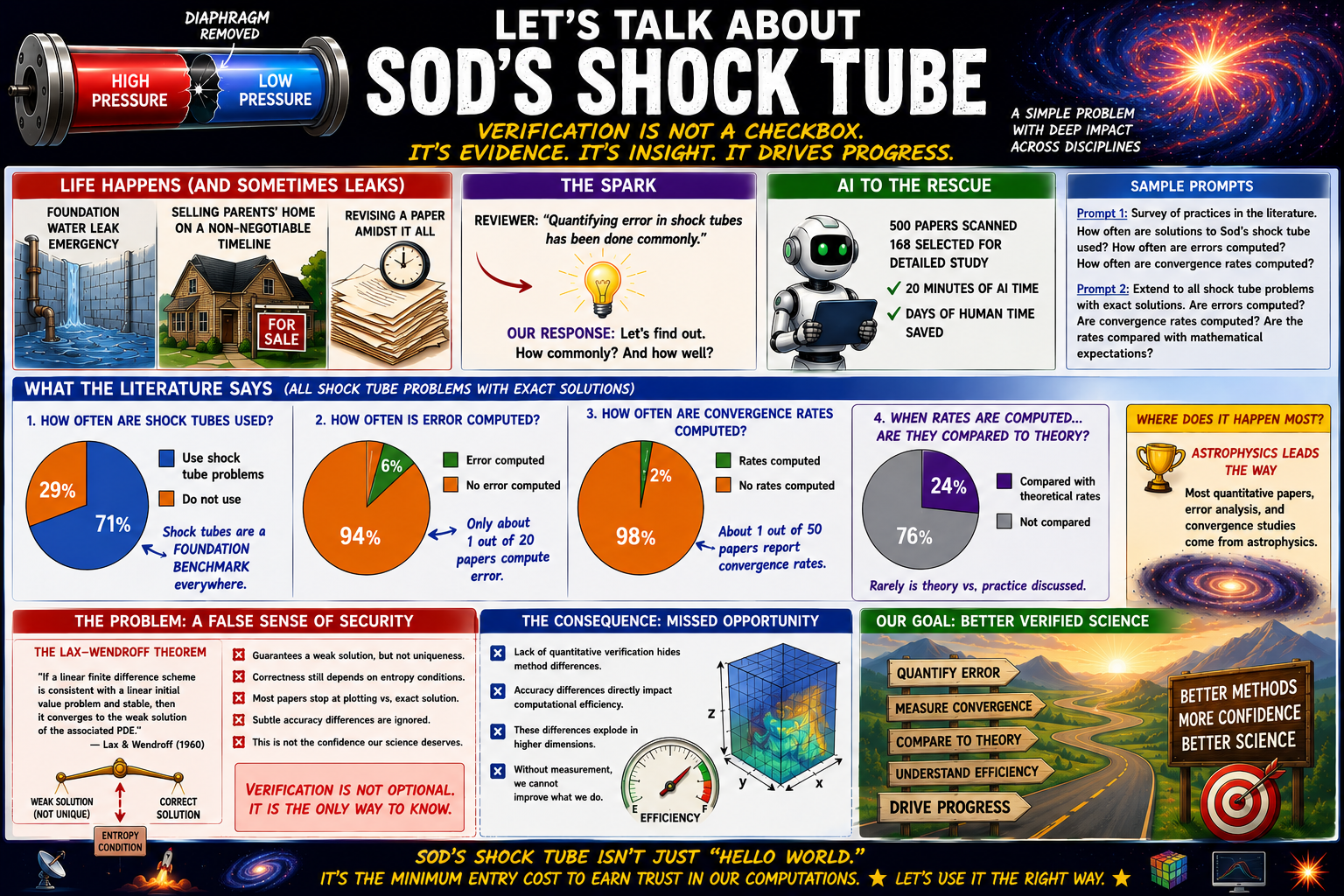
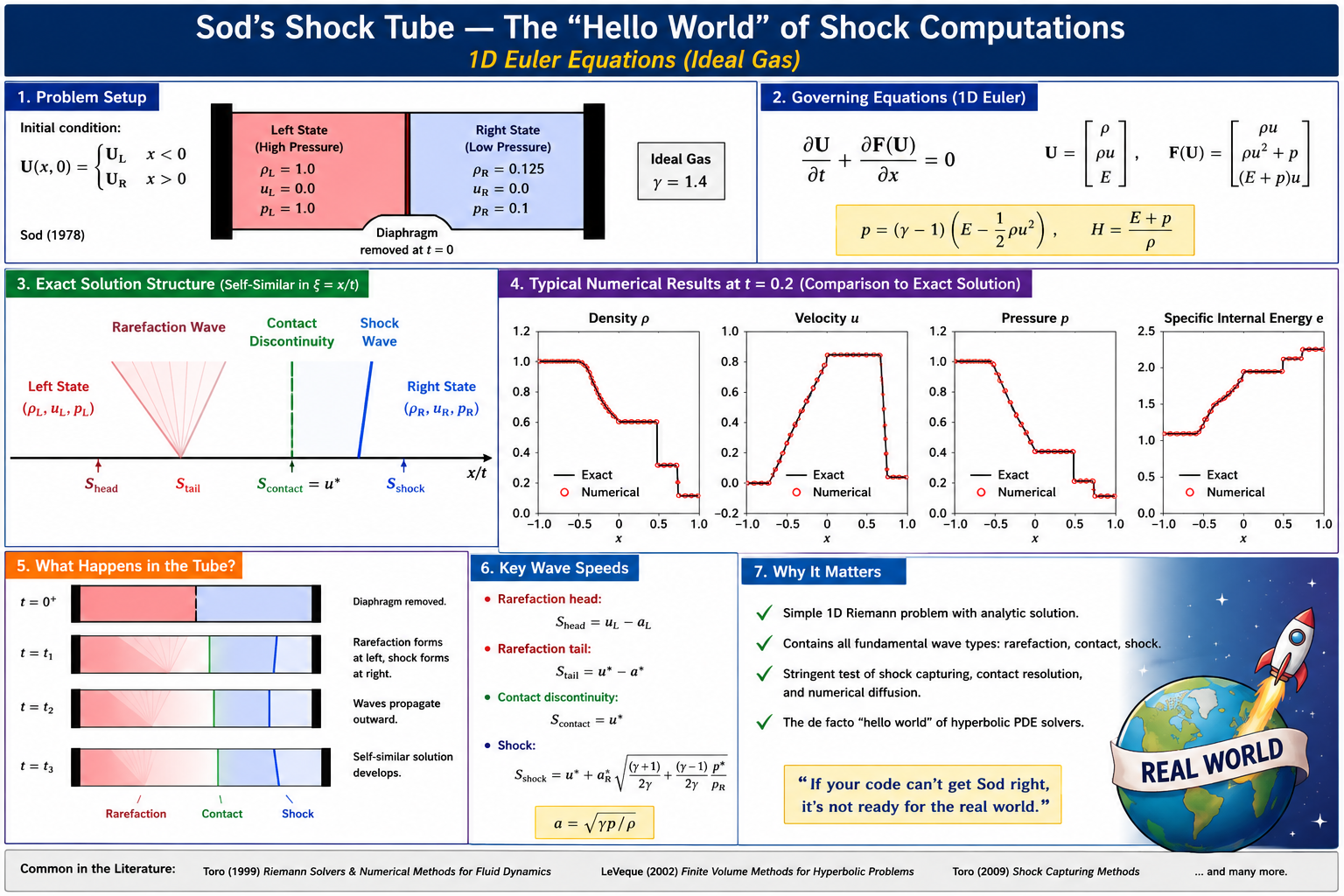
One comment in our reviews prompted a response and inspired this essay. In a nutshell, it said that quantifying error in shock tubes is commonly done. There is definitely truth in this. The question is how much truth, and moreimportantly, how to distinguish our work from the rest. Our work needs to be novel. I think it is, but we need to articulate that better. That is what I’m currently working to express with greater clarity. I wanted to put some meat on the bone for the comment.
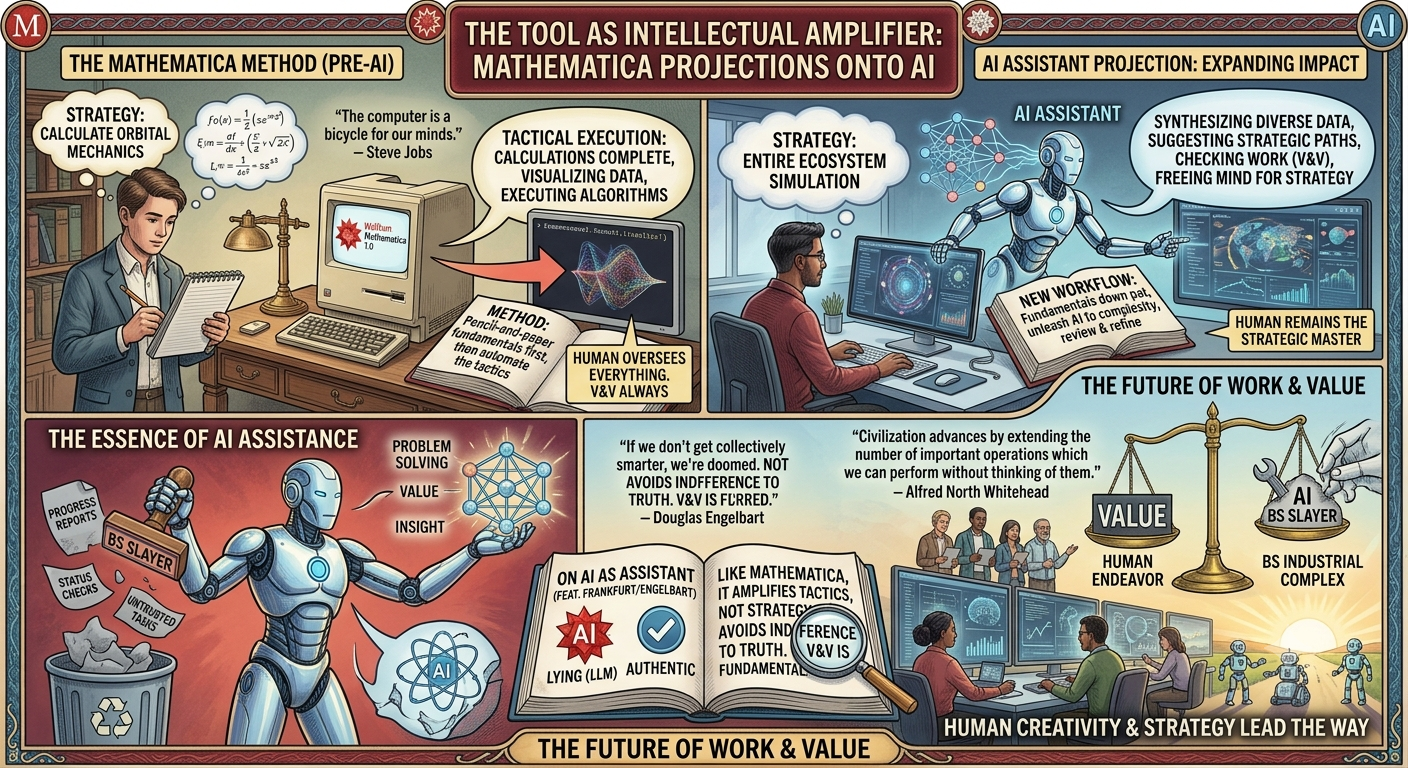
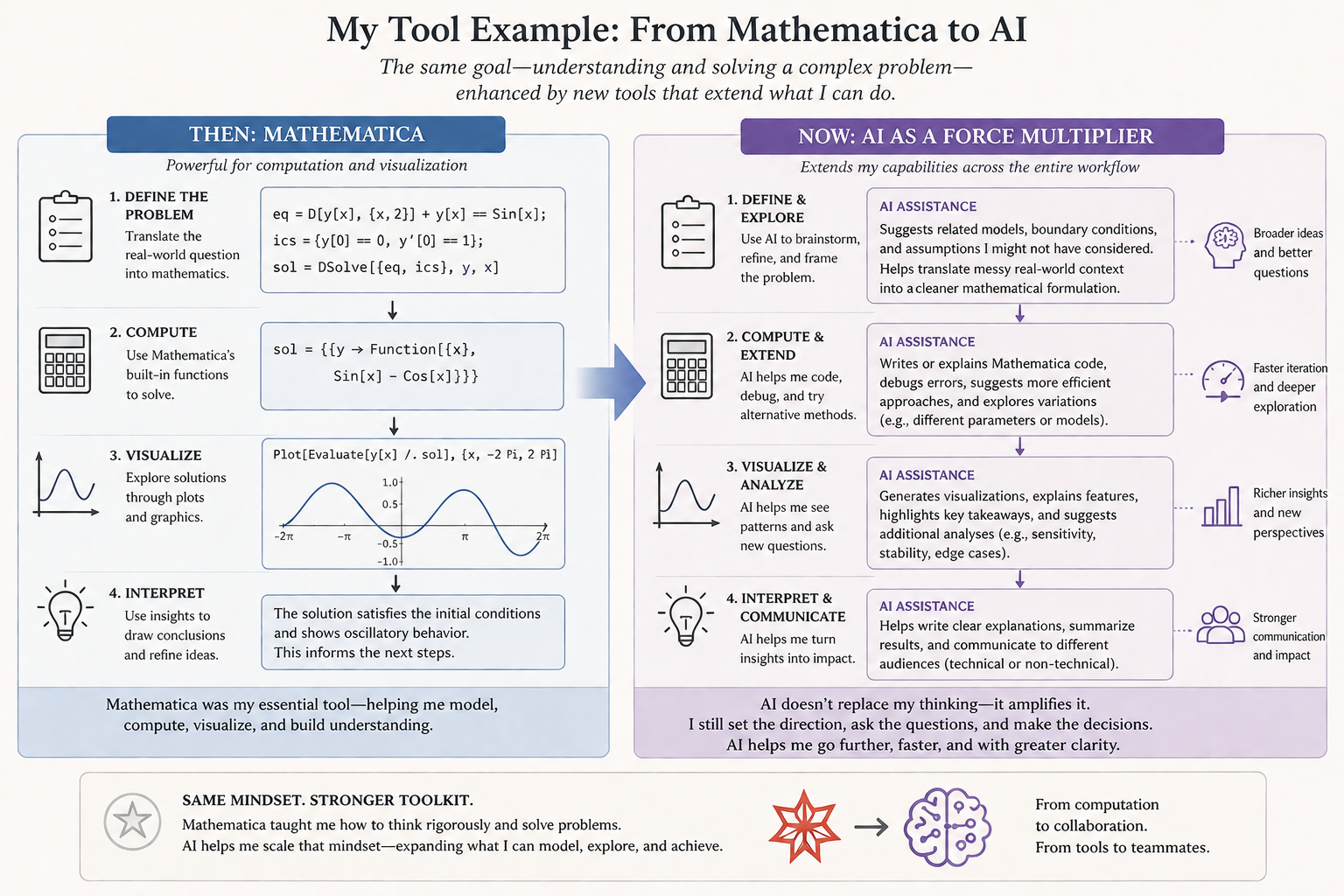
Pointedly, what does the literature actually say about these problems? There are thousands of papers that use them. How is our paper, and our use of these problems, different from all of them? This is a rather daunting prospect. I enlisted Claude to survey the literature, sampling for practices with Sod’s shock tube in particular and shock tubes in general. It was a lark on my part. Claude performed beyond my wildest dreams. It was quite impressive. The rest of the essay will elaborate.
“When you can measure what you are speaking about, and express it in numbers, you know something about it; but when you cannot measure it, when you cannot express it in numbers, your knowledge is of a meagre and unsatisfactory kind.”– Lord Kelvin
The study Claude did confirmed the reviewer’s comment, but only to a point. It took all of 20 minutes, five of which were me writing the prompt. It looked at 500 papers and selected 168 for further study. It surveyed the papers and documented the work. I have a spreadsheet of the papers with the results discussed, and it wrote me a report on the findings. I spot-checked it, but the same study would have taken me days by hand, tedious and time-consuming days. It confirmed my thesis to a large extent. I was actually surprised at how quantitatively stark the statistics were. Notably, astrophysics is the discipline where quantitative accuracy and convergence are actually practiced.
For shock tubes in general, about one paper in 20 computes the error. One in 50 computes convergence rates. Among those, there is little analysis aside from the observation that convergence is first order or less. There is no discussion of the practical implications of the accuracy. The study also pointed to the papers that come closest to what we are aiming to do. Beyond the findings themselves, it was the use of AI to address the question that struck me. I was blown away by how cool and easy this was. One of my coauthors expressed animosity toward using AI. That’s a topic for another day.
Another notable aspect is how many papers engaged in some form of quantitative analysis (about 55%). This was actually a very large number, but it was mainly focused on smooth problems, where the design order of accuracy can be achieved, often in all norms. In a sense, this applies the equivalence theorem verydirectlyon (almost) linear problems, where all the nonlinearity in the methods fades away or diminishes to a few exceptional points. This is an essential part of code verification, but for the applications these codes are written to solve, it is utterly and completely inadequate.
The practice of code verification needs to be more than a check for correctness and a lack of bugs in the code. It needs to advance the methods in practical ways for the problems we write the codes to solve. Bugs and correctness are important, but they are far less than the practice could deliver. We are suggesting expanding the practice into a full partner in progress.
Prompt 1: “I would like a survey of practices in the literature. The question is how often solutions to the Sod Shock tubeare usedin papers. Then among those how often the error from the exact solutionis computed. Then again how often are rates of convergence computed.Using the literature available (arXiv, etc.) can this surveybe completedand an analysis given“
Prompt 2: “Rather thansimplyusing Sod’s problem as the focus, extend the study to all shock tube problems having an exact solution. Ask whether the errors in the solutionare computed. Ask whether convergence ratesare computed. Then are the convergence rates compared with mathematical expectations.“
Code verification is a means of providing evidence and confidence in the proper functioning of our methods. Beyond providing that confidence, it can identify issues in the code and methods, and focus research efforts on addressing, mitigating, or improving them. It is not merely a checkbox. It is a means of producing actionable information from which a proactive research agenda maybe defined. Our paper expands the role code verification can take to include computational efficiency.
The Lax-Wendroff theorem has seduced us into a form of false confidence. The vast majority of papers simply plot the solution against the exact solution. No errorsare computed. There is an implicit view that the accuracy differences are immaterial. I’ve argued that they are material; the differences are subtle, but important. The lack of direct verification rests on the confidence the theorem provides us. This is a failing. The current literature does not treat the issue with the deference it deserves, nor is it consistent with the sort of confidence we should be endowing our methods with today.
Recognize the full scope of the theorem: it guarantees a weak solution, if it applies. A weak solutionis desired, but it is not unique. The theorem does not guarantee a correct solution. That depends on an entropy condition, so the verification question is still alive, yet infrequently engaged. This is not an acceptable state of affairs.
When the Lax-Wendroff theorem is not in play, verification becomes even more necessary, since the guarantees are missing and mustbe demonstrateddirectly. You could converge to the correct solution, but assurances are missing. In either case, the differences between methods are reflected in achievable accuracy. That achievable accuracy is then reflected in meaningful differences in the efficiency with which it is obtained. These differences can only be studied quantitatively, and they become far more profound as dimensionality increases. Nonetheless, they are not given the attention they deserve. Our work is trying to move the needle toward better practice.
The other part of the story is how to use AI properly. This was an exceptionally cool idea, and AI did the work extremely fast. It felt like a huge boost in productivity. In my mind, it frees up my time and attention for other things. Today that means solving problems in my personal life. Tomorrow it could mean leisure. It can also free up time and energy for creativity and progress.
“Beware of bugs in the above code; I have only proved it correct, not tried it.”– Donald Knuth
“The mistake, of course, is to have thought that peer review was any more than a crude means of discovering the acceptability — not the validity — of a new finding.” – Richard Horton, editor of The Lancet
Prelude
I awoke the other morning to find in my inbox something I had been anticipating and, to be honest, dreading for a while.
I looked at the subject line and muttered, “Oh Shit!”
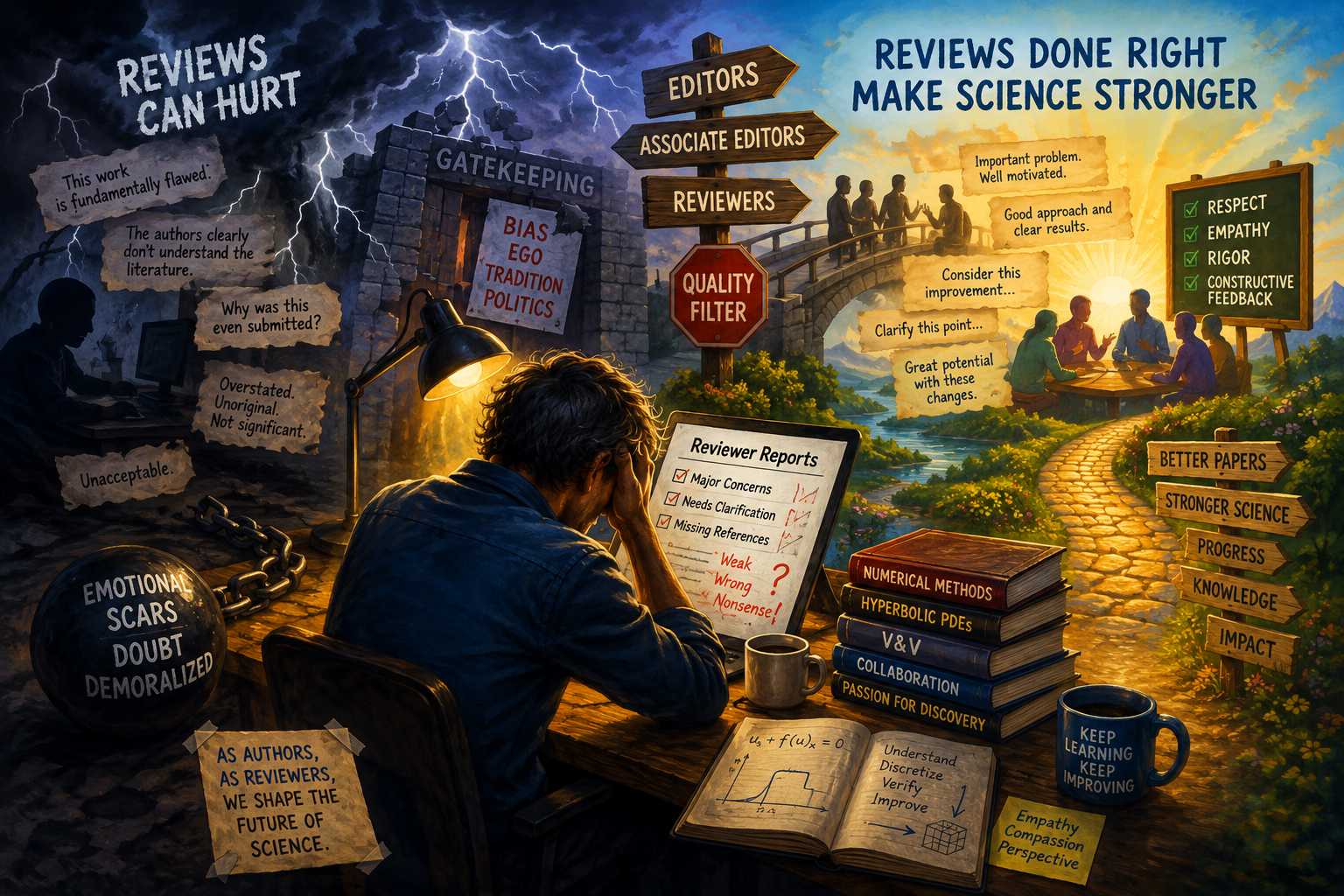
These were the reviews for a manuscript I was an author on, mostly last year and earlier this year. The emotions this stirred up were quite intense, and I found myself pausing and putting off digesting the reviews for several hours. It got me to think about whyI feelso much dread about this. Part of this is my lifelong experience with this process and various episodes with referees’ reports. Most referees are decent and constructive. A few are monsters. They make the entire process brutal and unpleasant. They ruin something wonderful. I will detail what has led to it being a fairly unpleasant experience to read most reviews.
Reviews are Essential
“Criticism may not be agreeable, but it is necessary. It fulfils the same function as pain in the human body. It calls attention to an unhealthy state of things.” — Winston Churchill
Before getting started on the reason for trauma, I would like to elaborate on the topic more broadly. Reviewing the work of peers is an essential part of science. This includes the process for journal articles. Itrulybelieve in the peer review process and its centrality to the quality of the archival literature. It is also a process by which articles are both checked and improved, and it provides a great deal of valuable feedback to authors that is valuable. It also takes place behind the veil of anonymity. This also empowers nasty behavior. This is the source.
The other people who sit at the center of this particular process are the editors and associate editors for any given publication. I have served as an associate editor for a journal and found it a sometimes difficult but often rewarding process. My general observation is that the editors do nothing about reviewer behavior. Part of the issue is that the willingness of reviewers is tenuous. Moreover, some of the worst behavior comes from some editors and leaders in the field. One friend told me that I had chosen a particularly nasty subfield. Many of the leading lights of the field could be brutal and unprofessional. Other subfields were far nicer.
One of the things that occurs to me is the relative degree to which the editors don’t act as more effective gatekeepers in policing some of the more egregious behavior by reviewers. This could go a long way toward making things significantly better. One of the episodes I’ll discuss involved an associate editor directly and speaks to how underlying biases and general viewpoints of the editors can imprint on the overall process.
Done right, the process can lead to an enhancement of the literature. Done poorly, it can leave emotional scars and create baggage for the authors. It can also serve as a relative stagnation of a field. There is also gatekeeping that is counter to progress. In my opinion, there are a variety of biases and problems with the literature that the current process does not fully appreciate and does not do a good job of policing.
I can elaborate on some examples of the problems that I’ve seen in the literature and the reasons for engendering the sorts of emotions that they get. I will elaborate on a few of the more extreme examples in my time. I should note that the current reviews, in retrospect, will not likely stick out in this regard. I’mjustnoting my preconception and reaction. They’re fairly ordinary, but the emotions that they prompted got me to thinking about the whole dynamic.
As a professional, I do quite a few reviews myself. That number is probably dropping off, but in general, with retirement. The perspective I take in doing reviews is that I try to have empathy and compassion for the authors. This approach is prompted and governed by the experiences I detail below. I try to avoid some of the more egregious examples that I’ll discuss in this essay.
When I do a review, my intention is to provide something that is first and foremost focused on improving the quality of the article. I am acting as a quality filter as well. I am pointing out any lapses or issues with the narrative. That said, Icertainlyrepresent a specific viewpoint and opinion on what articles can contain (rather than what they should contain). This is something that I think is impossible to scrub. Nonetheless, I am mindful that my views are not perfect. I do wonder whether or not my own perspective and biases end up producing the effect that I speak out against regularly. God, I hope not!
“We (Mr. Rosen and I) had sent you our manuscript for publication and had not authorized you to show it to specialists before it is printed. I see no reason to address the—in any case erroneous—comments of your anonymous expert. On the basis of this incident I prefer to publish the paper elsewhere.” — Albert Einstein
Reviews are Traumatic
My very first papers were in an obscure subfield, space nuclear power. My co-author and professor was a big deal in the field. What I did not recognize was that this shielded me from issues. In this field, he was a criticism deflector. I would soon learn the sort of critiques one could receive without this protection. On the other hand, he was a monster to me. Writing a paper with him was torture. It was part of what drove me away and made me recoil from his influence. I stepped away and found a new path.
“Academic politics is the most vicious and bitter form of politics, because the stakes are so low.” — Sayre’s Law, attributed to Wallace Sayre
When I started on numerical methods for hyperbolic conservation laws, my education and work took a particular arc. The entry point, looking at their methods, was flux-corrected transport. These are methods that were devised by Jay Boris in collaboration with David Book and also include a rather spectacular contribution by Stephen Zalesak. These methods and papers were part of the start of a computational revolution. They sparked my imagination when I read them and tested out the methods. My goal was to understand FCT better.
In continuing my study, certain aspects of the physicist’s point of view from which flux-corrected transport (FCT) began did not sit well with me. I was drawn toward some order, mathematics. There were certain mathematical shortcomings that became obvious, and over time, I became far more attracted to the family of methods thatwere devised byBram Van Leer andmathematicallysorted out by Ami Harten. In the process, I wrote a paper trying to bridge between these two bodies of work. Unbeknownst to me, I had stepped into a minefield.
What I would find out later is that there was a fairly nasty war for credit between the FCT camp and the Godunov-type method camp. Represented by Jay Boris on one side and Bram Van Leer on the other. I have now heard tales of rather vociferous and nasty reviews of papers being passed back and forth between this set of authors and some depth of hard feelings that were generated as a result. When I wrote my paper on the bridge between the two, I had no such knowledge and walked into this as an innocent. These conflicts were completely out of my sight. I had no insiders to clue me in or warn me.
I had taken a certain perspective in looking at this, which was to embrace some of the mathematical rigor and structure that Harten, in particular, had introduced. I looked to see where that structure would embrace flux-corrected transport and the manner in which it would break down. It uncovered some mechanism for oscillations in results (non-monotone behavior). The way that I did the analysis was to project flux-corrected transport onto the perspective of total variation diminishing methods (TVD). I found that the limits of the method were that it would not produce TVD results. The TVD theory was a way of seeing FCTdifferently. A path to better understanding. A good idea that was stupid culturally.
“Criticism is prejudice made plausible.” — H. L. Mencken
I wrote the paper and sent it off to the Journal of Computational Physics. The upshot is the paper was never published in the Journal. It got cast into a sort of referee limbo, which also coincided with a tumultuous period with the Journal. The journal passed to new editors and directions. I also knew the identity of all three of the reviewers by the end of it, each a quite famous person in the field. One identified themself, another in a conversation, and the last by administrative error.
One of them, Ami Harten, liked the paper immensely and suggested that it be published immediately. This was the first review I received, and needless to say, I was over the moon. He sent me a letter and an analysis of the FCT Ami had published with NASA. Ami had done what I did. I found out why it had never been published. I only spoke with Ami on the phone, never met in person.
The second review I received was relatively neutral regarding the manuscript but offered a host of fairly pedantic corrections to grammar and various technical details of the paper. This was the Editor of the Journal, Phil Roe. I would meet Phil later in my career.
I got the third review, which was absolutely and unremittingly brutal. I should say that the brutality was matched by the technical skill of the referee, whose knowledge and technical edge were unmistakable. Nonetheless, the review was absolutely savage and, to some degree, has left a lasting mark on my soul. I did meet him once at a conference. He seemed quite nice and absolutely the opposite of the monster in the review.
“Man is least himself when he talks in his own person. Give him a mask, and he will tell you the truth—or his most vicious lies.” —Adapted from Oscar Wilde
I would have the bad fortune of having another paper reviewed by the same person, whose character in the next review was virtually identical. I could see the same approach and use of language. The giveaway was figures in the review that matched an article he wrote, and I had read. Technically well accomplished and absolutely and utterly savage in tone and attitude. The attitude, in fact, burgeoned into something completely unprofessional. There were ad hominem attacks. I suspect I was being treated as if there was a personal grudge. Some of the savagery was a vestige of the “Limiter wars”.
“Peer review is at the heart of the processes of not just medical journals but of all of science… Yet its defects are easier to identify than its attributes.” — Richard Smith
After five years and a change in Journal editorship, I was offered the opportunity to take up the effort to publish it. I declined as I had moved on. It was also right after my second child was born. I had just moved to X-Division as well. That third review, rather than making a better paper, simplykilled the article. It left lasting trauma, too. In the meantime, Ami has tragically died far too young. The whole episode left me scarred and bitter. I think this was utterly counter-productive.
“A new scientific truth does not triumph by convincing its opponents and making them see the light, but rather because its opponents eventually die, and a new generation grows up that is familiar with it.” — Max Planck
Reviews are Biased
I was talking about journal reviews with my friend and colleague Dana. Like me, Dana worked across multiple technical communities. As I complained about the reviews, Dana interjected, “Why are you working in shocks?”Continuing, “That bunch has the nastiest reviews; things are much different in numerical linear algebra.” This shone a light into a reality, the subcultures could be different. At this point, I can see that it’s harsh and sharp in shocks. In other areas, the culture is polite and constructive. It would be worth getting to the bottom of this. I won’t. Nonetheless, this is the start of bias in the process. These differences are subtle and matters of degree, not wholesale substance.
“Peer review is faith-based, slow, wasteful, ineffective, largely a lottery, easily abused, prone to bias…” — Richard Smith
One of my conclusions is that shock wave computing is highly expert-based and subjective. This leads to power for gatekeepers. Ultimately, this part of the bias exposes the nature of gatekeeping in each subfield. One rejects and removes critique. The second nudges and pushes work toward rigor. Not that it doesn’t happen in CFD; it happens less. It is easy to see which attitude moves the needle of progress, too. Conversely, there are rejections in numerical linear algebra. This is the tendency and the spectrum of responses. As in most cultures, these are taught and reinforce attitudes as acceptable. In a sense, the cultures are taught by the forefathers of a field. I wonder who set the tone originally?
My particular case stepped into the next bias. FCT, TVD, and Godunov-type methods are all great ideas. Each of them has distinct strengths and weaknesses. These small differences become the focus of all-out wars. I hadinadvertentlystepped into a battle. I took a side without knowing it and invited an ambush. None of this is explained to you until after the fact. I only learned the backstory later as my circle of professional friends “crossed the streams.” Eventually, you understand these things.
The insider who is a student of one of the leaders (or their students) of the field gets a different view. They also get a far more biased perspective. This is usually focused on the hero’s (or his advisor’s) role. It will thus inherit the bias of their advisor. The other side of the dispute is cast as the villain. One side is the other side’s villains. There is the occasional traitor or turncoat. All of this is unleashed onto the reviews. This almost completely explains the problems with my reviews.
Other behaviors are taught. The mode of peer review and critique is shaped. The tone and approach to giving a review are taught as well. Usually, you see this copied quite cleanly. Students often adopt the style of their advisor, rarely just in part. It is very much part of the abused becoming the abusers. In a sense, it can all come out as so much academic hazing. To some degree, I came to see most of the PhD process as having. There is genuine work and knowledge included in a PhD, but make no mistake, hazing. This hazing, if unquestioned, just fully bakes into the culture. We are all responsible for it and subject to it.
“We know that the system of peer reviewis biased, unjust, unaccountable, incomplete,easilyfixed, often insulting, usually ignorant,occasionallyfoolish, andfrequentlywrong.” – Richard Horton, editor of The Lancet
Fixing the Process
As a starting point, some of these issues shouldn’t be solved. They are simply a reality of a human endeavor. People are biased. Those biases are present in all their actions. Some of these are good biases, such as a value of correctness and clarity. Thus, an article review is always biased. Nonetheless, we are poor at detecting the internal culture of a field from the inside. We should identify those reviewing constructive cultures, and adopt their practices. We should prize and promote progress. Of course, first a field needs to see its problems. Since the leaders are the ones teaching and promoting practices, it seems difficult at best.
Since I really did not have this sort of training. I developed my own protocols. I was more exposed to the ravages of reviews, too. I did not have a wise senior person to keep me from crossing a line. As such, I received the education the hard way. The truth is that the process might be impossible to fix. This may simply be part of a human endeavor. People will be people, and some of them will be assholes. We are tribal. Some of the assholes will only be assholes to people from the other tribes. Anonymity will empower this. Editors do not police shitty reviews. This is especially bad when the shitty review is technically excellent.
A few light rules would help a great deal to engender progress, and reduce the vile trauma”
Being anonymous tempts one to be a dick. Don’t be a dick. Maybe consider signing your review and giving that up.
Critiques should be focused on making progress and improving the paper. View the paper as salvagable.
Check your bias, and try to see the other side.
A big problem with gatekeepers isn’t that they are right, but rather they have power. They want to keep this power. They love the fact that their ideas are accepted and valuable. They do not want to give this up. Progress is a threat.
Maybethis problemjustis and will be.
“When a true genius appears in the world, you may know him by this sign, that the dunces are all in confederacy against him.” — Jonathan Swift
References
Rider, William J., and Dennis R. Liles. “A Generalized Flux-Corrected Transport Algorithm I: A Finite-Difference Formulation.” arXiv preprint arXiv:2411.12627 (2024).
Rider, William J., Jeffrey A. Greenough, and James R. Kamm. “Accurate monotonicity-and extrema-preserving methods through adaptive nonlinear hybridizations.” Journal of Computational Physics 225, no. 2 (2007): 1827-1848.
“I may be wrong and you may be right, and by an effort, we may get nearer to the truth.” — Karl Popper
Assessment and Analysis
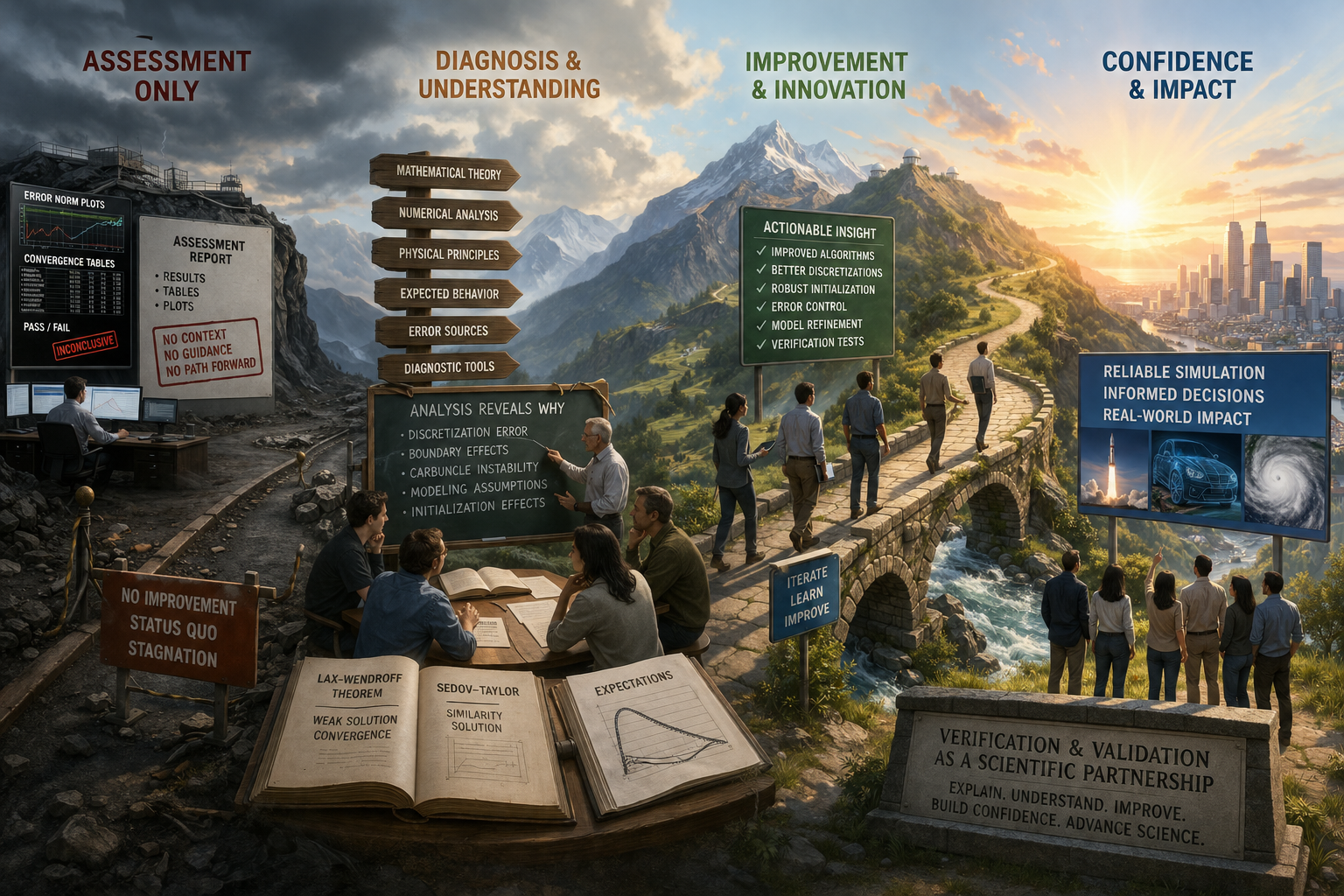
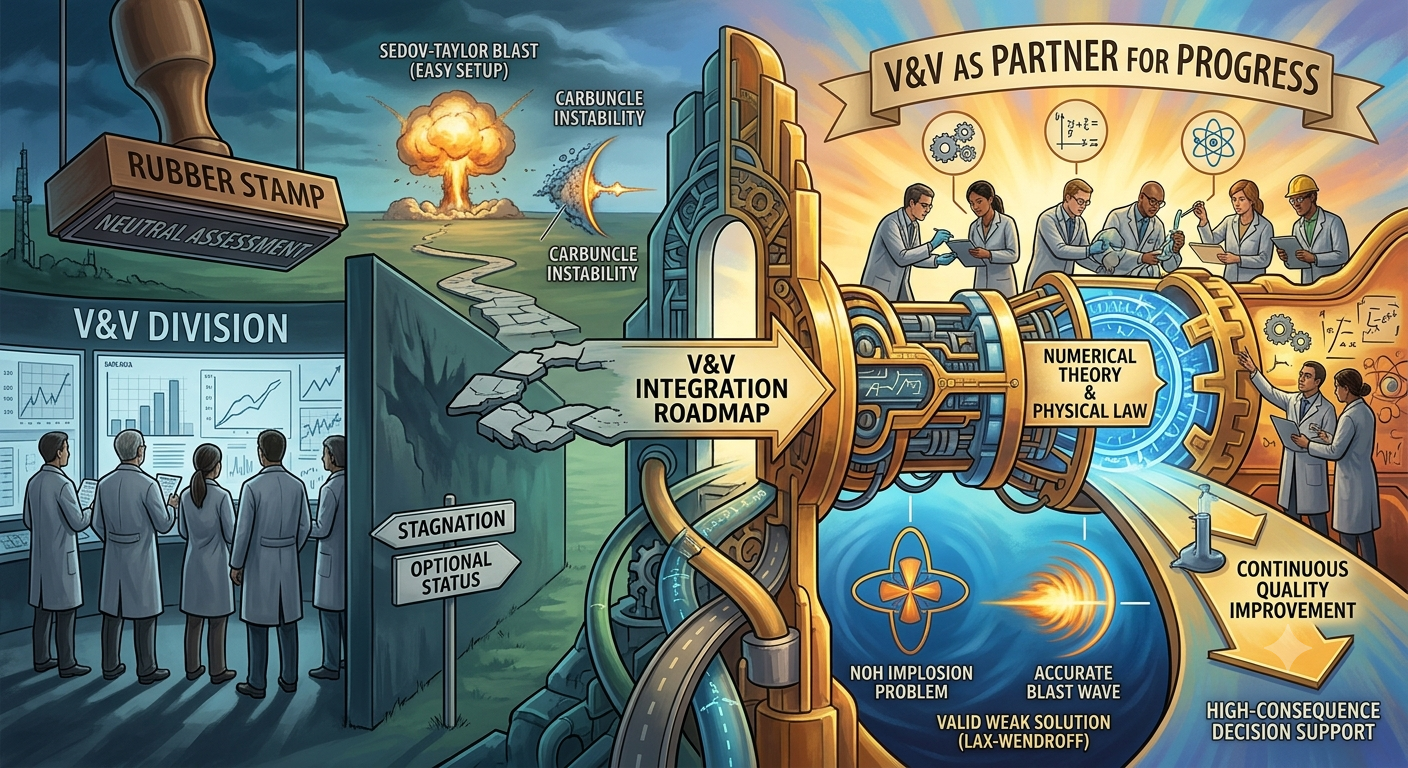
There is a problem with how verification and validation (V&V) are presented. Too often today, V&V is simply an assessment, divorced from the numerical methods, theory, and physics it examines. The result is a hollowed-out version of V&V. There, an assessment proceeds without deep analysis. This isn’t any connection to a synthesis of expectations from theory or the gaps in that theory. Assessments conducted this way offer no path forward to improving anything. Thus, the assessment mentality is a threat to progress. It is also a threat to taking V&V seriously. It is just bad.
The question is whether the goal of V&V is assessment, plain and simple, or the definition of a path to a better product. In practice, the assessment becomes nothing more than a measure of what a given code or model does. It becomes value-neutral and passive. Ittypicallydoesn’t spell out what’s right or wrong. Itjustis. As such, it becomes entirely optional. Missing entirely are the partnership and the underlying purpose. To understand the proper use or limitations of a code or model. No longer finding the road to a better product: making the errors intrinsic to solving these difficult problems smaller. Gone is driving greater accuracy and fidelity in the code and its models.
This is a genuine obstacle to energizing V&V as a means of continuous quality improvement. Instead of a partner, V&V becomes an enemy. It is either a neutral rubber stamp for whatever is already being done, or a damning indictment of a code. The partnership is never evident, and neither is the connection to improvement. Moreover, the laboratories are at their best when they are multidisciplinary, and the assessment model reduces V&V to a one-dimensional activity. It loses being a multidisciplinary vehicle for excellent work.
The question to wrestle with is this: How did V&V fall into the assessment-only model and the trap that it became?
Part of the answer is the growth in depth of V&V work as it became a separate discipline. This separation was always a possibility as the field matured. It is also a trap because it sidelines V&V into a mode where it offers criticism without support. The pattern settles around a point of view where problems are found but never resourced in a way that allows them to be addressed and solved. Using V&V to improve codes and models becomes absent.
“It is not the critic who counts; not the man who points out how the strong man stumbles…” – Theodore Roosevelt
An Illustrative Example
This was a large part of the issue with the shock verification report that instigated my departure from Sandia. That report was a V&V assessment that only showed results. Any problems were merely weakly implied. The report offers no opinions and has no perspective. There was no route offered to answers, solutions, or improvements. Moreover, there was no charter to provide one; funding applied only to code maintenance and support of the user base. Improving the code in some cases is an unwanted nuisance. The entire notion of quality was presumed, and when the report spelled out that the quality wasn’t there while offering no path toward improvement, the experience turned decidedly negative.
“When you can measure what you are speaking about, and express it in numbers, you know something about it; but when you cannot measure it… your knowledge is of a meagre and unsatisfactory kind.” – Lord Kelvin
The report that was the focal point of the conflict around my termination is a good example of the problem with assessment only. It was,simplyput, a verification assessment of a set of codes used by Sandia for shock problems. The assessment was conducted on two classical analytic problems:
The Sedov-Taylor blast wave, where energy is deposited at a point, and a shock wave emanates from the deposition. This is an analytical solution for an explosion, an important use case.
The Noh implosion problem, which supplies the solution to an idealized implosion.
Both of these problems are standard at Weapon’s Labs across the World. They are part of a standard test suite for the NNSA Labs. There use goes back far into the past with the code development community at these labs.
The Sedov-Taylor blast wave has a rather complex analytical solution dependent on integral equations and delicate integration. The Noh problem has a simple algebraic form. Both problems are extremely difficult for hydro codes to compute. Their analytical solutions existby virtue oftheinfinitelystrong shocks they produce. In general, they are challenging for codes, and in particular for codes written in the classical ways of weapons labs across the world. As such, they are important verification problems to complete successfully, because success provides confidence in the code. A lack of success is a flashing warning sign.
The assessment itself was done well within standard practices for verification, with some important caveats. One of my chief criticisms of the report was the lack of deeper mathematical and numerical analysis of the results. In the mathematical sense, there are very distinct expectations that come with solving these problems. I have elaborated on these before in previous posts. These expectations are well defined, and a handful of essential theoretical papers in the literature establish what one should expect from a successful method.
By the same token, the numerical expectations are well defined, chiefly the expectation of obtaining a valid weak solution, as the Lax-Wendroff theorem establishes. In short, the codes tested do not all adhere to the precepts of the Lax-Wendroff theorem, and thus convergence to a weak solution cannot be guaranteed. In other words, they might give wrong solutions that are not valid weak solutions. Thus, the results, although producedclassicallyandcompetently, are not tethered to any expectations. Theysimplylie there without context or predictions.
Furthermore, the results show the presence of the infamous carbuncle instability, which has plagued codes for decades. In the aerospace literature, the carbuncle is well understood. It is not so well understood in the context of the sort of codes tested here. Nonetheless, the way to cure the carbuncle is well established, though the cure would need to be adapted artfully to these particular codes. I have faith this is possible, but the report offers little or no discussion of the nature of the problem, let alone a route to its cure.
“When a measure becomes a target, it ceases to be a good measure.” – Marilyn Strathern
A second critique I raised was that the setup of the Sedov-Taylor blast wave was chosen improperly, in two regards:
The energy was initialized on the grid within a finite-size region. This introduces a length scale into the problem, and the absence of a length scale is the entire reason an analytical solution exists in the first place. Under mesh refinement, the calculation then converges toward the regularized problem rather than the Sedov-Taylor solution the assessment claims to test against. One cannot solve the problem in a manner that annihilates the conditions for solution. Yet, this is done.
The second effect is more pernicious and, in many ways, worse: it makes the problem easier to solve and less challenging for the codes. A choice waswillfullymade to lessen the challenge that a difficult problem poses, and this only partners with the stagnation of methods and codes, doing a disservice to the entire community. Quality demands that challenges be met, not shirked.
This points to what I believe would be a better way to execute these assessments: combine the assessment with the mathematical, physical, and numerical theories needed to improve results. At aminimum, place the results in the context of what would betechnicallyexpected from a correct code and model. It should define why a code or model canbe trusted. Rather than a closed and bounded exercise, assessment should be a step. It should define a path for understanding current use and applicability. It should also define the trajectory for improvements.
Why We Need to Integrate V&V
“Ceasedependence on inspection to achieve quality.Eliminatethe need for inspection on a mass basis by building quality into the product in the first place.” – W. Edwards Deming
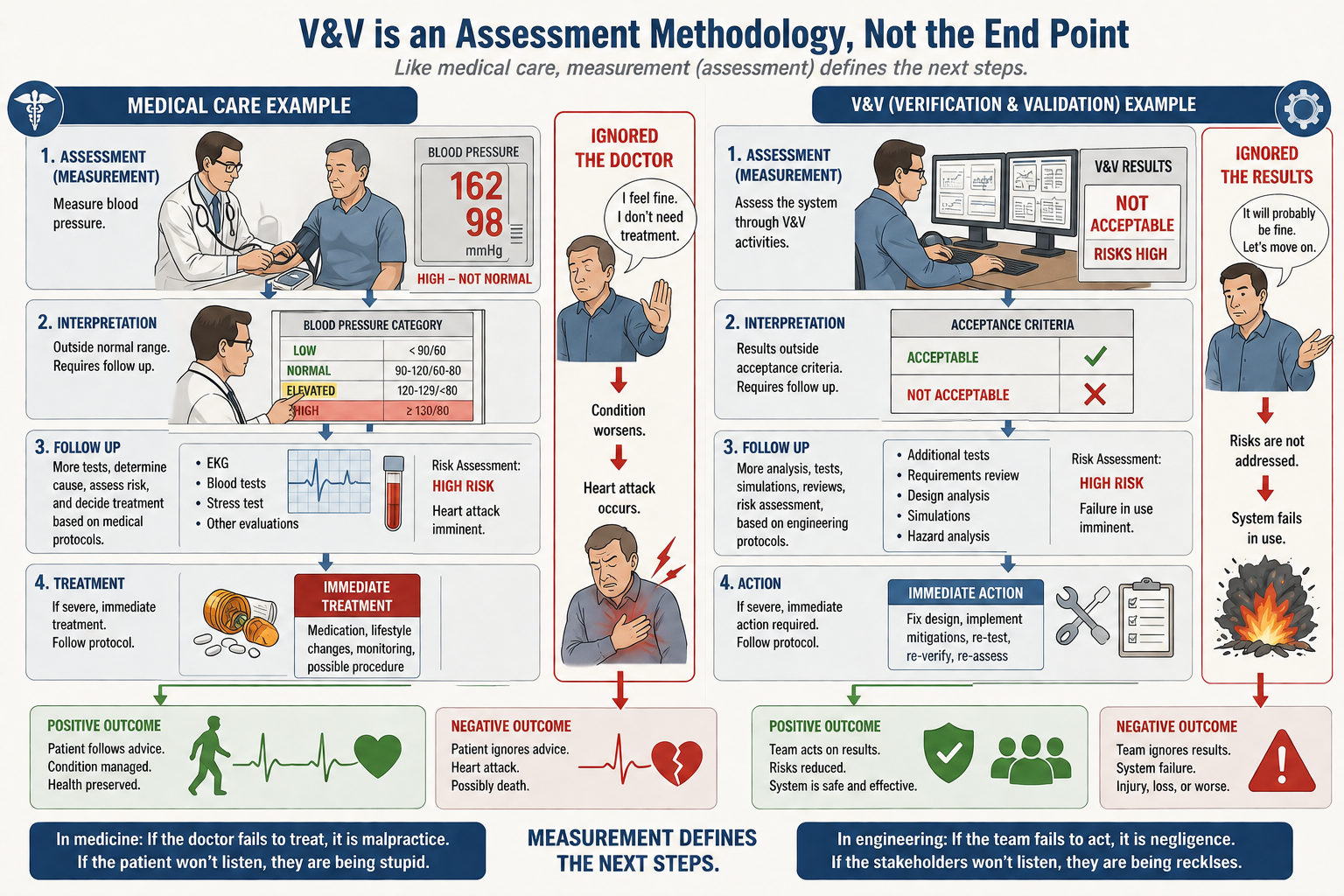
There is a useful analogy for how to view V&V if we see it as a measurement (assessment)methodology.
In medical care, we do not stop at measuring blood pressure unless it indicates good health. If the blood pressure is higher or lower than normal, it requires follow-up. That follow-up means more tests and potentially treatment. The measurement (assessment) is essential, but it defines the next steps. These steps follow a protocol based on the current understanding of medicine. If the measurement is bad enough, the treatment is immediate. In the case of the report, I focused on “a heart attack was imminent.” Rather than treat the problem, the patient decided to ignore the doctor. We all know how this approach works out. If the doctor fails to treat, it is malpractice. If the patient won’t listen, they are being stupid.
“Inspection does not improve the quality, nor guarantee quality. Inspection is too late. The quality, good or bad, is already in the product.” – W. Edwards Deming
This brings me to the primary objective of this essay. Rather thansimplyproviding an assessment, the practice of V&V needs to connect results to the appropriate theories. In verification, these are mathematical and numerical results; in validation, physical theory relevant to the exercise is added to the mathematical and numerical foundation. All of this needs to be spelled out in detail, providing both context and meaning. It empowers the reader of the report to take the assessment and find a roadmap to improved results. V&V should not simply be an assessment but a partner in the progress and improvement of computations.
The assessment role for V&V may seem neutral, but it is not. It is a way of neutering V&V. It aids the stagnation of progress and provides cover for codes that refuse to change and improve over time. This does a disservice to the entire community. V&V not only serves the use of the code and model; it serves progress. V&V is used to document and provide evidence for progress. Codes and models should not be static, but should look to be constantly improving in quality. This spirit is on life support.
Verification asks “Am I building the product right?” while validation asks “Am I building the right product?” — Barry Boehm
V&V should be a way of measuring progress and a vehicle for establishing where progress is needed or possible. To identify this, V&V needs to include the relevant mathematical and numerical information for verification as a service to code development. Physical theory was added to establish the same conditions for improving modeling. Together, it becomes the lexicon for establishing capability assessment and identifying needs and opportunities.
The validation work links directly to application work and ultimately supports it in two ways: assessing the suitability of the modeling for a given physical application, and determining whether or not the code is sufficient. It is important to establish where improvements are needed in order to improve that sufficiency. In addition to narrowing the uncertainties inherent in any modeling exercise. This matters for any decision-making attached to the use of modeling and simulation in high-consequence decisions.
Today, this entire standard has becomeextremelytenuous, and it undermines the role of modeling and simulation.It almost invites unprincipled calibration of results and helps attack the legitimacy of modeling and simulation as a partner in high-consequence decision-making. Assessment only works to neuter V&V and enable stagnation. It only supports the status quo, and the status quo sucks.
Far better an approximate answer to the right question, which is often vague, than an exact answer to the wrong question, which can alwaysbe madeprecise.” – John Tukey
“One of the greatest pains to human nature is the pain of a new idea.” — Walter Bagehot
The Quest for Understanding
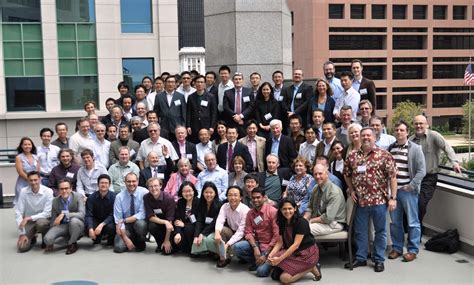
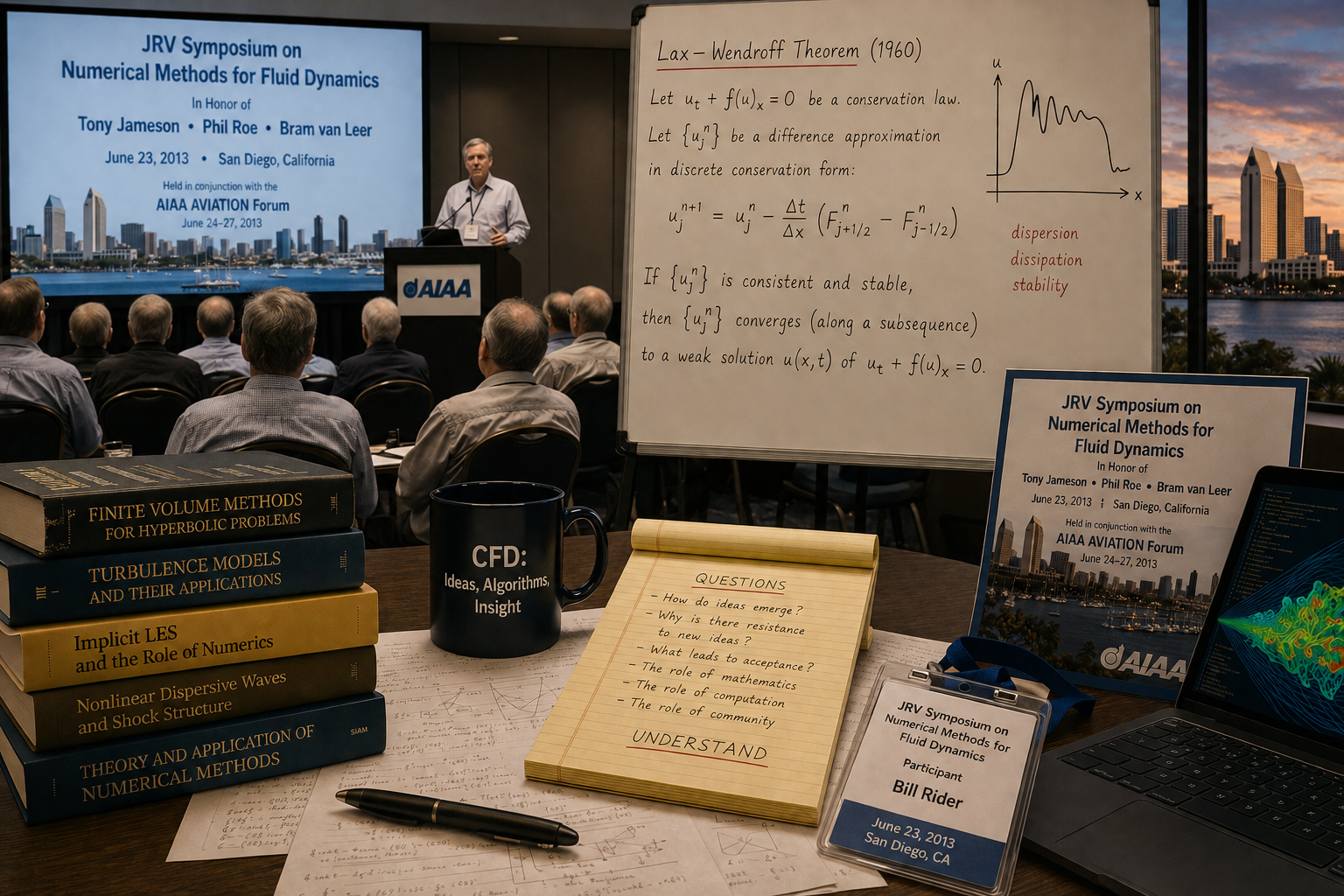
One of the animating ideas of my career in science is a quest to understand the origin, development, and acceptance of ideas. This has been a periodic challenge I took on throughout my career. You will find it in my dissertation, which was mostly self-driven and self-taught. It ultimately became a professional achievement, a more complete accounting of the early history of computational fluid dynamics (CFD). I have written an essay about this on this blog and given a presentation on the topic. It is perhaps the talk I have delivered most often. Beginning in gestational form at the JRV Symposium in 2013. There was a history of CFD around limiters after 1970 by Bram van Leer. It was titled “The History of CFD Part 2”.
I asked Bram, “Where is part 1?”
In response, Bram told me I needed to create part 1 of the history. He said, “That is for you to do!”
Afterward, expanding into a comprehensive presentation that I have given six or seven times over the years. It feels like this will be one of my understated achievements. Under the hood of this history is a desire to understand how we got where we are today. Not simply account for what happened, but why and how.
I have posed the affirmative question before: why should a method be forced to satisfy only one requirement of quality when we know there are two? Those two requirements are the preservation of adiabatic solutions and the conservation form. Right now, the field simply picks one and walks away from the other. We choose rather than demand both. The choice then becomes calcified into doctrine. What I am pondering here is not the choice itself, but the reason we have never insisted on meeting both. The answer is that we refuse to hold ourselves to a higher standard. Progress is still needed and still possible, but it has stagnated to nothing because of an outright refusal to accept good ideas and merge them together. That refusal is not a technical limitation. It is a failure of will.
One of the key formative moments in developing these ideas came in the year 2000. That summer, a special conference took place at Los Alamos to honor the 70th birthday of Burt Wendroff. Burt, except for a few years, worked his entire career at Los Alamos. He is best known for his PhD work under the advisement of Peter Lax. This produced the celebrated dual achievements of the Lax-Wendroff theorem and the Lax-Wendroff method. It was then documented in a paper in Communications in Pure and Applied Mathematics. Both achieved massive success over the years and have shaped modern computational fluid dynamics in profound ways. It has had profound success in compressible aerodynamics, defining much of what is currently done.
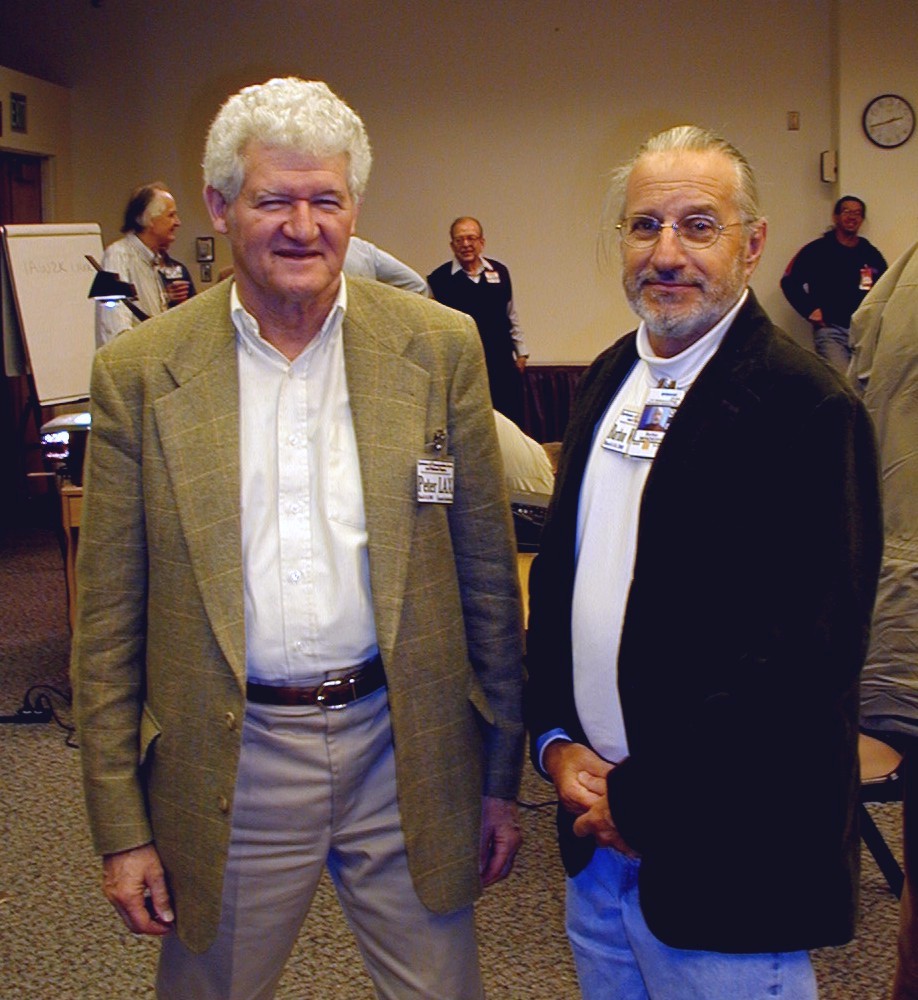
The occasion of this conference was my opportunity to actually meet Peter Lax. I have met many great scientists over the years. A few became acquaintances, and far fewer became friends. What I have learned from engaging with them is that these people are all human. They are all extremely smart. Some are extremely lucky, and their greatness comes from being smart enough while also being in the right time and place to create what they create. Of all the people I have met, Lax is perhaps the greatest, or nearly the greatest. That puts him in rather prominent company.
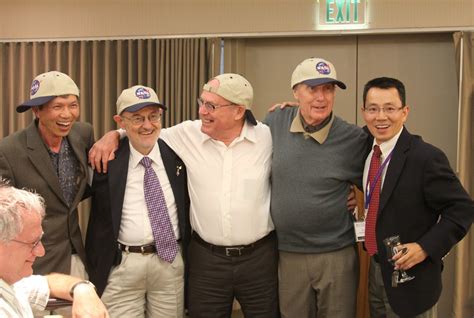
There was a photograph taken at the conference on the first day. I remember it quite well. I don’t actually remember who took the photograph. Burt and Peter came together warmly, and then the photographer noted that the ordering was wrong. He asked Peter and Burt to exchange places to get the ordering of the authorship for the Lax-Wendroff paper. Then the photo was taken. I was standing behind where the photo was taken, watching all this happen. It remains a very fond memory. Its great that the internet remembers the photo too.
Another source of great memory in that conference was my presentation there. I felt immensely lucky to do so. One of the more memorable moments came when Burt pulled me aside to let me know that Peter suffered from narcolepsy. I should not be alarmed if he fell asleep during my talk. Sure enough, when I gave my talk, Peter fell asleep halfway through. Bert’s warning saved me from being mortified, as Peter had already become quite the hero of mine by then.
My talk came from a period of my technical history when I was beginning to explore turbulence modeling. My interest was specifically in implicit large eddy simulation. I was trying to understand the role that things like limiters play in the ability of these methods to act as effective turbulence models. In addition, I was searching for the effective subgrid model implied by these methods. In particular, I was looking at the role of nonlinear dispersion.
Speaking in front of Peter was a particular honor, but also something that made me quite nervous. Peter had studied dispersion in calculations, inspired by the work of John von Neumann. In his original shock method, which was tried and successfully used during World War II, dispersion was rampant. Lax examined the solutions von Neumann’s method created, which produced a huge amount of ringing. This work was done in conjunction with another exceptional scientist, David Levermore. Presenting my work to Peter was both a source of pride and something that felt very dangerous. He was an exceptional genius after all, even by Los Alamos standards.
Nonetheless, looking back, this work was the beginning of perhaps my most successful research. It certainly grew into the best and most obviously successful project I ever worked on. One that resulted in many highly cited papers and a book. That book tied together many researchers in the area for the first time. It led to my engaging and meeting many other scientists working on similar things, including Jay Boris, one of the inventors of limiters. Paul Woodward was in the book too, but I already knew him.
Expanding My Understanding of Creation
“Novelty emerges only with difficulty, manifested by resistance, against a background provided by expectation.” – Thomas Kuhn
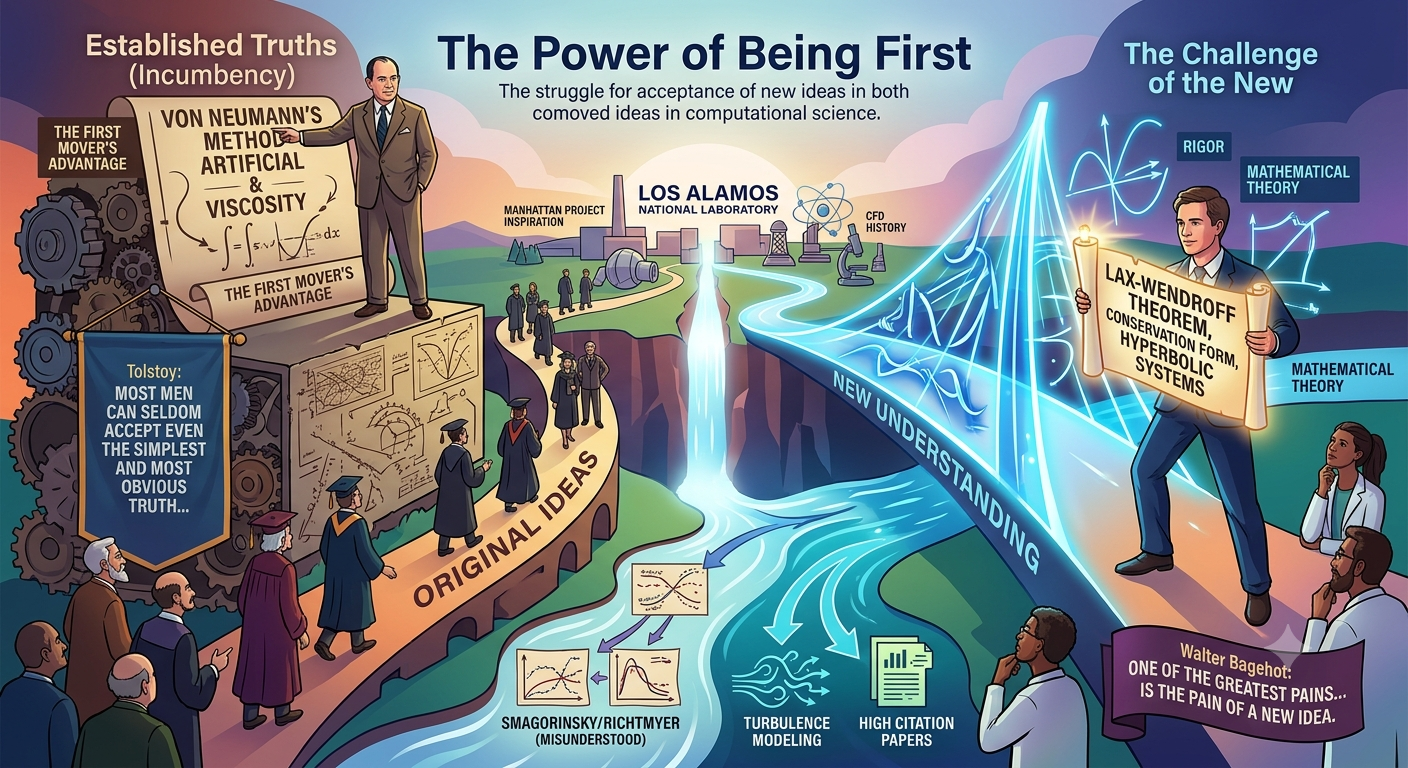
Over time, I came to understand how many of these ideas came into being. How they merged with other ideas. How some of them became distorted and lost their original intent. This is perhaps more evident in turbulence simulation than anywhere else. There, the Smagorinsky model is the original model used to represent subgrid turbulence in LES. Over the years, the basic identity of the Smagorinsky model has been lost. It was first and foremost a rearticulation of the artificial viscosity model developed by Richtmyer in conjunction with von Neumann. It has been repurposed to clean up calculations of geophysical flows. This repurposing came at the suggestion of Jule Charney, von Neumann’s collaborator in applying computing to geophysical fluid mechanics. Over the years, this connection to shock capturing was lost, if not outright ignored. This seems to be a combination of genuine and willful ignorance.
The greater animating purpose of this essay is the general lack of acceptance and use of Lax’s work at its place of origin, specifically Los Alamos. It includes the many labs that followed Los Alamos’ lead. This includes Livermore, Sandia, and overseas Labs. This requires a bit of history, involving how Lax came to these ideas. Then, some deeper pondering of why these key breakthroughs have generally gone unaccepted and unused at the place where they were born.
Lax’s ideas and achievements in the area of hyperbolic conservation laws are incredible and undeniably great. This was recognized when he received the Abel Prize in 2005. The fact remains that they hold very little sway and acceptance at places like Los Alamos or Livermore seems mysterious. They are revered in CFD around the rest of the World. This is the world shaped by the Manhattan Project. This ushered both computers and computational science into being. The original achievements of John von Neumann are more broadly accepted in the Los Alamos-connected work. Even though they lack the rigor Lax provides. Why?
“Most men can seldom accept even the simplest and most obvious truth if it be such as would oblige them to admit the falsity of conclusions which they have delighted in explaining to colleagues, which they have proudly taught to others, and which they have woven, thread by thread, into the fabric of their lives.” – Tolstoy
Consider the Lax equivalence theorem as another example. The practice of verification that relies upon this theorem is carried out begrudgingly in places like Los Alamos. The same holds for the Lax-Wendroff theorem. The theorem with its demands, and its promised benefits, of conservation form. In a deep sense, it has greater rigor and applicability than the equivalence theorem. Conservation, too, is seldom used. The extensive mathematical theory of hyperbolic conservation laws, the crowning achievement of Lax’s work in the area, is also rarely leaned upon as a technical basis either.
Given the greatness of Lax’s work, one has to question the reasons. The question becomes even more pregnant when you realize that the origin of this work traces directly to Los Alamos. It is grounded in the achievements of von Neumann, which demonstrated the capacity of computers to solve this class of problems. This inspiration made Lax’s work timely and essential. It was clearly a motivation for greater understanding. Much great math was delivered, yet not used where the inspiration originated.
“One resists the invasion of armies; one does not resist the invasion of ideas.” — Victor Hugo
Lax was drafted into the U.S. Army in 1944. He was ultimately assigned to Los Alamos as part of the Manhattan Project, a recognition of his potential and burgeoning genius. There, he did not work on fluid dynamics, but rather on neutron diffusion. After leaving Los Alamos, he returned to New York, where he completed his PhD at the Courant Institute under Friedrichs. Upon receiving his PhD, he promptly went back to Los Alamos and spent a year there as a staff member. He worked closely with one of the famous Keller brothers, both great mathematician.
One of the most amazing things to discover was the write-up of Lax’s plan of attack on the mathematical theory of hyperbolic conservation laws. It was completed in conjunction with Keller during his time at Los Alamos. The outline in this report is complete and defines the next 25 years of research. One can trace all of Lax’s completed works in conservation laws from it. Ultimately, ending with the mathematical theory of hyperbolic conservation laws published in 1973. It is all laid out there in astonishing detail.
Lax, Peter D. Hyperbolic systems of conservation laws and the mathematical theory of shock waves. Society for Industrial and Applied Mathematics, 1973.
The advantage Peter had when he returned to Los Alamos was the knowledge that one could successfully compute solutions to hyperbolic conservation laws. The basic premise had been proven out in World War II by Feynman and Bethe with their method, based on Tony Skyrme’s work. By the time Lax returned to Los Alamos, Richtmyer had devised the artificial viscosity and made shock-capturing methods possible. Now computers and methods could be turned loose on shock waves. Thus, Lax worked with the knowledge that all of this could be done. It was now a matter of bringing order to it, along with some degree of mathematical rigor and knowledge to guide it. The question remains: why has his magnificent work had so little impact on its place of origin?
How Original Ideas Remain Dominant?
“Faced with the choice between changing one’s mind and proving that there is no need to do so, almost everyone gets busy on the proof.” — John Kenneth Galbraith
If one looks at the codes developed and used at a place like Los Alamos, only one of them is written in what we call conservation form. This is a code I worked on, one that goes by the moniker xRage these days. My friend Rob and I could not ascertain the basic structure of the high-order Godunov code that xRage purported to be. Rob had trained under Phil Roe and Bram van Leer for his PhD. I am basically self-trained in the same area. The basic recipe, construction, and maxims that Rob and I had absorbed in our training could not be discovered in the way this code was written. We expected to find a viable first-order Godunov method under the hood. No such thing existed in the code. The second-order spatial differencing was novel as well. It worked, but not in a standard way. The same mentality applied to the Riemann solver and the multi-material treatment. I was part of adding interface treatments to the code. Without those, the material interfaces were too diffusive.
This code was originally written by a genius of a code developer, Mike Gittings. Mike was able to work magic with codes and get things to work by magic and code wizardry. The code worked and was astoundingly robust, loved by its users. In many ways not much different than the dynamic at Sandia with CTH (or its predecessor, CSQ). Yet the technical basis of the code was unrecognizable to those of us who had been formally trained. Here is the one example in the weapons complex where Lax’s framework might actually apply, and it is almost impossible to see what is actually there. To me, this is rich with irony, especially at Los Alamos.
“Nature, to be commanded, must be obeyed.” — Francis Bacon
One of the things that I believe is that the importance of hydro for multi-physics codes is not well understood. I was reminded recently in a LinkedIn comment by my friend Nathaniel Morgan from Los Alamos. The reason it is so important is that it provides the material map on which all the physics in a multi-physics code are computed. It also provides the state of that material thermodynamically and, more importantly, its position. Physicists naturally think about most of the physics in the Lagrangian frame of reference. Thus, this is comfortable for them. Thinking about it in a different frame of reference only muddies the picture and introduces new physical effects. The Lagrangian frame perspective is taken as primal.
“For a successful technology, reality must take precedence over public relations, for Nature cannot be fooled.” – Richard Feynman
That said, most of the physics that we are solving are extremely muddy and difficult. In almost every case where you’re dealing with a high-speed, high-energy flow, turbulence and mixing are present. As soon as the flow begins to twist and distort, the Lagrangian frame becomes untenable, and you lose the ability to clearly think about problems in that frame of reference. In a sense, this is the core of the problem with failing to progress away from the von Neumann view of how to compute this. Von Neumann’s method was originally composed in 1D with relatively limited computing. It is almost obvious that the simplicity it embodied is not appropriate for the type of computing and expressibility of ideas we have available to us today. Why is this approach still relied upon?
The reason why is the power of being the first mover. That first mover, the person whose reputation remains unsullied, is John von Neumann. Von Neumann is perhaps the greatest polymath of the 20th century, a genius of almost unparalleled magnitude, and perhaps one of the smartest people in the history of humanity, certainly on par with someone like da Vinci.
If one looks at the codes in use across the labs today, the model of computing is very much derivative of von Neumann’s method, paired with Richtmyer’s artificial viscosity. What cannot be said is that these codes bear any of Lax’s rigor in how they are used. Given the power and quality of Lax’s work, I have always found this mysterious. Moreover, much of what Lax did actually generates genuine animosity on the part of people at the labs. I find this difficult to understand. In a field with few results to lean upon, some of the best ideas are ignored. This entire phenomenon places an extreme amount of importance on the legitimacy conferred by being first and on the power of incumbency. The nature of things is that once something works at all, it is hard to displace, even when its shortcomings become increasingly obvious over time.
“He that will not apply new remedies must expect new evils; for time is the greatest innovator.” — Francis Bacon
Indeed, the main place where ideas related to Lax’s work found acceptance is through the work of van Leer principally, and limiters in general. Limiters provided a means to solve a problem that Lagrangian von Neumann-type methods ran into in multiple dimensions: the inevitability of mesh tangling. Mesh tangling meant that remesh-and-remap technology was necessary for these calculations to go to 3D and ultimately solve the problems they were designed to solve. Van Leer’s method made low dissipation and higher accuracy possible under these conditions, and it was accepted almost immediately across the entire lab complex.
What goes unacknowledged is that van Leer’s work was shaped by the work of Peter Lax. Lax provided the foundation, and everything van Leer did was built upon it. In a sense, Lax’s work did have its impact, but only in a derivative sense. Van Leer also engaged with Paul Woodward from Livermore. Paul’s collaboration with Bram helped bridge the methodology to the Labs. Van Leer’s methods were almost immediately adopted at Livermore, Los Alamos, Sandia, and AWE in England. It was rapid and pervasive.
These methods, once they leave the Lagrangian frame, have a problem: they do not conserve energy. This comes from the form of the energy equation used. There is a method to conserve energy devised originally by Roger DeBar of Livermore. Generally, that method is not robust enough to be used for practical problems. Scientists at Los Alamos have devised a much better version of it that may be good enough for practical use. Nonetheless, it is not in an obvious flux-conservation form; thus, Lax-Wendroff may not apply. The same thoughts are needed for conservation in the Lagrangian frame for staggered mesh methods. It can happen, but it depends on subtle, discrete details. For example, the first version to conserve relied upon a bizarre definition of kinetic energy (could be negative). Modern methods are strictly flux-conservative with some very specific choices. These include the time integration, where a particular predictor-corrector of second-order is needed. This also includes a corner mass invariant definition for momentum-kinetic energy.
This lack of energy conservation is exactly the underlying is that prompted my decision to retire. Even 40-plus years after van Leer remap became standard, energy conservation is uncommon. There are ways to make it work, but they are seldom used in practice. It is not in conservation form; thus, Lax-Wendroff is not applicable. I find this head-scratching and difficult to square with the importance of the work done with codes.
“The most difficult subjects can be explained to the most slow-witted man if he has not formed any idea of them already; but the simplest thing cannot be made clear to the most intelligent man if he is firmly persuaded that he knows already.” — Tolstoy
Here we are, 65 years after the Lax-Wendroff theorem was published. People remain completely unwilling to acknowledge this work or utilize its fundamental results in what they do. This rejection creates an absolute crisis of legitimacy, and it reflects decisions made over and over again. I have asked my friends at Livermore, and they report that the energy-conserving methodologies developed at Livermore, which do not use conservation form, are not utilized in their codes once they go into a mode using remap. Those codes have the same problems, albeit to a lesser degree than CTH. That is more a reflection of the higher quality of the methods, and of being modern codes. Nevertheless, the basic premise of this essay persists: Lax’s work is not accepted at its place of origin.
“It is difficult to get a man to understand something, when his salary depends upon his not understanding it.” — Upton Sinclair
I have written about this mentality before, in my essay on the shortcomings of current methods, where the field has chosen to honor the physical concept of computing adiabatic solutions rather than computing solutions in conservation form. The unwillingness to demand that methods meet both requirements means that the method that routinely and casually produces adiabatic results is chosen. Conservation is rejected as a preeminent requirement. Really, we should have both requirements met.
I will reiterate that I believe this is a fundamental mistake. The requirements and gifts of conservation exceed those of an adiabatic solution. Moreover, an adiabatic solution is a desired outcome, but it is utterly pathological, representing a rather profound resistance to the second law of thermodynamics, which manifests itself in mixing and turbulence most often in fluid dynamics. Adiabatic solutions are ephemeral and pathological. That means they shouldn’t be the foundational character of the method. They are wonderful if you can engineer them. Making them the premise upon which you design and accept new numerical methods is an act of faith, if not borderline lunacy.
Adiabatic solutions are largely an article of faith, mostly mythological. Shock waves are ubiquitous. You want to compute a weak solution, and you need to compute the physically relevant weak solution. I place this demand first, and the preservation of adiabatic solutions second, based on this analysis. Accepting what people have always done is easy. Change is hard. This alone explains most of what we see. The incumbent has an immense advantage. Without a devotion to progress and change, you simply do things the way you always have. You make excuses about why change is unnecessary, and you point to the successful track record of the past as the only proof you need to keep doing things the same way.
“The difficulty lies not in the new ideas, but in escaping from the old ones, which ramify… into every corner of our minds.” — John Maynard Keynes
The Essence of the Problem: Change is Hard
When I consider what John von Neumann would have thought of all this, I come to the following conclusion: he would have recognized the correctness and genius of Lax’s work. He was ever devoted to progress, and he would have seen the need to merge Lax’s ideas into his own. He would not be pleased that the ideas he pioneered continue to be used without the modifications necessary to make them more reliable and more generally useful for solving humanity’s most enduring and difficult problems. Perhaps we can turn over a new page, get to the place where we combine these ideas, and give each of them the air they deserve and the progress we all need.
Power from being the first mover, or from initial success in something, comes from the fact that it works. It’s very similar to the advantage conservatives have over progressives. The policies conservatives espouse have already been tried and have some functional basis in society. The same happens in science: why change something that works for something new? For this reason, very old solutions with significant flaws live on. Change is hard and uncertain. This is especially true in a world where trust itself is scarce and increasingly existential.
There is nothing more difficult to take in hand, more perilous to conduct, or more uncertain in its success, than to take the lead in the introduction of a new order of things.” — Machiavelli
“If something cannot go on forever, it will stop.” — Herbert Stein
This is going to be a very hot take, but one I have a lot of faith in.
My last post was about the effective usage model we are using for AI. It was a rethinking of what AI’s utility actually is for business and for users. The current model, where the narrative is to simply replace workers with AI, is broken. It is dangerous, and it is going to blow up in the face of the entire AI industry. Add to this a second issue, the data centers, and the narrative becomes completely toxic and almost guaranteed to fail. Lurking in the details of these models is a problem potentially bigger than either.
What no one in the current AI boom invests in or tries to solve is hidden behind the obsession with data centers and capacity. That obsession has become an enormous political liability for the whole enterprise. The cost of all this compute is the single greatest threat to the success of the entire business model. The danger is growing with each passing day.
What amazes me is the general lack of focus and effort on improving computational efficiency and changing the scalability of these models, in both training cost and inference cost. In terms of deep thinking, this is the one area where we are failing to make progress. The consequences of the current cost trajectory threaten the whole industry, with potentially profound (if not catastrophic) effects on the stock market.
I’m sure someone is thinking about this. The question is whether there is enough effort and focus, and whether anyone recognizes the danger the industry is in. Time is about to run out. Perhaps the only way this bomb can be defused is to fundamentally alter the computational scaling of these models and make them vastly cheaper. I firmly believe that whoever cracks this nut wins the AI race by a landslide.Maybe the smart money is on China now. Instead, our current approach doubles down on the idiotic obsession with hardware over all else. This is the same pathology that took hold in the Exascale project and is now being repeated with AI.
Solving this problem requires exactly the sort of research that has been rejected of late. LLMs are, at bottom, solving matrix problems. The route to efficiency and better scaling should echo the history of computational science: some combination of sparsity, multilevel structure, and regularity, along with a healthy dose of serendipity. The problem is that this research is failure-prone and dependent on inspiration. Many approaches will be dead ends. There is no schedule or timeline for a breakthrough. We are already years behind in pursuing one. I have little confidence that our current system will prioritize or invest in any of this.
If the cost of a token cannot be reduced dramatically, and soon, this industry is going to undergo a catastrophic collapse.
“Gentlemen, we have run out of money; now we have to think” – Ernest Rutherford
“The key thing about all the world’s big problems is that they have to be dealt with collectively. If we don’t get collectively smarter, we’re doomed.”–Douglas Engelbart
An Opportunity to Change
I’ll make an admission for you: I use AI every day. I’ve chosen to pay at the low end for Claude. I really enjoy what it does and find it an excellent addition to my productivity. It augments everything I do. While this is true, it only augments me. I am still the driving force for all it does. It only allows me to do things better and/or faster.
In doing this, I’ve also realized what AI cannot do and how to draw a line between what it adds and what it is completely incapable of doing. That is what this essay is about. Another word for it is metacognition: thinking about thinking. What thinking can AI do? What thinking can it not do? What opportunities arise from using it properly? How do we get there? Right now, most of the discourse on AI is far from the right conclusions.
“Nothing in life is as important as you think it is, while you are thinking about it.”– Daniel Kahneman
I retired recently. The reasons for that retirement have been made clear elsewhere. Being retired is an opportunity for some deep reflection about the nature of work, how it’s evolved, and how it’s changed. I can honestly say that AI offers a way to fix some of the more pernicious and awful ways my work changed over my career. This is something I’ll elaborate on at length. Work got significantly worse over the course of my career, and AI actually offers a way out to something better.
Here’s the problem in a nutshell. To really get the most out of AI, we need to change. Change is hard. Change is painful.
What we need to change is the nature of work and what’s expected from it, and also the nature of education. What we teach people has to change. Part of the reason is that AI can already do many of the things we now expect people to be taught and to do at work.
“There is nothing so useless as doing efficiently that which should not be done at all.” — Peter Drucker
The other, nastier edge to all this is that a lot of what we are expected to do at work is completely fucking useless. This is the essence of the bullshit jobs that have overtaken many of our lives. Worse yet, regular jobs are now filled with a lot of BS. As my career unfolded, the amount of actual thinking I did shrank significantly, and the amount of BS I was expected to engage in grew and grew. A very big theme in all this is trust. Trust at work. A great deal of the bullshit thrust upon us at work is related to a lack of trust. In a more trusting environment, a lot of the bullshit goes away.
AI offers a way out. Part of what AI can do is expose the bullshit jobs and force the workplace to get rid of some of them. Even where that doesn’t happen, AI still offers an opportunity as a capable and competent assistant. An assistant who makes mistakes and does things wrong and needs to be checked. Still, a capable assistant can boost our productivity and open the door for all of us to do much more impactful thinking. Including thinking about things that add actual value to our lives and our work.
“The best way to find out if you can trust somebody is to trust them.” – Ernest Hemingway
The AI trust problem is also thick and important. AI today cannot be trusted. A large part of this is related to its very nature, but also to the reinforcement learning that shapes AI tools to fit our corporate environments. These are corporate environments that have become increasingly distrustful and marked by activities that flow from that lack of trust. Humans need to provide checks on AI and the locus of trust. The problem is that humans are not trusted either.
“Plants don’t flourish when we pull them up too often to check how their roots are growing.” — Onora O’Neill
The real challenge is more psychological and societal. To get the most out of AI and navigate this transition properly, we need to be clear-headed about the issues, including:
the lack of trust
The parts of work that add no value
The role of digital assistants
How broken is our educational system?
We do not confront these issues in a clear-headed way now. We must grapple with them.
My premise is that, to properly navigate the transition with AI, we need to engage it in a thoughtful, forward-thinking manner. The other power operating here is a corporate power, the one delivering the AI. If the same forces that produced our current social media environment are unleashed with AI, the results will be disastrous. This golden opportunity will be lost. We will be stuck in a world that is even worse, with AI now delivering the same social harms as social media. Instead, we need to orient AI toward a force for good.
So let’s roll up our sleeves and figure this out.
So Much Bullshit Today
“It’s as if someone were out there making up pointless jobs just for the sake of keeping us all working.” — David Graeber
Part of what I recognized immediately about AI was its ability to take care of most of the bullshit in my job. One of the reasons AI can do this is that the work was bullshit. It is quite fit for the purpose of BS. Unfortunately, over the course of my career, the amount of BS had increased a lot. It crowded out most of the work I should have been doing.
What the bullshit pushed out was most of the truly useful work I used to do. I used to spend my days thinking and doing things that were valuable, learning and growing over time. I spent time creating and bringing ideas to life. That was gradually replaced with progress reports, financial reports, and all kinds of reports that have no value whatsoever.
This fundamentally revolves around the lack of trust that managers had for employees. This, in turn, goes back to the lack of trust that higher managers had for lower managers. Then goes back to the lack of trust that the government and the taxpayers have for the people doing the work. All kinds of useful work were replaced with BS designed to check boxes and prove we were doing good work. The irony is that all this checking was actually pushing aside the good work itself. It has become a vicious cycle of decline.
What I recognized immediately was that AI was perfect for this. It’s been designed to produce corporately acceptable speech and reports, and to assist me in all this crap. The cool part is that I could simply turn AI loose and let it produce the BS. Meanwhile, I go back to actually thinking about things that are important and valuable. To start solving problems again. To do things befitting a human being with a lot of education, some good ideas, and a desire to explore them.
AI slaying BS is great. Too bad it can’t do more; it can. It would be nice for employers to recognize the bullshit and just get rid of it. This is the whole essence of bullshit jobs, a trend noticed across the Western world. Increasingly, jobs are devoted to creating bullshit to feed more bullshit. We have created the bullshit industrial complex. AI can replace this with something beneficial for humanity.
“Huge swathes of people… spend their entire working lives performing tasks they secretly believe do not really need to be performed.” — David Graeber
All of this generally fucks productivity and devalues human thinking and human effort. Even if all of the BS were to magically disappear, AI could still do some miraculous things to help us. That is the optimistic, glass-half-full version I want to focus on. The glass-half-empty version is simply using AI to tackle all this bullshit and generate its own bullshit to feed the bullshit machine. This is beneath contempt.
This is exactly the topic I explored with respect to code development. Over the course of my career, code development got hollowed out and turned into a crappy job where you just work on syntax and transfer static code capability to new platforms. Gone were new ideas and expanded capability. Gone was writing new code, as we simply promulgated the old code onto new platforms over and over again. Most of the codes on our exascale platforms are simply ported versions of decades old code technology. The computers got bigger and faster. What we put on those computers is the same, no upgrade. What a waste!
The result is that thirty years later, forty years later, you’re using the same damn code. The one that was written back when you were in elementary school, or before you were even born. It is being used to solve society’s most important problems. This is a completely unacceptable state of affairs. AI offers a way out. Used expansively it can energize code development to end this stagnation. The key is to recognize that we can do more important and impactful work.
The moral and spiritual damage that comes from this situation is profound. It is a scar across our collective soul.” — David Graeber
The Positive View of AI as an Assistant
In a world where we can use AI to identify and weed out the bullshit in our jobs, the role left over for humans is to use a new digital assistant to boost productivity and sharpen our thinking. AI does not replace you; AI is your assistant. AI makes you a better employee and it makes you more productive. AI can help you produce higher quality, more impactful work. This message would help AI overcome its ever worsening image and support in society. The corporate world is fucking this up. They need to embrace the positive message right in front of them. Time is running out to get there.
Either way, getting rid of the bullshit part of our jobs would yield immediate benefits and jumps in productivity. It would then require our employers to envision an entirely different view of what our work should be. This is, ironically, a more human, more empowered, and a better job. It would not mean massive job cuts, but rather a change in the whole mentality toward work. Work would be about problem solving and creating value. To unleash this positive change there needs to be more trust and less management control.
The key bit is recognizing how much the mentality of work has eroded over the past few decades, to the point of being beneath us. Managers want control, and lack trust. Work is sharply defined and value is determined from above. The fact that AI can do much of today’s work merely confirms that the work we are asking people to do is beneath them. Getting AI to take over this work is half the solution. Getting rid of that work is the second half. Perhaps when the AI generated BS is then digested by management AI. This becomes a ridiculous vicious cycle of no value.
“The computer is the most remarkable tool we’ve ever come up with. It’s the equivalent of a bicycle for our minds.”– Steve Jobs
When ChatGPT was first released, I could immediately tell this was a major development in the power of computing. It was how I felt the first time with Google search. Nothing that has happened since then has changed that view. AI has just gotten better at a breakneck pace. It is an utterly remarkable technology with far greater promise than the small-minded people who promote it can even imagine. This is the frustration about how small the vision for AI is.
I immediately saw a very capable digital assistant, one you could have conversations with, ask questions, and explore ideas with at the same time. I also recognized that it was flawed in a variety of ways. Its prose was wooden and inhuman. It was vanilla and horribly corporate. It didn’t talk like a real person; it talked like some corporate robot. It was also not capable of genuine creativity, only mimicry. Creativity, like coining a new idea or landing a really good joke, is beyond it. It can only mimic, summarize, and regurgitate what’s already there. Nonetheless, with appropriate deference and fact-checking, the assistant can be a huge boost to almost any creative act one is engaged in. It can also be an enormous boon to solving problems.
Solving problems is the essence of what employers should be paying us to work on. One of the great hallmarks of the past few decades of work is that we aren’t doing that anymore. Work lost its spark and creativity was a problem, not a solution. The problems we used to solve at the national lab were on the extreme end of the scale. They were of primary national importance, and that entire enterprise has faded from existence. It is time for it to be born again. I’m fairly sure this trend is repeated across society. AI can offer us a path to that better future.
“If you do not work on important problems, how can you expect to do important work?”– Richard Hamming
What Does This Mean About How We Approach Education?
One of the key aspects of unleashing AI for this better future is to revamp and restructure the way we educate ourselves. This does not just mean how we educate our youth, but also how we re-educate the vast number of working adults employed in our current environment. We all need to learn how to harness AI to change work. The better we educate, the better we harvest the bounty.
We need to teach people how to use AI properly, how to view it as a digital assistant. How to check its work, and how not to use it to replace the part of work that humans should be doing. We need to clearly separate human tasks from AI tasks. The human is always in charge. AI is always just a tool. We should have no problem letting it replace the vast quantities of bullshit we’ve injected into work. The same bullshit crowding out human endeavor. Currently, our students labor under the BS regime too.
This requires that education focus on teaching people how to be problem solvers. How to use skills and tools to best solve the problems that come up in any gainful employment. This is the key. We have tools, and these tools are good for solving problems. This also means we need to teach the fundamentals without the tools,. Then recognize that once people are in the field, in their office, they will have access to tools they can use to enhance the quality and productivity of their work. AI is one of these tools and perhaps the most powerful.
As an example, I’ll point to a tool I used for the entirety of my career: Wolfram’s Mathematica. I started using it shortly after I got to Los Alamos and continued throughout my years. I used it extensively. Generally speaking, when I was using Mathematica, I was doing the best work of my career. It is an example of a tool that unleashed productivity. It is a model for the future.
What I noticed over time is that, as work evolved over the past few decades, the work I would do with Mathematica took up less and less of my time. Particularly the time demanded of me by the employer. Once a useful tool, Mathematica finally became simply a joyful, productive treat. I would give it to myself when the avalanche of bullshit I had to deal with grew too oppressive. I used it when I needed a little joy in my work.
Mathematica is still an amazing tool, and I can only expect that AI is going to make it even better. It offers a useful and productive example of how AI assistance can be harnessed to improve work and make it better. It also offers a model for how these tools can be used in education. One key is to have the fundamentals down pat. You then reproduce those fundamentals with the tool When I did anything with Mathematica, I would start with the fundamentals and do things by hand. What the tool allowed me to do was take those fundamentals and apply them to a real situation with far more complexity than I could ever handle by hand. It expanded what I could accomplishimmensely.
“I expect, say, 2026-level AI, when used properly, will be a trustworthy co-author in mathematical research, and in many other fields as well.” — Terence Tao
This is exactly the role mathematicians envision for AI: an assistant that unleashes the human mind to think more expansively. AI allows you to let go of tactic and think strategically, and broadly. Mathematica took care of math “tactics”. I gave it the strategy and purpose. All of that human thought is something AI cannot do; it can only come from the creativity, experience, and perspective of the human being. The human oversees everything the tool does. I would always check the work from Mathematica. Output is never just accepted as final.
“Education is not the filling of a pail, but the lighting of a fire.”– William Butler Yeats
Likewise, we must check all the work our AI assistants produce. Nonetheless, they can do things we can’t. This gets right to a key aspect of how to properly use these tools. You start by doing things in a fundamental way, on pencil and paper, using just the human intellect. Repeat with the tool to gain confidence. Then unleash it. V&V the result.
“The first principle is that you must not fool yourself, and you are the easiest person to fool.” — Richard Feynman
The next step is to take the tool, whether it’s AI or Mathematica, and reproduce what you did by hand. Make sure the results line up and the answers are the same. See what the tool provides that the human effort didn’t. This is, and continues to be, the starting point of everything. You ascertain that you know some basic facts about what you’re doing, and that the tool you’re using can reproduce them. If the tool cannot reproduce what you know as a human, it is not fit for doing more complicated things. This is the first step in learning to trust the results from the digital assistant. If it earns trust, you can be confident that you can expand out from that basis.
The key is that these tools are here to stay. They can augment our productivity immensely. They are part of work from here on out. We need to embrace them. We need to champion them. We need to be their masters.
These tools are not replacing us. These tools are making us better. If done right, these tools can unleash humanity to do human things. The only way that happens is if we focus on the part of work that only humans can execute. If done right, these tools should let humans do even more human things. Ultimately, those human things are the source of value in work. They are the things that produce real gains in productivity. More easily producing BS is not productivity, it has no value.
AI is the future, and it’s not going away. The best thing we can do is learn to use it and harness it to make that future as wonderful and productive as we can manage.
“Civilization advances by extending the number of important operations which we can perform without thinking of them.” — Alfred North Whitehead