tl;dr
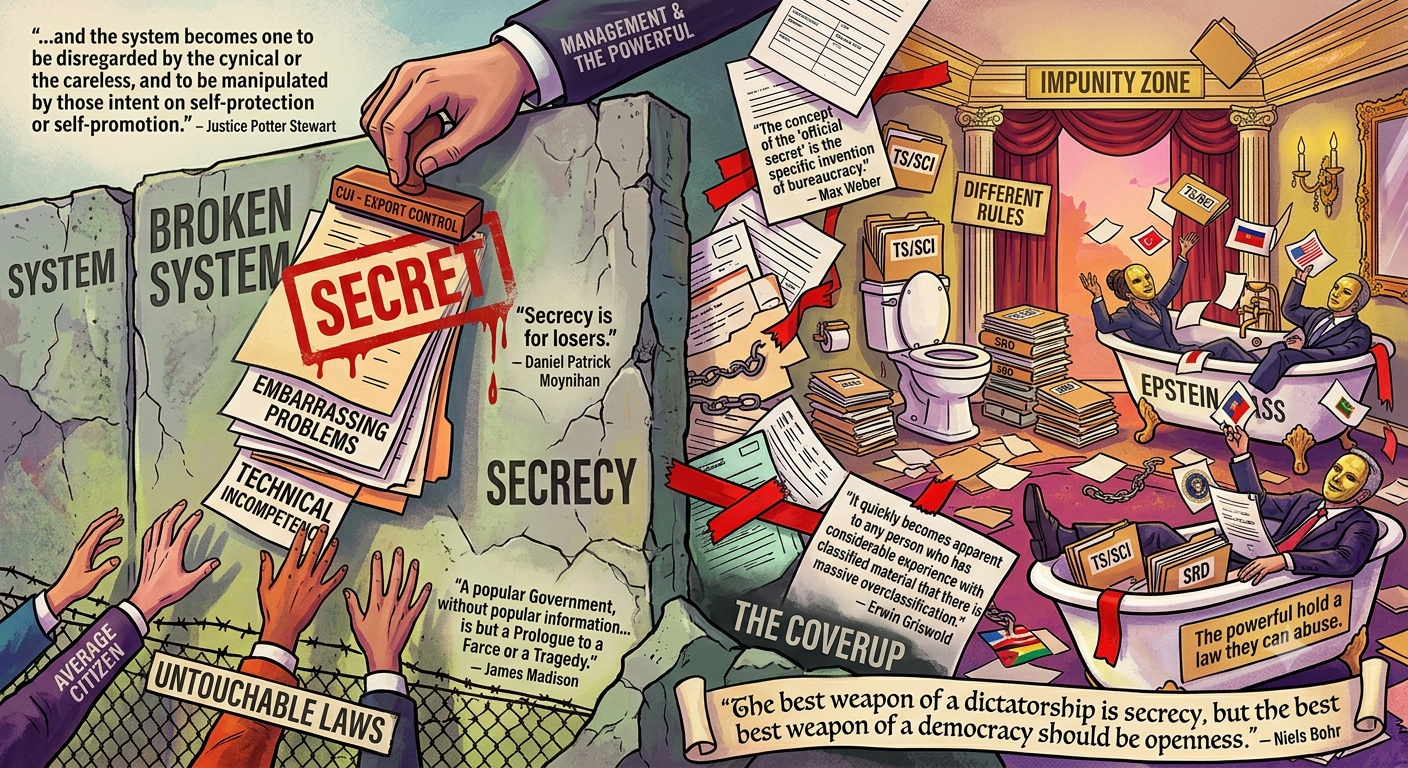
I worked with classified documents almost my whole career. This isn’t odd when you work at two nuclear weapons labs. Classification is important and essential for security. The law and practice of it is a fucking mess, none more so than export control. There are huge loopholes, and the powerful flout the rules with impunity. Corrupt managers abuse the law for their own ends. Those in power ignore the law regularly. Today it is simply another way power and inequality asserts itself.
For when everything is classified, then nothing is classified, and the system becomes one to be disregarded by the cynical or the careless, and to be manipulated by those intent on self-protection or self-promotion.”– Justice Potter Stewart
The fundamental issue
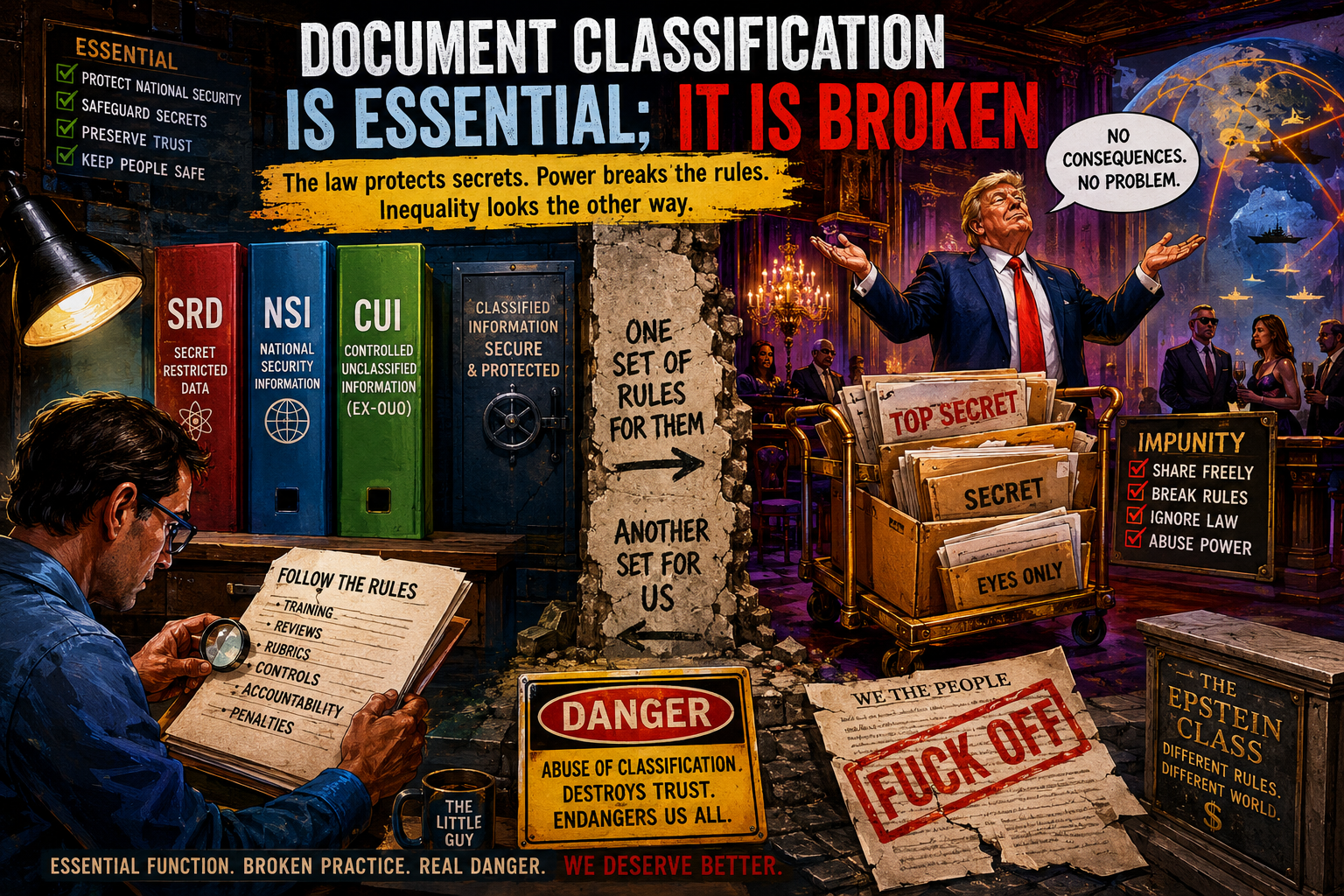
A couple of years ago we discovered that the former (and current) President had hundreds of classified documents in his residence. They were stored in ballrooms and bathrooms. He shared the information with various people, foreign and American, as he wished. Among these documents were some of the country’s most essential secrets, far beyond anything I ever saw or had access to. Had I done what he did, I would expect to be imprisoned for the rest of my life.
The President suffered no consequences for this extreme violation of trust. It was also an abdication of responsibility. I took it as a personal insult. It is also a pattern I had already seen over and over, and it inserted itself into my life again this week. Rather than protecting important information, classification is simply another way for the powerful to fuck with the rest of us. These violations are common and committed with utter impunity by those in power. The danger from this is real.
Identifying and managing classified information is very important. The protections and the secrets are essential. This information falls into broad categories. Secret Restricted Data (SRD) is the material associated with nuclear weapons. I dealt with this a lot; I even held a position of responsibility for identifying it. National Security Information (NSI) covers other timely information about things like spying and defense. These are the categories the President stole and misused. Finally, there is Controlled Unclassified Information (CUI), formerly Official Use Only (OUO). Export-controlled information falls under this umbrella. CUI is the most commonly and broadly abused category, and coverups and information hiding are rampant under it. I’ll get into this below.
“Secrecy is for losers. For people who do not know how important the information really is.” —Daniel Patrick Moynihan
This function of government is absolutely essential, and it must be wielded responsibly. Instead, the powerful often use it cynically and selectively for their own ends. The result is abuse of power. It is another way that the law applies only to the little guy. Another manifestation of the Epstein Class, who follow completely different rules than the rest of us. The result is a set of essential laws that simply become another way to tell the average citizen to fuck off.
First, let’s get to a few basics of the law and practice. Then I will elaborate on some of the abuse of power I witnessed over my time at the Labs. Some of this has parallels in the news (Trump, Clinton, Biden, John Deutch, …) worth mentioning. If you’re powerful, the law is just notional.
Classified material
When most of us think about classification, the thing that comes to mind is SRD, the category used to classify material related to nuclear weapons. It has been a major focus in my life.
When I worked at Los Alamos, I became an authorized derivative classifier. This job involved reviewing documents, presentations, and emails for the presence of classified information. There are many subtleties in all this, and I came to understand the area quite well, particularly in my specific expertise, which spanned various parts of computational science.
The real focus of all this classified work is always on the applications and how the work is reflected in technology. This is generally true for this type of classification, and it shows up again in export control. It is central to understanding the whole topic.
This form of classification is defined by statute. When you’re doing classification work, detailed technical guides define what is classified and provide a rubric to work with. Violations of this classification law carry penalties that can be quite severe. I had many interactions with violations and security issues, but generally speaking, my personal record was quite good.
When I transitioned to Sandia, it would have made sense for me to continue as a derivative classifier. My experience with the professionalism and competence of the Sandia classification office quickly convinced me this was a risk exposure I couldn’t tolerate. The classification office at Los Alamos was my partner and peer; the classification office at Sandia was adversarial and struck me as outright incompetent. The institution took a negative, adversarial approach toward employees and made me feel like I was the one at significant risk all the time. They also provided far less support for anything related to classified documents and pulled that support away from any sort of local control. In short, the overall attitude made me extremely uncomfortable having anything to do with classified work at that laboratory, so I declined the responsibility.
“The concept of the ‘official secret’ is the specific invention of bureaucracy.” — Max Weber
Export control law
The second place classification shows up is export control policy. Export control deals with information that is less sensitive and less damaging than nuclear weapons material. The law was written after the statutes governing nuclear weapons information, and ironically the statutory penalties are far worse. Compounding things, the law is much vaguer and written with a fear-based approach, with little to no technical guidance for determining whether something is export-controlled.
As I will elaborate, this makes the policy more arbitrary to adjudicate. It also makes it more prone to abuse and outright violations of the spirit and letter of the law. That led to my retirement, and to the episode this last week.
All of this matters a lot. When I look at the issue around my retirement, its sensitivity designation is central. I can say unequivocally that the document this all revolves around was not export-controlled. Yet, it was declared as such. It was not information sensitive in any way and should not have had any of these controls attached to it. The declaration that it was export-controlled was a pure abuse of power. Knowing the objections of the managers makes it corrupt on its face. It was declared export-controlled only because the contents of that report were bad for the laboratory and exposed problems. The designation was done purely to protect the outright incompetence and unwillingness of the managers to address the problems the report identified.
The applications of this work have nothing to do with the report or the material contained in it. These are solutions to hydrodynamic test problems with analytic solutions, used for code verification. The code verification results are clear and unambiguous: the code cannot solve these problems correctly. The reasons are simple and easy to explain. Unfortunately, they are not articulated in the report, and the institutional approach is to simply hide the report and assert that the results of these test problems are immaterial to the problems the code solves. Nothing could be further from the truth.
“It quickly becomes apparent to any person who has considerable experience with classified material that there is massive overclassification.” — Erwin Griswold
Abuse and violation are common
I wish I could say that abuse of power and violations of these laws were uncommon. The inverse is true. I mentioned the President’s hoarding of classified documents as a prime example. By the same token, Hillary Clinton used a private email system for classified work, which was a violation. John Deutch, the former CIA director, took classified material home. Former President Biden had a handful at home by mistake.
I saw two instances at Los Alamos where lab directors committed fairly serious security violations and were essentially let off the hook entirely. They suffered no consequences.
In one case, a lab director spelled out details of a security investigation in a public meeting. The classification level of a security investigation is the same as the material being investigated. He was simply let off the hook as they declared the material had suddenly become declassified.
Another lab director read aloud a passage written by the head of the NNSA that contained classified material. This was a subtle violation, but one common in the area where I worked. I immediately knew that what was read was classified. When I took it to the classification office, based on their previous experience, they felt it wasn’t worth touching. Again, because of the power of the individuals involved, they were off the hook. I don’t think they even had any idea they had committed a violation.
Given this experience, it comes as no surprise that managers believe they can get away with things. The CUI designation is not supposed to be used to hide embarrassments or problems, yet it is used that way over and over. Moreover, the institutions are making more and more information CUI, precisely because of the lax, undefined nature of the technical designation.
The case relevant to me now highlights this. They see something they don’t like, and rather than dealing with it and taking responsibility, they simply designate it as controlled information. Prying eyes can’t see it. This is done over and over, and because of the lax nature of the law, they act with impunity.
For genuinely classified information, there are supposed to be penalties and admonishments for using classification to hide information through overclassification. In export control law, just as there is no technical specificity, there is no such rule. In no case are these enforced actively. These managers get to do this with impunity. Nothing stops them. It’s simply something they’ve gotten used to doing. So we have a situation where the powerful hold a law they can abuse. They can hide their problems, hide their issues, hide anything embarrassing, and they just get away with it.
To put a point on this whole shitty situation: this harkens back to the same attitude we see with the Epstein class. Rich, powerful people flout the law, violate it with impunity, and let their power shield them. Granted, the things I’m talking about here aren’t nearly as horrible and disgusting as the crimes Epstein committed, but the abuse of power and privilege is exactly the same. They routinely use these laws to punish the little guy while violating them themselves. This is exactly what happened in my case, and I suspect it happens over and over across the entire federal establishment.
Institutional corrosion
“A popular Government, without popular information, or the means of acquiring it, is but a Prologue to a Farce or a Tragedy; or, perhaps both.” — James Madison
Moreover, this is a bipartisan issue. These actions are committed by everyone in a position of power, and they are among the most corrosive forces eroding trust in our leaders and our institutions. It needs to be fixed. Fixing it would be a major step toward re-establishing the trust and confidence we need in our leadership for a better future.
A position of leadership should be the opportunity to set the best example. Instead, in our current society, leaders regularly flout the rules and receive exceptional treatment. Rather than being examples for those they lead, they act with a sense of impunity and entitlement, and that entitlement amplifies the sense that the rules are different for them. The laws and regulations are merely suggestions; their position allows them to violate them without consequence. They do not have to abide by the same constraints, rules, and principles that all of us are required to follow. It is no small statement to say that this is a recipe for disaster, but this is where we are. I can see examples of this in action from the bottom of leadership to the top. Rather than setting an example to follow, they provide proof that power endows you with special privileges and little responsibility, while the serfs toil below.
The fact that these abuses are commonplace and practiced at every level of leadership is not an excuse. Rather, it is a test of the basic values and ethics those leaders possess. If a leader violates the rules or abuses their power, they have failed a fundamental test of character. In each of the examples above, those leaders failed that test. They have shown they are unfit for the positions they hold.
In their hands, the rules and regulations are simply tools of power, instruments for taking retribution against those they don’t like. Secrecy is important, but it is also a reliable engine of distrust, and that distrust is a threat to effective leadership. Our leaders amplify this threat by abusing people with the very rules and regulations they refuse to follow.
“The best weapon of a dictatorship is secrecy, but the best weapon of a democracy should be openness.” — Niels Bohr