“AI won’t replace humans, but those who use AI will replace those who don’t.” – Garry Kasparov
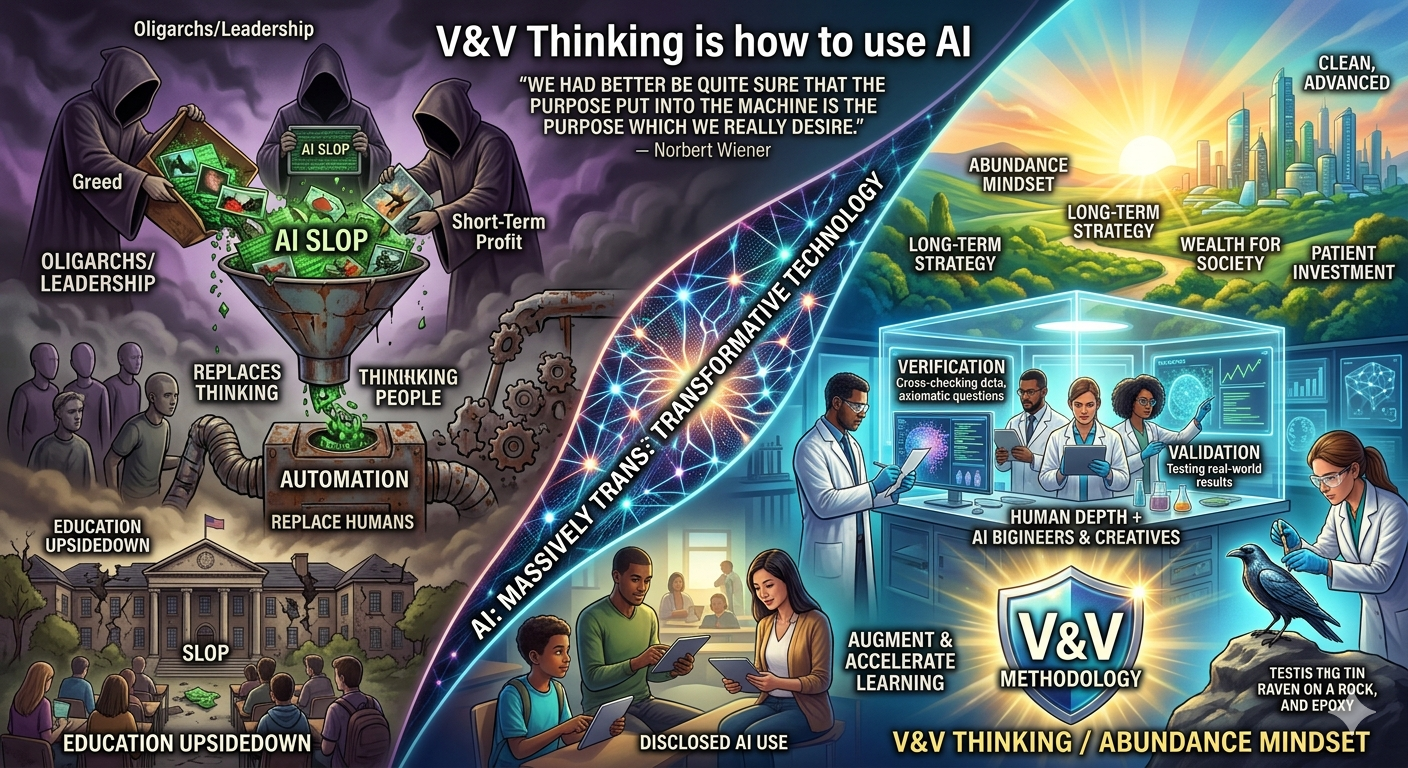
One of the most important questions that needs to be answered today is: How do you use AI? How do you use it properly and effectively to do your work, help run your life, and ultimately make things better? It has an amazing capacity to do this, but only if it’s used well. AI is also potentially completely and utterly destructive. It is destructive if it merely replaces the thinking person with unthinking AI slop. The direction today is moving towards destructive, and change is needed for it to be good for society.
As I wrapped up my professional life, AI suddenly landed on my radar in 2022. I immediately saw it as something huge and amazing, a moment that had happened a few times before. It felt bigger than either the advent of the Google search algorithm or the smartphone. AI is a massively transformative technology. We need to tackle the task of making the transformation positive.
“Abundance … is the state in which there is enough of what we need to create lives better than what we have had.” –Ezra Klein and Derek Thompson
My concern right now is that the oligarchs and their endless greed and appetite for money will just look for more. Look at how social media played out. In addition, we have government incompetence and plain mental laziness. Corporate interests are simply poisoning our national “strategy.” Mostly, we don’t have a strategy other than buying a shitload of computers (data centers). Alongside this is destroying scientific research. The result is we are going to completely botch the rollout of AI and fail to take advantage of what it can truly do.
The bottom line is that dealing with AI properly is twofold:
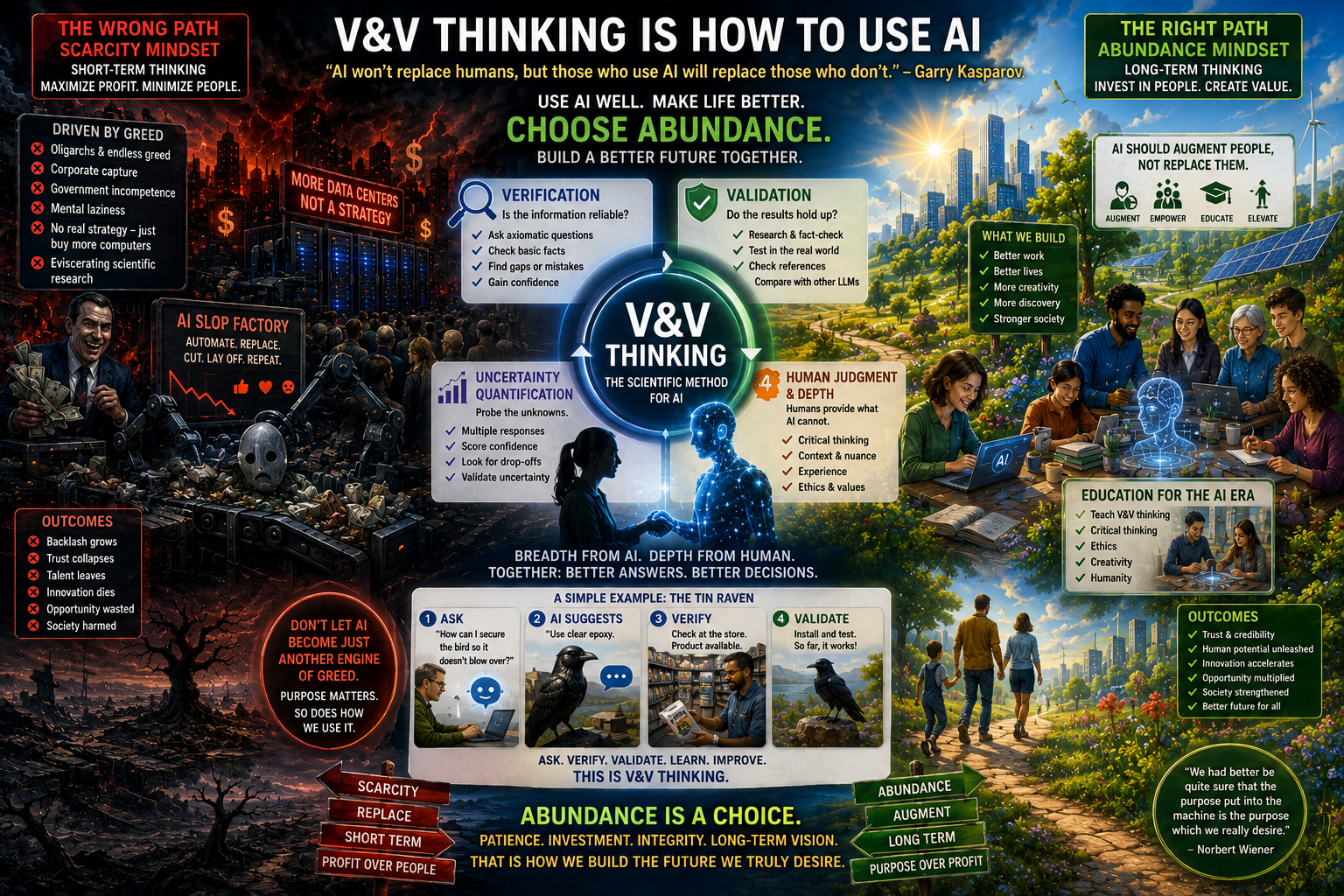
- There’s a technique and a mindset one needs to adopt. This mindset is verification and validation of AI’s work.
- The goals for our organizations and institutions need to adapt to get the most out of them. AI can allow people to work more and better, not simply eliminate people.
This is a mentality of abundance, not scarcity. Right now, both of those things are decidedly not in place. The correct mindset for engaging with AI is the scientific method. In practice, that means using verification and validation. These are mindsets and techniques that help unleash AI safely and productively.
The core mindset is that AI should augment people, not replace them. It should help each person do more and better work, whether at work or at home. A foundational principle is to improve human life. Clearly, this idict is absent today as a backlash is growing day by day. Right now, no one (corporately or institutionally) is actively engaged in this mindset. If we do not change, AI could ultimately doom itself as a technology. The United States will lose its edge in the battle for dominance through the backlash. To succeed with AI, we need to adopt an abundance mindset rather than a scarcity mindset.
“The confidence people have in their beliefs is not a measure of the quality of evidence but of the coherence of the story.” – Daniel Kahneman
I’ll start with a non-technical example. My wife and I recently bought a tin raven sculpture for our front yard. We love ravens in the mountains here in New Mexico and wanted to display this. I found the perfect pedestal: a rock in our front yard where the raven could stand and be visible from the driveway, the street, and my kitchen window. The problem was that the raven kept blowing over in the wind. So I asked ChatGPT, “How can I secure the bird to the rock so this doesn’t happen all the time?” It suggested buying clear epoxy. It seemed a reasonable logical solution. To validate that approach, we checked at the store where we normally shop and found a product that matched the recommendation.
The validation was straightforward: the product was available. Moreover, the solution seemed like it would work both short-term and long-term. So far, it has been a great solution we hadn’t thought of initially. We shall see how it weathers through our seasons and persists.
This example illustrates a basic methodology in simple form. It also shows the danger of AI. The danger is that AI becomes like social media: it sells you a specific product (a brand), lets you click to buy it on Amazon, and has it delivered. One could easily see that happening, and it would start a downward spiral for AI as a tool to transform society. It would be monetized just like social media and become an engine of greed. It would sell us crap and rapidly become enshitified like all those companies.
I’ve argued that V&V is the scientific method. I think the terms in V&V are especially useful for constructively engaging AI. The first piece is verification. It can apply to confidence that a tool is theoretically correct. For modeling and simulation, the definition is straightforward. For AI, the definition is slightly different: it’s about whether the tool can provide basic information reliably and correctly.
“Progress is more about implementation than it is about invention.” –Ezra Klein and Derek Thompson
When I start querying a large language model on a topic, I always begin by asking axiomatic questions to determine whether the basic information is present in the LLM’s responses. More importantly, are there gaps or mistakes in that knowledge that need to be accounted for before I try to probe into the unknown? This is a verification exercise and a way for me to gain confidence. Conversely, I might find that the LLM is faulty. I can proceed through other avenues. Through verification, I can find if the LLM is well-suited for the pursuit of the question that I am thinking about. This is the initial step.
The real work comes in validating the LLM’s responses to deeper, more unknown questions. A key is to approach this with a healthy dose of doubt and take everything the LLM produces with a grain of salt. Addressing and calming these doubts is V&V thinking. One way to validate the results is to research the LLM’s responses and check whether they are factually correct. Another approach is to test the results in the field and see whether they hold up. We did this with the tin raven.
If you are writing code or running a literature search for your work, you should also validate. See that the references the LLM finds are actually real. Once you have validated the results, you can use them with confidence. You get an acceleration of your work, but you still have to do the legwork to confirm whether it is correct. One can do far more validation by using multiple LLMs to flag variations in response.
There are a few ways to query an LLM to help you assess the reliability of its responses:
- Ask the LLM to provide references and links so you can track where the information came from and evaluate whether it is reliable.
- Ask the LLM to provide multiple responses to the same question. Make the LLM score each result to get a sense of its relative confidence. This can help you probe the broader uncertainty in the results. For higher-stakes questions, draw more samples and pay attention to where the score drops off. You can see if LLM is providing responses it believes are less likely. Validation would examine the veracity of its assessment.
- This uncertainty needs to be probed and validated. I have seen cases where the lower-probability response was actually the better one. This rightly calls its results into question.
This gets at the power of AI, which is very good at breadth and at incorporating a broad spectrum of views. That breadth is also the danger, since there is no truth embedded. One needs to be mindful of the breadth it is producing. It is dangerous. Some of the responses LLMs provide are garbage (hallucinations or bullshit).
Humans provide depth. Humans provide thought and checking. The combination is powerful. If you take the breadth and consider it carefully, the LLM results can broaden your perspectives. This can, in turn, encourage deeper thought. That deep thought needs to be encouraged across the board.
This gets to the worry I would have when the leadership at work engages with using AI. When I was working, the push to use AI was superficial and clumsy. I’ve heard from friends at several institutions that the leadership’s approach to AI has been mindless cheerleading. For example, getting people to use it without any sense of responsibility or technique. For example, they might say, “Let AI write your performance review or performance plan.” No effort was put into showing how to engage with it properly. The entire engagement lacked any skill or depth.
“We have a startling abundance of the goods that fill a house and a shortage of what’s needed to build a good life.”–Ezra Klein and Derek Thompson
This kind of mindless work calls into question the performance review itself. It is not befitting leadership and malpractice. Leadership should encourage people to think and do the hard work of using AI properly. Use AI to augment their work (not replace it). The goal should be to make work better, deeper, and of higher quality. Ultimately, the aim is to use it as a tool to encourage broader, more open-minded thinking. That thinking needs to be applied in a verified and validated way so it can be used for things that matter. Given the mission of these institutions, any other approach is reprehensible.
Let’s get to the real enemy of success and AI: a short-term view of what constitutes success. For corporations, that means money. For institutions, it means money too, and increasingly so. Success means taking the long-term view of success. Using AI properly is a long journey. It requires deep engagement with the development of detailed processes analogous to V&V used in modeling and simulation. We all need to put in the work.
“The ability to discipline yourself to delay gratification in the short term in order to enjoy greater rewards in the long term, is the indispensable prerequisite for success.” — Brian Tracy
If you adopt a scarcity mindset, you use AI to replace workers and reduce the workforce size. You invite the backlash we are starting to see. In the short term, this works like a charm. We have institutions and corporations that show no fealty to the nation as a whole and will eagerly make decisions that are negative for society. We’ve seen this with social media, and if we see it with AI, the damage will be profound. The opportunity cost is even higher. AI could do miraculous things. That opportunity is being squandered.
This dynamic between humans and AI plays out most profoundly in education. If we adopt a scarcity mindset and fail to adapt, AI could completely upend our current educational system. We can choose to make it better or worse. Right now, we are moving towards worse by resisting this technology. Our educational system already needs an overhaul. Do we grab the opportunity to improve it, and train the next generation with this technology? It could be a catalyst for a positive transformation.
My attitude is that we should assume every student is using AI and design a system that is impervious to cheating. That assumption is the key. The essence is teaching students how to use AI properly. It is what I described above. They need to have the necessary techniques, knowledge, and drive to augment and accelerate learning. These lessons can be meaningful with or without AI. The hard part is putting some burden on the teachers. Education cannot be static or underestimate this technology. The value of a liberal arts education will suddenly skyrocket. The skills and knowledge are going to be in greater demand. True human individuality and authenticity are also needed to stand out with AI. AI flattens and makes work anonymous. In the future, the touch of inspiration from an individual will be a hunger.
“The first lesson of economics is scarcity: There is never enough of anything to satisfy all those who want it. The first lesson of politics is to disregard the first lesson of economics.” – Thomas Sowell
My stance is this: if you submit work that is essentially regurgitated AI “slop,” you get no credit. That is a zero, a foundation. If you produce something wonderful and good without AI, more power to you. The question is, if you are using AI, are you producing a better product? Have you done the due diligence and the work required to make something better than you could produce on your own? We should adopt disclosure about AI use across the board. We should always talk about how AI was used in the production of the work, and we should do this at work and at school, every time.
For example, I use Claude to edit and do a comprehension and grammar pass on my writing. I also use Claude to generate potential social media posts for each blog post. I do this as a matter of course as part of my education on LLMs. I make sure the writing itself is all from me.
Ultimately, this attitude should apply in education, in work, and in life. Placing the scientific method and verification/validation at the center of how our new world works is long overdue. The quest to use AI productively in society can power this shift. It would change AI from a force of unbridled destruction into one of creation and quality.
The abundance mindset, which says we keep all the people but make them produce more over the long run, is the path to wealth and success for society as a whole. It requires patience, investment, and a strategy that our current leadership seems incapable of producing. Ultimately, this is our greatest battle: getting our leadership to choose a long-term path to success over short-term profit-taking. The signs today do not look good, since short-term profit and wealth are dominating everything, whether public or private.
“We had better be quite sure that the purpose put into the machine is the purpose which we really desire.” – Norbert Wiener