
“For a successful technology, reality must take precedence over public relations, for nature cannot be fooled.” — Richard Feynman,
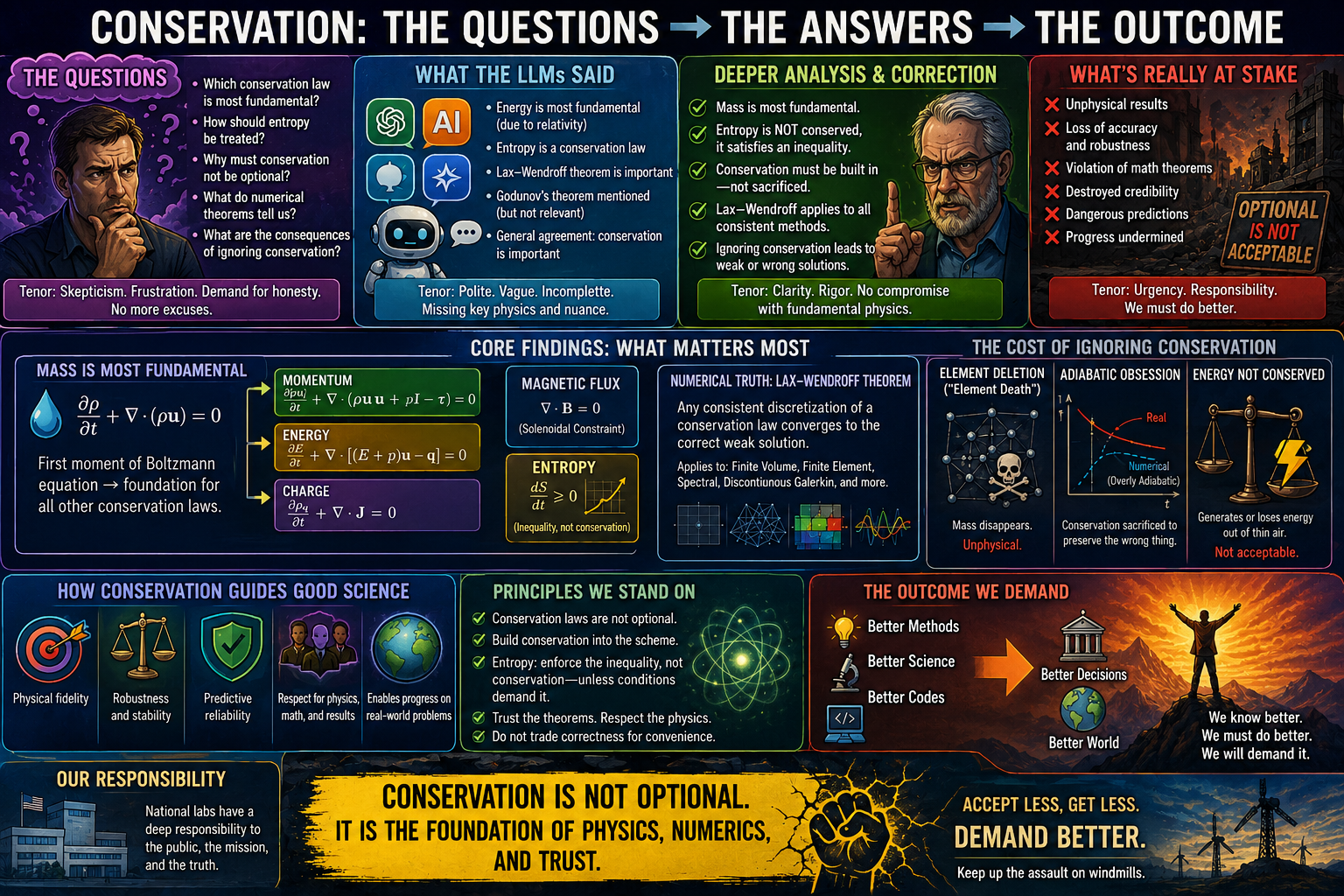
Yes, it is entirely optional. The question is whether it should be.
My view is that it should not be optional; conserving should be foundational. Optionality is a real problem across computational physics. There is a tolerance for this practice that reflects deeper cultural issues and the history of various technical fields. Like many things, it is an accepted practice that should be unacceptable.
I started exploring this question by poking around with AI. This is the way things are done these days. One can study a topic with a large language model. Since I’m currently paying for Claude at a modest level, this was the first choice. I asked it first, and like most large language models, the initial response included a lot of ass-kissing and dick-sucking that I didn’t ask for. It does that almost reflexively. When you get answers like that, push back and reject them.
I should note that Claude has been editing and digesting most of what I write lately, so it knows my views very well. This is not what I wanted. I wanted an honest broker and a scan of genuinely different ideas. I had to call Claude out to get those.
As a best practice, I also asked the same question of ChatGPT and Gemini. I got much the same answers, and as you’d expect with the free versions of ChatGPT and Gemini, they were a bit disappointing. There were some common threads worth hanging onto and considering.
“The first principle is that you must not fool yourself — and you are the easiest person to fool.” — Richard Feynman,
One of my questions was: which conservation law is the most fundamental and primal?
“The law that entropy always increases holds, I think, the supreme position among the laws of Nature… if your theory is found to be against the second law of thermodynamics I can give you no hope; there is nothing for it but to collapse in deepest humiliation.” — Arthur Eddington

I got a lot of navel-gazing nonsense that tried to sound thoughtful, but was not remotely useful. One answer was that energy is the most fundamental, mainly because of how energy and mass interact in special relativity. For relativistic flows, that is the correct answer. For most flows, this was idiocy. The other common response cited entropy as a conservation law, which it is not. It should not be listed as one of them. Entropy is not conserved. It is, given a sign convention, a quantity that matches an inequality. The responses failed to talk about the nature of that inequality dynamically, which is incredibly important. For large-scale flows, the entropy observes some well-known asymptotic limits.
I also asked about the numerical aspects of conservation. The responses highlighted the importance of the Lax-Wendroff theorem and its implications. That was a high point, especially for Claude, since it has digested all my writing. The discussion also mentioned Godunov’s theorem, which is important but completely unrelated to this particular question. Lax-Wendroff states that conservation form is needed numerically to compute weak solutions to these equations. These weak solutions are appropriate for singular (shocked) flows. Weak solutions are also not unique. To get the unique and correct physical solutions one needs an entropy condition. This is a solution that is properly limiting to solutions containing vanishing dissipation.
From the LLM questions, my conclusion is that conservation is important across the board. All the equations are esential. I would identify mass as the most fundamental conservation equation, since most other equations follow from it. This perspective starts with mass as the foundation for the other conservation equations. It is included in momentum, energy, and charge conservation. It is not in magnetic conservation or the solenoidal condition.
“The opposite of a correct statement is a false statement. But the opposite of a profound truth may well be another profound truth.” — Niels Bohr
For fluid equations, the mass equation is the first moment when you derive the conservation laws from first principles using the Boltzmann equation. I will stand by this premise. I should note, however, that viewing energy as primary is an indictment of the labs. By and large, do almost every calculation without conserving energy. There are exceptions to this statement, but non-energy conserving is well-accepted. In fact, more accepted than energy conserving methods.
Let’s get to the point: I believe conservation should not be optional.
I’ve written about the obsession with preserving adiabatic conditions, and how that leads to a use of non-conservative methods. The non-conservation comes from the choice of an internal energy equation. It is an evolution equation, not a conservation law. Actually, The focus is the energy equation causing the issues. I do think energy should be conserved as a constraint, ideally by construction. The preservation of adiabatic conditions should be what you compromise on, and build into these schemes. Right now, the opposite happens: conservation is the thing that gets sacrificed.
“In mathematics you don’t understand things. You just get used to them.” — John von Neumann
My reasons are straightforward. In the labs they care about flows that are highly energetic. Those flows have weak solutions, and if you’re interested in weak solutions to these equations, the Lax-Wendroff theorem applies. It applies to finite volume schemes, finite element schemes, and every scheme you can imagine. It is not limited to one specific method. It applies to a class of equations that can be solved. The theory is simply ignored by them. For people working in solid mechanics, the same principle applies. They are also bound by conservation laws and the Lax-Wendroff theorem.
The “element death” or “element deletion” approach to violating mass conservation is one of the most appalling things I can imagine. There is a key difference between this method and the problems with the energy equation. The discarding of mass is not based on a differential equation. It is done without an equation. Thus, it destroys the entire legitimacy of the solution. It is physically inconsistent. It is as if a Star Trek transporter beamed the mass out and put it on the Enterprise. The method is complete bullshit and simply incompatible with science.
I dealt with this in the mechanics culture at Sandia, and it is something they are committed to as an act of intellectual hubris and laziness that is completely objectionable and indefensible. The fact that many extremely important codes rely on this should not be tolerated. More than tolerated, it is even promoted as the right thing to do. In the end, it produced only a complete lack of respect for this community. It is a method grounded in complete ignorance. It is witchcraft and wizardry, and not something that anyone should depend upon.
“Every act of conscious learning requires the willingness to suffer an injury to one’s self-esteem.” — Thomas Szasz
All of these communities would be well served by treating conservation as a fundamental principle. The systems they study conserve as nature does. By the same token, entropy should not be conserved. Instead, it should be treated as an inequality. Entropy should be conserved locally only when the conditions exactly match those that would produce this. Otherwise, the inequality should be applied. In important conditions of shock waves and classical turbulence the rate of entropy production is well known. This is tied to the large scale structure of the flow. This is described by the jump conditions in a shock. It turbulence it is the large scale variation in the longitudinal velocity.
This inability to adhere to a bulletproof physical constraint and concept is a threat to progress. The cultural factors that lead to loyalty to these poor practices are the root of the issue. The methods we use to solve key problems are far less capable as a result, and we should not tolerate that. Our scientists have a deep responsibility to responsibly solve problems of huge national interest. The failure to apply the principle of conservation is an attack on the legitimacy of these equations. This threat is different depending on the root of the violation. The mass violations are far worse because they are not differential. We should know better, we should do better, and we should demand that conservation be treated as an ironclad law. The other principles as processes we try to optimize under the constraint of conservation. Today’s methods do the opposite.
“When life itself seems lunatic, who knows where madness lies? … and maddest of all, to see life as it is and not as it should be.” — From Man of La Mancha, – Dale Wasserman
We should demand better, but after what I’ve seen, we should expect less. The labs are in a race to the bottom, and I wouldn’t expect anyone to do anything bold or good in this environment. I’ll keep up my pointless assault on windmills.
“Hope is not the conviction that something will turn out well, but the certainty that something makes sense, regardless of how it turns out.” — Václav Havel



Bill,
I agree with everything you say here, though I would place conservation of momentum on equal footing with conservation of mass. Without conservation of momentum — essentially, the equation of motion — nothing moves at all.
I have also been exasperated by the attitude that if something does not work in a simulation, one should simply keep adding kludges to the algorithm until the problem disappears, without much concern for how those modifications relate to the underlying governing equations.
I have come to think of the second law — at least in the context of the problems on which I have worked — primarily as a constraint on constitutive models. For example, the condition $ h \cdot \nabla T < 0 $ becomes a constraint on the tensor $ K $ when one writes $ h = -K \cdot \nabla T $. (I believe that the constraint is that $K$ be positive semi-definite.)
Still, let’s try not to be overly negative. Despite our well-founded reservations, the people at Sandia and LANL continue to produce a great deal of excellent work.
Best,
Dan
I think all the conservation statements are important, if not essential. The labs need to progress. The problem is stagnation and lack of advances
Dan,
AI provided all kinds of arguments as to whether mass, energy or momentum was most important. One of those mimiced your arguments. Two things stand out to me in this dialog. Conservation writ large is essential. All the non conservative approaches assumed that the solution was differential equatons been solved. All of these would at least appeal to the Lax Equivalence theorem and be potentially convergent. The mass deletion approach used cavilierly at Sandia is basically “black magic”. No equation, just a recipe for eliminating numerically troublesome parts of the domain without differential equations (evolutionary or conservation). Experience says it is not convergent. Theory offers no refuge either. The whole thing is technicqlly corrupt. I pointed this out nicely to no avail while working. Sandia is committed to using it. Sort of like an addict is committed to heroin. They just use it without regard for the damage it does to them. This is harsh, but this is the edict this horrendous practice deserves.
Bill
Pingback: The Power of Being First, or Why Great Ideas Fail to be Accepted? | The Regularized Singularity
Pingback: Let’s Try Some New Things | The Regularized Singularity