
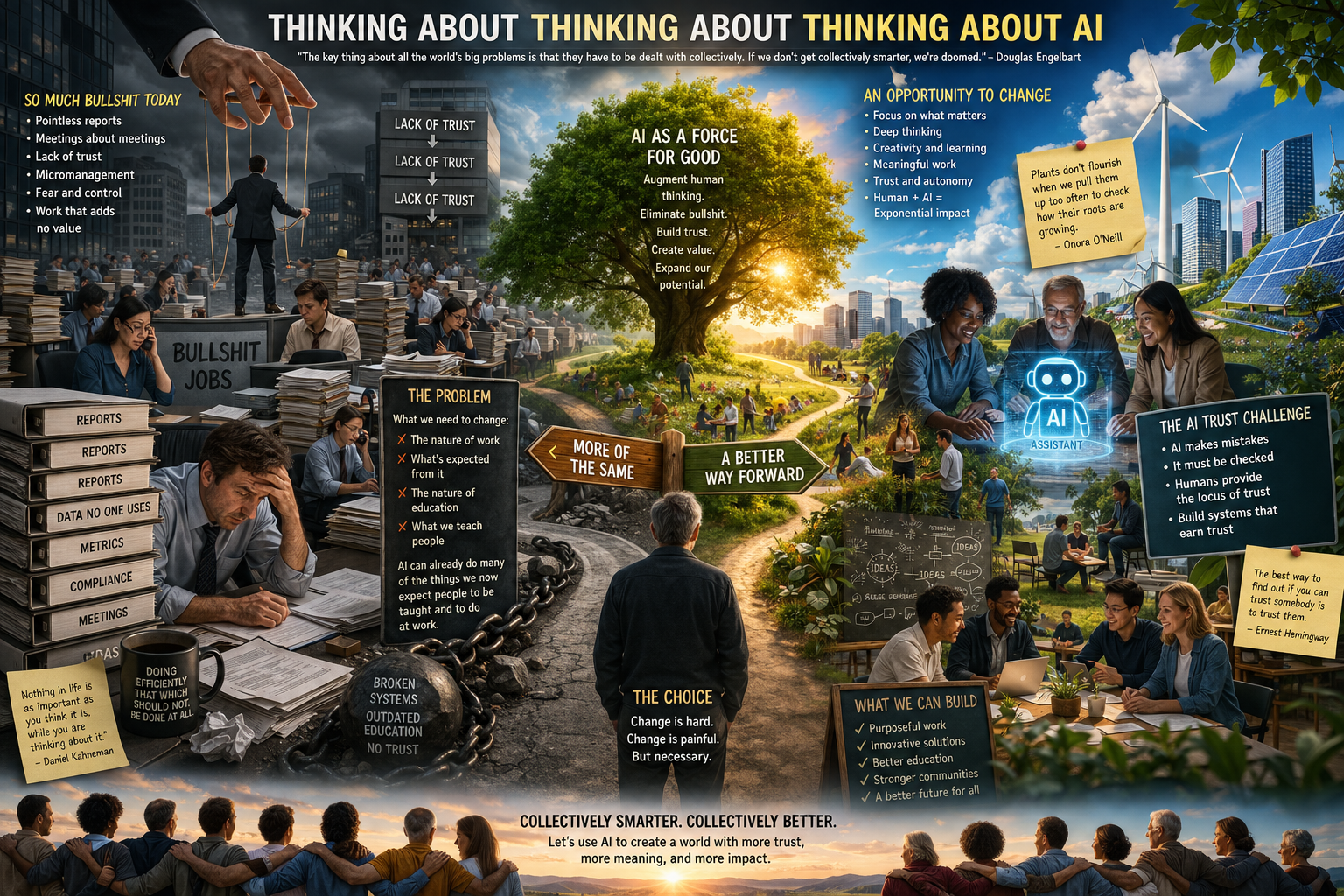
“The key thing about all the world’s big problems is that they have to be dealt with collectively. If we don’t get collectively smarter, we’re doomed.”–Douglas Engelbart
An Opportunity to Change
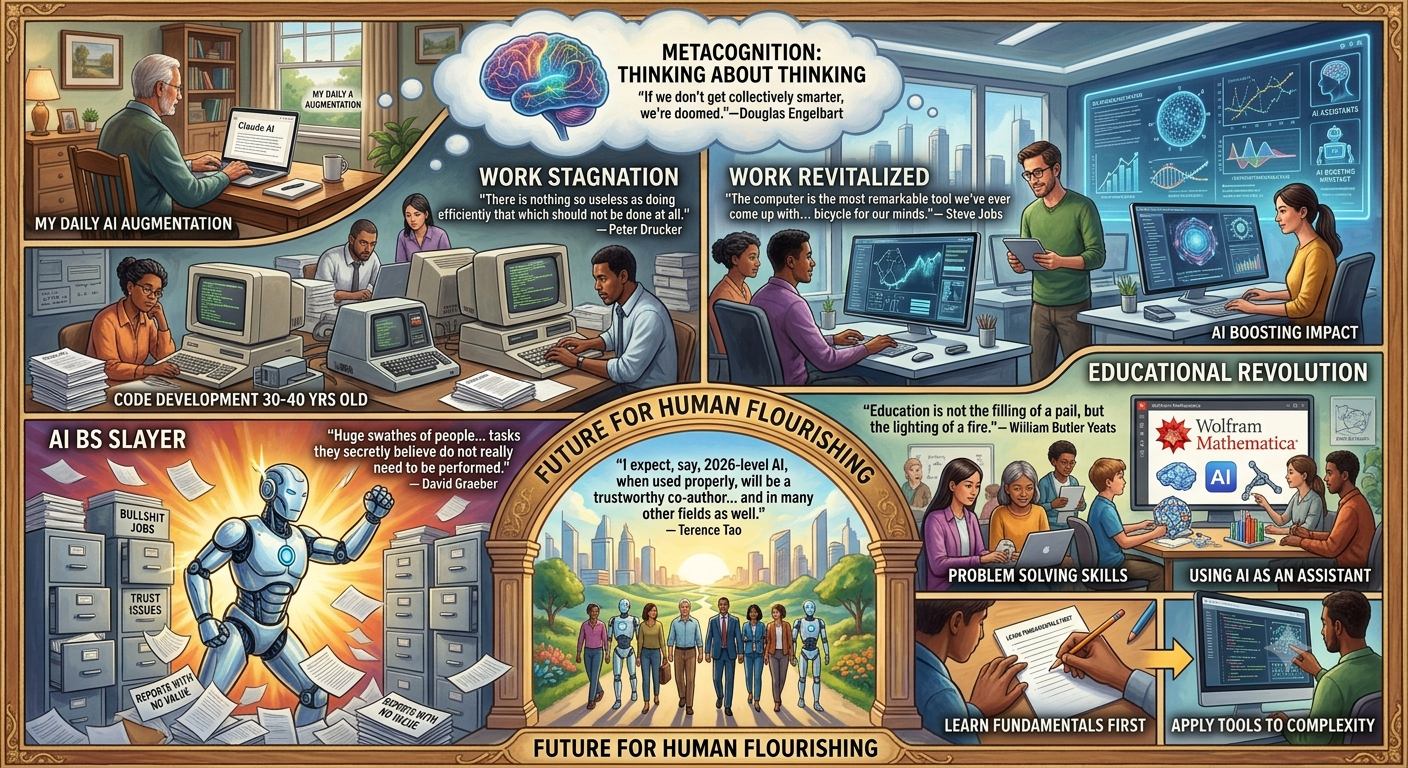
I’ll make an admission for you: I use AI every day. I’ve chosen to pay at the low end for Claude. I really enjoy what it does and find it an excellent addition to my productivity. It augments everything I do. While this is true, it only augments me. I am still the driving force for all it does. It only allows me to do things better and/or faster.
In doing this, I’ve also realized what AI cannot do and how to draw a line between what it adds and what it is completely incapable of doing. That is what this essay is about. Another word for it is metacognition: thinking about thinking. What thinking can AI do? What thinking can it not do? What opportunities arise from using it properly? How do we get there? Right now, most of the discourse on AI is far from the right conclusions.
“Nothing in life is as important as you think it is, while you are thinking about it.”– Daniel Kahneman
I retired recently. The reasons for that retirement have been made clear elsewhere. Being retired is an opportunity for some deep reflection about the nature of work, how it’s evolved, and how it’s changed. I can honestly say that AI offers a way to fix some of the more pernicious and awful ways my work changed over my career. This is something I’ll elaborate on at length. Work got significantly worse over the course of my career, and AI actually offers a way out to something better.
Here’s the problem in a nutshell. To really get the most out of AI, we need to change. Change is hard. Change is painful.
What we need to change is the nature of work and what’s expected from it, and also the nature of education. What we teach people has to change. Part of the reason is that AI can already do many of the things we now expect people to be taught and to do at work.
“There is nothing so useless as doing efficiently that which should not be done at all.” — Peter Drucker
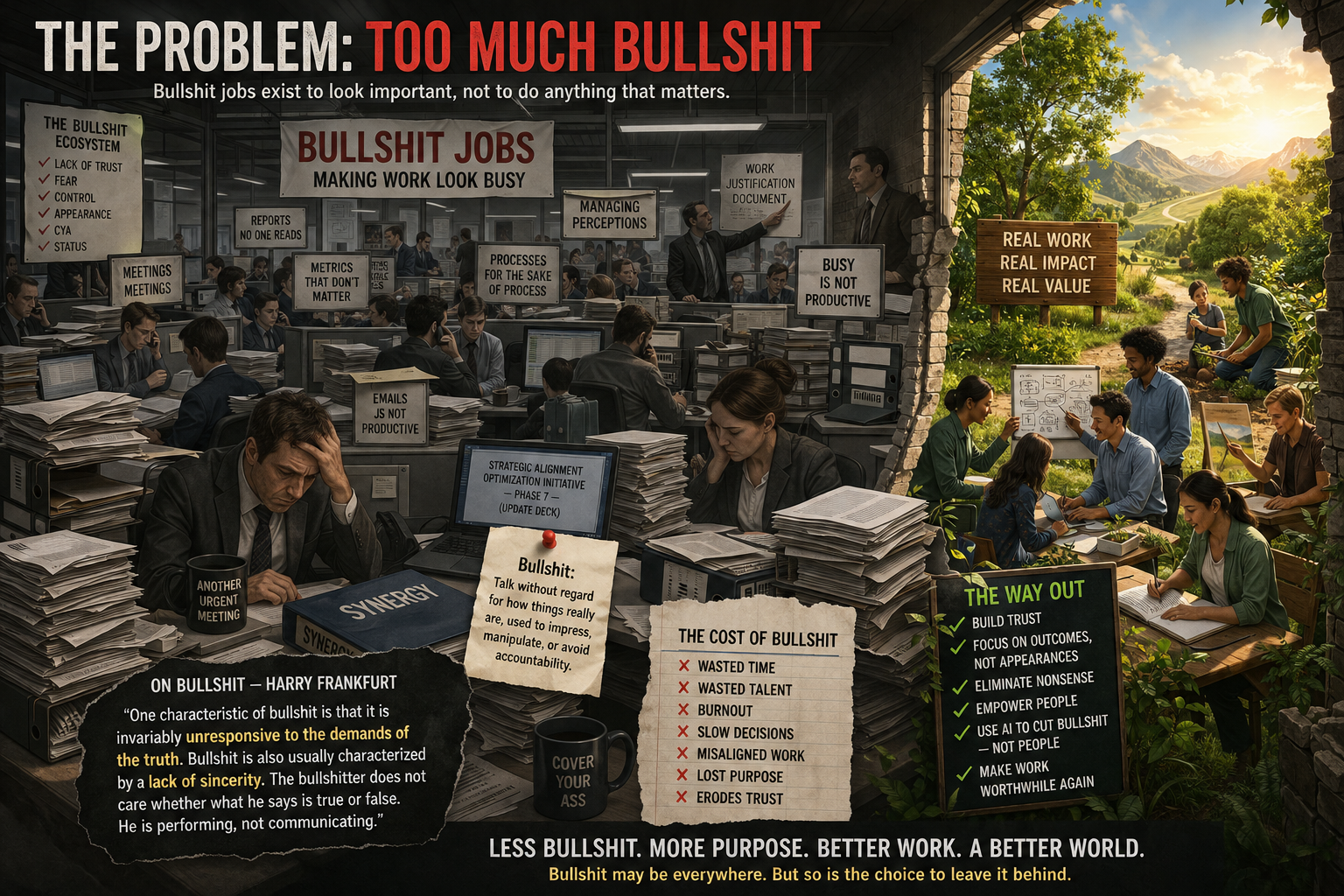
The other, nastier edge to all this is that a lot of what we are expected to do at work is completely fucking useless. This is the essence of the bullshit jobs that have overtaken many of our lives. Worse yet, regular jobs are now filled with a lot of BS. As my career unfolded, the amount of actual thinking I did shrank significantly, and the amount of BS I was expected to engage in grew and grew. A very big theme in all this is trust. Trust at work. A great deal of the bullshit thrust upon us at work is related to a lack of trust. In a more trusting environment, a lot of the bullshit goes away.
AI offers a way out. Part of what AI can do is expose the bullshit jobs and force the workplace to get rid of some of them. Even where that doesn’t happen, AI still offers an opportunity as a capable and competent assistant. An assistant who makes mistakes and does things wrong and needs to be checked. Still, a capable assistant can boost our productivity and open the door for all of us to do much more impactful thinking. Including thinking about things that add actual value to our lives and our work.
“The best way to find out if you can trust somebody is to trust them.” – Ernest Hemingway
The AI trust problem is also thick and important. AI today cannot be trusted. A large part of this is related to its very nature, but also to the reinforcement learning that shapes AI tools to fit our corporate environments. These are corporate environments that have become increasingly distrustful and marked by activities that flow from that lack of trust. Humans need to provide checks on AI and the locus of trust. The problem is that humans are not trusted either.
“Plants don’t flourish when we pull them up too often to check how their roots are growing.” — Onora O’Neill
The real challenge is more psychological and societal. To get the most out of AI and navigate this transition properly, we need to be clear-headed about the issues, including:
- the lack of trust
- The parts of work that add no value
- The role of digital assistants
- How broken is our educational system?
We do not confront these issues in a clear-headed way now. We must grapple with them.
My premise is that, to properly navigate the transition with AI, we need to engage it in a thoughtful, forward-thinking manner. The other power operating here is a corporate power, the one delivering the AI. If the same forces that produced our current social media environment are unleashed with AI, the results will be disastrous. This golden opportunity will be lost. We will be stuck in a world that is even worse, with AI now delivering the same social harms as social media. Instead, we need to orient AI toward a force for good.
So let’s roll up our sleeves and figure this out.
So Much Bullshit Today
“It’s as if someone were out there making up pointless jobs just for the sake of keeping us all working.” — David Graeber
Part of what I recognized immediately about AI was its ability to take care of most of the bullshit in my job. One of the reasons AI can do this is that the work was bullshit. It is quite fit for the purpose of BS. Unfortunately, over the course of my career, the amount of BS had increased a lot. It crowded out most of the work I should have been doing.
What the bullshit pushed out was most of the truly useful work I used to do. I used to spend my days thinking and doing things that were valuable, learning and growing over time. I spent time creating and bringing ideas to life. That was gradually replaced with progress reports, financial reports, and all kinds of reports that have no value whatsoever.
This fundamentally revolves around the lack of trust that managers had for employees. This, in turn, goes back to the lack of trust that higher managers had for lower managers. Then goes back to the lack of trust that the government and the taxpayers have for the people doing the work. All kinds of useful work were replaced with BS designed to check boxes and prove we were doing good work. The irony is that all this checking was actually pushing aside the good work itself. It has become a vicious cycle of decline.
What I recognized immediately was that AI was perfect for this. It’s been designed to produce corporately acceptable speech and reports, and to assist me in all this crap. The cool part is that I could simply turn AI loose and let it produce the BS. Meanwhile, I go back to actually thinking about things that are important and valuable. To start solving problems again. To do things befitting a human being with a lot of education, some good ideas, and a desire to explore them.
AI slaying BS is great. Too bad it can’t do more; it can. It would be nice for employers to recognize the bullshit and just get rid of it. This is the whole essence of bullshit jobs, a trend noticed across the Western world. Increasingly, jobs are devoted to creating bullshit to feed more bullshit. We have created the bullshit industrial complex. AI can replace this with something beneficial for humanity.
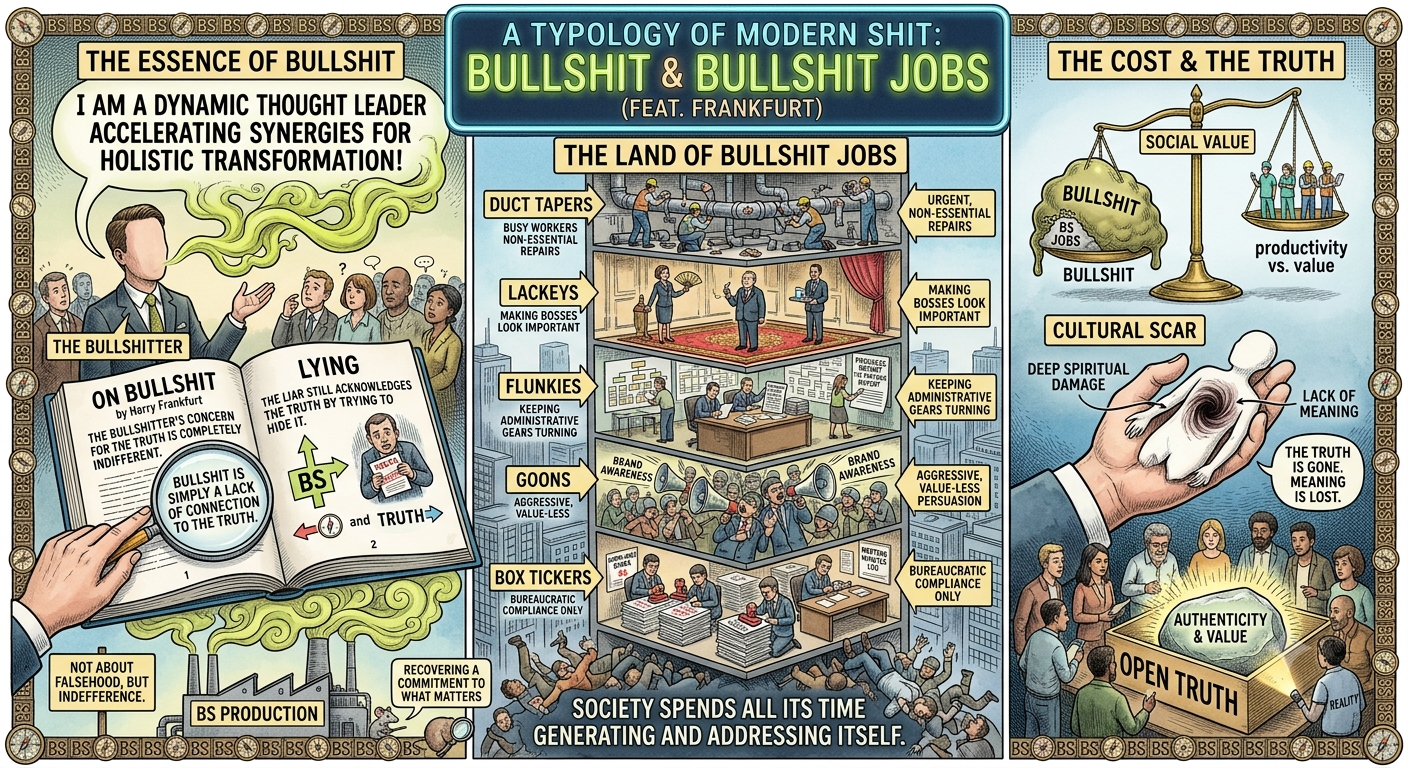
“Huge swathes of people… spend their entire working lives performing tasks they secretly believe do not really need to be performed.” — David Graeber
All of this generally fucks productivity and devalues human thinking and human effort. Even if all of the BS were to magically disappear, AI could still do some miraculous things to help us. That is the optimistic, glass-half-full version I want to focus on. The glass-half-empty version is simply using AI to tackle all this bullshit and generate its own bullshit to feed the bullshit machine. This is beneath contempt.
This is exactly the topic I explored with respect to code development. Over the course of my career, code development got hollowed out and turned into a crappy job where you just work on syntax and transfer static code capability to new platforms. Gone were new ideas and expanded capability. Gone was writing new code, as we simply promulgated the old code onto new platforms over and over again. Most of the codes on our exascale platforms are simply ported versions of decades old code technology. The computers got bigger and faster. What we put on those computers is the same, no upgrade. What a waste!
The result is that thirty years later, forty years later, you’re using the same damn code. The one that was written back when you were in elementary school, or before you were even born. It is being used to solve society’s most important problems. This is a completely unacceptable state of affairs. AI offers a way out. Used expansively it can energize code development to end this stagnation. The key is to recognize that we can do more important and impactful work.
The moral and spiritual damage that comes from this situation is profound. It is a scar across our collective soul.” — David Graeber
The Positive View of AI as an Assistant
In a world where we can use AI to identify and weed out the bullshit in our jobs, the role left over for humans is to use a new digital assistant to boost productivity and sharpen our thinking. AI does not replace you; AI is your assistant. AI makes you a better employee and it makes you more productive. AI can help you produce higher quality, more impactful work. This message would help AI overcome its ever worsening image and support in society. The corporate world is fucking this up. They need to embrace the positive message right in front of them. Time is running out to get there.
Either way, getting rid of the bullshit part of our jobs would yield immediate benefits and jumps in productivity. It would then require our employers to envision an entirely different view of what our work should be. This is, ironically, a more human, more empowered, and a better job. It would not mean massive job cuts, but rather a change in the whole mentality toward work. Work would be about problem solving and creating value. To unleash this positive change there needs to be more trust and less management control.
The key bit is recognizing how much the mentality of work has eroded over the past few decades, to the point of being beneath us. Managers want control, and lack trust. Work is sharply defined and value is determined from above. The fact that AI can do much of today’s work merely confirms that the work we are asking people to do is beneath them. Getting AI to take over this work is half the solution. Getting rid of that work is the second half. Perhaps when the AI generated BS is then digested by management AI. This becomes a ridiculous vicious cycle of no value.
“The computer is the most remarkable tool we’ve ever come up with. It’s the equivalent of a bicycle for our minds.”– Steve Jobs
When ChatGPT was first released, I could immediately tell this was a major development in the power of computing. It was how I felt the first time with Google search. Nothing that has happened since then has changed that view. AI has just gotten better at a breakneck pace. It is an utterly remarkable technology with far greater promise than the small-minded people who promote it can even imagine. This is the frustration about how small the vision for AI is.
I immediately saw a very capable digital assistant, one you could have conversations with, ask questions, and explore ideas with at the same time. I also recognized that it was flawed in a variety of ways. Its prose was wooden and inhuman. It was vanilla and horribly corporate. It didn’t talk like a real person; it talked like some corporate robot. It was also not capable of genuine creativity, only mimicry. Creativity, like coining a new idea or landing a really good joke, is beyond it. It can only mimic, summarize, and regurgitate what’s already there. Nonetheless, with appropriate deference and fact-checking, the assistant can be a huge boost to almost any creative act one is engaged in. It can also be an enormous boon to solving problems.
Solving problems is the essence of what employers should be paying us to work on. One of the great hallmarks of the past few decades of work is that we aren’t doing that anymore. Work lost its spark and creativity was a problem, not a solution. The problems we used to solve at the national lab were on the extreme end of the scale. They were of primary national importance, and that entire enterprise has faded from existence. It is time for it to be born again. I’m fairly sure this trend is repeated across society. AI can offer us a path to that better future.
“If you do not work on important problems, how can you expect to do important work?”– Richard Hamming
What Does This Mean About How We Approach Education?
One of the key aspects of unleashing AI for this better future is to revamp and restructure the way we educate ourselves. This does not just mean how we educate our youth, but also how we re-educate the vast number of working adults employed in our current environment. We all need to learn how to harness AI to change work. The better we educate, the better we harvest the bounty.
We need to teach people how to use AI properly, how to view it as a digital assistant. How to check its work, and how not to use it to replace the part of work that humans should be doing. We need to clearly separate human tasks from AI tasks. The human is always in charge. AI is always just a tool. We should have no problem letting it replace the vast quantities of bullshit we’ve injected into work. The same bullshit crowding out human endeavor. Currently, our students labor under the BS regime too.
This requires that education focus on teaching people how to be problem solvers. How to use skills and tools to best solve the problems that come up in any gainful employment. This is the key. We have tools, and these tools are good for solving problems. This also means we need to teach the fundamentals without the tools,. Then recognize that once people are in the field, in their office, they will have access to tools they can use to enhance the quality and productivity of their work. AI is one of these tools and perhaps the most powerful.
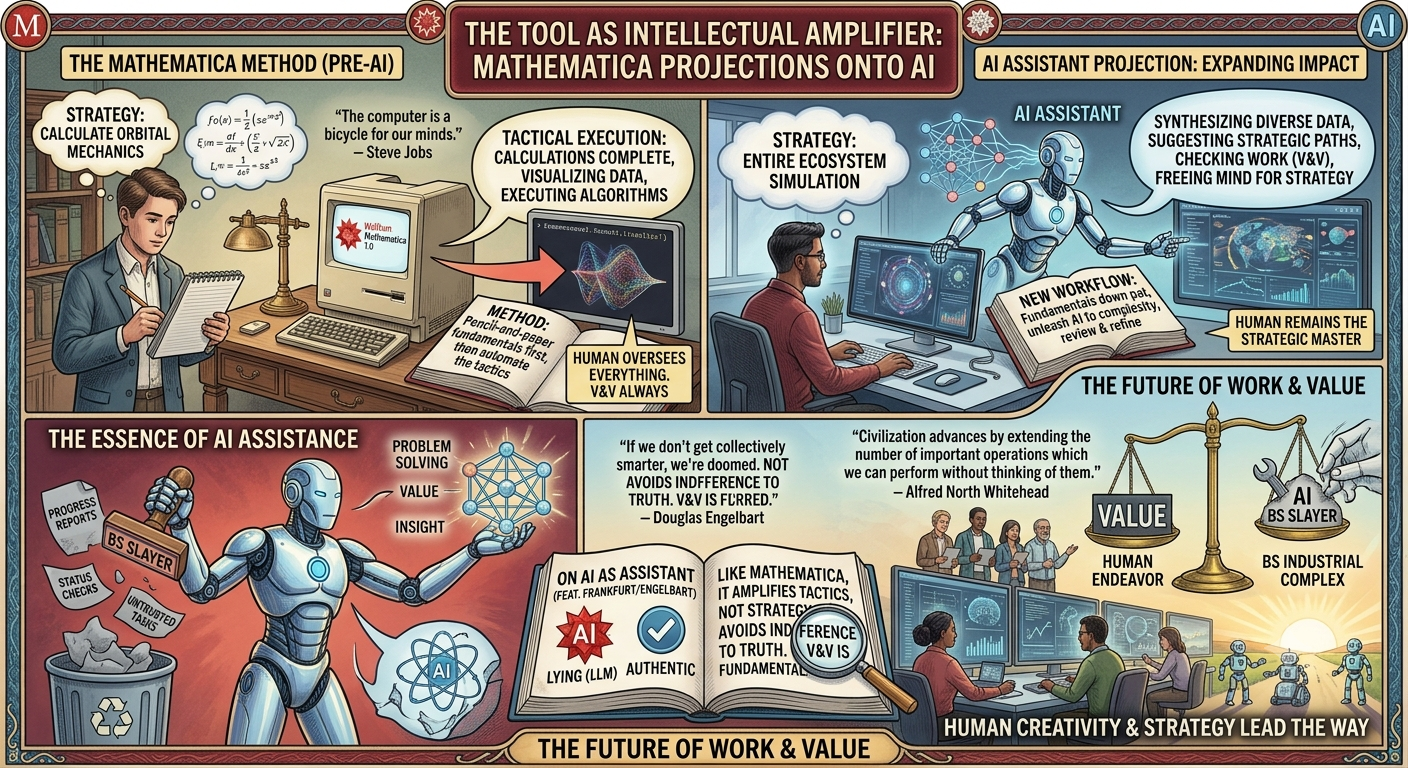
As an example, I’ll point to a tool I used for the entirety of my career: Wolfram’s Mathematica. I started using it shortly after I got to Los Alamos and continued throughout my years. I used it extensively. Generally speaking, when I was using Mathematica, I was doing the best work of my career. It is an example of a tool that unleashed productivity. It is a model for the future.
What I noticed over time is that, as work evolved over the past few decades, the work I would do with Mathematica took up less and less of my time. Particularly the time demanded of me by the employer. Once a useful tool, Mathematica finally became simply a joyful, productive treat. I would give it to myself when the avalanche of bullshit I had to deal with grew too oppressive. I used it when I needed a little joy in my work.
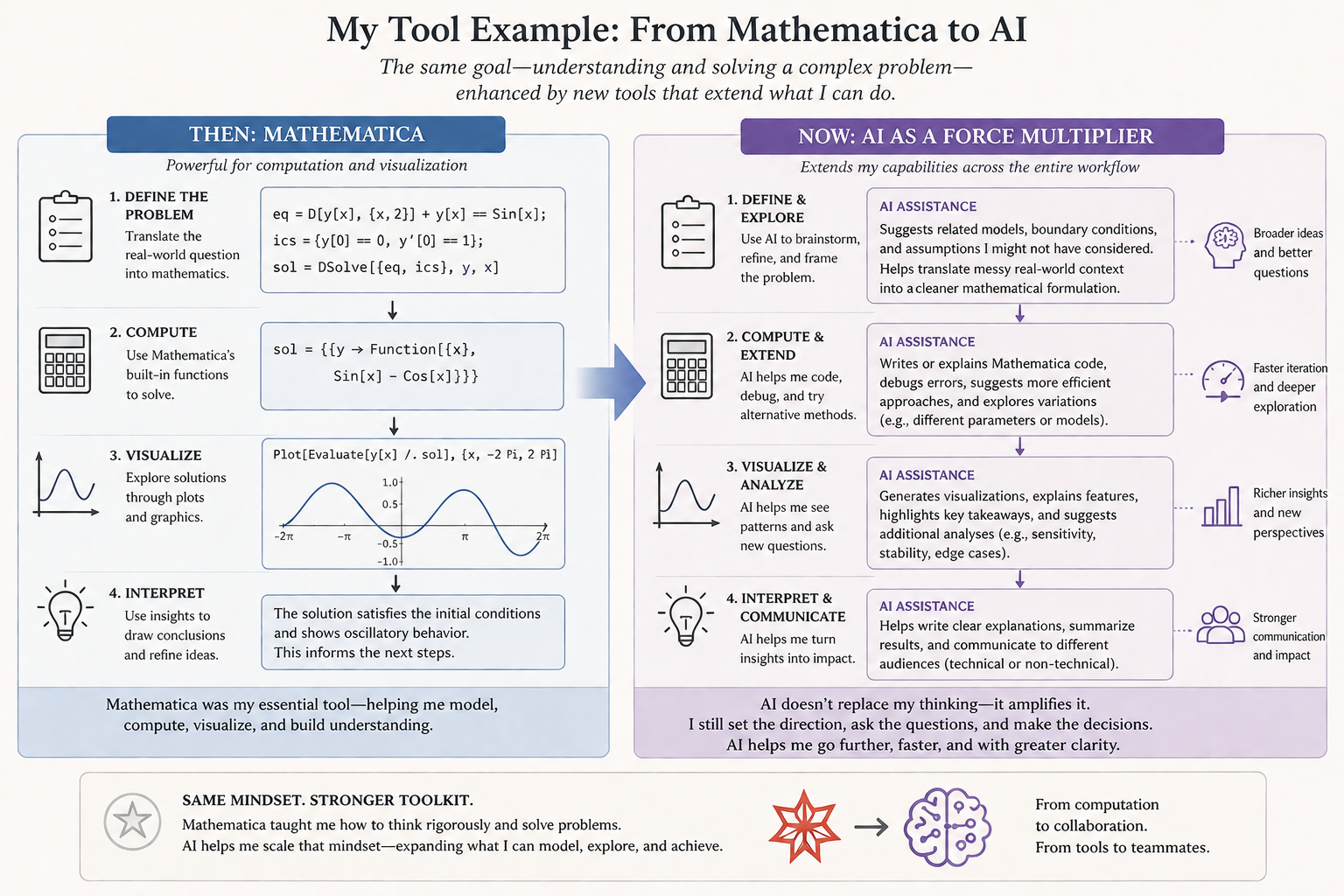
Mathematica is still an amazing tool, and I can only expect that AI is going to make it even better. It offers a useful and productive example of how AI assistance can be harnessed to improve work and make it better. It also offers a model for how these tools can be used in education. One key is to have the fundamentals down pat. You then reproduce those fundamentals with the tool When I did anything with Mathematica, I would start with the fundamentals and do things by hand. What the tool allowed me to do was take those fundamentals and apply them to a real situation with far more complexity than I could ever handle by hand. It expanded what I could accomplish immensely.
“I expect, say, 2026-level AI, when used properly, will be a trustworthy co-author in mathematical research, and in many other fields as well.” — Terence Tao
This is exactly the role mathematicians envision for AI: an assistant that unleashes the human mind to think more expansively. AI allows you to let go of tactic and think strategically, and broadly. Mathematica took care of math “tactics”. I gave it the strategy and purpose. All of that human thought is something AI cannot do; it can only come from the creativity, experience, and perspective of the human being. The human oversees everything the tool does. I would always check the work from Mathematica. Output is never just accepted as final.
“Education is not the filling of a pail, but the lighting of a fire.”– William Butler Yeats
Likewise, we must check all the work our AI assistants produce. Nonetheless, they can do things we can’t. This gets right to a key aspect of how to properly use these tools. You start by doing things in a fundamental way, on pencil and paper, using just the human intellect. Repeat with the tool to gain confidence. Then unleash it. V&V the result.
“The first principle is that you must not fool yourself, and you are the easiest person to fool.” — Richard Feynman
The next step is to take the tool, whether it’s AI or Mathematica, and reproduce what you did by hand. Make sure the results line up and the answers are the same. See what the tool provides that the human effort didn’t. This is, and continues to be, the starting point of everything. You ascertain that you know some basic facts about what you’re doing, and that the tool you’re using can reproduce them. If the tool cannot reproduce what you know as a human, it is not fit for doing more complicated things. This is the first step in learning to trust the results from the digital assistant. If it earns trust, you can be confident that you can expand out from that basis.
The key is that these tools are here to stay. They can augment our productivity immensely. They are part of work from here on out. We need to embrace them. We need to champion them. We need to be their masters.
These tools are not replacing us. These tools are making us better. If done right, these tools can unleash humanity to do human things. The only way that happens is if we focus on the part of work that only humans can execute. If done right, these tools should let humans do even more human things. Ultimately, those human things are the source of value in work. They are the things that produce real gains in productivity. More easily producing BS is not productivity, it has no value.
AI is the future, and it’s not going away. The best thing we can do is learn to use it and harness it to make that future as wonderful and productive as we can manage.
“Civilization advances by extending the number of important operations which we can perform without thinking of them.” — Alfred North Whitehead


while I agree fundamentally about BS jobs, to become people like us, we needed to see numbers and math – to start developing intuition…and that started at addition and numeracy at a young age. I would assume the same is true for most fields. Sure calculators exist, but being able to think in powers of ten, to know approximately the scale lengths that are important and to visualize what the model is telling you overlaid with what can be measured…these are skills that are only developed based on repetitive and in depth learning, like mastering basic soccer skills needs repetitive drills. Inherent to becoming a professional is mastering the basics at a fundamental level and that can feel like BS (especially if you are never going to be a physicist, computer scientist or mathematician)
I think all fields have their core skills. You put these to work on solving novel problems. These happen in plumbing, soccer, music, art and CFD. This is where tools come into play be it a wrench, drill-screwdriver, Mathematica, or AI. The key is to be able to use the tools to enhance your human ability. This is our thought or opposable thumbs. Our basic humanity is enhanced and preserved. The real key is to unleash the humanity in work.
BS jobs and BS content in jobs is different. It is things that are a waste of time. Mostly its all about lack of trust and box-checking. A checklist for a procedure is different. This is an assistance to memory. Nothing is wrong with program reviews and presentations, but the issue is the reason for the review. Is it to check up on the work (trust), or is it genuine curiosity and desire to learn. It can also be two-way where you look for feedback to help. If you want help, you’re honest. How often is one of the reviews honest and forthcoming? Almost never. They just want a good grade and have no interest in what the reviewers have to say beyond that. I’ve seen curiousity and learning fade from sight at work. This points toward BS. The same goes for most of the paperwork we do. Its BS cause its all about lack of trust.