
“If something cannot go on forever, it will stop.” — Herbert Stein
This is going to be a very hot take, but one I have a lot of faith in.
My last post was about the effective usage model we are using for AI. It was a rethinking of what AI’s utility actually is for business and for users. The current model, where the narrative is to simply replace workers with AI, is broken. It is dangerous, and it is going to blow up in the face of the entire AI industry. Add to this a second issue, the data centers, and the narrative becomes completely toxic and almost guaranteed to fail. Lurking in the details of these models is a problem potentially bigger than either.
What no one in the current AI boom invests in or tries to solve is hidden behind the obsession with data centers and capacity. That obsession has become an enormous political liability for the whole enterprise. The cost of all this compute is the single greatest threat to the success of the entire business model. The danger is growing with each passing day.
What amazes me is the general lack of focus and effort on improving computational efficiency and changing the scalability of these models, in both training cost and inference cost. In terms of deep thinking, this is the one area where we are failing to make progress. The consequences of the current cost trajectory threaten the whole industry, with potentially profound (if not catastrophic) effects on the stock market.
I’m sure someone is thinking about this. The question is whether there is enough effort and focus, and whether anyone recognizes the danger the industry is in. Time is about to run out. Perhaps the only way this bomb can be defused is to fundamentally alter the computational scaling of these models and make them vastly cheaper. I firmly believe that whoever cracks this nut wins the AI race by a landslide.Maybe the smart money is on China now. Instead, our current approach doubles down on the idiotic obsession with hardware over all else. This is the same pathology that took hold in the Exascale project and is now being repeated with AI.
Solving this problem requires exactly the sort of research that has been rejected of late. LLMs are, at bottom, solving matrix problems. The route to efficiency and better scaling should echo the history of computational science: some combination of sparsity, multilevel structure, and regularity, along with a healthy dose of serendipity. The problem is that this research is failure-prone and dependent on inspiration. Many approaches will be dead ends. There is no schedule or timeline for a breakthrough. We are already years behind in pursuing one. I have little confidence that our current system will prioritize or invest in any of this.
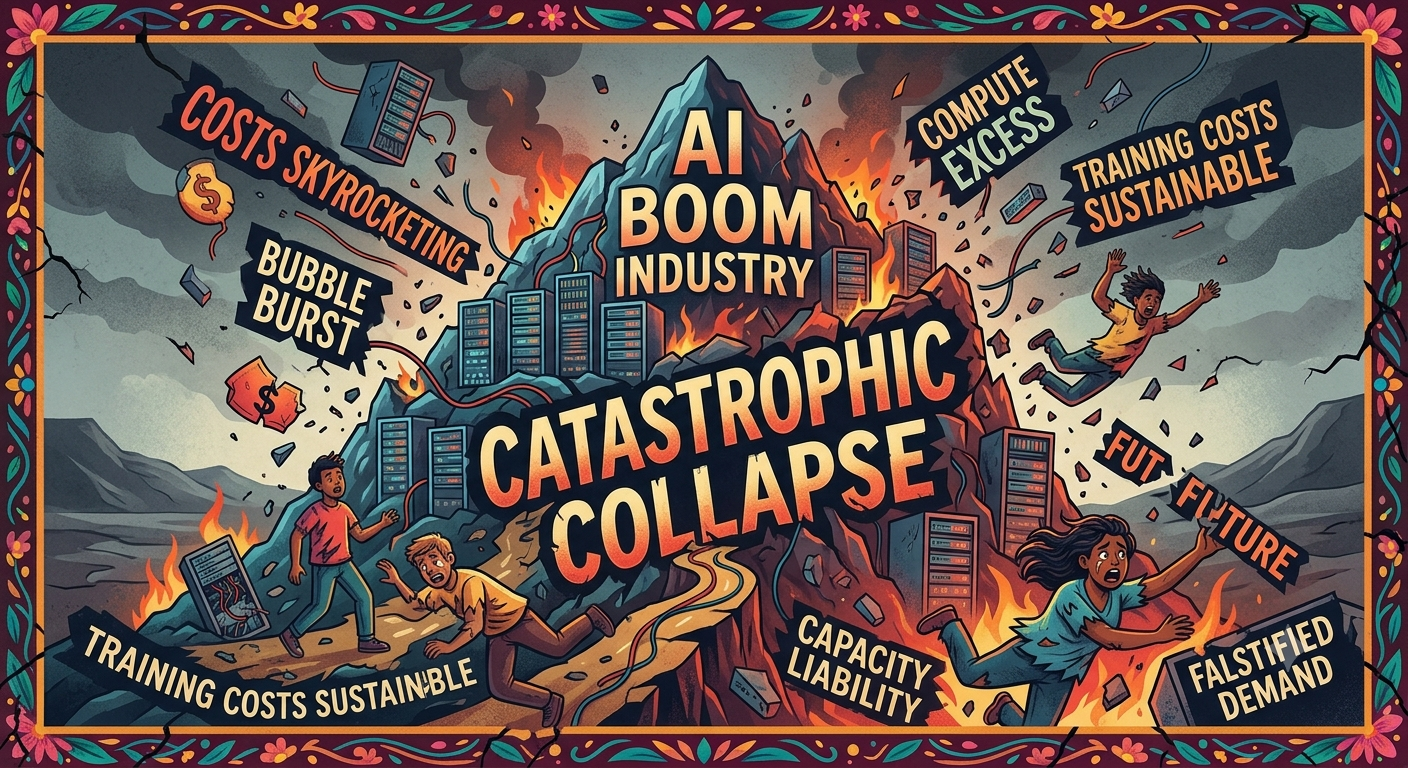
If the cost of a token cannot be reduced dramatically, and soon, this industry is going to undergo a catastrophic collapse.
“Gentlemen, we have run out of money; now we have to think” – Ernest Rutherford

