
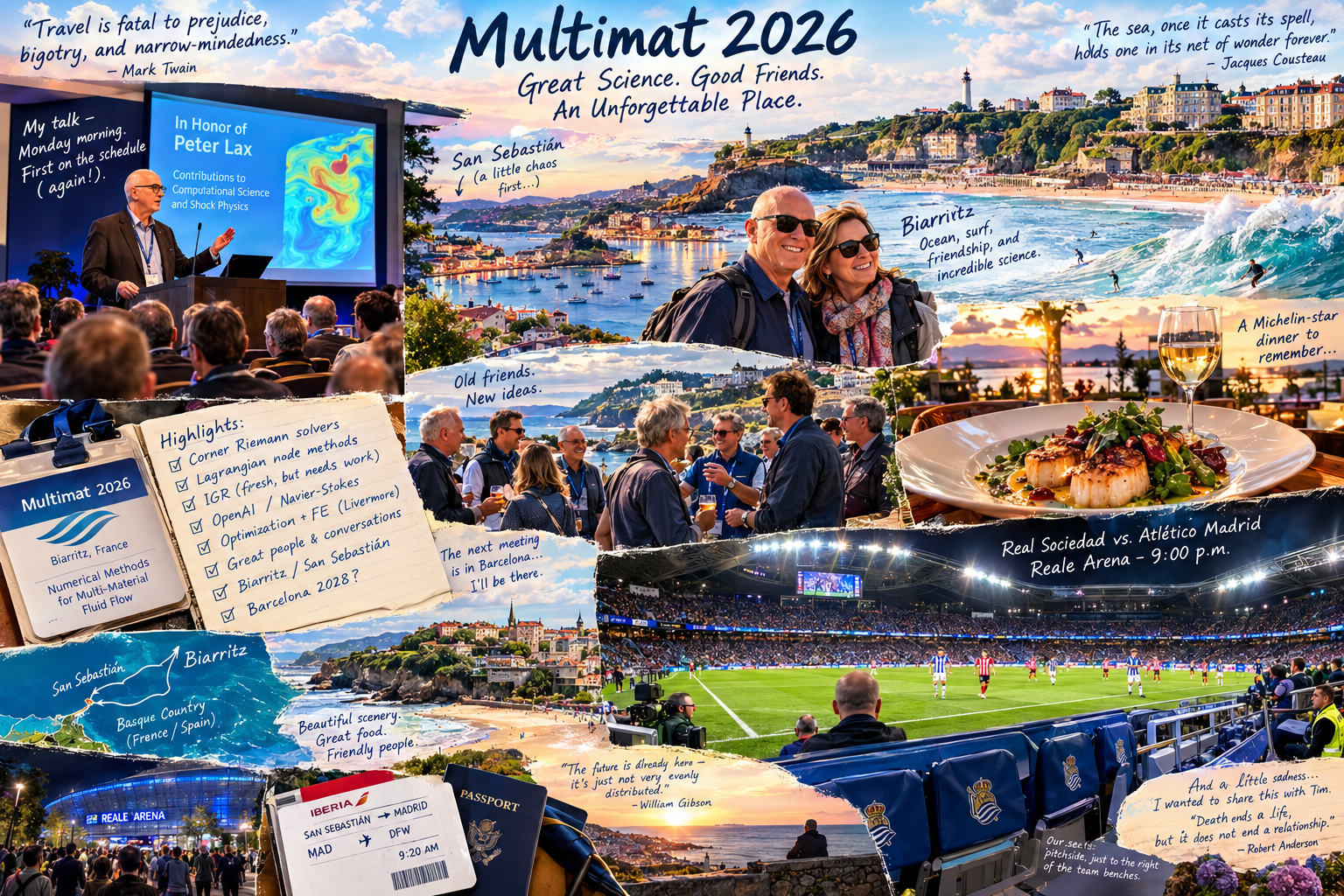
“Travel is fatal to prejudice, bigotry, and narrow-mindedness.” – Mark Twain
About a month ago, I attended the 12th International Conference on Numerical Methods for Multi-Material Fluid Flow. In short, it is colloquially called “Multimat 2026.” I went to the conference to give a talk related to my paper honoring Peter Lax’s contributions to computational science and shock physics. The unusual aspect of the attendance was my being retired. I no longer had program funding to pay for the meeting; instead, I paid out of my own pocket. The reason was the overall quality of this series of conferences over the years. The topics would be intensely interesting to me, and the attendee list was full of friends.
“The sea, once it casts its spell, holds one in its net of wonder forever.” – Jacques Cousteau
The setting for the meeting, Biarritz, France, was wonderful too. It is on the Atlantic coast in the Basque region that spans northern Spain and southwest France. It felt like I had to go. When abstracts were due, I put one in and asked for a speaking slot. The organizers gave me the first spot on the schedule for Monday morning. I had actually given the very first talk of the series of conferences back in 2002 in Paris.
My wife and I traveled there a few days early, deciding to fly into San Sebastian, Spain. No longer bound by U.S. government rules, we flew a foreign airline, Iberia. I ended up flying on my birthday, meaning it was a short day of 16 hours. My wife made up for that with a date at a Michelin-star restaurant in Biarritz. It was a bucket-list item for me. As it turned out, the travel to San Sebastian was awful due to circumstances. We arrived late, around 9 pm, and there was a festival in the city center all around our hotel. Not much sleep was had despite our exhaustion. After the day in San Sebastian and a bus ride to the hotel in Biarritz, I had recovered.
Once we got there, I did my usual scouting of the area. I took a walk down to the coastline to find the conference venue. Unfortunately, Apple Maps and Google Maps were not helpful. I was a bit flummoxed. Then I ran into Misha Shashkov, who was experiencing the same difficulty. I had an idea about its location to explore, and on the way there we ran into the organizers, Raphael Loubere and Pierre-Henri Maire, along with others. My idea was correct, and the mystery cleared up. Raphael and Pierre-Henri took us for a quick tour of the Biarritz coastline and its many attractions. Then we settled in for drinks and dinner at a lovely cafe.
“If I have seen further it is by standing on the shoulders of giants.” – Isaac Newton
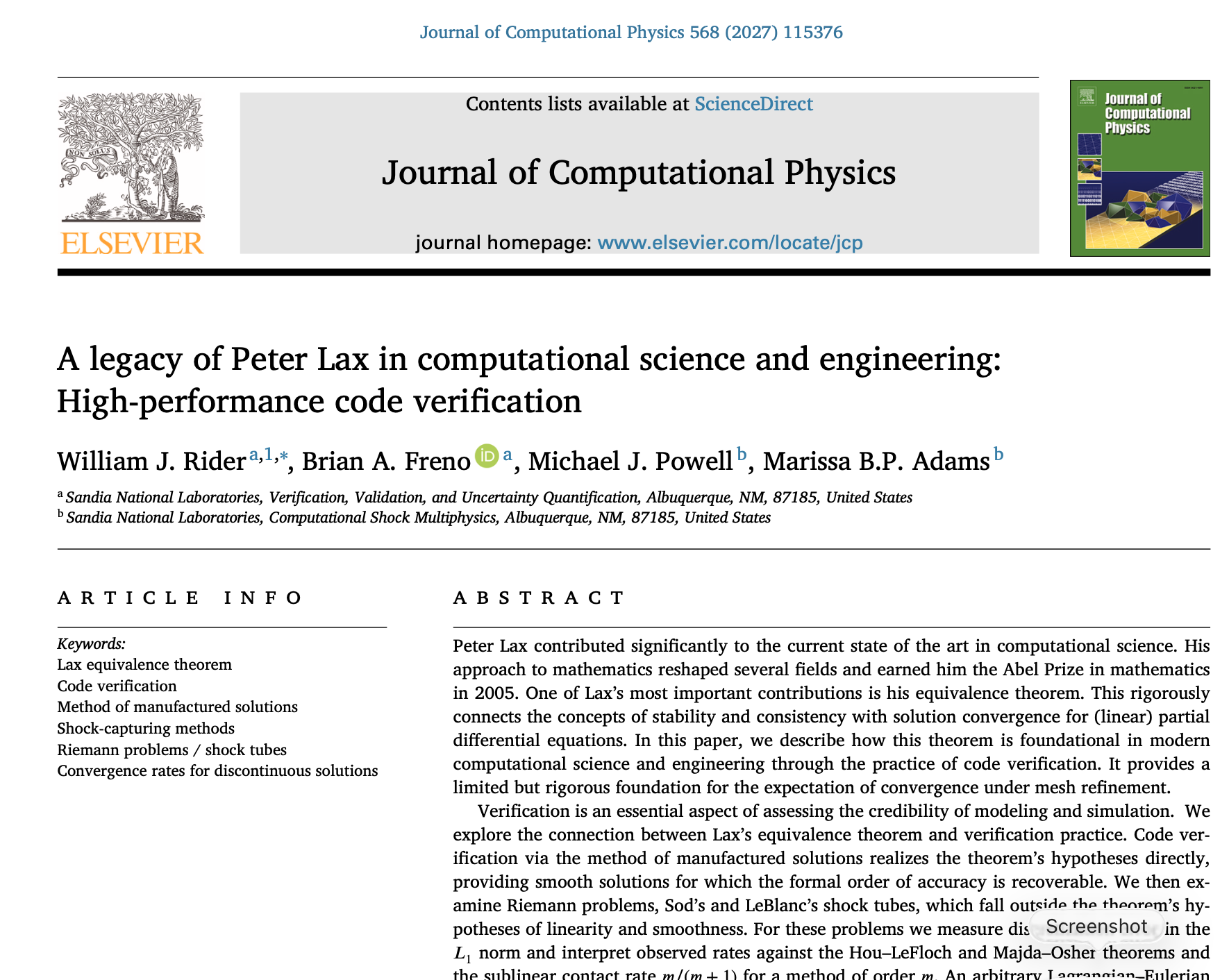
At breakfast before the meeting started, I was reviewing my e-mail. I found that our paper on Peter Lax had been accepted by the Journal of Computational Physics. This was especially fitting, as I was giving a talk on the paper in a couple of hours to kick off the meeting. The meeting venue overlooked the main beach in Biarritz. The waves and ocean hydrodynamics were there to entertain us all week. Biarritz has surfers galore, and the waves invite them. As expected, the organizers did a great job of hosting and organizing the meeting. It is an outstanding meeting, which is why I attended.
I gave my talk, going over the main results of my paper. I was able to express the principal points. Unfortunately, I didn’t get as much discussion as I would have liked. You want vigorous questions after a talk! That said, my talk came up over and over for the whole week as speakers either used my example or apologized for the gaps in their presentations. Overall, I was happy with the outcome. I was thrilled to see the latest research presented. The meeting is overwhelmingly full of great talks and topics. Even better, the meeting is teeming with friends and great conversations at the breaks. It is a single-session meeting with about 100 attendees.
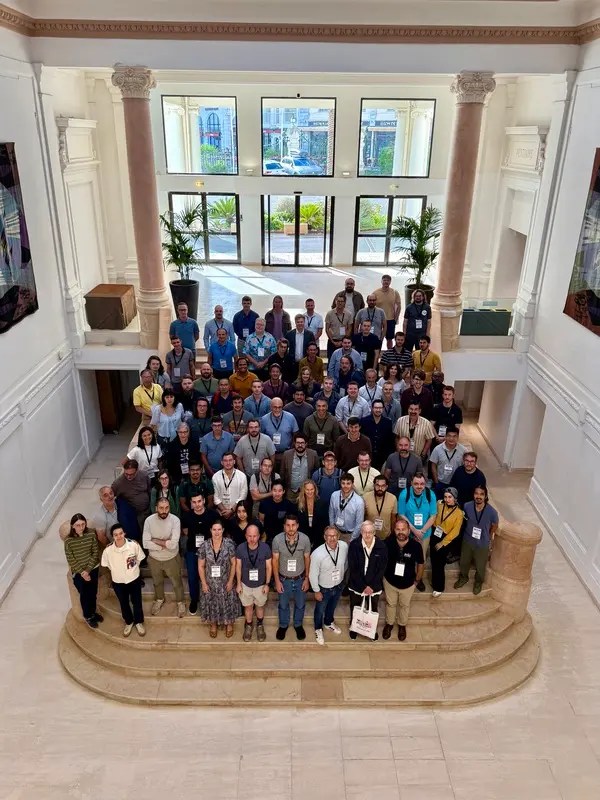
With the meeting in France, European scientists dominated the attendance. LANL had around 12 attendees and LLNL about 19. Unfortunately, Sandia had one attendee. It should be a shocking statement, but it is actually par for the course. I will note in passing that I’ve attended 10 of the 12 conferences. I regret not attending the two I missed (in Prague and Zurich). Sandia isn’t welcoming to foreign travel or conferences in general. This meeting is an exemplar of that attitude. The codes and methods used at Sandia suffer as a consequence. It is really unfortunate and dismal. If I hadn’t retired, I’m not sure I would have attended.
“Science is built up of facts, as a house is built of stones; but an accumulation of facts is no more a science than a heap of stones is a house.” – Henri Poincaré
A few highlights stand out in the technical program. There was a great deal of discussion of corner Riemann solvers. This approach is being extended to more general use. Classically, Riemann solvers are found on cell edges. For cell-centered Lagrangian methods, the Riemann problem needs to move to the nodes defining the mesh to define the movement of the nodes. This approach was pioneered by Bruno Després (a notable and unfortunate absence from the meeting) and Pierre-Henri. A high point of the meeting was Pierre-Henri’s talk on the topic. It also featured in many other talks, along with some generalizations and additional study. To me, this feels like a major advance.
The last day of the meeting had a couple of talks from Pacific Fusion. I perhaps expected more talks from these companies, but it was cool to see. I kept my general disillusioned view of inertially confined fusion as a route to useful societal power to myself. Livermore presented some initial results combining the power of optimization with their impressive finite element solver. This is a great idea, and it is good to see things moving in this direction. If AI weren’t such a big deal, this would be the way of the future. AI muddles this, but it might augment it too.
In the past couple of years, another topic always shows up. This is the IGR (information geometric regularization) approach, which feels genuinely new and fresh. It is also confusing. This time, a relatively young student presented it. This was actually good, as the talk had more explanation and less hype. I could see why and how it works, but also the holes in how it is currently presented. This presentation helped, as it looked at the method in the Lagrangian frame. As such, the underlying solver was much different. The use of WENO in the Eulerian version was a weakness, mostly because WENO would be a good standalone solver without the extra regularization. The formulation is based on the pressureless Euler equations. The form of the elliptic solve hasn’t changed, even as the characteristic structure of the equations changes. This is something to address and fix!
“The future is already here – it’s just not very evenly distributed.” – William Gibson
The week also had the OpenAI announcement of the Navier-Stokes solution by 10,000 agents. Needless to say, this created a real buzz one morning, with plenty of chatter about it. It was a cool place to be when this came out, and we all collectively digested the result. I’m still chewing on it. This contrasted with the almost complete absence of AI (or LLMs or machine learning) in the technical program. This was amazingly refreshing at this time. AI and agents came up in conversation. How could they not? The use of agents to code is a massively important technology for this community, and it is being explored feverishly.
“Friendship is born at that moment when one person says to another, ‘What! You too? I thought I was the only one.'” – C.S. Lewis
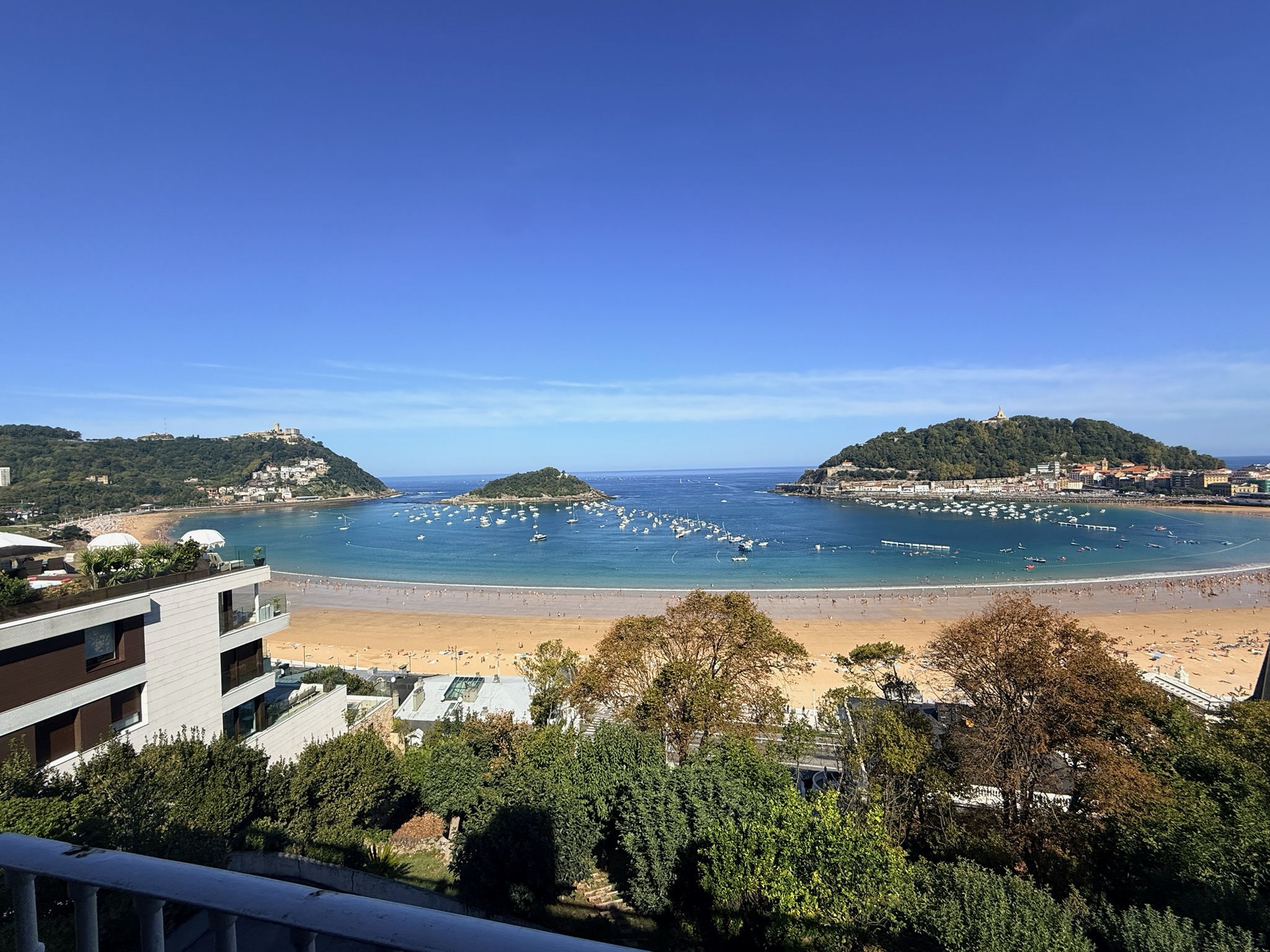
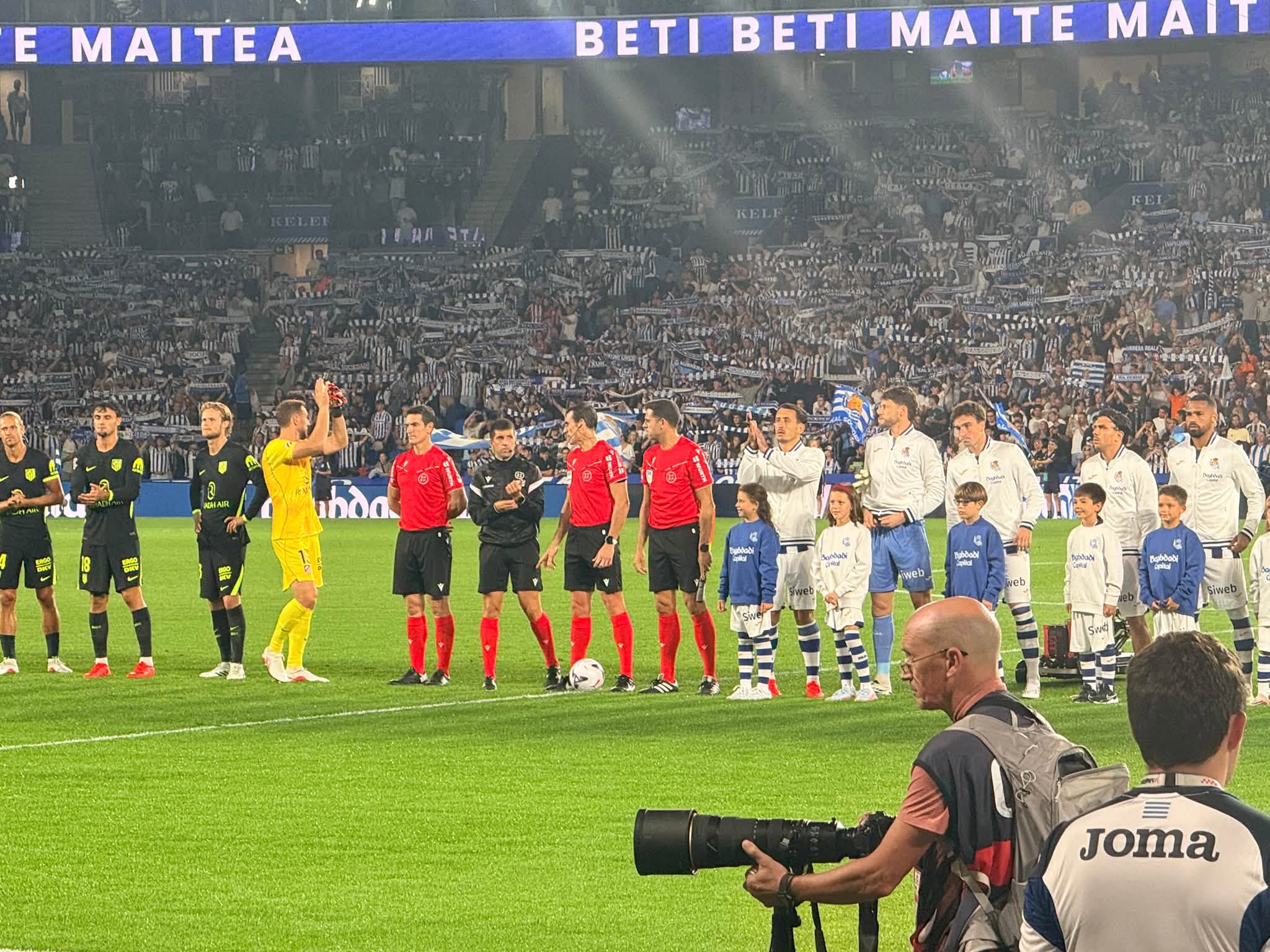
One of the real highlights of the conference is the people. There were old friends and new ones, along with wonderful events. Biarritz and San Sebastian are beautiful, with gorgeous scenery and friendly people. The weather was perfect. I can’t say enough good things about our visit. The hotel was impeccable, and the food was delightful. The area teems with Michelin-star places. My wife and I saw another La Liga game. This time it was Real Sociedad versus Athletic Madrid. The 0-3 scoreline flattered the visitors. The fans of Real Sociedad are phenomenal, and the tickets are reasonable. Great seats for about 100 Euros. In two years, the next meeting is in Barcelona. There’s a good chance I’ll go.
This blog post is overdue. The death of my dear friend Tim delayed it. I had been eager to share this meeting with him in person. That opportunity never came.
“Death ends a life, but it does not end a relationship.” – Robert Anderson


This was an interesting read! It’s great to hear your take on IGR. I was a classmate with Florian so I root for the technology a bit from the sidelines.
^Boy. That really feels like it puts things in perspective. Is there some other technically similar workshop where Sandia sends a giant contingent? Or does Sandia send a big contingent when this is in the US?
Sandia send people in number to some mechanics meetings. Larger presence in Aero meetings. Shock stuff tens to focus on Applied meetings in the DoD frame, but not computational physics. Supercomputing is big there too (not really a technical meeting any longer, but a trade show)