
“Never attribute to malice that which is adequately explained by incompetence.”– Arthur C. Clarke
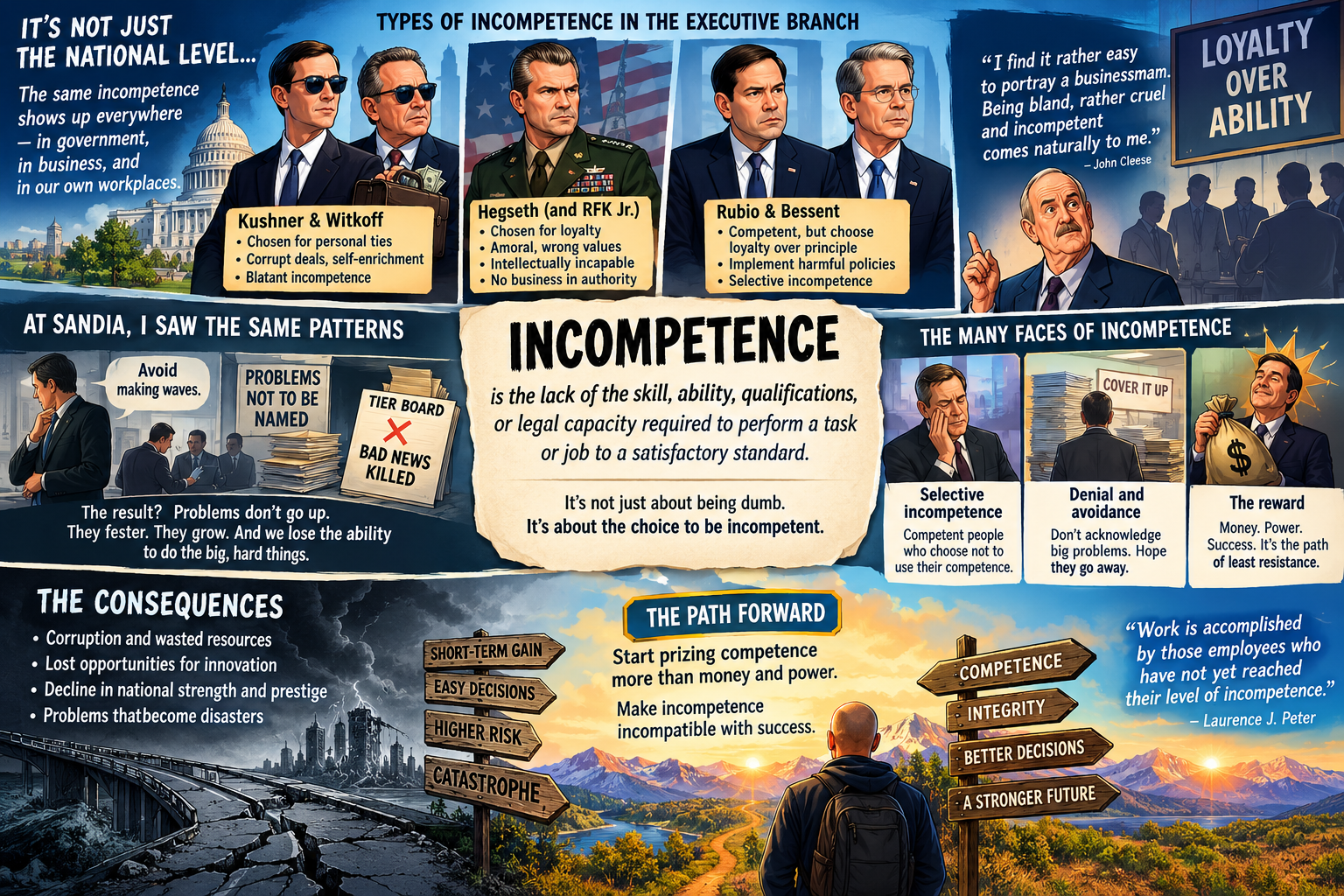
Incompetence is the lack of the skill, ability, qualifications, or legal capacity required to perform a task or job to a satisfactory standard. It represents the opposite of competence and can manifest across general performance, specialized fields, and interpersonal dynamics.
I got some fairly sharp feedback on my essay about incompetence and its spread among leadership. It even went so far as to say I should take the post down because leaders can’t possibly be interested in putting incompetent people beneath them. I beg to differ on the basis of what I see, both at the national level and in my experience over the past few years at Sandia. It is not what should be. It is what is actually present. Examples follow below.
It’s from the observation that the incompetence we see in the Trump administration is actually present across society.
Typically, when we think of incompetent people being placed in positions of authority, it is the selection of someone due to loyalty. Often related to a personal relationship, a bribe, or some other decision factor that has nothing to do with the job being done. This happens in situations where loyalty to the leader is the most important thing. Sometimes these people have the capacity to be competent but simply choose not to operate competently so that the leader is happy. This is selective incompetence. It is quite common everywhere in society.
“I find it rather easy to portray a businessman. Being bland, rather cruel and incompetent comes naturally to me.” – John Cleese
To most of us, the current executive branch of the government is a sparkling example of incompetence in action. We see the different types of incompetence on display.
For example, Jared Kushner and Steve Witkoff are our envoys and negotiators. They are completely incompetent and were chosen only because of their personal relationship with the president. Then you see the incompetent people chosen for loyalty. These are people like Pete Hegseth and, astonishingly, RFK Jr. Finally, you have the people who are competent and simply choose not to use their competence. These are people like Treasury Secretary Scott Bessent and Marco Rubio, our Secretary of State.
The way the incompetence manifests itself is different in each case. For Kushner-Witkoff, it is simply the capacity to operate in a manner that would be viewed as criminal in any sane world. They are simply using their positions to make corrupt deals rather than negotiating in the best interests of the United States. This is ordinary and blatant incompetence. They are loyal to the boss and work to line their pockets along with his.
Then you have the people who merely operate through loyalty or vested interest. Hegseth is this sort of incompetent person. He is certainly intelligent, but his fundamental philosophy and approach to the world, basic values, and ethical system undermine any competence he might have. He is simply an astonishingly amoral person who has no business being in a position of authority. He’s also intellectually incapable of the job he’s doing, including an inability to administer something as sprawling and huge as the Department of Defense.
Finally, you have Bessent and Rubio, who, by all accounts, are both highly competent individuals. They choose to support incompetent decisions time and time again, merely out of loyalty. Both Rubio and Bessent are agreeing to and implementing the administration’s policies. These policies are basically a withdrawal of American power and prestige, purely for near-term gain, usually the gain of the president himself. They are implementing them without regard to the damage they’re doing to the future of the nation. This is the epitome of selective incompetence.
“The first method for estimating the intelligence of a ruler is to look at the men he has around him.” – Niccolò Machiavelli
When I change over to my observations about Sandia, this is the most common form of incompetence I encountered.
Before I retired, I saw people who certainly had the intelligence and the capacity to operate competently but chose not to. The reasons for choosing not to were varied. Most often, it was to avoid making waves and causing problems for those above them. This was probably the motivation behind what happened to me.
There also emerged this maxim among leadership: problems were not to be named. Often, the idea of simply covering them up and hoping that they wouldn’t blow up became the operative principle. This was seen clearly in what Sandia would call the tier board, a means of moving and escalating information up or down the management chain. It is useless because of implicit incentives.
What I noticed more and more over time was that anything negative on the tier board was simply killed. It never made it up the chain. My understanding is that this behavior was repeated over and over across the levels. Thus, bad news, problems, and issues never made their way up to the highest ranks. We see this same behavior reflected in our government. There seems to be an absolute moratorium on reality anytime that reality is in any way, shape, or form negative for the leader. The long-term consequences of this sort of leadership are likely to be catastrophic. Problems fester and grow, and solutions are rarely sought. Thus disaster is courted.
The biggest problem at the labs is the increasing inability to do big things. Doing big things is the result of solving hard problems. When those problems don’t exist or aren’t acknowledged, we don’t create, we don’t innovate, and we don’t do the hard things. The reason is the incompetence of leaders who refuse to acknowledge or accept big problems. Worse yet, they punish those who bring them the problems and do not enlist expertise in solving them. This is something I witnessed over and over in my final years at the labs. The decisions are made by nominally competent people who chose a different path. The easy, incompetent decision in front of them is easier to implement. Thus, they choose the easy way. Again, selective incompetence is found.
Selective incompetence is a fundamental moral or ethical failing. It is taken by a competent individual who chooses the path of incompetence. Why do they do it? I can only surmise that it is the path to success, money or power. Other considerations are insufficient to choose competence.
The path forward is to start prizing competence more than money and power. Incompetence becomes incompatible with success.
“Work is accomplished by those employees who have not yet reached their level of incompetence.”– Laurence J. Peter

