
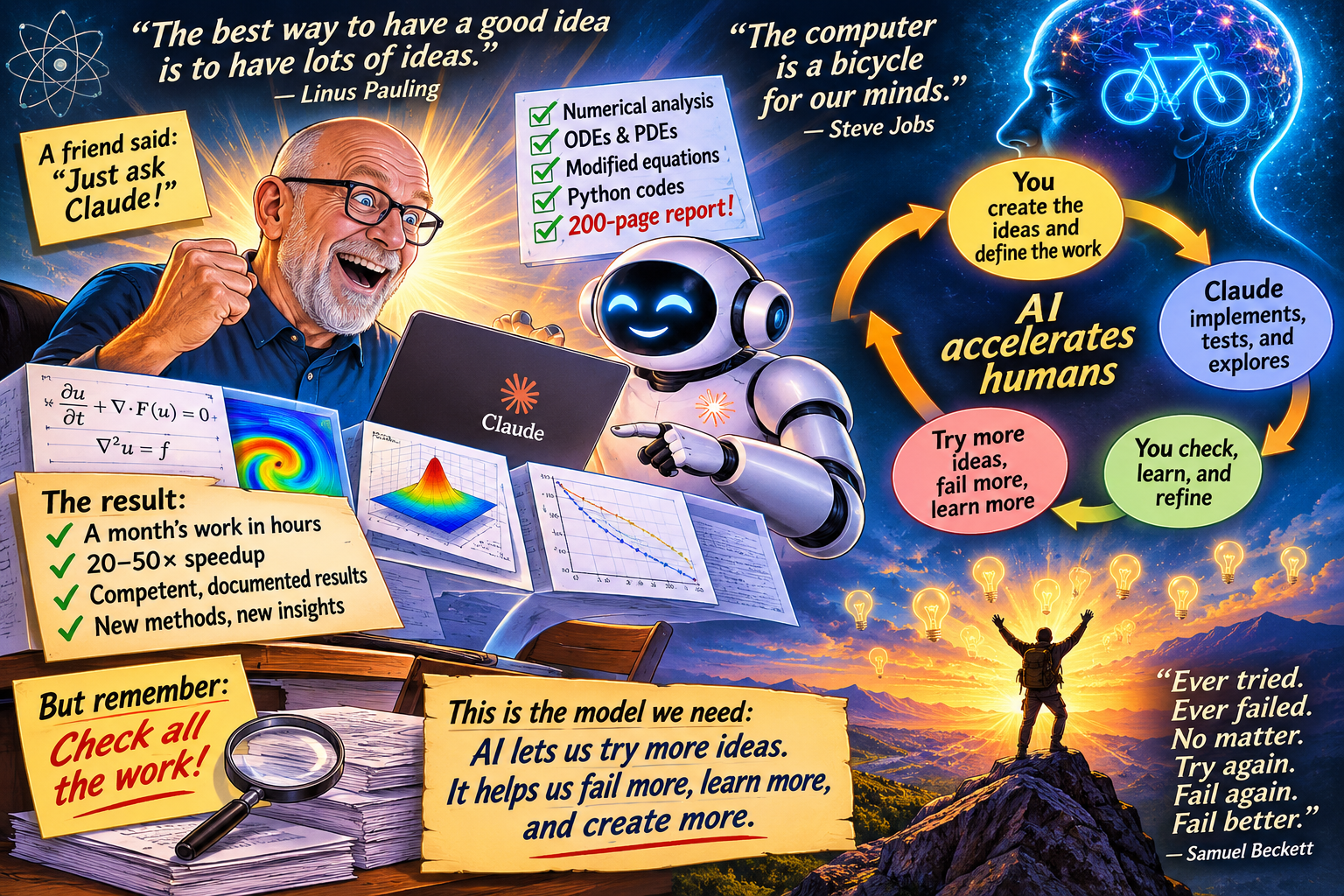
“The best way to have a good idea is to have lots of ideas.” – Linus Pauling
Steve Jobs called the computer “a bicycle for our minds.”
I’ve been working on an idea with a friend and colleague. Some of that work called for numerical analysis, and since retiring I no longer have the software I used to rely on. For these tasks, I had always used Mathematica, which is expensive. My friend kept saying I should just ask Claude to check things, as if it were easy. This weekend I finally took him up on it.
I quickly found that Claude could do the analysis using Python libraries. Even better, it wrote up a report, and I could ask questions in plain language. What else could it do? I started asking Claude for the kinds of analyses I used to do myself. I derived numerical approximations. I analyzed accuracy and stability for ODEs and PDEs. I did modified equation analysis of various methods. It did a great job on every task, did it quickly, and produced documentation for me to check.
Next, I wanted to see the methods in action. I had Claude write and run code. I defined metrics and computed convergence rates. I implemented a host of linear and nonlinear methods, and I created some new ones. All of this happened at lightning speed. Soon I had a 200-page report covering everything I had asked for. The work was extremely competent, the feedback was useful, and all of it was scrupulously documented.
My mind was completely blown!
By the time I was done, it had done a month’s worth of work in hours. Counting the time I spent checking results, it was maybe one full working day. That is a speedup of 20 to 50 times, depending on how well I specified the tests. I can now see how easily it can help with work and accelerate the fuck out of progress. It gives me feedback, but the ideas and the direction are mine. I also need to check all the work. It needs to be verified! Without my guidance and creativity, the work isn’t worth much.
This should be the model for AI. It increases your productivity. You create and define the work, and it implements and tests your ideas. This applies to some very specific kinds of knowledge work, and it mirrors what we’ve seen with coding agents. The human is still driving. It lets you test, study, and implement more ideas. You can innovate and fail at a breakneck pace.
This is a change from how we usually work. Checking and verifying the work is critical. Verification needs to be based on well-defined and understood principles. It is somewhat more results-based, but requires a full education. I can see this change being needed in education. Any work done with AI needs to be seriously scrutinized. This is a skill to be learned as an emphasis.
This is the model we need. AI accelerates humans. It lets us try more ideas. Really, it lets us fail more. The barrier to exploring an idea gets lower. Most ideas won’t be good. The key is to fail and learn, then refine the idea and try again. You go through more cycles: fail more, learn more, create more.
“Ever tried. Ever failed. No matter. Try again. Fail again. Fail better.”– Samuel Beckett

