
tl;dr
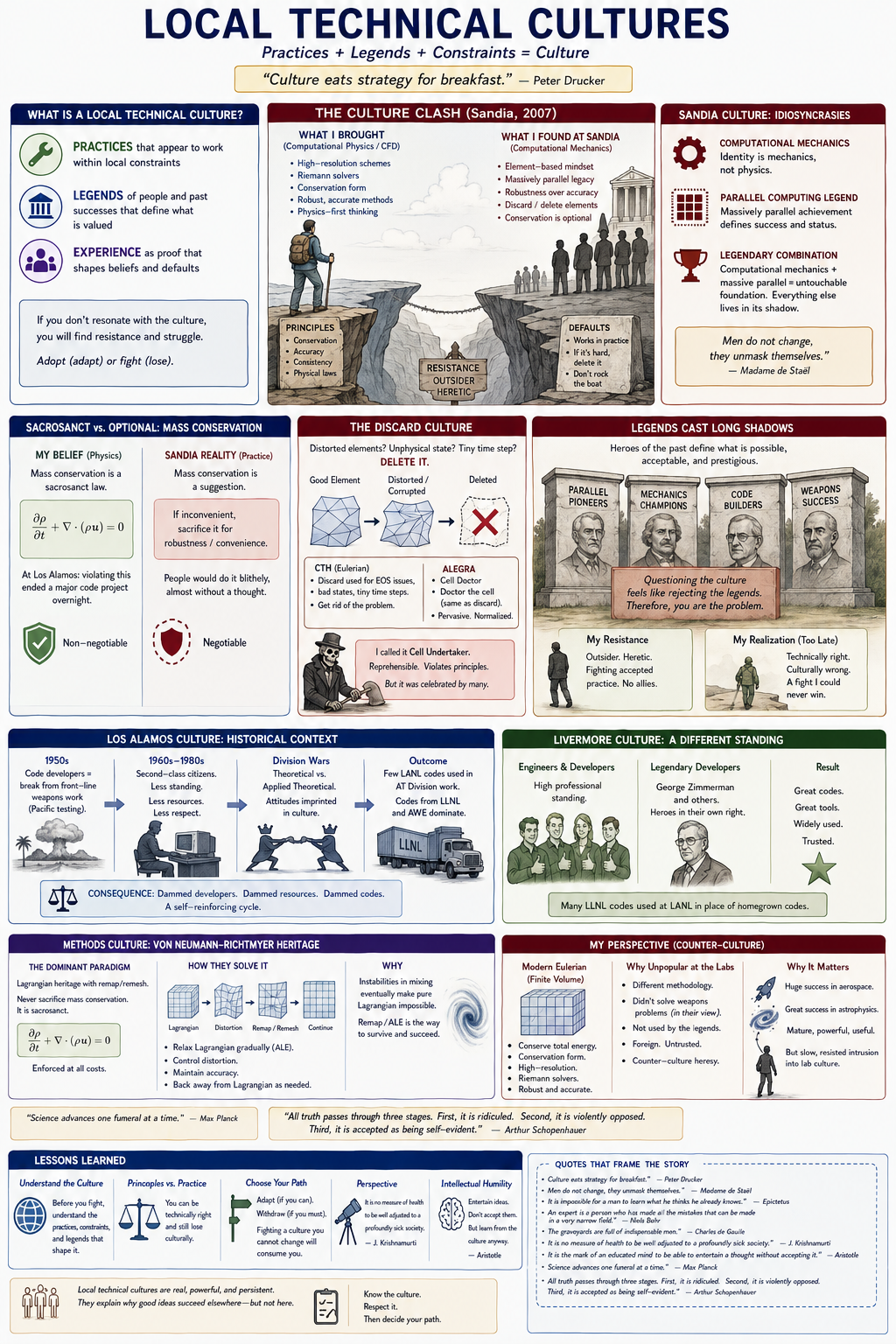
A key element in personal and professional success is the culture of the place you work, down to a very local level. What I discovered is that these local cultures are essential to how places operate. They are founded on practices that appear to work given the constraints of the job. They are shaped by the legends of people who have excelled there in the past. Together, these comprise a local culture that your work had better resonate with. If you don’t, you will find resistance and ultimately difficulty in achieving professionally. You either adopt the culture by adapting your beliefs to it, or you fight it and lose.
“Culture eats strategy for breakfast.” — Peter Drucker
Every Culture Holds Experience as Proof with Practices and Legends
As I described in my last post, when I took the job at Sandia in 2007, I had a highly refined set of skills. I had refined the craft of producing robust, powerful numerical methods for a wide class of problems of interest to the labs. The people who hired me at Sandia saw this as well. The thing that neither of us understood well enough was how difficult the craft I possessed would be for the culture I was going into. The culture and computation at Sandia have several strongly idiosyncratic aspects:
- It is fundamentally a computational mechanics community, not a computational physics community.
- Massively parallel computing was an epic achievement at Sandia, and the momentum from that achievement still holds sway today in the minds of those who lead it.
- The combination of computational mechanics and massively parallel computing is a legendary success. Everything else at Sandia is in the shadow of those.
“Men do not change, they unmask themselves.” — Madame de Staël
Coming from Los Alamos, I thought of things more in terms of computational physics. I was also well versed in modern computational fluid dynamics and generally believed in what came with it: high-resolution schemes, Riemann solvers, and the absolute necessity of conservation form. Virtually none of this was accepted or even deemed important at Sandia. This led to an almost immediate culture clash between my firmly held beliefs and the beliefs of those I was working with. This was true even when working on the ALEGRA code, which was an outlier within the core computational mechanics community at Sandia.
Take, for example, the concept of mass conservation. In my mind, conservation of mass is a sacrosanct physical law. At Sandia, in the computational mechanics community, conservation of mass is merely a suggestion. There is a willingness to sacrifice it in the name of robustness and convenience. The willingness to sacrifice mass, when it became inconvenient, almost immediately came to a head when I arrived at Sandia. The people would do it blithely, almost without a thought. I can contrast this with Los Alamos, where such a practice ended a storied and very expensive code project virtually overnight.
“It is impossible for a man to learn what he thinks he already knows.” — Epictetus
The episode at Los Alamos is interesting because the adherence to conservation of mass, and the consequences of not doing so came from an avenue at the lab that was hardly the most principled in terms of how computations were pursued. I’ll get into that a little bit later.
At Sandia, the computational mechanics community will remove elements from problems as soon as they become distorted. The elements are viewed as corrupted and completely unable to be fixed or retained. They’re just deleted. To me, this looked like a practice that was tailor-made to destroy the legitimacy of any calculation that was done.
“An expert is a person who has made all the mistakes that can be made in a very narrow field.” — Niels Bohr
Much to my revulsion, this practice was copied in the Eulerian hydrodynamics arena with the code CTH. There, the discard feature was used to get rid of problems, dominantly with the equation of state. This was whenever a material entered some modestly unphysical state that would cause issues with things like sound speeds, creating very small time steps. ALEGRA had a similar feature. They called it Cell Doctor, a way of doctoring the code in the same fashion as discard. The procedure was simple and pervasively used, without seeming understanding of the negative consequences of doing so.
“The graveyards are full of indispensable men.” — Charles de Gaulle
My reaction to this practice was immediate and strong. I found the entire idea completely reprehensible and a violation of principles so important that there had to be a different solution. I started by making fun of Cell Doctor, giving it other names like Cell Undertaker. Nothing could change the fact that I was pushing against a practice that was widely accepted and, to some extent, celebrated within the community I was now working in. Let me be perfectly clear: there is nothing that has ever convinced me that discarding the conservation of mass is a good idea.
I look back now, still feeling the same way, and realize that what I was chafing against was an extreme cultural norm that the computational mechanics community had accepted as almost second nature. My resistance to it made me an outsider and a heretic. I was so sure of the correctness of my perspective that I didn’t step back to examine the nature of this disagreement and its sources. I was rejecting a technique that was storied and accepted within the Sandia community, one that had been championed by several key people who were heroes and legends of the past. Therefore, my repudiation of it was also a repudiation of those legends.
“It is no measure of health to be well adjusted to a profoundly sick society.” — Jiddu Krishnamurti
In retrospect, I see my error. Not that I was wrong technically, but that I was wrong culturally. I was choosing to battle something that had been accepted by this community, and it was also something I could not replace with other means. I had a general set of principles and practices that pushed against all of these ideas. In the end, I should have simply withdrawn, because it was a fight I was never going to win. My retirement was my final surrender, see the light of the futility of fighting culture no matter how wrong it is.
To some extent, I witnessed similar trends at Los Alamos. For example, code developers in the Los Alamos ecosystem were treated as second-class citizens. I have described before how this came to pass. Being a code developer in the 1950s was seen as a way to take a break from the front-line grind of developing nuclear weapons, especially with Pacific testing. This mentality persisted through the 1960s, 1970s, and 1980s. Code developers were always considered less than the people who designed and analyzed nuclear weapons. This lack of professional standing damned them to second-rank status. It damned the resources given to code developmetn too. It really damned the codes they developed.
There was also ongoing tension between the Theoretical Division and the Applied Theoretical Division, where the weapons work predominantly took place. Those wars, and the attitudes that were imprinted in the culture. This meant that very few Los Alamos codes were ever used to do the work in the Applied Theoretical Division at Los Alamos. Almost all the code work was done using codes developed at Lawrence Livermore National Laboratory, and even at AWE in England. Conversely, it’s no small statement to say that code developers in computational physics had a much higher standing at Lawrence Livermore. The difference is huge. Livermore developers are some of their most storied employees (e.g., George Zimmerman). This alone accounts for much of that laboratory’s success in developing codes. Many of these codes were ultimately used by Los Alamos in their work in place of homegrown codes.
“It is the mark of an educated mind to be able to entertain a thought without accepting it.” — Aristotle
I had already waded into some pretty deep waters in terms of the culture. My expertise in modern methods (which came more from CFD) chafed against the methods used by Los Alamos and Livermore. The methods most in use at those labs were based on the work of John von Neumann and Robert Richtmyer. The codes developed in two and three dimensions were ultimately derivatives of that basic methodology. They had been used for decades and their basic use was axiomatic.
The codes at Los Alamos and Livermore would never sacrifice mass conservation under any circumstances. It was viewed as sacrosanct. This gave rise to the use of various remap and remesh methods. These allowed the Lagrangian approach they took to be relaxed, but solving many problems as they became more complex. Ultimately, instabilities in mixing took over, rendering a Lagrangian calculation impossible. The Labs used methods that allowed one to slowly back away from Lagrangian.
“Science advances one funeral at a time.” — Max Planck
My own work was on modern Eulerian codes, which completely sidestep this problem. They are also quite unpopular at the labs. They had great success elsewhere, primarily in the aerospace community. They had also achieved greatly in astrophysics, which is similar to work at the Labs. None of this mattered at all. These methods were counter-culture heresy. One of the key differences is energy conservation. Modern Eulerian codes conserve total energy. The Lab codes do not and they have reasons for this preference. High contrast adiabatic compression is the reason.
Outside the labs, these codes have matured greatly and have a great deal of energy and utility. The intrusion of this technology into the labs’ work has been slow and fraught with problems. The main issue is that these methodologies are quite different and come in as a counterculture example. The culture fights and resists it because it’s foreign, not because it’s not a good idea. It simply wasn’t used by the heroes of the past, and it is something external that they don’t trust. It matters little that the methods had their foundational origin at Los Alamos (e.g., Peter Lax). These methods had not pulled their weight in solving nuclear weapons problems.
“All truth passes through three stages. First, it is ridiculed. Second, it is violently opposed. Third, it is accepted as being self-evident.” — Arthur Schopenhauer


Pingback: The Power of Being First, or Why Great Ideas Fail to be Accepted? | The Regularized Singularity