
“Responsibility is a unique concept… You may share it with others, but your portion is not diminished. You may delegate it, but it is still with you… If responsibility is rightfully yours, no evasion, or ignorance, or passing the blame can shift the burden to someone else. Unless you can point your finger at the man who is responsible when something goes wrong, then you have never had anyone really responsible.” — Adm. Hyman Rickover
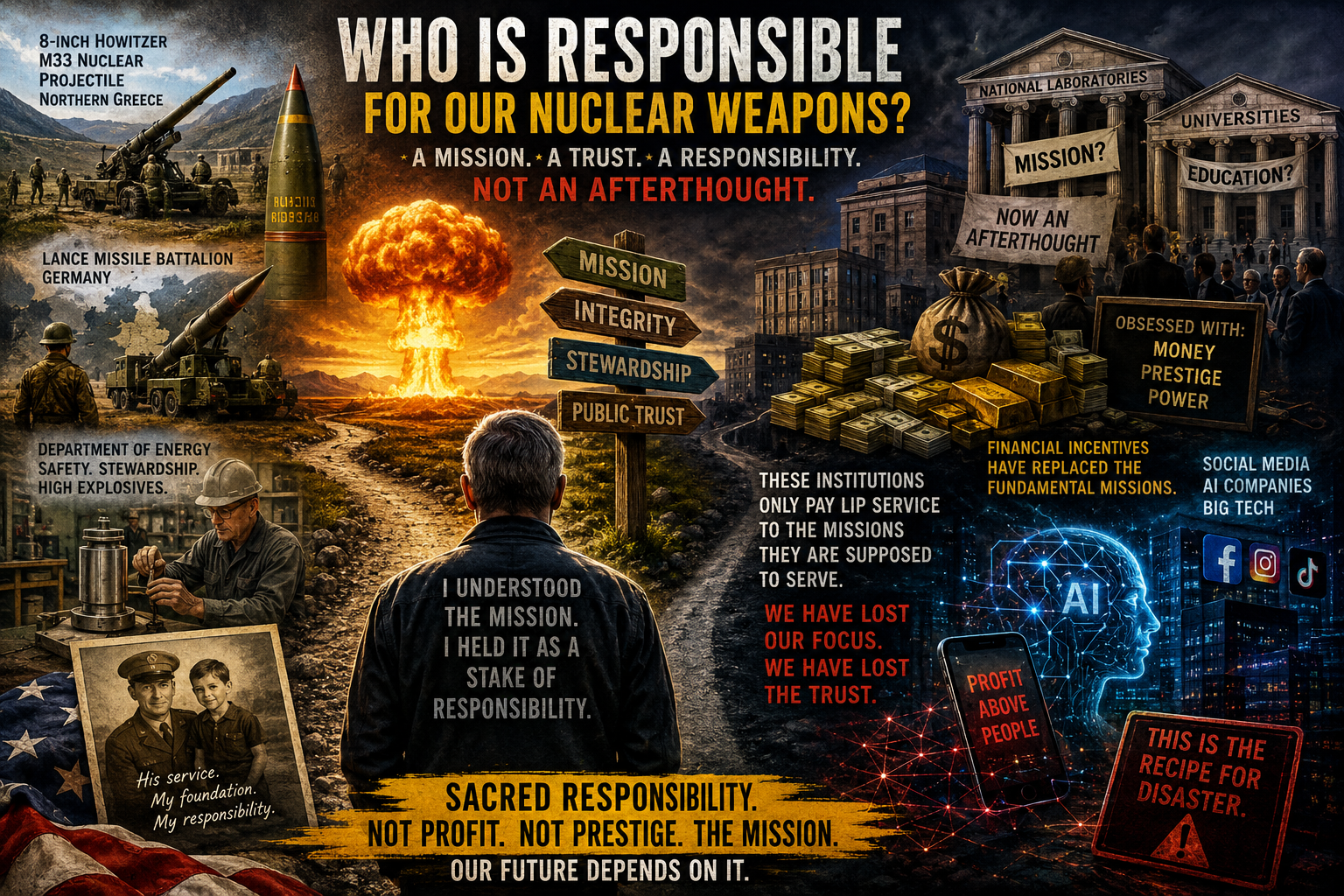
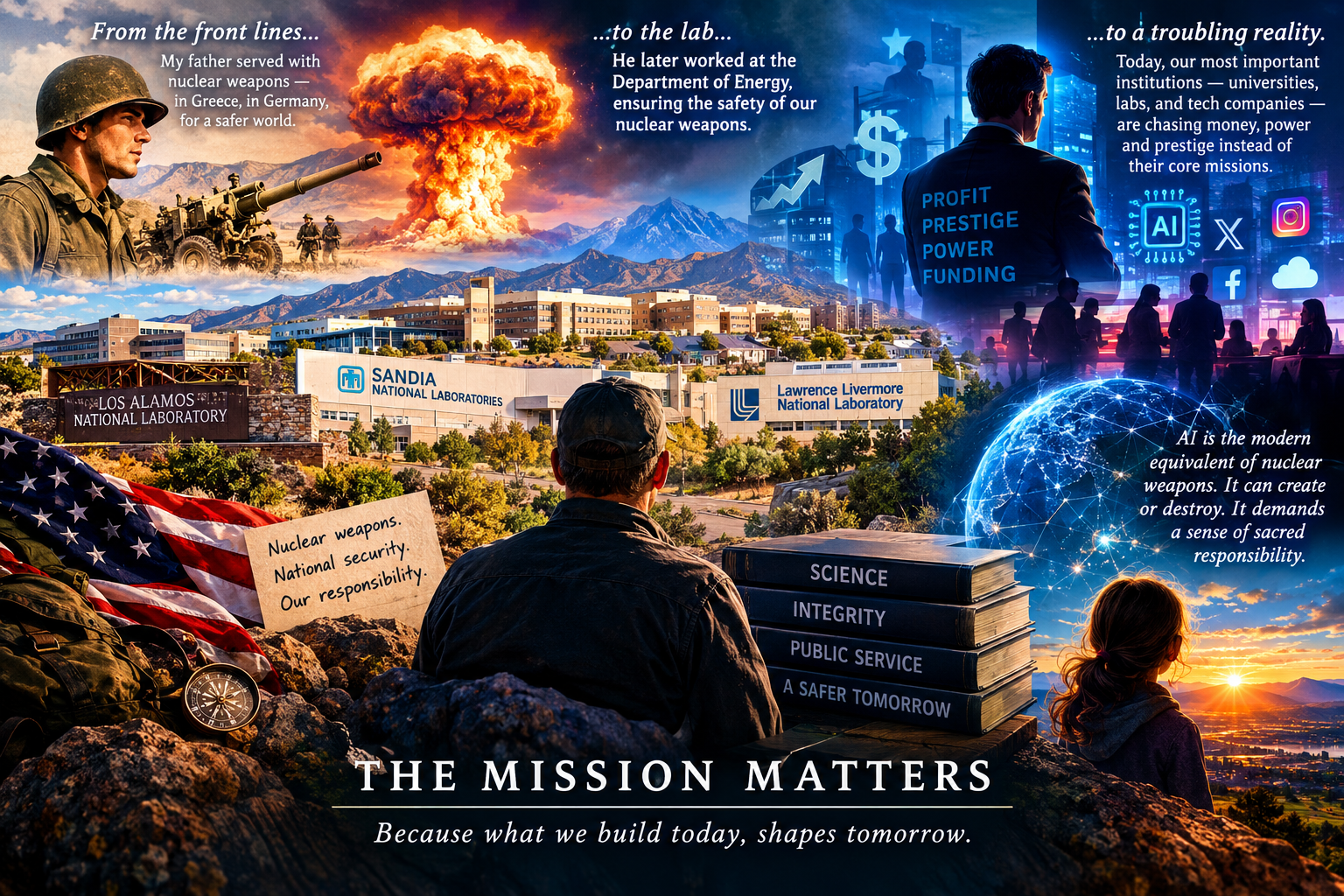
My father spent a career in the United States Army and then a second career at the Department of Energy, much of it working with nuclear weapons. When I was born, he was overseeing a battery of 8-inch howitzers armed with the W33 (or Mark 33 as my dad called it) projectile, which is a multi-kiloton-class nuclear weapon. He was stationed in Northern Greece, just south of Yugoslavia. My own conception was centered around the Cuban Missile Crisis. That event was our closest approach to Armageddon. Surviving it was the impetus for starting a family.
Later in his career, he was working with a Lance missile battalion for the Army in Germany. These were nuclear-tipped tactical weapons defending against a potential Soviet invasion of Western Europe. After he retired from the Army, he worked for the Department of Energy in a capacity to ensure the safety of our handling of the high explosives used in the nuclear weapons. He spent his life supporting the use and safety of these powerful weapons. It was noble service to a grateful nation. It shaped my own view of them.
“To be somebody or to do something. In life there is often a roll call. That’s when you will have to make a decision. To be or to do? Which way will you go?” — Col. John Boyd
His service on the use end of nuclear weapons had a deep impact on me. I joined the family business with a job at Los Alamos. I could see the production, the design, and the use of nuclear weapons vividly in my mind. When I began to work for the National Laboratories, I understood the mission, but I also held it as a sacred responsibility. I saw that fulfilled early in my career, but gradually, over time, after the turn of the 21st century, things began to change.
I am roughly six months into my retirement. As my more loyal readers might recognize, I left my career under rather distressing circumstances. I’ve been asked by friends, acquaintances, and family about the circumstances and the figure with which I write about that circumstance. I feel that it’s useful to articulate more about the foundation of these reasons. The same question from those who love me or those who know me. I hope the rest of you find it beneficial.
I am alarmist because the issues are alarming.
I spent nearly 40 years working at two national labs. Each has as its ostensible primary mission the care and performance of the nation’s nuclear weapons stockpile. This is a responsibility that I felt deeply and personally for most of my career. It is the advertised mission for both Los Alamos and Sandia National Laboratories, as well as Lawrence Livermore. These revered institutions no longer take this mission with the seriousness it deserves. During the Cold War, these Labs were founded and became amongst the best in the world. They no longer have that status. I’ve written about why.
“The prospect of domination of the nation’s scholars by Federal employment, project allocations, and the power of money is ever present and is gravely to be regarded.” — Dwight Eisenhower, Farewell Address (1961)
I have some deep personal reasons why it feels so important to me, perhaps more important than the average person. I believe that the circumstances of my departure speak volumes about the institutions that I worked for and their current status. Institutions of this sort, with other missions in the United States, are under continued assault and have lost the trust of the people. I believe the reasons for this are very clear. These institutions, including the ones I worked for, are only paying lip service to the very missions they are supposed to be serving. This is true at the nuclear weapons laboratories where I worked, and it is a fact that should dismay the people of our country. It is not limited to the nuclear weapons laboratories.
My wife worked for the last 20 years of her career at a university. The university’s primary mission is education, and what she saw there was similar lip service to the mission and a change in the priorities of leadership. This change paralleled what I saw at the National Laboratories. In both cases, the primary mission of the institutions had become an afterthought and almost something that the leadership simply supposed was being supported. Instead, the leadership was focused on a host of other things unrelated to the mission.
“In a fully developed bureaucracy there is nobody left with whom one can argue, to whom one can present grievances, on whom the pressures of power can be exerted… this is what the political jargon calls rule by Nobody.” — Hannah Arendt
Primarily, they all became obsessed with money and prestige, the prestige of power and the money that fed the institutions. Financial incentives had replaced the fundamental missions. The fundamental mission had become a second-rate, mildly unsupported activity at each of these places, universities and laboratories alike. The mission has become diluted by numerous objectives from the left and the right politically. All of them detract from the focus on the core mission.
I believe the same trends hold across our most important institutions, and also across our industries. No more so than our internet, social media, and artificial intelligence companies, which now only work to support profit and money objectives. They hold virtually no adherence to the benefits and well-being of the society that they exist within. Care for societal well-being is essential. Artificial intelligence perhaps serves as the modern equivalent of nuclear weapons. Both artificial intelligence and nuclear weapons have the power to destroy as well as create good. They both need a sense of sacred responsibility from those who are charged with their development and use. This is the recipe for disaster.
“We must not allow Big Science to destroy the tradition of scholarship.” — Alvin Weinberg
The leadership began to fail in this duty. Over time, they gradually began to work in a way that did not serve the best interests of the nuclear weapons mission. They were instead focused on their own professional success, which revolved around funding and securing money. They would seek programs that adequately funded their organizations, whether or not those programs actually served the nuclear weapons mission. Perhaps no national program epitomized this change more than the Exascale program. The advanced computing program at the labs after the Cold War ended began on the wrong foot. They took a course correction after a few years and operated well for about a decade. Then it fell into the broader national decline.
We have a process of annual certification. I worry that it has stumbled into a box-checking exercise. We go through the motions, but the option of raising a red flag is missing. The Lab Directors have no option other than approving the status without regard to the evidence. Meanwhile, the evidence becomes thinner and thinner with each passing year. We are nearly 34 years since the last test of a weapon. Hopefully they are aging well and still safe and secure. I don’t know one way or the other. My concern is that the quality of work is in free fall. Those with responsibility for them act in ways that give me great pause. Are we really doing the hard work? It seems like we are just going through the motions, pretending everything is okay. Given the constraints of not testing, we are not doing the hard work necessary for confidence. I’ve seen this clearly.
I am fairly sure that if a Lab Director failed to certify the stockpile, they would be fired in short order. It would be career-ending. They would lose millions of dollars in compensation for that act. So given this, do they even have the choice?
“It would appear that, for whatever purpose, be it for internal or external consumption, the management of NASA exaggerates the reliability of its product, to the point of fantasy.” — Richard Feynman, Appendix F, Rogers Commission Report (1986)
This finally came to a head in my own career, in the events that unfolded right before I retired. This is the origin of the vigor with which I have pursued truth-telling. I see leaders who are using the secrecy necessary for nuclear weapons to defend their own incompetence and irresponsible actions. No one is rewarded for acknowledging problems. There are always problems. The actions that were taken that led to my retirement were modest. I know of other circumstances that are far worse, far more dangerous, and far more damaging to our national security. Nonetheless, in principle, the things they did do not serve the nation well in its ability to have a sufficient and usable nuclear stockpile. The consequences of this are profoundly disturbing.
“Secrecy is a mode of regulation. In truth, it is the ultimate mode, for the citizen does not even know that he or she is being regulated.” — Daniel Patrick Moynihan, Secrecy: The American Experience (1998)
A few notes about the nature of responsibility. Nuclear weapons writ large are the responsibility of the President. The military, like my father, is responsible for the care and use of the existing weapons. Scientists and engineers like myself are responsible for the design and analysis of them. We use our talents and work to make sure the military and the Nation can rely upon them. This is integrated into the Lab Directors and the annual certification. Part of my retirement decision was related to the evidence that my talents would not be used. When my talents and experience were ignored, I knew that my own responsibilities would be neglected. I was wasting my precious life at the Lab. It was time to go.
If you take the events around my decision to retire into account, it informs the issue. The managers know they were in the wrong. They aren’t that stupid. Their actions were about power and control. Their actions were choosing money over responsibility. They are also reading the incentives we have put in place. You only do what you are explicitly paid to do. Bad news is to be squashed. Never admit fault or that a problem exists. You have the power to make the problem go away (until events overwhelm that). You have access to secrecy and information control to bury almost anything. Most of the time, no one will ever notice. The people above the managers are even more poorly motivated and less technically equipped. Most of those who lead us today are completely unfit to lead.
“The only people who should be allowed to govern countries with nuclear weapons are mothers, those who are still breast-feeding their babies.” — Harold Agnew, third director of Los Alamos
The question is: do I sit idly by and watch this happen, or do I continue to speak out? It became obvious to me before I retired that continued struggle within the labs was futile. It was clear that taking the responsible actions would only lead to me being punished. This is because it worked against the professional objectives of those that led me. I was wasting precious time in my life that could be spent enjoying my final years on Earth. Still, I hold on to the responsibilities that I felt so deeply and must speak out about this vital national interest. Perhaps my current actions are equally futile, but I must endeavor to do the right thing.
I only hope that someone will listen. We need reform and rebirth of these institutions. Nuclear weapons have the power to wipe out humanity. It would seem that AI may be as powerful and dangerous.
What motivates those responsible for them?
Today, it is not the well-being of humanity. Today, it is money. Personal wealth, power and enrichment are the drivers. This is a recipe for catastrophe. If we fail to recognize the warning signs, disaster awaits. The lights are all flashing red. There are many signs of impending danger. All these institutions are important. You might think nuclear weapons would be treated as a sacred responsibility. Today, they are not, and we all are in danger.
I hope someone stems this tide of incompetence before it drowns all of us.
“The glitter of nuclear weapons. It is irresistible if you come to them as a scientist… it is something that gives people an illusion of illimitable power, and it is, in some ways, responsible for all our troubles.” — Freeman Dyson, in The Day After Trinity (1981)


Hi Bill! A small typo toward the start of your post. I believe that when you wrote “M33” you meant “W33.” (I googled M33 looking for something that matched your description without success. The W33 was a direct hit, so to speak.)
you are correct. My dad actually called it the Mark 33. Will correct
thanks !!!