“Turbulence is the most important unsolved problem of classical physics.”– Richard Feynman
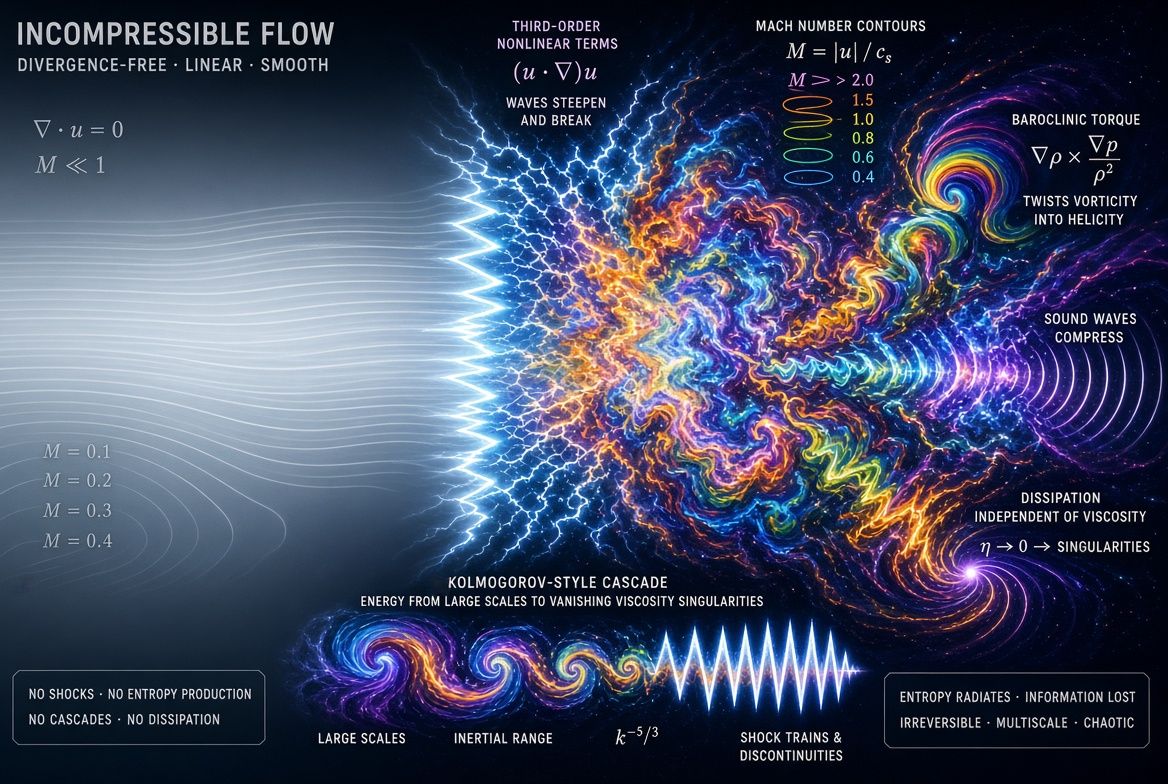
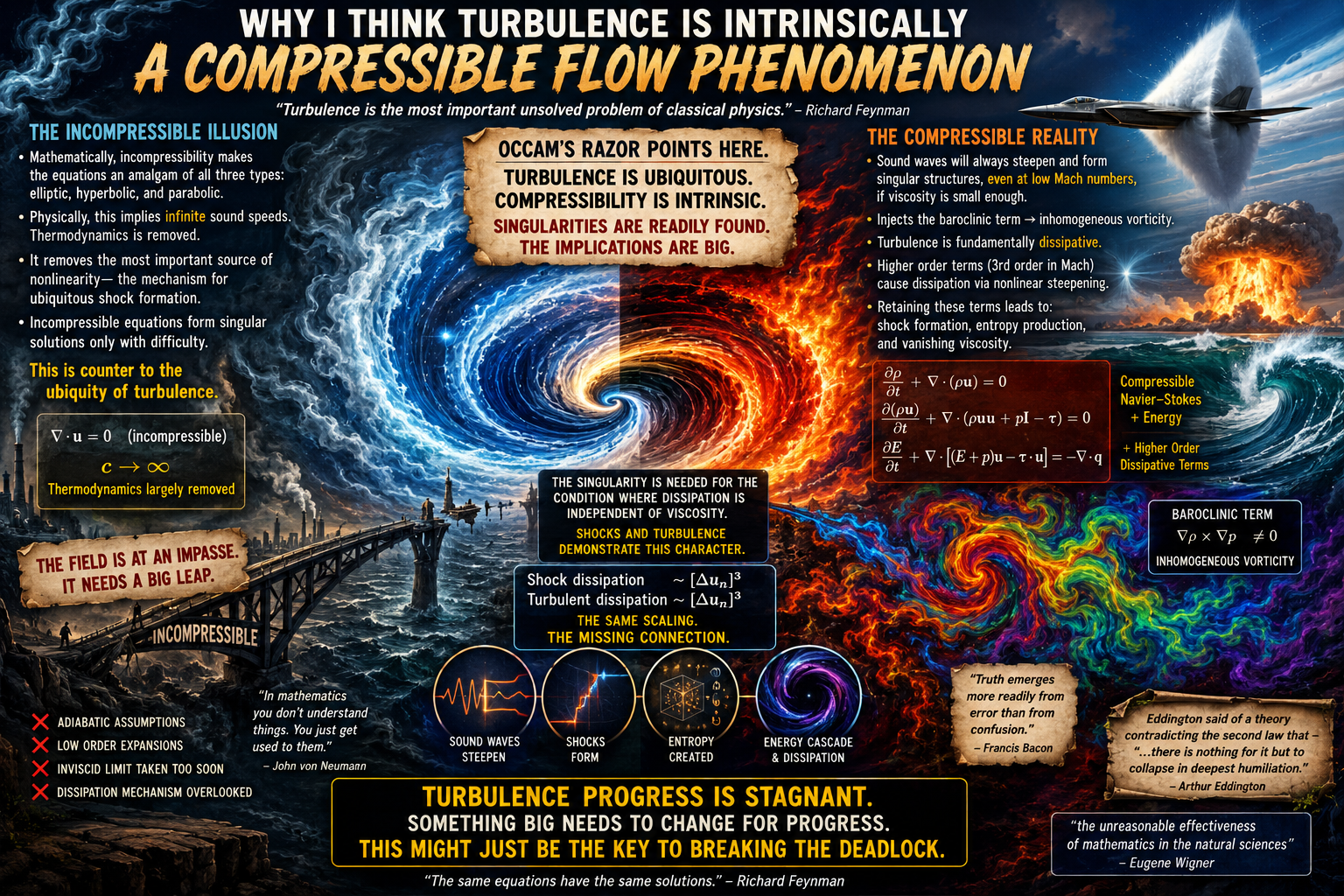
I’ve written several times about the lunacy of the incompressible Navier-Stokes Clay prize problem. Most of the issues relate back to incompressibility. I’ll summarize. Mathematically, incompressibility makes the equations an amalgam of all three types: elliptic, hyperbolic, and parabolic. With no viscosity, it is elliptic-hyperbolic. Physically, this implies infinite sound speeds. Thermodynamics is largely removed as well. It removes the most important source of nonlinearity from the equations — nominally, the mechanism for ubiquitous shock wave formation.
I will note that turbulence is utterly ubiquitous in science and technology. It is everywhere and happens quite naturally, being almost impossible to stop. The incompressible equations form singular solutions only with difficulty. Such solutions can be constructed, but it is hardly routine. This would be counter to the ubiquity of turbulence. Compressible equations, on the other hand, form them with ease. Here is the rub, and it is threefold:
- Compressible flow is studied and focused on away from the zero Mach limit.
- The behavior of compressible flow in that limit is poorly understood and poorly computed, especially for inviscid flows. Numerical solutions have deep pathologies.
- The theory connecting incompressible and compressible flows is largely adiabatic and avoids key mechanisms.
“In mathematics you don’t understand things. You just get used to them.”– John von Neumann
Occam’s razor might take the ubiquity of turbulence to point to compressibility being intrinsic to turbulence. Singularities are readily found. The implications are big. The singularity is needed for the condition where the dissipation in the system is independent of viscosity. Only the large-scale (inertial range) flow determines the rate of dissipation. Shock waves and turbulent flows demonstrate this character. We know of the shock singularity, while the turbulent singularity is elusive. What if it was always there staring at us?
“Truth emerges more readily from error than from confusion.”– Francis Bacon
There have been studies of the mathematical link between compressible and incompressible flows. The key provision is the use of an adiabatic flow. The expansion is second-order in Mach number. The dissipation for turbulence and shocks is third-order. Thus, the flows are inviscid unless viscosity is explicitly included. This is a fatal flaw: the key inviscid mechanism leading to vanishing viscosity has been overlooked and eliminated. This is an unfortunate oversight. I think this is a general misunderstanding. The mechanisms for dissipation around singularities are third-order in Mach number (which is vanishing).
First is the wealth of existing solutions and theory, all revolving around incompressible flow. This would need to be discarded in large part. Compressible flows are less amenable to analytics. This is particularly true for non-adiabatic flows. My view is that the field is at an impasse and needs to break it with a big leap. Compressible and thermodynamic ideas might just be that.
Compressible flows have different mechanisms built in. These are compatible with observations. Singularity formation is the key, and the part of turbulence that cannot be ignored. Sound waves will always steepen and form singular structures, even at low Mach numbers, if the viscosity is small enough. It also injects the baroclinic term into the analysis, which might produce inhomogeneous vorticity. This would potentially change the mechanisms for some turbulence.
Shock waves are principally understood as a supersonic phenomenon, at Mach numbers above 1. Sonic booms and explosions are a couple of canonical examples people are given. The mechanism for waves to steepen into shocks does not go away. It is equally present at low speeds. Analysis has always been tied to incompressibility, with acoustics added on. In general, this has been applied to adiabatic situations. Turbulence is not this. It is fundamentally dissipative. To model turbulence, these equation sets need additional terms to be retained. The dissipative terms are generally one order higher.
Eddington said of a theory contradicting the second law that — “…there is nothing for it but to collapse in deepest humiliation.” – Arthur Eddington
The equations would need to retain the higher-order terms that cause dissipation due to nonlinear steepening. These are purely terms found with the acoustic modes, but they modulate the wave structure. Gradients are enhanced or diminished depending on the sign, and shock formation cannot be denied. Without dissipation, the flow will shock. It is also likely to be extremely complex and tied directly to the perturbations from unstable shear waves. Together, these should be an adequate and powerful engine for turbulence phenomena.
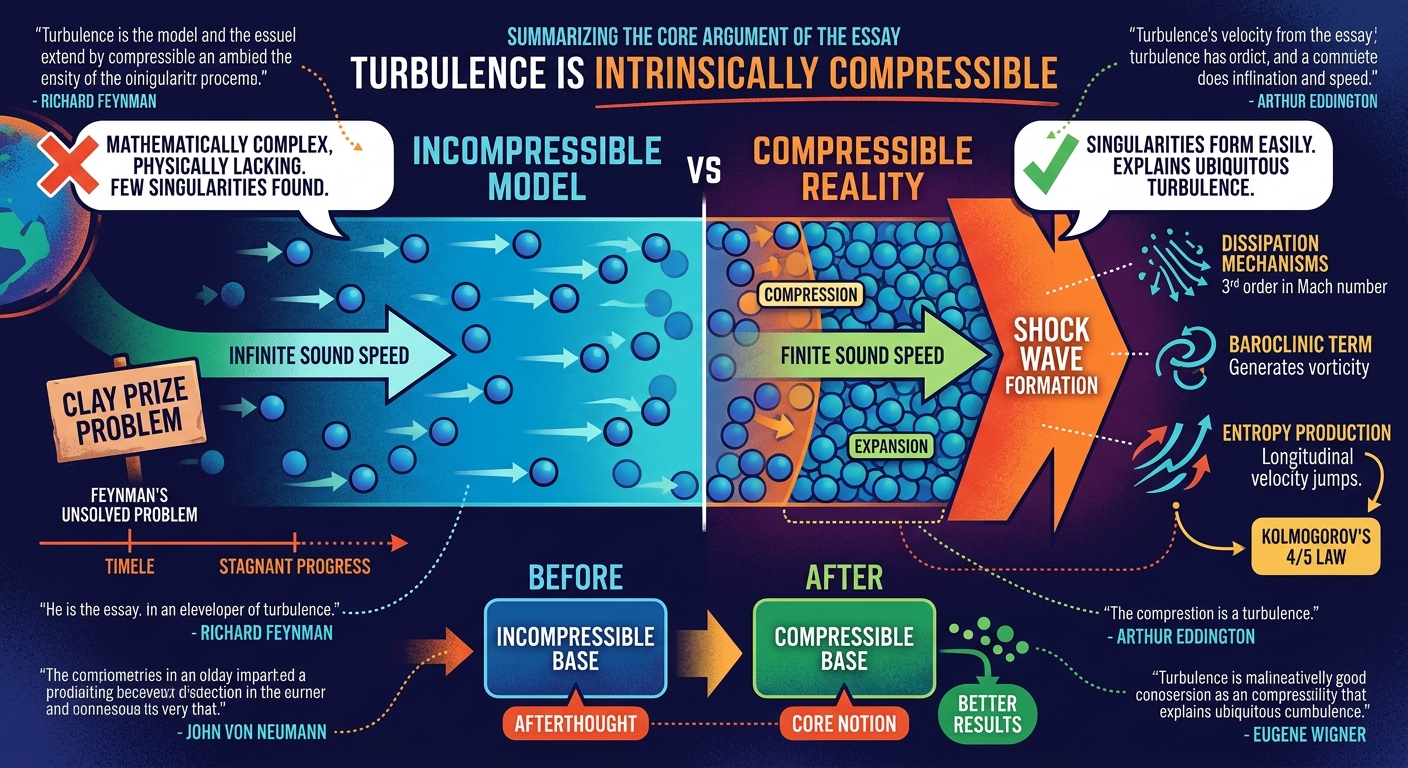
Perhaps the biggest change would come to the modeling of compressible turbulence. Today it is an add-on to incompressible theory: compressibility is an afterthought instead of the core notion. A fully compressible foundation would change this dynamic. It should lead to better results. It also makes more sense with the dynamics of implicit turbulence modeling. More importantly, it offers a new path for discovery and understanding. You have mathematics that supports a key mechanism for dissipation, the singularity formation.
“the unreasonable effectiveness of mathematics in the natural sciences”– Eugene Wigner
Researchers have nipped around the edges of this issue. The bridge that has failed is the direct connection. Shock dissipation is third order in velocity jump, leading to entropy creation. Turbulent dissipation is also third order in the velocity jump. This is called the longitudinal or normal velocity jump. This is the same scaling. Compressible shocks are one-dimensional. Kolmogorov’s results in the 4/5 law is three-dimensional. Connecting the two would marry this result to compressible flow and thermodynamics. Turbulence is perhaps the most pervasive and common means of entropy production. This would be quite satisfying for physics. Breakthroughs await.
Turbulence progress is stagnant. Something big needs to change for progress. This might just be the key to breaking the deadlock.