
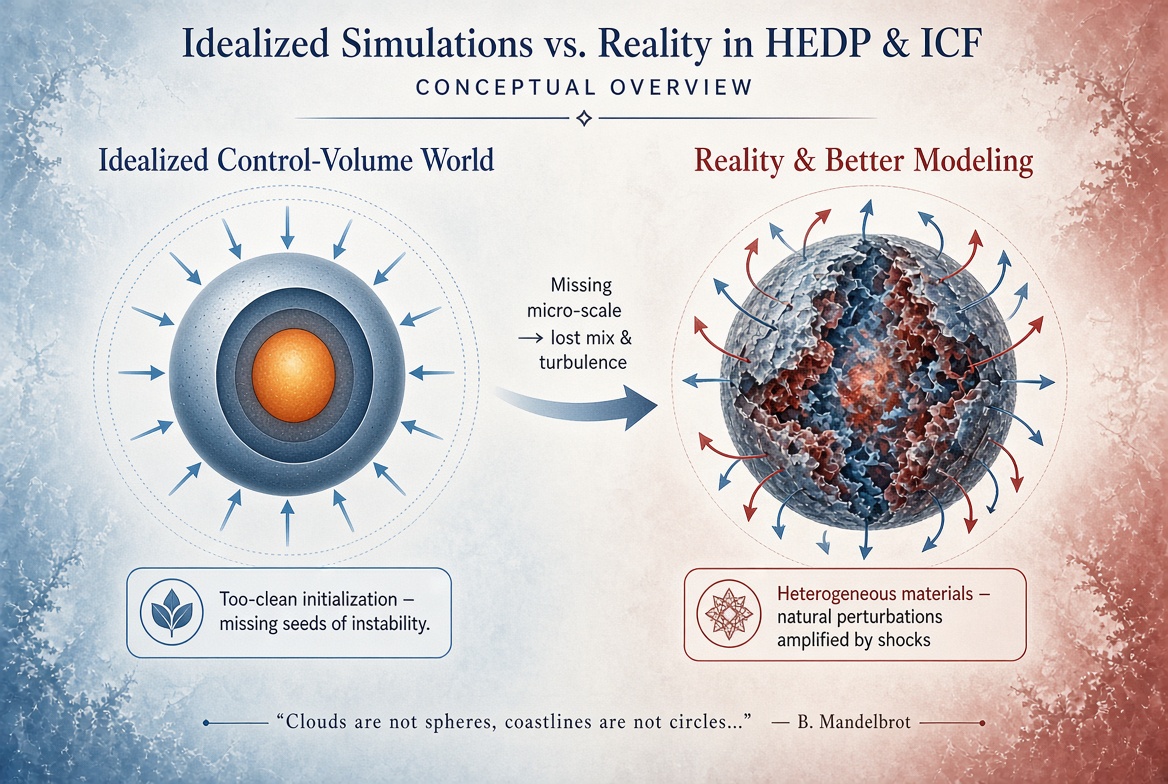
“Clouds are not spheres, mountains are not cones, coastlines are not circles, and bark is not smooth, nor does lightning travel in a straight line.” – Benoit Mandelbrot
There is this problem with numerical simulation that has bothered me forever. The simulations are generally too clean, too symmetrical, and too perfect. For a while now, my judgment has been that the initialization of the codes is the problem. The initial conditions are generally too clean and perfect to represent reality. When we start a problem, we initialize it with material at a defined density, pressure, and temperature. This leads to over idealized unrealistic simulations. Usually, this is constant in regions occupied by a given material. In the parlance of the codes, the material is painted into these regions.
There are a couple of questions that come to mind:
- What is the correct level of variability in these materials? How do we set this properly?
- What sort of impact would this have on calculations? Where would it matter, and what calculations would change character in a fundamental manner?
When we construct our methods, we rightly desire them to retain ideal properties. We don’t want the methods to unphysically seed instability, break symmetries, or violate basic laws. An example of this I’ve hit upon before is perfect entropy conservation. A method can be designed to do a perfect job of not generating spurious entropy. Such a method would not perturb smooth conditions. When we see reality, this is not what is manifested. If I look at places where simulations are used heavily, have these ideals poisoned our success? Reality is rarely ideal, and simulations should model reality.
“The law that entropy always increases holds, I think, the supreme position among the laws of Nature.” – Arthur Eddington
For inertially confined fusion, the answer seems to be yes. The two things they need for success are entropy-conserving compression to very high densities and lack of mixing. If they could achieve both, fusion would be easy. Neither is present in reality. If the methods were more accepting of reality, could the fusion designs be more successful? I think so. Mixing and turbulence are ubiquitous. They should be accepted. The second law is also ubiquitous. Ideals should be a guide, but reality should be respected more. This would be a longer but truer path to success.
“Nature, to be commanded, must be obeyed.” – Francis Bacon
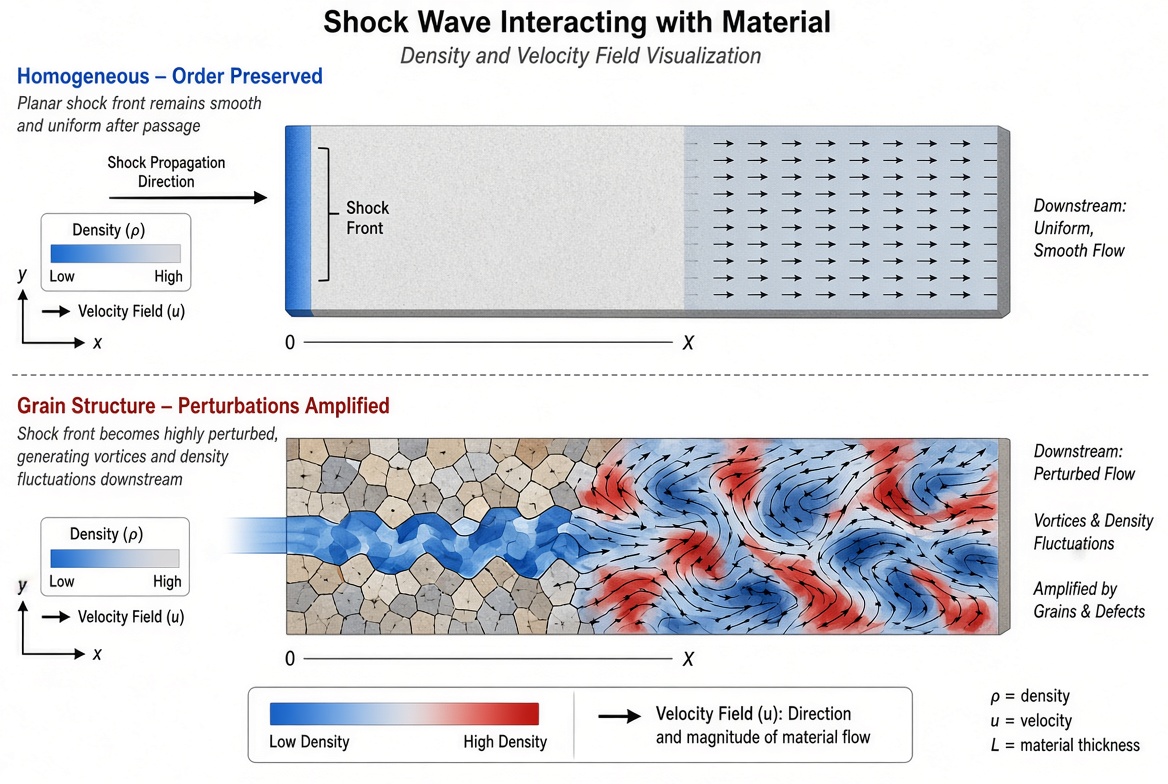
I’ll start with the clearest example of issues with painting homogeneous materials for initialization: solid materials with defined grain or crystalline structures that are subjected to high energy forcing. This can happen with explosives, lasers, or radiation that causes the material to flow hydrodynamically. In my view, painting these materials in homogeneously is simply wrong. The thing that made me think about this was high-performance computing. We started to get to the point that we had control volumes close to the grain or crystal size. Clearly, as we refined the mesh, the initial conditions were getting less true to reality. The smaller the mesh cells became, the rougher the landscape should be. The smoothness of the properties is an illusion.
“Crystals are like people: it is the defects in them which tend to make them interesting.” – Colin Humphreys
The variations at that size would cause deviations in the material properties to grow. As you refined, the cell-to-cell variations would become more extreme. You would be losing connection with reality. The materials are defined by their macroscopic properties, which are frequently determined at a large scale. These properties would become less accurate under these conditions. This seems pretty fucking obvious, and yet nothing is done. We just keep painting macroscopic properties into smaller and smaller cells. This seems destructive and dumb.
We can see the impact of this in comparison with data. Whenever we have an image of one of these hydrodynamic flows, there are small-scale details missing. The simulations are far cleaner than measured reality. I’ve had a career of seeing this, yet we have done nothing. In some cases the simulations deviate in large ways. The small details scale up and change the large-scale flow. The simulations are not modeling reality. The source of the problem is not the equations or the numerical methods. The source is details missing in the initialization of the problems. It is an own goal caused by a deeper gap in our practice.
What is needed to deal with this is measurement and characterization of materials. One needs to determine the length scales and statistical properties of the materials. As the mesh is refined, the heterogeneous nature will be resolved. As it is coarsened, the material will be more properly homogeneous. Part of this is realizing that control volumes are integral averages. Integration smooths, and thus as the control volume is larger, the averaging is greater. It is appropriate to be homogeneous as the volume samples more. The inverse is true.
What is the potential impact of this? In very large part, the impact on any phenomenon where you have something like a hydrodynamic instability is going to be quite large. Something like a shock wave is an extremely energetic way to hit the material and produces amplification of these perturbations. When these perturbations at the mesh scale are missing, this amplification and feedthrough is lost. Some of the observed ubiquity of turbulence and mix can be explained by this. At small scales, there is always a high degree of perturbation needed to drive turbulence. The counterargument is that these all average out as the shock sweeps over. However, the size of the perturbations from a shocked material is going to be far larger than the perturbations as defined by the material. If there are orientation effects, these changes could be quite large indeed.
“It may happen that small differences in the initial conditions produce very great ones in the final phenomena.” – Henri Poincaré
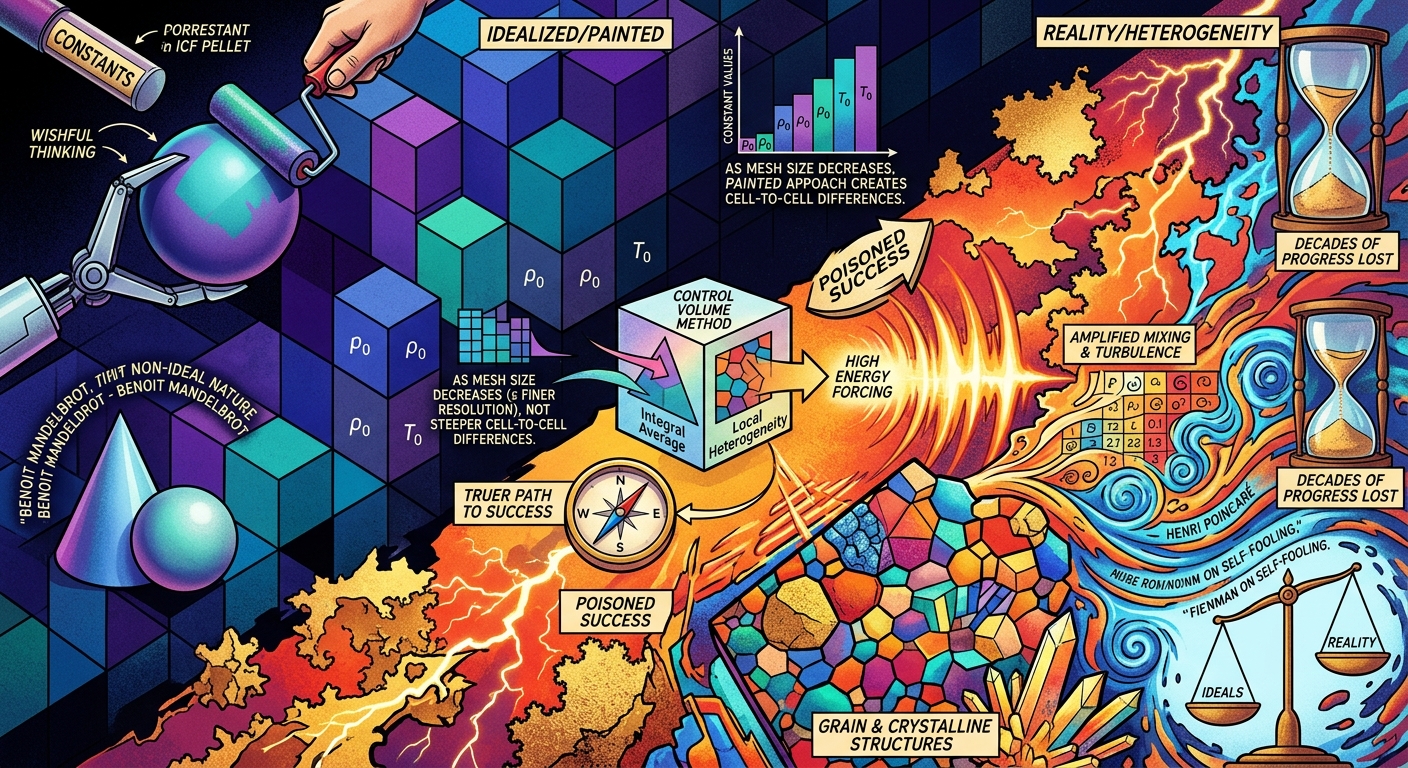
Is painting in material and removing these small-scale features simply another form of wishful thinking? Wishful thinking that makes mixing phenomena subside? In fact, there is a lot of heterogeneity that would drive mixing. I’ve always felt that ICF pellets would be better designed if they gave in to the fact that mixing and turbulence will develop. It is going to happen. How do we design when we accept that reality rather than wishing it away? I wonder how many decades of progress were lost at the altar of wishful thinking. We wishfully treat entropy and turbulence away when simple observation of the universe say they are universal. Why should we believe that we can engineer these into submission?
“The first principle is that you must not fool yourself, and you are the easiest person to fool.” – Richard Feynman
No time like the present to do something different.
Perhaps part of the wishful thinking comes from this particular issue: the small-scale heterogeneity is removed, and a source of perturbations is basically excused from the problem. We believe that it is handled by subgrid modeling. That also removes the natural formation of these instabilities from the passage of high-energy forcing through the body of materials that are treated too homogeneously. In spite of lots of knowledge, subgrid modeling is generally problematic. It is rarely first-principles. It is a computational band-aid. We do not know how to do this nearly as well as we say. Moreover, the subgrid modeling is not working on the same processes discussed here. Thus the modeling is divorced from much of the cause for the effect.
Working on simulating reality with more fidelity should help. If we are modeling things with an eye on the wrong cause and effect, we should expect issues. It will be stubbornly unsuccessful. Modeling things from the right philosophical perspective should be better. It is worth a try.
“Far better an approximate answer to the right question, which is often vague, than an exact answer to the wrong question, which can always be made precise.” – John Tukey
 The Regularized Singularity