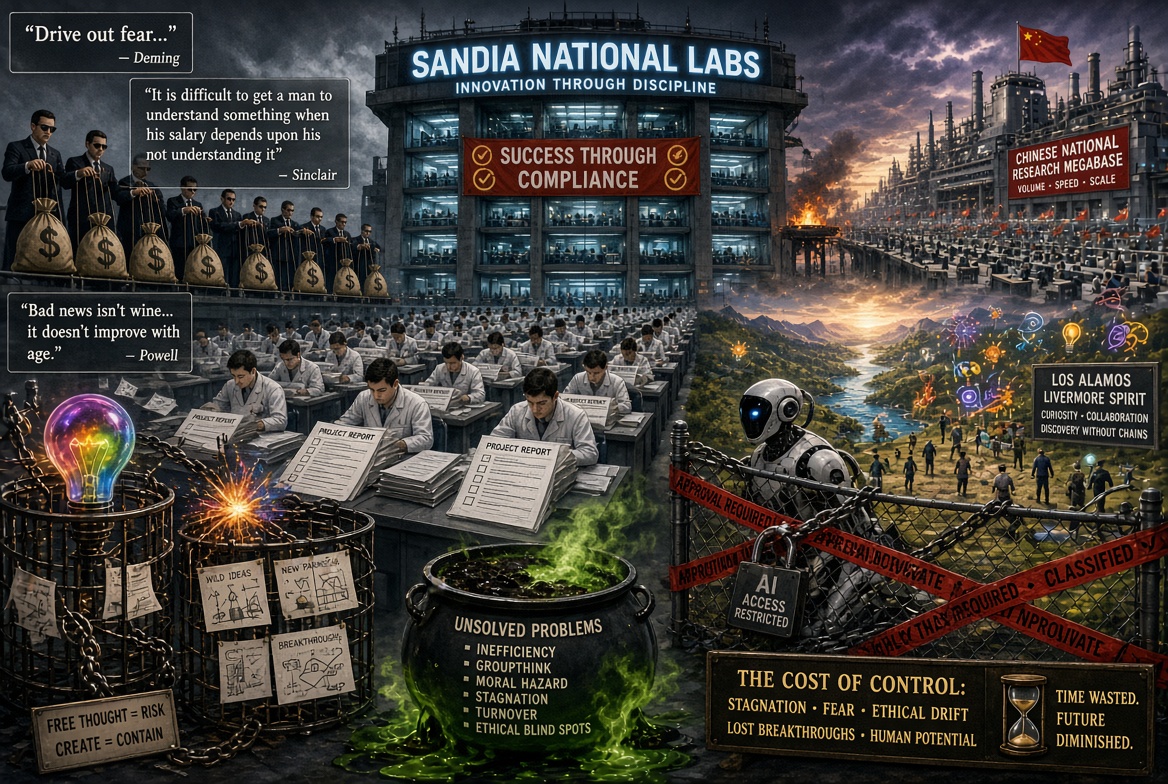
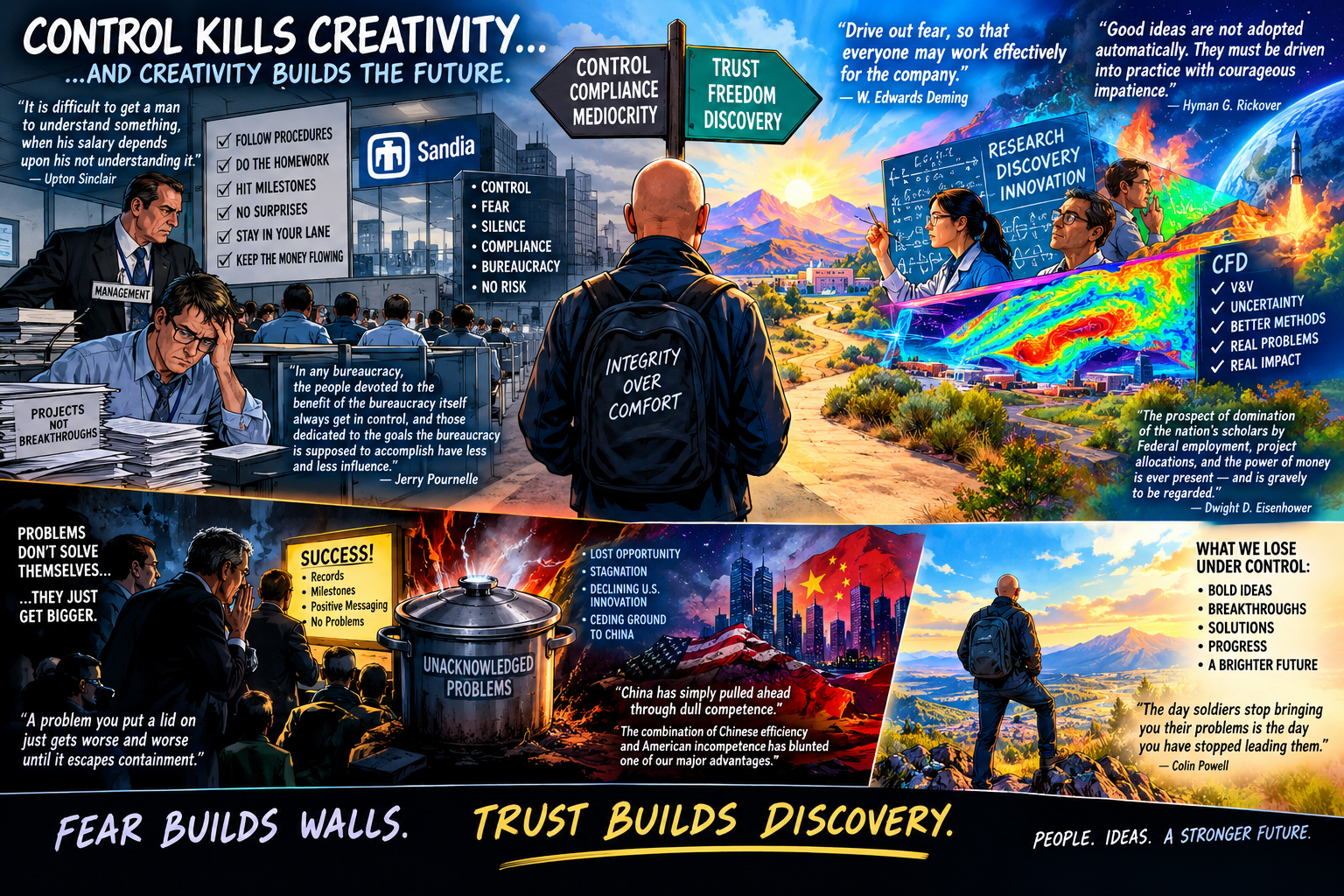
“It is difficult to get a man to understand something, when his salary depends upon his not understanding it.” — Upton Sinclair
Lately I have been thinking about something an instructor of mine said back in graduate school. He was a staff member at Sandia. He was teaching the graduate reactor theory class, and we were learning how to analytically compute the criticality of reactor configurations. One day, class was more informal. A foot of snow had fallen overnight. The University was actually closed for the day. Our 7 am class started before that was known. It was the days when you needed a radio or TV to tell you about closures and delays. He made an offhand comment about the nature of employees at Sandia. He noted that he had met plenty of staff who came out of school with a 4.0 GPA and couldn’t find their ass with both hands. It took me a number of years at Sandia to process what that actually meant. I understand him clearly now.
What I came to understand is that Sandia is not an organization that wants outstanding researchers. It does not manage people to create the basic conditions for flourishing research. It wants outstanding homework doers, the people who are really good at completing assignments correctly. Those assignments don’t require you to think outside the box. If you think outside the box, you are exposed and vulnerable to attack. They require you to grind through and do what you’re told. This is the essence of what it takes to succeed there. Shut up and do what you are told to do. Anything extra will be used against you.
One of the ironies of the modern era is that AI is far more effective in an environment where doing the homework well is the standard. Sandia, then, stands to benefit from AI more than most. Yet its fear and control issues mean AI will actually be used less there. It will be fenced in with controls and never explored as expansively as it could be. The irony is thick. Where AI can open up vistas for human attention and creativity, it will be neutered. Creativity is not welcome in completing your homework. Fidelity to the task and correctness are the expectation.
“Drive out fear, so that everyone may work effectively for the company.” — W. Edwards Deming
So Sandia may suffer more in the current era precisely because of these issues, while places like Los Alamos and Livermore, where research matters far more, are helped. AI’s capacity to do the homework really well shores up a genuine weakness in those organizations and raises all of their work to a higher level. In the process, Sandia undermines its core advantage in the modern era. Ironic indeed.
In the environment that developed over the last quarter century, where money flowed into project work, Sandia had an advantage. Having employees chosen primarily for their ability to do homework worked out rather well. Project work is much like homework: well-defined, bounded, and carrying very little chance of failure. We are not doing research or finding breakthroughs. We are executing a project as defined, on schedule, against well-defined milestones and outcomes.
“Good ideas are not adopted automatically. They must be driven into practice with courageous impatience.” — Hyman G. Rickover
It is no wonder Sandia has grown so much larger in this period. Their approach is perfect for the modern era. The problem is that the modern era is one of a diminished United States. It is a country that has lost supremacy in scientific research and engineering and is ceding that crown to China. The USA has simply capitulated. China has simply pulled ahead through dull competence. A system that is better designed for the high control of people. In the meantime, the USA is sabotaging its prime advantage. Freedom of thought and bold solutions. It has given in to fear and distrust of institutions. Fear kills freedom. Trust is needed for bold action.
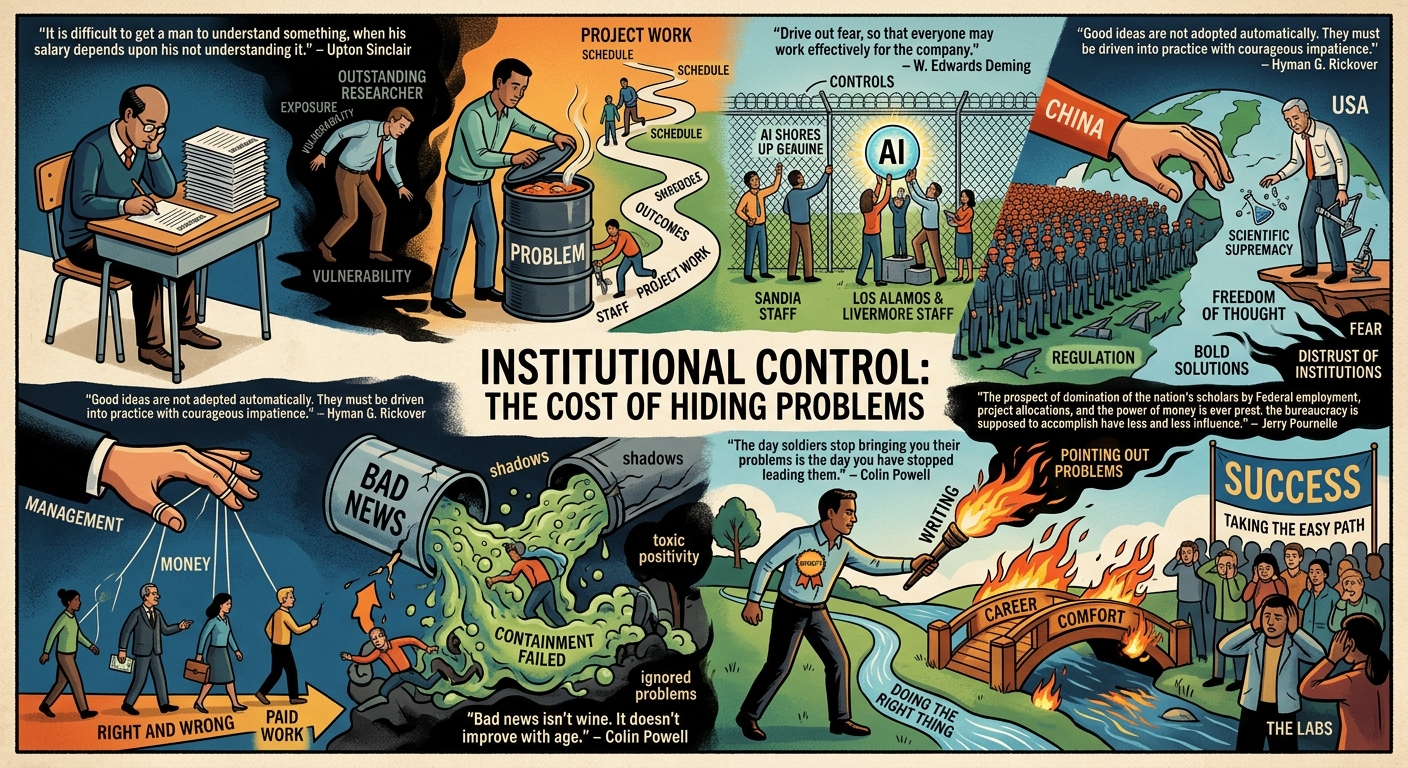
That said, I strongly suspect China is very much in the homework mode as well. It is a very controlling environment. The difference is that the Chinese have numbers on their side: vastly more researchers at vastly lower cost, free of much of the regulation we have here. They can efficiently execute more and bigger projects, and ultimately consume the advantage the United States once had. The combination of Chinese efficiency and American incompetence has blunted one of our major advantages. I just happened to be in an organization perfectly suited to thriving in a declining America.
“Bad news isn’t wine. It doesn’t improve with age.” — Colin Powell
Control is an attempt to keep issues and problems from boiling over. But problems do not magically solve themselves. A problem you put a lid on just gets worse and worse until it escapes containment. How many problems are we trying to control this way? The containment will fail. It always does. What will happen when they break free? Our current philosophy only ensures that the problems will be bigger and more damaging than necessary.
In the meantime, management acts out of fear and instills that fear in the people it manages. The fear revolves around control, around keeping everybody in line with the prime directive: keep the money flowing. It provides an element of stability to the labs, but it also saps them of inspiration and motivation, which are critical to executing the mission properly. In the process, we have no energy left to solve the major problems we face as a society. We are just allowed to nibble around the edges. The heart of the problems are never exposed.
Let me be perfectly clear about what this control sacrifices: the ability to confront and solve problems. Problems management doesn’t want to acknowledge won’t be solved, because they won’t be funded. The funding controls people, keeping them from doing what they think is right. This was the lesson of my last year at work. Instead, it focuses them on what they can be paid for. Management gets what it wants through power and force. Money is power today. It rules every decision. Right and wrong is measured in dollar signs.
“In any bureaucracy, the people devoted to the benefit of the bureaucracy itself always get in control, and those dedicated to the goals the bureaucracy is supposed to accomplish have less and less influence.” — Jerry Pournelle
In the process, problems that need solving simply languish. The real loss is the creative work necessary to solve them. That work leads to breakthroughs, and it also leads to many failures, because these problems are difficult, bordering on intractable. In a controlled environment, the people working on them don’t have the leeway to try bold ideas. For people to be bold, safety is needed. Control removes that safety. Without bold ideas, we are reduced to incrementalism at best and complete stagnation at worst. That is where we are today.
By failing to confront problems, we also fail to produce solutions. These solutions are the things that change the future, make it better. They are breakthroughs and discoveries. That is the other thing control denies us. Control is robbing us of progress and a more bountiful future. Fear does that. I will note that AI is a problem in need of vigorous and concerted effort. We need breakthroughs to help us navigate the perilous times ahead of us. Our control will deny us positive solutions.
“The prospect of domination of the nation’s scholars by Federal employment, project allocations, and the power of money is ever present — and is gravely to be regarded.” — Dwight D. Eisenhower
I recently met a friend at a conference who is quite critical of my writing. He sees it as self-destructive. Perhaps it is, in this sense: by writing about what has actually happened at the labs and what their problems are, I have burned my bridges. The labs aren’t interested in solving their problems. They are interested in hiding them. That is the essence of the control they seek. They are nervous about the future and about keeping their programs funded. They have concluded that the best way to manage that is to keep any problems under wraps.
I saw this in the messaging from leadership to the rank and file. Only success was talked about. Any issues or problems were only discussed in private. They could be mentioned in hushed tones without management acknowledgement. In public, everything was great. Success was the message. The organization is doing great, whatever the reality is. This is the nature of a toxic positivity that has taken root at the Labs. Maybe in the country as a whole. Problems lie festering in the shadows. They grow larger and more intractable in the fertile environment of enforced ignorance.
Control, and joining the project of power, brings money. I get several reactions to my writing. It is a service; it is self-destructive. It is patriotic; it is pointless. You give in so that you can have comfort. What I am describing is a low-key version of what is happening with Trump: power and money used to squash all resistance. That power and money is in service of decaying institutions and terrible outcomes. Trump’s version is over the top. Mine is quiet, but the mission is the same. People do shitty stuff to lead in a bad direction, and reward those who let them. It is self over community, self over the collective. It is dragging society down one capitulation at a time.
I burned those bridges by pointing out the problems, because pointing them out was the right thing to do. Being able to live with myself means doing the right thing instead of the easy thing. If I suffer for it, so be it. At least I have my integrity. Maybe at the end I can face myself and know that I did what the moment required.
“The day soldiers stop bringing you their problems is the day you have stopped leading them.” — Colin Powell