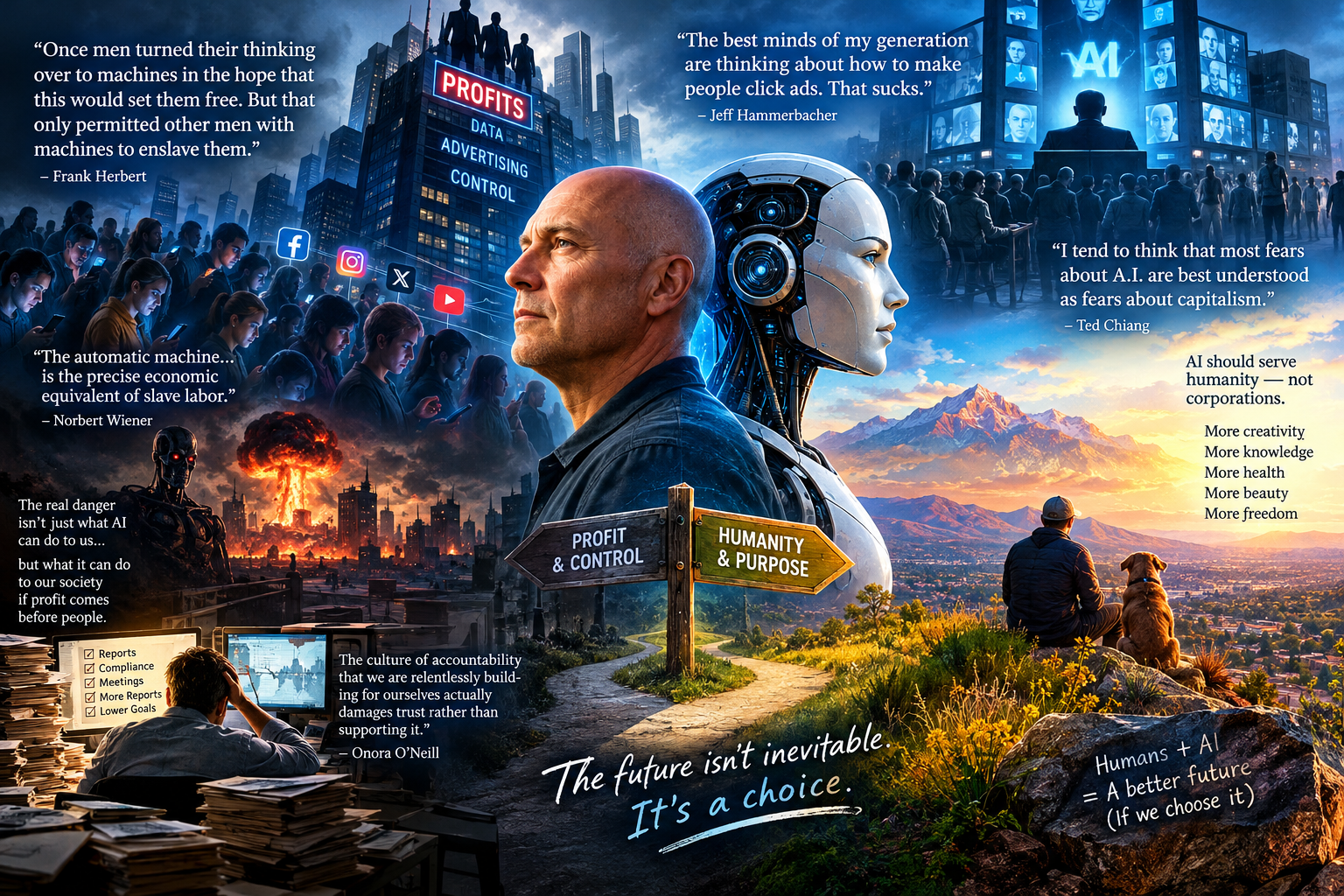
“Once men turned their thinking over to machines in the hope that this would set them free. But that only permitted other men with machines to enslave them.” – Frank Herbert
Recently there has been a flurry of concern about the safety of AI. This is all prompted by the obsession with the possibility that AI could cause the extinction of mankind. This is typically envisioned through a variety of scenarios. These are like creating apocaolyptic biological weapons. Perhaps even a malicious AI that decides that humans are a nuisance to be exterminated. Of course, more spectacularly, there is the famous Terminator scenario from the movie. The AI gets control of nuclear weapons and decides to wipe out humanity in one fell swoop. A handful of survivors live in an apocalyptic doomscape and resist in vain.
“The automatic machine… is the precise economic equivalent of slave labor.” – Norbert Wiener
I’ve written recently that I believe a more likely scenario is that humanity could end up enslaved by AI. This would come directly from the same sort of corporate practices we’ve seen with social media. Tech companies operate under motives where profits outweigh any other perspective. Healthy societal impact isn’t on the radar when the profit motive is completely and totally in control. In that case, the negative societal impact is merely fallout.
“The best minds of my generation are thinking about how to make people click ads. That sucks.” – Jeff Hammerbacher
One of the fallouts may be that AI will become a much more sophisticated and powerful tool. It will provide these corporations with control over humanity. Lost in all of this safety discussion is a more positive framing. We get a smattering of potential benefits spoken of by the companies, which are mostly thrown out in scattershot, ill-formed thoughts. There’s talk of medicine, cures for diseases, and universal basic income. There is little rhyme or reason. No one is asking what humanity wants or needs. All of this begs the question of why these sorts of good outcomes haven’t already been received from our tech overlords. There is zero track record of a single step toward societal or social well-being.
The same incentives that gave us Facebook and Twitter are working for AI. Those incentives will be weaponized by corporations to make more money. To make their founders and employees rich. None of the current incentives have social or societal good as a focus. Without explicit engineering of the incentive structure, we will get the same result. That result will be social and societal damage and chaos. Anyone happy with the current chaos?
“I tend to think that most fears about A.I. are best understood as fears about capitalism.” – Ted Chiang
The discussion we are not having is: What sort of future do we want, and how will AI play into that future? I think this is the flip side to the conversation we’ve been having about doomsday. Instead, we should be talking about what we’re going to get from AI, and specifically how the particular genius of humanity will be preserved. Even better than preserving our genius, how can AI augment it.
A large part of my enslavement idea comes from the belief that there are aspects of thinking and intelligence that AI cannot replicate. Aspects of humanity that are purely human. It may necessarily be found in our embodied selves. Maybe other ways of thinking that AI does not currently replicate and perhaps never will. Other breakthroughs are likely necessary to expand AI’s intelligence.
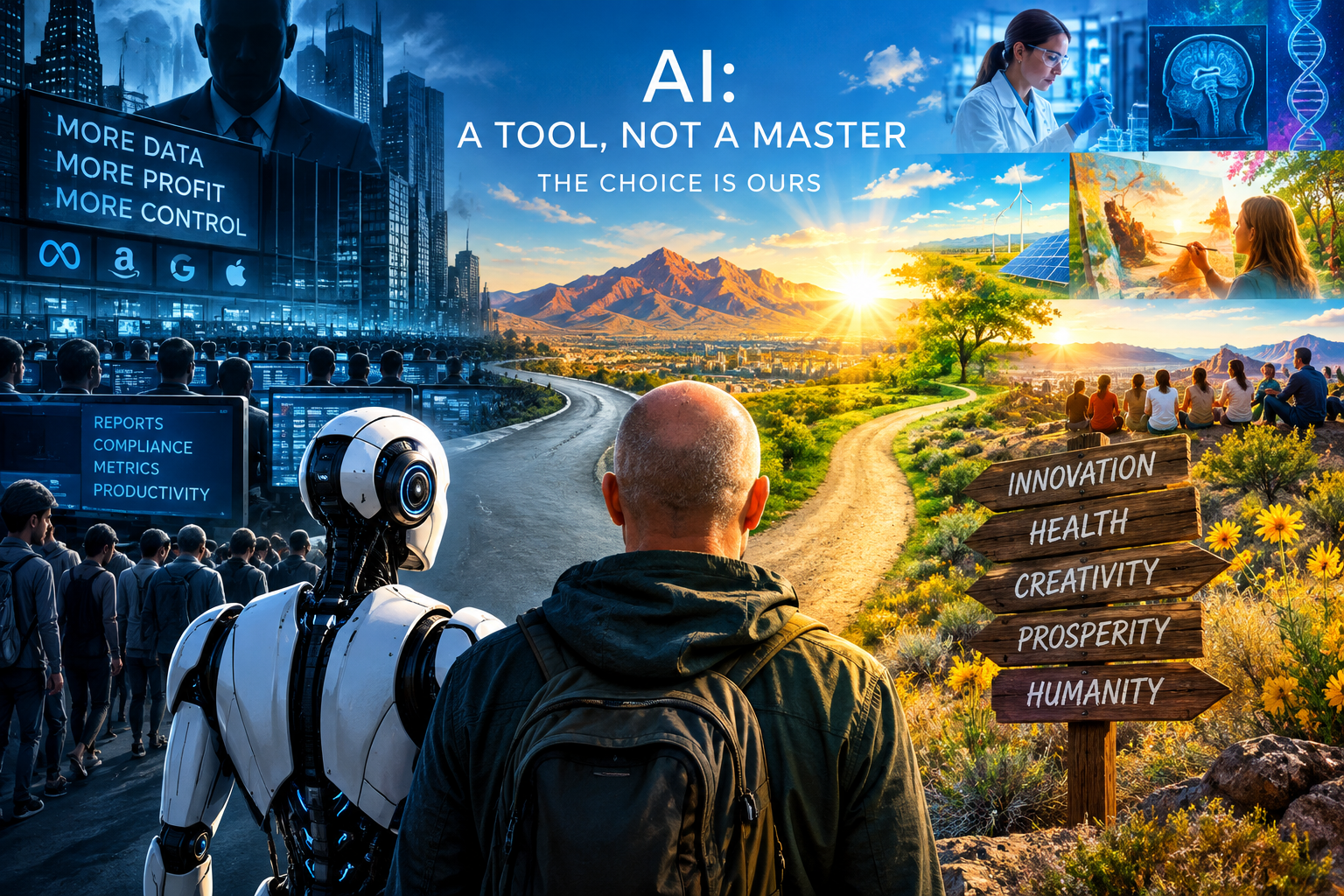
In lieu of this, one of the most important questions is whether the genius of humanity is preserved. Does it serve AI, or serve the corporations that currently develop AI and tech? This may be the path towards enslavement. An alternative is that society places value on preserving the genius of humanity. AI is engineered in a way that expands the positive aspects of our lives and produces wealth and beauty, art, and things of aesthetic value. These positive aspects have primacy over pure profit and wealth.
“Perhaps the culture of accountability that we are relentlessly building for ourselves actually damages trust rather than supporting it.” – Onora O’Neill
I can certainly see many positives in AI. One of the most positive things I could see about AI was what it could do for my former workload when I was employed. I’ve opined that, as my career went on, the load of bureaucratic garbage increased monotonically. This increase is driven by reporting requirements reflecting the overall lack of trust that has developed in our society. This untrusting attitude arose from a belief that the most likely outcome for my research was simply that I wasn’t getting anything good done. Worse yet, I was absconding with the money and fucking off with it.
I had to regularly report on everything I did, with that reporting eating up an increasing portion of my work life. In no small way, I cannot overstate the degree to which this burden ate into my productive capacity. Worse yet, the objectives and goals at work began to lower. One way to not look like you are failing is to make success a very low bar. Over the years, we’ve seen the bar drop lower and lower in order to ensure that success is engineered into every activity. This does nothing to reduce the burden of reporting.
“Huge swathes of people… spend their entire working lives performing tasks they secretly believe do not really need to be performed.” – David Graeber
AI was perfectly well suited to more seamlessly and easily generating the sorts of reports that you fed into the system. In doing so, it could free up useful time to do real work. Nonetheless, the problems are still there. We see something toxic and in need of reform in how work itself is structured. We need to change the work so that there is more trust and more capacity for people to do creative work without all the oversight. This is where the focus of AI should really be. AI should be something that can assist us in developing, running through, and executing more of our ideas.
“Move fast and break things.” – Facebook motto
This would be something that could enliven research and work to generate more progress than we are used to seeing. By the same token, ideas and innovations are the engine by which wealth and prosperity are generated. These are all outcomes we should seek. Currently, there is not nearly enough progress going on in the world, and AI could be an engine for assisting humans in finding it.
The problem is that we need to escape several things:
- The expanding collapse of trust across society, which saps all of our energy.
- The profit motive standing above all else, without any sort of societal responsibility, that our corporations currently exhibit.
If both of these things can be wrestled under control, the possibilities are endless. Perhaps the most important single theme to work toward is greater trust. The recent behavior of corporate high tech has only hollowed out trust further. Sam Altman is the poster boy for untrustworthiness. He is only eclipsed in being sketchy by the President himself. Rather than build trust that allows a better future, they are digging a deeper hole.
“AI will probably most likely lead to the end of the world, but in the meantime, there’ll be great companies.” – Sam Altman
Unleashing AI into a world where Altman and Trump are at the helm is almost suicidal. A superpowered intelligent tool will simply take our crisis of trust and put it into overdrive. It is courting disaster. This would be akin to striking a match adjacent to a gasoline-soaked blanket. You can see what’s going to happen, and if you go forward and do this, you should be ready for the outcome. Mindfully, we should turn toward better possibilities.
AI has shown great facility in a couple of areas that are near and dear to my heart.
- Code writing: Over my career, I did a substantial amount of it. This is something AI has shown miraculous power at, but also limitations.
- Mathematics: Again, mathematics has become the showpiece for AI, where its capacity, as the companies want to show it, is being demonstrated. The key is how much of this is mere mimicry or raw computation versus genuine intelligence.
“Programs must be written for people to read, and only incidentally for machines to execute.” – Harold Abelson and Gerald Jay Sussman
In both cases, the case for human control and the necessity of human intervention is clear. In coding, our key strategic and intellectual ideas are manifested in the code. The thing AI has shown itself to be most capable of is grinding through the gross, gory, and intricate details of implementations. Where it falls short is in the broader strategic thoughts needed to weave everything together. This is where humanity is essential. This must be preserved and augmented.
This is much like the story with bureaucracy. AI can simply devour the mind-numbing details, but human thought is needed to manage the overarching views, the meaning, and ultimately how to put everything together into a coherent whole. The key to making things better is to amplify the message of human control. We are in charge, and AI simply becomes an efficiency. AI becomes a way to get these awful parts of work out of the way. There needs to be a focus on genuine work benefits that people can feel and control.
“It is by logic that we prove, but by intuition that we discover.” – Henri Poincaré
With mathematics, we see this pattern repeated again. We see that the need for humans to solve problems comes from inspiration, leaps of faith, and insight. All of these are beyond what AI can generate. The recent spate of results is crowned by the Navier-Stokes-related Millennium Prize. The basic concept, ideas, approach to solving the problem, and strategy, if you will, were devised by humans. AI simply ground through details too complex and mind-numbing for humans to easily tackle.
This model is similar to the supercomputing we are all familiar with. The well-programmed supercomputer is incredibly useful. It can do calculations at blazing speed. If these are arranged and done in the right way, miracles are possible. If they are not, it is garbage. AI is no different. Human guidance and genius make sure the strategy is meaningful. Utility is found in the collaboration between man and machine. The machine alone is wasteful.
The key is that without human inspiration and invention, the mind-numbing details and all the work I could do would be for naught. Again, human control is the key. AI does not do things by itself. The failed message from the companies is that AI does everything. This is bullshit. It is damaging to the future. The real and true message is that AI can bring ideas to fruition. AI makes the impossible to execute possible. More importantly, AI does not replace people; it makes them better.
This gets to the core of the narrative that the AI companies, the US government, and the whole dynamic get wrong. They are completely fucking this up! They have only seeded fear and opposition. If AI is coming for your job, you oppose it. It is also the seed of opposition to data centers. The AI story is a public relations nightmare. The reason is that they didn’t think they needed to convince the public. Money and greed were the only things necessary.
“Imagination is more important than knowledge.” – Albert Einstein
When one talks about reform in the working world, this needs to be backed by reform in the educational system. When I’ve spoken to people associated with or working directly in the educational system, the reaction I get from all of them is a desire to put the genie back in the bottle. Somehow we will keep students from using AI and force them to learn the old-fashioned way. This is shortsighted and foolish. This genie is not going back in the bottle, and students will use AI. These students will need to use it well to survive in the future. Avoiding AI is malpractice.
“What I cannot create, I do not understand.” – Richard Feynman
All of these students will need to learn to use AI effectively when they get out into the workforce. Sending them out of school without training on how to properly use AI is like sending lambs to the slaughter. As consumers, they are destined to be consumed by these corporate overlords. The educational system needs to adapt, and fast. We need to prepare them for the World that is. AI is going to be with us. It is going to be important. Our future prosperity, health, and safety all depend on it. Students must be ready.
“Plants don’t flourish when we pull them up too often to check how their roots are growing.” – Onora O’Neill
The way I see it, AI is going to be used. The question is: are we going to be teaching people to use it effectively? Are we going to be expecting people to add human value to AI? In a very real sense, the danger is that people will turn off their thinking entirely and simply regurgitate what they ask AI for, question by question. This means the questions, the teachings, and the expectations for students need to change to account for this behavior.
“We are drowning in information, while starving for wisdom.” – E. O. Wilson
Rather than trying to put our heads in the sand and pretend that AI is not there, students need to know how to effectively engage with AI. How to produce the sort of results that we desire. It should be clear that all students are expected to put some of themselves into every solution. True even if they are using AI to assist them along the way. Our job is to guide them to make that use effective and appropriate.
We then need to accentuate and accelerate the degree to which human uniqueness, creativity, innovation, adaptation, and thought are applied to these results. In this way, we will produce students who actually can deal with the world that is before them.
“The best way to predict the future is to invent it.” – Alan Kay