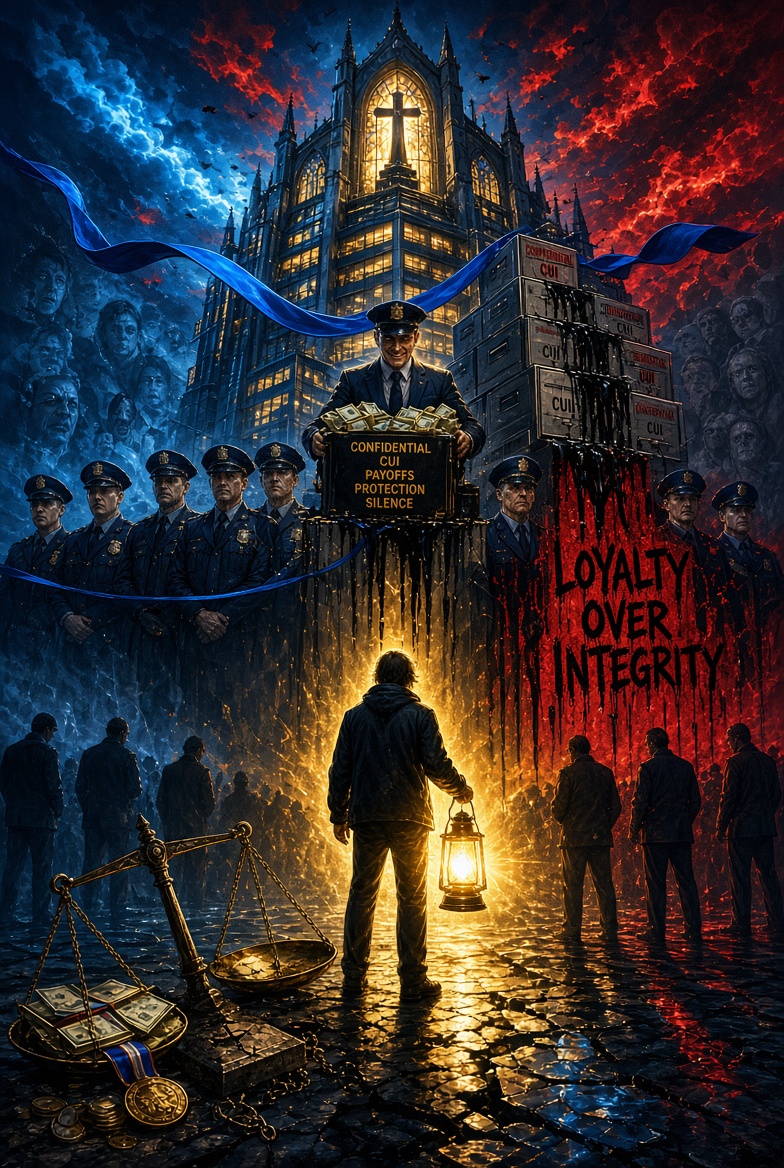
“It is difficult to get a man to understand something when his salary depends upon his not understanding it.” — Upton Sinclair
In the last week, I’ve been working through my part of the eulogy for my friend Tim. Tim and I worked together at Sandia, and over the years, many of our conversations were really just the two of us trying to make sense of the place. Writing the eulogy brought up old thoughts and feelings about how I retired. It had been a topic Tim and I talked about at length. On the one hand, it would be good to let it go. On the other hand, it was a serious issue with deep implications. The problems go further and farther than the knee-jerk response would allow.
I have made peace with my decision to retire. Continuing to work there was a complete waste of my time. It would have been financially beneficial to stay. In terms of my life, that benefit would have come at too great a cost. I’ll say something a bit arrogant too: I was too talented to work for those people. Continuing to be associated with incompetent and unethical people was beneath me. It was a waste of my considerable talents and my time on Earth.
“Silence becomes cowardice when occasion demands speaking out the whole truth and acting accordingly.” — Mahatma Gandhi
It should be obvious to my readers that I’m still engaged with science and technology. I’m. engaged with a large degree of passion. I have ideas I still want to explore. The reality is that every bit of that engagement was wasted at Sandia. It’s simply the sad truth that a national lab was a dismal place to put my talents to use. Not every talented person belongs at the Lab. That’s fine. That’s normal. The difference in my case is that my interests and talents sit pretty close to the bullseye of the Lab’s actual mission. That’s what concludes utterly damning.
“Loyalty to the organization, loyalty up and down the line, is prized above integrity to oneself.” — William H. Whyte,
In the process of all this pondering, I wandered into another thought. Why did Sandia protect the terrible managers? Why did they choose to do the wrong thing? I started seeing direct parallels to a couple of other issues. We seem to be having a society-wide collective-action problem around ethics and morals. Bad behavior and corruption run rampant among the rich and powerful. Nobody with the power to stop it does. As a society, we simply look away. The corrupt have impunity.
“Every society honors its live conformists and its dead troublemakers.” — Mignon McLaughlin
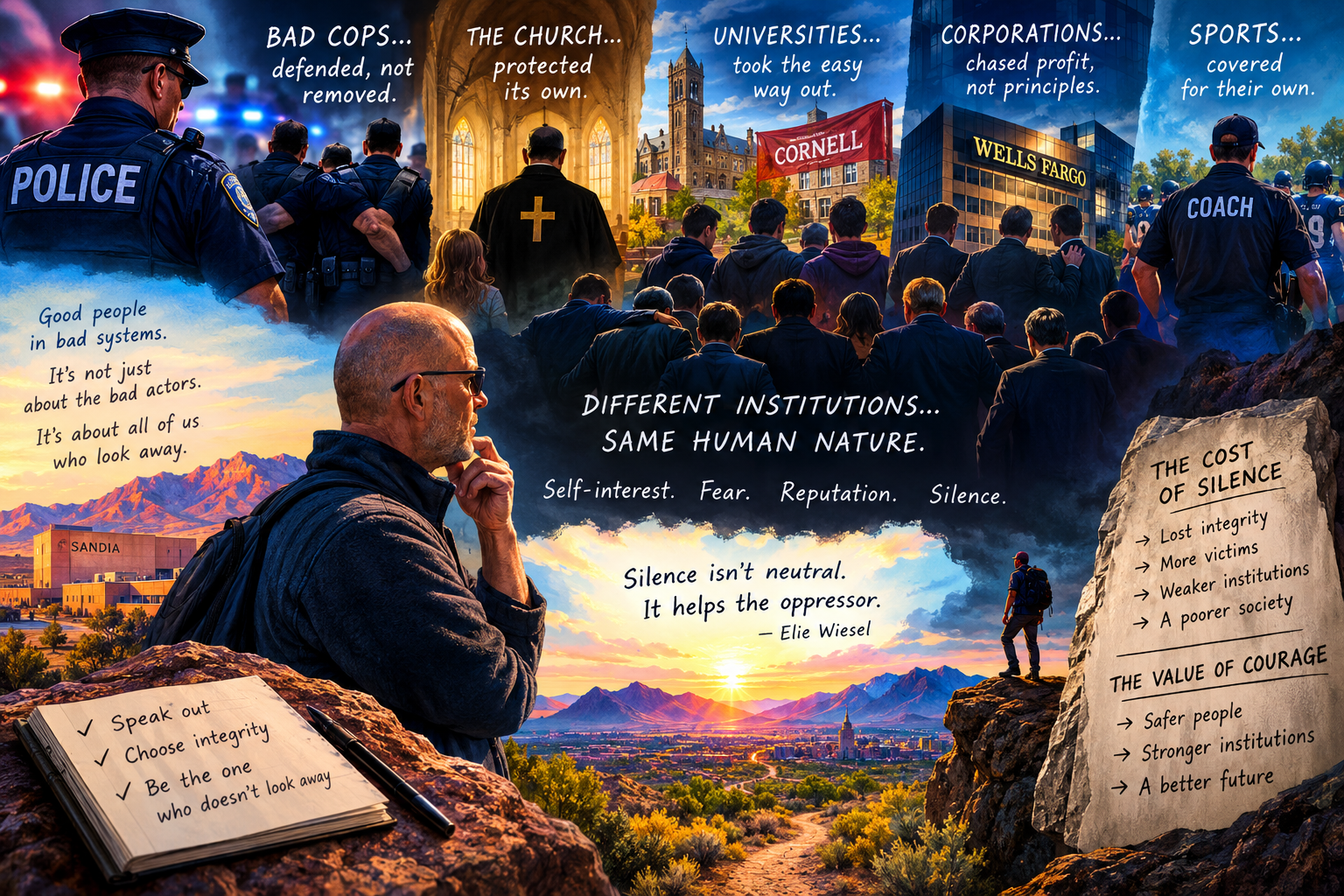
What if bad cops and bad managers are manifestations of the same problem? Think of the Catholic Church and its molesting priests. Think of the echoes of the same dynamic in the Cornell gang-rape case. Penn State sat on what it knew about Jerry Sandusky for years. USA Gymnastics protected molester-rapist Larry Nassar. They protected them long after coaches and staff had known of the violations. Wells Fargo managers were pressured to hit sales quotas by opening fraudulent accounts. The bank’s leadership looked away for years; money was being made. Police departments and the “thin blue line” look the other way, even protecting bad cops. Why do organizations cover for bad behavior instead of ridding themselves of the offenders?
“We must take sides. Neutrality helps the oppressor, never the victim.” — Elie Wiesel
The Cornell case is the one that has stuck with me deeply. I’ve dug into the details of the secrecy around it and the sheer number of people who stayed quiet. What’s remarkable, and damning, is that so many people knew what was happening and did nothing. No one intervened. No one alerted officials. No one helped the young woman at the center of it. This happened among a group of privileged, by all accounts intelligent, young men. That’s a damning indictment of moral rot and a basic lack of character in people we’re about to hand the future to. If bystander silence shows up naturally like this, before anyone has a career or a pension or an institution to protect, the issues run deeper than any incentive structure. It condemns society as a whole. It looks closer to a default, and we just give that default legitimacy
“The sad truth is that most evil is done by people who never make up their minds to be good or evil at all.” — Hannah Arendt
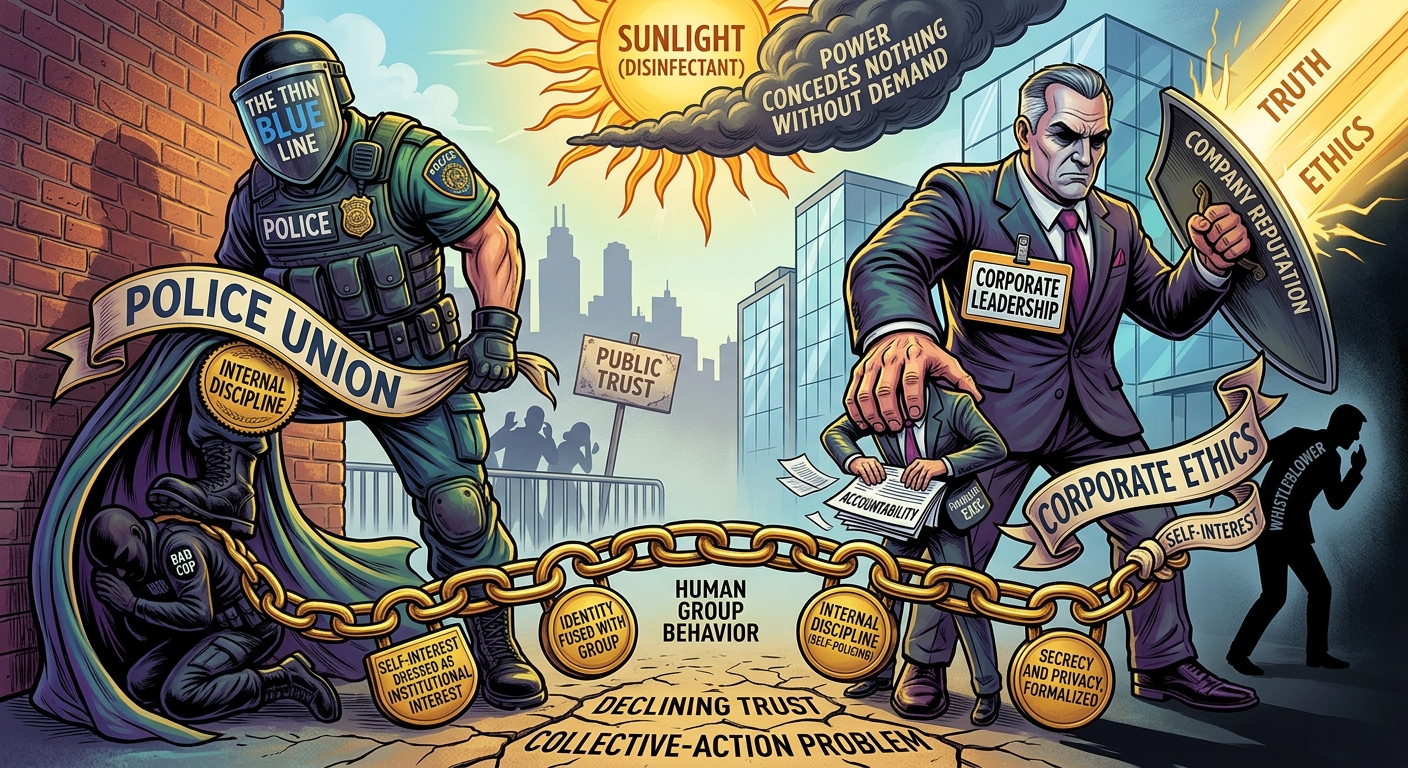
That same willingness to look away shows up anywhere institutions have a reputation worth protecting. I’ve always wondered why police forces protect bad cops. Bad cops are a huge threat to public trust. You’d think good cops wouldn’t want to be associated with them. But the behavior of police forces and police unions is the opposite. Bad cops are defended reflexively. They defend bad cops to a degree that’s repugnant. They let them keep working. They rarely drive them out. The bad cops keep doing bad things.
The question I kept circling back to: is the tolerance of bad management I’ve seen the same idea? Do managers, writ large, close ranks around the bad ones among them, the same way police close ranks; the same way dioceses did; the same way as frat boys; coaches finding a criminal among their ranks; the same way corporate boards do when a star executive turns out to be a fraud?
Upon reflection, you start to see the parallels and the reasons these things happen. A few maxims of human group behavior are doing the damage. These show up again and again, in every one of these institutions. The Labs, it turns out, are completely ordinary in this regard. They are subject to the same human frailties and shortcomings.
A big one is self-interest dressed up as institutional interest. Exposing a bad actor costs the people who’d have to do the exposing: lawsuits, bad press, lost trust, lost donors or votes or customers. The people positioned to catch the problem are usually the same people whose careers and reputations are tied to the institution looking good. So the short-term incentive is almost always to contain the story, not tell it. Increasingly, the cover-up is assisted by policy and secrecy.
Identity fused with the group. Police, clergy, and tight political or corporate networks all ask for, and get, unusually strong identification: the thin blue line, the body of Christ, the firm, the family business. Once your sense of self is wrapped up in membership, a colleague’s wrongdoing starts to feel like an attack on you personally, not a policy problem to be solved. Covering for a fellow member reads internally as loyalty. The cover-up becomes a virtue instead of a damning action.
Internal, self-run discipline. In every case I’ve mentioned, there are disciplinary procedures that are largely internal to the organization. That lets punishment stay hidden, or not happen at all. Police investigate police. Dioceses handled abuse allegations themselves for decades. Legislatures police their own members’ ethics. Corporations run HR processes before, if ever, anything reaches an outside authority. Self-policing without an external check reliably degrades into self-protection. The investigators and the investigated share the same stake of institutional cleanliness.
Secrecy and privacy, formalized. There’s always an element of confidentiality that these organizations provide their members, and it’s remarkably easy to stretch. In my case, the clearest version of this was the laboratory’s own culture of secrecy, which has only grown. There was always secrecy around nuclear weapons data. That part makes sense. That necessary secrecy has expanded hugely in recent years. More and more of the lab’s ordinary business gets classified as protected data. What used to be OUO, Official Use Only, is now CUI. Basically the same thing: a category where information gets locked away from external eyes. Once locked away, scrutiny is impossible.
I’ll note this gets used for exactly the purpose you’d expect: protecting the organization, not the mission. In my case, one category was “export control” data (CUI). Export control is so poorly defined that almost anything can be declared export-controlled without any rational basis. That’s exactly what happened to the report that ultimately led to my decision to retire. That kind of power lets bad actors act without consequence and without accountability. It was clear the organization backed their lack of accountability. They actively defined information that was not export-controlled to hide a problem from the outside world.
The secrecy at Sandia points to something bigger than any one report: transparency itself. Sandia was always far less transparent than its sister lab, Los Alamos. Some of that came from Los Alamos being a company town. There, the lab and the community were practically the same thing, and almost nothing stayed hidden for long. The differences went deeper than geography. It was a real cultural difference between the two labs, baked in from the start. A lack of transparency is the perfect environment for corruption to take root. Secrecy is part of the basic mission at both labs, for understandable reasons tied to weapons work. That same secrecy is easy to misuse for reasons that have nothing to do with the mission, and at Sandia, it was.
We’re also living through a moment when secrecy and a lack of transparency are getting worse generally, not better. The powerful understand that transparency is their enemy. They lean on the threat of retaliation and on legal tools like NDAs, all built to make sure no one can shine a light on the corruption, or on the people benefiting from it.
“Sunlight is said to be the best of disinfectants.” — Louis Brandeis
Add a collective-action problem on top of all that secrecy, and you get exactly the paralysis I watched play out at the lab. Often many people have partial knowledge of a problem: rumors, a handful of complaints, a pattern that looks off. But no single person has enough to act alone. Each person who might speak up carries the full personal risk, while the benefit of exposure is shared diffusely by everyone else. That’s a reliable recipe for silence. Whistleblowers aren’t just disliked. They’re frequently pushed out, sued, or frozen out of advancement, while the people who stayed quiet suffer nothing at all.
It’s very much like internal-affairs investigations in police departments. Rather than drum out the people who do a bad job, abuse their position, and bring disrepute on the organization, the organization protects them and lets them keep operating as members in good standing.
The counterpoint is brutal and consistent: if you’re the one who sheds light on the problem, you’re the one who gets drummed out, looked down on, and punished. I saw this directly. The investigatory process at the lab was oriented around protecting the lab, not around doing what it claimed to do. Corporate ethics means the corporation is ethical without regard to actual ethics.
This is corporate ethics in its purest, ugliest form: whatever the corporation wants to do is right. If you oppose the corporation, you’re the one in the wrong. It’s a might-makes-right argument dressed up in process and procedure. It ends in the same place every time: protecting the organization over protecting anything genuinely ethical. The mission quietly gets replaced by the institution’s own self-perpetuation. Once that substitution happens, anything that threatens the institution’s standing gets treated as the real threat. The wrongdoers being protected are just collateral damage. Calling it out is worse than the original crime.
“Whistleblowers are seen not as allies but as threats, because they expose the gap between what an institution claims to be and what it actually is.” – Conventional wisdom
Can it be fixed? Imperfectly, but yes, and not through better mission statements or stronger-worded codes of conduct. The institutions that have actually improved did it by giving something up, not by writing something down. They give up control. Independent investigation and discipline, run by people with no stake in the institution’s reputation, is the single most effective lever. Examples include civilian review boards with real subpoena power for police, outside lay boards for dioceses, independent ethics commissions with real enforcement teeth for legislatures, and regulators with real authority for corporations and national labs alike. The word doing the work there is independent. A review board stocked with the institution’s own alumni just recreates the same conflict of interest wearing a different badge.
Strong, enforced whistleblower protection changes the math for the person deciding whether to speak. In my case and another close friend’s, whistleblowing was an absurd prospect. It is a completely toothless option. It exists, but it is completely ineffective. If the personal cost of reporting drops, and the cost of retaliation to the institution goes up, more people with partial knowledge come forward instead of staying quiet and hoping someone else goes first. Mandatory public disclosure of misconduct complaints and their outcomes takes away the institution’s ability to absorb its bad actors quietly. It costs money and reputation up front, which is exactly why institutions fight it, and exactly why it works.
“It takes 20 years to build a reputation and five minutes to ruin it.” — Warren Buffett
Decoupling the people who benefit from the institution’s good name from the people who judge its wrongdoing attacks the conflict of interest at the root. It makes accountability systematic, instead of hoping individual virtue will outcompete a bad incentive structure. None of this is a clean fix, because the dynamics are structural, not a matter of a few bad apples with weak morals. They show up anywhere a group controls its own oversight and ties its members’ sense of self and livelihood to the group’s image.
“Those who stand for nothing fall for anything.” — attributed to Alexander Hamilton
The honest, uncomfortable truth is that each of these fixes requires the institution to give up some of its autonomy. Humans prize control, and control is exactly what institutions exist to protect and amplify. The fix rarely comes from inside. It comes from outside pressure: courts, legislators, the press, public opinion, or simply someone deciding to speak up. I made that decision myself, when the cost of staying became higher than the cost of leaving.
Zooming out from my own story, the upshot is grim. We should expect far more corruption, graft, and outright fraud in the years ahead, not less. Until we change the underlying dynamic, the cost of declining trust will keep compounding across the clergy, the police, corporations, national authorities, our government, all of it.
“Power concedes nothing without a demand. It never did and it never will.” — Frederick Douglass
Almost everything runs on trust, but nothing runs on it more than the economy. The economy depends on the faith of consumers and investors that the system is basically honest. Take away that faith, and take away a legal system willing to hold bad actors accountable, and the economy suffers. Eventually, the whole society bears that cost.
In the meantime, I’ve started seeing this behavior for what it actually is: the exercise of raw power. That power gets exercised for the benefit of the powerful, not for the good of society. The people running these institutions act with impunity, because there is no real recourse against them. Competence doesn’t enter into it. The good of society doesn’t enter into it. They get to do what they want, and nothing happens to them.
“Evil, when we are in its power, is not felt as evil but as a necessity, or even a duty.” — Simone Weil