“As far as the laws of mathematics refer to reality, they are not certain; and as far as they are certain, they do not refer to reality.”– Albert Einstein
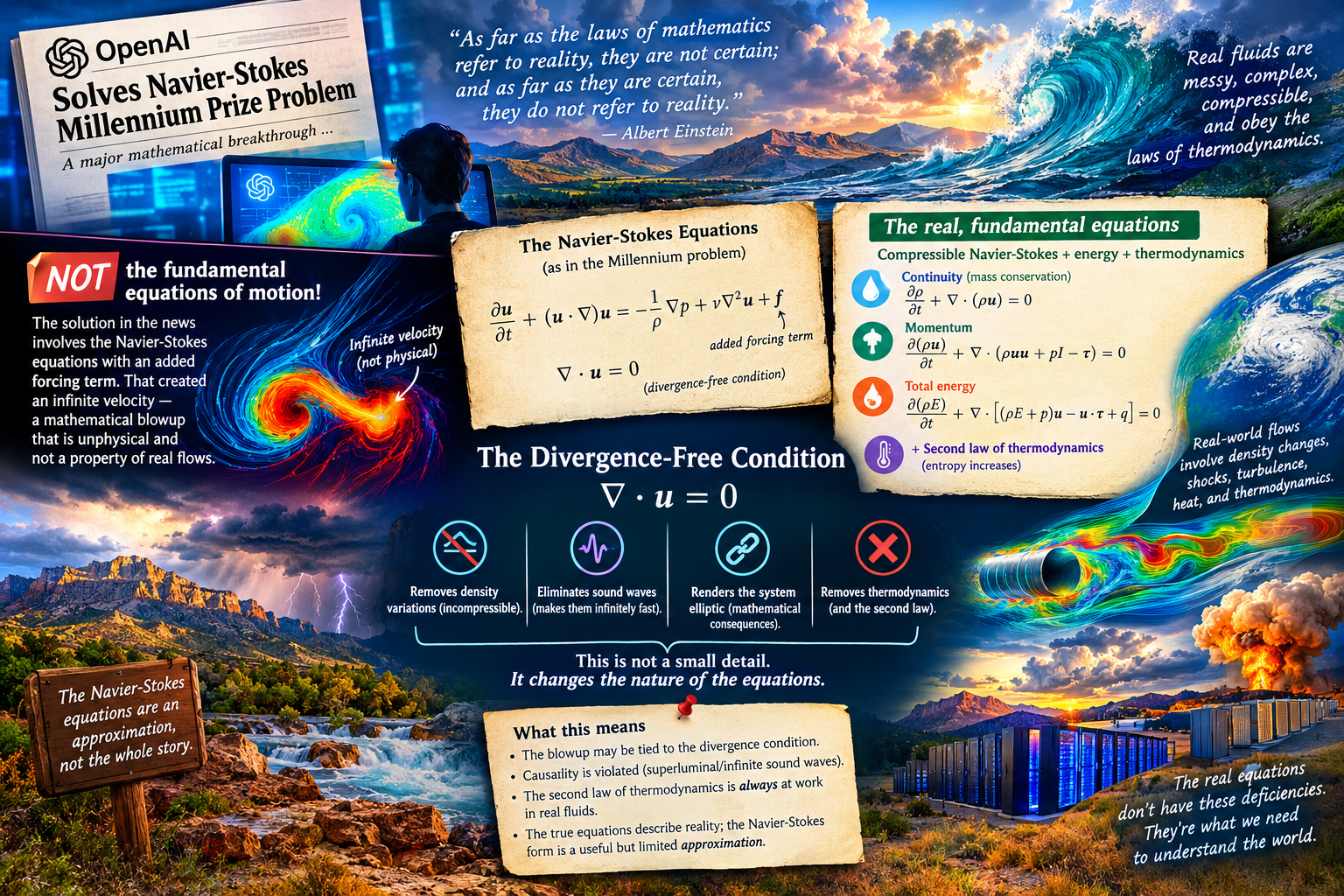
The recent news that OpenAI solved the Navier-Stokes Millennium Prize problem has put these equations in the spotlight. I must admit to feeling fairly significant irritation every time I read a story.
Why? Because of how these equations are being presented.
They are not the fundamental equations of motion. The solution, if it is indeed true, actually points to some fundamental limitations of that formulation. It does not undermine the utility or correctness of the actual equations that best describe reality. Those are different equations! Any fault lies with this particular form of the Navier-Stokes equations. This should form a key part of any narrative. To date, it has not, and it is a disservice.
When one understands the true nature of the fundamental equations, it brings into the light the deficiencies of the Navier-Stokes equations as stated by the Millennium Prize. The true equations do not have these deficiencies. It’s useful to elaborate on this. That means describing the true equations and the derivation of the equation solved in all the stories. It also means pointing out the limitations that may have been highlighted by this solution.
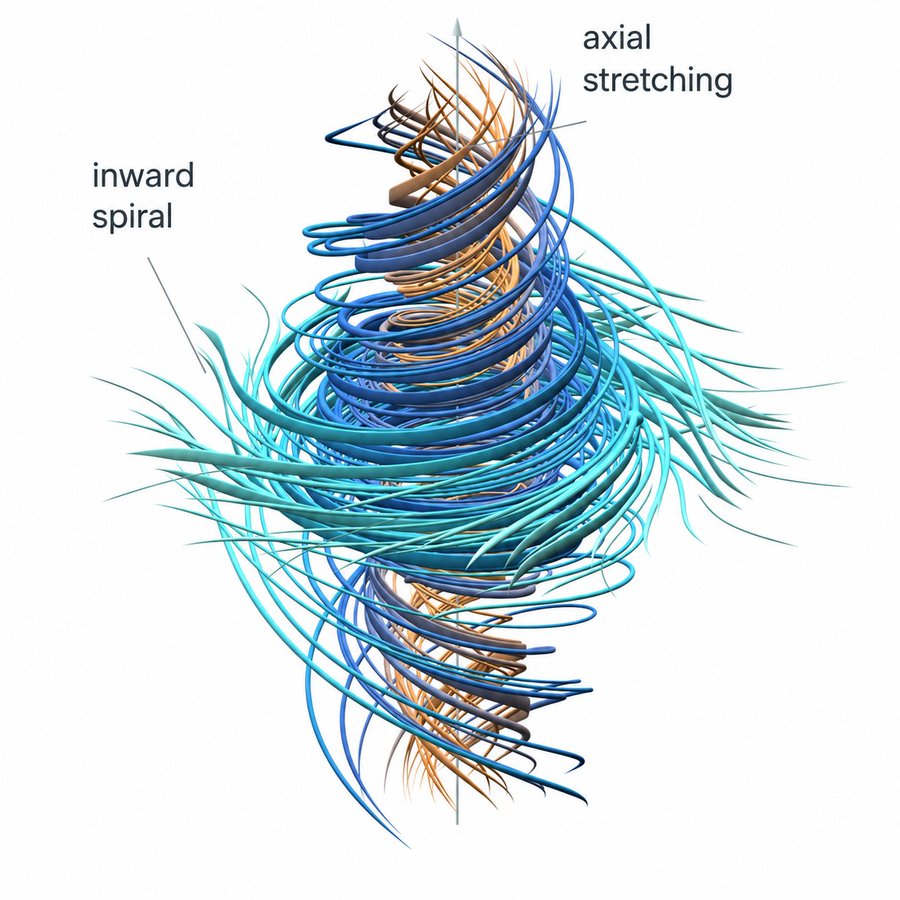
Just to review, the solution involved adding a forcing term to the equations. This created a situation where you had an infinite velocity. This blowup is completely unphysical. It is not related to other blowups that would be of physical significance. Instead, it is related to some sort of failure in the framework.
The whole situation is quite complicated technically. Thus, one can give some credence to the popular descriptions of these equations. However, the damage done by the descriptions can be quite great, because they don’t come with any of this nuance. The fulcrum of this deeper explanation is the simplest equation in the stated set of Navier-Stokes equations, the divergence-free condition for the velocity. This is the term is 
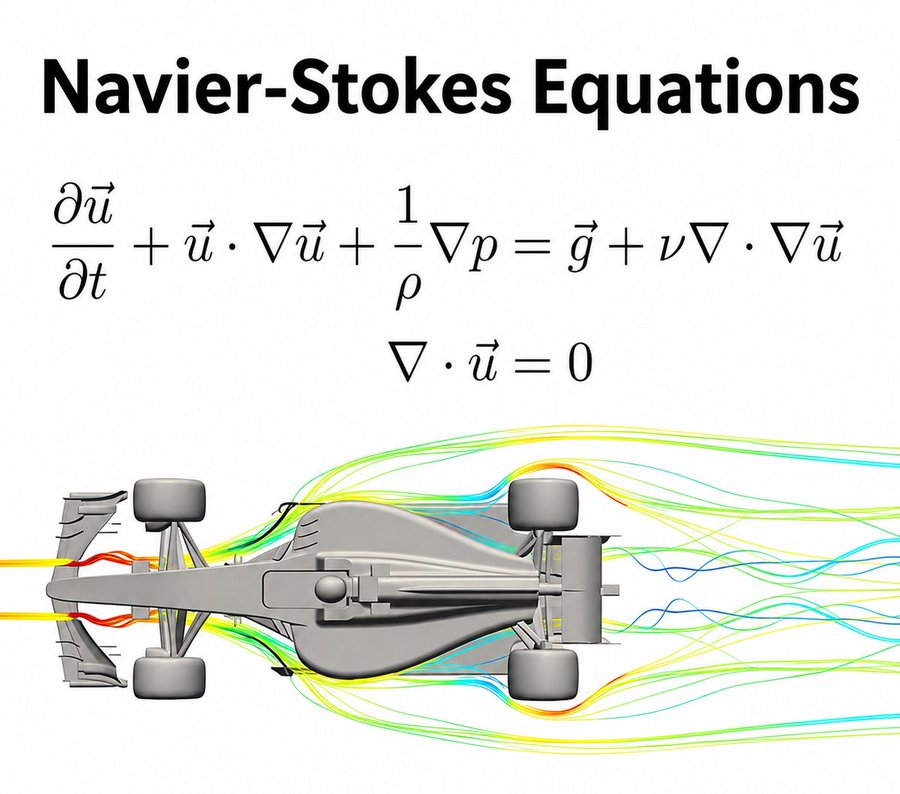
The divergence-free condition can be derived several ways. Fundamentally, it means that the equations themselves do not support variation in density. This variation in density is a fundamental characteristic of almost every fluid flow. This includes the situations these equations claim to model! When it is removed, there are a number of consequences. Most acutely, from a mathematical perspective, this equation renders the coupled system of equations elliptic in nature. This ellipticity brings several consequences that are probably related directly to the blowup that was discovered. I would be quite surprised if the blowup was not directly related to the divergence condition.
The ellipticity results from the removal of sound waves from the equations. These sound waves are an important mechanism by which density varies in real fluid flows. The removal of sound waves effectively means that they have been rendered infinite in speed. Thus, the equations, as stated, violate causality. As one of my friends at Los Alamos quipped, you have suddenly introduced superluminal sound waves into the system of equations. By superluminal, I mean sound waves that move faster than the speed of light. Here the speed is infinite.
I will return to causality later in the essay.
“If your theory is found to be against the second law of thermodynamics I can give you no hope; there is nothing for it but to collapse in deepest humiliation.”– Sir Arthur Eddington
A second, and potentially more persuasive, way to make this point is that the divergence-free condition removes thermodynamics from the equations. Thermodynamics is a fundamental constraint on continuum physics. In that sense, it results in the removal of the second law of thermodynamics. The energy equation could be added to Navier-Stokes for good measure. However, with incompressibility, it lacks some of its connections to the full system. Again, this is a fundamental flaw in the equations as stated. The reality is that they do not describe flows in reality. They are, rather, an approximation to those flows. The nature of this approximation is worth discussing in a bit more detail.
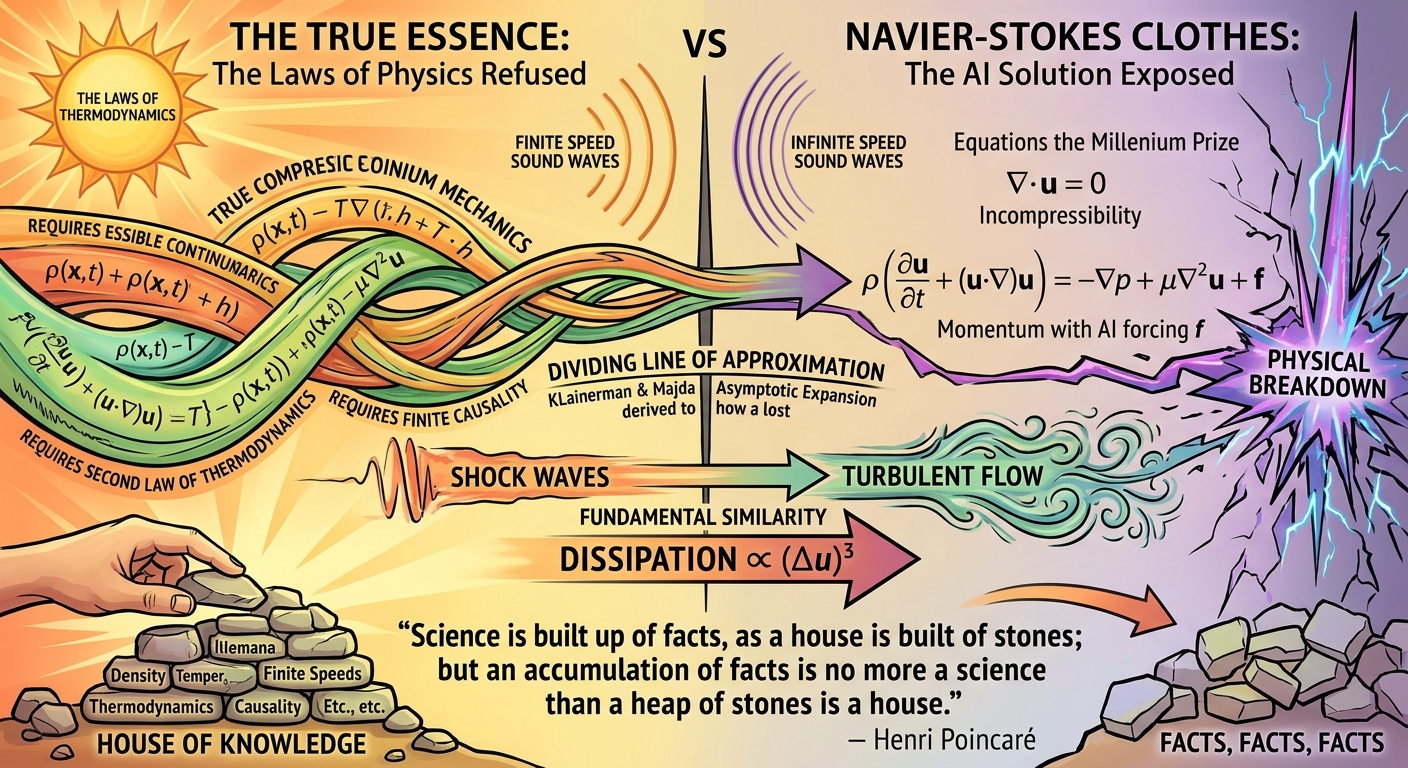
The Navier-Stokes equations described in the stories can be derived from a truer set of equations by simply doing what mathematicians call an asymptotic expansion. Klainerman and Majda did this work, and their derivation is bulletproof. However, the equations they start with are themselves the adiabatic (meaning constant entropy) version of the compressible flow equations. Thus the second law of thermodynamics is removed by fiat. This is a fatal flaw. To get to the equations they wanted, they needed to remove it. They knew the end point of the incompressible equations and left the second law behind to get there.
This is an explicit statement that one is not operating in flows where the second law of thermodynamics is working. What one should know is that the second law of thermodynamics is always at work in continuum systems. It is a fundamental bridge to the determination of physically admissible flows, particularly as the effects of viscosity become small and negligible. In turn, the small and negligible viscosity behavior is important for understanding the fundamental dynamics of turbulence.
This, in turn, gets to the fundamental failing of these equations in terms of their ability to describe nature. As posed, there are many who believe that the phenomena of turbulence are contained wholly within the incompressible equations being solved. I, for one, have expressed extreme doubts about this. My doubts come mostly from two things. The first is the removal of the second law of thermodynamics.
The second is the observed behavior in turbulence matching, in a very real sense, the derived behaviors of compressible flows. Namely, the presence and behavior of shock waves do not depend on the value of viscosity. Just as with shocks, the behavior of turbulence in a higher Reynolds number flow does not depend explicitly on the value of viscosity either. This similarity is not a happenstance. This similarity is fundamental.
In both cases, the amount of dissipation that is seen is proportional to the cubed difference in the longitudinal velocity of the flow field. The two expressions, for dissipation in shocks and dissipation in turbulence, only differ by the constant leading them. The shock relationship is a one-dimensional relation, whereas the turbulence relationship derived by Kolmogorov is 3D. Nonetheless, the removal of thermodynamics is a huge gap. It is something that should be recognized when looking for the physical significance of these solutions. It should make one disregard them.
If I haven’t courted enough controversy yet, let me dig myself an even deeper hole.
The dissipative terms in the equations also carry with them some difficulties. In short, they also imply an infinite speed of propagation, thus violating causality as well. This is a more subtle and far less well-accepted point. The dissipative terms, whether they are associated with viscosity or heat diffusion, are approximations as well. The true terms actually include a finite speed of propagation. Thus, the real, true system is entirely hyperbolic. In nature, what one might expect is that, under similar conditions, the parabolic terms might also produce some abhorrent results that produce infinite velocities. This is pure supposition.
By and large, the hyperbolic version of these equations is not useful to solve. However, it is pretty clear that causality and finite speed of propagation are something worth keeping in mind. Thus, the same kind of limitations that one sees with Navier-Stokes in terms of incompressibility may also be present with the parabolic terms. This would include parabolic terms included in the compressible flow equations.
Just throwing it out there as a possible deeper outcome of all of this work.
“When I die and go to heaven there are two matters on which I hope for enlightenment. One is quantum electrodynamics, and the other is the turbulent motion of fluids.”– Horace Lamb (attributed)
The whole term “blowup” is also something that requires a bit more explanation. With a shock wave, one experiences a blowup in derivatives. In other words, the derivative of the flow values becomes infinite. The values of the quantities being evolved remain finite, but there is a formation of an infinite gradient. This is true in the absence of viscosity, but it can be navigated with the second law of thermodynamics. The same blowup is almost certainly the mechanism by which turbulence achieves its observed characteristics. In both cases, this produces the sort of dissipation that arises independent of the value of viscosity.
The real mathematical exercise that would be useful going forward would be to determine under which conditions such a blowup occurs in low-speed flows. These are the flows approximated by the Navier-Stokes equations that were solved. Instead, keep the 2nd law and finite-speed sound waves.
The clear message is that these equations have been shown to have a problem by this AI proof. They already had problems that were rather obvious. Now we have a mathematical exercise that demonstrates the consequences of this. This is useful mostly in navigating the fundamental flaws in these equations. It should be an exercise in appropriate limits on their use. Instead, they are being promoted as the fundamental equations in most of the descriptions, and that is a damaging thing to do.
The reality is that all of these equations are models of reality. The universe does not run on mathematics, but mathematics is a good description of how the universe runs.
“Mathematics is the part of physics where experiments are cheap.”– V. I. Arnold
The reality is that these materials are formed from collections of atoms or molecules. They involve certain collective behavior described by even more fundamental equations. Those equations are too detailed to be useful for solving these equations in a regular way. By the same token, the fully hyperbolic description of all these equations is only useful in a limited frame of reference. The key thing to do is to determine which approximation is appropriate for which circumstances.
More than anything, it is these nuances and notions that need a human touch. The greatest place for humanity is to put cognitive limits and choices into the recipe for mathematics. The mathematics done in the absence of this becomes something that may be much ado about nothing. Meanwhile, the OpenAI result is impressive and troubling, all in one fell swoop.
It also fails to recognize the broader context of “so what?” Why is this strategically important? What are the consequences? Even if the proof is entirely true, they didn’t make any sort of broader conceptual understanding of the equations themselves. They may have discovered something really important, but they can’t tell you why it is important. This is, in an essential way, the role of humanity and human cognitive effort.
It would be good if there were a broader recognition that the Navier-Stokes Millennium Prize is poorly stated. As such, they are useless for understanding our physical world. We should instead be focused on equations that don’t have these profound causality issues. Equations that allow the invocation, either explicitly or implicitly, of the second law of thermodynamics. This would be a route by which mathematics could have a deeper and more profound impact on our understanding of the universe.
“Science is built up of facts, as a house is built of stones; but an accumulation of facts is no more a science than a heap of stones is a house.”– Henri Poincaré