“The real problem is not whether machines think but whether men do.” – B. F. Skinner
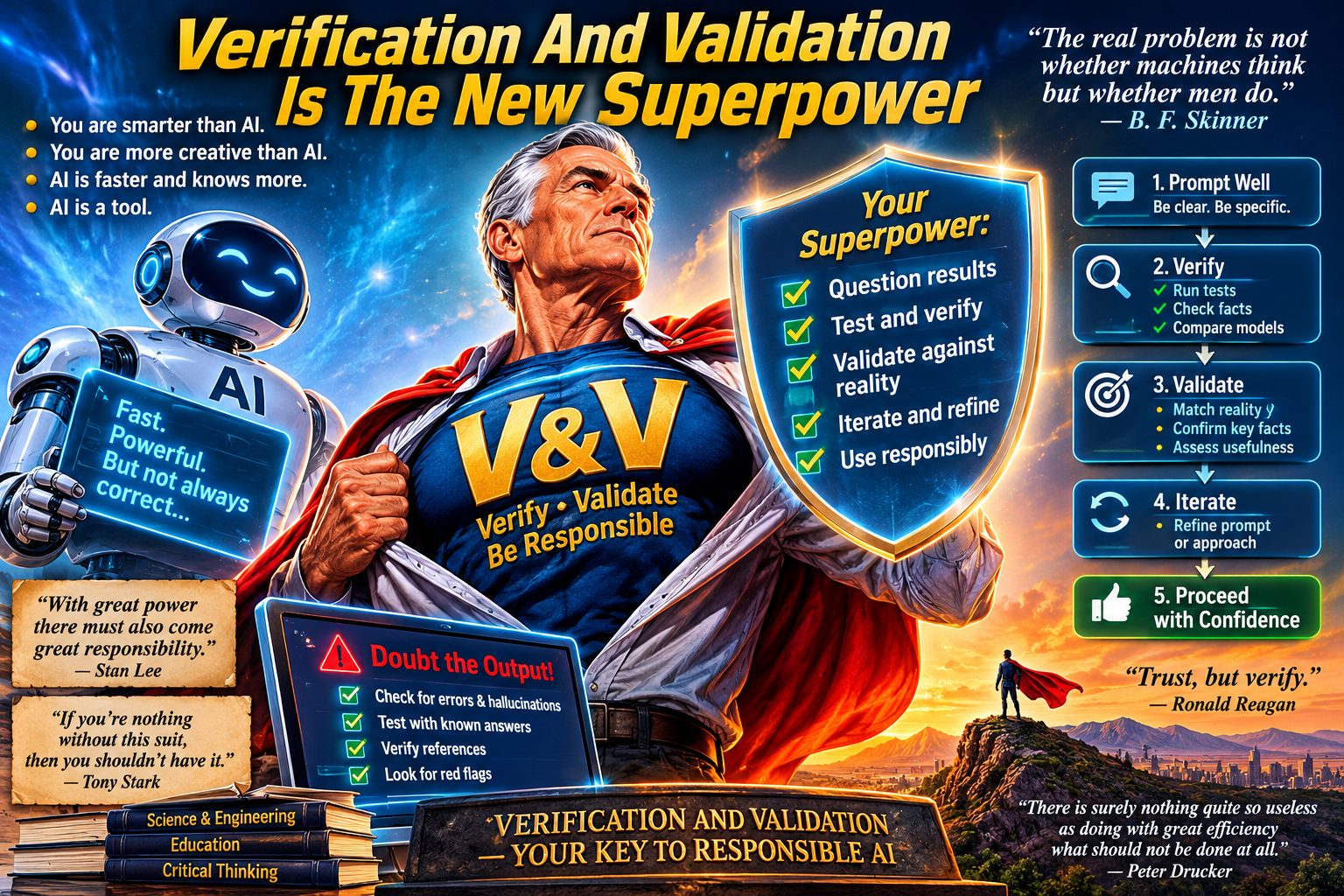
You are smarter than AI.
You are more creative than AI.
AI is faster than you and can digest more information.
AI is a tool.
“With great power there must also come great responsibility.” – Stan Lee
You are responsible for determining whether AI results are correct and fit for purpose. If and how any of these results find their way into a finished product is your decision. Your intelligence, energy, and creativity must be harnessed to determine any ends. Anything less is human malpractice.
This process is known as verification and validation. It is your superpower in this new age of AI.
“If you’re nothing without this suit, then you shouldn’t have it.” – Tony Stark
Tony Stark’s Iron Man armor is a good analogy for all this. When Tony Stark puts on the Iron Man armor, what happens in that armor is still his responsibility. He is still in charge. He is still the one completing the action. He is in control.
With AI, you are granted a different kind of power in an intellectual sense. Your suit of intellectual armor is something you are responsible for. You must use it in a way you can stand behind. If you want to be a superhero and use this superpower, you are the one who must be responsible for what it does. Doing that is a skill. It t is a skill I am working hard to develop better. I believe it should be part of the development of everyone using AI. This is a society-wide project.
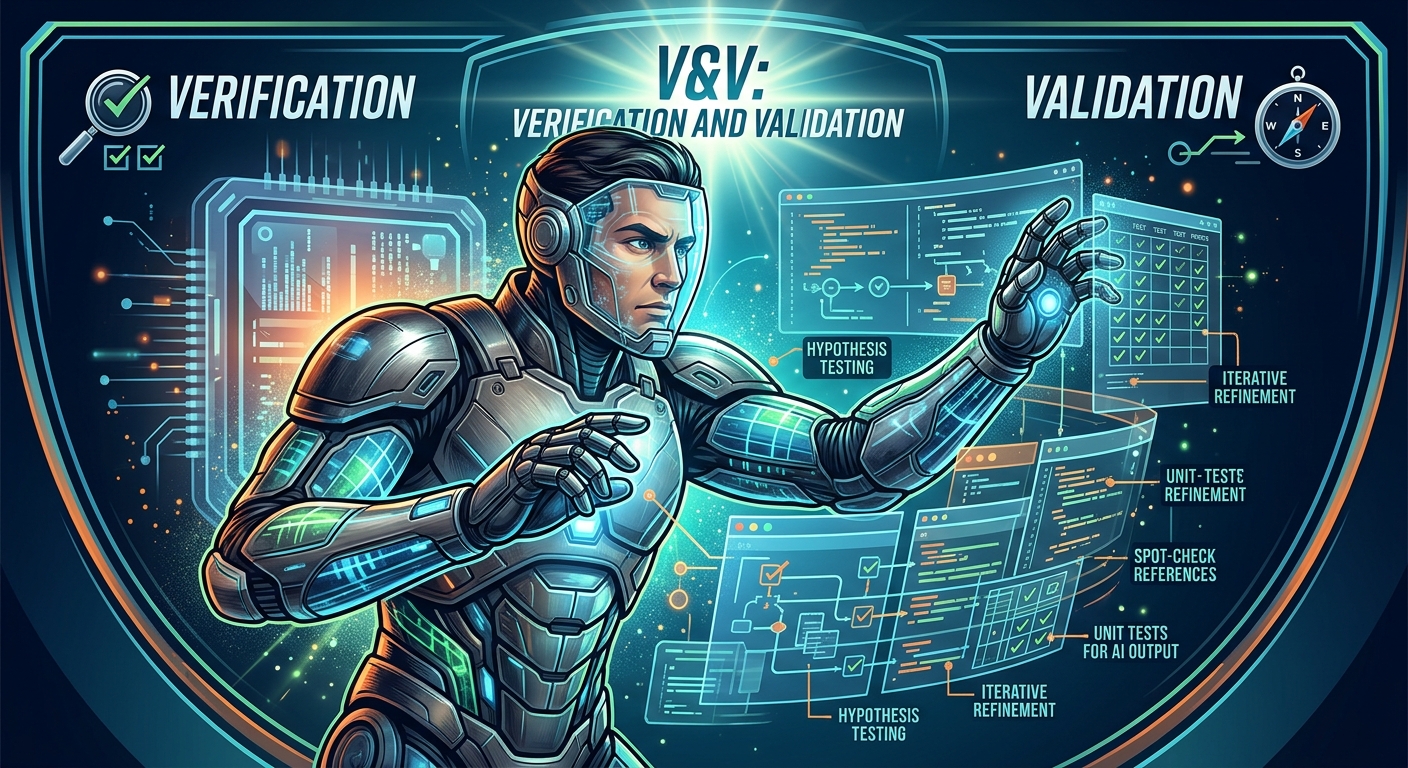
I submit that verification/validation, as a skill, is the equivalent of your suit of armor. Practicing it when working with AI is the path toward success. It is also the path toward responsible use. It is the path toward getting the best out of these AI platforms. Step one is looking at each query as one in a series of tests. Reacting to each through iterative refinement of what I had asked is always necessary. In almost every case an essential step to getting the best results.
“Essentially, all models are wrong, but some are useful.” – George E. P. Box
Our experience with verification/validation is not new. It was born in a closely related area of science and engineering. The practice of verification and validation started under similar circumstances for computational simulation. It is a practice in which the scientific method is harnessed to produce evidence that a simulation is correct.
What AI shares with simulation is the speed and volume of computation done with modern computers. In both cases, they vastly exceed anything humans can comprehend. Just because things are fast and involve many computations does not mean they’re correct. The whole verification and validation mindset is structured to test correctness. Discover how true it is and the evidence of that truth.
Just as in AI, the vast amount of computing does not equal correctness. Correctness must be proved with serious evidence. That evidence can then guide decisions.
The advent of AI as a productivity tool has created a need to restructure the way we work. It also demands a restructuring of how we teach and how we learn. One benefit of AI might be making work look more like school. That would be a very good thing. The impact on the workplace and the educational system is profound. They are also closely aligned.
“Trust, but verify.” – Ronald Reagan
As the Borg say, “Resistance is futile.” This AI genie is not going back in the bottle. It needs to be developed for the good of humanity. Not the good of a few humans. We need to learn how to use this technology effectively. If we’re educating young people, their success in the workplace is predicated on mastering this technology. The more it’s mastered, the more it’s used, the more successful individuals will be.
What I have found is that the concepts of verification and validation have grown in importance. Any result AI comes up with, whether it’s a body of writing, a literature search, or coding work, requires testing and verification. This actually starts with the mindset you approach the use of software.
The foundational thought is “this is probably wrong. I just need to find out where.”
One needs to approach anything it produces with doubts. Doubt the output and look for things that are not sensible or expected. There are techniques for this that we need to teach people, and their use needs to be expected. It’s a necessary part of the educational reform needed to meet the moment. One way to do this is to outfit the output with many tests. This should always include tests you know the answer to. If AI can’t give you the answer you already know, you can’t trust it.
This is the verification part of the work.
This assumes that you asked the question or request properly. One of the things to recognize is that there are different failure modes. Most people think the failures are all in the output. Garbage in. Garbage out. One more important mode of failure is an inadequate prompt. You were not clear. You were not specific. You were misunderstood. Often, the prompt is flawed and needs to be refined. Corrected and given more detail in order to get the right answer. So, correct yourself and try again.
Then there is the case of hallucinations or outright mistakes. These require other steps. For instance, when code is being produced, demand unit tests for each capability (to establish the adequacy and dependability of what’s produced). Check those test cases! There’s also spot-checking outputs, making sure references actually exist, and a host of other checks that AI can help with.
The key is always to approach the output from an AI platform with an element of doubt. Work steadfastly to remove those doubts. Go again looking for anything you missed. Only when you feel sufficiently confident, move forward.
Given how weak the actual practice of verification and validation is, there’s plenty of reason for concern. V&V is often the first thing to go in computational simulation. With AI, this will be calamitous. In many areas of endeavor, the entire workforce will be using AI to do their work. We need to think about how to do this in an effective, efficient, and safe manner. If we don’t develop these skills, we’ll feel very productive, but that productivity will be an illusion.
The ability to test AI starts with your prompt. Is your prompt well understood? Is it clear, and does it get the response you were expecting? Sometimes that’s the core of your problem. A second way prompting is essential is whether you outfit the response with tests that get at the legitimacy of the output. Do you actually build the sort of strong testing environment that lets you check whether the results you get are good? This is one of the key things to do.
Part of good prompting is being well equipped with an understanding of the topic you’re prompting about.
This is where education comes in. The education of students needs to include the basics, an understanding of how to get to the basics. Additionally, a refined sense of where the gaps in understanding are. What is foundational knowledge, and where is that knowledge a little fuzzy? Finally, how do you test knowledge? How do you test what you’re doing, and how do you make sure you’re on the right track? These form the foundation of any product. The product will go further than the foundation, but must include it..
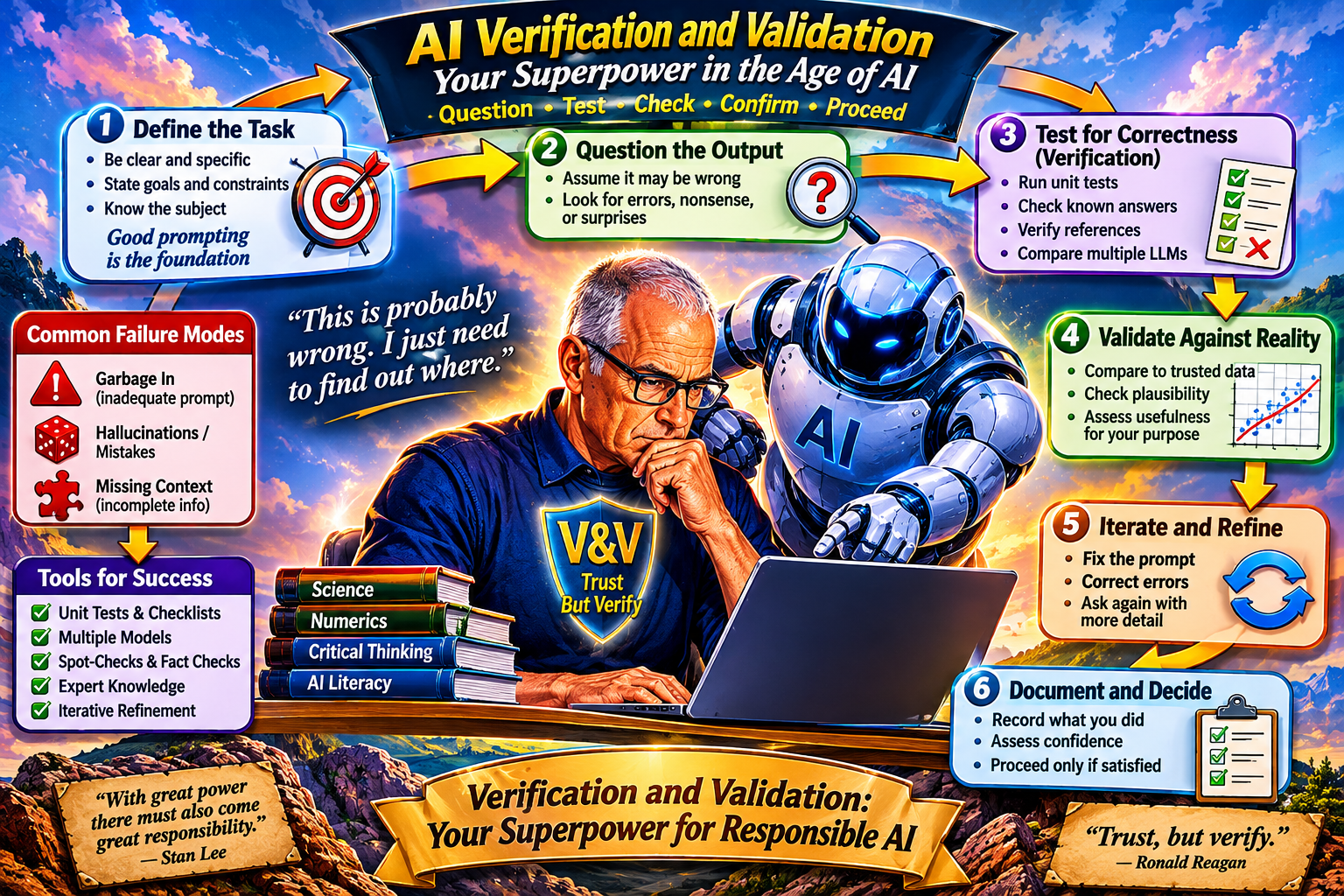
The key is repeated prompting and correction. The corrections are born from the doubt and reflection on the output. The whole cycle is driven by not being satisfied with the result until it is “perfect”. The first prompt is rarely sufficient for any complex task.
Using more than one LLM is another path to success. This might fill the role of code comparison in simulation. Where answers are most interesting is where they differ. You have some evidence of correctness where they agree. I did not say correct, both could be wrong. Still, the differences in the answers are where to focus initially.
Recently, I asked Muse to recreate what I asked Claude to do. This was creating a modern Von Neumann-Richtmyer Lagrangian code. Claude had done an outstanding job and matched what I had once done by conventional means. Muse messed it up. The answers were different. The numbers were off due to errors. Then I looked at the answers; they had oscillations that were unexpected. It turned out Muse had left out some of the stabilizing artificial viscosity. Things were almost identical with this. Things are still a little different, but I haven’t figured it out yet.
That said, if Muse had done this a year ago, I’d be writing about it.
The validation part with AI is a bit less structured. This is just like simulation. Validation is comparing the new information or results against reality. That reality depends greatly on what the prompt is doing. One place it is easy is in checking references. New references should be confirmed. Hopefully, lay eyes on the actual print. You cannot test all the new information. You need to look to confirm some of what it produces. The more you confirm, the more confidence you can have. Each confirmation is that evidence.
“There is surely nothing quite so useless as doing with great efficiency what should not be done at all.” – Peter Drucker

