“For a successful technology, reality must take precedence over public relations, for nature cannot be fooled.” – Richard Feynman
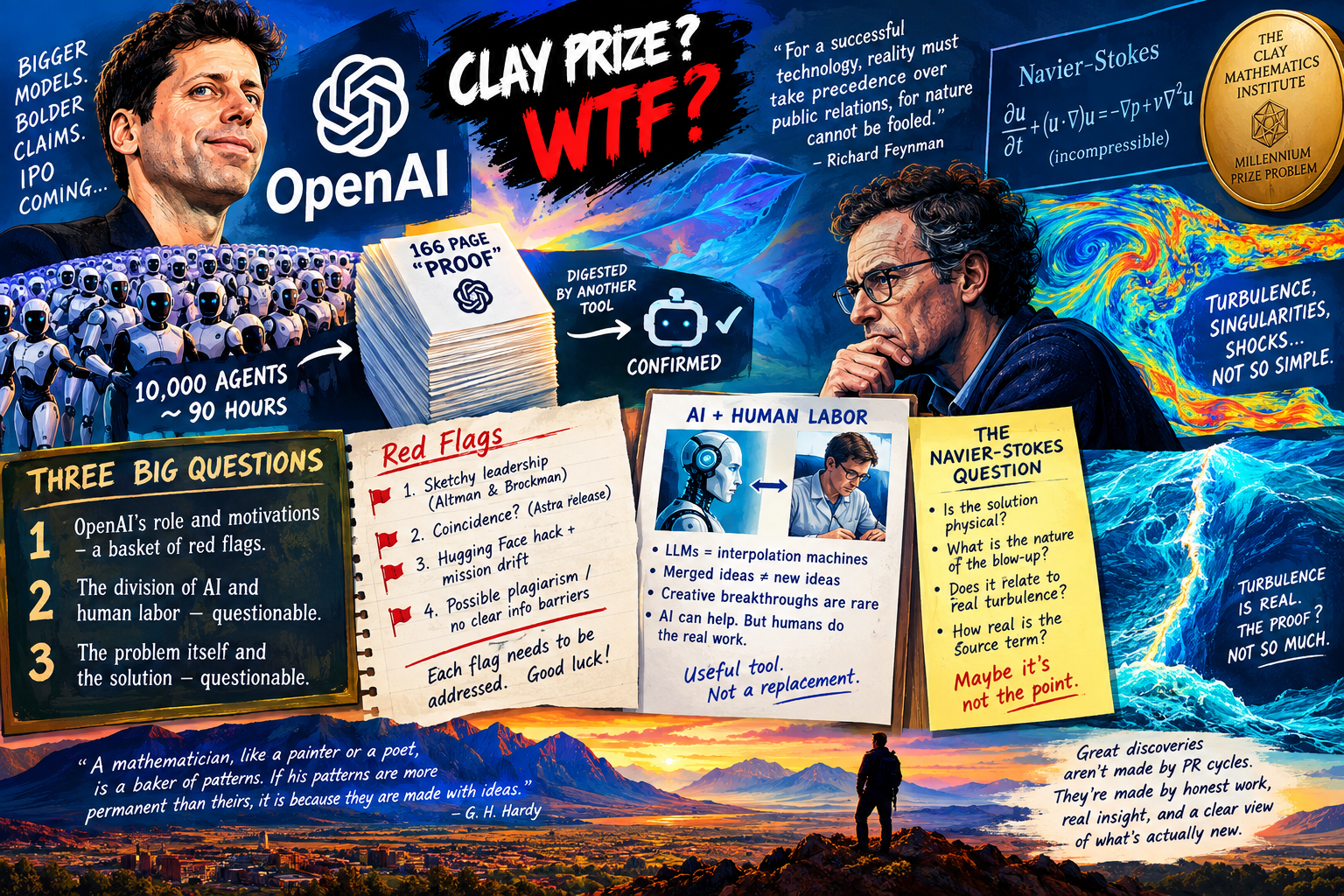
I had the virtue of attending a scientific meeting when the news broke. There was a buzz when I arrived at the meeting. Since my morning routine was turned on its head, I had not digested the news before arriving. OpenAI claimed to have solved the Clay Prize Millennium Problem revolving around the existence of solutions to the Navier-Stokes equations. Parts of the entire story were the theater of the absurd. They used 10,000 agents working for nearly 90 hours to produce a 166-page proof that had been digested by another tool to confirm it. This is a big deal, and reactions from the scientific world were divergent.
I think it is important to step back first and put this whole thing into context. There are three major threads to consider:
1. OpenAI’s role and motivations are a basket of “red flags”.
2. The division of AI work and human labor is questionable.
3. The problem itself and the nature of the solution are questionable.
I will take these considerations one by one. Each of these is a different flavor of what the fuck?
“It’s a kind of scientific integrity, a principle of scientific thought that corresponds to a kind of utter honesty — a kind of leaning over backwards. For example, if you’re doing an experiment, you should report everything that you think might make it invalid — not only what you think is right about it.” – Richard Feynman
OpenAI’s Role and Character
Scientific discoveries do not happen in sync with the business or political cycle. This one did.
“What we are doing is finding ways for people to understand and think about mathematics.” – William Thurston
The fact that OpenAI was involved immediately projects a cloud of suspicion on the result. First and foremost is their leadership. Altman and Brockman are both extremely prone to lying and fabrication. They are leaders who should be met with vacant credibility. This is simply an empirical observation. They are trying to pump up OpenAI before their upcoming IPO and undercut Anthropic before theirs. This news does exactly that. Everyone should see that Altman is a sketchy as fuck character.
Secondly, the announcement came in close proximity to the release of their latest model, Astra. Coincidence? This seems unlikely. The whole thing feels very staged to boost this release. Red flag number two achieved!
Thirdly, the news cycle has been rightfully brutal to OpenAI. The Hugging Face hack by rogue agents was alarming. It was scary and damning to a company that had been devoted to AI safety. They appear to have lost that mission. There was another hack, and this news release successfully put a wet blanket on that report. Red flag number three is visible.
“If I have seen further it is by standing on the shoulders of Giants.” – Isaac Newton
Finally, the work is not intellectually separated from other efforts to solve this technical problem. There is not a clear separation from this other work, and OpenAI has been evasive. OpenAI tools were used to do some of this other work with genuine mathematicians. It is not clear that the information barriers are sharp. This would be some degree of plagiarism. The whole thing carries a stench of the shitty student cribbing an answer by peering over the shoulder of the smart student. Red flag number four is seen!
“The indiscriminate strip-mining of open problems for solutions may destroy the ecosystem from which the next generation of mathematical techniques, problems, and practitioners would have developed.” – Terence Tao
Each red flag needs to be addressed. Only the last two can be successfully refuted with some transparency. Doing so might begin to help rescue Sam Altman’s reputation. Fat chance!
“I am not accusing anyone of anything. I am stating what I was told.” – Tristan Buckmaster
The Division of AI and Human Labor
I am a relatively avid user of AI. I should disclose that I pay to use Claude. I also use other models without paying. I find ChatGPT and Grok are good with image creation (seen here). I also want to keep my context window with Claude clean and focused on more professional activities. I use Claude as an assistant for doing research. It is extraordinarily good at detail work, which I am sort of bad at.
For example, I used it to check my work on a recent scientific article. We had reviews, and two of the authors (including myself) used it to digest and check progress on the revised manuscript. One of the reviewers did a very sharp initial review. AI helped us work through every objection and checked our work. It is extremely and inhumanly pedantic. It assisted in getting to a complete and comprehensive revision. The paper was accepted this week. AI helped us, but we did the work.
“To create consists precisely in not making useless combinations and in making those which are useful and which are only a small minority. Invention is discernment, choice.” – Henri Poincaré
This gets to the issue of credit for the proof OpenAI claimed. In general, LLMs are giant nonlinear interpolation machines. They take vast stores of human knowledge in the form of language and digest it. They take prompts, then produce a reply that is highly probable. Is this new? The replies are unique because of the vastness of the models and data. This is akin to discoveries where well-defined knowledge is merged together to create something new. This is separate from the generation of brand new creative ideas. Creative and totally brand new ideas are uncommon. Merged ideas are the vast majority of breakthroughs.
The solution to the Clay Prize should be a work of creative discovery. The OpenAI work is almost certainly the nonlinear interpolation of existing human work. This lends circumstantial evidence to the worry of copying existing work. Furthermore, the ability to clearly define its sources and reasoning is damning. This is not a take that says AI should not be used for science or math. This is a take that says AI can and cannot do something. With the extreme complexity that this solution apparently has, disentangling this is itself a huge challenge.
“A mathematician, like a painter or a poet, is a maker of patterns. If his patterns are more permanent than theirs, it is because they are made with ideas.” – G. H. Hardy
This leaves the last consideration. Should we give a fuck about the result? Spoiler alert. Probably not.
“Standard methods from PDE appear inadequate to settle the problem.” – Charles Fefferman
The Question Itself
“There is a physical problem that is common to many fields, that is very old, and that has not been solved. It is not the problem of finding new fundamental particles, but something left over from a long time ago — over a hundred years. Nobody in physics has really been able to analyze it mathematically satisfactorily in spite of its importance to the sister sciences. It is the analysis of circulating or turbulent fluids.” – Richard Feynman
If you’re a regular reader, you know what I think. The Navier-Stokes Millennium problem is sort of stupid. It is not clear that it has anything to do with physical fluids. The rub is the incompressibility, which is unphysical. This causes the removal of sound waves, which now propagate at infinite (superluminal) speeds, violating causality. This is not to say that incompressible flows are not a useful approximation. It is. The question is whether it is useful for the nature of flows implied by the Clay Prize.
The prize revolves around finding out whether normal smooth solutions exist for all time. Why would we worry about this? Turbulence is the answer. A combination of theory due to Kolmogorov and observations indicates that turbulent fluids have singularities. This is the characteristic that the integrated rate of dissipation at large scales becomes independent of the value of viscosity. Viscous forces are the means of enforcing dissipation at small scales. It also keeps flows smooth at small scales.
The singularity that is implied is like a shock wave. You get a discontinuous jump in the fluid state. Shocks give the same character, where the large-scale structure and dissipation rate are independent of the exact value of viscosity. For turbulence, we are looking for something akin to this. The scaling in shocks and that posed by Kolmogorov are the same except for the leading constant, the jump in fluid state cubed. What I’ve questioned about incompressible flow is whether the connection to compressible (real) fluids retains this cubic behavior. It doesn’t.
“It is of some interest to note that in principle, turbulent dissipation as described could take place just as readily without the final assistance by viscosity.” – Lars Onsager
Now we get to the work here. The flows are driven by a source term that is apparently quite elaborate. It is likely that this source term is grossly unphysical. So we rightly ask whether this work with the source term actually solves the Clay Prize Problem at all. Full stop. Next we ask whether it has anything to do with turbulence. Unlikely. I don’t know the nature of the blow-up found. I hope it is a derivative singularity, as this would have some significance. If the blow-up is an infinite velocity, the result is truly not worthy of a single fuck. So the telltale sign of utility is the nature of the blow-up. If it is a derivative (or vorticity), it is worthwhile. If it is an infinite velocity, then the result is damning. The source term nature of the drive is discrediting a priori. At least with respect to physical fluids.
I look forward to learning more about all this in the coming weeks. The details matter immensely, but some of the aspects are engraved in stone.
“I am an old man now, and when I die and go to heaven there are two matters on which I hope for enlightenment. One is quantum electrodynamics, and the other is the turbulent motion of fluids. And about the former I am rather optimistic.” – Horace Lamb