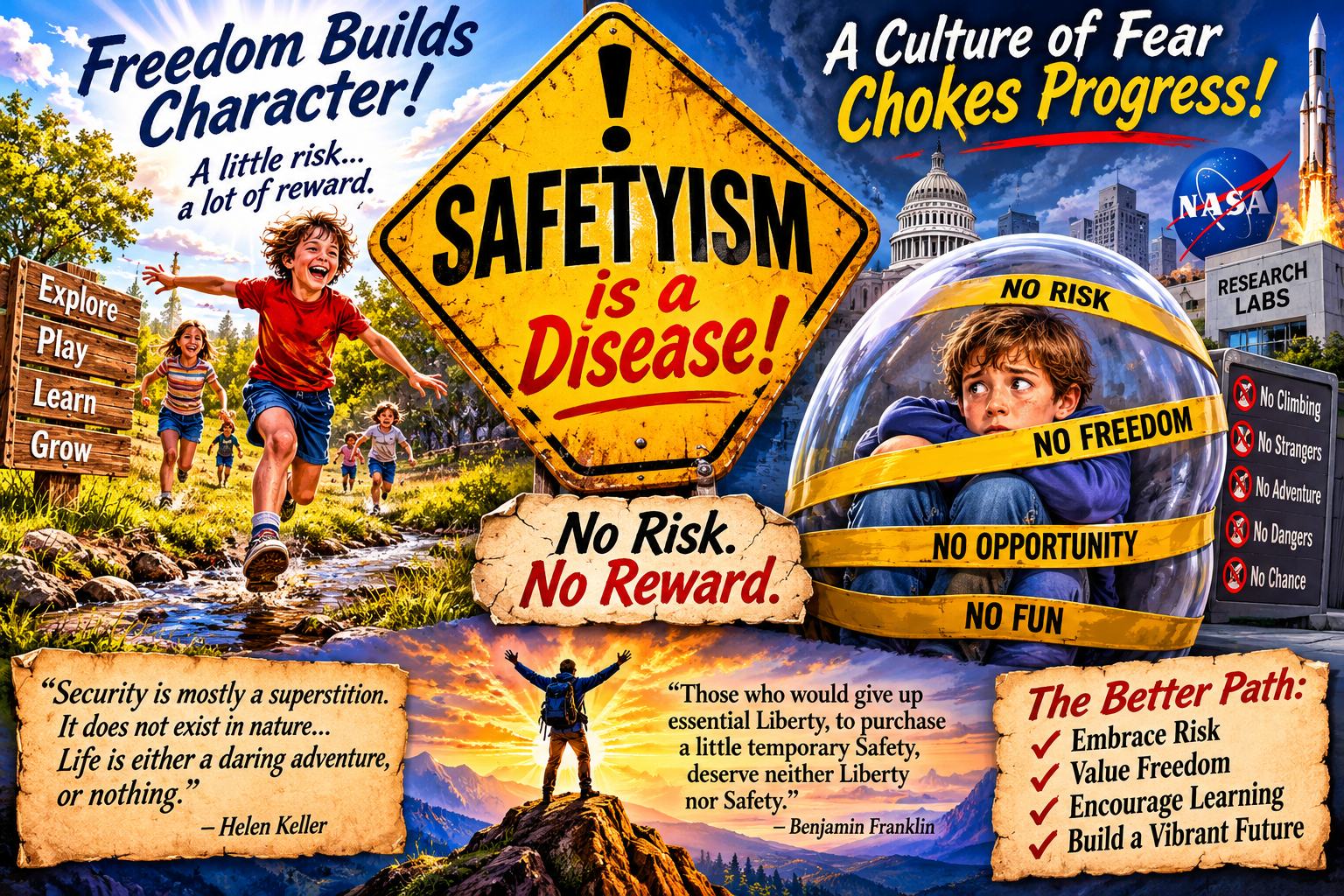
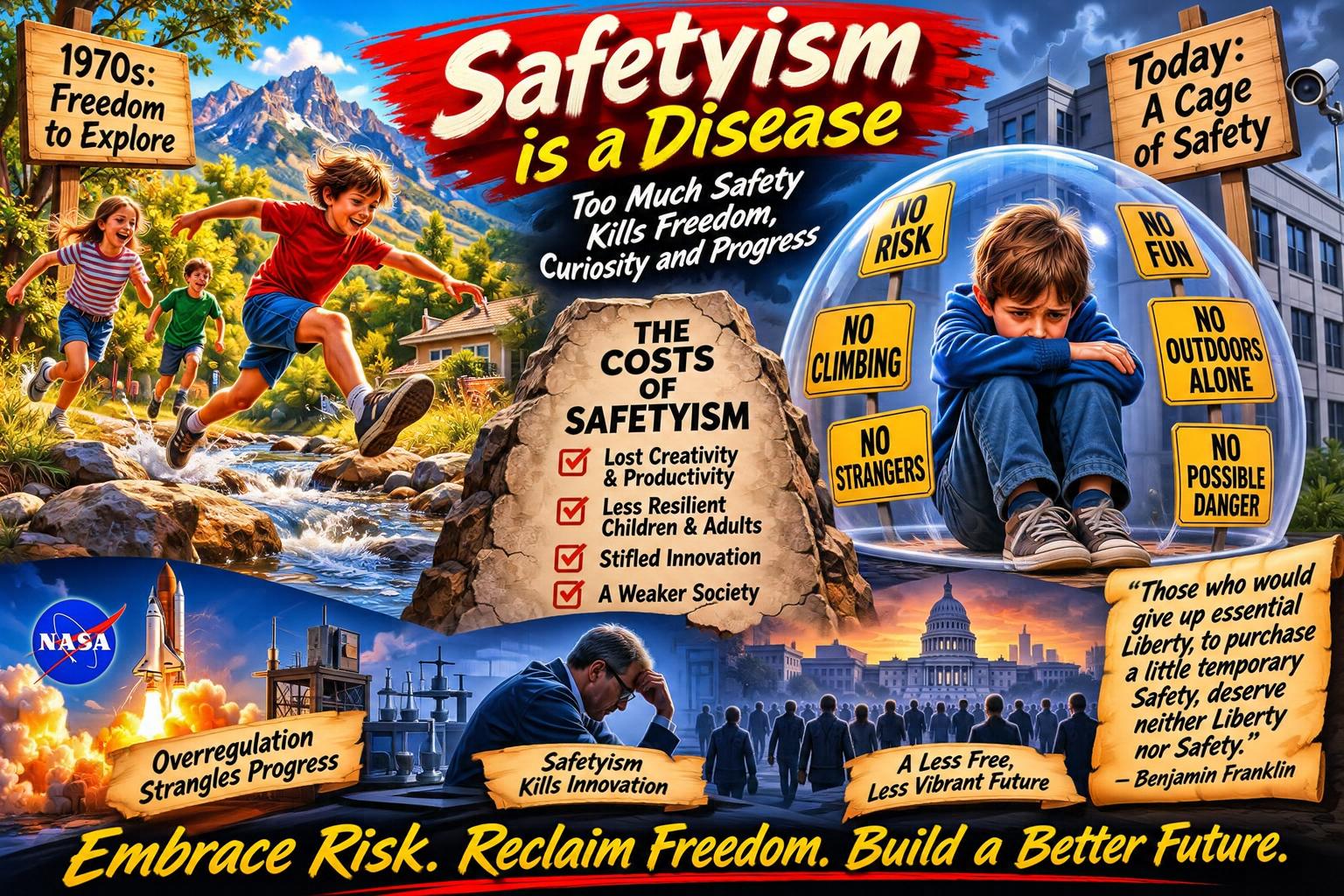
“Security is mostly a superstition. It does not exist in nature, nor do the children of men as a whole experience it. Avoiding danger is no safer in the long run than outright exposure. Life is either a daring adventure, or nothing.” – Helen Keller
One of the most damaging aspects of American life today is the plague of safetyism. It is a destructive philosophy that we have allowed to infect our private and public lives. In our public life, it creates costs we cannot bear and ultimately destroys productivity and progress. In our private life, the same attitudes hamper our development and reduce opportunities for joy and happiness. It is especially bad for children. Greg Lukianoff and Jonathan Haidt spoke to and popularized the term “safetyism” in The Coddling of the American Mind.
The work I have been doing with Claude to explore ideas has made perfectly clear that I lost a great deal over the last 25 years. Much of this loss is to the disease of safetyism at work. Safetyism is incredibly destructive in utterly innocuous ways. It has taken from me years of productive, creative breakthroughs and research. This damage is repeated across our entire population of scientists. It goes much further, too, to society as a whole.
It needs to be rejected whole cloth. It has no place in a vibrant future.
“Those who would give up essential Liberty, to purchase a little temporary Safety, deserve neither Liberty nor Safety.” – Benjamin Franklin
Safetyism takes different forms on the left and the right of the political spectrum, but both contribute to its excesses and damage. Personally, I watched safetyism encroach on my children’s childhood. I watched safetyism erode and destroy the national laboratories where I worked. It gives diffuse benefits of a sense of safety. In return, it pervasively impacts the conduct of normal lives.
We are long past the time when we should have found a different philosophy to organize our public lives around. We need one that acknowledges that life comes with no guarantees and that risk and failure are key parts of learning. Learning is something all of us need to embrace lifelong, and it is the key to progress. Risk is the price for this. It is the key to creating a better, more vibrant, wealthier future for all of us. It is difficult to grapple with and estimate the cost of this diffuse safety. In the United States, it has not brought any great benefit in lifespan. It has seemingly only given riches to the already wealthy.
Today, we have a grim future ahead of us, where possibilities have been choked off, and decline seems the only natural outcome. Safetyism is a large part of that.
First, let’s define what safetyism is. In a nutshell, it is the choice to make safety the organizing principle for an activity. Safetyism is born out of recognizing a number of potential outcomes that are bad and structuring an activity to avoid them. In the process, good outcomes are also avoided. No risk. No reward.
The problem is that safetyism has become dominated by obscure and rare outcomes that are quite unlikely to happen. All of them are terrible if they do happen, but the safety of a small number of citizens is prioritized over the well-being of the great majority. Safetyism also does not take into account what is sacrificed and lost in choosing safety as the organizing principle.
A common and pervasive example of safetyism is illustrative: how we manage the free time and freedom of children while they’re growing up. When I was a child, back in the 1970s, I had an immense amount of freedom. I walked to school with friends and my brother, with no adults. It was a half mile, and there was very little danger along the way. I also had free time with my friends to explore the neighborhood and get myself into trouble. Nothing really bad ever happened to me, but it certainly could have.
For example, there were some marshy, swampy areas at the headwaters of the creek that ran through our neighborhood. We would take our shoes off and walk across, and when we made it to the other side. Then we’d discover our legs were covered with leeches. Before putting our shoes and socks back on, we had to sit down and carefully remove the leeches. Lesson learned.
“Wind extinguishes a candle and energizes fire.” – Nassim Nicholas Taleb
Today, you never see this. Today, my parents would be reported to child protective services and visited by the authorities. The sort of freedom I experienced would not be allowed. The reason is concern about child molesters or other dangers that could befall me. Surely some of these things are possible, but they’re incredibly rare. Tragic when they occur, but rare.
Meanwhile, the vast majority of children are actively harmed by the lack of freedom. They enter the world without the skills and capacities that freedom would have taught them. In other words, this is one of the reasons our young adults are less well and less well off than they were in the past. They don’t exit childhood with the toolset they need to succeed.
Similar forms of pathological safetyism exist within our government. The research laboratories where I worked are a perfect example. NASA is another, where safetyism has destroyed it as a space launch organization. In both cases, the organizations have become shadows of what they were. Safetyism is at the root of it.
The attack of safetyism comes in equal parts from the left and right. The left seems to be the more obvious source, but the right has its own sins in this regard.
The left is mostly afraid of ideas that are backward or traditional. It is afraid of various threats like climate change, sexual violence, and the dangers of new technology. Each injects its own form of safetyism as a response. The right is afraid of new ideas, of the waste or seeming waste of money by government, and of the encroachment on freedom from the consideration of societal good. It is driven by a general desire to turn anything the government does into a scandal. Safetyism is often their chosen vehicle.
“I think that most people are underestimating just how radical the upside of AI could be, just as I think most people are underestimating how bad the risks could be.” – Dario Amodei
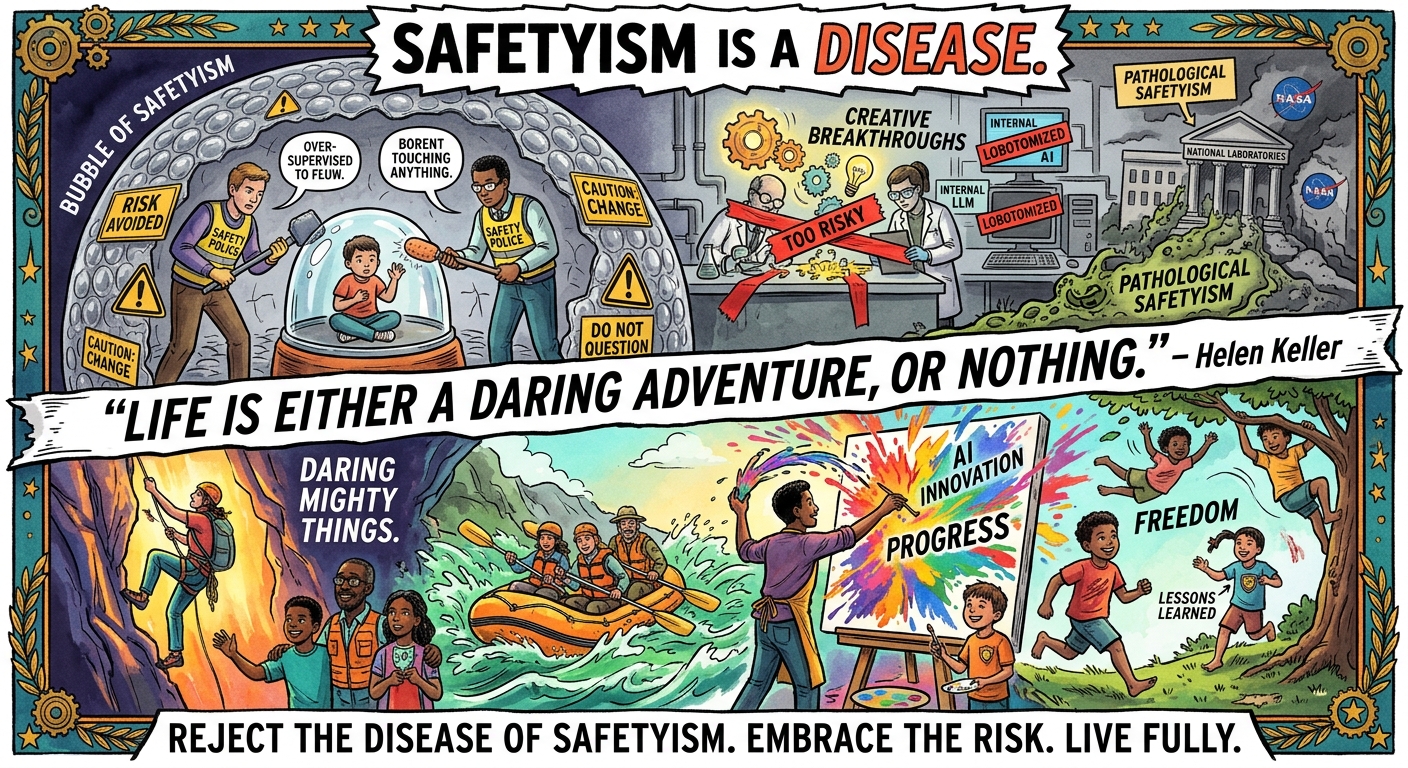
How do we navigate safteyism in the age of AI?
The key is to get a reasonable handle on actual risks. There’s also this notion of risk versus reward. In my opinion, this talk of dooming humanity and extinction events is misguided. It lets us avoid the very real current risks of AI while focusing on things that are both very unlikely and incredibly vivid.
Instead, there should be a real focus on the potential for societal good and defining a much more vibrant and human path for AI. I’m convinced it’s a very powerful tool. At the same time, we need to be very much focused on the societal harms that it can cause. Chief among these are harms that have already come from things like social media, where we fail to act to protect society from the harms that algorithmic software can do. These harms are extremely profitable for the companies, but they damage society in profound ways. Worrying about AI doom while avoiding action on social media harms is madness.
The entire narrative around AI needs to change in terms of what it brings to us, but also what it costs. There is an attitude that the companies need to change in order to garner the proper public support. Destroying jobs with AI is a loser, technically and politically. Equally, there are attitudes on the part of the public that need to change. This genie is not going back in the bottle. Ignoring AI is not an option.
The most damning part of safetyism for AI is this doomerism driving development. There existential, over-the-top risks are put in the driver’s seat. Meanwhile, rather normal use and concerns about well-developed software go by the wayside. There isn’t a sense that real, meaningful concerns around AI are being addressed effectively. The commonplace is ignored. The doom is the focus.
The focus on the existential is used in a way that avoids dealing with difficult, practical, realistic circumstances. It has also led to views of a future as an AI nirvana, while avoiding the real needs of the electorate and humanity. This leads to a weak case for the development of AI, where there should be strength. The entire narrative is the real disaster. Safetyism is at the core of that disaster.
In my opinion, the focus of development needs to be maintaining the human element in this technology. AI should be a tool for accelerating human cognition and thought. An accelerator for creativity and ideas. Using it to amplify humanity’s progress. My recent experiments with AI certainly demonstrate this to me.
In a nutshell, the doomerism in AI is safetyism run amok. It allows the frontier labs to avoid actual meaningful, realistic safety issues that need to be addressed as a matter of course. Is AI dangerous? Yes, absolutely. Can it be controlled? Yes, absolutely. This is the work that we need to set out before us, not overwrought concerns. The focus on the extremes has allowed the banal concerns to be ignored.
As an example of safetyism run amok, when I was at Sandia, and we started to use AI extensively, we got access to ChatGPT. When I tested the internal version against the free external versions, the internal version was always worse. Safetyism had taken the capability of the LLM and lobotomized it to satisfy its demands. This was a prime example of the damage safetyism does to productivity and work. Because of safetyism, a premier research institution was forced to use an inferior version of a product that could transform its ability to do research.
The implicit message in all this is that we are only protecting old secrets. We are not creating new ones. Not having the best and most capable tools in the hands of our national security laboratories should be a scandal in itself. The price of safetyism is actually less aggregate safety for society, with a degradation in our national security. If we are not creating new secrets and new technology, we are going to be surpassed by our adversaries. They are not standing still, but we are.
“If the parts of a system are prevented from facing risks, the whole will become unable to adapt to new dangers.” – Aaron Wildavsky
While the left became obsessed with the use of language and with places like safe spaces, the right attacked anything the government did. The effect where I worked was that any project that failed or didn’t produce the intended goals was viewed as a waste of money. Management started to avoid these sorts of problems by lowering their sights on what was to be accomplished, more and more. They chose targets that were slam dunks and easily achieved.
Any time a project didn’t do exactly what it said it would, it was viewed as a fuck-up. Increasingly, managers simply lost the ability to take those leaps of faith and risks. Over time, projects became more and more risk-averse, and work became less intellectually engaging and creative. Big breakthroughs and big ideas were rarely explored. Our top research institutions were hollowed out by this irrational fear, by the belief that funding would be withdrawn if a project ever involved anything that didn’t pan out.
The issues on the left infected society as a whole, and they resulted in things that are genuinely funny being viewed as cringe and unacceptable. They choked off valuable and essential conversations about race and gender. Instead, an enforced political correctness took hold that avoided all of these topics. These topics are far from settled, and the conversations that should have been happening across society were simply destroyed.
“Far better is it to dare mighty things, to win glorious triumphs, even though checkered by failure, than to take rank with those poor spirits who neither enjoy much nor suffer much, because they live in the gray twilight that knows not victory nor defeat.” – Theodore Roosevelt
Then COVID came and kicked all of these fears and behaviors into overdrive. Now, when you see someone wearing a mask, it’s a safe assumption that the person is left-wing. On the right, there is the overwhelming stupidity of vaccine denial and the idiocy of the MAHA movement. All of it is safetyism in its dumbest form.
COVID was an example of safetyism in overdrive, as we went too far in many regards to ensure the safety of people who were not really at risk from the disease. Meanwhile, we probably didn’t do enough to help the vulnerable. It was a safetyism catastrophe that made our societal reaction to COVID far worse than it should have been. With COVID, safetyism killed many people. The USA did terribly by almost every conceivable measure.
The cost of safetyism is incalculable. Its cost to society is massive, not just in dollars, but in opportunities lost, lives less rich, and upbringings damaged. It’s even worse than that. It costs lives. It costs more lives than it protects.
“Only those who will risk going too far can possibly find out just how far one can go.” – T. S. Eliot
One of the facts that has become clear to me is that you will die. Something bad will befall you, and your life will end. Safetyism will not save you from this outcome, but what safetyism can do is make the life you lead before then shallow, less full, and less accomplished. Safetyism will hollow the good out of a life.
Life, being finite, needs to be well lived. Part of living life well is risk-taking: failure and the danger that things might not work out. Safetyism tries to take all of that away. What you get with safetyism is protection from obscure and rare fates, but also the destruction of what makes life good and worth living.
I watch safetyism destroy childhoods, like my own children’s. I watched safetyism take a wonderful place to work, Los Alamos, and make it gross and terrible. Just as it made my time at Sandia a shadow of what it could have been. It’s time that society as a whole cast this off and take more risks. The rewards would be massive.
“Life, if well lived, is long enough.” – Seneca