I Developed a Craft; No One Needed It

tl;dr

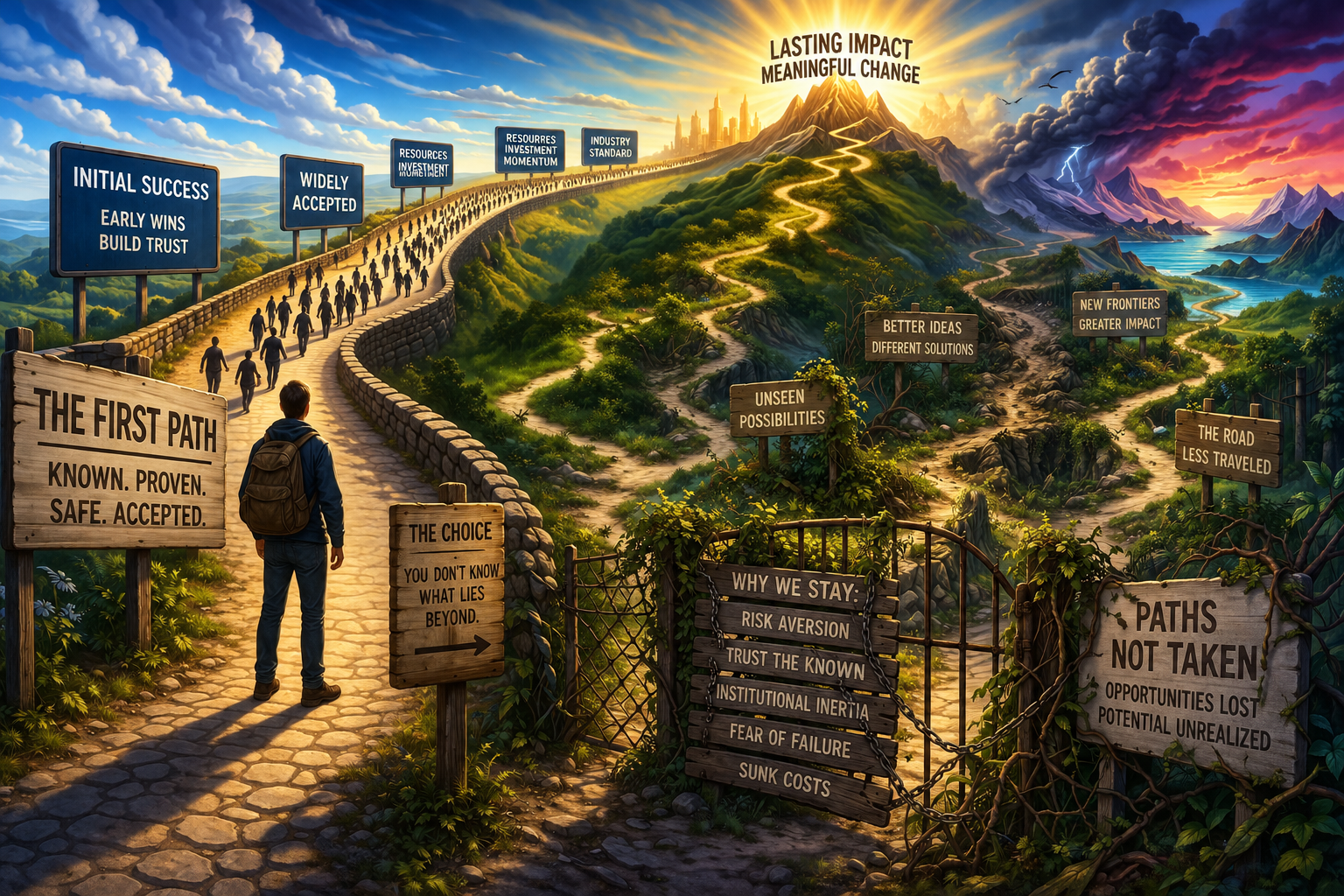
I built a craft over four decades. I found deep knowledge of the literature, numerical methods, tools, public speaking, and the discipline of writing. Most of it went unused in the second half of my career. Los Alamos in the 1990s was generous, curious, and open enough to hone that craft. Senior staff would give you their expertise if you showed up with intellect and judgment. Sandia was an engineering culture that valued maintaining the status quo over advancing science. The edge I had developed was treated as a liability rather than an asset. My craft stagnated. Much of my writing now is an attempt to understand what happened and why.

“I had to learn quickly, for the work was hard and the demands real, but no one could have asked for a better apprenticeship.” — Bertrand Russell

My Hard-Won Craft, Its Use, and Its Ultimate Lack of Utility

The things you know how to do make a huge difference in work. They define what you can technically achieve and provide to where you work. Success, it turns out, depends on things like personality, culture, and interpersonal skills. Usually, one thinks about education as happening at school. I think this is short-sighted and too narrow. I went to a second- or third-rate university. The skills I left school with were modest and ordinary. These basic skills did provide me with a foundation that was ready for something extraordinary.

“Life can only be understood backwards; but it must be lived forwards.” — Søren Kierkegaard

I would say that I have extensive knowledge of the literature in my field. I read widely and absorbed an immense amount of knowledge. In addition, I have learned much about the history of my field, and this is hard-won because it is hidden. Scientists are not terribly good historians.

At school, I did a Master’s thesis. It was pretty much shit and mostly a waste of time. I did learn a bunch of things not to do. I learned who not to work with, and what attitudes and relationships at work are unacceptable. In a deep sense, I found the same thing at the end of my career at Sandia. What was unacceptable when I was 24 was even worse at 62. When it happened again, I retired and left. Ironically, I did the same thing at school. I lucked out and got a job at the best possible place. So many other jobs would have been horrible, and my craft would have been frozen in place.

“If I have seen further, it is by standing on the shoulders of giants.” — Isaac Newton

I had the great luck of working at Los Alamos in a period when you could learn a great deal. The staff at Los Alamos were generous and full of curiosity and love of science. If you showed a decent intellect and judgment, you could tap into their expertise. This is exactly what I did. If I look at the structure of this, I see a drama happening in three acts at Los Alamos.

  1. My initial job provided modest education, but support for education and my PhD. This was mostly individual self-study. The main thing the job did was connect me to the rest of the Lab and set the stage for the next stage.
  2. I worked on a real research project and started to connect with the rest of the Lab. There was a collaboration with Doug Kothe. Also, what effectively became a Habilitation-style thesis with that Project. The project also connected me to high-level researchers like Phil Colella and John Bell.
  3. I moved to the Applied Theoretical Physics Division (X) and started to apply my skills to the Mission. There was a well-funded program (ASC) with lots of energy. I also executed a very successful research project on turbulence. The mission work motivated me to do a bunch of really hard things (like turbulence). This really matured me. I wrote a couple of books and a shitload (or is that a fuckton) of papers.

“What we have to learn to do, we learn by doing.” — Aristotle

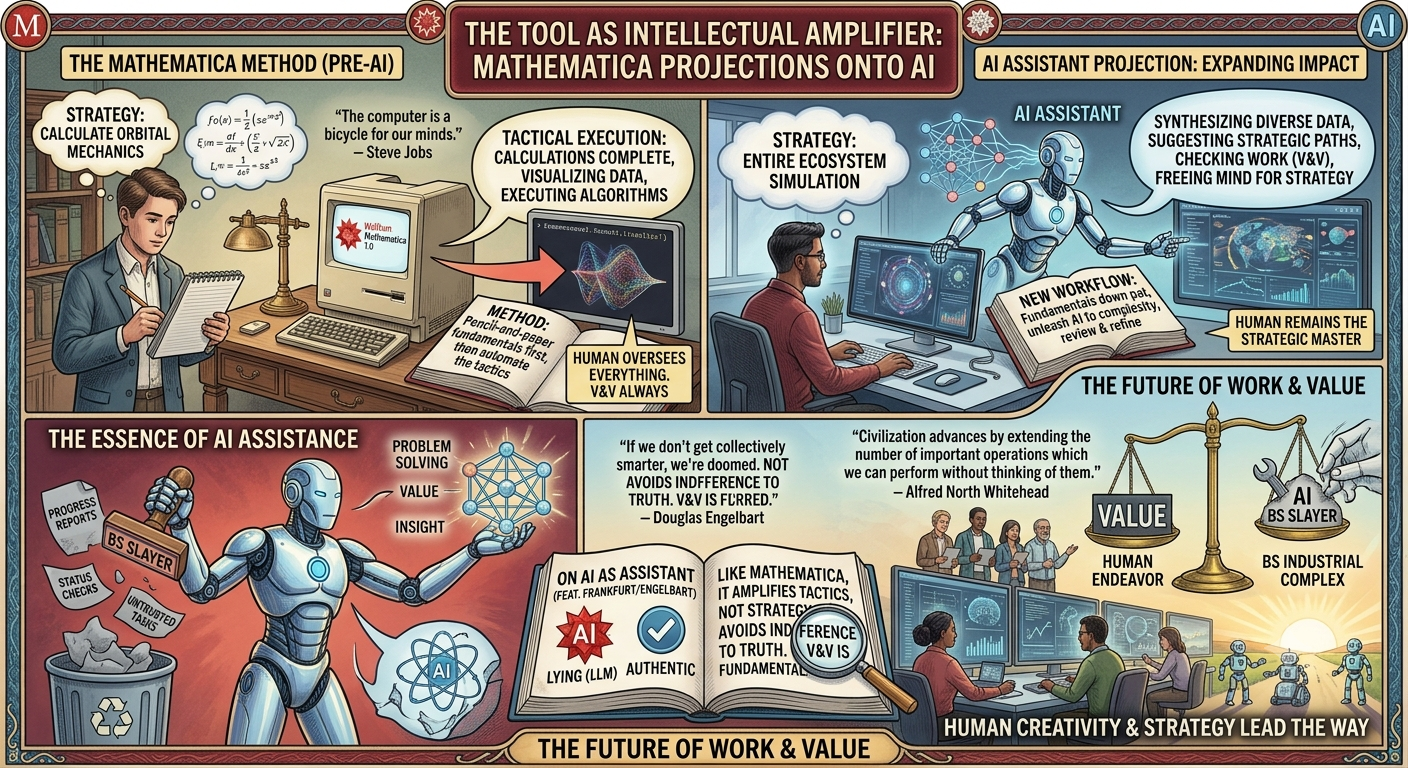
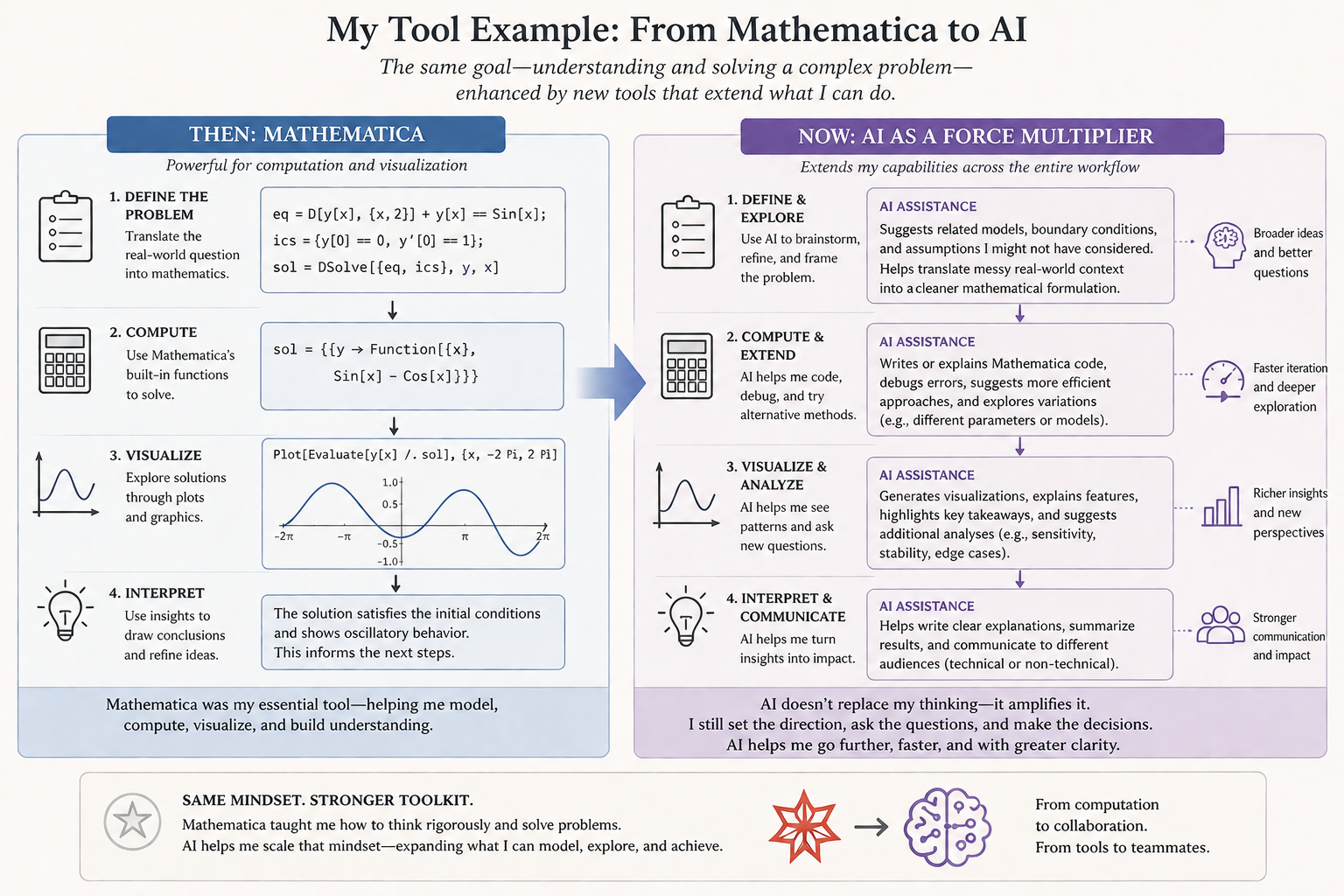
In addition to my extensive knowledge of the literature, I had a bunch of practical skills. Early on, I started using symbolic manipulation software (Mathematica, Maple, Macsyma). I learned how to do everything by hand, but found complex analysis could be automated. Using software like this is informative about how to think and use AI. This included many forms of stability analysis, derivation of methods, and other forms. This automation allowed me to attack a variety of methods and explore things efficiently. I also began to catalog problems and pathologies to combat. I explored ways to mitigate them.

I remember a quip Phil Colella threw at me: “You’re a really good method engineer.” I think it was meant as an insult, but eventually I took it to be true and a modest compliment. Yes, I became a “numerical methods engineer.” I had a great set of skills and knowledge to tackle all kinds of problems. I learned a great deal about hyperbolic conservation laws, multiphysics, numerical linear algebra, and turbulence. I combined these, mixing and matching to great effect.

“We do not remember days, we remember moments.” — Cesare Pavese

I remember when I gave my first talk on hyperbolic PDE solvers at the AIAA CFD conference. Phil was in the audience. I gave a really shitty talk. Too many equations and too much nervous energy all put together into a blur. At the end, I knew that I had fucked that up. After that, I worked diligently on becoming a better public speaker. Today, I feel like I am a very good speaker. Along the way, I gave a class on “Eulerian Hydrodynamics” at Los Alamos with 40 lectures and 1200 slides. They asked me to give the class again. In a sense, this was the capstone of my career there. I was giving back to the Los Alamos staff what I had been given by others before. I was giving my experience and knowledge as a reflection of my growth there.

My time at Sandia was a way for me to apply my skills, but the work I was assigned did not require the skills I developed later, after 2000. Everything I learned beyond that was surplus to requirements. I kept learning while I was there, but the environment was much more closed off and conservative, and it lacked generosity. It is hard to say whether that was a feature of Sandia culture or just the passage of time, but it was probably a combination of both.

“It is difficult to get a man to understand something when his salary depends upon his not understanding it.” — Upton Sinclair

I still learned a lot, especially through statistics and how to apply them, and the job was difficult. Much of what I did at Sandia involved adapting well-established technologies to the limitations and constraints we faced there. It also meant accommodating the relatively backward practices and less-than-optimal problem-solving approaches that seemed standard there.

In the end, my craft stagnated and did not grow during my time at Sandia. I feel some regret and a sense of loss about that. A lot of my recent writing has been an effort to understand and explain what happened. I think the simplest explanation is that Los Alamos was special and different from most places. Sandia was ordinary and lacked that special something: curiosity and open-mindedness. One reason for this is culture; another is the particular pace of our modernity. Sandia is fundamentally an engineering culture, with interesting local cultures surrounding it (next post). Those cultures tend to be more focused on maintaining the status quo than on advancing the state of science.

The unexamined life is not worth living.” — Socrates

That is not to say Los Alamos has all of this figured out. When I got there in 1996, they were still using code written in the 1950s for some of their most important analysis. The same attitude is present at Sandia with their famous code, CTH. It is even older now than that LANL code in a comparative sense. Both cultures tolerated unacceptably old technology for essential work. Why do places like these hold onto technologies that are obviously past their sell-by date? It seems to be a matter of resistance to change. The active choice of very conservative communities of practice. They lack the imagination and bold resolve to do anything different.

I’ll close by saying that I’m sure Los Alamos is a shadow of what it was in the 1990s, when it generously honed my craft and gave me a set of tools I’m proud of. That makes me wonder whether Sandia also declined during that era. In my experience, there isn’t much reflection of that decline at the lab itself. I see the deep-seated issues in the United States as a whole.

“Mastery is not a function of genius or talent. It is a function of time and intense focus applied to a particular field of knowledge.” — Robert Greene

My Greatest Professional Accomplishment

tl;dr

My greatest professional accomplishment was founded on a failure. It shaped the rest of my career, but those heights were never returned to. The work was key to how my craft as a computational physicist grew. It made me who I am. The culture of Los Alamos in the early 1990s allowed it to happen. That culture is dead today. The culture at Sandia would have never allowed it.

“The most important questions in life can never be answered by anyone except oneself.” — John Fowles

An Inspired Lunchtime Question

A good friend took me to lunch recently to celebrate my retirement. He’s a few years out from his own retirement. Lunch was enjoyable as expected, but one moment stands out. He asked me about my greatest professional accomplishment. In your career, what achievement do you look back on with the most pride? What a spectacular question! I asked him as well. Our answers said a lot about us.

My answer was easy to come up with.

Back in 1994, I had moved into the computational science part of the Lab. I was continuing my examination of interface tracking while collaborating with Doug Kothe. I had come to understand the importance of these methods to the Lab and its core mission. The method of David Youngs, with piecewise linear (or planar) interfaces, was the state of the art. To understand it, I implemented it and used the manner of implementation I had seen in code. The time integration of the method used operator splitting. It worked pretty well.

I have a firm belief that to really understand a method, you improve it. An obvious way to improve this method is to remove operator splitting and create an “unsplit” method. This was far more complex and logic-intensive. When I tested it using the standard translation of simple shape tests, it worked.

I was also working on better tests for these methods. The standard tests were lame as fuck. The whole reason you need interface tracking is the phenomenon of shear. Without shear (and vorticity), Lagrangian methods are just fine. Vorticity in a flow is what makes Lagrangian methods fail. I introduced problems from the literature for advection with vorticity. These problems were introduced by Randy LeVeque and Piotr Smolarkiewicz. Randy also introduced a cool time reversal term where a flow could be rewound to the initial state. These problems were more realistic and difficult. They immediately broke my “improved” method. I could not debug it either. As I learned, the new method had too much cyclomatic complexity (too many nested if-thens).

An important point about this is failure. I tried something, and it failed badly. This failure would power accomplishment. Without the failure, all the good things that followed would not have happened. The other key point is that no one paid for this work. There was no project, no funding, no management involved. I was working on another project using C++ to code up methods. In those days, the compile-link cycle with C++ took forever (15 minutes a pop). The code I wrote, along with everything below, happened during the compile-link time. I was using Fortran, and it compiled and linked very fast. The Fortran on the UNICOS Cray Y-MPs was awesome.

“The scientist is not a person who gives the right answers, he’s one who asks the right questions.” — Claude Levi-Strauss

I went back to the drawing board. I ingested techniques from computational geometry. I realized the entire methodology for Youngs’ method could be implemented using it. I created a set of primitives from computational geometry and created Youngs’ method anew. It worked great. The code had very low cyclomatic complexity. I then did the unsplit version, and it worked too. It passed the tests and was easy to debug. Doug and I wrote up the work and submitted “Reconstructing Volume Tracking” for publication. It was published in the Journal of Computational Physics, including the history of these methods. The paper has over 2500 citations now.

Something else is the clincher for the greatest accomplishment. A few years later, I was involved in adding interface tracking to an important Eulerian code at Los Alamos. It turned out that any Eulerian code needs this, and AMR is not enough for interfaces. I was working with Ed Dendy, who was hands-on in the code. I was mapping out and deriving methods. We designed a method using artificial compression that blended with the existing code seamlessly. It is the standard method used today. Ed also added the version of Youngs’ method I created to the code. Recently, I confirmed that this code is still used today.

The achievements here were multiple. I created a new way to implement a method that is a genuine improvement. I created a better version of the existing method. We wrote a comprehensive paper on the methodology that was well-received. Finally, I created better test problems for this class of methods. These tests have become far more standard and helped drive improvements across the board in interface tracking. Improved level set methods are a key example. Finally and critically, the methods and code I worked on are used for important problems at Los Alamos. It is a substantial and meaningful contribution to our national security.

All of this produces a great sense of pride and accomplishment.

The lessons from this chapter of my career are deep and bountiful. Almost everything about it is counter to the current scientific environment at the Labs. Today, no manager trusts their staff enough to allow this unless you do the work off the clock.

“To be yourself in a world that is constantly trying to make you something else is the greatest accomplishment.” — Ralph Waldo Emerson

Postscript

This work is a source of pride and achievement, but it also fills me with dismay. I left Los Alamos 20 years ago, and this work is 30 years old, with the implementation in the code dating back 25 years. I expect the technology to have advanced over that time. The work I did so long ago could be a foundation, but it should have been replaced by something better. The fact that something better is not on the agenda at Los Alamos leaves me with a sense of despair. The part of me that feels responsibility and duty would rather have seen that work replaced by something newer, better, and more capable. It’s been a quarter century after all. My accomplishment was shaped by curiosity, responsibility, and duty.

I was driven by a desire to support the Lab’s mission and national security by addressing something that seemed very important. Those are things to celebrate with hopes young people find the same inspirations. My greatest worry is that the combination of motivations today undermines this. The basic incentive structure for the institutions and people is different today. Another key element is trust, which is lower in both directions. Proper incentives and trust were key to my accomplishment.

“If what you have done yesterday still looks big to you, you haven’t done much today.” — Mikhail S. Gorbachev

I’m going to write shorter, more frequent posts for a bit. See how that works. I would love any feedback or reactions.

References

Rider, William J., and Douglas B. Kothe. “Reconstructing volume tracking.” Journal of Computational Physics 141, no. 2 (1998): 112-152.

Rider, William, and Douglas Kothe. “Stretching and tearing interface tracking methods.” In 12th Computational Fluid Dynamics Conference, p. 1717. 1995.

Kothe, Douglas B., and William J. Rider. “Comments on modeling interfacial flows with volume-of-fluid methods.” Submitted for publication (1995).

Kothe, Douglas, W. Rider, Stewart Mosso, J. Brock, and John Hochstein. “Volume tracking of interfaces having surface tension in two and three dimensions.” In 34th Aerospace Sciences Meeting and Exhibit, p. 859. 1996.

Stability and Applications Guided Early CFD: What We Can Learn from It

tl;dr

Algorithmic stability is an essential concept for solving problems with computers. Studying stability provides a foundation for everything a computer does. Any algorithm for any purpose can exhibit stability issues that are fatal. Simply put, a lack of stability arises from a small change in data, yielding a huge change in results in an anomalous way. The archetype of stability is the numerical solution of differential equations. This arose from key wartime applications and early computing use (WW2 and the atom bomb). Von Neumann’s numerical algorithm for computing shock waves failed miserably. It became a key topic to study and understand. This spurred essential developments in computational science. Despite progress, problems still exist needing attention. There are parallels to AI that we should look to for better outcomes with that technology.

“Mathematics is the art of explanation.” ― Paul Lockhart

In the Beginning

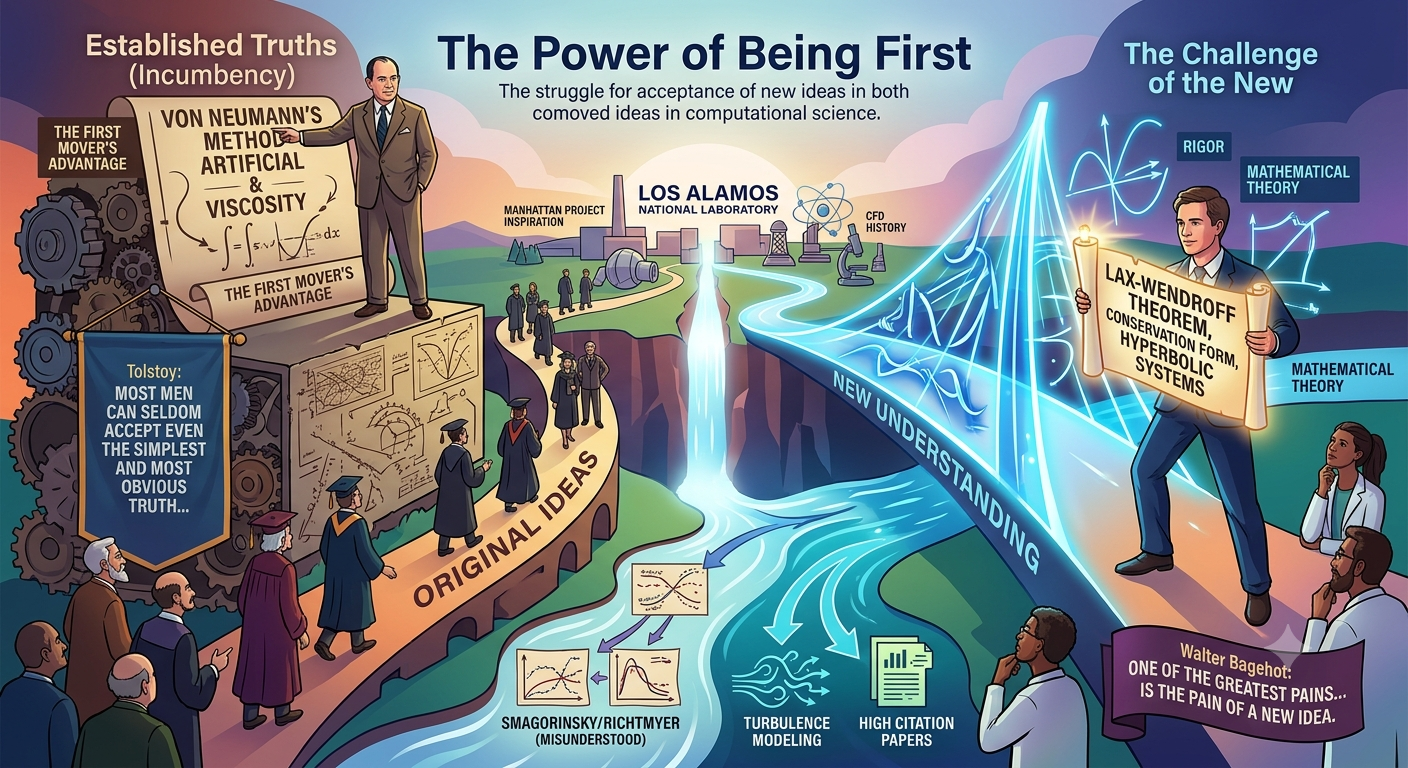
By 1944, the American effort behind creating the atomic bomb was beginning to make genuine progress. Part of the Manhattan Project was nascent computational physics efforts led by the vision of John Von Neumann. In Los Alamos, they were examining design ideas numerically. The effort was led by Hans Bethe and Richard Feynman, both future Nobel Prize winners in Physics. Von Neumann had led the concept of using computing for science. He also devised a computational scheme for shock hydrodynamics. Bethe and Feynman did early calculations using Von Neumann’s method. It failed, catastrophically. The method produced horrible oscillating results (ringing). Today, we would recognize this as numerical instability.

This outcome was recognized as a problem. Scientists in Los Alamos (Peierls) also conceptualized ways to mitigate it. These changes to Von Neumann’s method would not be realized until after the war. During the war, success was achieved with another algorithm devised by the British mission at Los Alamos. The method was first proposed by Peierls and then refined by Skyrme. It was fundamentally different than Von Neumann’s. It involved some similar methods to Von Neumann’s, but computed the shock wave explicitly via tracking. The shock was treated with precision by Feynman via the Rankine-Hugoniot conditions as an internal boundary. Von Neumann’s method was more general, but fatally flawed.

“Mathematics is the cheapest science. Unlike physics or chemistry, it does not require any expensive equipment. All one needs for mathematics is a pencil and paper.” ― George Polya

From the foundational work of Courant, Friedrichs, and Lewy in 1928, the methods used a heuristic for stability. This is the famous CFL condition named for them. This is a simple argument about the domain of dependence for information (waves). This means a finite speed of propagation of sound waves should not move more than the spacing of the mesh in a time step. It is simple and rational, and still the core of stability today. It is also subtly flawed, as I’ve written. Both of the two WW2 methods used it, and it holds today (for explicit methods). For Von Neumann’s method, it was insufficient. Something else was needed to keep it viable. This seeded two developments key to the future of computational physics.

A key question to consider is whether current difficulties are seeding any similar fundamental mathematics. The failures and problems are things to explore that lead to discovery. AI has vast swaths of problems needing math. Efforts are generally lacking and sub rosa.

“But in my opinion, all things in nature occur mathematically.” ― Rene Decartes

Context and Modern Significance

“If rounding errors vanished, 95% of numerical analysis would remain.” – Nick Trefethen

My focus here is numerical stability for solving differential equations, especially partial differential equations. Other forms of numerical stability are equally important for computation. The classical case is Gaussian elimination, which drove much of the early work, including von Neumann’s efforts with Goldstine. This study algorithms and how to structure them for stable computation. It also draws attention to when computation is untrustworthy, defined by the structure of the problem. By and large, these algorithms are designed to produce exact or precise results, except when numerical errors occur. Roundoff error and changes in the order of operations can lead to stability issues. These approaches focus on eliminating those problems and ensuring reliable results.

The primacy of stability in numerical computations powered the growth of the technology. Contrast this with the lack of a coherent, encompassing theory for large language models. This is true when you look at how these models behave during training or use. That behavior is stochastic, so it is perhaps logical that stability would not be a key concern. I would counter that stability concepts might yield order to AI where it is lacking today. The absence of stability theory erodes confidence in the underlying techniques. Addressing it should be a priority going forward, and would likely yield practical benefits.

“Do not imagine that mathematics is hard and crabbed, and repulsive to common sense. It is merely the etherealization of common sense.” ― Lord Kelvin

Unfortunately, as noted previously, the United States is loath to invest in this kind of work of late. The applied math that has been so crucial to computational physics is largely absent today in AI. It is absent in almost every scientific endeavor. The partnership between the two is all but dead. This all points to an indictment of the American strategy in AI (or lack thereof). We assume we’re in the lead, but we’re increasingly failing to do the things that would sustain and expand that lead. Instead, the USA is doing everything it can to lose the lead in the long run. This applies to what we are and are not doing. My goal is to outline a key methodology for the birth and growth of computational physics. In contrast, it will highlight the lack of a similar framework for our current revolution. This is badly needed and would be a huge boon to AI in the future, improving every aspect of the technology.

Many things stand in the way, but one thing is galling in the extreme. I’ll note that claims of industrial espionage are true, but it is also propaganda. They’re also used to make Americans think they’re stealing the edge of technology through spying. It belittles an adversary we should fear for their own creativity and creation. We avoid recognizing our own self-defeating philosophy: our systematic internal attack on science and technology. These self-defeating actions are the core of the danger.

“If you know the enemy and know yourself, you need not fear the result of a hundred battles. If you know yourself but not the enemy, for every victory gained you will also suffer a defeat.” —Sun Tzu

Industrial espionage happens and is part of the picture, but it pales in comparison to the absolute incompetence and the attack on science and technology that the government and industry are waging on themselves. We’re the ones laying the groundwork for Chinese supremacy in science and technology, because China is inherently competent at doing the right things while we do all the wrong things. It will become clear that the Americans are the ones who need to engage in industrial espionage of the Chinese quite soon, because we will increasingly be firmly behind. The coffers of science and technology that the Chinese might be emptying were filled decades ago, and those coffers will now be empty and threadbare. Given American attacks on its own internal science and technology, any claims otherwise are simply hubris and empty patriotism, so common these days.

What’s clear today is that the United States is losing its dominance, and it’s losing it because of its own actions. The Chinese are pulling ahead because they’re competent and doing the right things, while the USA is undermining its science and technology.

The first principle is that you must not fool yourself — and you are the easiest person to fool.” — Richard Feynman

To anyone who questions the current American thought, I’ll share a personal anecdote from right before I left Sandia.

I was taking the required training for a conference where British scientists would be present for classified discussions. The training is standard before these meetings, and the Sandia person leading it was a young fellow. During the training, he made comments belittling Russian or Soviet accomplishments in nuclear weapons. He seemed to believe those achievements were illegitimate and based on espionage, particularly pointing to Klaus Fuchs.

While the Russians did engage in espionage and stole much of the design for early atomic bombs, it would be wrong to belittle their capabilities or the brilliance of how they executed their program. Once they knew an atomic weapon could be produced, they could build it from scratch. The only thing the American design did at Trinity was confirm that it could be done. Once you know it can be done, it becomes a much simpler matter to do it.

This also belittles the brilliance of scientists like Andrei Sakharov, who did unique and brilliant work in support of the Soviet hydrogen bomb program. They had many other extraordinary theoretical physicists like Landau and Zel’dovich. I corrected the young man and encouraged him to look at the real history, as explained by Richard Rhodes. The literature has some obscure publications by Russian scientists who were key to their program. These are eye-popping. The same fictions are at work today with regard to the Chinese and their advances in AI. The same fictions in a host of fields. We Americans need to be guided by facts and not pulled in by faux patriotism and hubris about our scientific prowess. We should be completely in sync with the rather politically incorrect notion that the Manhattan Project was powered more by the efforts of immigrants than by homegrown American science.

“Intellectual freedom is essential to human society — freedom to obtain and distribute information, freedom for open-minded and unfearing debate, and freedom from pressure by officialdom and prejudices.” — Andrei Sakharov

Another key aspect of this dynamic is the cost of information protection. The American system operates under the premise of assumed superiority. This then leads to protectionist policies in classification and export control. These policies can be quite effective in limiting spying and keeping information from being lost. It is also effective in controlling this information domestically. The impact harms innovation and progress in the USA. American institutions have cracked down on information dissemination more and more. This has played a significant role in dragging American science down. Even worse, if American science is behind, these policies will act as friction, undermining catching up. We may already be behind, and the approach taken is foolish at best.

The question is whether the United States will wake up to a Sputnik-like moment and turn things around. Alternatively, the United States may be done, and the nearly century-long era of international dominance, fueled by supremacy in science and technology, could come to an end. That chapter has not been written yet, but the current signs are worrying. The American public seems asleep and is not taking the steps needed to return to the approach that helped us achieve our dominance.

With that table setting out of the way, let’s get back to our story.

“All that it is reasonable to ask for in a scientific calculation is stability, not accuracy.” – Nick Trefethen

Shock Capturing Methods and Applications

After World War 2, science jumped to the attention of everyone. This was powered by the stunning use of atomic bombs against Japan, shining a light on the Manhattan Project. In the wake of this, resources and importance flowed toward scientific work. This allowed the powerful vision of John Von Neumann to begin to come to fruition. Part of his vision was the use of computers for scientific work. Part of his vision was chastened by the lack of success for his differencing scheme. Its results were unstable. This was not an isolated problem, as other schemes that seemed reasonable produced bad results. He sought to understand this.

By the summer of 1946, he had produced an analytical tool to examine stability. This was his spectral stability analysis of finite difference schemes. He presented it in Los Alamos that summer for parabolic equations. It only applies to linear equations, but provides results that guide nonlinear methods and equations. It is still an essential tool for understanding methods. It can provide answers to subtle stability problems invisible to inspection. The method is still used broadly today. This method leaked out over the remainder of the 1940s, most notably by Crank and Nicolson. Von Neumann published the method in 1950 along with another key invention.

The method used successfully in the War was a tracking method. As application complexity grew, the tracking method became intractable. Los Alamos was looking at the H-bomb (super, as they called it). A more general method was needed to support progress. Robert Richtmyer, who was leading the Theoretical Division, sought to produce this. He worked on the suggestion of Peierls to add dissipation to Von Neumann’s method. By 1947, Richtmyer worked out the solution. He would add an extra term in and near shock waves to produce the entropy needed by a shock’s passage. This was dubbed artificial viscosity. In my opinion, an unfortunate choice. It is not artificial, but entirely physical. Shocks create singularities, and entropy rise is necessary to navigate the singularity. It allowed shocks to be captured and not tracked. Von Neumann’s method was salvaged, and the stage was set for numerical methods to flourish on complex applications.

This was the first shock-capturing method. The paper Von Neumann and Richtmyer published had three major advances. First, there was the differencing scheme Von Neumann devised in 1944, but it failed in use. The second was the stability technique Von Neumann devised. Finally, the third was the artificial viscosity invented by Richtmyer to stabilize shocks. As I’ve noted before, this viscosity has also become the foundational method in Large Eddy Simulation. The reason for this commonality is dissipation in turbulence that functionally acts similarly to shocks. In both cases, the large-scale dissipation acts as viscosity vanishes in nearly identical manners. The understanding of shocks is primarily one-dimensional. For turbulence, this is fully three-dimensional and introduced by Kolmogorov as his “4/5 law.”

“As technology advances, the ingenious ideas that make progress possible vanish into the inner workings of our machines, where only experts may be aware of their existence. Numerical algorithms, being exceptionally uninteresting and incomprehensible to the public, vanish exceptionally fast.” – Nick Trefethen

Many of the most important aspects of computational science arose out of this single thread of science and math. These works are foundational to the entire field. They show us the path not taken today with AI. We should heed this as a warning.

Subtle Stability

“Computing has changed not only the way mathematics is practiced, but mathematics itself.” —Peter Lax

Given the success of this method, numerical solutions exploded onto the scene. Applications of numerical methods multiplied, especially in fluid dynamics. The key aspect was the proof that it could be done. Everyone knew it was possible, especially in Los Alamos. This seeded ideas with luminaries like Peter Lax and Frank Harlow. Both of these men pioneered whole fields of practice in what we now call CFD. Harlow started to invent a host of methods still used today, first in compressible fluids, then in incompressible fluids. He also invented an important aspect of turbulence modeling. Lax produced fundamental methods for compressible fluid dynamics. He produced several methods that are foundations today, and the theory of conservation form, which underpins computational aerodynamics.

“One must watch the convergence of a numerical code as carefully as a father watching his four year old play near a busy road.” — J. P. Boyd

More importantly, he produced foundational mathematics for computational science. Lax’s equivalence theorem connects stability, consistent approximations and convergence. Convergence is the promise that more computing power yields better answers. This has underpinned the pursuit of better computers for better science. It took the stability work discussed above and connected it to numerical approximation accuracy to ground all efforts. The practice of code verification is dependent on this theory. Scientists design stable, accurate methods to solve equations and implement these in code. If they can be shown to converge to the correct solution, we have assurances of correctness. Lax provided the theory to see this.

“The unreasonable effectiveness of mathematics in the natural sciences.” – Eugene Wigner

The importance of the applications to the world meant that the theory for partial differential equations came first. Ordinary differential equation theory from Dahlquist actually came afterward. One might logically think the order would be reversed, but not. This is due to the importance and energy for PDEs.

The inspiration for this post is my discovery of stability problems that infest our codes today. These are associated with strong expansions I’ve discussed recently. The problems are multiple, with under-estimates of wave speeds leading to unstable time steps and schemes. The saving grace is that the instability is a mid-frequency and not at the grid scale. Shocks produce instability at the grid scale Thus they are catastrophic almost immediately. The expansion instability is mitigated by a little resolution and a few time steps. The question is whether the instability has a lasting influence on the solution. Does the instability leave a lingering corruption of the solution that is never healed? Right now, theory can’t tell us. Evidence says that this may well be the case/

Postscript

By embracing the past, the current administration is killing the future. The future is about moving forward and adapting to the problems we already have. The solutions of the past will not work in the future. That is true in every area, from warfare to science. This administration is focused on the past, and its actions will destroy a positive future for the United States. I spent my entire professional career at nuclear weapons laboratories. I watched them decline and lose capability. I can say without equivocation that we are not ready for what is coming. Our science is not prepared to compete in the world that is about to unfold.

We’ve arranged a society on science and technology in which nobody understands anything about science and technology, and this combustible mixture of ignorance and power, sooner or later, is going to blow up in our faces.” — Carl Sagan

We need to get our shit together, fast. The current administration is damaging our ability to compete on every front. True, whether it is national security or economics. We are not ready for the world that is coming. If you want to highlight how unprepared we are, just look at Iran or Ukraine. In both wars, American power is failing in spades. We are not adapting to the world that is already here.

America has rejected expertise, and it is going to do our country harm. Whether we are talking about nukes, fusion, AI or drones, we need experts to define our strategy. Then to execute it and adapt to an every changing landscape. I have seen this rejection of expertise all the way down to the working level at a national laboratory. There, my own expertise was deemed too cutting and too critical. It was way too much for the incompetent leaders to take seriously.

Our current leaders and their approach to leadership are failing the country at this critical juncture, and time is running out. Looking to billionaires to lead us is foolish. They are increasingly driven by their own greed and could not care less about society as a whole. Just look at how they have stewarded the technologies that have driven their wealth. In every case, those technologies have caused real harm to our society, to our children, and to the way we live. They show no responsibility other than maximizing their own wealth and power. Letting them guide something with the power of AI is suicidal.

“In mathematics you don’t understand things. You just get used to them.” —John von Neumann

This essay shows a small vignette of how fundamental math supports computational science. The computational science has become essential for work supporting a host of applications. These include everything from nuclear weapons to climate science to car design. It encapsulates much of what is missing from science today (including, but not limited to AI).

“Mathematics, rightly viewed, possesses not only truth, but supreme beauty—a beauty cold and austere, like that of sculpture, without appeal to any part of our weaker nature, without the gorgeous trappings of painting or music, yet sublimely pure, and capable of a stern perfection such as only the greatest art can show.” ― Bertrand Russell

References

Von Neumann, John. Proposal and analysis of a new numerical method for the treatment of hydrodynamical shock problems. Applied Mathematics Group, Institute for Advanced Study, 1944.

VonNeumann, John, and Robert D. Richtmyer. “A method for the numerical calculation of hydrodynamic shocks.” Journal of applied physics 21, no. 3 (1950): 232-237.

Mattsson, Ann E., and William J. Rider. “Artificial viscosity: back to the basics.” International Journal for Numerical Methods in Fluids 77, no. 7 (2015): 400-417. Morgan, Nathaniel R., and Billy J. Archer. “On the origins of Lagrangian hydrodynamic methods.” Nuclear Technology 207, no. sup1 (2021): S147-S175.

Margolin, Len G., and K. L. Van Buren. “Richtmyer on Shocks:“Proposed Numerical Method for Calculation of Shocks,” an Annotation of LA-671.” Fusion Science and Technology 80, no. sup1 (2024): S168-S185.

Lax, Peter D. “Hyperbolic difference equations: A review of the Courant-Friedrichs-Lewy paper in the light of recent developments.” IBM Journal of Research and Development11, no. 2 (1967): 235-238.

Lax, Peter D., and Robert D. Richtmyer. “Survey of the stability of linear finite difference equations.” Communications on pure and applied mathematics 9, no. 2 (1956): 267-293.

Kolmogorov, Andrey Nikolaevich. “A refinement of previous hypotheses concerning the local structure of turbulence in a viscous incompressible fluid at high Reynolds number.” Journal of Fluid Mechanics 13, no. 1 (1962): 82-85.

Smagorinsky, Joseph. “General circulation experiments with the primitive equations: I. The basic experiment.” Monthly weather review 91, no. 3 (1963): 99-164.

Higham, Nicholas J. Accuracy and stability of numerical algorithms. Society for industrial and applied mathematics, 2002.

Grcar, Joseph F. “John von Neumann’s analysis of Gaussian elimination and the origins of modern Numerical Analysis.” SIAM review 53, no. 4 (2011): 607-682.

Lax, Peter D. “The flowering of applied mathematics in America.” Siam Review 31, no. 4 (1989): 533-541.

America is leading in AI, but we won’t for long

tl;dr

AI is the single most important technology for our future. It will likely form the foundation of economic and military power for decades if not longer. The USA leads the World in AI largely through our corporate power. Government is a powerful customer and a junior partner in the technology. This is far different than pervious world changing technologies like nuclear weapons or the Internet. Our forward-looking “strategy” is to double down on computing hardware. It envisions a continuation of the current technology rather than future breakthroughs. We are one breakthrough away from losing dominance. Meanwhile, the USA is structuring itself to ensure those breakthroughs happen elsewhere. Our leadership is planning our demise by a pure short-term focus. Their incompetence will have long-lasting and disastrous consequences.

“As we peer into society’s future, we — you and I, and our government — must avoid the impulse to live only for today, plundering, for our own ease and convenience, the precious resources of tomorrow.” – Dwight D. Eisenhower

Something Amazing

In 2022, I used a large language model LLM for the first time. The abilities of ChatGPT felt almost magical and definitely jaw-dropping. It felt almost exactly like the first time I used Google search. I was immediately struck by the feeling that the future had arrived. There was no going back. These LLMs have become synonymous with AI ever since. Furthermore, AI has become the principal engine of economic progress and national power. They have huge implications for work, investment, and national security. Their importance and capability have grown and grown. Industry is investing huge amounts of money in training and running AI in vast data centers.

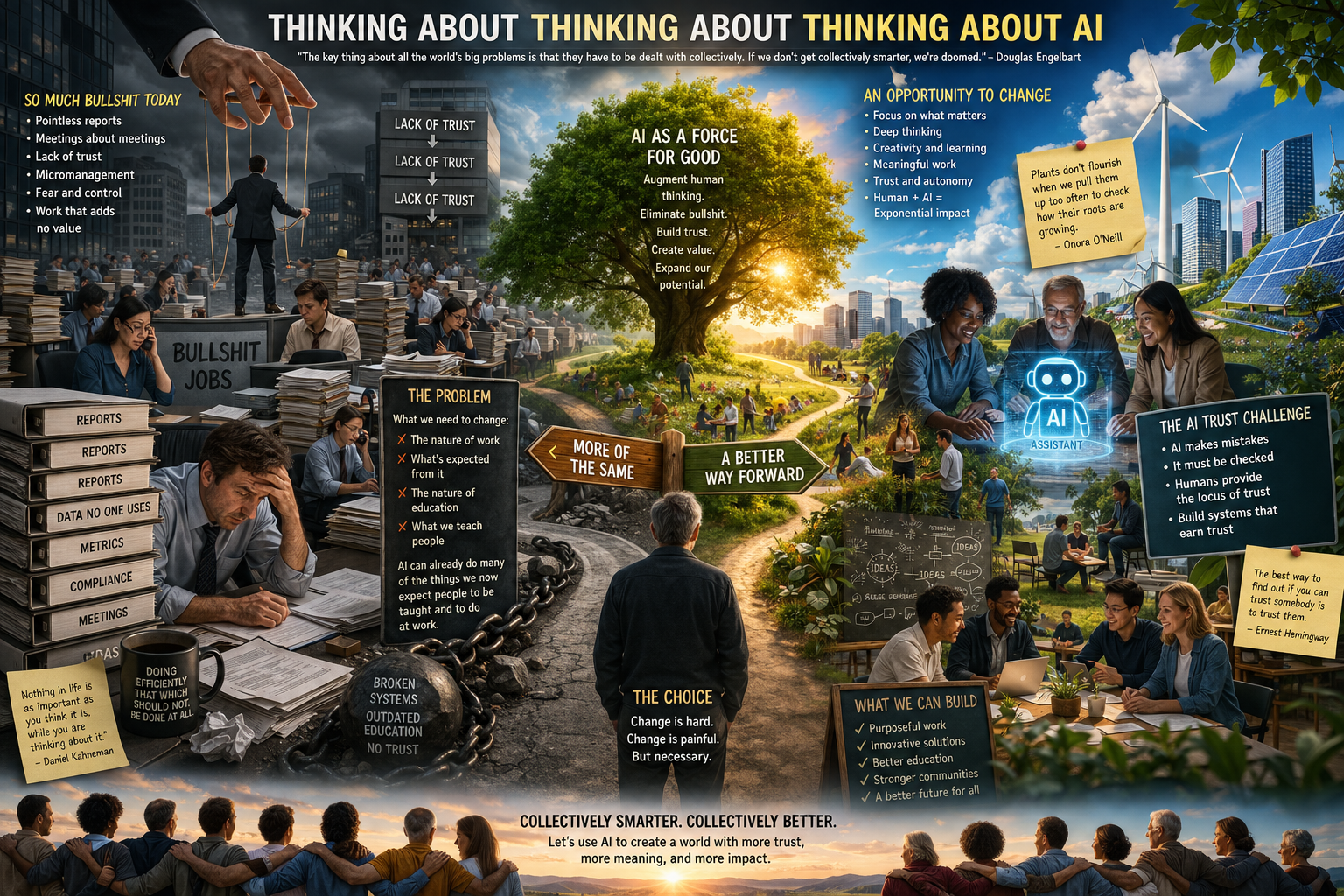
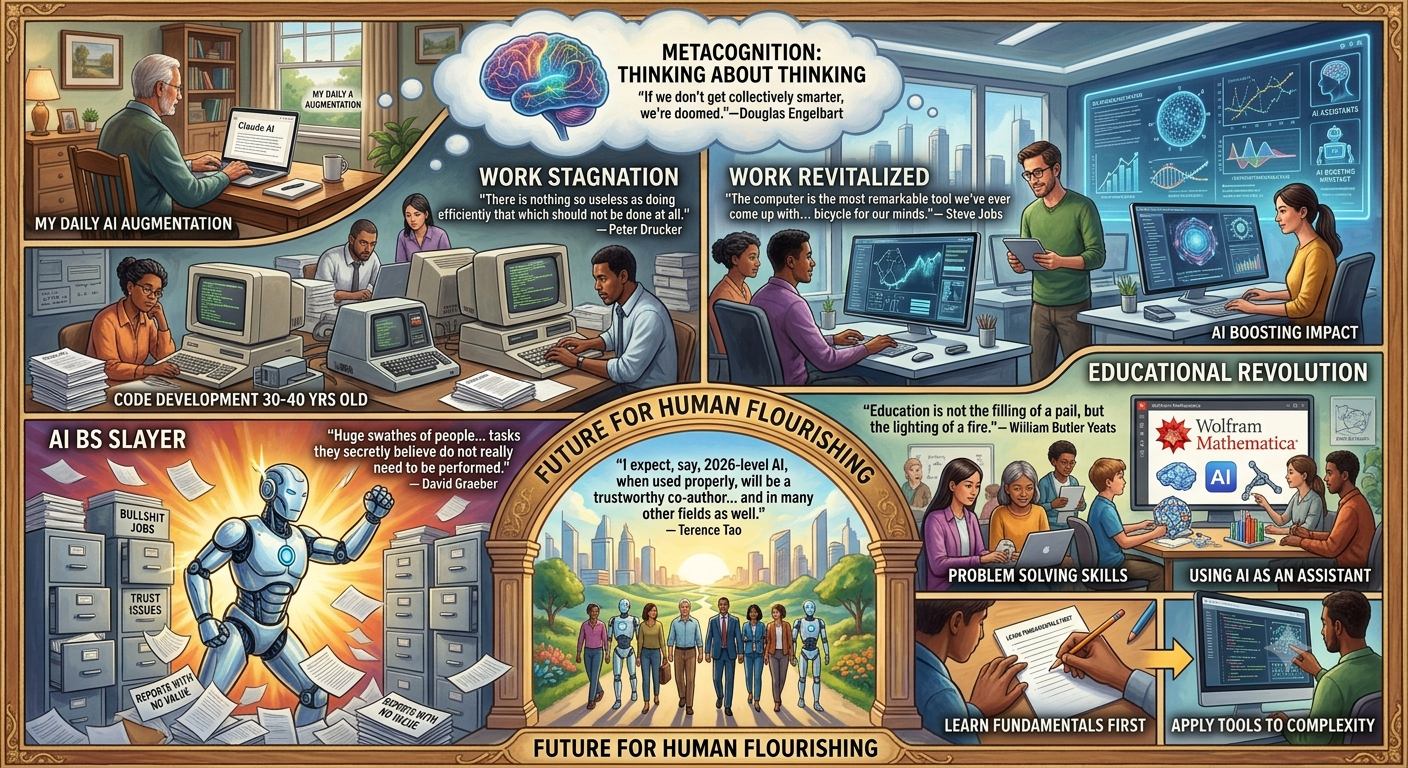
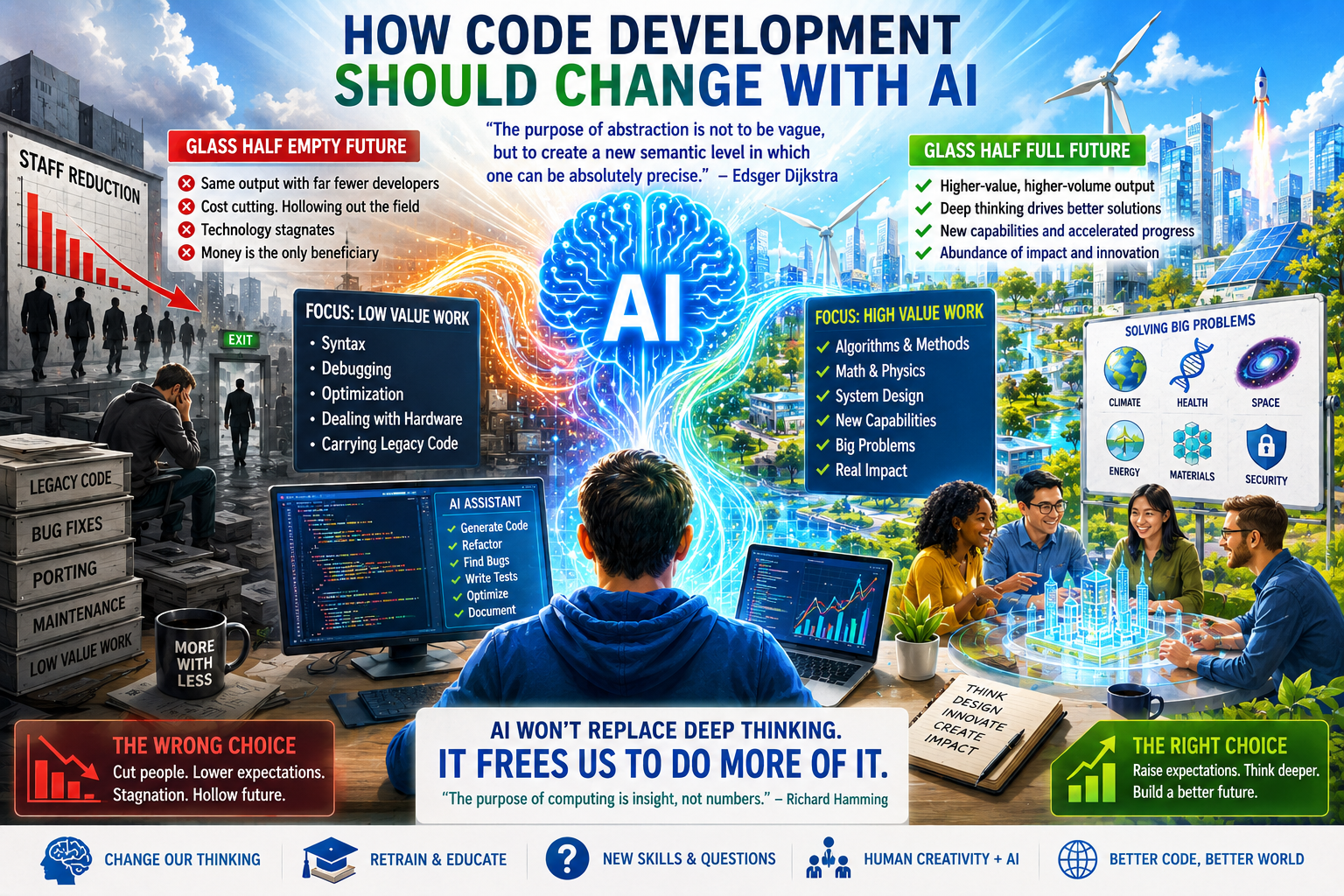
I am growing more capable with each passing month. I finally bought service from Claude amazed with the LLM, cowork, and code. The things it can do are beyond anything imaginable a mere five years ago. It’s able to do much of many white-collar jobs. This feels acute in programming most of all. This is a manifestation of short-term thinking and scarsity. The real thing for Americans to tackle is to start demanding more from the job. Their needs to be a more human edge and human thought from the job. Leave the tedium for AI, or better yet eliminate it. Make AI a capable assistant that frees up people to create more, and higher quality things. This is the long-term and abundance thinking.

“In order to achieve this, jobs have had to be created that are, effectively, pointless.” – David Graeber

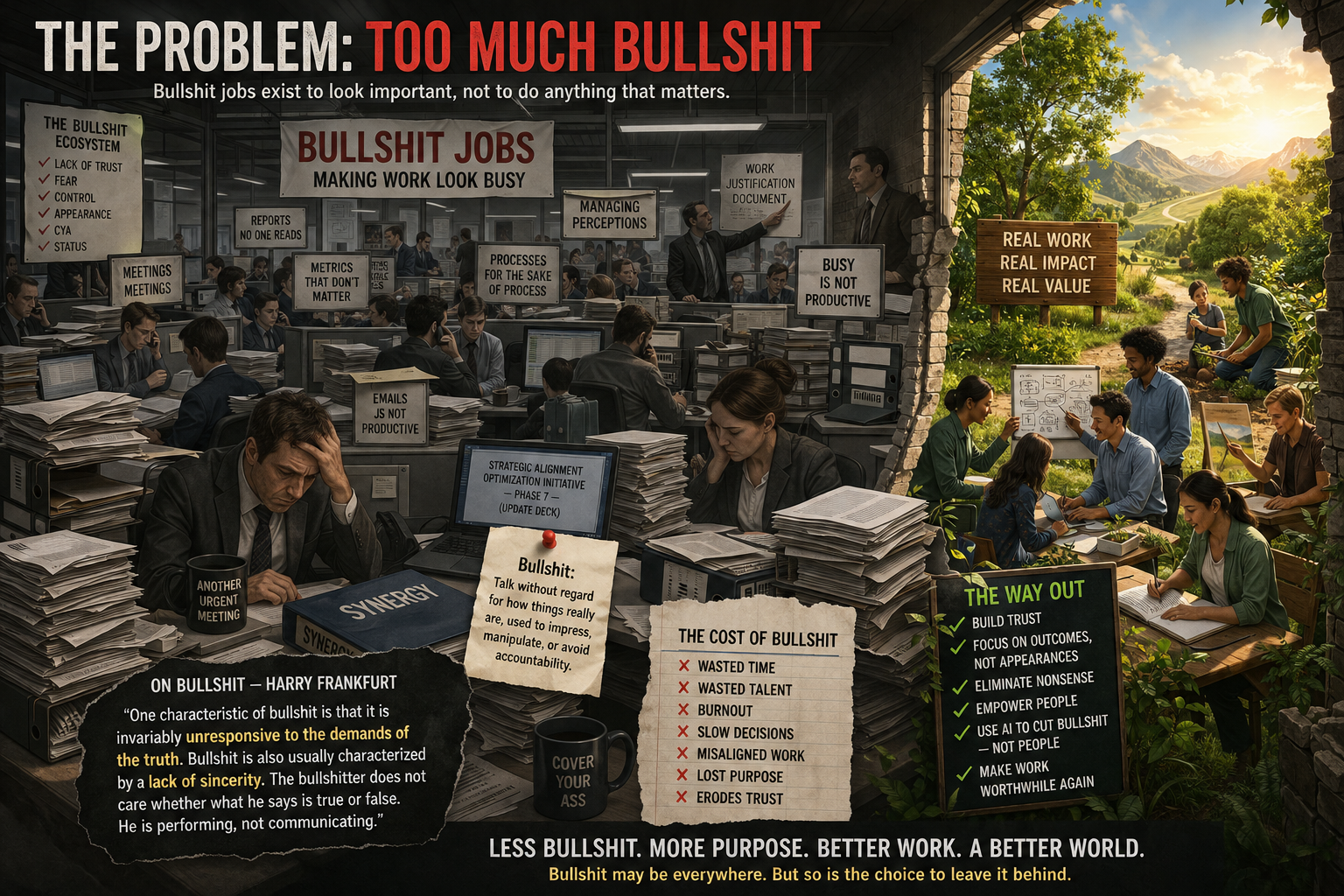
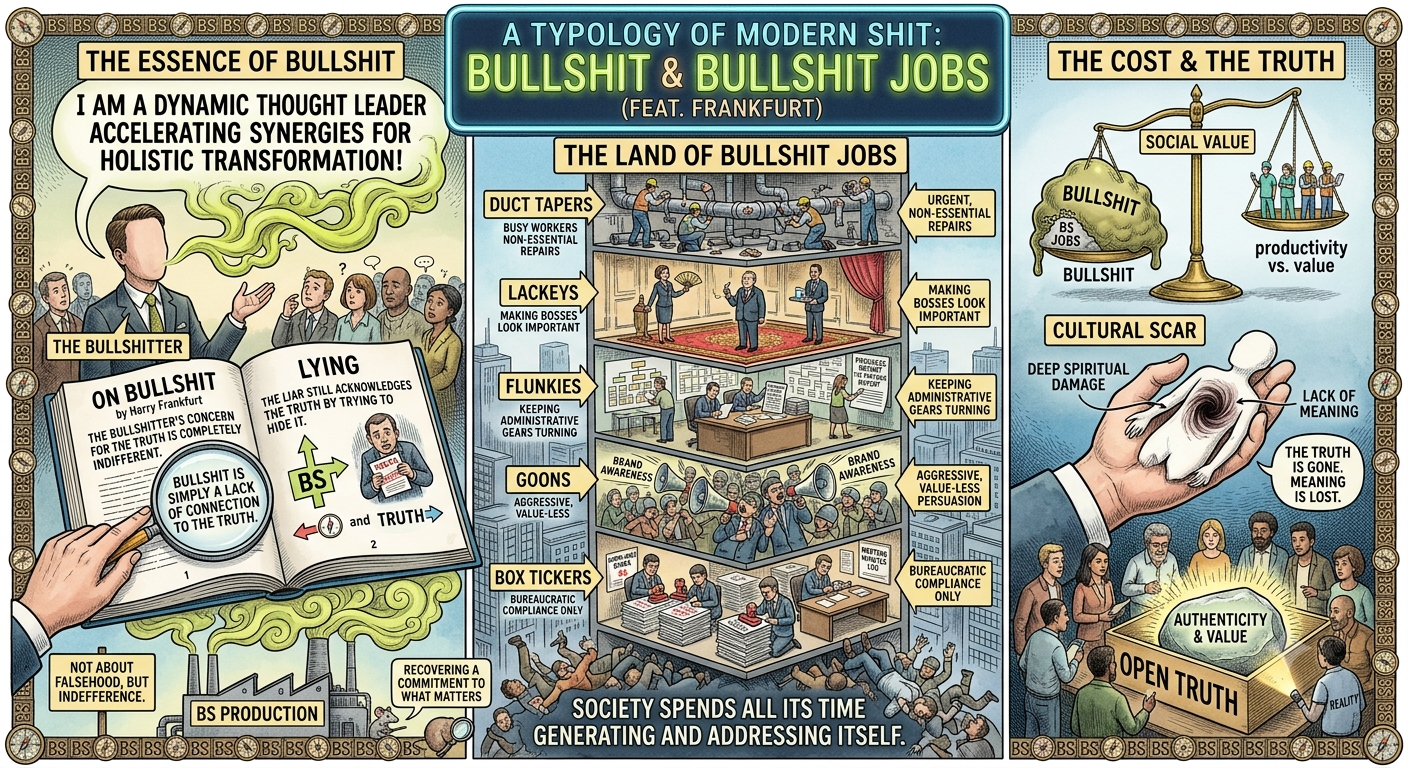
What I found AI is most impressive at is removing tedium from work, not providing better thoughts. It provides a breadth of information and perspective, but the depth of that thought is severely lacking. Every time I went deep into a topic where I had expertise, the AI floundered. It painted in broad brush strokes, but the refined work and understanding was poor. What is needed from jobs is to demand more depth from the work. What this really means is there needs to be a demand for greater quality and less rote, useless work. In other words, AI should be the death of what have been called “bullshit jobs.” If AI can do a job that job is of questionable value.

From what I observed at work as I went out the door, the opposite was happening. The amount of bullshit that I was required to focus on was growing year upon year. The quality was lower and lower. The management actually had less room for high-quality, innovative work and more. In other words, trends were all going in the opposite direction from what is needed for us to survive AI in the workplace. The ways my managers asked me to use AI was moronic. Worse yet. friends at other Labs told me the same thing. I should note this is at a top-tier research institution. I can hardly imagine what it’s like at companies. We are led by people who are clueless. The scary part is I know many of these leaders and they are smarter than this.

The leaders I know are the core of our nation’s intellectual leadership. They guide the very institutions we need for AI to flourish. The irony is that what science needs and what AI needs to truly succeed is higher quality work and much more thinking. Our leads are pushing us to do less, AI or not. Human thinking, not more computing power, is the key. Computing is a great tool, but thinking is the silver bullet. AI is the same, an incredible tool to augment humans. This is the secret to long-term success and victory in the quest for AI dominance across the world. This is making AI a tool and collaborator for humanity rather than a replacement.

My first big point is that we need to embrace the long term and abundance if we want AI to succeed. Humanity and thinking are essential, we need more of it. Not less. Short-term thinking and scarcity is a losing approach. The problem is we have already chosen the losing approach.

How the USA will lose the Lead

What I observed in my last few years at the lab was an almost complete and total lack of coherent strategy around science and technology. Thinking was all short term and money focused. The most acute version of this is around AI. There the lack of thoughtful-principled approaches and strategy has been appalling. Increasingly, the management of the lab simply looks to how they can get money and as much of it as possible. What that money does and how it’s applied and what the long-term future looks like is immaterial. These attitudes are paralleled across society. The nation as a whole has the same disease

This is a final festering of this habit of short-termism. Simply looking at quarterly progress in annual budgets, with little or no thought to any sort of long-term coherent plan. Labs were once engines of innovation and cornerstones of American security. That is difficult to assert today. Over the long run, this simply erodes these institutions and turns them into mere contracting organizations. It also reflects the lack of any sort of coherent strategy nationally. In the end, will lead the United States towards being a second-rate power. Our most powerful technologies in industry and defense are based on research that is decades old. That technology pipeline is almost annihilated today.

The first incarnation of this, and a continuing theme, is this obsession with computing hardware. I have seen this for almost my entire career. Naive short term leadership sees computers as an easy sale politically. When one looks at computing, whether it’s classical or modeling and simulation, or AI, there is a balanced set of activities that need to be cared for. Many different things contribute to the whole. In both cases math, science, and software are more important. In the current age, all the focus and the only strategy that can be seen is hardware. This obsession with hardware leaves most of the ecosystems supporting computing famished. It will produce poor performance compared to a coherent, thoughtful strategy that balances all the needs.

The case for a focus on hardware in classical modeling and simulation was nuanced. It was not a complete slam-dunk although the benefits are small. The case against focus on hardware in AI is quite bulletproof. The scaling laws supporting increased capability in computing for AI are incredibly weak. In fact, far weaker than the scaling of prowess, capability, and simulation. Yet we see complete devotion to hardware across both AI business interests and government. It is as if all the other is simply being ignored, and this is the only thing they know how to do. The lack of coherent thought and broad, encompassing strategy staggers the imagination.

The Labs have completely rejected their traditional role of providing scientific leadership and feedback to the national programs. What we have now is laboratories existing in a hand-to-mouth existence happy for money. Internally they have a complete lack of any sort of strategic thought that could lead to success. The entire system seems to be spiraling down the drain. It is in need of vast reform and improvement. Instead, we are just doubling down on the very forces that have led to the decline in the first place. Now they are aided by a federal government that destroys rather than fix or reform.

Personal Perspectives on AI

Part of my decision to retire revolved around these questions. I had of confidence in both Sandia and federal agencies’ ability to appropriately and wisely steer our future. AI was more of the same. I’d already seen horrible decision making. The actions of both Sandia managers, federal agencies, and our national leadership have all convinced me that no one is thinking about how to do this in a balanced, wise manner. Everything revolves around money. Nothing revolves around the scientific work needed to assure American supremacy in these areas. Quite frankly, we have no national strategy, and we soon will be lost in the wilderness. I was wasting my time working.

This is the exemplar of everything I wrote about in “The Decline of American Science.” The way science is managed today, we cannot stay on the cutting edge of anything. All of this is because of a lack of trust and fear. We are so fearful of anything that looks like a scandal that we basically cut our own throats. In AI, which is moving at light speed, this is a fatal flaw. There are other fatal flaws, and the institutions fail to acknowledge all of them. They seem powerless to affect anything for the better.

One of the things I did in my last couple of years at Sandia was start to investigate the power and proper use of AI. In the process, I came to a number of conclusions. Now, I should note that Sandia provided a version of ChatGPT internally. I tested this and used this, but I also compared it to what was available on the outside. This was not just ChatGPT, but also Gemini and Claude. What I determined in short order was that the internal version of ChatGPT that Sandia provided was a piece of shit. It was terrible. At least, compared to the free versions externally. The free versions!

“The first principle is that you must not fool yourself — and you are the easiest person to fool.” – Richard Feynman

It hallucinated worse than the outside models. It answered every single question I asked worse than any of the other available models (the free versions). One of the things to note is the internal version of ChatGPT was structured to not violate security issues (hence data that needed to remain internal was safe). It cut it off from the open internet and by Standards necessary for use were careful and secure yet. Also, it was updated less frequently and was generally behind. It is a general software issue at the Labs. Software processes are extremely conservative, leading to slow progress. One of the things that is most damning, but this is way the labs operate. Security rules are deep, Byzantine and dripping with paranoia.

Cyber security gets power and money by being as paranoid as possible. When a mistake is impossible, progress is impossible too. It is risk adverse in the extreme. Stupid rules are common. For example, the approach to medical device security is insane. They would make people choose between the best medical treatment, and outlandish security concerns. It is a massive “fuck you” to employees and scientists. They cost an enormous amount of effort and time to make sure that everything we do is behind in cutting-edge technology. LLMs for AI were no different. They reflect some of the worst characteristics of attacking science today. AI at the labs is slow, expensive and behind.

How I Learned to be Effective with AI; Its being Ignored

“The greater the gap between self perception and reality, the more aggression is unleashed on those who point out the discrepancy.” ― Stefan Molyneux

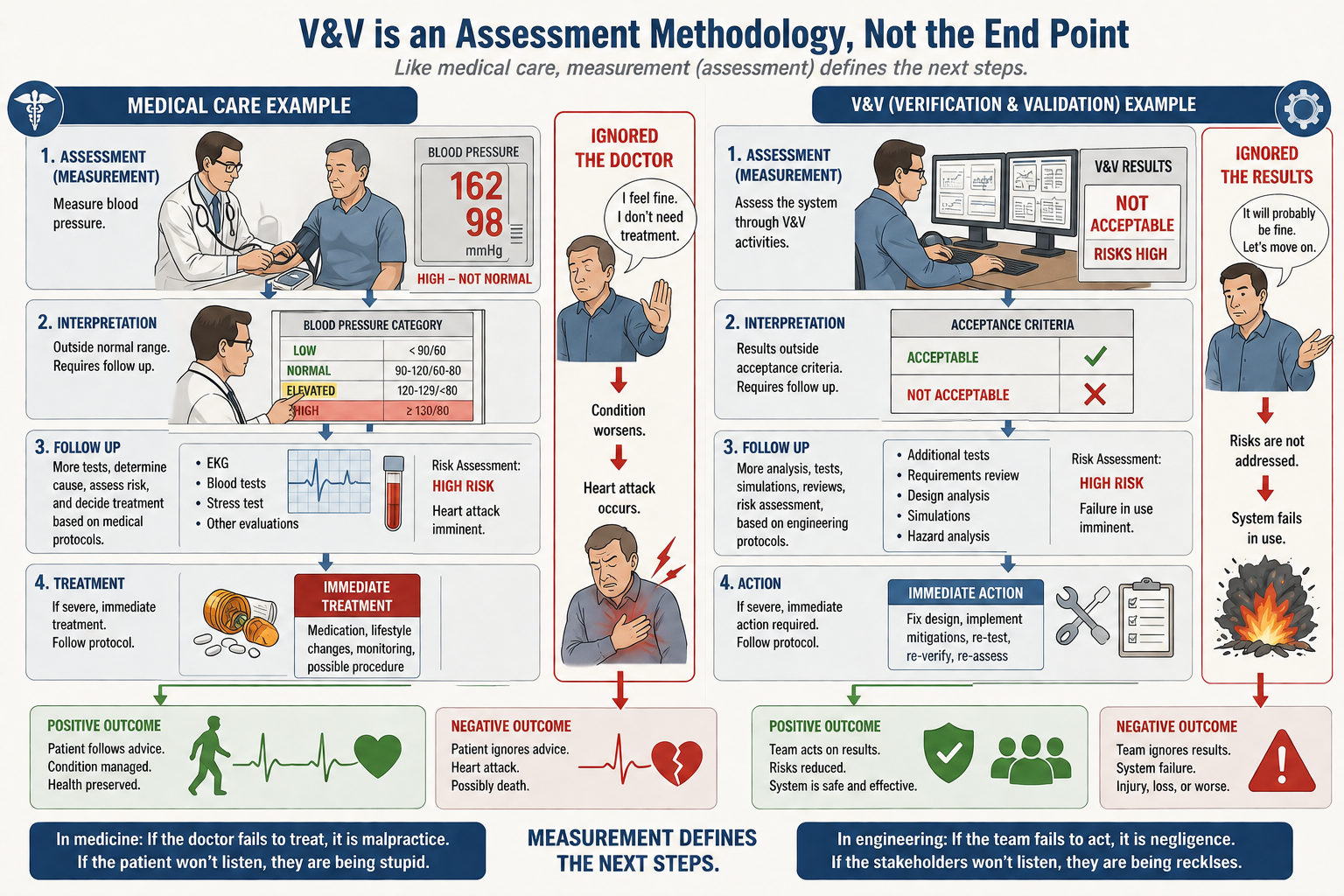
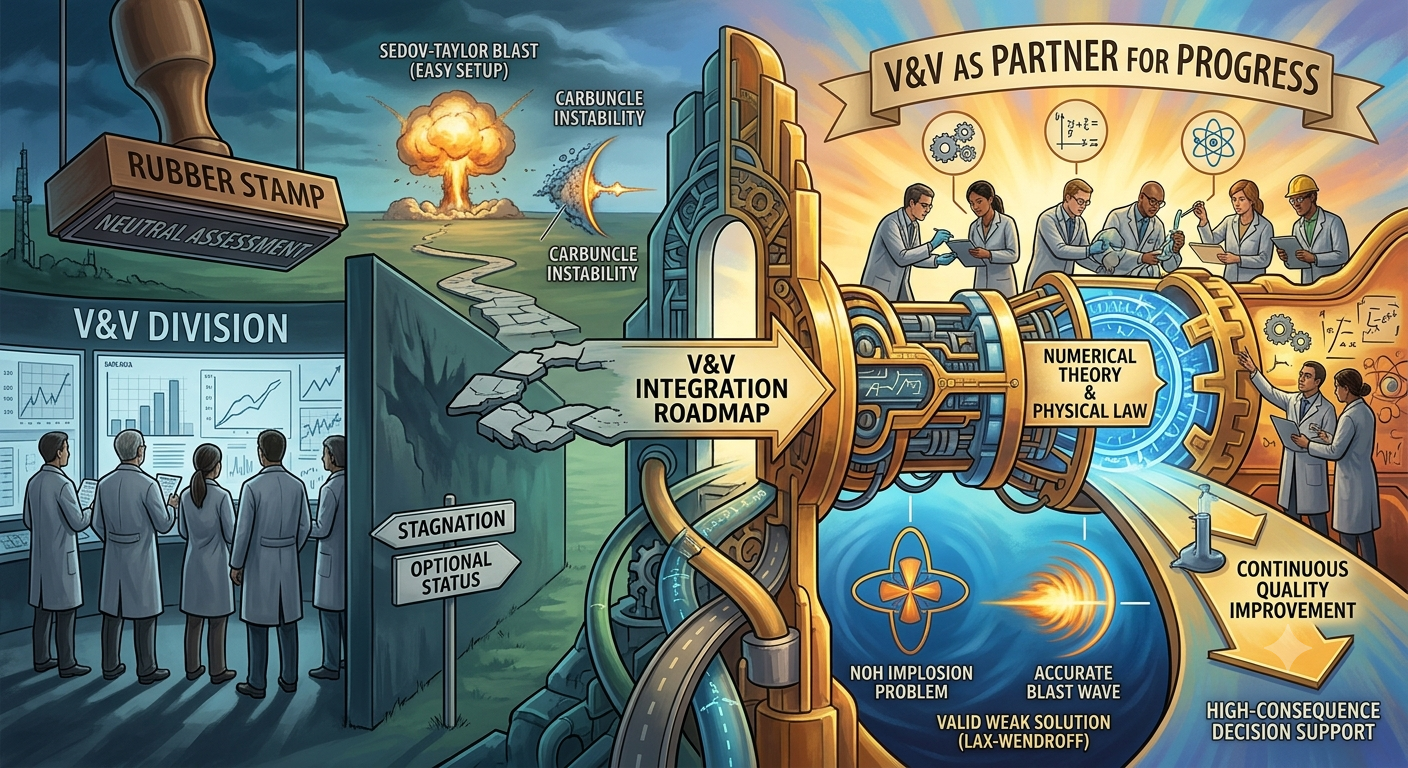
While I learned that internal AI efforts were verging on hopeless, I did figure some things out. One of the key things that I discovered in my exploration of AI is the mindset for engagement. This is a verification and validation mindset. I am bootstrapping from the perspective that V&V is the scientific method. This has been seen by others, where one needs to approach AI as a collaborator. To do this with a spirit of pushback and doubt in every interaction. There needs to be a demand for evidence from the AI about their assertions. The evidence needs to be checked independently. This is exactly what is done in V&V and science in general.

After I retired, I continued. This is an essential technology for our future. Eventually. I paid for Claude. Before the purchase Claude impressed me. After the purchase, it’s largely been underwhelming. Largely because my expectations were so high. Nevertheless, the desktop version is amazing with Cowork and Code. It definitely improves my efficiency and it is a huge leap forward. I am fairly sure that the capability for software creation will be incredible. I’ve also worked with friends going amazing work with it. This is hard core science and its level of competence with a good collaborator is unbeatable today. The key is the right approach to using AI. At the labs this is hard to find, certainly from leadership. Lab leadership acts clueless about how to use it well.

“A government contract becomes virtually a substitute for intellectual curiosity.” – Dwight D. Eisenhower

This is the exemplar of everything I wrote about in “The Decline of American Science.” The way science is managed today, we cannot stay on the cutting edge of anything. All of this is because of a lack of trust and fear. We are so fearful of anything that looks like a scandal that we basically cut our own throats. In AI, which is moving at light speed, this is a fatal flaw. There are other fatal flaws, and the institutions fail to acknowledge all of them. They seem powerless to affect anything for the better.

As I’ve noted before, V&V; is in deep decline in science, especially at the labs. The V&V mindset useful for AI isn’t present in science. AI needs V&V thinking in simply judging the results. One of the most repugnant aspects of our current approach to AI is that V&V; is rejected. It should be the standard way to engage with these models for science. In the recent Genesis call V&V is not a priority. It is weakly nodded towards, and not emphasized. With AI V&V is vastly more important than classical computing. This is basically a call to cut the throat of progress, and destroy the best way to interact with AI in a scientific enterprise. This lack of confidence in our direction validated my decision. I was wasting my time.

“For me, it is far better to grasp the Universe as it really is than to persist in delusion, however satisfying and reassuring.” ― Carl Sagan

I had a direct engagement with a Lab Director about this. It was discouraging in the extreme. While the incompetence and lack of ethics of my direct management at Sandia was the principal reason for retiring, there was a deeper reason. I had engaged with a new lab director on a topic related to AI. Her response was so underwhelming and weak that I lost all faith. Internal search at Sandia is awful. The search technology is first-rate and modern. The reason is information hiding that defines the internal culture. The culture short-circuits an essential technology for the information age.

I asked her about information control and its cost in training for AI. Since training data is essential for LLMs, the issue that undermines search is fatal for LLMs. Security rules and culture would rob AI of training data if applied strictly. Rather than answer the question, she attacked me and said the question I asked was “harsh”. It was a legitimate question, and it gets to the heart of the utility of this work. It confirmed to me that she was just like all the other managers. She would be incapable of solving real problems and addressing real needs of the institution. It should be obvious by now. I am completely fed up with ineffective managers who refuse to confront real problems. The new director would be more of the same incompetence. Another leader to rubber-stamped the current decline. Every single day that this happens, the lab declines further and gets worse and worse.

Moreover, my understanding was that she was a last-minute second choice over another person. Someone who could have been vastly better in all likelyhood. This other person is someone I respected greatly, and knew personally. He was rejected for political reasons. Honestly, I don’t have a lot of confidence that had my friend been chosen as director, the outcome wouldn’t be any better. There seems to be an institutional and societal barrier to addressing any problems. Managers just seem to be completely devoted to the prospect that they can just define success, declare it, and ignore problems.

Maybe it is just the outcome of social media. Our leaders are now just influencers. Moreover, paying attention to problems is a losing prospect and will simply get one fired. The blame for the problems will be laid at their feet. This broad character is one of the main reasons for the accelerated decline in American science. The problems are obvious, but no one is addressing any of them. When managers are confronted with the truth, they reject it and basically shoot the messenger. If we continue down this path, American dominance in AI will be fleeting and short.

“You cannot connect with anyone except through reality.” ― Stefan Molyneux

China isn’t beating us in science. We are beating ourselves.

tl;dr

For most of the period of time after World War II, the United States has been the unrivaled superpower economically, militarily, and scientifically. American science has been the foundation of much of the military and economic might. It was a virtuous cycle and engine. This is not true today. The USA is losing its grip on all of this. Over the past 40 years, this supremacy has declined in every respect, including science. The decline of scientific supremacy arose from a sense of hubris and false security. There was a belief that we could focus on a host of other things. The efficiency and effectiveness of our scientific enterprise were unimportant. I witnessed this first-hand during my career at two national laboratories. In the past few years, it has become a question as to whether the United States has been surpassed by China. I believe that it has. Now, under the second Trump administration, it has turned into a surrender. American science is in full retreat. All its institutions are being destroyed.

“A great civilization is not conquered from without until it has destroyed itself from within.” — Will Durant

Seeing this in Personally

Over the span of my own career, I have seen this change dramatically. When I started my career, the Chinese were definitely far behind the USA. There were relatively few Chinese scientists who were leaders in the field. Moreover, when I did encounter them, the work was quite pedestrian and ordinary. By and large, the papers were on par with mediocre American science. Over the past decade, this has completely changed. More and more, the quality of papers has started to rival the best in the West. I started to see a unique capability across a host of CFD endeavors. I saw the Chinese work draw to parity with the USA. This is paired with the degradation in American quality and quantity of science in my area. The Chinese had radically improved. The USA had allowed itself to get worse.

I remember meeting a chemist who had given a distinguished lecture at our local University. He was a well-known chemist from another National Lab. In our conversation, he reported exactly the same pattern I had seen in CFD. The same blueprint. The Chinese had radically grown their science, in this case, chemistry. The USA had allowed our work to stagnate or decline. Suddenly the Chinese were every bit as good at the USA. How widespread is this? I will mention a study below that indicates that it is a broad pattern.

The clincher to my tale is the reaction from my leaders. For the leaders at the Lab, the reaction ranged from inaction to complete disinterest. Even though this is a serious National security issue, there is no reaction or response. I raised the topic with our National program manager from the agency supporting Lab computational work. The reaction was complete disinterest. There was no reaction or care concerned. Our leaders simply don’t give one single fuck about it; none at at all.

So we’re cooked, right?

“Every nation has the government it deserves.” — Joseph de Maistre

Scientific Operating Systems

American science is constructed out of a series of institutions. Science happens a universities and National labs. It used to happen in industry, but this is mostly gone except perhaps medicine. A host of federal departments and agencies fund science and manage it. Many others also regulate the science done everywhere. The oversight and regulation interacts with the legal profession to keep science inside the law. All of these working together define the Nation’ productions of science. This is the operating system for American science.

“Research is what I’m doing when I don’t know what I’m doing.” — Wernher von Braun

It is malfunctioning. It is now mostly stopping and harming science.

This is not to say that all the institutions that are being attacked are not in need of massive overhaul and rebuilding. They are. All of them need it. The problem is that this is not what the Trump administration is engaged in. They are engaged in wanton destruction. This was true with Elon Musk’s DOGE. It continues to be true today with the broad attacks on the federal infrastructure, dominated by the OMB head Russell Vought. None of what they are doing is creating any sort change needed in these institutions. The institutions are not becoming more efficient or better. They are all becoming worse. Worse yet, political litmus tests have started to be issued forth on a variety of scientific enterprises. None more so than weather and climate research.

There’s a lot of discussion these days about the Chinese reaching supremacy in science and engineering in the world. I tend to believe this is true. My evidence comes not from the United States but from an Australian study (Austrailian Strategic Policy Institute) that looked at this in a less biased way. The Austrailians have a balanced concern about understanding the pros and cons of the two superpowers. They are not prone to account for either nation’s preconceptions. They see China dominating globally and the USA second. This is before the damage caused by Trump since 2025.

“Basic research is what I’m doing when I don’t know what I’m doing.” — Wernher von Braun

The deeper issue is that the truth is that the United States is basically ceding science to the Chinese. We have torn down our institutions, reduced our investment, and the investment that is left is spent very inefficiently. This is all on top of the broad decline giving up the lead. The current administration has done nothing to stop this but rather accelerate the whole process. They’ve nibbled around the edges of the inefficiency but attacked the funding and institutions mercilessly. Before the Trump administration, we were already losing to China. Now we’ve basically given up. We will be second if not lower.

“Far too many managers are short-term, horizon-less decision makers.” — W. Edwards Deming

What was already killing science was a host of misteps. Quarterly profits killed industrial research. The payoff for research simply is too far in the future. The same mentality has taken hold across the federal government. Long-term investments have decreased, and short-term focus has taken over everywhere. None of this is sustainable, and none of this can take the United States anywhere good in the long term. The short-term-ism is one of the biggest issues.

The other major issue at work is the lack of trust. The lack of trust is predominantly from the Left. This is shown in terms of regulation and various initiatives that all take an immense amount of effort. There no trust is held and in its place bureaucracy is created. This is to make sure that the initiatives are met. The fact is that most of these initiatives have proven poor and play out through metrics that can easily be cooked into seeming compliance. Thus we get failure at a huge cost.

“Trust is the lubrication that makes it possible for organizations to work.” — Warren Bennis

The other big thing that lack of trust harms is risk taking. In the current environment risk unacceptable. Without risk innovation and progress are nearly impossible. The impact is a loss of innovation in every institution. Progress is grinding to a halt. The lack of trust then generates fear and caution. Both fear and caution produce an augmented effect. Innovation became impossible. Over time we will see the movement of discovery and awards move away from the USA.

Nothing that the Trump administration has done has improved anything. They are just meat cleaver cuts in funding and aimless directives towards overhead. This needs to be thoughtful and strategic, not simply wishful thinking. We need all our scinece funding and generate efficinecy to spend it better. Innovation and progress is vital and trust is needed for that. With trust the fear and caution can lower. All their steps are moving the trust lower and fear higher. All of these institutions are in need of deeper forms that focus on the needs of the country in the long term . There should be focus on reinvigorating the quality, focus, and adventure in science. The loss of any ability to take risk has only accelerated under this leadership, Where more trust, adventure, and risk-taking are needed. Instead there is less. Much less.

The American system should be vastly better than the Chinese system for science. The real truth is we’ve managed to attack and destroy almost all of our advantages in science. In spite of our advantages culturally we have managed to poison them all.

“When a measure becomes a target, it ceases to be a good measure.” — Charles Goodhart

The Period of American Science Supremacy

“Plans are useless, but planning is indispensable.” — Dwight D. Eisenhower

We should talk about the period of unrivaled and unquestioned superiority of American science. This arose out of the ruins of World War II, in large part because most of the rest of the world had been seriously destroyed and damaged by the war. The United States remained relatively unscathed. In addition, the scientific enterprise in the United States had a huge achievement and had leapt to the forefront of human thought with the development of the atomic bomb. This produced a sort of commitment to science as the foundation of national security in Vandever Bush’s Endless Frontier. The American government began to strategically invest and create scientific institutions that could wanage science. There was huge support for science across the federal enterprise. This includes many national and defense laboratories. There was support for university science, and various government organizations to support the broad scientific enterprise. Chief among these were the National Science Foundation and the National Institutes of Health, which provided a large amount of funding. Moreover, U.S. industries provided a scientific enterprise, perhaps none more evident than Bell Labs. There was a huge investment and spirit of forward progress in the United States. The United States also had vast economic power that was enhanced by this science and technological investment. It also provided a large amount of funding for that.

“Scientific research is one of the most important keys to our future national security.” — Vannevar Bush

The scientific successes from World War II provided the start of this. The continued energy for scientific advancement was created by the competition with the Soviet Union. When support for science began to lag, the Soviet Union pushed ahead with Sputnik and the Space Program. This reinvigorated American science and included a desire to leap ahead of the Russians in space. This produced vast support for NASA and the Apollo Program, with the apex event of the moon landing in 1969. Throughout this time, the American scientific enterprise provided a large amount of technological advances that fed U.S. industry. It allowed also the mighty armed forces of the United States.

This situation continued unabated until around about 1980. This was marked by the Reagan Revolution politically. This would become the beginning of the end for American scientific supremacy.

“A nation which depends upon others for its basic science is a nation which will be slow in its industrial progress and weak in its competitive position.” — Vannevar Bush

The Decline of American Science

“The nine most terrifying words in the English language are “I’m from the government, and I’m here to help.” – Ronald Reagan

The real root of the beginning of the decline of American science preceded Reagan. There was a series of events that occurred in the mid to late 1970s that began to undermine the trust and ability of the government to support science. Trust in the government failed. Much of this can be traced back to the actions of Richard Nixon and Watergate. There was also the overreach of the Vietnam War. In the wake of the Apollo program and the collapse of Soviet space exploration, the withdrawal from government investment in space. All of this conspired to create the environment for the beginning of the end for American science supremacy. Reagan, when he was elected, ushered in a period of distrust and hate for the government. Part of that government that was being attacked was the scientific enterprise. This is not to say that all of the problems with science came from the conservative side of the political spectrum. There was plenty from the liberal side as well.

The lack of trust in technology had started to become manifest in the desire for regulation of all things. The lack of trust in industry and technology and the desire to create a framework of safety. This overall framework of safety is one of the major forces that has sapped vitality out of science, as more and more resources went to regulating and administering science. Less of it went to exploration and creation; energy and focus moved.

“Government does not solve problems; it subsidizes them.” – Ronald Reagan

These checks and balances were created to deal with a variety of missteps and mistakes. Plus the belief that the American society was rich enough and powerful enough that it could easily afford these sorts of steps. This belief has ended up being quite foolhardy and has acted as a continual friction and drag on the scientific enterprise. By the time that I started my work in Los Alamos in 1989, the effects were already clear. The general belief is that the lab peaked in 1980 and was marked by the departure of Harold Agnew as laboratory director.

In the few years that I was at the lab, I saw a huge change. This was the end of the Cold War. With the end of the Cold War, there was a huge withdrawal of trust and resources from the National Labs. There was also a very sharp focus on cleaning up the environmental harm that the nuclear weapons program had done. This took the form of the Tiger Teams sent to find problems. This unleashed a huge amount of administrative and bureaucratic energy at the labs that was all detracting from the conduct of science. When I first got to the Lab I would see my Division leader once a quarter or so. It was great. After the Tiger Teams hit the Lab I wouldn’t see a Division Leader in my office til 2005.

In this time, we saw the first changes in the leadership of the lab. The original servant leadership model that the lab had worked for a while, as managers worked to protect and try to keep as much science going as possible. Over time, this eroded, and gradually there was also a change to a more competitive environment for funding and resources. This environment created a drive for money as the chief measure of laboratory strength. With this came the era of the Empire Builders and a distinct change in the tenor of management. The money also brought a short term quarterly report mentality. The standards started to become different and technical quality dropped.

The final blow at the laboratories was the corporate takeover of laboratory management. This came from this misbegotten belief that industrial and business management ideas were the best way to run the lab. The quarterly profit, shareholder value philosophy that had taken hold across the corporate world was injected into the management of laboratories. All of this, combined with the regulatory environment, acted as a huge drag on the laboratories and science in general in this country. The labs became shadows of their former glory.

Places like universities were not immune from this. Part of the forces of change in the university were the same bureaucratic and administrative additions. Everything from environmental regulation to workplace regulation to DEI became the priority. With this came an enormous growth of the administrative staff at the universities, and the cost of the universities exploded. States removed much of the funding support as well. The same mentality about money and empire building took over at the universities. The ability of professors to bring in money began to become far more important than their ability to teach the next generation. The money replaced research quality as the principle measure. Education of the next generation was almost an after thought.

Surrender and Retreat

“The best way to predict the future is to invent it.” — Alan Kay

All these forces are still active today. They have worked to continually drag American science down and erode the supremacy. The fact of American supremacy in science is now an issue of debate. Studies have started to speak, as the various sources around the world have begun to see that China has replaced the United States as the top country in science.

“In any bureaucracy, there’s a natural tendency to let the system become an excuse for inaction.” — Chris Argyris

The conclusion that I would like to draw attention to is that the Chinese did not beat Americans in science so much as Americans beat themselves. The Chinese system is not superior to the American system in terms of innovation and freedom. In the face of all that the American system has done to undermine itself, the Chinese have surpassed it. One of the reasons is a genuine strategy. This is somewhat a function of their leadership, which is dominated by people with engineering backgrounds. In the United States is dominated by people with legal or business backgrounds. This difference is key. The Chinese have a national strategy and execute; the Americans have no strategy at all. American science is simply chaos and greed and professional drive. There is little or no coherence. Intellectual thought going into scientific direction has been replaced by focus on money.

“Culture eats strategy for breakfast.” — Peter Drucker

All of this was in place before we got to the current day. There was genuine damage to science that was done during the first Trump administration. The Biden administration, which was a continuation of the trends of the last 40 years. The real difference is that when we got to the second Trump administration there are attacks against the institutions of science. Coming out of the administration are both huge budget cuts and attacks on fundamental science across the board. There is the broad personal departure of experts and people who offer genuine professional expertise in a variety of scientific fields. These are replaced by people who are chosen for their loyalty politically. The combination of personal selections and huge resource cuts means that what was a decline in American science has turned into a surrender.

“Success breeds complacency. Complacency breeds failure.” — Andrew Grove

Beware of systems that make people worse, not better.

tl;dr

I’ve noticed a trend as I prepared to exit Sandia. The system of management was corroding the basic character of some individuals. It didn’t ruin everyone, but many. Some people seemed to resist the system and remain good. Others became raging assholes where once a decent person existed. Ethical lapses were commonplace. It became something I worried about when a good person entered the system. I would warn my friends who entered management to guard themselves. I had seen it enough to suggest a trend. If the system and demands of leadership make you a terrible person, is it a terrible system? In all likelihood, yes, it is. How commonplace is this? I suspect Sandia is not an outlier, but reflects society as a whole.

“Ninety percent of all problems are caused by people being assholes.” “What causes the other ten percent?” asked Kizzy. “Natural disasters,” said Nib.” ― Becky Chambers

This is a huge problem

I managed to pop out a couple of blog posts all about deeply technical issues. Lying in the background of these posts are terrible leaders who stand in the way of solving these problems. If I step back and see the reasons why I wasn’t actively working on these problems, it is shitty leadership. Shitty leaders who act like assholes standing in the way of genuine progress are a plague. They don’t simply stand in the way; they actively undermine it. American science is in disarray and generally collapsing. The era of dominance is functionally over. Terrible leadership is much of the reason for the precipitous decline. The institutions that select them, then tolerate them, are losing their edge.

The end of my career was punctuated by terrible leadership. I started to see obvious and common ethical issues over and over. The combination of (at least) two incompetent and unethical managers ended my career. One of these managers was someone I had worked with before. He seemed like a pretty decent person back then. Then ten years later, I worked with him again. Those ten years as a manager seemed to corrode him. He turned into a fuckhead, and a general “piece of shit”. An outwardly nice person with a passive-aggressive soul. He was a much worse person having been a manager.

“Whoever fights monsters should see to it that in the process he does not become a monster. And if you gaze long enough into an abyss, the abyss will gaze back into you.” ― Friedrich Nietzsche

Why had the previous decade been so harmful to his basic character? Did the system harm him directly? What went wrong? What corrupted him? He is not an isolated case, but rather an example of a trend.

The promotions did not improve him; they made him worse in every way. I saw this almost immediately. This is with someone I was predisposed to think well of. The experience of having greater responsibilities had hurt his character. The person I used to know would not have violated ethics so casually. He seems to have lost all his technical and scientific sense as well. I would surmise that the feedback as a manager nudged him toward less competence and lower ethics. I know that several of his superiors over those 10 years were monstrous individuals. They demonstrated many ethical lapses that I personally witnessed. I would assume this was the tip of the iceberg. Their shitty examples might be enough to explain what I saw. He was mentored by assholes (and a sociopath in one case).

By putting these sorts of people in positions of responsibility, they are engineering more assholes. This is the easiest explanation of my question. We are then left with concluding that bad judgment in hiring and promotions leads to the problem. Assholes often like other assholes and systematically choose them for positions of authority. These people naturally demonstrate the sort of terrible behavior the asshole leader favors. Likely, the story isn’t quite this simple. Assholes are having a societal moment. The President is one of the biggest assholes imaginable. Many people seem to think this is a good thing. Maybe the same people believe the same thing holds for other leadership positions. This is a bit deeper and indicts large swaths of society.

The fact that these people were promoted to higher positions leads me to believe this is a systemic problem. I also think the problem is getting worse. This led me to ponder the reasons for this. First, we should get to the bottom of what leadership looks like these days. Why is being a raging asshole prized in leadership? Why does leadership today make someone an asshole? Fundamentally, is it generally bad for us to be led by assholes?

I will get to a genuine personal concern. If you look at the leadership of the DOE labs, it is marbled with people I know. I have personally known many of the Lab directors, deputy or associate directors. There were a great number of really good people. They had good character. They were technically excellent in most cases. I now wonder how many of them have become assholes. I certainly see some examples amongst them who have degraded as humans. It would seem that power corrupts. Power doesn’t corrupt everyone, but many. I have also seen some who remain excellent humans with power.

“Imaginary evil is romantic and varied; real evil is gloomy, monotonous, barren, boring. Imaginary good is boring; real good is always new, marvelous, intoxicating.” ― Simone Weil

Nonetheless, asshole leadership seems to be having a moment. This is obvious simply by watching the news. I remain convinced it is corrosive and destructive for all they lead. All of us will suffer from the direct effects.

Leadership by assholery

There is a really good way to detect an asshole. Go to a meal with them at a restaurant, and see how someone treats the wait staff. If a person treats their wait staff like shit, that person is probably an asshole. The lower the bar they have for treating people poorly, the worse they are. Someone nasty to people in low-power positions is abusive. They are likely to be someone to be avoided in general. If you give them power over others, they will treat them like shit, too. It is a real tell. This doesn’t always work, especially if you have a passive-aggressive person as the asshole. At Sandia, the managers are predominantly passive-aggressive, and the assholes are prone to being a bit Machiavellian. These are backstabbers.

During my last year at Sandia, there was one specific case that solidified my point of view about this particular issue. I was sitting in on a meeting where we were preparing for a meeting where young scientists would be introduced to their program managers. I was providing feedback and watching it online (Teams). My wife had come out to the table where I was working so that she could work on her quilting. I had things on mute, and she made the comment about the manager during the meeting. Her question was, “Who is this asshole?” I sat a little shocked as the manager who had asked me to sit in on the meeting was one of the nicest people I knew at Sandia. I’d known him as a staff and he was definitely not an asshole. Yet, when I step back and let go of my preconception, she was right. He was being a controlling jerk to all these young people. Being a manager had turned him into an asshole. This is a trend.

Later on, I went to the meeting, and I decided to have a conversation with this guy, and I subsequently found out that he was incredibly stressed by the job. I should state that the previous two managers who had held the same position were definitely assholes. Both of them were definitely made much worse by being in the job. One of them, in fact, rose to the ranks and is ultimately the very likely person who caused the first blog shutdown. He’s also someone whom I very strongly suspect of being a complete sociopath. There’s lots of evidence in his behavior. The second, who succeeded him, was grossly distorted by his time at the job. He swallowed his true personality and became a shell of himself. When I talked to my friend, I found that the job was having the same effect on him. It was eroding him, putting him under stress, and, what I can surmise, the position and his resistance to it were slowly undermining his health.

Thankfully, he stepped down from the job not long after this. I sincerely hope he’s making a swift recovery. He will forget the impact of his job and everything it taught him. It very clearly made him a worse person rather than a better one. If this were the only time I saw this and the only job that did this, there wouldn’t be much to write here. It could be just an idiosyncrasy of this particular position and the people that it serves, which happens to be some of the more highbrow academic blind and research at Sandia. Another friend noted that the program manager at DOE was an asshole. As I dug in, I began to find out this was hardly an isolated case. The number of managers involved and ethical lapses is far larger and more widespread. The Lab is full of sleazy managers who do gross things with their power.

This leads me to the question of: How does this happen? What is it about the job that actually corrupts people? What needs to change? And why do some people succumb to it while others seem to resist and retain some sense of decency?

A Case Study in Assholery in Leadership

“People who try hard to do the right thing always seem mad.” ― Stephen King

At Sandia, the lords of the various fiefdoms are called Center Directors. They are the ones who manage Sandia’s basic molecular unit called Centers. In my time at Sandia, which spanned 19 years, I worked under six different center directors. Looking back at it, exactly half of them were assholes, and half of them weren’t. My first Center director ended up being incredibly successful and ultimately the director of Sandia National Laboratory. He’s somebody I like; he definitely has a hard edge, but I wouldn’t consider him an asshole. It is also clear that the job took a huge toll on him. He was the lab director during Covid and the first Trump administration. These events took a huge toll on him. Rumor has it that he eventually withdrew from the job as a result. Upon reflection this is not a surprise.

He was definitely replaced by an asshole. This guy was just the sort of person who thinks that they’re really incredible, thus producing an arrogance and an air of superiority that they lord over everyone. By and large, he wasn’t a horrible person. Just kind of a completely insufferable one. He had been a White House fellow. You would hear this all the time. He was also the sort of dimwit to wear a light colored suit for a somber 911 event. He was the kind of executive who would show you all the wonderful shots of his expensive and wonderful ski vacation. He issued forth an air of superiority over all around him and seemed completely and utterly unaware of just how completely over the top his self-image was. Moreover, how much his self-image actually exceeded who he was, and made him actually far less of a person. He lacked any air of humility or vulnerability. He also had no sense of humor that could be detected. He was far from the biggest asshole to have that job.

He was succeeded by someone who was an incredibly good person. Now I say this as someone with whom he often would get into disagreements. In fact, the fact that we disagreed, yet he was kind and respectful to me at all times, still stands out. We didn’t see eye to eye, but he was open to conversation. He could admit that he could be wrong, and he treated people with an uncommon degree of decency. This includes sitting down and being very vulnerable with me at a time when he was trying to help me succeed better professionally. I will always treasure the sort of personal touch he provided. He was a great example of vulnerable, humble leadership from someone amazing. That second guy could stand to model his character to great effect.

I do remember the time when he moved away from Sandia to another Lab. I ran into him on a visit. He invited me to his house to dinner. I had an absolutely phenomenal evening with him, his wife, and his dinner guests. In my time at the labs, he stands out as one of the kindest and finest individuals I have met. He was extremely intelligent and well accomplished professionally. He showed humility where the other guy had nothing but hubris. I would say he was the model of the sort of person who should be leading.

“Power attracts the corruptible. Suspect any who seek it.” ― Frank Herbert

True to form, he was replaced by a complete and utter sociopath. In all my time in the lab, he is amongst the worst I have met. He practiced horrible manipulation and abuse of his underlings and staff. One of his direct reports told me about the awful loyalty tests he would subject them to. He was a consummate liar and rarely uttered anything honest. He was constantly working on shading every statement, “We need to get the messaging right.” He was given great responsibility.

He was also the supervisor of my recent manager, who was so corrupt. I am convinced he served as an example to him. This example destroyed his character, making him a significantly worse person. Maybe other things happened to corrupt him. He became a horrid manager and quite incompetent. Worse for the experience. Several of his outstanding underlyings were driven away by his awfulness. The lab was harmed deeply by his tenure.

“Power does not corrupt. Fear corrupts… perhaps the fear of a loss of power.” ― John Steinbeck

I will say there might be a genuinely worse person who was ultimately the director of Sandia. He was an abysmal person with all the characteristics of a sociopath, plus arrogance and hubris. He is the person who threatened X-Division with the death penalty at the meeting about the missing hard discs. “Remember what they did to the Rosenbergs.” After uttering that gem, he should never have held a position of authority ever again. When I dealt with him in person 15 years later, he was still an asshole. He had been promoted to higher positions. He was still an abusive person. Thankfully, he’s retired and no longer in a high position. God only knows how much institutional rot he has contributed to.

What I cannot understand is how people like this succeed. How are people so completely and utterly unsuitable for leadership positions chosen? Then they are promoted. The people above them are either assholes or terrible judges of character. Even a modest exposure to them shows how deeply unfit for any position of responsibility these people are. Yet we see these people as successful and exemplars of the institutions. No wonder the USA is falling apart.

How the System Corrupts People

“A person may cause evil to others not only by his actions but by his inaction, and in either case he is justly accountable to them for the injury.” ― John Stuart Mill

I will state the obvious to begin with. The system corrupts people by putting people who are assholes into positions of authority. Then, let them mentor other people. Letting them serve as examples of professional success. The last two guys I mentioned are prime examples of this. I saw the result of the mentoring and influence on the manager I worked for last. He was worse for it. His time as a manager corrupted him. An asshole in a position over him probably caused this. His example made this guy worse. One would think a position of authority would improve someone. When the opposite happens, one needs to pause and understand why. Modeling a bad example is a key mechanism. This mentoring is similar to that of an abusive parent whose children become abusers too.

As I noted several blog posts before, one of the other things that breeds problems are ethical lapses. One ethical lapse will breed another, especially when those ethical lapses go unpunished and uncorrected. This is certainly the issue that I talked about with the community around the code CTH. The CTH team was treated unethically repeatedly by the lab. The impact of this is to breed more unethical behavior in response. It doesn’t help that the code was put into a hand-to-mouth existence where they were fighting for every dollar. The struggle to survive can push people to engage in behavior they wouldn’t otherwise. All of this creates a mentality where ethical lapses are simply considered to be part of the business and common. It becomes acceptable. The upshot of all of this is the ethical standards slide, and bit by bit, the integrity and quality of the lab go with it. Now the work on CTH is untethered by technical fundamentals. They simply become ignored and optional instead of a foundation/

A clear driver in the corruption of people is the desire for success. When the system makes you successful by being an awful person, that is, an asshole, the system is the problem. This is a fair conclusion. There’s widespread bad behavior that leads to a reasonable conclusion is that being successful requires you to give up something of yourself. This is a source of corruption, and we should ask those who are in charge of the system and served by it whether or not the system itself is worth retaining. It seems we need to chart a new path before we drive everything off a cliff.

One of the other keys is the centrality of money in the system. The quality of the people and the work is not what’s important. A manager is rated more and more by their ability to get money to become an empire builder. Success in the technical ladder is optional, too. Getting money and building programs is what gets rewarded. I would state that a great deal of the problem at the laboratory is the degree to which empire-building is rewarded. Somebody who is a “rainmaker” is viewed very highly. How you treat people, whether it is to build them up or show the best in humanity, is meaningless. So the institution gets what it values. The result is the choice of assholes for leadership.

“Virtue is more to be feared than vice, because its excesses are not subject to the regulation of conscience.” ― Adam Smith

I would be remiss in not mentioning how our national culture plays into this. I have come across this T-shirt that seems to be popular with a certain segment of the population. The T-shirt says “Assholes live forever.” There is a segment of the population that seems to revel in asshole-ery. We see this in the current president and his entire administration. There’s a large segment of the American population that believes that assholes make good leaders, that they’re strong and powerful. Leadership by assholes is the way it should be done. They are fine with an asshole until they turn on them. The only way to deal with an asshole is either to knuckle under to their behavior or become an asshole yourself. This is a vicious cycle, and it leads nowhere good. I fear that this vicious cycle is consuming our country.

“All governments suffer a recurring problem: Power attracts pathological personalities. It is not that power corrupts but that it is magnetic to the corruptible.” ― Frank Herbert

What Can Be Done?

“Leadership is not about titles, positions or flowcharts. It is about one life influencing another.” ― John Maxwell

A clear path to getting past this problem is servant leadership. When I arrived in Los Alamos, this was the mantra among managers. They were servants to the staff. Their job was to get obstacles out of the way to allow work to proceed. The manager would wrestle with the system to allow the staff to focus on technical things. Hand-in-hand was a value of the technical staff’s work. Managers were there to enable and find resources. Managers took an effort to allow staff to focus. They also worked to develop people and guide professional development. The core principle was service. For the most part, this mode of management is a relic today. We should come to terms with why this ended. Part of it is CEO worship, whether it is the awful Jack Welch or Elon the asshole.

“There is one and only one social responsibility of business–to use it resources and engage in activities designed to increase its profits so long as it stays within the rules of the game, which is to say, engages in open and free competition without deception or fraud” ― Milton Friedman

At the heart of much of this is our shared incentive system. Money and compliance have replaced quality and service. In a system where finances and regulatory subservience replace technical excellence and people, assholes reign. I still found managers who held to the former value system, but institutional norms have changed. Those who have embraced the new system are worse to work for. This is the common thread to all the asshole managers. The new system is corrosive and seems to engender ethical lapses. With peer review in full retreat, technical quality is optional. Personal development is also waning. I suffered greatly from both changes. With the changes in incentives, we have gotten what we prioritize: money and rules. Gone is quality and great people. Until the incentives change, the decline will continue, and the assholes will run free.

“Androids with Artificial Intelligence have no heart or soul. They will make our perfect masters.” ― A.R. Merrydew

I will note that our current incentives are horribly arrayed against society with the advent of AI. Low quality and devalued people will allow AI to do far more damage while limiting the good. Valuing high-quality work, human beings, and ethics will provide a hedge against AI. It will guide decisions far more favorably. Money, ruling the view of efficiency and little respect for humanity, will allow AI’s damage to be maximized. We are on a collision course with a disaster of our own making. The assholes in leadership positions are the shock troops of societal carnage. We need to blunt these ideas before they unleash awful side effects.

The biggest issue is the tolerance for awful behavior on the part of managers. This is the real bottom line here. Sandia is tolerating assholes with stunning regularity. Managers who treat their staff with little respect and engage in sleazy behavior are allowed to continue to lead. There are mechanisms to resist these people, and the institutions don’t use them. Corporate ethics is a good example. Rather than actually enforcing ethics, they are simply a corporate police force. I saw this. A manager used it to attack me. A true ethics enforcement would have rejected this step and forced him to manage. A proper feedback would be “don’t be a passive-aggressive asshole, and use your authority.” Instead, the whole case was used in a dysfunctional and damaging way. It should have been a mark against him. It was just par for the course.

Another excellent example of acceptance of an asshole was my last interaction with a Lab Director. He had invited a group of senior staff to talk about problems with the research environment. Instead of graciously accepting the critique and working to improve things, he lashed out. He went forth to engage in a soliloquy full of arrogance and hubris. Then turned to directly attack the staff. He did this in front of another executive. It was disgusting. He lost all respect in the process. He basically identified himself as a complete asshole. Worse yet, there was never an apology or mea culpa from anyone. His horrendous behavior was tolerated. He covered himself and his office in disgrace. The Lab put someone awful in power and did nothing to fix the problem. We see the same thing happening at the National level every day.

This gets to the answer to this problem. Remove the assholes from leadership. Quit choosing them (or electing them). Prize leadership that empowers others. Prize leadership that has humility and values, people. Prize leadership that can admit fault and mistakes. Prize leadership that admits problems and faces these head-on. Do not tolerate, much less reward, leaders who are assholes. When they lie (and they always lie) call them on it. When one is chosen, admit the mistake and do something about it. As long as assholes are successful, we will get more of them. If we don’t change this course, we are fucked. I have little hope for Sandia; the passive-aggressive culture is the ideal incubator for assholes.

My conclusion now is that the general system that I saw at the national laboratories is in precipitous decline. The same conclusion should be drawn: the USA had global supremacy, and today we are ushering in a time of abject mediocrity. Those who successfully resist the corruption of power are the special ones. A person who can rise to a great level of power and not become a monster is the special one. Those who fall and allow corruption to swallow them are contemptuous. Those who are corrupt to begin with must be cast out. They will corrupt everything they touch.

“Management is doing things right; leadership is doing the right things.” ― Peter Drucker

Wave speed estimation: importance, flaws, and consequences

tl;dr

In CFD computing, a stable time step size is fundamental to explicit methods. To do this, accurate wave speeds are needed. Wave speeds are important for (approximate) Riemann solvers or artificial dissipation settings. Classical methods evaluate the wave speeds from static data at the beginning of a time step. Dynamics in a problem can change these wave speeds significantly. In some cases, the increase in speed can be far larger than realized commonly. Under estimates result in violating linear and nonlinear stability conditions as well as entropy conditions. These violations are subtle and manifest themselves in unusual ways. We suffer from focus on shock and have ignored expansions to our detriment.

“The biggest wave is the one that comes from where you least expect it!” ― Mehmet Murat ildan

Recap from void problems

As a starting point we can do a brief summary of the void problems that inspired all this. Sandia (and other places) codes introduce void into their problems to avoid issues usually with equations of state. These voids then offer a place for material to expand into. It turns out that expansion to void is a very hard problem for hydro codes. The answers it produces are quite bad too. In the case of the code I was examining, the initial problem produced a catastrophic collapse of the calculation. When abstracting to a simple 1-D problem, the code produced poor answers that converged very slowly to the correct solution, if at all. The instability in the calculation seems to be a multidimensional effect. The mesh required for good solutions is ridiculous. There needs to be a better way forward.

“Without boundaries you are lost in the void with no horizon.” ― Elena Tauros

In order to look for ways to solve this problem correctly, I looked at other codes and methods. These codes are based on more solid principles, and I expected better results. This did not happen. The problem appears to be a pox on all hydrocodes. I started to look at the problem in detail and examined all manner of variation in the methods. Nothing worked to cure the issues. Some things made matters worse. Riemann solvers were not the cure. Higher order methods were not the answer. WENO (or ENO) was not. A host of modern methods considered standard or better failed to solve things. Excess dissipation made things worse too. There is something much deeper at the bottom of this.

A core issue is that CFD codes focused on shock waves since the beginning. Expansions looked benign and not dangerous to code stability. When a shock formed and was not stabilized, the entire solution was threatened, and the code’s results blew up. This made is a focus for artificial viscosity and development. Shocks are exciting. When we got them working we created a whole field of shock capturing methods and CFD was born. Expansions seem to be simple and easy, until they aren’t. The expansions are details we haven’t focused much energy on and now its time to fix this. In a large class of problems these effects are important, it is time to start cleaning this up.

“Youth always tries to fill the void, an old man learns to live with it.” ― Mark Z. Danielewski

The issue of poor wave speed estimates is not the cure, but it is important. Too important to not elaborate on.

How wrong can it be?

“The wave is never alone; if there is a wave somewhere, there are other waves in front and behind!” ― Mehmet Murat ildan

One of the big things I discovered in looking at this problem is how bad standard wave speed estimates can be. I had known about this for a while. In a sense I knew about half the problem, and true to form, the half involving shock waves. I knew that as shocks grow stronger the shock speed becomes much larger than the wave speeds on either side of the wave. This can be seen in computing a shock moving from high pressure to low from stationary initial conditions. Rankine-Hugoniot conditions are algebraic and shock conditions are tractable to compute. I had added these conservative estimates to Riemann solvers, and time step size considerations in all my codes.

What I didn’t realize was how wrong the wave speeds would be in an expansion. For extreme expansions like expansion into vacuum, the waves peeds could be very fast. The difference between these waves speeds and initial conditions could be larger than an order of magnitude. Worse yet, the expansions are integral conditions and more difficult to compute and bound. Fortunately, this problem has attracted a great deal of attention in the last decade (references at the end). Some of the papers are quite challenging to read. Much of the focus is on wavespeeds for dissipation in methods. In addition, they use it to determine time steps sizes. What isn’t entirely clear is the penalties for not doing this.

“You never really know what’s coming. A small wave, or maybe a big one. All you can really do is hope that when it comes, you can surf over it, instead of drown in its monstrosity.” ― Alysha Speer

These are potentially quite severe, but also not as bad a one might fear. It isn’t clear whether any of this is associated with the convergence issues afoot in the extreme expansions. I’m about to elaborate on all this.

What’s at stake?

“Stability. The primal and ultimate need. Stability. Hence all this.” ― Aldous Huxley

If one consults the literature and asks how does one determine the time step size?

The answer is usually “linearize the equations and compute the eigenvalues of the flux Jacobian”. For the Euler equations this gives the velocity and the acoustic eigenvalues with velocity plus or minus the sound speed. These are evaluated from initial conditions. As noted above dynamics of the Euler equations produce wave speeds that are far larger. Ad hoc methods are used to deal with this. First, one applies a safety factor to the time step size. With initial conditions, the time step is often slowly ramped up. A problem is that these sorts of conditions can arise dynamically as a problem evolves. This would occur without some of these remediating procedures. A good example is the collision of two shock waves (like the Woodward-Colella blast wave problem).

I will note that this could be fixed generally. If one tested the final conditions from a time step and computed a limit. Then check the time step just taken, and see if it was stable. If it is not stable then back up, throw away that time integration and do it over with a smaller time step. This would require storing an additional solution field. This is a difficult method that no one does this. Its a painful method that still might be worth the effort. It would be fun to explore this. I’m sort of amazed that no production codes do this.

“Real stability isn’t inherited. It’s engineered.” ― Shamail Aijaz

This does not get rid of all the problems. Wavespeeds are needed to properly dissipate methods to produce stability. If you have estimates that are lower, the method isn’t properly upwind. This not quite upwind method will have a lower stability limit proportional to the under-estimate. If you are taking a larger time step due to a smaller wave speed, you are also violating stability. These two effects then work together and the impact is quadratic in the underestimate. So if you miss the wave speeds by a factor of two, the effect on the stability is four times. If you miss by a factor of ten, the effect on stability is 100. Fortunately (or not), there is a saving grace.

“But what happens when there’s a ripple in the flow and it turns out to be more than you can handle?” ― Dominic Riccitello

The worst instabilities happen at high wave numbers, the grid frequency. This is the classical catastrophic numerical instability. Fortunately for the problem discussed here, the instability is at mid to low wave numbers. Its unfortunate because this has masked the problem for decades. Thus, the instability and oscillations are generated on a larger scale. This is probably why solutions are not blowing up. Nonetheless, the result is likely oscillations and solutions that survive, but are damaged. We should probably fix this in our codes. Mostly people don’t give a fuck. The code runs on a super-fast computer. The problem is that this problem can’t be escaped by a faster computer. A bigger faster computer just means you waste more money. You don’t solve the issue at all.

This issue is not done fucking us yet. If one looks at upwinding it is a monotone method. This means that it is positive in its coefficients. This positivity is the foundation of high-resolution non-oscillatory methods. This can be seen through the theory of TVD methods. If you upwind with too small a wave speed, the method is no longer monotone or positive. In addition to stability violations this is another source of oscillations. All the high resolution methods use upwind methods of some sort as a foundation. Thus this problem undermines all of these and potentially injects oscillations into the solutions. The proper and correct upwind method is the foundation of all high resolution methods. If your monotone method is wrong, nothing rescues what is build on top of it.

This problem is a veritable multi-headed hydra of effects undermining our fundamental methods. Fixing these should be essential to our codes. We have a route to improve all our most important codes. I’ve wondered why this sort of fundamental work is so difficult to get support for. It is also unlikely to fix the issues with extreme expansions, but might be part of it. If we care about fundamental issues like stability (we should) the answer is easy.

In this topic I find yet another concise reason for my decision to exit Sandia. There was so little respect for fundamentals or the experts who care for them.

“Never think that lack of variability is stability. Don’t confuse lack of volatility with stability, ever.” ― Nassim Nicholas Taleb

References

Menikoff, Ralph, and Bradley J. Plohr. “The Riemann problem for fluid flow of real materials.” Reviews of modern physics 61, no. 1 (1989): 75.

Guermond, Jean-Luc, and Bojan Popov. “Invariant domains and first-order continuous finite element approximation for hyperbolic systems.” SIAM Journal on Numerical Analysis 54, no. 4 (2016): 2466-2489.

Guermond, Jean-Luc, Murtazo Nazarov, Bojan Popov, and Ignacio Tomas. “Second-order invariant domain preserving approximation of the Euler equations using convex limiting.” SIAM Journal on Scientific Computing 40, no. 5 (2018): A3211-A3239.

Guermond, Jean-Luc, and Bojan Popov. “Fast estimation from above of the maximum wave speed in the Riemann problem for the Euler equations.” Journal of Computational Physics321 (2016): 908-926.

Toro, Eleuterio F., Lucas O. Müller, and Annunziato Siviglia. “Bounds for wave speeds in the Riemann problem: direct theoretical estimates.” Computers & Fluids 209 (2020): 104640.

Clayton, Bennett, Jean-Luc Guermond, and Bojan Popov. “Invariant domain-preserving approximations for the Euler equations with tabulated equation of state.” SIAM Journal on Scientific Computing 44, no. 1 (2022): A444-A470.

Clayton, Bennett, and Eric J. Tovar. “Preserving the minimum principle on the entropy for the compressible Euler Equations with general equations of state.” arXiv preprint arXiv:2503.10612 (2025).

Add Expansions to HLL Riemann Solvers

tl;dr

The HLL family of approximate Riemann solvers is amongst the most popular available. They have an appealing simplicity, performance, and structure powering their use. They apply simple wave diagrams and an adaptive structure for an easy-to-understand formulation. I had an idea years ago during COVID to explore, and it really had no outlet at Sandia. Rather than model each wave as discontinuous, waves could be modeled as having a finite width. This choice could be made based on the nature of the waves. This makes the solver more complex. My hope is that this would improve resolution and behavior near expansions. The idea arose after seeing some systematic shortcomings in (strong) expansion and looking for cures. I will outline the basic ideas here.

“Every problem is a gift – without problems we would not grow.” ― Anthony Robbins

The Origin of the Idea

The focus here stems from the collision of several parts of my work. Back in the 2010s, I discovered some very troubling behavior in hydrocodes. By the time I had investigated it for several months, it shook my confidence in some of the methods. Under extreme conditions, the solutions to the Euler equations fell apart. Many note that the physics falls apart there. The equations do not hold as you approach a vacuum. The continuum falls apart. Nonetheless, this is a limit where the math and codes should still work for robustness, if nothing else. At first, I thought this was the consequence of the nature of the Sandia code, ALEGRA. One of the features of Sandia hydrocodes is the void. This is an empty field variable, nothing at all. Void has no density or pressure. It gets introduced physically during an interaction, such as a spall, where a material breaks. It is also introduced when material is deleted from the problem.

“There is no greater agony than bearing an untold story inside you.” ― Maya Angelou

This material deletion is a truly disgusting procedure. It renders the solution physically and mathematically corrupted. I have pointed out that it renders the modeling inconsistent with the governing equations. If one invokes the Lax Equivalence theorem you can see that the model is rendered non-convergent. To me, this is a fatal flaw and unacceptable. It should be obvious to any well-trained CFD person. The response from Sandia shock physics was somewhere on the spectrum of “meh” to “we don’t give a fuck”. Thus, you can see the level of technical non-excellence I was dealing with. Sigh.

In CTH, it is called “discard”; in ALEGRA, it is called “Cell Doctor”. I joked that ALEGRA should call it, “Cell Undertaker”! Many code users will make excuses for it. They say the deleted material is inconsequential or outside the problem’s focus. This is complete and utter bullshit. This procedure violates the conservation of mass. The conservation of mass is the primary conservation law at the foundation of the entire model. The technical disregard is profound. Violations of energy conservation are bad enough, but mildly defensible. Throwing away mass is simple and pure incompetence. It should not be tolerated. Yet, it is a key feature for code robustness. Other routes for robustness with physical and mathematical legitimacy are ignored. They are too hard. Barf!

So this is what I thought was causing the problems I was seeing. I was wrong. There was something far more insidious happening. The issues are more pervasive and apply to principled methods, too. It is a big challenge awaiting a solution.

I was handed a mysterious problem one of the users of the code was having. They were running a pretty classic problem for the code, an explosive going off and simulating the effects. The explosive was isolated and modeled in a standard way. They were using the common JWL equation of state. In the classical CTH (Sandia) way, as the explosive products blew off and expanded the material was eventually deleted as it expanded. The JWL becomes weird and unphysical as the explosive products expand too much. The deletion of the weird material replaces it with a void (nothing). Pretty soon, the flow accelerates and then actually goes faster and faster, until… The code ends up blowing up and grinding to a halt. The time step crashes due to high velocities. It looks like a semi-classical instability. This is exactly the issue the material deletion is supposed to fix.

I had recently sat down with my Friend Misha from Los Alamos at a conference. Misha is a Lab Fellow and leader in the field. He had issued a challenge on the topic of behavior of void material. He had posed a set of problems to solve. It is an understatement that the behavior of unphysical materials is an issue for hydrocodes. My general view is that the right way to do things is fix the equation of state. Impose physical asymptotic behavior. Definitely conserve masa. Conserving energy is also a good idea. Deleting material is unacceptable and a perversion of science. The codes should act well in extreme expansions (or infinite shocks too) and not blow up.

“The intelligent have plans; the wise have principles.” ― Raheel Farooq

I went to abstract the problem to something classical. I would look at a classic problem of material expanding into void. This is just an extreme shock tube. The LeBlanc shock tube is like this. LeBlanc uses 1000:1 in density jumps, and a billion to one in pressure. It kicks the ass of codes. What I discovered is that as the density jump grows past 1000:1 to much larger, everything goes to shit. LeBlanc is hard, but larger density jumps are seemingly impossible. These calculations do not converge to the right answer with reasonable resolution. They are too difficult in 1-D. Modern codes are all about 3-D, so this is bad. The gauntlet was thrown down.

“The problems are solved, not by giving new information, but by arranging what we have known since long.” ― Ludwig Wittgenstein

Background on HLL

One of the things at ALEGRA is that it does not conserve energy. With the deletion of material, you have a code that doesn’t conserve mass or energy, and I know that that’s wrong. At least, you should. I’d also accepted some of this as a cost of working at Sandia. I created the test problems to approach vacuum step by step towards the ideal. I solved it in ALEGRA, CTH and codes I’d written. I also started solving it with codes that I had written that do conserve energy (and mass of course).

“Mental acuity of any kind comes from solving problems yourself, not from being told how to solve them.” ― Paul Lockhart

ALEGRA can solve the problem in Lagrangian mode. I also have a simple classical Lagrangian code I wrote too (back in X-Division at LANL). A Lagrangian code will work, but falls apart quite quickly. The reason is that the Lagrangian mass mesh is proportional to the mass, and the mass is going to zero. The mesh resolution is also becoming larger and larger. There is no hope of convergence there or resolution of the problem. In an Eulerian code, you do have resolution, and as I discovered, ALEGRA, CTH and all other codes were having problems. When I used my research-grade conservative codes based on things like the piecewise parabolic method (PPM), I found that the problems were not fixed. It had all kinds of issues, and so I had to go back to the drawing board.

My confidence was shaken as I tried the best method I could devise, which is a PPM with a high order approximations for the edge values and an exact Riemann solver. The code did not converge to the right answer, even using extreme resolution. I relayed this to others, and subsequently it has been discovered that if you apply enough mesh cells, on the order of 30,000 cells one does start to get better behavior. This class of problems appears to be a genuine challenge.

Now, one of the key methods used in this class of codes are approximate Riemann solvers based on the Harten-Lax-van Leer formulation. In the midst of this, I started to look at this formulation more deeply and saw a potentially key issue about making them work for strong expansion waves. This wouldn’t solve this problem that I had discovered, but rather would make them potentially more robust for expansion problems in general. Shocks and contacts are discontinuous waves and the conditions are algebraic. This is a source of simplicity. The solution jumps from one state to another.

This is the idea I’m exploring here. The gist is that the HLL solvers all are based on simple waves, where you have a discontinuous jump across each wave in the material states. Now, if you look at an expansion, it’s a continuous wave where you have a continuous transition from one state to the other. I started to wonder: could you create an HLL solver with a continuous transition? I think the answer is yes. It doesn’t solve the original problem that I was dealing with, but it’s an interesting thing to explore. It might be a genuine improvement. That’s what I’ll discuss next.

The Details and Changes

“Every solution to every problem is simple. It’s the distance between the two where the mystery lies.” ― Derek Landy

I will go on a slight aside to say that, in posing this problem and trying to draw a diagram of the solution, I found the moment where the Claude AI actually pulled way ahead of its competitors. I had asked ChatGPT and Gemini to draw a wave diagram based on HLL that expressed my ideas. Both of these large language models failed miserably, even with a number of corrections to their initial response. Then I opened up Claude, still in free mode, and asked it the original question. On the very first try, Claude drew the right diagrams. These are given here. This convinced me that I would at least try to buy a pro license, a first for me, and was the single most impressive thing Claude had done for me to that point. Although I was already genuinely interested, as my last post on querying large language models showed. Claude produced exemplary results for fairly technical questions and much better than its competitors.

So let me outline the idea. This is something I worked on during the COVID lockdown, and I exchanged a lot with my friend, Tom, at work. The basic idea is to detect when you have a continuous wave in the remap fan and replace the discontinuous jump with a continuous jump. My sense is that just a linear profile would be a good start. Do the derivation and see how it works. This is something that I hope to actually complete. It’s a very simple idea. The detection of the structure is easy if you look at the wavespeeds. If they converge into the wave, its a shock. At a contact the wavespeed is the same. In an expanding wave the wavespeeds spread the wave. This spread defines the extent of the expanding wave. The math’s a little bit messy, but overall it’s quite doable, and I think would make an interesting study, particularly if you can get rid of things like expansion shocks and improve the behavior in problems like the LeBlanc shock tube.

There are a host of other issues with the original expansion into void problem that I posed that I’ll get to in the next section, but this, in a nutshell, is the gist of the idea. I’ll close just the basic statement of the idea with the comment that this kind of work is completely unsupportable at a place like Sandia. They don’t use codes like this. They don’t fund work like this, and it’s not related to anything I’m doing. Generally speaking, the HLL class of solvers is not used at Sandia at all (maybe in an aerospace code), so I shelved the idea. It went into the dustbin of all the other ideas I had at Sandia that I couldn’t follow because the environment is so non-conducive to research in this area.

“It is an acceptance of being uncomfortable that drives change.” ― Curtis L. Jenkins

Lots of Related Issues

“The possession of knowledge does not kill the sense of wonder and mystery. There is always more mystery.” ― Anais Nin

The response of Sandia to the issues around this mass deletion algorithm should have told me everything I needed to know. They don’t care. Issues that centered around energy conservation would be ignored too. Not just ignored; they would be defended tooth and nail. A Lab that tolerates and even celebrates mass deletion wouldn’t give a fuck about lesser variationsal crimes. The fact that there was a set of choices that led to a lack of convergence with thisa dismissal of convergence is a flashing red warning. For me, a technical concerns such as this, which I view as absolutely essential, is optional to them. It was foolhardy for me to try to stick up for technical correctness, or competence at Sandia. Ultimately, I stuck to my principles and paid for it.

“We are all in the gutter, but some of us are looking at the stars.” ― Oscar Wilde

As it would turn out, looking into the void problem ended up being a gateway to uncovering a whole host of issues! This shows the power of verification in computational science. An exact solution makes it hard to look away. It asks hard questions about correctness,. When that correctness is not found, it provides a source of research opportunities. Unfortunately, this scrambles the careful plans of managers. Thus, today, problems are more convenient to ignore. In this case, I found a host of these that should be explored, but were not. I will expand on these in a later post. I’ll just mention them here in brief.

One of the key aspects of this problem, in the expansion of material into a vacuum, is that the wave speeds that arise are fast. They can be much faster than initial conditions. The wave speed estimates typically used are linearized. These are then used to set things such as time step size and determine levels of dissipation in a calculation. If these are not properly physically bounded, there can be a loss of stability, and there’s also a loss of dissipation. This lack of stability could be related to the code blowup I observed. So, this needed to be explored. It is indeed a substantial problem for codes and methods to tackle. It is essential. At present, it is being ignored.

“Which is the greater sin? To care too much? Or too little?” ― K. Ritz

References

Harten, Amiram, Peter D. Lax, and Bram van Leer. “On upstream differencing and Godunov-type schemes for hyperbolic conservation laws.” SIAM review 25, no. 1 (1983): 35-61.

Einfeldt, Bernd. “On Godunov-type methods for gas dynamics.” SIAM Journal on numerical analysis 25, no. 2 (1988): 294-318.

Toro, Eleuterio F. Riemann solvers and numerical methods for fluid dynamics: a practical introduction. Springer Science & Business Media, 2013.

Toro, Eleuterio F., Michael Spruce, and William Speares. “Restoration of the contact surface in the HLL-Riemann solver.” Shock waves 4, no. 1 (1994): 25-34.

Toro, Eleuterio F. “The HLLC Riemann solver.” Shock waves 29, no. 8 (2019): 1065-1082.

Osher, Stanley, and Fred Solomon. “Upwind difference schemes for hyperbolic systems of conservation laws.” Mathematics of computation 38, no. 158 (1982): 339-374.

Dumbser, Michael, and Eleuterio F. Toro. “A simple extension of the Osher Riemann solver to non-conservative hyperbolic systems.” Journal of Scientific Computing 48, no. 1 (2011): 70-88.

The anatomy of a career: The Sandia years (Part 3)

tl;dr

When I consider Sandia separated from the tsunami of change sweeping over society, clarity is found. Moving to Sandia was a huge mistake professionally. I did not fit in there, and my career was much less than what it could have been because of that. I’m an extroverted rebel, and Sandia is introverted conformity. Hierarchy is rigid and matters most of all. Information and organization is tightly controlled and fragmented. At Los Alamos, my career moved in a coherent direction. My knowledge and expertise were valued. At Sandia, the same career was an incoherent mess. My knowledge and expertise are greatest in an area that expresses the culture of Sandia most pathologically. It was hopeless from the outset unless I was willing to change; I was not. Some people have incredible careers at Sandia. It is right for them. It was not for me. It was a good job with a good salary and benefits. Moving was right for my family. For my family, living in Albuquerque was better; Sandia was just the route there.

“Healey’s First Law Of Holes: When in one, stop digging.” ― Denis Healey

The Perspective I needed

My last post did wonders for my ability to write about my time at Sandia. In a way, it works sort of like the math technique called separation of variables. I managed to pull my time at Sandia out of the stream of modernity, our current societal crisis. There I could look at it alone. I cannot write this in the same way either. The core of the narrative arc does not match what happened in school or Los Alamos. The coherence of direction and growth disappeared at Sandia. This essay will be organized by theme rather than chronology. It is the only way to make sense of this.

The other major realization was that Sandia would always be compared with Los Alamos. Sandia does it to itself. Sandia has a huge chip on its shoulder. Los Alamos birthed Sandia from itself. Los Alamos had this important gestational role in my career. It birthed me; it was where I had my technical childhood and adolescence; it’s where I came to adulthood. The changes due to the passage of time make this comparison unfair to Sandia. The 1980’s and 1990’s still had the momentum of the post-WW2-Cold War support of science. Los Alamos and Sandia of that time were much better than today. Virtually every institution in the country was better. Today, the institutions are under assault. and most in free fall. I lived this precipitous decline at Sandia. This warps my perspective considerably.

The thing is that when I walked in the door, I was full of optimism and hope. This comparison could have been a good one; it could have actually ended up with Sandia being better. In pure hindsight, that’s an impossibility. This impossibility is mostly the result of who I am. I realize that my innate personality and talents, my motivation, are all ill-suited for Sandia. All of these are more well-suited and better taken advantage of at Los Alamos. I should say the Los Alamos when I was there before the scandals that distorted it.

One of my issues with Sandia is that I tried to make it work and express optimism about it at the start. I was not willing to ingest the message that it was the wrong place for me after I made this big change. I moved the family; I bought a home; I settled into life. All of these things skewed me towards trying to make it work. I really wasn’t honest with myself about what was going on.

This also enticed my friend Jim Kamm to come to Sandia as well. This was a direct consequence of the optimistic hope that Sandia could be better than Los Alamos. I had expressed this optimism to him. Jim had a different calculus around life at Sandia, and he tried to make it work. Increasingly, Sandia made it harder and harder for him to continue working. Part of it was his life. He insisted on staying at his home in Santa Fe, which made the commute precarious. Changes at Sandia made it impossible for him to reasonably get to work. He eventually returned to Los Alamos and was there for a short time. Finally, being fed up, retiring, and moving to France. My sense was that his departure had as much to do with changes in America that he found unacceptable and troubling.

I should focus on those things about Sandia, good and bad, that didn’t work for me.

“I’ve always believed there are moments in our lives which can be defined as a transition between the before and after, between the cause and the effect.” ― Benjamin X. Wretlind

What Went Wrong?

“Follow the urge to transition from one phase of your life to the next. Whether this is inside or outside work, it’s time for intentional transformation to take place.” ― Robin S. Baker

Sandia is a very collaborative place, but only on a small scale. At first, I felt a deep sense of commitment and collaboration within the department I was working in. I was working on overhauling the numerical solution of hydrodynamics in the code ALEGRA. It was work I was perfect for. I also accepted the rather extreme limitations of the code. It was deeply imperfect. This was challenging, and it forged a tight team. In that time, I felt deep accomplishments that are a source of pride.

Shortly after I arrived at Sandia, we had a crisis. Our funding was under threat because the code was unreliable for our primary customer. This was the Army, not DOE or ASC. In short, we needed to improve or else. The code was too fragile and slow for its users. We were handed a death sentence by them unless we made progress. I was a key part of the plan. With focus and joint effort, we succeeded in a massive improvement. We improved the code and its robustness massively. The Army was overjoyed with our work. It stands as one of the greatest achievements of my career. The team was essential to success, and it should have bonded us. Inside my department, it was celebrated. Outside the department, it was totally meh. My Center and Sandia as a whole didn’t even know it happened, much less care. This is the origin of all that went wrong.

The problem with Sandia is that collaboration at a large scale is utterly and completely discouraged. There is no broader institutional identity aside from “we’re engineers, damn it”. Sandia is more of a federation of centers and projects under a common banner. Our great work with ALEGRA meant nothing to the Lab. Cynically, I would say because the money was so little. There’s truth in that. In a sense, Sandia works like the United States before the Civil War. This is where each state has great power, and the federal government is weak. It is completely different than Los Alamos with its “federal” model, and the lack of recognition disappointed me.

If you move or change jobs at Sandia, it is virtually like changing employers. Not in the sense that your benefits or basic rules of employment change. Rather, your interactions and your friends completely change. You no longer interact with the same people. Over a short time, it eventually turns into a completely different community. Any achievements in your former organization are pretty meaningless. People who succeed are those who stay put. You are primarily recognized by your organizational achievements (for a technical person). Cross-organizational achievements are mostly recognized by managers. Money and program building are the most prized. Technical achievements are rarely viewed as important.

Sandia is very fractured, and this is paralleled by its attitude towards information sharing. Information is not shared by default. Once you get outside your organization or project, the information becomes attenuated and hard to get a hold of. One of the key cultural notions of Sandia is “need to know”. It is applied very strictly, far more strictly than the way it was applied at Los Alamos. At Los Alamos, the sharing and collaboration happened on a large scale. Your identity was the whole lab, and achievements in other organizations meant something if you moved. This led to substantial coherence of my career there, even while changing organizations. At Sandia, changing organizations was professional suicide. Working on a small project with little funding growth was also bad for you, too. Politics and money are the lifeblood of success.

This distinction, the innately tribal nature of identity at Sandia, is my second greatest issue at the laboratory. This follows the diminished role of technical achievement and mastery. I found that my professional life there was far poorer. Rarely enriched by the breadth of scientists, disciplines, and expertise that I encountered at Los Alamos. This is part of a lack of generosity. The information rules and time-keeping norms hurt generosity. The lack of a common identity was even more toxic in this regard. I had more intense interactions locally, but once you got past your local organization, things narrowed and became incredibly superficial. This drove a deep sense of dissatisfaction that grew with each passing year. By the time I had been at Sandia for five years, it felt like this was the wrong place for me. This would coincide with other forces in my life.

One of the key things that I came to realize immediately is that Sandia is extremely conscious of hierarchy. If you are at a certain level, you’re expected to remain silent unless you’re spoken to. If you’re the lowest-ranking person in a room, your silence is presumed to be complete unless you’re called on. There’s always a deference to the people of rank. I saw this clearly immediately. It was a fairly complete departure from the free-wheeling culture of Los Alamos. Politics was much more important than Sandia. The issue is that the political nature of Sandia was very introverted and subtle. Conversely, Los Alamos was an extroverted politics, where it was a free-for-all and very open. Rank mattered little at Los Alamos, especially as a scientist. Managers were treated with modest disdain. Their rank did matter somewhat. Sandia inverted this completely.

Let me be clear: in the grand scheme of things, both Los Alamos and Sandia are exceptional technical organizations. Los Alamos is more scientific. Sandia is an engineering organization first and foremost. Both places do exceptionally high-quality work and hold themselves to very high standards. This is compared with the vast majority of other government labs and universities. The number of places in the USA better than Sandia or Los Alamos is a small number of exceptional ones. Sandia is far better administratively, too. They have bureaucratic competence that Los Alamos can only dream of.

The problem is that those standards are slipping with time. The decline is profound. The sort of professional excellence I aspire to work towards is no longer supported. I would say, in broad terms, no longer supported by either organization today. It is certainly not encouraged by current organizational behavior or societal norms. Both places are in deep decline. This reflects the science and engineering in the United States dropping in quality. Both Los Alamos and Sandia reflect that decline strongly.

“Self-awareness is the foundation of meaningful change. Know thyself.” ― Binod Shankar

Politics and Conflict

In relative terms, both places are quite good, even exceptional by the standards of the day. In terms of what the country needs and the sort of standard we should expect from them, both places leave very much to be desired. The decline in science in the United States is across the board. Perhaps the only exception right now is in terms of AI. Our lead there is precarious in the extreme and threatened by a national strategy that is foolish at best. Massive cuts in fundamental foundational research will produce a diminished status in AI as well. The combination of declining institutions and lower funding is the recipe for long-term failure. We can argue that the USA is still the leader. Even if true, that lead will evaporate soon.

At Sandia. technical achievements, while important, mattered little compared to your political stance. There was a reward for political or programmatic success. Often, the people who succeeded the best were either quietly supportive of their management’s decisions or actively acted as a mouthpiece for what the managers wanted to do. Being a tactical leader or doing work of high technical quality was unimportant and would lead to no substantial success. This, along with my area of work, limited my professional achievement in terms of institutional recognition.

Where Los Alamos has (had) an open and aggressive politics. At Los Alamos, beliefs are shared and debated in a vigorous and public way. Sandia is far more behind the scenes, with Machiavellian actors doing things that are unseen. Often manifesting in extremely manipulative ways. In a brutal sense, in Los Alamos, you get stabbed, but they stab you from the front. You know who’s killing you. At Sandia, you get stabbed in the back. The result’s the same; you’re stabbed, but at least at Los Alamos, you knew where the perpetrator was. If you are me, the Los Alamos model of open and identified conflict was far better than being undercut without knowing who was your undoing. Los Alamos is rude and in your face. Sandia is polite and tends to keep their opinions to themselves, or rather, talk behind your back and spread rumors. Sandia is a passive-aggressive culture to a fault.

To make another analogy, this time using warfare, Los Alamos had open battles. These would be like the sort of pitched battles between the Spartans and the Persians, or trench warfare in World War One, or the grand sweeping blitzkriegs and armored combats of World War Two. Sandia was more like cyber and drone warfare: everything hidden. No less dangerous, but subtle, unseen, and rarely admitted openly by those engaged in it. Conflicts are unavoidable. Warfare is never good, but the kind that you wish to engage in is a matter of personal taste. In retrospect, my personal taste was slanted towards the open conflict, which felt honest and true and less like lying. I’m not a good poker player. Sandia is much more like poker than a boxing match.

My Personal Response

All of this wasn’t fully realized or even articulated, perhaps until now. By the time I’d been at Sandia a little over ten years, these factors started to weigh on me. I knew I didn’t fit in, and if I was going to be true to myself, I would never fit in. In retrospect, I began truly realizing this around my 50th birthday. This became a time of a bit of a midlife crisis. It had some distinct manifestations.

“One of the most dangerous things that you can do is to change yourself before you know yourself.” ― Craig D. Lounsbrough

It was perhaps most acutely marked by getting my very first tattoo shortly after I turned 50. Having one tattoo, I didn’t stop there, and more than twenty-five tattoos later, I’m still at it. My pace has slowed, but I did design a pretty massive one to commemorate my retirement. I could argue that getting tattoos is a distinctly Albuquerque thing. Albuquerque is one of the more heavily tattooed places in the United States. I think in a deeper way, this was simply an outward sign of rebellion against who I was forced to be at Sandia. I needed to express myself. I needed an outlet. Part of the outlet was the tattoos. The other part is the blog, but that story is deeper. If you look at them, these tattoos tell a story of what I care about, what is important in my life.

The blog and other writing outlets are a huge outlet. The idea was hatched in my 2013 performance review (the year of my 50th birthday). The blog was a response to a frustrating professional development plan. It had become clear that I already knew more professionally than was useful at Sandia. If I wasn’t going to be a manager (and I wasn’t), professional development was moot. I did want to write more, and the blog was the way to do it regularly. Writing is also tantamount to thinking clearly. Both better writing and thinking are invaluable professionally. Their benefits are clear more broadly in life. It seemed like a great idea. In a different world, or ten years earlier, it was.

I started writing. I experimented with different themes and approaches. After a bit, I found my voice and stride. The blog could take on a more personal, informal, and unprofessional tone. I expanded my topics to include how science is managed. Given that American science is being managed abysmally, the writing struck a nerve. The loss of the edge over the rest of the World is something our managers don’t want to admit. Rather than take the critique, they took it out on the critic. So I wrote. Some of my essays were terrible, some were good, and a few were great. It was a good thing to do personally. Unfortunately, the critique and failures are not something Sandia could tolerate.

As I noted, Sandia is passive-aggressive culturally. When you get stabbed, it’s in the back. I know that now. Someone reported my blog to ethics. I’m pretty sure it was one of my managers. He could have simply told me to stop. That would have left fingerprints. The ethics people investigated. They focused on the idea that the blog was all about money. Was I making money from it? I wasn’t! The fact that I was doing it pro bono was foreign to them. It was a tell. I was cooked from the jump. Eventually, I was given a reprimand. I needed to stop the blog. My conclusion is that it was my critique of the national exascale program that did me in. What I said struck a nerve, and it was time to shut me up.

Perhaps, or definitely foolishly, I started it up again in 2024. I had already determined that retirement was an option. Sandia came for me again. It was more passive-aggressive behavior from managers. Fortunately, I was warned, and I ducked. They were still coming for me. I would not escape. So, I retired. In the end, the blog was the single best thing I did at Sandia. I could be accused of not learning my lesson back in 2018. I didn’t take the hint to shut the fuck up. In another view, I refused to be intimidated. I did not surrender. Nonetheless, it was my ultimate failure professionally. I was unfit for today’s Sandia. This was the wrong place for me to work, much less flourish.

The tattoos are the most obvious manifestation of my change in focus. The blog was the most obvious work-facing focus. Since I’m still writing the blog, clearly it has a value for me. I also shifted to more emphasis on my marriage, family, and friends. All of this was aided by Sandia’s excellent commitment to work-life balance. The shift in my foci was an implicit admission of the futility of professional success at Sandia. I knew it, but I also resisted. I still wanted it all. I would not fully accept my fate. The safety and security of my job and pension were the trade.

“To change yourself is not to cultivate yourself. Rather, it is to rob yourself of what you could have been as a means of becoming what you cannot.” ― Craig D. Lounsbrough

A huge change; A huge chance

In 2006, the Nuclear Explosives Code Development Conference was held in Los Alamos. One of my staff was the organizer. He was the same person who got fucked over by his ethics and calling out homophobia. I attended, as did some Sandians. The gateway was my friend Tim Trucano, whom I had met back in Washington DC in 1999. Tim and I interacted as part of the V&V program, where he was the voice of the pioneer. Along with Tim was Randy Summers, who was managing the ALEGRA code. I approached them in friendship, but also with curiosity about working at Sandia. They were interested. We hatched a plan for me to apply for a position.

“Man makes plans . . . and God laughs.” ― Michael Chabon

The plan unfolded. Los Alamos was under new management. This was an ensemble of different entities led by the University of California (UC) and Bectel. UC had managed Los Alamos since World War 2. Bectel was a disgusting corporation, and they dumped their toxic waste on Los Alamos. I was extremely unhappy with the new management due to them. The UC management was from Livermore: Mike Anastasio and Charlie McMillian. Mike and Charlie were quite good and competent. Charlie died in a tragic accident a few years ago. He was also close friends with a number of my friends and was a truly impressive man. The Bectel contingent was poisonous and gross. They were nothing but awful. I didn’t think the change was positive at all.

I interviewed at Sandia. They put me up in a terrible hotel near the Big I. My advice for Sandia was to never-ever put anyone in that hotel again. It was in a really shitty area near a truck stop next to the Big I. Lots of hookers and drugs with a sprinkling of homeless. What the fuck were they thinking? Aside from that, the interviews went great. The highlight was Bill Oberkampf. Bill and I had never met professionally. As I told Bill, we had met under some odd circumstances. Back when I was 23 years old, I was Bill’s son’s boss at McDonald’s. Bill was concerned about his son’s schedule, and we met on the topic. Bill’s son was an amazing worker, and I loved working with him. He also had a super hot girlfriend. She was also a really great employee, but Bill wasn’t fond of her. This was a great source of laughter. One of my best memories of a job interview ever.

I got the job and transferred to Sandia on February 19, 2007. It was Martin Luther King’s Day and a holiday in Los Alamos, but not at Sandia. A subtle sign of things to come.

“Every ending writes the first chapter of something new.” ― Shivanshu K. Srivastava

Trying to fit in: the foundation of the failure

This gets to a real vexing challenge in life. Do you work to fit in and change yourself to smoothly connect to a place? Or do you continue to hold on to your unique self? Unfortunately for myself, the nearly 18 years at Los Alamos had transformed me. I was brimming with confidence and knowledge, with ideas brought to life. As I would learn, these were all detriments to Sandia’s success. It would have been far better to enter into my time there with a subservient heart. Better to have ideas that are only small excursions from what Sandia does. So I lowered myself to their level, and the novelty of my work shrank. When you look at my publications in the Sandia years, this is obvious. Nothing in the environment encouraged excellence for me. It lowered my goals.

This is not a place for big things, but rather incremental progress on the things Sandia likes. Sandia is an engineering lab, and it wears this like a weight. Engineering is an applied science. There is much less science at Sandia. In many parts of the lab, they are creating miraculous things and engineering the fuck out of them. In computational science, Sandia plays third fiddle to Los Alamos and especially Livermore. In every part of computational physics they are less. The only place they compete is in the engineering of computers and software. Sandia does the best software engineering of the three labs. They engineer the computers themselves better, too (but that’s what the companies do). What they do on these computers with this software is less. Since this is where my career was all about, I was in the wrong place.

I’ll share with you one of the deepest ironies about my time at Sandia. The person I was before either of my crises that I spelled out in part one would have been far better suited to work at Sandia. He was far less confident and energized by science. He would have just been happy with the work there and put his nose to the grindstone and grind things out. Neither the person who revamped himself so that he could excel at school and get a Ph.D. nor the person who had balance in his life would have succeeded. The untransformed version of me was better suited for Sandia.

Unfortunately ,that was also the person who had the 3.16 grade point average, which, given Sandia’s s hiring practices, made me undesirable. Sandia always hired people who were very, very good students with high GPAs. These are those who were also conformist and rule followers. They would take their assignments and complete them dutifully. These are people who were excellent homework doers and test takers. They were a very different kind of people from those who did the research at Los Alamos and Livermore. Sandia carried this self-image to the extreme. They always felt second fiddle to those other labs and had a distinct lack of self-confidence. Sandia has a huge chip on its shoulder when it comes to Los Alamos and Livermore. This chip was always looming just out of sight, just under the surface, but reared up whenever the other labs were mentioned. I carried the Los Alamos identity too clearly.

One of the things that I had a misperception about going to Sandia was the role of the contractor. At the time, Sandia was run by Lockheed Martin and had been since 1994. This was over a decade before the takeover of Los Alamos and Livermore by the amalgam of corporate interests. I have been told by friends that the Sandia that was run by Bell Labs was a different and far better place. I believe it. The upshot is that the destruction of the institution had been going on for over a decade at Sandia. This preceded the destruction that happened at Los Alamos and Livermore under the new corporate governance. Rather than fix problems, this governance has powered the decline of these institutions.

“The best lack all conviction, while the worst are full of passionate intensity.” ― William Butler Yeats

Shock Physics at Sandia: A Model of Dysfunction

The worst thing that I stepped into when I hired on was the absolute shit show. This is Sandia’s shock physics efforts. There were two shock physics codes, CTH and ALEGRA. These two codes were basically at war with each other; it was a virtual Hatfields and McCoys. Unbeknownst to me, I was hired into the Hatfields under ALEGRA, and the CTH McCoys hated me immediately. One of the key aspects is that Sandia had treated CTH with enormous levels of unethical behavior. The response of CTH over time was to become unethical themselves. It was the epitome of horrible passive-aggressive conduct so evident at Sandia. As usual, it revolved around money and power, but also the self-critical public image.

“My biggest problem with modernity may lie in the growing separation of the ethical and the legal” ― Nassim Nicholas Taleb

Thus, the unethical behavior of the CTH manager that helped prompt my retirement was encoded into the culture years before. It had it roots in dumb management decisions. CTH was cast aside at the beginning of the ASCI program. The reason is superficial because it was a Fortran code, and Sandia was going to be a C++ shop. The wheels of dysfunction were put in place. The main unethical behavior that Sandia engaged in was to continually use CTH as marketing for ASC(I). Because CTH did stuff that was on par with what the other labs could do. At least, it looked like it. So CTH was used to defend funding that felt threatened. CTH didn’t receive anything in return. No wonder they were so pissed off.

Especially true when the CTH effort was existing in a hand-to-mouth manner. The code and its use survived for decades, building a loyal customer base in National security. Nonetheless, this was a difficult existence. The Sandia management had laid the foundation of generational dysfunction. The reasons were stupid and petty. This was simply another manifestation of the massive chip on the shoulder that Sandia had. Whenever they were compared to Livermore and Los Alamos, they felt inferior. CTH was blunting that edge. Meanwhile, with a deficit in funding, CTH began to reflect this inferiority objectively. The code was not refreshed technologically while shock physics modernized in the 1990’s and this Century. It was work I could have assisted immensely. Given the culture and dysfunction that was impossible.

I walked into this feud between the two codes like a lamb to the slaughter. I am guilty of not realizing that anything technical was completely and totally immaterial for how the interaction would go. For CTH, I was the enemy. They would treat me as such. This was mere foreshadowing for what happened recently. I was still the enemy. CTH was defensive, and any critique was treated as an assault. I can say that my greatest sin is not learning and recognizing this and modifying my behavior accordingly. The unethical behavior behind my departure was simply the latest incarnation.

When I step back and think about CTH, it completely speaks to the nature of Sandia as an organization. CTH is a brilliant, streamlined code that its users love. It is simple and runs fast. The user interface is elegantly simple. The shortcomings of CTH are primarily that it’s been around too long. A perfectly reasonable bit of code work for the early to mid-1980s. In 2026, it is antiquated and out of date. Yet it persists. The current version lacks innovation and adaptation to how technology has marched over the last few decades. The other aspect is a general lack of appreciation for the deep science and mathematics underpinning this type of code. This lack of content leads to all the problems. Combine this with dysfunction and ethical lapses one gets baked in mediocrity. The effort simply cannot escape it.

What happened to me was a political intervention to rescue technical shortcomings. The will and motive to fix the code’s shortcomings, to produce something that was actually worthy of a national laboratory, is absent. Also absent is the notion of responsibility to the Nation. Our national security needs the best science, but that is a vacant belief at Sandia. In CTH, you see both the strengths of Sandia and its greatest weaknesses manifested in one place. CTH has lots of loyal customers from second and third-rate organizations. These organizations cannot produce anything better. In place of nothing, CTH looks amazing. Their standards of acceptance, with a lack of scientific rigor, are even lower. Thus, CTH stands in an important position for a host of national security applications. God help us. It is the epitome of the USA’s broad decline in science and technology.

“Look on every exit as being an entrance somewhere else.” ― Tom Stoppard

Closure

My time at Los Alamos felt like I was in a continual evolution towards coherence and contribution. My time at Sandia felt like an incoherent, jumbled mass of disjointed work. Shock physics was a common theme spanning my time and a place for huge potential contributions. The nature of that community doomed it from the beginning. This dysfunctionality was ultimately my undoing. Everything else was just projects that were a way a way of filling my time card out. Nothing ever felt like it was actually going anywhere. There were no deeper accomplishments. There was nothing that created a lasting imprint. It was just passing time and something to do.

I worked on nuclear power (CASL), exascale computing, and continually on V&V. CASL was pointless. Exascale was deeply flawed and simply big money to blunt an unpleasant reality. V&V was an area in decline and has become a shell of its virtuous origin. I had seen work on machine learning and AI following this path. It was a retread of the exascale program. A waste of taxpayer money. V&V had become utterly toothless. Shock physics was the only place where I could make an impact. As I’ve noted above, that is totally fucked at Sandia. In the end, all of these were very unsatisfying. and left me feeling rather empty. This emptiness was in a place where fulfillment and achievement should be a natural outgrowth of one’s work.

This outcome for me was somewhat pre-ordained the moment I walk in the door. The things that I do and am very good at are not valued at Sandia. I was never going to stand out there. It was never going to be a success, and this incoherent, jumbled mess of 19 years simply was the outcome of that. Sandia doesn’t really value what I bring to the table. There is little value in the knowledge I have at this Lab. There’s little use for the expertise I possess. I came to accept this and finally just submitted to working for a pension. It saddens me to write that, but it’s the truth. Without a pension from Sandia, I probably would have given up and left.

I truly hope that Sandia can overcome this dysfunction. The Nation needs it to be better. It needs some better leadership that can jettison the past. The people who work in shock physics are genuinely quite talented. All of them are better than this. I am sure I was, too. It is an important area of achievement, but the management and the system at Sandia do not support it in the way that’s necessary. Shock physics is necessary in engineering the nuclear stockpile. It also has deep scientific and mathematical pieces that are necessary. Sandia needs to value these more. They don’t because this knowledge is damning of their efforts. Without valuing and empowering the work needed to be first-rate, it will continue to be mediocre.

“Never try to teach a pig to sing; it wastes your time and it annoys the pig.” ― Robert Heinlein

Postscript

I ran into a good friend while writing this. He commented on my writing.

He told me, “You know people read what you write.”

I said, “I know and hope they do.”

He went on, “Some of the stuff you say isn’t very nice.”

“It’s the truth,” I replied.

He then amplified, “I wouldn’t say these things; most of them are not going to listen.”

I concluded, “If they didn’t want me to say it, they should have acted decently and ethically.”

“Power does not corrupt. Fear corrupts… perhaps the fear of a loss of power.” ― John Steinbeck

It is clear to me that Sandia wants to launder its image. There doesn’t seem to be any effort or willingness to fix the problems. I articulated this reason as the nature of our modern super-connected World. It traces back to the internet. The desire to manage organizational images turns into toxic positivity. There is a complete loss of institutional transparency and honesty. The institutions are worried that any honesty will be used against them. Thus, problems are submerged. Managers only message positive things and endless accomplishments. More bluntly, they are bullshitting everyone, including themselves. Worse yet, they have bought their own bullshit. Problems just fester and grow rather than get solved. Shock Physics is a great example of this in practice.

While I was there, the internal message was “we are so awesome” and “our culture is excellence and nearly perfect.” There’s nothing that needs any fixing. They don’t want the truth out there for all to see. They won’t admit their problems even in private. It felt like madness to me; the problems were legion. I can point at the similarities to the subserviant and self congradulating Cabinet meetings in the White House. It is the same spirit. There are no problems, and the awesomeness is unbounded. When the delusional assessment is internal, there is an express train to catastrophe. This is where Sandia is. This is where the nation is.

My friend noted that the writing is probably cathartic. Indeed, it is. I’m trying to sort out and understand my own part in this. I made some conclusions about this. I gave up on Sandia when I got the reprimand for the blog in 2018. It was my professional demise. I kept on making foolish forays into doing the right thing. Near the end, I had a couple of good managers that me some hope. When they were replaced, that hope was dashed. They were replaced by inept and unethical ones.

Walt entreated me to get involved with Sandia shock physics again. He took my expertise seriously. In retrospect, this was a huge mistake and foolhardy. In the face of how fucked up this discipline is at Sandia, it was futile. Any thought that expertise and knowledge were useful for shock physics was madness. It is too broken, and my mastery of the topic was not respected at all. It was my end at Sandia. I was a fool to go down that road. I should have known better. I was guilty of looking past the problems and optimistically throwing myself back into the maw of the dysfunction I knew so well.

I had some really good managers there; they are genuinely good people. I’m thinking of Bruce, Walt, and Lauren in particular, who all stand out as some of the best of my life. Sandia needs more of them and fewer of those who stabbed me in the back. There seems to be a system in place that distorts and perverts good people into shitty managers. Andy, Erik, and Scott come to mind. Sandia made them worse people, too, with appalling ethics. Worse yet, a system that seems to support the bad far more than the good. There are other terrible managers I won’t name. I don’t know them well enough to know if they were ever decent people.

Yet in the final analysis, I am the one with the lion’s share of the blame. It was the wrong place for me, and I knew it very soon after I arrived. I stayed anyway.

“I am somewhat exhausted; I wonder how a battery feels when it pours electricity into a non-conductor?” ― Arthur Conan Doyle

References

Barlow, Andrew J., Pierre-Henri Maire, William J. Rider, Robert N. Rieben, and Mikhail J. Shashkov. “Arbitrary Lagrangian–Eulerian methods for modeling high-speed compressible multimaterial flows.” Journal of Computational Physics 322 (2016): 603-665. (218 Citations)

Alexander, Francis, Ann Almgren, John Bell, Amitava Bhattacharjee, Jacqueline Chen, Phil Colella, David Daniel et al. “Exascale applications: skin in the game.” Philosophical Transactions of the Royal Society A 378, no. 2166 (2020): 20190056. (127 Citations)

Robinson, Allen, Thomas Brunner, Susan Carroll, Richard Drake, Christopher Garasi, Thomas Gardiner, Thomas Haill et al. “ALEGRA: An arbitrary Lagrangian-Eulerian multimaterial, multiphysics code.” In 46th aiaa aerospace sciences meeting and exhibit, p. 1235. 2008. (196 citations)

Banks, Jeffrey W., T. Aslam, and William J. Rider. “On sub-linear convergence for linearly degenerate waves in capturing schemes.” Journal of Computational Physics 227, no. 14 (2008): 6985-7002. (140 Citations)

Rider, William, Walt Witkowski, James R. Kamm, and Tim Wildey. “Robust verification analysis.” Journal of Computational Physics 307 (2016): 146-163. (42 Citations)

Mattsson, Ann E., and William J. Rider. “Artificial viscosity: back to the basics.” International Journal for Numerical Methods in Fluids 77, no. 7 (2015): 400-417. (62 Citations)

Yanilkin, Yury V., Evgeny A. Goncharov, Vadim Yu Kolobyanin, Vitaly V. Sadchikov, James R. Kamm, Mikhail J. Shashkov, and William J. Rider. “Multi-material pressure relaxation methods for Lagrangian hydrodynamics.” Computers & fluids83 (2013): 137-143. (55 Citations)

Scovazzi, Guglielmo, John N. Shadid, Edward Love, and William J. Rider. “A conservative nodal variational multiscale method for Lagrangian shock hydrodynamics.” Computer Methods in Applied Mechanics and Engineering 199, no. 49-52 (2010): 3059-3100. (59 Citations)

Rider, W. J., E. Love, M. K. Wong, O. E. Strack, S. V. Petney, and D. A. Labreche. “Adaptive methods for multi‐material ALE hydrodynamics.” International Journal for Numerical Methods in Fluids 65, no. 11‐12 (2011): 1325-1337. (26 Citations)

Kieweg, Sarah L., Jaideep Ray, V. Gregory Weirs, Brian Carnes, Derek Dinzl, Brian Freno, Micah Howard, Eric Phipps, William Rider, and Thomas Smith. “Validation assessment of hypersonic double-cone flow simulations using uncertainty quantification, sensitivity analysis, and validation metrics.” In AIAA SciTech 2019 Forum, p. 2278. 2019. (24 Citations)

Love, E., and William J. Rider. “On the convergence of finite difference methods for PDE under temporal refinement.” Computers & Mathematics with Applications 66, no. 1 (2013): 33-40. (21 Citations)

Our Shared Moment: What does it say?

“It is our misfortune, as a historical generation, to live through the largest expansion in expressive capability in human history, a misfortune because abundance breaks more things than scarcity.” — Clay Shirky

I’ve had great appreciation for the thoughts of Clay Shirky about the internet’s impact on society. He had some quite profound thoughts about what it means more broadly. Apparently, he moved into college administration more than a decade ago. His views have faded even as the internet writ large has even larger impacts. AI is a by-product of the internet, along with algorithmic innovation and a shitload of computing power. If anything, the changes in society have accelerated. Things are evolving so quickly that we can’t adapt. Everything is breaking. This includes a host of institutions on which the stability of society depends. This includes the National Labs where I worked. The result is that everything feels broken; everything is completely fucked up.

“A revolution doesn’t happen when society adopts new tools. It happens when society adopts new behaviors.”— Clay Shirk

“Institutions will try to preserve the problem to which they are the solution.”— Clay Shirky

I am having a great deal of difficulty with part 3 of my career retrospective. I’ll muse here a bit about the core of my difficulty. My difficulty is that the years at Sandia were bad for me. Sandia isn’t necessarily bad. Primarily, Sandia wasn’t a good fit for me. By most objective standards its a good place to work and a net benefit for society. This is also complicated by the details of the time we live in. We live in a transformational time for the USA and the World. American institutions of all types are straining under the pressure of today. Huge changes are afoot. We are living in the wake of huge changes of historical proportions. This time will be marked as especially turbulent when history is written. I don’t want to be unfair to Sandia. It has issues, but much is outside their control.

“The future is already here – it’s just not evenly distributed.”— William Gibson

My thesis is that the central element breaking society is the internet and all its related technology. I have heard it quipped that the internet rivaled the printing press in terms of disruption. The printing press created changes in society that drove decades if not centuries of war. It broke the stranglehold of the Catholic church in Europe and created the conditions for the Reformation. The democratization of information changed the dynamic of society then, and it has now. The internet created the opportunity for instant communication and destroyed the preceding mass media. That destruction is accelerating today. The smartphone was a huge lever arm for this. Suddenly, the internet was ubiquitous and penetrated every aspect of life. On the heels of this, we had social media. Now we have AI, which might dwarf all the rest. All of this was enabled by the internet. These changes have disrupted society. Every institution is reacting to this. Every institution is changing. Change like this, at this rate, really, really sucks!

“When we change the way we communicate, we change society.”— Clay Shirky

The thing to consider is what institutions have done in response to the internet. How have they responded to the ease of communication and information? I’ve seen a general increase in the transmission of information, and thus scandals like those I’ve encountered. Employees also have a potential voice via blogs, video, and social media. The institutions want to cut that out because that’s a source of power. This blog is a good example. At the same time, the executives and the power of the “top” of society have unparalleled power. Billionaires (and soon Trillionaires) abound. They wield vast power and influence due to their wealth. They engage in “rent seeking” behavior to amplify their power. The legal system gives them carte blanche to rule over their minions. So they crack down on the transparency that the internet could provide. It is both the source of their wealth and a threat to their power simultaneously.

Sandia squashed my voice. They want to control their image online. They want to control the narrative. I’ve seen a relative increase in the inappropriate classification of information. It’s about asserting control, ethics and truth be damned. Again, I am a personal example. The report that ushered in the end of my career was inappropriately restricted to hide it. We’ve seen an orgy of classification across the government in the Internet age. The reason for this? To hide information that might be embarrassing. The internet makes it possible to see much more, but the institutions shut that down. We have this information war in society. Into the vacuum of information, we see the proliferation of conspiracy theories.

There’s another force at work to amplify this. In the USA, there is close to unparalleled societal inequality. It rivals the “Gilded Age” and societal upheaval is the usual consequence. Two things have come together to drive this inequality. The past 40 years of neoliberal order has driven massive wealth into a small number of hands. The USA is very rich. Even the relatively poor people have a lot. What people see is their comparative wealth, and the bulkk of society has very little to those at the top. The rich are leveraging their wealth into power via “rent seeking” (Citizens United!). The law is simply a suggestion to them, not remotely a constraint.

“Tragedy of the Commons: while each person can agree that all would benefit from common restraint, the incentives of the individuals are arrayed against that outcome.”— Clay Shirky

All of this has come together in political strife and conflict. Trump is without a doubt, a consequence of these trends. This is true whether one believes he is good or bad. I would submit that he is the result of both inequality and information technology. Trump is a transformational leader. The USA will be a different country by the end of his reign. Institutions like NATO will not be the same. Meanwhile warfare is changing due to drones, missiles and AI. American institutions are being changed. Labs and science are under assault with science funding reduced. The USA is more isolated and separate from the rest of the World. The nature of the International order will be different and more conflict ridden.

“You realize that our mistrust of the future makes it hard to give up the past.”

Chuck Palahniuk

No one really knows where this is going. Chances for disaster and catastrophe are definitely high. The economy could explode due to AI. Or it could implode. AI could drive massive unemployment or grow massive abundance. With all this uncertainty the institutional response is caution. They are protective instead of bold. The dangers are too high. Sandia is among these places exercising caution. I need to factor this into my career assessment. It still sucked for me, and nothing can change that.

“We’re collectively living through 1500, when it’s easier to see what’s broken than what will replace it.”

Clay Shirky