• About The Regularized Singularity

The Regularized Singularity

~ The Eyes of a citizen; the voice of the silent

The Regularized Singularity

Category Archives: Uncategorized

Verification and Validation Must Combine with the Science They Support

09 Thursday Jul 2026

Posted by Bill Rider in Uncategorized

≈ Leave a comment

“I may be wrong and you may be right, and by an effort, we may get nearer to the truth.” — Karl Popper

Assessment and Analysis

There is a problem with how verification and validation (V&V) are presented. Too often today, V&V is simply an assessment, divorced from the numerical methods, theory, and physics it examines. The result is a hollowed-out version of V&V. There, an assessment proceeds without deep analysis. This isn’t any connection to a synthesis of expectations from theory or the gaps in that theory. Assessments conducted this way offer no path forward to improving anything. Thus, the assessment mentality is a threat to progress. It is also a threat to taking V&V seriously. It is just bad.

The question is whether the goal of V&V is assessment, plain and simple, or the definition of a path to a better product. In practice, the assessment becomes nothing more than a measure of what a given code or model does. It becomes value-neutral and passive. It typically doesn’t spell out what’s right or wrong. It just is. As such, it becomes entirely optional. Missing entirely are the partnership and the underlying purpose. To understand the proper use or limitations of a code or model. No longer finding the road to a better product: making the errors intrinsic to solving these difficult problems smaller. Gone is driving greater accuracy and fidelity in the code and its models.

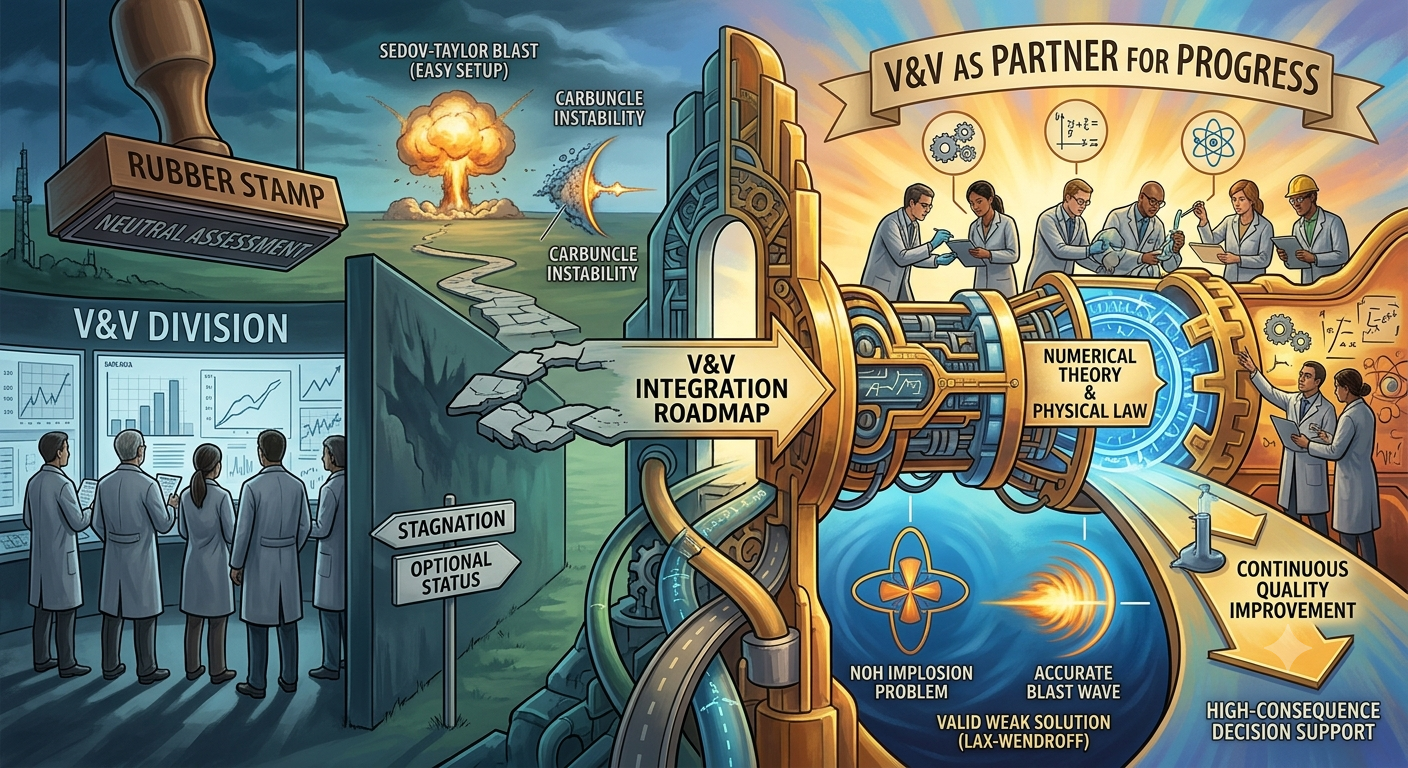
This is a genuine obstacle to energizing V&V as a means of continuous quality improvement. Instead of a partner, V&V becomes an enemy. It is either a neutral rubber stamp for whatever is already being done, or a damning indictment of a code. The partnership is never evident, and neither is the connection to improvement. Moreover, the laboratories are at their best when they are multidisciplinary, and the assessment model reduces V&V to a one-dimensional activity. It loses being a multidisciplinary vehicle for excellent work.

The question to wrestle with is this: How did V&V fall into the assessment-only model and the trap that it became?

Part of the answer is the growth in depth of V&V work as it became a separate discipline. This separation was always a possibility as the field matured. It is also a trap because it sidelines V&V into a mode where it offers criticism without support. The pattern settles around a point of view where problems are found but never resourced in a way that allows them to be addressed and solved. Using V&V to improve codes and models becomes absent.

“It is not the critic who counts; not the man who points out how the strong man stumbles…” – Theodore Roosevelt

An Illustrative Example

This was a large part of the issue with the shock verification report that instigated my departure from Sandia. That report was a V&V assessment that only showed results. Any problems were merely weakly implied. The report offers no opinions and has no perspective. There was no route offered to answers, solutions, or improvements. Moreover, there was no charter to provide one; funding applied only to code maintenance and support of the user base. Improving the code in some cases is an unwanted nuisance. The entire notion of quality was presumed, and when the report spelled out that the quality wasn’t there while offering no path toward improvement, the experience turned decidedly negative.

“When you can measure what you are speaking about, and express it in numbers, you know something about it; but when you cannot measure it… your knowledge is of a meagre and unsatisfactory kind.” – Lord Kelvin

The report that was the focal point of the conflict around my termination is a good example of the problem with assessment only. It was, simply put, a verification assessment of a set of codes used by Sandia for shock problems. The assessment was conducted on two classical analytic problems:

  1. The Sedov-Taylor blast wave, where energy is deposited at a point, and a shock wave emanates from the deposition. This is an analytical solution for an explosion, an important use case.
  2. The Noh implosion problem, which supplies the solution to an idealized implosion.

Both of these problems are standard at Weapon’s Labs across the World. They are part of a standard test suite for the NNSA Labs. There use goes back far into the past with the code development community at these labs.

The Sedov-Taylor blast wave has a rather complex analytical solution dependent on integral equations and delicate integration. The Noh problem has a simple algebraic form. Both problems are extremely difficult for hydro codes to compute. Their analytical solutions exist by virtue of the infinitely strong shocks they produce. In general, they are challenging for codes, and in particular for codes written in the classical ways of weapons labs across the world. As such, they are important verification problems to complete successfully, because success provides confidence in the code. A lack of success is a flashing warning sign.

The assessment itself was done well within standard practices for verification, with some important caveats. One of my chief criticisms of the report was the lack of deeper mathematical and numerical analysis of the results. In the mathematical sense, there are very distinct expectations that come with solving these problems. I have elaborated on these before in previous posts. These expectations are well defined, and a handful of essential theoretical papers in the literature establish what one should expect from a successful method.

By the same token, the numerical expectations are well defined, chiefly the expectation of obtaining a valid weak solution, as the Lax-Wendroff theorem establishes. In short, the codes tested do not all adhere to the precepts of the Lax-Wendroff theorem, and thus convergence to a weak solution cannot be guaranteed. In other words, they might give wrong solutions that are not valid weak solutions. Thus, the results, although produced classically and competently, are not tethered to any expectations. They simply lie there without context or predictions.

Furthermore, the results show the presence of the infamous carbuncle instability, which has plagued codes for decades. In the aerospace literature, the carbuncle is well understood. It is not so well understood in the context of the sort of codes tested here. Nonetheless, the way to cure the carbuncle is well established, though the cure would need to be adapted artfully to these particular codes. I have faith this is possible, but the report offers little or no discussion of the nature of the problem, let alone a route to its cure.

“When a measure becomes a target, it ceases to be a good measure.” – Marilyn Strathern

A second critique I raised was that the setup of the Sedov-Taylor blast wave was chosen improperly, in two regards:

  1. The energy was initialized on the grid within a finite-size region. This introduces a length scale into the problem, and the absence of a length scale is the entire reason an analytical solution exists in the first place. Under mesh refinement, the calculation then converges toward the regularized problem rather than the Sedov-Taylor solution the assessment claims to test against. One cannot solve the problem in a manner that annihilates the conditions for solution. Yet, this is done.
  2. The second effect is more pernicious and, in many ways, worse: it makes the problem easier to solve and less challenging for the codes. A choice was willfully made to lessen the challenge that a difficult problem poses, and this only partners with the stagnation of methods and codes, doing a disservice to the entire community. Quality demands that challenges be met, not shirked.

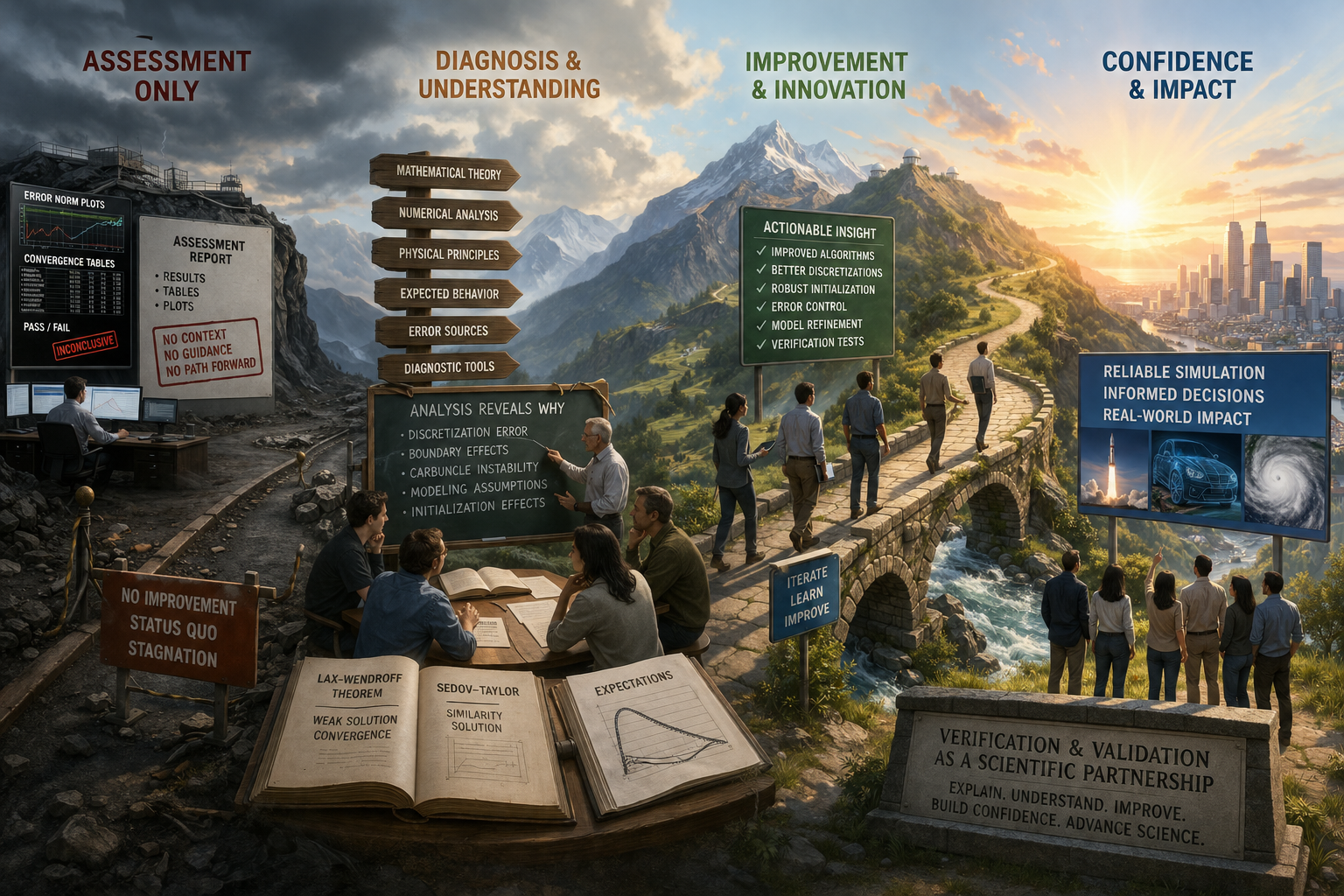
This points to what I believe would be a better way to execute these assessments: combine the assessment with the mathematical, physical, and numerical theories needed to improve results. At a minimum, place the results in the context of what would be technically expected from a correct code and model. It should define why a code or model can be trusted. Rather than a closed and bounded exercise, assessment should be a step. It should define a path for understanding current use and applicability. It should also define the trajectory for improvements.

Why We Need to Integrate V&V

“Cease dependence on inspection to achieve quality. Eliminate the need for inspection on a mass basis by building quality into the product in the first place.” – W. Edwards Deming

There is a useful analogy for how to view V&V if we see it as a measurement (assessment) methodology.
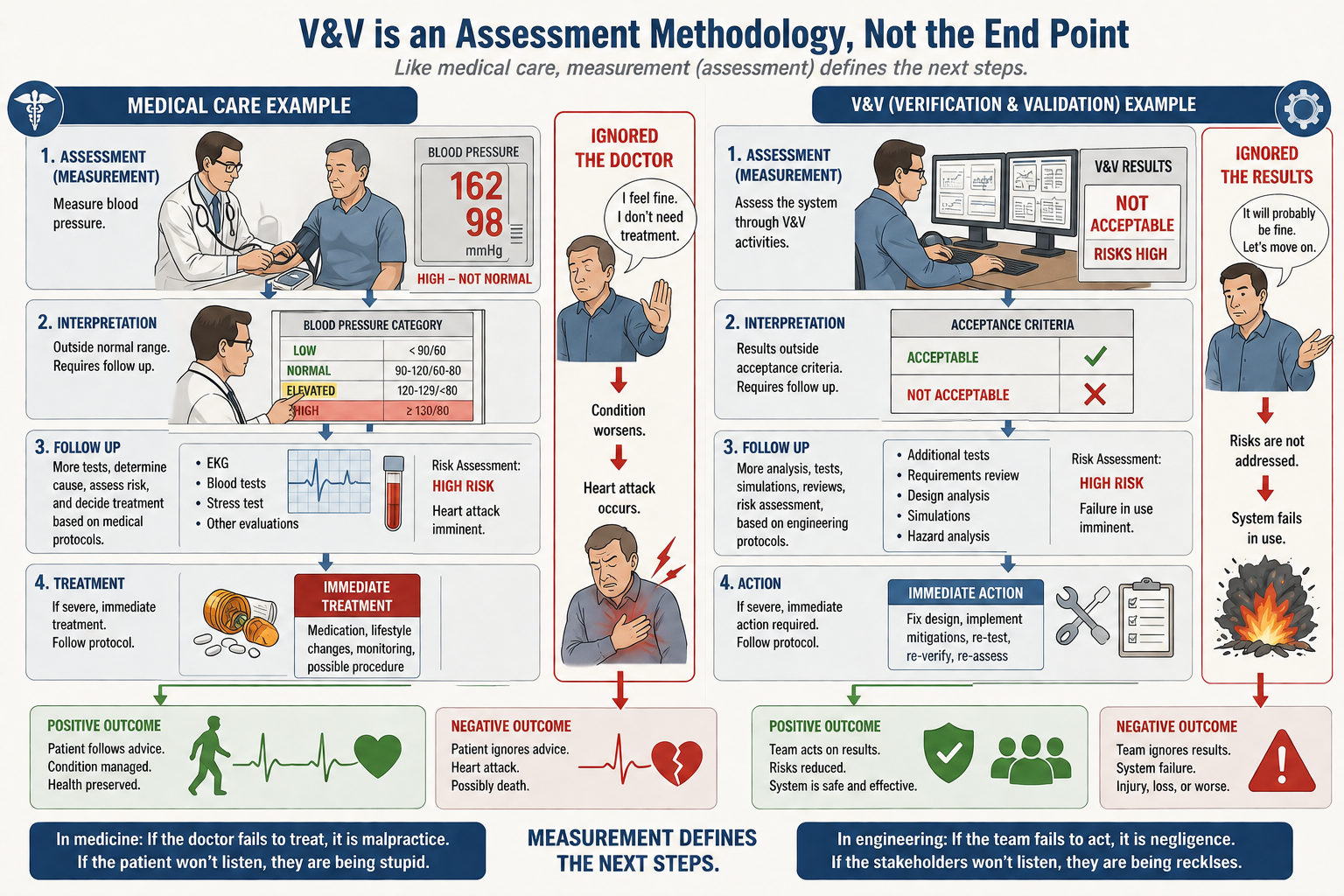
In medical care, we do not stop at measuring blood pressure unless it indicates good health. If the blood pressure is higher or lower than normal, it requires follow-up. That follow-up means more tests and potentially treatment. The measurement (assessment) is essential, but it defines the next steps. These steps follow a protocol based on the current understanding of medicine. If the measurement is bad enough, the treatment is immediate. In the case of the report, I focused on “a heart attack was imminent.” Rather than treat the problem, the patient decided to ignore the doctor. We all know how this approach works out. If the doctor fails to treat, it is malpractice. If the patient won’t listen, they are being stupid.

“Inspection does not improve the quality, nor guarantee quality. Inspection is too late. The quality, good or bad, is already in the product.” – W. Edwards Deming

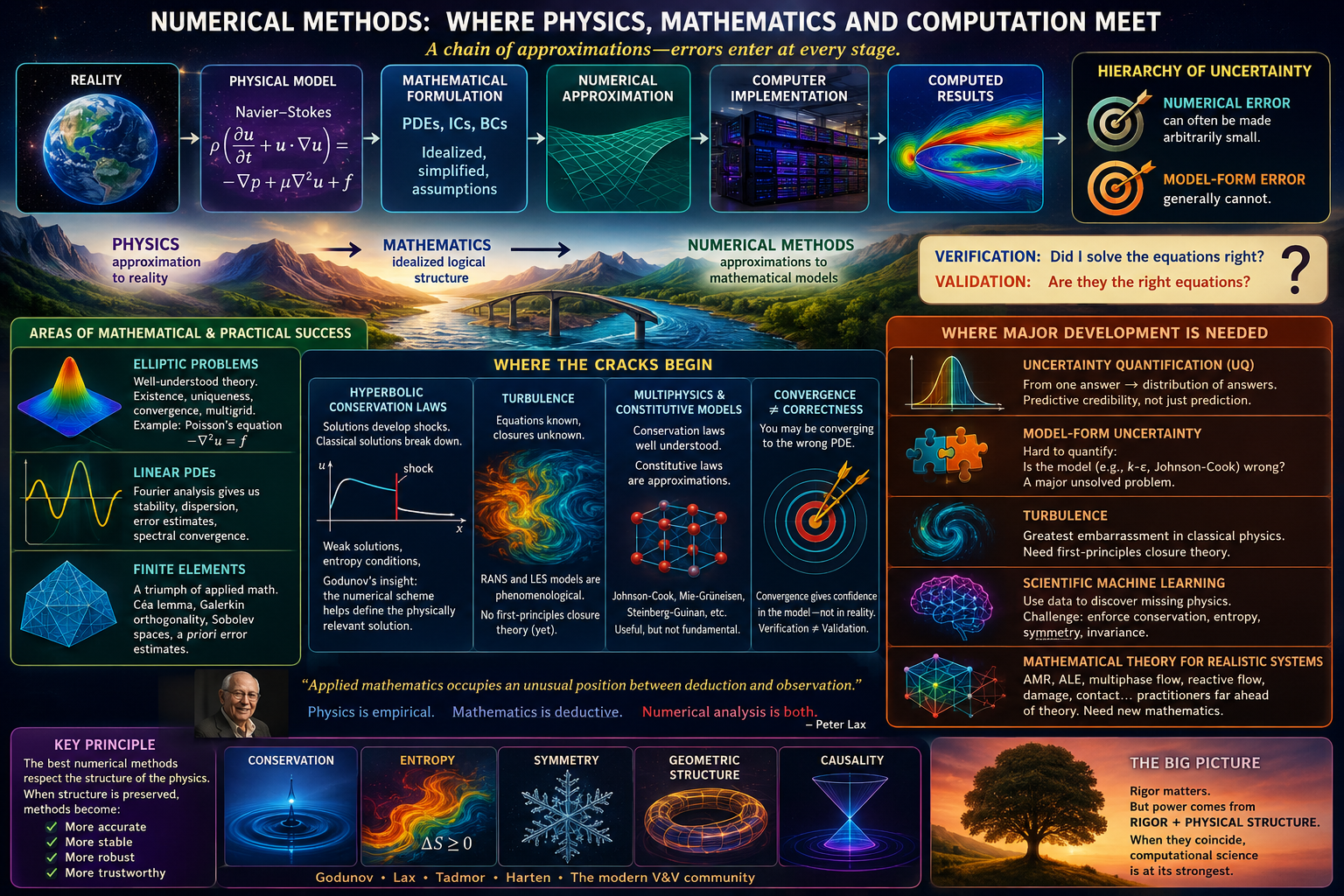
This brings me to the primary objective of this essay. Rather than simply providing an assessment, the practice of V&V needs to connect results to the appropriate theories. In verification, these are mathematical and numerical results; in validation, physical theory relevant to the exercise is added to the mathematical and numerical foundation. All of this needs to be spelled out in detail, providing both context and meaning. It empowers the reader of the report to take the assessment and find a roadmap to improved results. V&V should not simply be an assessment but a partner in the progress and improvement of computations.

The assessment role for V&V may seem neutral, but it is not. It is a way of neutering V&V. It aids the stagnation of progress and provides cover for codes that refuse to change and improve over time. This does a disservice to the entire community. V&V not only serves the use of the code and model; it serves progress. V&V is used to document and provide evidence for progress. Codes and models should not be static, but should look to be constantly improving in quality. This spirit is on life support.

Verification asks “Am I building the product right?” while validation asks “Am I building the right product?” — Barry Boehm

V&V should be a way of measuring progress and a vehicle for establishing where progress is needed or possible. To identify this, V&V needs to include the relevant mathematical and numerical information for verification as a service to code development. Physical theory was added to establish the same conditions for improving modeling. Together, it becomes the lexicon for establishing capability assessment and identifying needs and opportunities.

The validation work links directly to application work and ultimately supports it in two ways: assessing the suitability of the modeling for a given physical application, and determining whether or not the code is sufficient. It is important to establish where improvements are needed in order to improve that sufficiency. In addition to narrowing the uncertainties inherent in any modeling exercise. This matters for any decision-making attached to the use of modeling and simulation in high-consequence decisions.

Today, this entire standard has become extremely tenuous, and it undermines the role of modeling and simulation. It almost invites unprincipled calibration of results and helps attack the legitimacy of modeling and simulation as a partner in high-consequence decision-making. Assessment only works to neuter V&V and enable stagnation. It only supports the status quo, and the status quo sucks.

Far better an approximate answer to the right question, which is often vague, than an exact answer to the wrong question, which can always be made precise.” – John Tukey

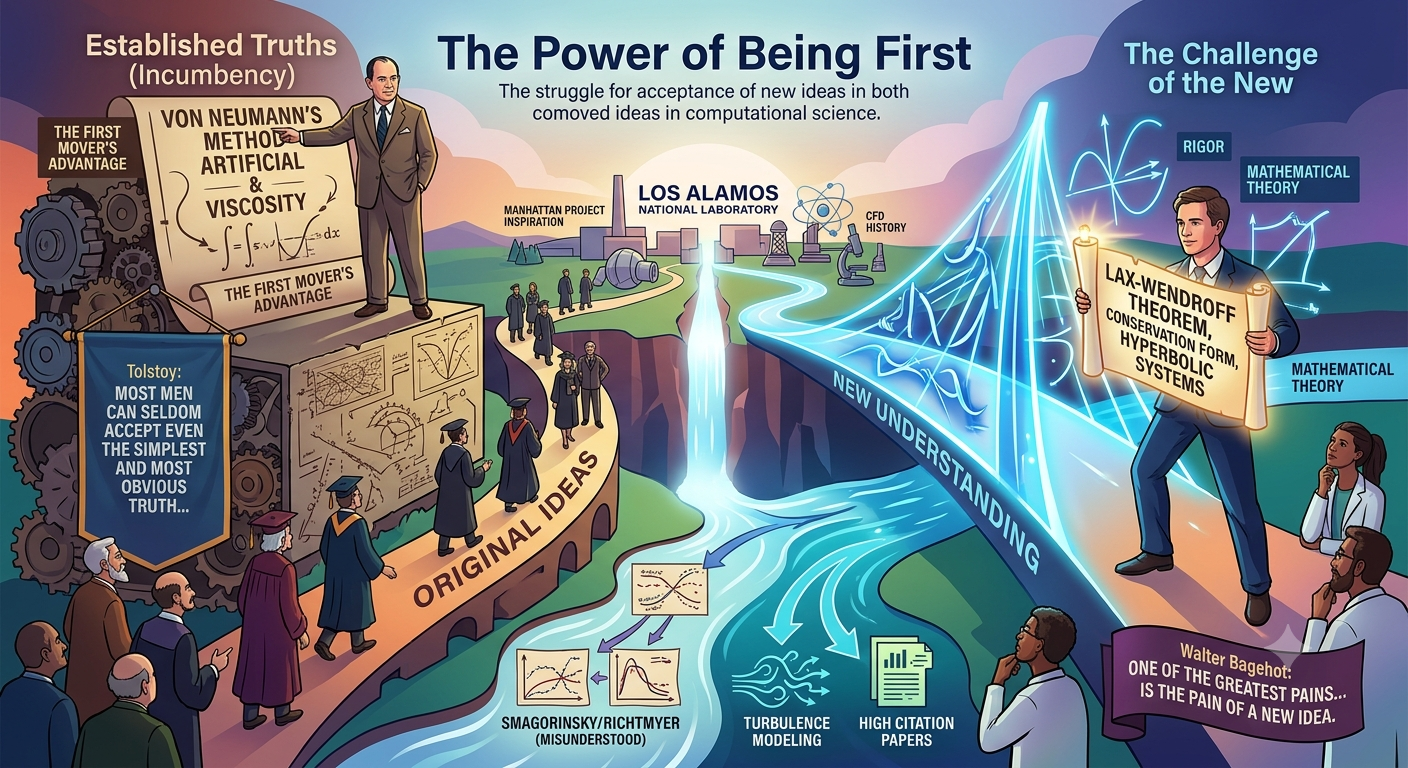
The Power of Being First, or Why Great Ideas Fail to be Accepted?

06 Monday Jul 2026

Posted by Bill Rider in Uncategorized

≈ Leave a comment


“One of the greatest pains to human nature is the pain of a new idea.” — Walter Bagehot

The Quest for Understanding

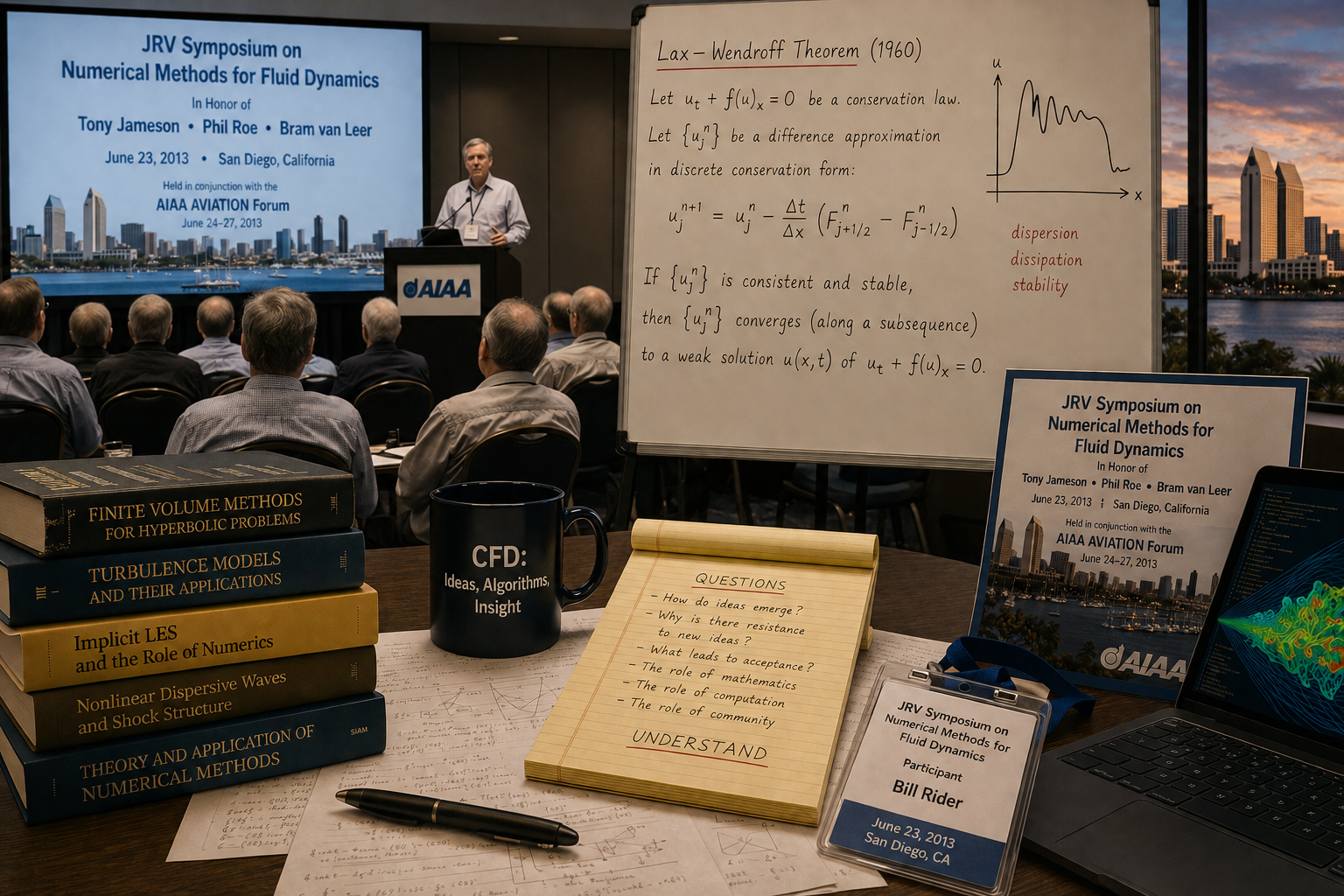
One of the animating ideas of my career in science is a quest to understand the origin, development, and acceptance of ideas. This has been a periodic challenge I took on throughout my career. You will find it in my dissertation, which was mostly self-driven and self-taught. It ultimately became a professional achievement, a more complete accounting of the early history of computational fluid dynamics (CFD). I have written an essay about this on this blog and given a presentation on the topic. It is perhaps the talk I have delivered most often. Beginning in gestational form at the JRV Symposium in 2013. There was a history of CFD around limiters after 1970 by Bram van Leer. It was titled “The History of CFD Part 2”.

I asked Bram, “Where is part 1?”

In response, Bram told me I needed to create part 1 of the history. He said, “That is for you to do!”

Afterward, expanding into a comprehensive presentation that I have given six or seven times over the years. It feels like this will be one of my understated achievements. Under the hood of this history is a desire to understand how we got where we are today. Not simply account for what happened, but why and how.

https://cfd.ku.edu/JRV.html

https://www.sciencedirect.com/science/article/abs/pii/S0021999124001980

Lessons from the History of CFD (Computational Fluid Dynamics)

I have posed the affirmative question before: why should a method be forced to satisfy only one requirement of quality when we know there are two? Those two requirements are the preservation of adiabatic solutions and the conservation form. Right now, the field simply picks one and walks away from the other. We choose rather than demand both. The choice then becomes calcified into doctrine. What I am pondering here is not the choice itself, but the reason we have never insisted on meeting both. The answer is that we refuse to hold ourselves to a higher standard. Progress is still needed and still possible, but it has stagnated to nothing because of an outright refusal to accept good ideas and merge them together. That refusal is not a technical limitation. It is a failure of will.

Conservation. Is it Optional?
Local Technical Cultures

An Encounter with the Great

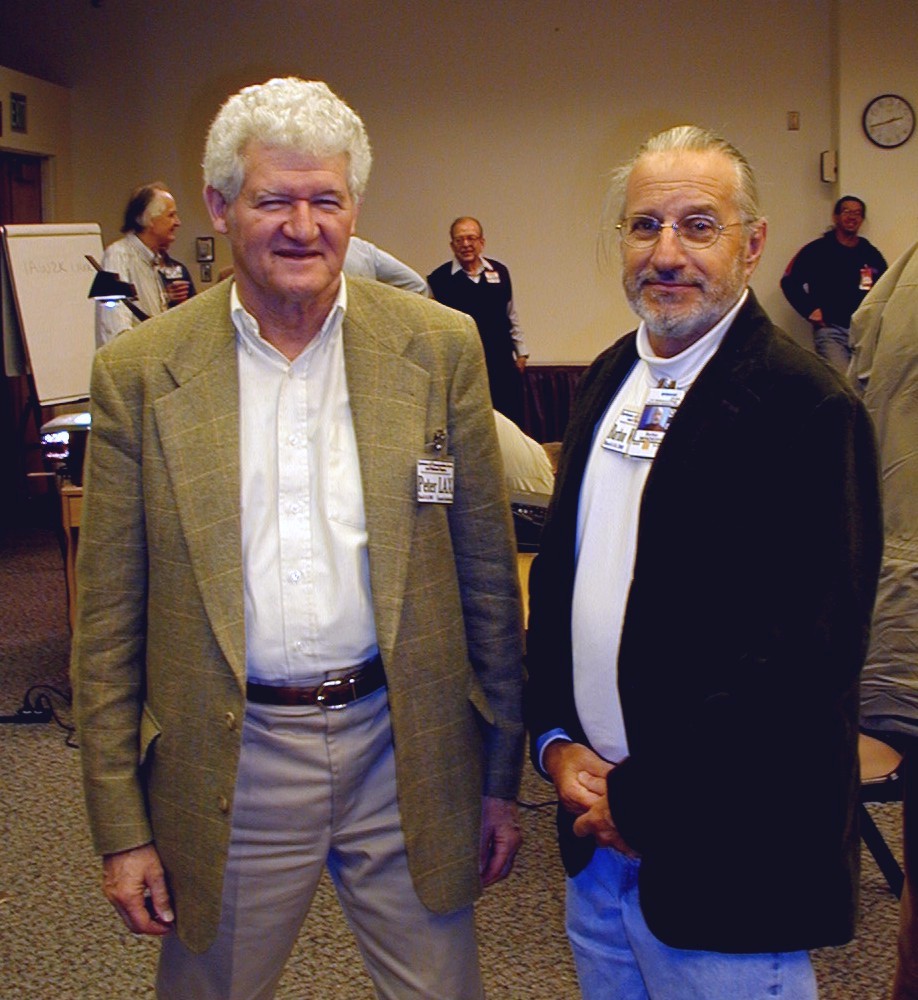
One of the key formative moments in developing these ideas came in the year 2000. That summer, a special conference took place at Los Alamos to honor the 70th birthday of Burt Wendroff. Burt, except for a few years, worked his entire career at Los Alamos. He is best known for his PhD work under the advisement of Peter Lax. This produced the celebrated dual achievements of the Lax-Wendroff theorem and the Lax-Wendroff method. It was then documented in a paper in Communications in Pure and Applied Mathematics. Both achieved massive success over the years and have shaped modern computational fluid dynamics in profound ways. It has had profound success in compressible aerodynamics, defining much of what is currently done.

Classic Papers: Lax-Wendroff (1960)

Thoughts about Lax’s mathematical philosophy.

Peter Lax’s Philosophy About Mathematics

The occasion of this conference was my opportunity to actually meet Peter Lax. I have met many great scientists over the years. A few became acquaintances, and far fewer became friends. What I have learned from engaging with them is that these people are all human. They are all extremely smart. Some are extremely lucky, and their greatness comes from being smart enough while also being in the right time and place to create what they create. Of all the people I have met, Lax is perhaps the greatest, or nearly the greatest. That puts him in rather prominent company.

There was a photograph taken at the conference on the first day. I remember it quite well. I don’t actually remember who took the photograph. Burt and Peter came together warmly, and then the photographer noted that the ordering was wrong. He asked Peter and Burt to exchange places to get the ordering of the authorship for the Lax-Wendroff paper. Then the photo was taken. I was standing behind where the photo was taken, watching all this happen. It remains a very fond memory. Its great that the internet remembers the photo too.

Another source of great memory in that conference was my presentation there. I felt immensely lucky to do so. One of the more memorable moments came when Burt pulled me aside to let me know that Peter suffered from narcolepsy. I should not be alarmed if he fell asleep during my talk. Sure enough, when I gave my talk, Peter fell asleep halfway through. Bert’s warning saved me from being mortified, as Peter had already become quite the hero of mine by then.

My talk came from a period of my technical history when I was beginning to explore turbulence modeling. My interest was specifically in implicit large eddy simulation. I was trying to understand the role that things like limiters play in the ability of these methods to act as effective turbulence models. In addition, I was searching for the effective subgrid model implied by these methods. In particular, I was looking at the role of nonlinear dispersion.

Speaking in front of Peter was a particular honor, but also something that made me quite nervous. Peter had studied dispersion in calculations, inspired by the work of John von Neumann. In his original shock method, which was tried and successfully used during World War II, dispersion was rampant. Lax examined the solutions von Neumann’s method created, which produced a huge amount of ringing. This work was done in conjunction with another exceptional scientist, David Levermore. Presenting my work to Peter was both a source of pride and something that felt very dangerous. He was an exceptional genius after all, even by Los Alamos standards.

Nonetheless, looking back, this work was the beginning of perhaps my most successful research. It certainly grew into the best and most obviously successful project I ever worked on. One that resulted in many highly cited papers and a book. That book tied together many researchers in the area for the first time. It led to my engaging and meeting many other scientists working on similar things, including Jay Boris, one of the inventors of limiters. Paul Woodward was in the book too, but I already knew him.

Expanding My Understanding of Creation

“Novelty emerges only with difficulty, manifested by resistance, against a background provided by expectation.” – Thomas Kuhn

Over time, I came to understand how many of these ideas came into being. How they merged with other ideas. How some of them became distorted and lost their original intent. This is perhaps more evident in turbulence simulation than anywhere else. There, the Smagorinsky model is the original model used to represent subgrid turbulence in LES. Over the years, the basic identity of the Smagorinsky model has been lost. It was first and foremost a rearticulation of the artificial viscosity model developed by Richtmyer in conjunction with von Neumann. It has been repurposed to clean up calculations of geophysical flows. This repurposing came at the suggestion of Jule Charney, von Neumann’s collaborator in applying computing to geophysical fluid mechanics. Over the years, this connection to shock capturing was lost, if not outright ignored. This seems to be a combination of genuine and willful ignorance.

The greater animating purpose of this essay is the general lack of acceptance and use of Lax’s work at its place of origin, specifically Los Alamos. It includes the many labs that followed Los Alamos’ lead. This includes Livermore, Sandia, and overseas Labs. This requires a bit of history, involving how Lax came to these ideas. Then, some deeper pondering of why these key breakthroughs have generally gone unaccepted and unused at the place where they were born.

Lax’s ideas and achievements in the area of hyperbolic conservation laws are incredible and undeniably great. This was recognized when he received the Abel Prize in 2005. The fact remains that they hold very little sway and acceptance at places like Los Alamos or Livermore seems mysterious. They are revered in CFD around the rest of the World. This is the world shaped by the Manhattan Project. This ushered both computers and computational science into being. The original achievements of John von Neumann are more broadly accepted in the Los Alamos-connected work. Even though they lack the rigor Lax provides. Why?

“Most men can seldom accept even the simplest and most obvious truth if it be such as would oblige them to admit the falsity of conclusions which they have delighted in explaining to colleagues, which they have proudly taught to others, and which they have woven, thread by thread, into the fabric of their lives.” – Tolstoy

Consider the Lax equivalence theorem as another example. The practice of verification that relies upon this theorem is carried out begrudgingly in places like Los Alamos. The same holds for the Lax-Wendroff theorem. The theorem with its demands, and its promised benefits, of conservation form. In a deep sense, it has greater rigor and applicability than the equivalence theorem. Conservation, too, is seldom used. The extensive mathematical theory of hyperbolic conservation laws, the crowning achievement of Lax’s work in the area, is also rarely leaned upon as a technical basis either.

The Foundation of Code Verification: The Lax Equivalence Theorem

Given the greatness of Lax’s work, one has to question the reasons. The question becomes even more pregnant when you realize that the origin of this work traces directly to Los Alamos. It is grounded in the achievements of von Neumann, which demonstrated the capacity of computers to solve this class of problems. This inspiration made Lax’s work timely and essential. It was clearly a motivation for greater understanding. Much great math was delivered, yet not used where the inspiration originated.

“One resists the invasion of armies; one does not resist the invasion of ideas.” — Victor Hugo

Lax was drafted into the U.S. Army in 1944. He was ultimately assigned to Los Alamos as part of the Manhattan Project, a recognition of his potential and burgeoning genius. There, he did not work on fluid dynamics, but rather on neutron diffusion. After leaving Los Alamos, he returned to New York, where he completed his PhD at the Courant Institute under Friedrichs. Upon receiving his PhD, he promptly went back to Los Alamos and spent a year there as a staff member. He worked closely with one of the famous Keller brothers, both great mathematician.

One of the most amazing things to discover was the write-up of Lax’s plan of attack on the mathematical theory of hyperbolic conservation laws. It was completed in conjunction with Keller during his time at Los Alamos. The outline in this report is complete and defines the next 25 years of research. One can trace all of Lax’s completed works in conservation laws from it. Ultimately, ending with the mathematical theory of hyperbolic conservation laws published in 1973. It is all laid out there in astonishing detail.

Lax, Peter D. Hyperbolic systems of conservation laws and the mathematical theory of shock waves. Society for Industrial and Applied Mathematics, 1973.

The advantage Peter had when he returned to Los Alamos was the knowledge that one could successfully compute solutions to hyperbolic conservation laws. The basic premise had been proven out in World War II by Feynman and Bethe with their method, based on Tony Skyrme’s work. By the time Lax returned to Los Alamos, Richtmyer had devised the artificial viscosity and made shock-capturing methods possible. Now computers and methods could be turned loose on shock waves. Thus, Lax worked with the knowledge that all of this could be done. It was now a matter of bringing order to it, along with some degree of mathematical rigor and knowledge to guide it. The question remains: why has his magnificent work had so little impact on its place of origin?

How Original Ideas Remain Dominant?

“Faced with the choice between changing one’s mind and proving that there is no need to do so, almost everyone gets busy on the proof.” — John Kenneth Galbraith

If one looks at the codes developed and used at a place like Los Alamos, only one of them is written in what we call conservation form. This is a code I worked on, one that goes by the moniker xRage these days. My friend Rob and I could not ascertain the basic structure of the high-order Godunov code that xRage purported to be. Rob had trained under Phil Roe and Bram van Leer for his PhD. I am basically self-trained in the same area. The basic recipe, construction, and maxims that Rob and I had absorbed in our training could not be discovered in the way this code was written. We expected to find a viable first-order Godunov method under the hood. No such thing existed in the code. The second-order spatial differencing was novel as well. It worked, but not in a standard way. The same mentality applied to the Riemann solver and the multi-material treatment. I was part of adding interface treatments to the code. Without those, the material interfaces were too diffusive.

This code was originally written by a genius of a code developer, Mike Gittings. Mike was able to work magic with codes and get things to work by magic and code wizardry. The code worked and was astoundingly robust, loved by its users. In many ways not much different than the dynamic at Sandia with CTH (or its predecessor, CSQ). Yet the technical basis of the code was unrecognizable to those of us who had been formally trained. Here is the one example in the weapons complex where Lax’s framework might actually apply, and it is almost impossible to see what is actually there. To me, this is rich with irony, especially at Los Alamos.

“Nature, to be commanded, must be obeyed.” — Francis Bacon

One of the things that I believe is that the importance of hydro for multi-physics codes is not well understood. I was reminded recently in a LinkedIn comment by my friend Nathaniel Morgan from Los Alamos. The reason it is so important is that it provides the material map on which all the physics in a multi-physics code are computed. It also provides the state of that material thermodynamically and, more importantly, its position. Physicists naturally think about most of the physics in the Lagrangian frame of reference. Thus, this is comfortable for them. Thinking about it in a different frame of reference only muddies the picture and introduces new physical effects. The Lagrangian frame perspective is taken as primal.

“For a successful technology, reality must take precedence over public relations, for Nature cannot be fooled.” – Richard Feynman

That said, most of the physics that we are solving are extremely muddy and difficult. In almost every case where you’re dealing with a high-speed, high-energy flow, turbulence and mixing are present. As soon as the flow begins to twist and distort, the Lagrangian frame becomes untenable, and you lose the ability to clearly think about problems in that frame of reference. In a sense, this is the core of the problem with failing to progress away from the von Neumann view of how to compute this. Von Neumann’s method was originally composed in 1D with relatively limited computing. It is almost obvious that the simplicity it embodied is not appropriate for the type of computing and expressibility of ideas we have available to us today. Why is this approach still relied upon?

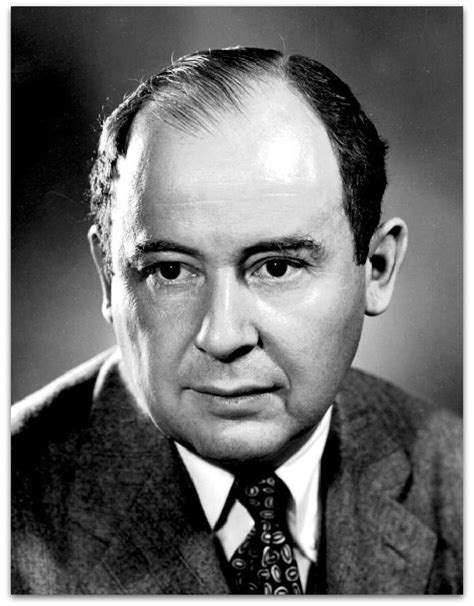
The reason why is the power of being the first mover. That first mover, the person whose reputation remains unsullied, is John von Neumann. Von Neumann is perhaps the greatest polymath of the 20th century, a genius of almost unparalleled magnitude, and perhaps one of the smartest people in the history of humanity, certainly on par with someone like da Vinci.

If one looks at the codes in use across the labs today, the model of computing is very much derivative of von Neumann’s method, paired with Richtmyer’s artificial viscosity. What cannot be said is that these codes bear any of Lax’s rigor in how they are used. Given the power and quality of Lax’s work, I have always found this mysterious. Moreover, much of what Lax did actually generates genuine animosity on the part of people at the labs. I find this difficult to understand. In a field with few results to lean upon, some of the best ideas are ignored. This entire phenomenon places an extreme amount of importance on the legitimacy conferred by being first and on the power of incumbency. The nature of things is that once something works at all, it is hard to displace, even when its shortcomings become increasingly obvious over time.

“He that will not apply new remedies must expect new evils; for time is the greatest innovator.” — Francis Bacon

Indeed, the main place where ideas related to Lax’s work found acceptance is through the work of van Leer principally, and limiters in general. Limiters provided a means to solve a problem that Lagrangian von Neumann-type methods ran into in multiple dimensions: the inevitability of mesh tangling. Mesh tangling meant that remesh-and-remap technology was necessary for these calculations to go to 3D and ultimately solve the problems they were designed to solve. Van Leer’s method made low dissipation and higher accuracy possible under these conditions, and it was accepted almost immediately across the entire lab complex.

What goes unacknowledged is that van Leer’s work was shaped by the work of Peter Lax. Lax provided the foundation, and everything van Leer did was built upon it. In a sense, Lax’s work did have its impact, but only in a derivative sense. Van Leer also engaged with Paul Woodward from Livermore. Paul’s collaboration with Bram helped bridge the methodology to the Labs. Van Leer’s methods were almost immediately adopted at Livermore, Los Alamos, Sandia, and AWE in England. It was rapid and pervasive.

These methods, once they leave the Lagrangian frame, have a problem: they do not conserve energy. This comes from the form of the energy equation used. There is a method to conserve energy devised originally by Roger DeBar of Livermore. Generally, that method is not robust enough to be used for practical problems. Scientists at Los Alamos have devised a much better version of it that may be good enough for practical use. Nonetheless, it is not in an obvious flux-conservation form; thus, Lax-Wendroff may not apply. The same thoughts are needed for conservation in the Lagrangian frame for staggered mesh methods. It can happen, but it depends on subtle, discrete details. For example, the first version to conserve relied upon a bizarre definition of kinetic energy (could be negative). Modern methods are strictly flux-conservative with some very specific choices. These include the time integration, where a particular predictor-corrector of second-order is needed. This also includes a corner mass invariant definition for momentum-kinetic energy.

This lack of energy conservation is exactly the underlying is that prompted my decision to retire. Even 40-plus years after van Leer remap became standard, energy conservation is uncommon. There are ways to make it work, but they are seldom used in practice. It is not in conservation form; thus, Lax-Wendroff is not applicable. I find this head-scratching and difficult to square with the importance of the work done with codes.

“The most difficult subjects can be explained to the most slow-witted man if he has not formed any idea of them already; but the simplest thing cannot be made clear to the most intelligent man if he is firmly persuaded that he knows already.” — Tolstoy

Here we are, 65 years after the Lax-Wendroff theorem was published. People remain completely unwilling to acknowledge this work or utilize its fundamental results in what they do. This rejection creates an absolute crisis of legitimacy, and it reflects decisions made over and over again. I have asked my friends at Livermore, and they report that the energy-conserving methodologies developed at Livermore, which do not use conservation form, are not utilized in their codes once they go into a mode using remap. Those codes have the same problems, albeit to a lesser degree than CTH. That is more a reflection of the higher quality of the methods, and of being modern codes. Nevertheless, the basic premise of this essay persists: Lax’s work is not accepted at its place of origin.

“It is difficult to get a man to understand something, when his salary depends upon his not understanding it.” — Upton Sinclair

I have written about this mentality before, in my essay on the shortcomings of current methods, where the field has chosen to honor the physical concept of computing adiabatic solutions rather than computing solutions in conservation form. The unwillingness to demand that methods meet both requirements means that the method that routinely and casually produces adiabatic results is chosen. Conservation is rejected as a preeminent requirement. Really, we should have both requirements met.

A Methods Challenge Worthy of Being Called World-Class

I will reiterate that I believe this is a fundamental mistake. The requirements and gifts of conservation exceed those of an adiabatic solution. Moreover, an adiabatic solution is a desired outcome, but it is utterly pathological, representing a rather profound resistance to the second law of thermodynamics, which manifests itself in mixing and turbulence most often in fluid dynamics. Adiabatic solutions are ephemeral and pathological. That means they shouldn’t be the foundational character of the method. They are wonderful if you can engineer them. Making them the premise upon which you design and accept new numerical methods is an act of faith, if not borderline lunacy.

Adiabatic solutions are largely an article of faith, mostly mythological. Shock waves are ubiquitous. You want to compute a weak solution, and you need to compute the physically relevant weak solution. I place this demand first, and the preservation of adiabatic solutions second, based on this analysis. Accepting what people have always done is easy. Change is hard. This alone explains most of what we see. The incumbent has an immense advantage. Without a devotion to progress and change, you simply do things the way you always have. You make excuses about why change is unnecessary, and you point to the successful track record of the past as the only proof you need to keep doing things the same way.

“The difficulty lies not in the new ideas, but in escaping from the old ones, which ramify… into every corner of our minds.” — John Maynard Keynes

The Essence of the Problem: Change is Hard

When I consider what John von Neumann would have thought of all this, I come to the following conclusion: he would have recognized the correctness and genius of Lax’s work. He was ever devoted to progress, and he would have seen the need to merge Lax’s ideas into his own. He would not be pleased that the ideas he pioneered continue to be used without the modifications necessary to make them more reliable and more generally useful for solving humanity’s most enduring and difficult problems. Perhaps we can turn over a new page, get to the place where we combine these ideas, and give each of them the air they deserve and the progress we all need.

Power from being the first mover, or from initial success in something, comes from the fact that it works. It’s very similar to the advantage conservatives have over progressives. The policies conservatives espouse have already been tried and have some functional basis in society. The same happens in science: why change something that works for something new? For this reason, very old solutions with significant flaws live on. Change is hard and uncertain. This is especially true in a world where trust itself is scarce and increasingly existential.

There is nothing more difficult to take in hand, more perilous to conduct, or more uncertain in its success, than to take the lead in the introduction of a new order of things.” — Machiavelli

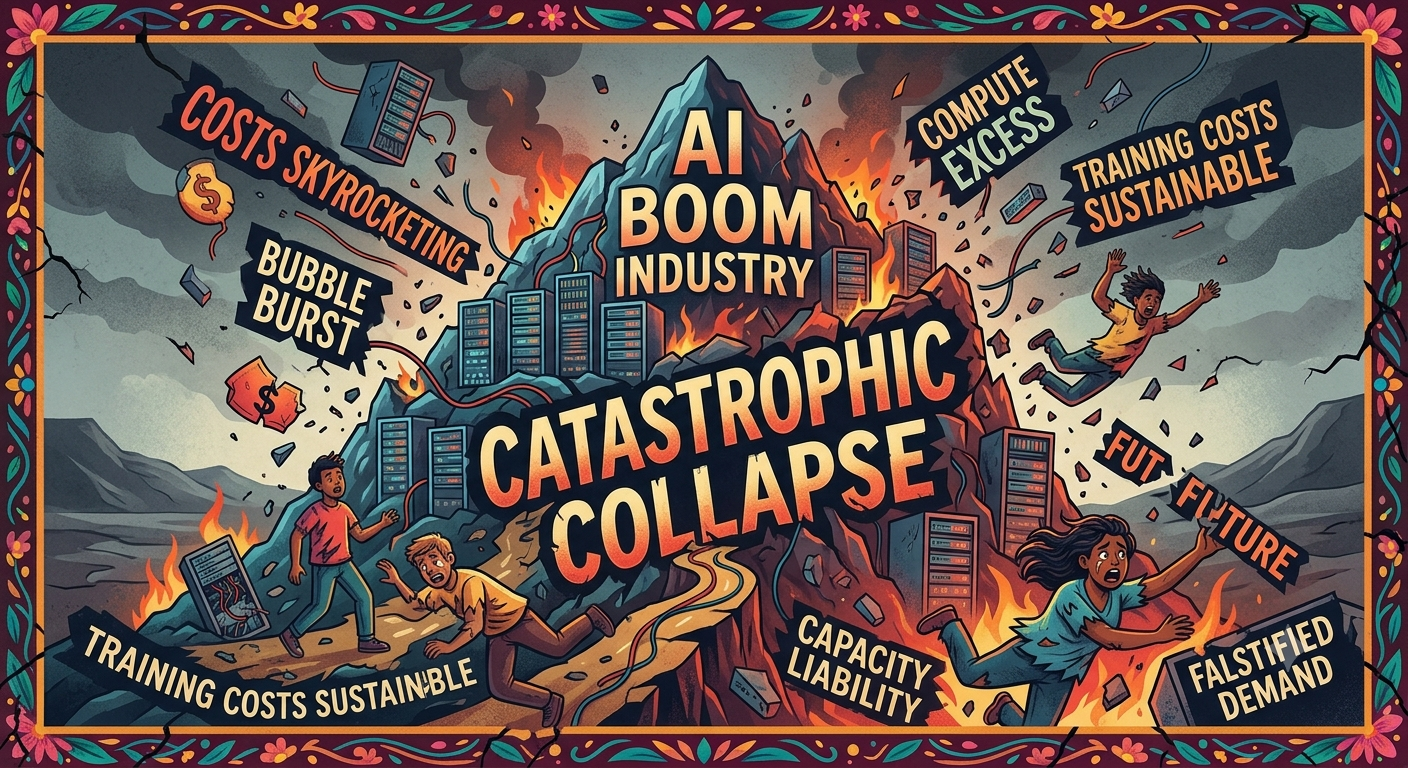
Defusing the ticking time bomb in the middle of the AI boom.

06 Monday Jul 2026

Posted by Bill Rider in Uncategorized

≈ Leave a comment

“If something cannot go on forever, it will stop.” — Herbert Stein

This is going to be a very hot take, but one I have a lot of faith in.

My last post was about the effective usage model we are using for AI. It was a rethinking of what AI’s utility actually is for business and for users. The current model, where the narrative is to simply replace workers with AI, is broken. It is dangerous, and it is going to blow up in the face of the entire AI industry. Add to this a second issue, the data centers, and the narrative becomes completely toxic and almost guaranteed to fail. Lurking in the details of these models is a problem potentially bigger than either.

What no one in the current AI boom invests in or tries to solve is hidden behind the obsession with data centers and capacity. That obsession has become an enormous political liability for the whole enterprise. The cost of all this compute is the single greatest threat to the success of the entire business model. The danger is growing with each passing day.

What amazes me is the general lack of focus and effort on improving computational efficiency and changing the scalability of these models, in both training cost and inference cost. In terms of deep thinking, this is the one area where we are failing to make progress. The consequences of the current cost trajectory threaten the whole industry, with potentially profound (if not catastrophic) effects on the stock market.

I’m sure someone is thinking about this. The question is whether there is enough effort and focus, and whether anyone recognizes the danger the industry is in. Time is about to run out. Perhaps the only way this bomb can be defused is to fundamentally alter the computational scaling of these models and make them vastly cheaper. I firmly believe that whoever cracks this nut wins the AI race by a landslide.Maybe the smart money is on China now. Instead, our current approach doubles down on the idiotic obsession with hardware over all else. This is the same pathology that took hold in the Exascale project and is now being repeated with AI.

Solving this problem requires exactly the sort of research that has been rejected of late. LLMs are, at bottom, solving matrix problems. The route to efficiency and better scaling should echo the history of computational science: some combination of sparsity, multilevel structure, and regularity, along with a healthy dose of serendipity. The problem is that this research is failure-prone and dependent on inspiration. Many approaches will be dead ends. There is no schedule or timeline for a breakthrough. We are already years behind in pursuing one. I have little confidence that our current system will prioritize or invest in any of this.

If the cost of a token cannot be reduced dramatically, and soon, this industry is going to undergo a catastrophic collapse.

“Gentlemen, we have run out of money; now we have to think” – Ernest Rutherford

Thinking About Thinking About Thinking About AI

02 Thursday Jul 2026

Posted by Bill Rider in Uncategorized

≈ 2 Comments

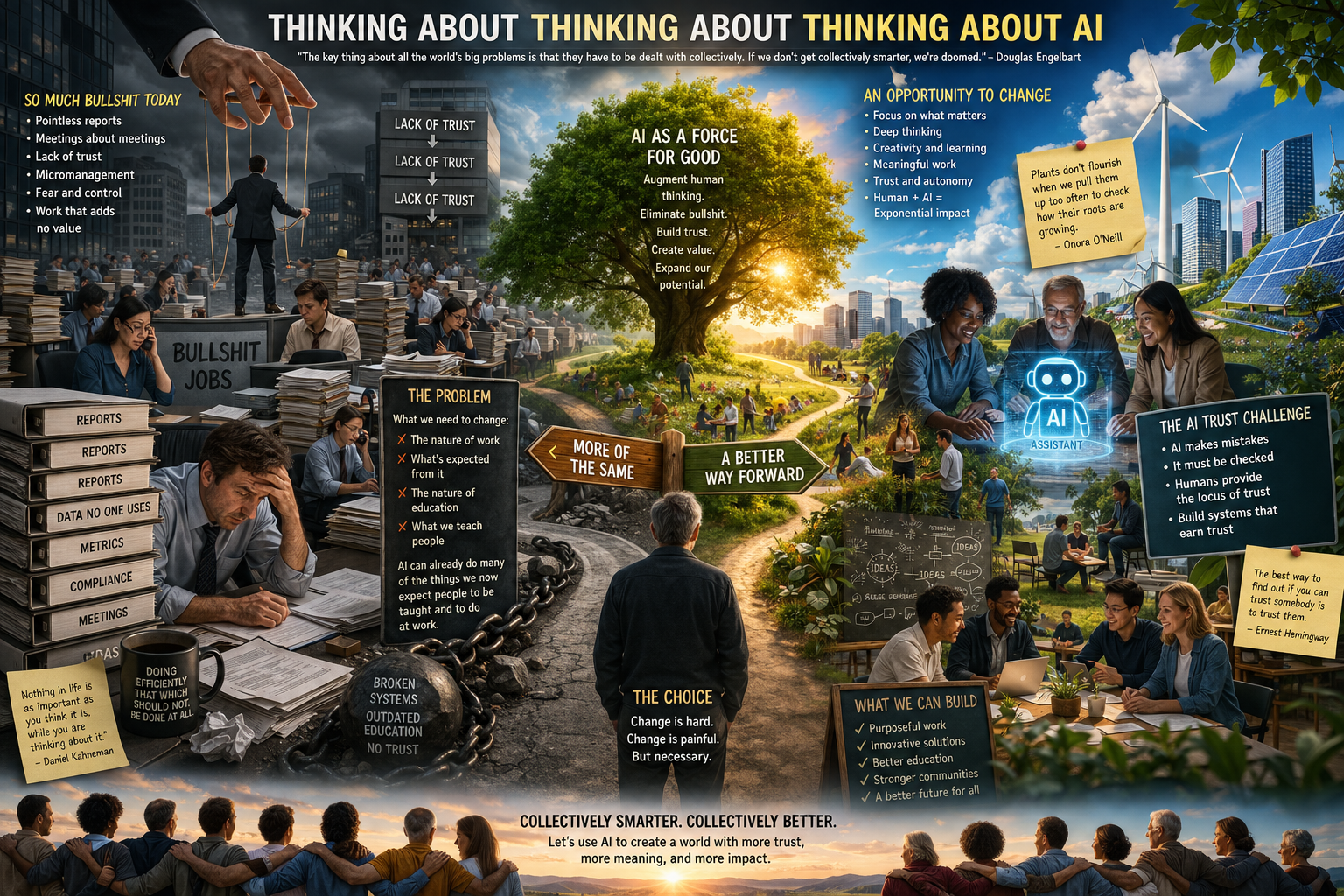
“The key thing about all the world’s big problems is that they have to be dealt with collectively. If we don’t get collectively smarter, we’re doomed.”–Douglas Engelbart

An Opportunity to Change

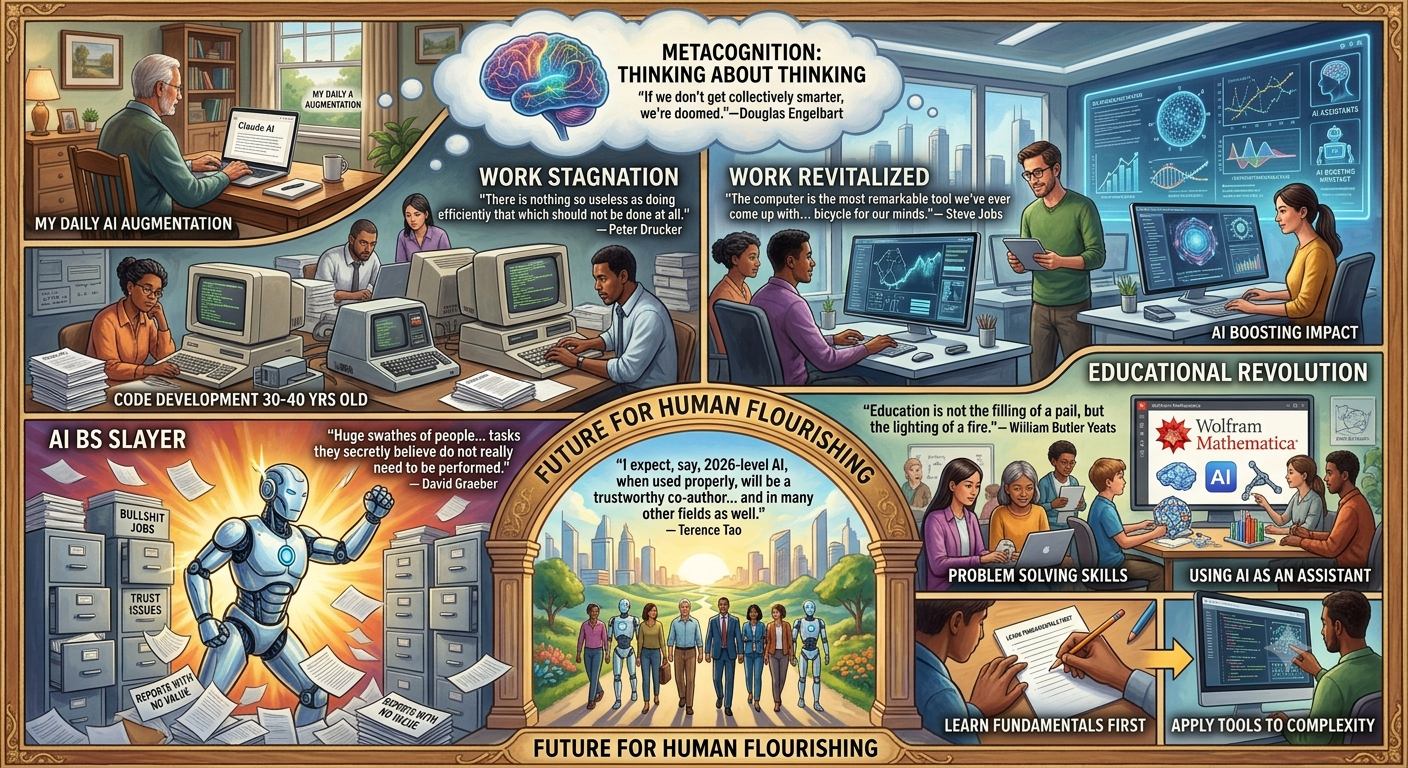
I’ll make an admission for you: I use AI every day. I’ve chosen to pay at the low end for Claude. I really enjoy what it does and find it an excellent addition to my productivity. It augments everything I do. While this is true, it only augments me. I am still the driving force for all it does. It only allows me to do things better and/or faster.

In doing this, I’ve also realized what AI cannot do and how to draw a line between what it adds and what it is completely incapable of doing. That is what this essay is about. Another word for it is metacognition: thinking about thinking. What thinking can AI do? What thinking can it not do? What opportunities arise from using it properly? How do we get there? Right now, most of the discourse on AI is far from the right conclusions.

“Nothing in life is as important as you think it is, while you are thinking about it.”– Daniel Kahneman

I retired recently. The reasons for that retirement have been made clear elsewhere. Being retired is an opportunity for some deep reflection about the nature of work, how it’s evolved, and how it’s changed. I can honestly say that AI offers a way to fix some of the more pernicious and awful ways my work changed over my career. This is something I’ll elaborate on at length. Work got significantly worse over the course of my career, and AI actually offers a way out to something better.

Here’s the problem in a nutshell. To really get the most out of AI, we need to change. Change is hard. Change is painful.

What we need to change is the nature of work and what’s expected from it, and also the nature of education. What we teach people has to change. Part of the reason is that AI can already do many of the things we now expect people to be taught and to do at work.

“There is nothing so useless as doing efficiently that which should not be done at all.” — Peter Drucker

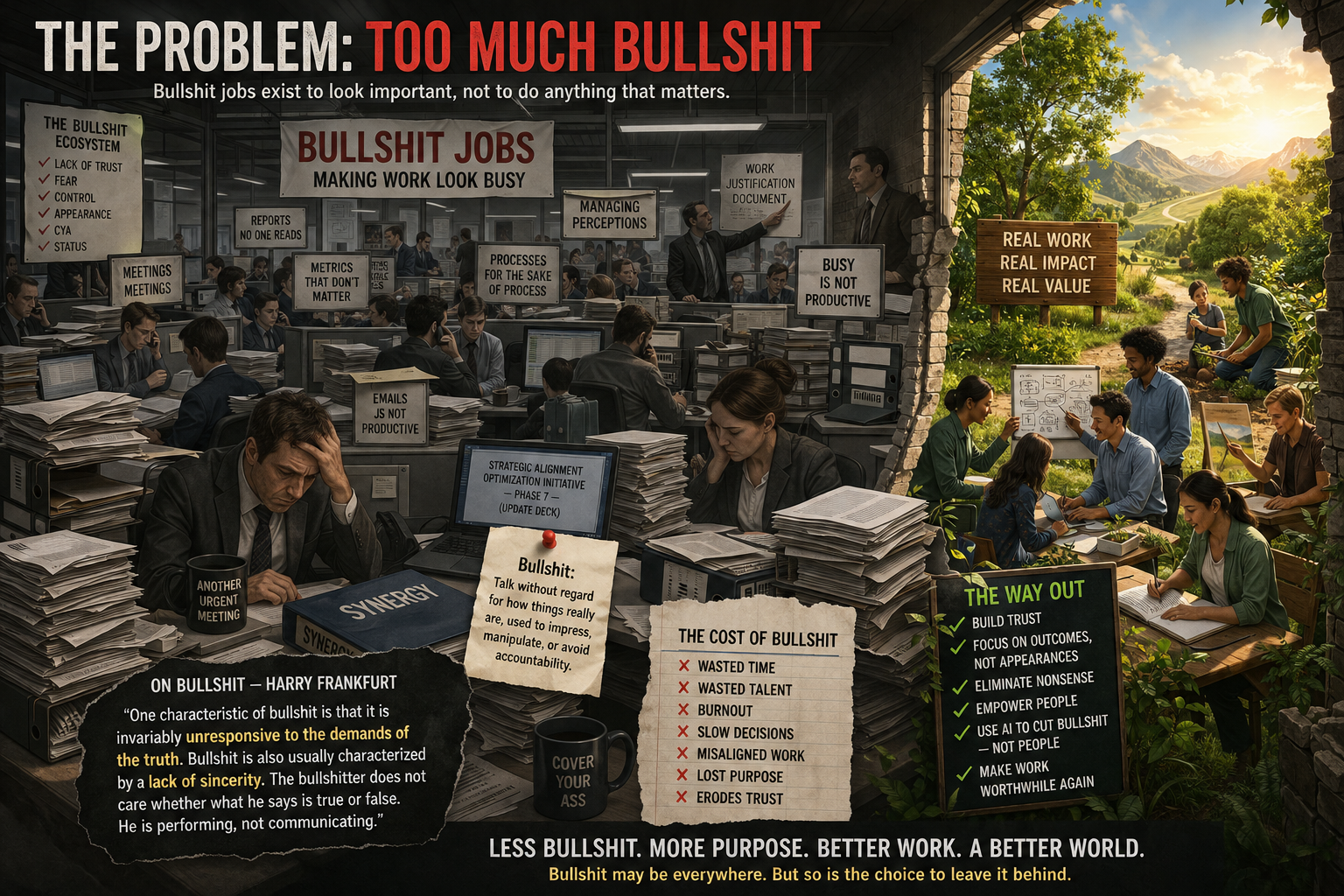
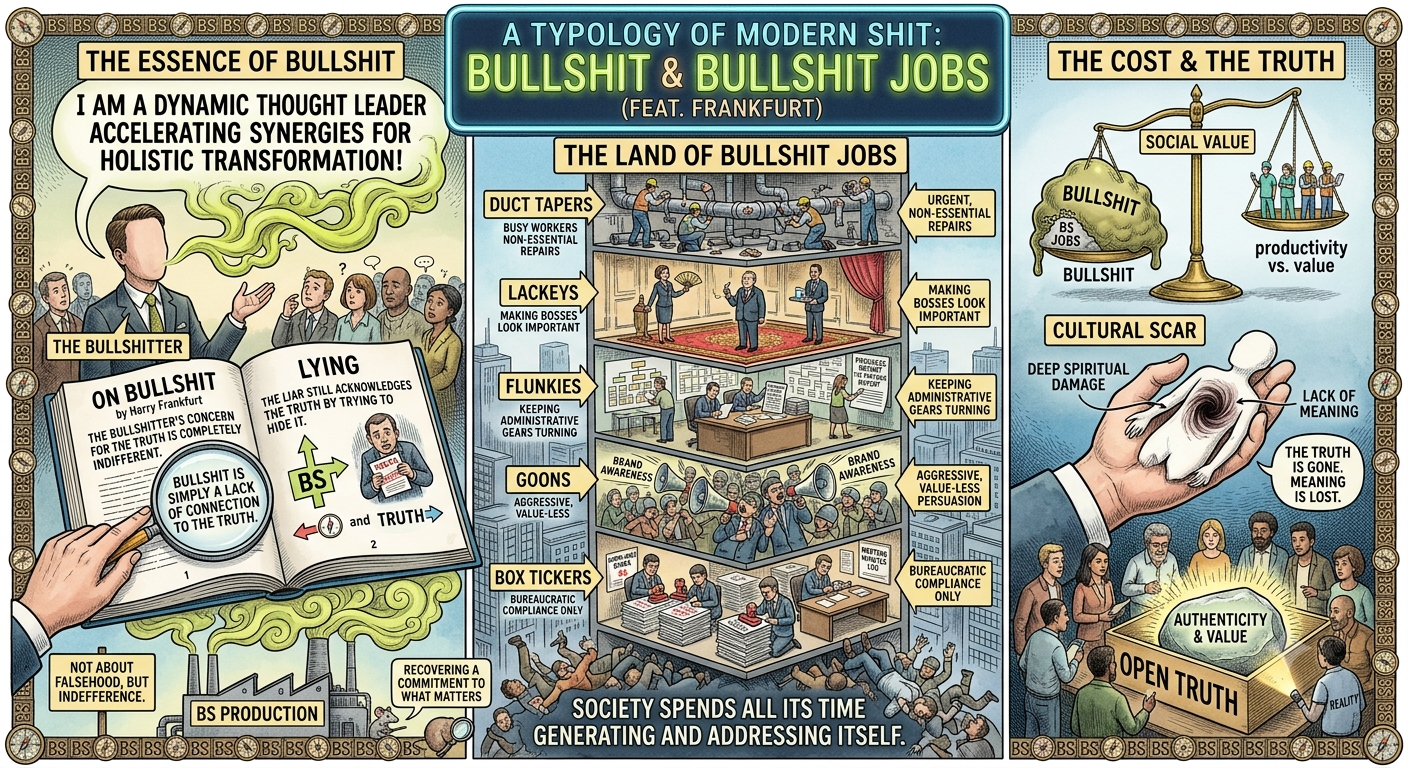
The other, nastier edge to all this is that a lot of what we are expected to do at work is completely fucking useless. This is the essence of the bullshit jobs that have overtaken many of our lives. Worse yet, regular jobs are now filled with a lot of BS. As my career unfolded, the amount of actual thinking I did shrank significantly, and the amount of BS I was expected to engage in grew and grew. A very big theme in all this is trust. Trust at work. A great deal of the bullshit thrust upon us at work is related to a lack of trust. In a more trusting environment, a lot of the bullshit goes away.

AI offers a way out. Part of what AI can do is expose the bullshit jobs and force the workplace to get rid of some of them. Even where that doesn’t happen, AI still offers an opportunity as a capable and competent assistant. An assistant who makes mistakes and does things wrong and needs to be checked. Still, a capable assistant can boost our productivity and open the door for all of us to do much more impactful thinking. Including thinking about things that add actual value to our lives and our work.

“The best way to find out if you can trust somebody is to trust them.” – Ernest Hemingway

The AI trust problem is also thick and important. AI today cannot be trusted. A large part of this is related to its very nature, but also to the reinforcement learning that shapes AI tools to fit our corporate environments. These are corporate environments that have become increasingly distrustful and marked by activities that flow from that lack of trust. Humans need to provide checks on AI and the locus of trust. The problem is that humans are not trusted either.

“Plants don’t flourish when we pull them up too often to check how their roots are growing.” — Onora O’Neill

The real challenge is more psychological and societal. To get the most out of AI and navigate this transition properly, we need to be clear-headed about the issues, including:

  • the lack of trust
  • The parts of work that add no value
  • The role of digital assistants
  • How broken is our educational system?

We do not confront these issues in a clear-headed way now. We must grapple with them.

My premise is that, to properly navigate the transition with AI, we need to engage it in a thoughtful, forward-thinking manner. The other power operating here is a corporate power, the one delivering the AI. If the same forces that produced our current social media environment are unleashed with AI, the results will be disastrous. This golden opportunity will be lost. We will be stuck in a world that is even worse, with AI now delivering the same social harms as social media. Instead, we need to orient AI toward a force for good.

So let’s roll up our sleeves and figure this out.

So Much Bullshit Today

“It’s as if someone were out there making up pointless jobs just for the sake of keeping us all working.” — David Graeber

Part of what I recognized immediately about AI was its ability to take care of most of the bullshit in my job. One of the reasons AI can do this is that the work was bullshit. It is quite fit for the purpose of BS. Unfortunately, over the course of my career, the amount of BS had increased a lot. It crowded out most of the work I should have been doing.

What the bullshit pushed out was most of the truly useful work I used to do. I used to spend my days thinking and doing things that were valuable, learning and growing over time. I spent time creating and bringing ideas to life. That was gradually replaced with progress reports, financial reports, and all kinds of reports that have no value whatsoever.

This fundamentally revolves around the lack of trust that managers had for employees. This, in turn, goes back to the lack of trust that higher managers had for lower managers. Then goes back to the lack of trust that the government and the taxpayers have for the people doing the work. All kinds of useful work were replaced with BS designed to check boxes and prove we were doing good work. The irony is that all this checking was actually pushing aside the good work itself. It has become a vicious cycle of decline.

What I recognized immediately was that AI was perfect for this. It’s been designed to produce corporately acceptable speech and reports, and to assist me in all this crap. The cool part is that I could simply turn AI loose and let it produce the BS. Meanwhile, I go back to actually thinking about things that are important and valuable. To start solving problems again. To do things befitting a human being with a lot of education, some good ideas, and a desire to explore them.

AI slaying BS is great. Too bad it can’t do more; it can. It would be nice for employers to recognize the bullshit and just get rid of it. This is the whole essence of bullshit jobs, a trend noticed across the Western world. Increasingly, jobs are devoted to creating bullshit to feed more bullshit. We have created the bullshit industrial complex. AI can replace this with something beneficial for humanity.

“Huge swathes of people… spend their entire working lives performing tasks they secretly believe do not really need to be performed.” — David Graeber

All of this generally fucks productivity and devalues human thinking and human effort. Even if all of the BS were to magically disappear, AI could still do some miraculous things to help us. That is the optimistic, glass-half-full version I want to focus on. The glass-half-empty version is simply using AI to tackle all this bullshit and generate its own bullshit to feed the bullshit machine. This is beneath contempt.

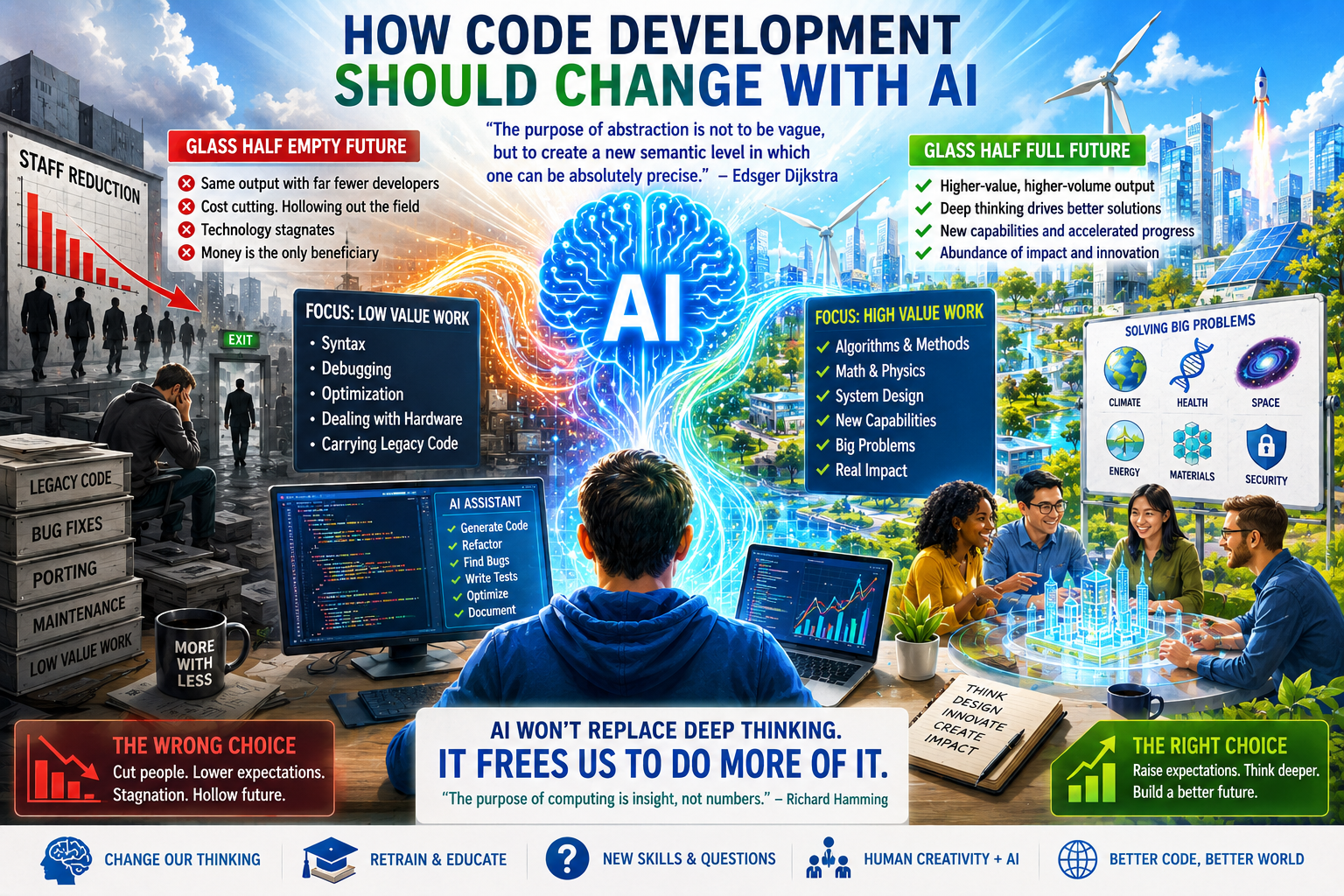
This is exactly the topic I explored with respect to code development. Over the course of my career, code development got hollowed out and turned into a crappy job where you just work on syntax and transfer static code capability to new platforms. Gone were new ideas and expanded capability. Gone was writing new code, as we simply promulgated the old code onto new platforms over and over again. Most of the codes on our exascale platforms are simply ported versions of decades old code technology. The computers got bigger and faster. What we put on those computers is the same, no upgrade. What a waste!

The result is that thirty years later, forty years later, you’re using the same damn code. The one that was written back when you were in elementary school, or before you were even born. It is being used to solve society’s most important problems. This is a completely unacceptable state of affairs. AI offers a way out. Used expansively it can energize code development to end this stagnation. The key is to recognize that we can do more important and impactful work.

The moral and spiritual damage that comes from this situation is profound. It is a scar across our collective soul.” — David Graeber

The Positive View of AI as an Assistant

In a world where we can use AI to identify and weed out the bullshit in our jobs, the role left over for humans is to use a new digital assistant to boost productivity and sharpen our thinking. AI does not replace you; AI is your assistant. AI makes you a better employee and it makes you more productive. AI can help you produce higher quality, more impactful work. This message would help AI overcome its ever worsening image and support in society. The corporate world is fucking this up. They need to embrace the positive message right in front of them. Time is running out to get there.

Either way, getting rid of the bullshit part of our jobs would yield immediate benefits and jumps in productivity. It would then require our employers to envision an entirely different view of what our work should be. This is, ironically, a more human, more empowered, and a better job. It would not mean massive job cuts, but rather a change in the whole mentality toward work. Work would be about problem solving and creating value. To unleash this positive change there needs to be more trust and less management control.

The key bit is recognizing how much the mentality of work has eroded over the past few decades, to the point of being beneath us. Managers want control, and lack trust. Work is sharply defined and value is determined from above. The fact that AI can do much of today’s work merely confirms that the work we are asking people to do is beneath them. Getting AI to take over this work is half the solution. Getting rid of that work is the second half. Perhaps when the AI generated BS is then digested by management AI. This becomes a ridiculous vicious cycle of no value.

“The computer is the most remarkable tool we’ve ever come up with. It’s the equivalent of a bicycle for our minds.”– Steve Jobs

When ChatGPT was first released, I could immediately tell this was a major development in the power of computing. It was how I felt the first time with Google search. Nothing that has happened since then has changed that view. AI has just gotten better at a breakneck pace. It is an utterly remarkable technology with far greater promise than the small-minded people who promote it can even imagine. This is the frustration about how small the vision for AI is.

I immediately saw a very capable digital assistant, one you could have conversations with, ask questions, and explore ideas with at the same time. I also recognized that it was flawed in a variety of ways. Its prose was wooden and inhuman. It was vanilla and horribly corporate. It didn’t talk like a real person; it talked like some corporate robot. It was also not capable of genuine creativity, only mimicry. Creativity, like coining a new idea or landing a really good joke, is beyond it. It can only mimic, summarize, and regurgitate what’s already there. Nonetheless, with appropriate deference and fact-checking, the assistant can be a huge boost to almost any creative act one is engaged in. It can also be an enormous boon to solving problems.

Solving problems is the essence of what employers should be paying us to work on. One of the great hallmarks of the past few decades of work is that we aren’t doing that anymore. Work lost its spark and creativity was a problem, not a solution. The problems we used to solve at the national lab were on the extreme end of the scale. They were of primary national importance, and that entire enterprise has faded from existence. It is time for it to be born again. I’m fairly sure this trend is repeated across society. AI can offer us a path to that better future.

“If you do not work on important problems, how can you expect to do important work?”– Richard Hamming

What Does This Mean About How We Approach Education?

One of the key aspects of unleashing AI for this better future is to revamp and restructure the way we educate ourselves. This does not just mean how we educate our youth, but also how we re-educate the vast number of working adults employed in our current environment. We all need to learn how to harness AI to change work. The better we educate, the better we harvest the bounty.

We need to teach people how to use AI properly, how to view it as a digital assistant. How to check its work, and how not to use it to replace the part of work that humans should be doing. We need to clearly separate human tasks from AI tasks. The human is always in charge. AI is always just a tool. We should have no problem letting it replace the vast quantities of bullshit we’ve injected into work. The same bullshit crowding out human endeavor. Currently, our students labor under the BS regime too.

This requires that education focus on teaching people how to be problem solvers. How to use skills and tools to best solve the problems that come up in any gainful employment. This is the key. We have tools, and these tools are good for solving problems. This also means we need to teach the fundamentals without the tools,. Then recognize that once people are in the field, in their office, they will have access to tools they can use to enhance the quality and productivity of their work. AI is one of these tools and perhaps the most powerful.

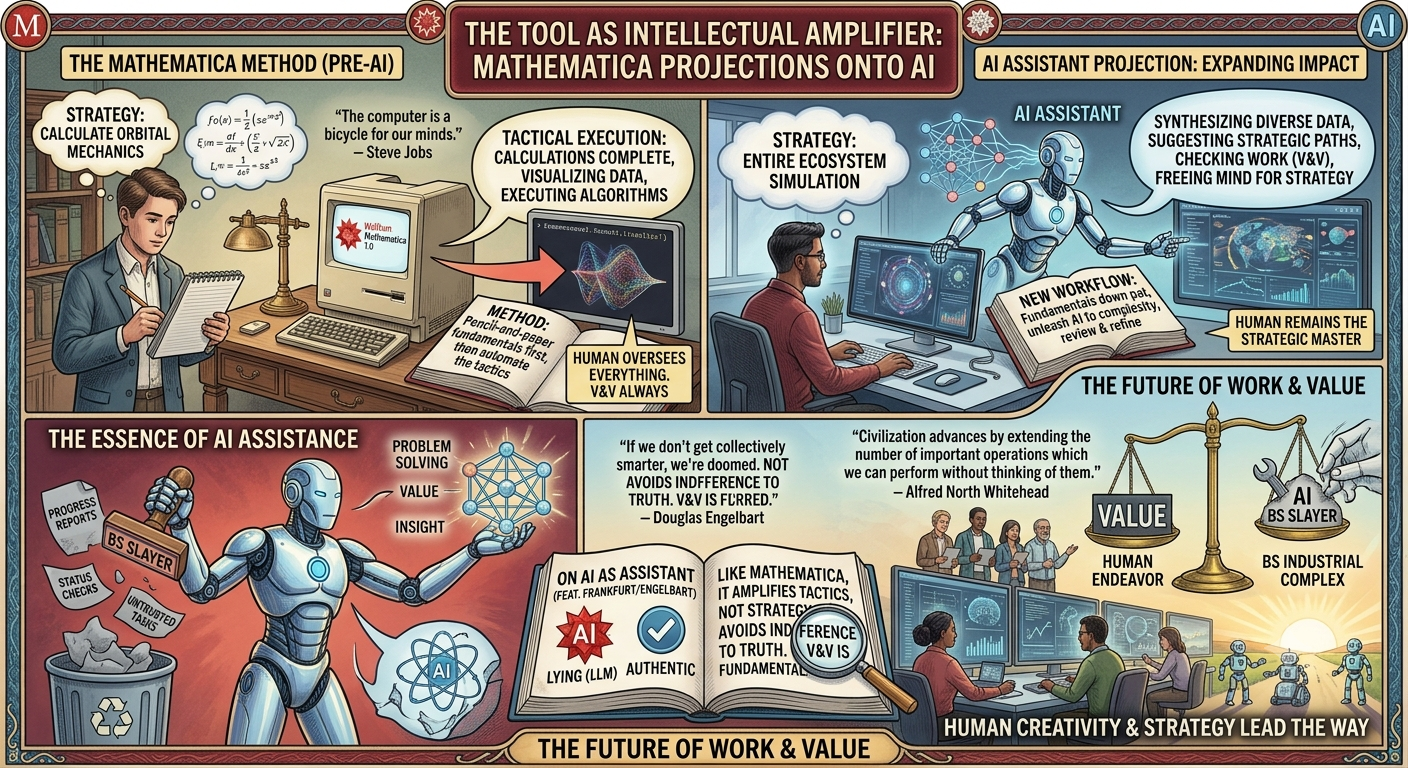
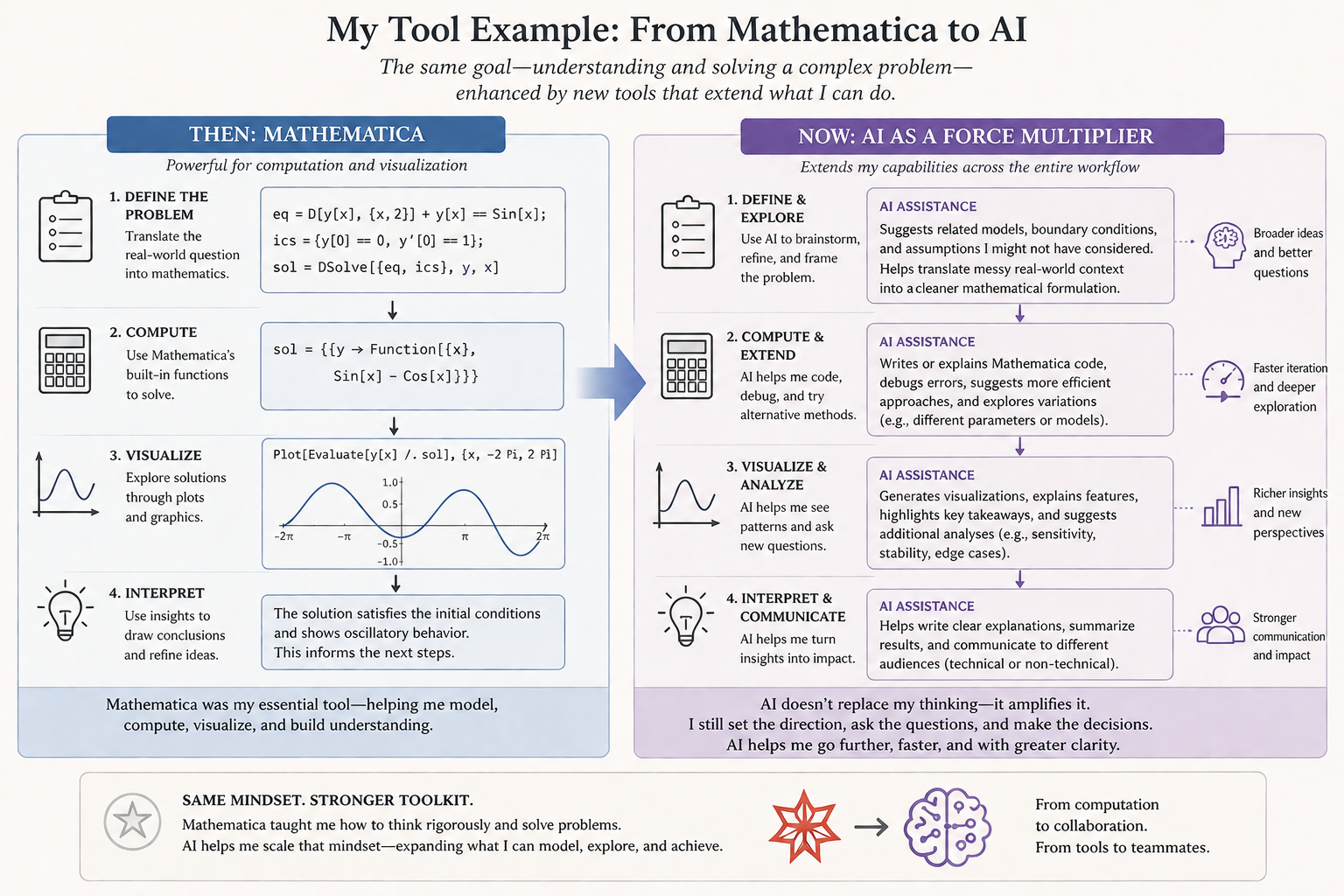
As an example, I’ll point to a tool I used for the entirety of my career: Wolfram’s Mathematica. I started using it shortly after I got to Los Alamos and continued throughout my years. I used it extensively. Generally speaking, when I was using Mathematica, I was doing the best work of my career. It is an example of a tool that unleashed productivity. It is a model for the future.

What I noticed over time is that, as work evolved over the past few decades, the work I would do with Mathematica took up less and less of my time. Particularly the time demanded of me by the employer. Once a useful tool, Mathematica finally became simply a joyful, productive treat. I would give it to myself when the avalanche of bullshit I had to deal with grew too oppressive. I used it when I needed a little joy in my work.

Mathematica is still an amazing tool, and I can only expect that AI is going to make it even better. It offers a useful and productive example of how AI assistance can be harnessed to improve work and make it better. It also offers a model for how these tools can be used in education. One key is to have the fundamentals down pat. You then reproduce those fundamentals with the tool When I did anything with Mathematica, I would start with the fundamentals and do things by hand. What the tool allowed me to do was take those fundamentals and apply them to a real situation with far more complexity than I could ever handle by hand. It expanded what I could accomplish immensely.

“I expect, say, 2026-level AI, when used properly, will be a trustworthy co-author in mathematical research, and in many other fields as well.” — Terence Tao

This is exactly the role mathematicians envision for AI: an assistant that unleashes the human mind to think more expansively. AI allows you to let go of tactic and think strategically, and broadly. Mathematica took care of math “tactics”. I gave it the strategy and purpose. All of that human thought is something AI cannot do; it can only come from the creativity, experience, and perspective of the human being. The human oversees everything the tool does. I would always check the work from Mathematica. Output is never just accepted as final.

“Education is not the filling of a pail, but the lighting of a fire.”– William Butler Yeats

Likewise, we must check all the work our AI assistants produce. Nonetheless, they can do things we can’t. This gets right to a key aspect of how to properly use these tools. You start by doing things in a fundamental way, on pencil and paper, using just the human intellect. Repeat with the tool to gain confidence. Then unleash it. V&V the result.

“The first principle is that you must not fool yourself, and you are the easiest person to fool.” — Richard Feynman

The next step is to take the tool, whether it’s AI or Mathematica, and reproduce what you did by hand. Make sure the results line up and the answers are the same. See what the tool provides that the human effort didn’t. This is, and continues to be, the starting point of everything. You ascertain that you know some basic facts about what you’re doing, and that the tool you’re using can reproduce them. If the tool cannot reproduce what you know as a human, it is not fit for doing more complicated things. This is the first step in learning to trust the results from the digital assistant. If it earns trust, you can be confident that you can expand out from that basis.

The key is that these tools are here to stay. They can augment our productivity immensely. They are part of work from here on out. We need to embrace them. We need to champion them. We need to be their masters.

These tools are not replacing us. These tools are making us better. If done right, these tools can unleash humanity to do human things. The only way that happens is if we focus on the part of work that only humans can execute. If done right, these tools should let humans do even more human things. Ultimately, those human things are the source of value in work. They are the things that produce real gains in productivity. More easily producing BS is not productivity, it has no value.

AI is the future, and it’s not going away. The best thing we can do is learn to use it and harness it to make that future as wonderful and productive as we can manage.

“Civilization advances by extending the number of important operations which we can perform without thinking of them.” — Alfred North Whitehead

Progress Is Found in Accepting the Imperfections

27 Saturday Jun 2026

Posted by Bill Rider in Uncategorized

≈ Leave a comment

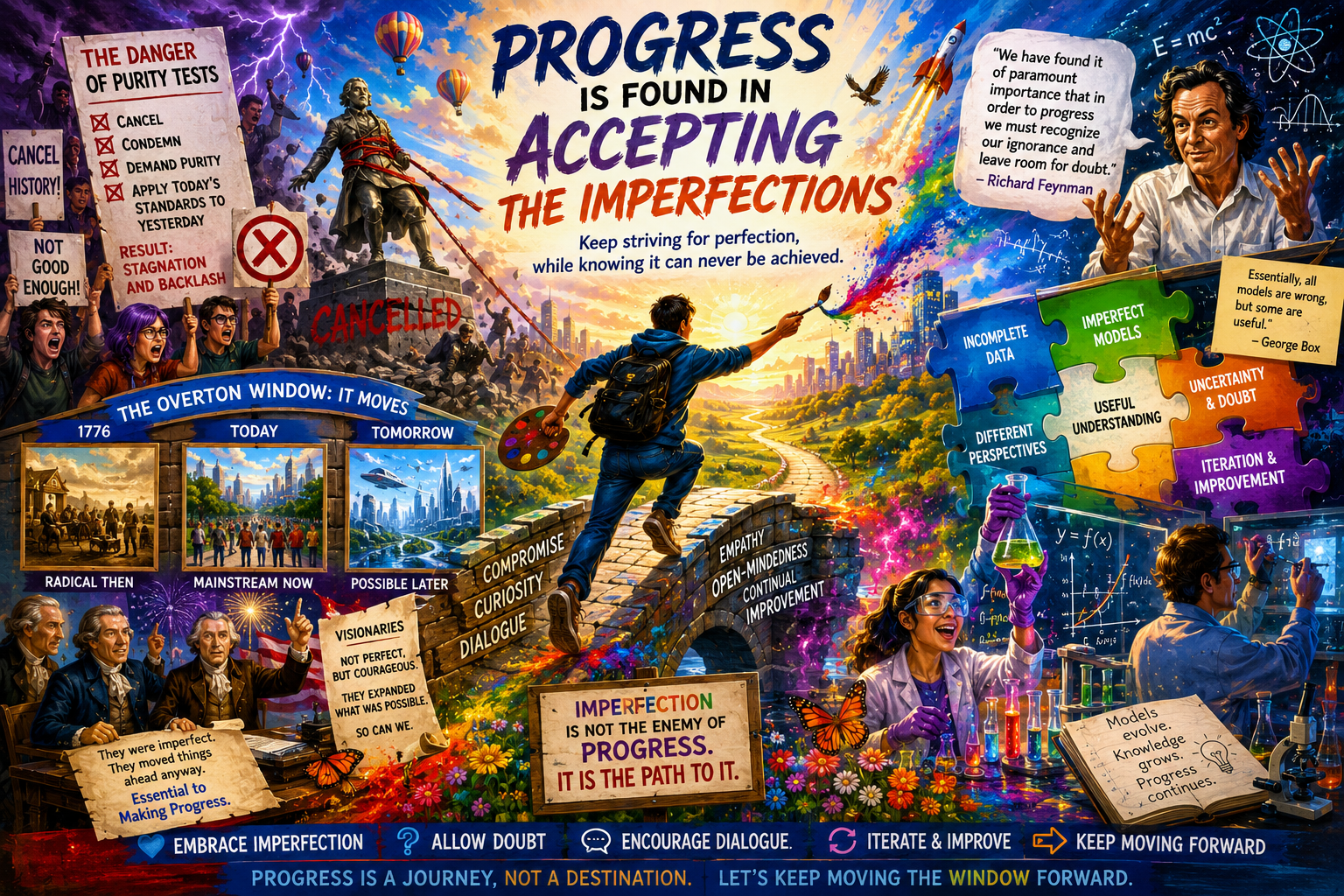
The Danger of Purity Tests

“With four parameters I can fit an elephant, and with five I can make him wiggle his trunk.” – John von Neumann

I’ve noticed a strange parallel between the forces that hinder progress in the technical world and in politics. This essay explores how imperfection can be an ally of progress, while perfectionism leads to stagnation and decline. One of the things I hold most dear is the continual need for progress. This is true for society and for science alike. The enemy of progress is a demand for purity of thought. Purity tests are toxic to political and cultural progress, and they are just as toxic in science. Here, I’ll take one example from social progress and map it onto math and physics.

The key to progress is accepting imperfections in the current state of affairs. The progress of the past was made by imperfect people with imperfect ideas, and they moved things ahead anyway. Through the lens of today, those imperfections are obvious. What we fail to embrace is that the imperfections are essential to making progress. This was true in the past and is even more true today. Purity tests and “absolutism” are deadly to progress and almost guaranteed to lead to setbacks.

The lesson here is one of strategic compromise. I’m arguing that absolutism holds progress back because it demands absolute answers. It does not allow adaptive, incremental progress. It is all or nothing. I’ve watched this play out in the obvious dysfunctions of our political system, and it also operates within technical and scientific work. When you raise a question or a problem, you’re met with dogma. It’s true across the board, whether you’re a physicist or a mathematician. When we become absolutists, we create dogma that props up existing views at the expense of progress.

Progress happens in the gray areas between perspectives. It is discovered by acknowledging that the perfect solution does not exist. This is true for technical problems, and it’s true for our political system. The key is to keep striving for perfection while knowing it can never be achieved.

“We have found it of paramount importance that in order to progress we must recognize our ignorance and leave room for doubt. Scientific knowledge is a body of statements of varying degrees of certainty, some most unsure, some nearly sure, but none absolutely certain.” – Richard Feynman

A Non-Scientific Example

Let me dive into the deep end. This is admittedly a dangerous approach, but it’s also instructive for the sake of clarity. I’m going to critique a place where this mentality shows up and hampers progress. The irony is that these particular purity tests kill progress and come from the progressive left. In a very real sense, the left is its own worst enemy. After that, I will discuss how, because scientists do exactly the same thing.

People on the left are fond of criticizing society’s heroes. In a nutshell, the main issue is the misapplication of today’s standards to yesterday’s people. Worse yet, they apply the most progressive standards, ones that aren’t even broadly accepted today. They then demand that the heroes be canceled and removed from the pantheon for these crimes. It is hard to imagine a more self-defeating way to catalyze progress. It only enrages the average person and makes the progressives look nuts.

As the USA approaches its 250th birthday, the Founding Fathers offer an instructive example. By modern standards of behavior, almost all of them would be viewed as conservatives or worse. Most were slaveowners. They engaged in abusive, exploitative practices that are illegal today. Their behaviors and life practices would be familiar to the MAGA movement. So some progressives want them canceled for this. This is idiocy. Let’s look at which Founding Fathers they would actually accept.

To put it differently, if the Founding Fathers had expressed the ideals and ideas the current left supports, they would have made no progress at all. They would have been imprisoned or institutionalized as criminally insane. Yet if we travel back 250 years, these men were viewed as radical progressives. They envisioned a society radically different from any that existed. Within the norms of 1776, they were arguably even more progressive than the people who criticize them today.

Another way to think about this is the Overton Window: the range of policy or social change that’s considered acceptable at a given moment. That range moves. The Overton Window of 1776 was driven by the Founding Fathers and the revolution itself. The possible changes in that era were vastly different from those of today. A standard conservative policy of today would have been considered radically left-wing then. The condemnation coming from the left is misplaced and illogical. Worse yet, it is completely counterproductive. It actually pushes today’s Overton Window away from progress.

Applying today’s standards to people from the past is plain stupid and reflects no logical understanding of how progress is made. If we make progress as a society, the things today’s people do will eventually be viewed unfavorably by progressives in the future. Applied with logical consistency, this same empathy would result in today’s progressives being canceled themselves. They would not stand up to the scrutiny of tomorrow’s progressives. Maybe those future progressives will act more rationally. We can hope.

The other thing that purity tests generate is mistrust. The demands of purity of thought from various parts of the academic left have destroyed trust. Institutions such as Universities have lost trust. This is a true threat to them. It has created a backlash. This doubles the damage to progress. The purity is alienating. It undermines the very institutions necessary to support progress.

What Does This Have to Do with Science?

“Essentially, all models are wrong, but some are useful.” – George Box

The concept of the Overton Window applies to science as well. There are ideas ripe for acceptance because the spectrum of the acceptable has finally opened to them. The story of “limiters” that I’ve told fits this. Overcoming Godunov’s barrier theorem went from impossible to possible to common practice. This shifts over time. This is the nature of progress, but it is also the fact of changing perspective. A variety of the great ideas of today would have been flatly rejected decades ago. Things that are acceptable and even commonplace today would have been viewed as outlandish in the past. This is the nature of progress, and we need to work with this reality.

A wonderful nexus for these problems is turbulence and the incompressible Navier-Stokes equations. I’ve criticized that construct repeatedly. Most of my critique centers on the lack of physical causality and realizability embedded in the choice of incompressibility. The model seems ill-suited to describing turbulence. The infinitely fast linear sound waves are a fatal flaw. In compressible flow, sound waves form shocks, meaning discontinuities. These shocks produce entropy at the cube of the variation in normal velocity. In compressible flows, shocks are ubiquitous, and it is pathological for them not to form. In my opinion, the rational conclusion is that turbulence is actually a compressible phenomenon. Its canonical behavior is, on balance, approximately incompressible, but entropy is produced naturally.

I’ll make a second argument here that is, in some ways, more compelling, and it invokes Occam’s razor. The phenomenon of turbulence is ubiquitous. It is everywhere in the world and the universe. We see it all around us every day, from the kitchen sink to the atmosphere and clouds to the cosmos. It is almost impossible to suppress. Incompressibility seems simple, pure. Some manipulations of the governing equations are enabled by it. This simplicity and purity of form are an illusion.

“Since all models are wrong the scientist cannot obtain a ‘correct’ one by excessive elaboration. On the contrary following William of Occam he should seek an economical description of natural phenomena.” – George Box

With that as a background, which I believe is an unassailable observation about our physical world, my mathematical observation is this: if the incompressible Navier-Stokes equations were the true basis for understanding turbulence, it would not be so difficult to solve them in a manner consistent with turbulence. Instead, many of our greatest mathematicians have struggled to show that these equations produce the structures necessary for turbulence. Where they have nearly succeeded, they have had to construct solutions so structurally bizarre and unrealizable that they defy description. If incompressible Navier-Stokes were the correct basis, the structures in the solutions would be common. Instead, they are pathological.

This points to a further argument that the equations are the wrong basis for understanding turbulence. If they were indeed the right equations, producing solutions consistent with turbulence would be far easier. It would be commonplace and simple. Instead, we are looking under a very classical lamppost for the keys to turbulence, and the keys are actually somewhere off in the dark. There is a trail of breadcrumbs we don’t even notice. We have mistaken a practical engineering model of incompressibility for a deeper scientific model. It is still useful for many applications. A deep scientific understanding of the physics of turbulence is not likely to be one of them.

Mathematical Purity Tests

“The purpose of computing is insight, not numbers.” – Richard Hamming

The example I mentioned a couple of posts ago about the publication content of the SIAM Journal of Numerical Analysis illustrates the dangers of the purity of thought. The main reason results have become scarce or even discouraged is the purity of thought ideas. The journal is that it has become focused only on concerns relevant to people who work in this stripped-down version of numerical analysis. This is math that is divorced from its utility. It is all ego and no sense. We do numerical analysis to produce numerical results. We do it for confidence in our algorithms, methods, and codes. The changes are akin to mental masturbation. In my opinion, this is a disservice to an area that applied math has contributed greatly to and is counterproductive.

A dismissal of mathematical progress by physicists is a prime example of absolutism working against progress. I have seen it in the reactions to my writing about the Lax equivalence theorem. In absolute terms, the theorem can be criticized for applying only to linear problems. The same is true of theories like total variation theory for hyperbolic PDEs. These critiques are made as the theory is fundamentally one-dimensional. Everything revolves around what you can rigorously prove. They fail to reflect the power of this work in areas where rigor cannot be achieved.

“We absolutely must leave room for doubt or there is no progress and no learning.” – Richard Feynman

A prime example is TVD theory, which provided a fundamental mathematical approach to limiters. Those limiters have been incredibly powerful, and they were largely developed by physicists. Even though the TVD result applies only to linear equations, it created a rigorous theory that set bounds on limiters. This helped make limiters more broadly accepted, especially in the engineering community. Despite that, the physics community I’ve worked in at the national labs doesn’t hold this in high regard and widely criticizes it for its narrow, rigorous applicability. I firmly believe that critique is only a threat to progress, and that it fails to recognize the benefits of the theory even where its rigorous applicability is limited.

The Lax equivalence theorem is limited. More deeply, it expresses the value proposition of increased computing power for solving partial differential equations. It articulates the basic components of verification practice with clarity. Its rigor is limited, and it does not hold in many cases, which remain challenges for mathematics. Still, it represents a huge breakthrough and a clear, crisp articulation of how you design numerical methods. It tells you how you evaluate their success. It tells you the value proposition for computing, clearly and crisply. In large part, its value proposition is seen in practice.

It is the essence of verification, but absolutists reject it because of its limited applicability rather than celebrating it as the progress it represents. Holding onto it is the glass-half-full view of progress. Rejecting it is the glass-half-empty view that represents stagnation and a lack of progress. This pattern recurs throughout mathematics whenever details undermine rigor. I think this is an excuse. It is a bad excuse at that.

It should be seen as a first step and as a gauntlet thrown down for greater mathematical results in the future. In all likelihood, we will never get a fully rigorous nonlinear theory for these equations. It will always be out of reach, but that does not mean we should stop reaching for it. This pattern is repeated over and over. There is a theory with limits on rigor and caveats. Nonetheless, the theory provides a foundation to build on. The same mentality holds for physical modeling as well. There is a lack of precision, rigor, and caveats across physical models. They are not held to the same standard.

The thing that doesn’t fit is the thing that is most interesting.” – Richard Feynman

Examples abound in numerical methods. Linear stability theory is essential to constructing methods. It only applies linearly and often to periodic problems, yet provides essential feedback to methods. The Lax-Wendroff theorem is another. It has limits and caveats around entropy conditions needed to select proper weak solutions. The key is to realize that these theorems are not bulletproof. The limits and caveats are places for continued work. Nonetheless, the basic principles and guidance are essential building blocks. Time and time again, we have found that linear theories guide nonlinear methods.

“Science is the belief in the ignorance of experts.”– Richard Feynman

Scientific Snake Oil

“The first principle is that you must not fool yourself, and you are the easiest person to fool.” – Richard Feynman

One thing I’ve learned over my career is that certain kinds of purity of thought can be particularly dangerous. That’s especially true today, when bullshit has become one of the most effective marketing schemes available. There are some prime examples to point to.

I saw the bullshit factory at work during the Exascale program. The claims of performance gains were hardly matched by reality, because the computers’ efficiency was dropping over time. Meanwhile, the things that actually make a computer valuable were not being invested in, which has led to a hollowing out of computational science. The marketing worked, and money flowed. We have faster computers that are very hard to use. We also saw code, methods, and algorithms stagnate. The insanity of hardware focus is being repeated with AI.

The same kind of bullshit surrounds the fusion power boom we’ve seen recently. It starts with people seeing money and making outlandish claims, like the National Ignition Facility’s “break-even” claim. That was an outstanding accomplishment, but it was hardly break-even. They cooked the books in the accounting to make it look that way. Still, the fusion evangelists and those who believe it must be the power source of the future jump on the bandwagon, and the result is irrational optimism about how close fusion energy is to being a viable source of electricity. I think it’s still quite far off. There are massive engineering and physics challenges we haven’t solved, and won’t until we can produce fusion at the scale and in the form required to actually generate electricity.

Similar bullshit comes from quantum computing. It has massive potential, but its real utility is far more limited than they would have you believe. Quantum projects and scientists bullshit their way to continued funding. Over time, when promises are not kept and potential is hyped in outlandish ways, trust erodes. Trust is one of the things most lacking in society, and these well-intentioned people end up becoming charlatans, exploiting the trust deficit and deepening it in the minds of people who feel duped.

At this point, you should be thinking, “What about AI?” AI is definitely another one of these over-inflated promises. I believe AI is a huge advance, on the scale of the Internet, as a breakthrough. Still, the AI charlatans (Altman, Amodei, Musk, and the rest) oversell it. They are trying to engineer IPOs out of their bullshit. Their claims are over the top and poorly thought through. They’ve inflated a giant stock market bubble while destroying trust even faster than quantum and fusion did. AI evangelists are scaring people left and right. In my opinion, AI is huge, but we are approaching it wrong. To get it right, we need to get down in the mud. It is going to be harder and fuzzier than they describe.

To be clear, each of these is worth pursuing. Fusion is an important technology for future energy production. Quantum is an essential modality for future computing. AI is going to change our economy and our future. In each case, the story is far murkier than the evangelists would have you believe. Fusion and quantum both face massive engineering challenges that stand in the way of success. AI needs a far more difficult kind of societal engineering to succeed. It also needs to avoid the trap that social media fell into, where a new technology was allowed to prey on society in order to make short-term profit. If AI follows the same path (and it appears to be), we will fuck this up completely.

“I can live with doubt and uncertainty and not knowing. I think it’s much more interesting to live not knowing than to have answers which might be wrong.” – Richard Feynman

Imperfection Defines the Space for Progress

In science, there is rarely a simple, easy, pure theory. All theory is flawed. The real work, and the real path to success, is uneven and difficult. Success is found in letting go of the purity of thought. Things are not black and white. Reality sits somewhere between the two, in the gray. The engineering challenges above are all messy, wicked problems. If we want to succeed at these big ideas, the wicked problems have to be solved. The purists avoid all of this. It isn’t good marketing, and it doesn’t bring in money. It is hard. Until we do the hard stuff, the big promises will keep falling short.

In science, the turn away from rigorous verification and validation is rooted in an emphasis on purity of thought. This approach focuses on exposing flaws and pointing out where the gray area lies. When marketing and funding depend on the acceptance of the purity of thought, V&V is the enemy. It attacks the purity of thought, which props up almost everything in the world of funding. V&V is rejected because it unnecessarily complicates things. For example, with exascale computing, why verify when you can assume convergence? Without proof, you work under the presumption that a faster, bigger computer will yield better answers. This approach relies on faith rather than evidence.

When I conducted verification, it was an active effort to confirm theoretical expectations. In many cases, the theory holds even when its rigorous applicability is not available. That is notable because it points to areas where the theory’s rigor could perhaps be extended.

There are also cases, especially where instability and turbulence exist, where the linear theory falls apart. In those places, the theory does not offer answers or expectations, and something else needs to be defined to fill the gap more proactively. This is the scientific process in operation. The key is to collect evidence and assess whether it matches the available theory. If it does, great. If it does not, you know where you have work to do. This is the process we are failing to engage in.

Validation provides feedback to theory and experiment, while verification provides feedback to mathematics and numerics. In validation, you need to understand the uncertainty and limitations of theory and experiment. Similarly, the limitations of mathematics and methods serve as the foundation for verification. In both cases, the feedback can highlight areas where more scientific effort is needed. It also points to where breakthroughs have been achieved with evidence that provides proof that this can be claimed.

“The idea that no one really knew how to run a government led to the idea that we should arrange a system by which new ideas could be developed, tried out, and tossed out if necessary, with more new ideas brought in, a trial and error system.” – Richard Feynman

In my view, the same principle applies politically. The past and the present are imperfect, but they represent a struggle toward perfection. This is a project we should engage in and move toward. It is a struggle that represents the best of humanity, and we take it on knowing that perfection is impossible. The way forward is to reject absolutism and live in the gray, whether in political discourse or in scientific and technical discourse. In politics, this means embracing “a more perfect union.” This is the essence of positive patriotism.

“We the People of the United States, in Order to form a more perfect Union…” – Preamble, U.S. Constitution

In science, it means building progress on imperfect theory and imperfect results. You examine where you have uncertainty or a lack of rigor, and you look for opportunities to push back against either one. You push back uncertainty with new methods of measurement or new analysis of data. You push back the lack of rigor with new physical theories or new theorems. New tools, ideas, and approaches all contribute to progress. Sometimes an idea needs wicked engineering work before it will succeed. The key is to recognize and embrace the imperfections we begin with. Once that reality is accepted, success and progress become possible.

How Code Development Should Change with AI

23 Tuesday Jun 2026

Posted by Bill Rider in Uncategorized

≈ Leave a comment

“The purpose of abstraction is not to be vague, but to create a new semantic level in which one can be absolutely precise.” – Edsger Dijkstra

Two Competing Futures

The coding capabilities embedded in AI and large language models will fundamentally change what we mean by code development. The question is whether we lean toward the “glass half empty” or the “glass half full” view. The glass half empty version: we trim down and eliminate large coding teams, producing the same output with far fewer developers. The glass half full version: AI unleashes a new kind of code development. It can allow us to generate higher-value, higher-volume output where quality improvement is the main outcome. I hope for this more optimistic outcome.

In the glass-half-empty narrative, you get the same output with far fewer developers. You trim your team, cut costs, and still get the same output with fewer people. The AI does the bulk of the work, overseen by a handful of senior developers who manage the AI. The side effect is the hollowing out of the field, a reduction in the number of code developers, and cost-cutting. The output and product remain largely unchanged, and the field’s trajectory is the same as it would have been with just more efficiency. This is dismal. It is technology stagnating and damaging the future. Money is the only beneficiary.

In the other view, the picture is more complex. Success is harder and more uncertain. Expectations, duties, and tasks for code developers need to change significantly. The coding tools provide more value because each person can produce far more. The key is that people need to have greater expectations about what they produce and what they expect. The key is deep thinking. You get more code, more capability, and an accelerated trajectory for what code can produce. In this view, you supercharge the value of code development. It is a path to a better future.

“The purpose of computing is insight, not numbers.” –Richard Hamming

Change Our Thinking

“Civilization advances by extending the number of important operations which we can perform without thinking about them.” – Alfred North Whitehead

Rather than stop thinking, AI requires us to think more. We need to expect deeper and more abstract thought. This is something only people can do. What needs to change is the mentality of those managing code development. They need to break out of the straitjacket they’re in today and recognize what code development tasks have fallen by the wayside in recent years, so they can reach the full value the code should produce. This is the narrative AI needs. The other direction is a horror show for society.

This dynamic plays out across the use of AI in society. Are we using AI to get rid of work and people, or to improve the quality, improve the thinking, and improve the work that’s done? The latter is a form of abundance we should seek. It must be reflected in how society plans AI use, what it expects from it. Ultimately, it should change how we educate people and the questions and skills we teach. We need to retrain and educate most of the current white-collar workforce, too.

What’s clear is that AI overturns traditional ways of thinking, teaching, and working. We need to adapt and change to reflect what these new capabilities produce and how to improve the quality and value of what we all do. These issues are prevalent across the modern workforce. It requires a different mentality for success. Code development is the key area where we can make real progress in changing the dynamic for the better. Workers and managers have the fundamental backgrounds to achieve success. To get there, we need to understand the problems we are trying to solve and how AI can help us overcome them. Not how AI can do the same, but how it can produce better.

My View of the Current State

Let me start by sharing my experience with co-development. I worked on it on and off for nearly 40 years at two national labs. The work was always focused on features, fixing bugs, or dealing with issues. Most of the time in code development was spent writing code, getting the syntax right, optimizing, and debugging. Over the years, the deeper thinking shrank from view. The tasks became ever more banal over time. Thinking about math and physics became uncommon, replaced by computer details. As a result, our codes have stagnated. Methods, models, and algorithms have all become fixed and merely ported.

The prospect of AI changes the dynamic considerably, since the work we used to spend all our time on is now largely automated. We still have responsibilities to check what AI produces, but my experience using Claude or OpenAI code tools has been miraculous. I can execute tasks that would have taken a lot of time in a very short period, with a relatively tiny cognitive load on my part. The gift is that I can move to thinking about other, better things. I have hours and hours freed up to imagine and create. No longer am I slaved to syntax wars.

The question is: what does that free up? What new responsibilities do I have, and what can we do with this? Over time, I noticed that writing code and dealing with computer hardware took up more and more of my time. Over my career, the value of a code developer’s time has steadily decreased. This was especially true during the Exascale program. Dealing with hardware and the challenges of writing working code became more time-consuming and difficult. Work on features and improving the value and power of the code faded into the background. The focus shifted toward porting code and simply carrying along legacy code. Our dreams became smaller.

This shift paralleled a decline in the very things that give code its value: algorithms, applied math, and physics. The entire code budget went to low-value things. Code swallowed methods and algorithms. Code developers spent less and less time on those areas as computing hardware, and the lowest-level mechanics of computer science became the focus of everything. Gradually, we lost the ability to do anything new or better. Only computers got faster. What we put on those computers stalled.

Opportunity Awaits

AI offers a chance to change this dynamic and significantly improve the thinking we do in code development. This is counterintuitive. AI, rather than killing thought, allows it to flourish. The key is that the thinking for work needs to be different. This applies to other fields as well. The key is that expectations and approach need to change to reflect it. Deeper thinking, creativity, and more value in what we do should become what is expected. As a side effect, that should be reflected throughout the educational process and all the way through co-development. Rather than dragging our feet in education, there is value in fully embracing the future.

“Simplicity is a great virtue but it requires hard work to achieve it and education to appreciate it. And to make things worse: complexity sells better.”– Edsger Dijkstra

I worked in very high-end organizations. I can only imagine how much worse code development must get as you move down the food chain to lower-level organizations. If things were this bad at the National Laboratories, what is it like in the trenches of some company? We have a chance to fix this problem and start producing code with more value, ingenuity, creativity, and thought put into it. This would have a profound effect and supercharge the area where I fear the developments of the last two decades have sapped almost all of the power. To put it differently, code development is broken. AI offers us the chance to fix it.

To achieve this, we need management to recognize that the new tools can fundamentally change the trajectory of code development. It is the answer to a huge problem. If they view this mainly as a way to reduce team size or improve efficiency while still producing the same product, we will miss the opportunity. Right now, this is the narrative winning. What a waste! The value should be managed first, not the budgets.

Right now, it feels like we are on a trajectory where code development is seen as fine as-is. It is not! We do not criticize what code development has become. We should. It is a shit show. We also do not acknowledge what is missing and what we are not doing that we should be doing. Over time, code development has evolved into a low-level, low-thinking, low-planning, low-creativity environment. This is toxic, full stop. It denies everything important and good about code. Code is abstract human thinking ported to incredibly fast thinking platforms. The key is powerful abstract thought!

How to Think About AI Coding

“Computer science is no more about computers than astronomy is about telescopes.”– Edsger Dijkstra

We need to recognize that our approach to code development needs to change. It needs to reflect the power these tools provide and to unleash people to think in ways they no longer do. There is a useful analogy in the history of coding. We have a blueprint for the phase change we need to go through.

Looking back at the early days of computing (the 1940s and 1950s), computer programming involved rewiring the machine. Think of it! We started with plug boards as a coding interface. This was an advance over human-powered calculators. Then we moved to machine code and assembler, which gave us more power. Our codes and methods could be more abstract than the plug boards. When Fortran and COBOL arrived, people who were skilled in assembler saw it as Armageddon and a horrible development. The coder lost a direct connection to the machine they were so intimately connected to. What we gained was the ability to express complex ideas. Codes, algorithms, and methods bloomed. The computer was unleashed by it.

A language that doesn’t affect the way you think about programming is not worth knowing.” – Alan Perlis

The same shift is happening now with AI coding tools. We can produce code without focusing on syntax and language expression the way we used to. The thing we fail to see is what the new technology allows. Just as the new languages allowed higher-level ideas to be expressed in the past. The new coding languages ultimately influenced the algorithms and methods we could envision. We can now implement ideas that were scarcely imaginable before. This complexity and capability can fuel an explosion, but we need to trust that code developers will thinkk about even bigger ideas. We need to manage and expect more. This is the opposite of the current thought and trajectory.

Beware of bugs in the above code; I have only proved it correct, not tried it.”– Donald Knuth

This is the possibility. There are also new responsibilities, reflected mainly in the need for much more extensive and broad-based testing of the code. Since we are not writing the bottom-level code, we need many more checks to ensure that what the AI produces is understood and meets the outcomes we want. The trust prospect is essential as AI is not as trusted as compilers. Test-driven development and thinking will be essential. Testing will become an even more important part of code development. With testing we can use AI in unleashing the creative energies we have bottled up as computing hardware has become ever more complex.

“We must give the mechanical verification of programs a serious try, for it is the only credible alternative to the present practice of debugging.”– Edsger Dijkstra

Closing Thoughts

What I came to recognize by the end of my career was how badly code development was broken. It had become garbage. I saw a budget that used to pay for creative methods and algorithms that expanded the capability of codes gone. It was replaced by grueling code work focused on syntax and subtle implementation details. This was simply because computing hardware had become so unresponsive and difficult to use. The budget was completely swallowed up with this effort and the cost of porting existing codebases.

What we saw was a value of code that became fixed, with the only improvement in capability coming from the speed of the new hardware. This grim vision of the future. Not surprising that this is exactly what we see with AI and the whole data center issue. AI needs this change in approach badly.

The system needs to evolve and change so it trains the human mind in ways it alone can produce. We must understand what is unique about human thinking. How the human mind can master AI as a capable assistant and tool. Humans create new things that have never existed before, and this is humanity at its best. Code development is the obvious place to make this advance. We need leadership that sees more rather than less.

Code development reflects this human characteristic in a product. For code development to flourish, we need to expect more than just working code (correct syntax and few bugs). We need new ideas, new concepts, new algorithms, and new methods that do more and produce more than what they replace.

“There is nothing so useless as doing efficiently that which should not be done at all.” – Peter Drucker

What scares me most is the key to this transition: management.

By the time I retired and left work, the manager’s job had degraded to a massive extent. It had shifted from leadership to an endless chain of bullshit activities. The focus was on finances and battles that only gave me reasons for contempt, not respect. Managers became increasingly technically weak and lacked the human skills to match. They were mainly capable of handling the bullshit they were given. The management job needs to be better too.

This is part of the problem with changing code development. Managers need to think, and they need to think deeply about what they should be doing. Not simply doing the same thing more cheaply. Right now, what they are doing is generally a waste of human effort and beneath what management should do. The real 0risk is that we let managers drive this change. If they do, they will choose the glass-half-empty version of the future and look to cut costs because they have no vision of a future that could be better. They will simply fuck up this massive opportunity for a better world.

“We shape our tools and thereafter our tools shape us.” – Marshall McLuhan

Better Connecting Mathematics and Physics: Numerics is the Bridge

20 Saturday Jun 2026

Posted by Bill Rider in Uncategorized

≈ Leave a comment

“The miracle of the appropriateness of the language of mathematics for the formulation of the laws of physics is a wonderful gift which we neither understand nor deserve.” — Eugene Wigner

I’ll start with a bit of subtext, both a boast and a complaint. All my degrees are in engineering, specifically nuclear engineering. I worked at Los Alamos for 20 years, ending up in the infamous X Division, also known as Applied Theoretical Physics. Working there gives you an honorary standing as a weapons physicist, and it becomes part of your identity. As such there is a heavy emphasis on the primacy of physical theory. By the same token math gets somewhat diminished in the Los Alamos pantheon. What is most important is recognizing when math supports the physics, impact is massive. One of the biggest problems for Los Alamos is ignoring math that matters. In its place they emphasize tradition.

One thing I’ve always appreciated is applied math. One of the greatest compliments I’ve ever received came from a coworker at Lawrence Livermore, who assumed I had degrees in applied math rather than engineering because of my knowledge of and taste for the subject. The fact that I could pass myself off as a mathematician to someone holding a Berkeley PhD in the field has always been a source of pride. I truly value applied math, which is why I see the tragedy in what has happened to it and in how it is not being used to solve society’s most difficult problems.

“Computers are useless. They can only give you answers.” — Pablo Picasso

The SIAM Journal on Numerical Analysis is emblematic of many of these issues. I was at work one day lamenting the demise of this journal. I may not have realized it at the time, but someone in the audience was an associate editor. I said something to the effect of, “That journal used to be good, and now it sucks.” I still stand by that. The utility of the journal has been replaced by academic purity, and that is extremely bad for applied mathematics. It has contributed to the field’s declining impact on the technical world.

To the point: this journal used to provide clear, evidence-based proofs, with numerical evidence that supported what could be observed in the real world. That was the essence of verification. When the journal published papers that offered practical demonstrations of the math, it made an impact. Now it has neither. It reflects an almost suicidal approach to managing a field: numerical analysis without numerical results. It can certainly be done, but it is certainly not advisable.

What has changed is that you are now left with a theorem and a proof, with any demonstration reduced to an exercise for the reader, or simply a matter of trusting the mathematics. For me, seeing that the math has real-world impact is what encourages me to engage with it: to read it, digest it, and understand it. It also gives me confidence that the mathematics is correct. This is a deeply disturbing shift in the field. It is as if they have mindfully chosen to be irrelevant.

We have seen applied math’s impact wane across broader technical fields. The example from this journal is more an indictment of the gatekeepers who have steered it toward uselessness. This is a self-inflicted injury, where academic purity has replaced the focus on being useful and impactful. I find this development truly sad and in need of deep repair. I stopped reading the journal closely. I began treating each article with suspicion: I would read the abstract, look for results, and move on if it wasn’t compelling. If I didn’t find results, it generally wasn’t worth my time.

“The purpose of computing is insight, not numbers.” — Richard Hamming

I give a talk on shock physics verification and on how many mathematical results bear directly on what you actually see. I’ve spent a significant part of my career doing verification work for various shockwave solutions. What people often don’t recognize is that there are a number of reasonably rigorous results in shock physics. Much of this is built on foundational theory. The Lax-Wendroff theorem states that putting a solution in conservation form ensures you obtain a weak solution to the hyperbolic conservation law. The catch is that a weak solution is not unique, and it can be physically incorrect, which is why an entropy condition is needed. This can come from upwinding, Riemann solvers, or artificial viscosity. Further work by Peter Lax, with Ami Harten and James Hyman, built on this. Accuracy of the solution is a key part of verification, and for shocks a few foundational works tell us what to expect.

One is my work with Jeff Banks and Tariq Aslam on the behavior of linear waves. Those waves converge at a sublinear rate, and they typically meet the pacing accuracy requirement under mesh refinement. This builds on work by Majda and Osher, who showed that you get first-order accuracy for results emanating from any discontinuity. This applies to the Riemann problem, except for the linearly discontinuous wave, where my results with Jeff and Tariq apply. Finally, there is a result by LeFloch and Hou on what happens when you do not use conservation: the result will be wrong, and the error will be proportional to entropy production. The caveat is that entropy production is itself necessary to get a physically correct solution. This is quite a bind.

What has always astounded me is how little these results are known and used at the national laboratories where I worked. Indeed, the ignorance of this body of work, set against my own knowledge of it, played a critical role in the unethical behavior that led me to retire rather than continue working in a place where ignorance is celebrated.

What I’ve observed is that these mathematical results consistently match what we see in practice. Even though the equations are nonlinear and the methods are numerical, the connection between the mathematical theory and the observed results is clear and repeatable.

“Young man, in mathematics you don’t understand things. You just get used to them.” – John Von Neumann

This gets at one of my conundrums. The national labs I worked at tend to ignore these results and even treat them with considerable animosity. The ignorance is especially profound when it comes to computing, which is reflected in how heavily they emphasize high-performance computing. In my opinion, that approach leads to enormous wasted effort relative to investment in methods and mathematics.

One of the ironies is that the people doing verification work often remain ignorant of the math that underpins what they should expect, and as a result they lose focus. This shows up most clearly where the solutions are discontinuous, even when exact solutions are available. The fact that a method does not deliver the expected order of accuracy at a discontinuity does not mean you can stop measuring its accuracy and convergence rate, especially since those circumstances are usually much closer to what you see when the method and code are applied to real problems.

This is captured by the relative lack of emphasis on the Lax equivalence theorem. Strictly speaking, it applies narrowly, and generally to equations and methods not in use today. Still, it captures the exact requirements we apply uniformly in verification work. Why do we expect precisely what the theorem spells out in cases where it does not formally apply? And why do we dismiss it when we are not rigorously applying it? It is exactly what we expect, and exactly what we demand from our methods. We define methods that fail to meet these expectations as incorrect or full of bugs.

The big message is that some degree of rigor is lacking everywhere, and yet we still take a leap of faith forward. People generally recognize that rigor and precision are lacking in physics, particularly in important areas. The same is true for mathematics.

Verification and validation are where these gaps can be exposed and addressed. By comparing actual results to mathematical derivations, we can demonstrate the level of rigor in the mathematics. Similarly, validation can reveal the precision of the physics. Solving the equations brings these two together into a unified exercise. To understand where rigor is lacking and where work is needed, we must separate which part of the problem lies in mathematics and which lies in physics. From my experience, both areas carry significant burdens that our current science programs do not adequately address.

“As far as the laws of mathematics refer to reality, they are not certain; and as far as they are certain, they do not refer to reality.” — Albert Einstein

The Navier-Stokes equations are amazing and largely predictive, but they are imperfect. They break down in situations like turbulence. These are the places where both physics and math fall short, and real classical science is needed to fill in the gaps. I will express clear doubts that AI is a significant path forward here. I’ve written about the problems with the incompressibility usually invoked for turbulence. By all accounts it removes the discontinuous behavior the observations point to. It removes thermodynamics. Turbulence is one of the most universal means for assuring the second law in our universe.

“(turbulence is ) the most important unsolved problem of classical physics.” – Richard Feynmann

Let me strike another blow against the incompressible Navier-Stokes equation’s ability to explain turbulence. This is, of course, the Clay Millennium Prize problem. Notable mathematicians, including Terence Tao, have brought their considerable talents and intellect to the task of showing that these equations produce a singularity. That singularity is necessary to explain the observations we have regarding turbulence. This points toward the problem being posed improperly in the first place.

The fact that it has not yielded to this assault is quite telling. Turbulence is such a universal phenomenon that I would submit that such singularities must be simple and common. They would naturally arise in the solutions. That they are so unyielding to analysis suggests that the equations themselves are the problem. The key point is that imposing incompressibility on these equations makes them unphysical. It blocks one from finding a reasonable solution that explains the phenomena. That’s what needs to be removed from the equation set. The problems with incompressibility from a physical perspective are mirrored by the mathematical challenges it creates. The incompressibility constraint makes the equations elliptic. That ellipticity is exactly what makes them so difficult. Removing it would yield conditions for a solution and the discontinuous behavior needed for the math to match physical reality.

The incompressibility constraint is the source of the mathematical difficulty. It is also the source of the physical difficulty. It renders the equation to have an elliptic character, which is contemptible both on physical grounds as well as mathematical grounds. It’s condemned from both sides. Removing it would allow the solution to include the discontinuities physical theory demands. To me, it’s obvious That it is the thing that is needed. Yet we persist in beating our heads against the proverbial wall.

“Far better an approximate answer to the right question, which is often vague, than an exact answer to the wrong question, which can always be made precise.”– John Tukey
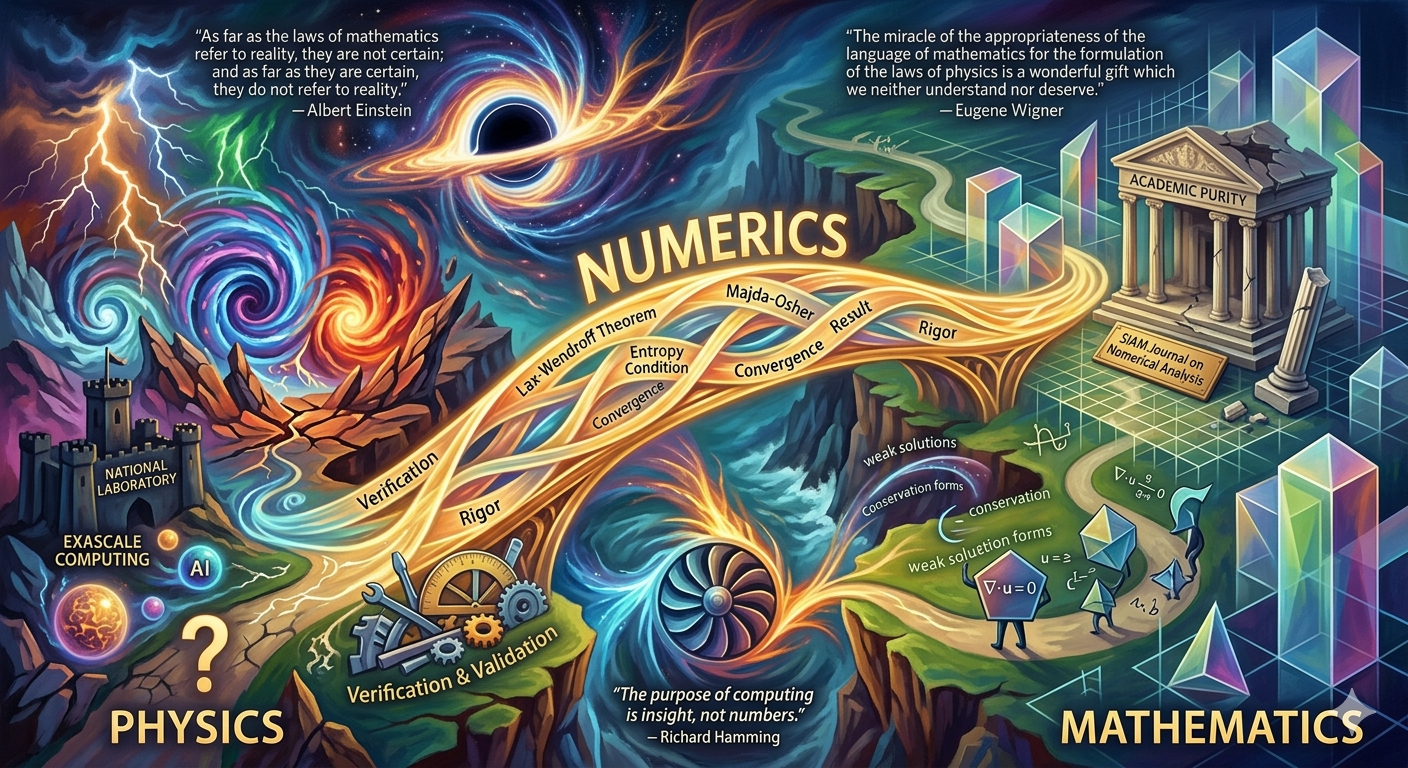
Solid mechanics equations work well when things are well behaved, but they fail when you have fracture and spall. We need to be mindful of where the mathematics breaks down, which often happens at discontinuities. The dynamics of shocks and turbulence share significant dynamical similarity, and this might yield a path to progress. The places where the continuum breakdown are the miscrostructural details. The basic equations average over these and the small scale structure has a macroscopic impact. Models bootstrap this influence, but the models are ad hoc and unconvincing. The mysteries of physics and mathematics run through discontinuous phenomena. These are weak solutions, and much is already known about them.

One key lesson I took from my time at Los Alamos and Sandia was the importance of being a first mover in a field. This is reflected in the continued commitment to numerical methods based on von Neumann’s original vision, as refined by Richtmyer’s work on artificial viscosity. There are two elements to this, both worth criticizing in depth. The first criticism is the devotion to the Lagrangian frame of reference. It becomes increasingly absurd as virtually every physical system evolves over time. Effects we commonly attribute to turbulence and instabilities eventually undermine the Lagrangian description. They render it useless. The Lagrangian description is rooted in classical physics. The imperfections become exposed as the physics grows more complex.

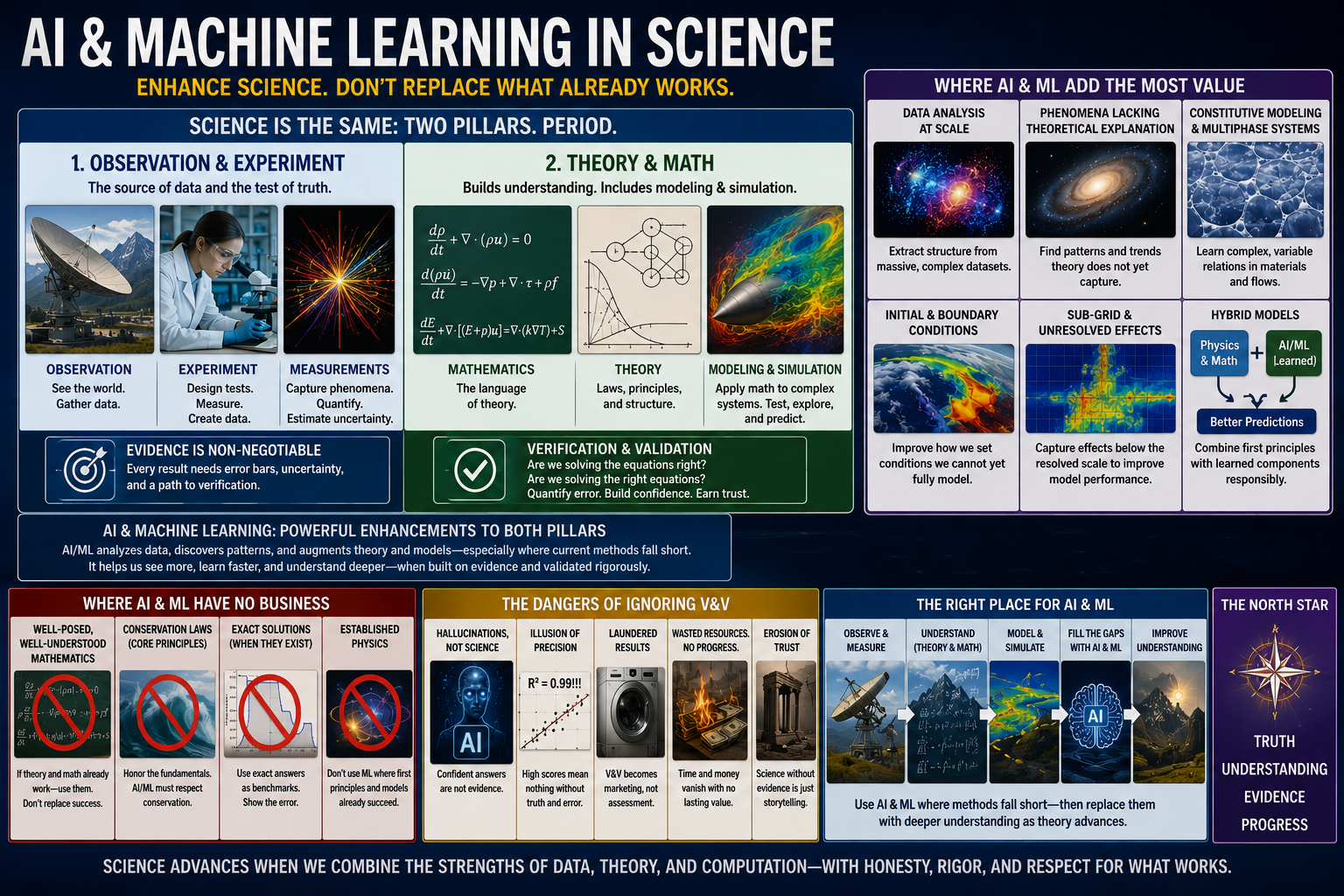
Physicists are still eager to think in this Lagrangian frame because it is the core academic lineage. The numerical side of things may be even worse. We continue to use methods that have been shown to have critical flaws, as Peter Lax so keenly and ably demonstrated. Most acutely, this shows up in the failure to solve the equations in conservation form. The Lax-Wendroff theorem makes is crystal clear. I remain somewhat flummoxed by the lack of recognition of this critical flaw and the continued adherence to solving these equations in non-conservative form. The lack of progress due to this intransigence is perplexing. The right response would be to acknowledge and react to the mathematics..
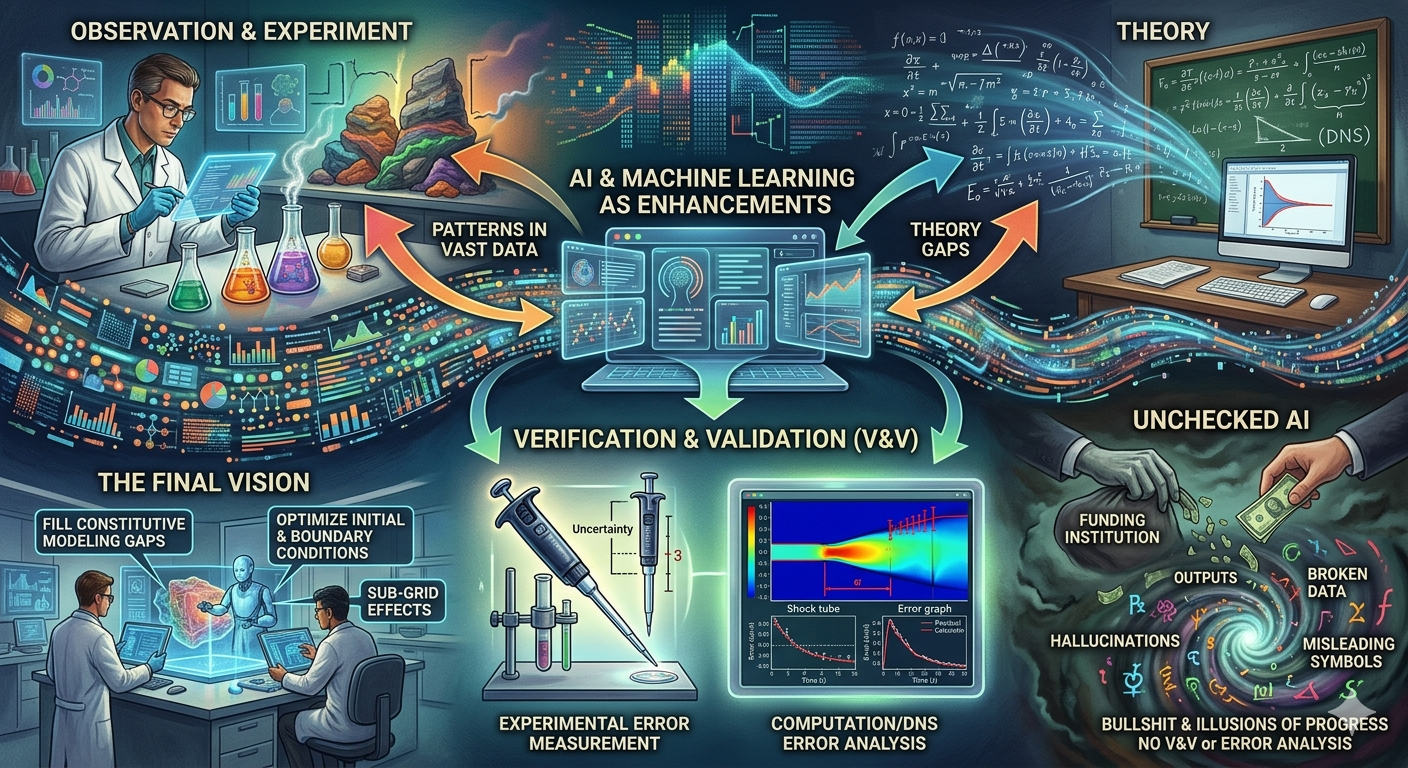
The key to advancing science is recognizing the primacy of observation and theory. New technologies like computing and artificial intelligence do not displace these fundamentals. They augment them. The path forward is to make the best of this augmentation while preserving and supporting the basics. Instead we have allowed the basic to wither away.

What we have lost sight of is the importance of the fundamentals. The core aspects of understanding the universe, rooted in theoretical models. We should always remind ourselves There mathematics and its partnership with physics gains value. This partnership reaches its zenith in the practice of numerical methods for these models. The full power of AI will be most fully realized by pairing it with applied mathematics to a much greater degree than we do today.

In the future, we will see that diminishing applied mathematics in the face of these new technologies has been a serious mistake. That mistake is setting progress back. Continued emphasis on math is the way forward.

There are other places where things break down as well, such as black holes, where the continuum equations and relativity break down. Are these really just discontinuities, or does physics take over? At large and small scales, the separation disappears, and one intrudes into the other. All of these gaps are the places where we need to work. Over the past several decades we have stepped away from attack on those challenges. Instead looking toward silver bullets of exascale computing or AI. Both means are useful, but do not veer toward explanation.

AI can fill the gaps statistically and projecting observations into modeling that can mimic. The thing it does not do is explain and understand the gaps. This is useful, but not an endpoint. The same holds for computing. It has utility and provides a temporary relief, but not the science. The ultimate goal of science is to explain the Universe. The place to do this is constructive physics models. These are mathematical in nature. This is where applied math is essential. It provides rigor and deep structural knowledge of the equations paired with physics. Together this provides a springboard for computing to work. This includes AI, which operates in the gaps physics and math leaves behind. The smaller the gaps, the better the understanding. This path is what we should pursue.

References

Lax, Peter D., and Robert D. Richtmyer. 1956. “Survey of the Stability of Linear Finite Difference Equations.” Communications on Pure and Applied Mathematics 9 (2): 267–293. https://doi.org/10.1002/cpa.3160090206.

Lax, Peter D., and Burton Wendroff. 1960. “Systems of Conservation Laws.” Communications on Pure and Applied Mathematics 13 (2): 217–237. https://doi.org/10.1002/cpa.3160130205.

Majda, Andrew, and Stanley Osher. 1977. “Propagation of Error into Regions of Smoothness for Accurate Difference Approximations to Hyperbolic Equations.” Communications on Pure and Applied Mathematics 30 (6): 671–705. https://doi.org/10.1002/cpa.3160300602.

Harten, Amiram, James M. Hyman, and Peter D. Lax. 1976. “On Finite-Difference Approximations and Entropy Conditions for Shocks.” Communications on Pure and Applied Mathematics 29 (3): 297–322. https://doi.org/10.1002/cpa.3160290305.

Hou, Thomas Y., and Philippe G. LeFloch. 1994. “Why Nonconservative Schemes Converge to Wrong Solutions: Error Analysis.” Mathematics of Computation 62 (206): 497–530. https://doi.org/10.1090/S0025-5718-1994-1201068-0.

Banks, J. W., T. Aslam, and W. J. Rider. 2008. “On Sub-linear Convergence for Linearly Degenerate Waves in Capturing Schemes.” Journal of Computational Physics 227 (14): 6985–7002. https://doi.org/10.1016/j.jcp.2008.04.002.

Chasing Greatness

15 Monday Jun 2026

Posted by Bill Rider in Uncategorized

≈ 3 Comments

“You could leave life right now. Let that determine what you do and say and think.” – Marcus Aurelius

The last month has been a tsunami of thought-provoking events for me. The most obvious is the death of my father, my last parent. His decline had prepared me for the psychological impact, or so I thought, but it still surprised me. Mortality is a hard concept to wrap my head around. It keeps intruding into my thoughts, conscious and subconscious, with startling regularity. There is much to consider and take forward into my remaining life.

Thoughts about the meaning and value of life are profound, and they lead naturally to questions about work. I have been thinking deeply about work since retiring earlier this year, weighing what it means for me. All of this feels important to write about, even if it is uncomfortable for most people. If you are not up for it, stop reading here. I think it is something we all need to confront. head on

With mortality comes what I believe is the foolhardy belief in an afterlife. I find myself envying those who have faith and take comfort in it, even though I do not believe it exists. I wrestle with this almost daily, trying to work out what a more reasonable version of an afterlife might look like if one did exist. What kind of supreme being would be consistent with it. It all feels like comforting lies we tell ourselves to keep away from the abyss.

That abyss is why I titled this essay “Chasing Greatness.”

“It is not that we have a short time to live, but that we waste a great deal of it.” — Seneca

Around the time my dad passed away, a group of giants in computational science and CFD also died. Phil Roe, Cleve Moler, and Tony Jemeson were all about my dad’s age. Each of them achieved greatness in their careers, which is why we remember their names. I still remember giving a talk at the JRV Symposium in 2013 to honor Tony, Phil, and Bram Van Leer. I was added to the program at the end, after the presentations. I spoke right after Bram. It was an honor, but it also felt, in some ways, exceedingly uncomfortable. To some extent, Bram’s talk shocked the audience.

In retrospect, I look back at that almost wistfully, but also with caution. Bram announced that this would be his final talk. He was going blind due to the effects of his time in a Japanese concentration camp as an infant during World War II. By the time my dad died, he was blind. I suffer from the same disease he did, so I am not completely sure I will not experience blindness myself. My feelings about it go beyond simple empathy for what it does to these men, both of whom I care about in different ways. It is very personal and real to me, and frankly, a prospect that scares me deeply. Honestly, I realize now that any ambition I might have had for fame is foolish, and my time has passed. Any fame on my part was always a long shot. It is for anyone.

I don’t need to sell the fact that my father’s death was existential in profound ways. What I do need to say is that my retirement felt like a kind of death and a reminder of mortality. What comes after retirement in one’s Life? The answer, of course, is your own death. One of the most striking things about my retirement is that it felt more like a divorce than a departure from work. I still have passion, love, and even a sense of responsibility for what I do. I hope it’s obvious to my readers that I still care, have fresh ideas, and want to contribute. My retirement was more of a feeling that I needed to leave an organization and institution whose values were at odds with my fundamental values. Its morals and ethics were incompatible with my own. If I had continued, I would only feel pain and struggle, with no chance of success. I saw my managers with contempt, with all respect drained away.

“Not to live as if you had endless years ahead of you. Death overshadows you. While you’re alive and able – be good.” – Marcus Aurelius

In short, I was wasting my time continuing to work with these people. I had already realized how precious that time was, and they were not worth it. I needed to leave. I still think there is much to do, and we live in both an exciting and perilous time. The future is taking shape before us, but its fate is still unknown. We need people of genius and creative power to shape it into something we can look to with hope and the promise of positive progress. I had come to the conclusion that progress at Sandia was impossible, and it was pointless to continue tilting at that windmill. My voice, my talents, and my time were all misspent there, and each of those things would only do less with more time.

The quest for immortality is driven in part by the desire to achieve greatness in life. This is to become someone who shapes history and writes their name indelibly into the record of mankind. The desire is fleeting, but it is common. In a world of billions of people, trying to achieve greatness is utterly foolhardy. As a life objective, it is not a sign of success, but a “stretch goal.”

There is also the question of what defines “great,” which I will get to, and the role luck plays in achieving it. In a sense, I spent a great deal of my personal luck early, by getting my first professional job at Los Alamos. Los Alamos would turn out to be as close to greatness as I would ever get. I met and worked with many people there, some of whom were great, a few of them even uppercase-G Great. I am grateful for that. My own chance at greatness was probably gone from the very beginning. I am simply not lucky or talented enough.

Before I turn to the definitions of greatness and what it takes to achieve it, I want to acknowledge what I deliberately chose when I gave up any of my own pursuit of it. When I left Los Alamos in 2007, I chose a better life for the people I cherish most, and the chance to meet my responsibilities as a man, a father, and a husband. If greatness had still been my goal, I would have stayed. I would have left Sandia in 2013, around the time I turned 50, when it became clear that Sandia was not a place where anything of true value would be achieved. I made the choice for my loved ones again and again. It was simply the wrong place for me.

Greatness comes in many forms, and it is usually a mix of talent and luck. You can be great in a good way by making humanity’s future better. The examples are everywhere: Nobel laureates, inspiring leaders, writers, artists. I was particularly struck by the vision of Antoni Gaudí highlighted during the Pope’s recent visit to Spain. Gaudí’s motivations mean little to me, but his art is inspired, unique, and incredible. Visiting the Sagrada Familia was a highlight of my return to Spain last year. It was the most wonderful birthday present to share with my wife.

At Los Alamos I met a couple of Nobel laureates. I had the briefest interaction with Hans Bethe, who is surely the greatest person I have ever met in person. I also had a mostly funny exchange with Murray Gell-Mann. Arriving at work before dawn one morning, I noticed an older gentleman having trouble getting into the Theoretical Division building, so I offered to help. He handed me his badge, and when I read the name I knew he was trying to get into the right place. I badged him in, he went inside, and that was that. A humorous way to brush up against greatness in science.

More meaningfully, I connected with people who would be seen as great by most standards, if in a slightly narrower way. Frank Harlow was foremost among them. He was one of the true pioneers of CFD and someone I could count as a friend while. Frank had the virtue of entering the field early, and he used his considerable talent and artistry to create new methods. Methods still in broad use today. Methods that are the foundation of the field of CFD. He built on John von Neumann’s work, armed with the knowledge that simulating fluids was a concept that could work. It was just a matter of working out the details. Frank may be the greatest person I have ever counted as a friend.

I met many of the other greats of CFD through Los Alamos. Bram van Leer was a friend’s advisor, and I got to meet and interact with him on a few occasions. I truly enjoyed it included that JRV symposium. Also at JRV I asked Bram about the history of CFD. He had a talk called the History of CFD Part 2. I asked about Part 1. Bram quipped to me, “that’s something for you to do.” Indeed I have done this. I also co-authored some work that included Jay Boris. Both men were key figures in my essay about limiters. At conferences I had the chance to meet Sergei Godunov as well, though language and demeanor kept that meeting about as deep as the one with Bethe.

The contrast between the two laboratories in this framing is striking. Los Alamos pursues the idea of greatness, largely because of its legacy. With so many great scientists present during the Manhattan Project, it was almost inevitable that Los Alamos would become a mecca for greatness. It makes celebrating it part of its core identity. Sandia, on the other hand, is a place of teamwork and the overall effort. Greatness is submerged there. If anything, Los Alamos tries too hard at greatness and Sandia not hard enough. Neither lab has it right.

The ability to pursue greatness is, moreover, as much a matter of luck as anything else. It includes having the talent and being in the right time and place to apply it to something new and different. The opportunity for greatness usually arises when a field is being born, not after it has reached maturity.

Greatness can also come from being terrible. Hitler is great in a horrible way. He destroyed lives and killed millions, and he stands as one of the worst people in history. Jeffrey Dahmer is great in the horror, violence, and perverse deaths he inflicted on his victims. He still lives in our imagination as a great in the most awful way.

The theme of “making America great again” is true in this sense. The President is famous and memorable. In all likelyhood he will be rememberd albeit for negative reasons. He is talented in the ways of manufacturing fame. In all likelyhood he is leading the United States into a precipitous decline. Is it good to be remembered for being horrible? He will achieve greatness. People in the future will know his name. Like Lincoln and Washington, he will be remembered, but for completely different reasons.

Alexander the Great and his mule driver both died, and the same thing happened to both.” — Marcus Aurelius

It begs the question of what leads to a good life? The obvious answers run along the axes of happiness and meaning. Greatness as a concept attaches itself to meaning, not necessarily to happiness. In fact, greatness and the meaning in a life can be at odds with happiness.

When I think about myself, I choose happiness. I am a pretty happy person. I have a life full of friends, love, and meaning, and I have a great deal of respect from the people who matter to me, which means a lot. I strive to be better, but I do not let any quest for greatness undermine all those other things. Some of the great people I named above were surely happy as well. Not all of them. For some, the quest for greatness undermined their happiness. For most of them, I never knew them well enough to sort it out.

The idea of greatness and fame is all around us. I was reminded of it again by the new Marc Maron film, In Memoriam, in which a man with a terminal diagnosis becomes fixated on appearing in the Oscars In Memoriam montage. The detail that stays with me is how much fame you would actually need to be remembered ten, twenty, fifty, or several hundred years after you are gone. The amount is, frankly, ridiculous. Go far enough into the future and no one will remember or appreciate that you existed at all. All the knowledge, memory, and importance of you happen in the here and now. What happens now is what really matters. Fame is fleeting.

“Time is the great equalizer; it will claim us all.” – Shelley, Ozymandias

Knowing this is both terrifying and freeing. The terror comes from realizing that mortality is unavoidable, which means what you do with your life right now is all that really matters, and that pursuing any kind of legacy starts to feel foolish and wasteful. The freedom comes from the same fact. If the legacy is an illusion, you are released to live for the present instead of for a monument no one will visit. I try to be a good person, especially to the people I love, and to meet my responsibilities. I also try to enjoy and appreciate what I have right now.

Be not afraid of greatness: some are born great, some achieve greatness, and some have greatness thrust upon ’em.” — Shakespeare

If you want proof of how short a human life is, count how many people from five hundred years ago are still remembered. The number is very small, and those who made the list relied on luck as much as on talent. Names like William Shakespeare and Christopher Columbus come easily to mind, and that ease is exactly the point. It shows how much fame and greatness it takes to reach that kind of immortality, and how few ever do.

“To be remembered is sweet; to be forgotten is fate’s decree.” – Shelley, Ozymandias.

Children are another route people hope to take, and I am here to burst that bubble too. When I think about my own family, I know only three of my great-grandparents, and even then I know little more than their names. I know the great-grandmother from whom my middle name, Jackson, is taken, and I know of two others who emigrated from Norway and homesteaded in the western United States. That is all. Nothing further, and that thin thread of memory reaches back at most a hundred and fifty years. If I cannot hold on to my own great-grandparents, I should not expect my great-grandchildren to hold on to me.

“So many who were remembered already forgotten, and those who remembered them long gone.” – Marcus Aurelius

The deeper truth is that chasing greatness or fame head-on is usually the worst way to find it. The fame worth having tends to arrive sideways. You pour your passion and talent into making something, and then luck decides the rest: the timing, and whether the world happens to be ready for what you made. That part is not up to you. It belongs to the world and to the long odds of fame and fortune. For every famous name, there are people of greater talent who gave everything and got nothing, working in obscurity until the end. And there are lesser talents who rose simply because the draw fell their way.

“The struggle itself toward the heights is enough to fill a man’s heart. One must imagine Sisyphus happy.” — Albert Camus, The Myth of Sisyphus

Proof by Authority

10 Wednesday Jun 2026

Posted by Bill Rider in Uncategorized

≈ Leave a comment

“If you’ve got the truth you can demonstrate it. Talking doesn’t prove it.” ― Robert A. Heinlein,

The interview

Watching President Trump on NBC’s “Meet the Press” on June 7, I was struck by what happened. It was the perfect epitome of modern leadership. Who needs facts when you have power? Your authority is all you need. Every time Kristen Welker asked for evidence, only authority was asserted. She was supposed to wilt in the face of his authority. Failing to do so only invited rage. This exchange that ended the interview is a near-perfect specimen of proof by authority.

Here it is worth quoting at length.

Pressed on the $1.8 billion “anti-weaponization” fund and his claim that January 6 defendants were victims of “dirty cops,” Trump asserted that FBI agents had ushered rioters into the Capitol:

WELKER: There’s no evidence of that, sir. There’s no evidence of that.

TRUMP: You had a bunch of dirty cops, and frankly, what they did was weaponization of our government.

WELKER: But sir, there’s no evidence of that. More than a thousand people pleaded guilty to crimes —

TRUMP: …Try looking at the tapes one time.

WELKER: Just to be very clear, there’s no evidence of what you’re saying…

TRUMP: There’s a lot of evidence… There’s tremendous evidence. There’s nothing but evidence.

WELKER: Well, it’s not been presented in a court of law.

TRUMP: The election was rigged. It was a dirty election… And it’s happening again right now in California.

WELKER: Do you have evidence to support that?

TRUMP: All I have to do is look. All I have to do is look.

WELKER: But that’s not evidence.

“All I have to do is look” is the entire epistemology of proof by authority compressed into seven words. The claim is true because the authority perceives it to be true; demonstration is beneath him. When the demand for evidence persisted, the response was not evidence but dominance:

TRUMP: They’re crooked just like you’re crooked, your press is crooked. And Meet the Press is crooked.

WELKER: To be fair, I’m not crooked. But let’s continue.

TRUMP: Really? Well, you play right into their hands then… You’re either crooked or you’re stupid.

Moments later, he tore off his microphone, declared, “You’re a one-sided crooked network. Sorry. Let’s call it quits because I’ve had enough,” and walked out. Asked for any evidence eight separate times, the President of the United States produced none. He produced insults, an assertion that looking is the same as proving, and finally a tantrum. The proof is non-existent. What exists is the power, and the power is the only authority that matters..

The same disease, closer to home

One of the great commandments of science is, ‘Mistrust arguments from authority.’ Too many such arguments have proved too painfully wrong. Authorities must prove their contentions like everybody else.” — Carl Sagan

Few leaders or experts can match Trump’s manic devotion to lying. The underlying mechanism is one I watched daily at work, and it helped push me to retire. The leadership I knew were “experts” in science. Some, even with actual accomplishments to point to used their position to dominate. They insisted their views be accepted even when wrong and refuted by evidence. They ignored evidence. When evidence was asked of them, they responded with power. Not really different from the way Trump responded to Welker. Just less colorful and childish. Who needs evidence when you’re in charge?

Most of the time the leaders are not promoting self-serving conspiracy theories as Trump does. I will touch on self-serving promotion of falsehoods below. They are telling us they are doing a great job and everything is going great, when this is not true. They are promoting their own success while suppressing any talk to the contrary. Most leaders will point to selective evidence to support their view. “The stock market is at an all time high.” Meanwhile any evidence to the contrary is ignored. At work this looked like only mentioning positive things while avoiding problems. This is not leadership. This is marketing. It almost always tips over into bullshit.

Many people submit to this even when what they see directly contradicts the claim. I saw it every day. The constant stream of bullshit, lies, and false claims promoted by leadership wears resistance out. Even when backed by no evidence and, often, no relevant expertise, This was corrosive to any responsilbe conduct. Being the one who said “there’s no evidence of that, sir” carried the same cost it carried for Welker. I was called out. Made an example of and singled out for punishment.. It is better for your career to support the lie. Accept the bullshit as the truth. Consequences of this are sure to be terrible.

Experts do it too

“Science is the belief in the ignorance of experts.” — Richard Feynman

Acknowledged leaders in many technical fields practice a politer version of the same disease. I wrote recently about direct numerical simulation (DNS). In DNS, you almost never see evidence that a result is, in fact, a valid direct numerical simulation. Error analyses are almost never presented. When they are, the discussion concerns statistical convergence, almost never numerical convergence. You see a flow solution and a description of the method, but no estimate of the actual numerical error. The result is a worse facade: DNS presented as an exact solution. A perfectly good and detailed replacement for actual experiments. “All I have to do is look” (at the pretty turbulent flow field) is the implicit argument. It is no better coming from a chaired professor than from the President.

Any expert worth their salt should have evidence at their fingertips. Command of a field should include command of the evidence supporting your claims. Consider a maxim everyone accepts in principle: errors should be estimated. Every experimental standard says measurement and statistical uncertainties must be reported. In practice they rarely are. The standard is honored in name only, proof by authority with a peer-reviewed veneer.

The deeper problem for these leaders and experts is that evidence works against them. Often they cannot provide it because they do not have it; when they do have it, it undermines the claim. Politicians whose policies fail market a success that does not exist rather than change course. Experts who built reputations on their life’s work cannot admit the problems that remain, so they present that work as the final answer. The result is the same in both cases: declining legitimacy, suppressed progress, and eventual failure. Turbulence modeling and DNS are a clear example: decades of little real progress, while the experts promote their success and starve the work that could deliver actual breakthroughs.

Why now?

“In God we trust; all others must bring data.” — attributed to W. Edwards Deming

Why has this become so prevalent? I have theories rather than an answer. Part of it is the collapse of trust in experts. People increasingly see them as full of shit, and the experts’ own behavior keeps supplying the evidence (the one kind of evidence they reliably produce). Part of it is that the internet’s “do your own research” reflex goes unanswered by the gatekeepers. That reflex cuts both ways: it is healthy when it holds gatekeepers accountable. It is toxic when the gatekeepers are themselves the problem, because real standards are also what weed out the charlatans.

The current administration is the limiting case. It is an organization in which genuine expertise is an impediment to advancement, staffed top to bottom by charlatans, liars, or both. Where this kind of leadership takes hold, reality eventually collects its debt. It eventually collects that devt from society at large, savagely.

The Bottom Line

“The fundamental cause of the trouble is that in the modern world the stupid are cocksure while the intelligent are full of doubt.” — Bertrand Russell

Trump’s behavior is over the top and a hyperbolic manifestation of poor leadership. That is precisely the lesson: Trump-style leadership, while awful, is not an anomaly. It is not isolated. It reflects deeper societal problems. Leadership across our institutions is unfit for success, and it will produce decline in everything we allow it to touch.

When a simple request for evidence is met with fury, the weakness of this leadership is laid bare. That reaction is exactly why science isin decline: evidence yields clear conclusions. When those conclusions contradict what leaders want to project, the evidence is dismissed. Many leaders in our technical and scientific institutions push back against V&V for the same reason, the evidence it produces undermines the message they are selling.

The deeper problem is that a significant number of people will believe whatever a leader says, even when the evidence contradicts it. They do not need evidence, and they do not demand it. I saw this at Sandia, where most people accepted what leadership told them and ignored what they could see with their own eyes. Even when their lived experience opposed the leader, belief was granted. As I discovered, these leaders will not accept any resistance.

Trump is the hyperbolic version of the same story. Occam’s razor, applied to the record, points to a habitual liar, prone to outbursts and capable of criminal or criminal-adjacent conduct. He has a long history as a grifter, and a civil jury finding of sexual abuse. His followers ignore all of it and believe him on the strength of his business image and his position. The presidency compounds the effect, since people tend to take a president’s words at face value. The pattern repeats across society with business leaders like Elon Musk being a prime example. Their position is the only proof some people demand. We will get the outcomes we deserve.

The path to better leadership is to celebrate success while acknowledging and attacking problems. Problems are not solved by being ignored; they are solved by being confronted. This is the path we are failing to choose. Leaders who celebrate success and sidestep problems do not make the problems disappear. The problems remain, and they compound. Today’s leaders believe they can defer the hard problems to someone else. That is cowardice, and it is a road to ruin.

Transcript excerpts from NBC News, “Meet the Press,” June 7, 2026.

“What can be asserted without evidence can also be dismissed without evidence.” — Christopher Hitchens

What should AI and machine learning do in science? What should they not do?

08 Monday Jun 2026

Posted by Bill Rider in Uncategorized

≈ Leave a comment

“The real purpose of the scientific method is to make sure nature hasn’t misled you into thinking you know something you actually don’t know.” ― Robert M. Pirsig

My thoughts on how machine learning (ML) fits into science are shaped by the question of how simulation fits into science. In the past, I have made my views on that clear. Modeling and simulation does not change science in any fundamental way. It is just a tool to do science better. ML or AI are the same. Useful tools for better science, but science is unchanged.

The scientific method remains solid. This is a core message: science is unchanged. You just have new tools to conduct it. These new tools offer new, potentially better ways to do the same work. They offer new avenues for engaging and improving parts of it. You still have theory and observation as the base of science. Now one has more effective and more broadly applicable computational tools to navigate that space. These new tools can apply to vast datasets produced by observations or simulations. They offer new perspectives or uses of data that could improve science.

As I have said before, the key to navigating this properly is the habits and practices of verification and validation. I have argued that verification and validation are the scientific method structured for modeling and simulation. For ML and AI the same maxims apply here. For ML and AI, the details need to be sorted out differently. These techniques carry a different set of key technical practices and issues, and V&V should be adjusted accordingly. Most notably the role of theory and mathematics is fundamentally different. The math for ML-AI is vastly different and less rigorous than modeling and simulation. That is the topic I will take up in the following post in an expanded form.

A good starting point is the subject of my last post: Direct Numerical Simulation (DNS). DNS is often promoted as the gold standard of modeling and simulation. It is supposedly so good that it can replace experimental data, which would be amazing if we could actually do it. Current practice is not up to this end. The same issue is doubly true for ML-AI. Without a great deal of improvement and better quality these won’t be silver bullets.

The history of science, like the history of all human ideas, is a history of irresponsible dreams, of obstinacy, and of error. But science is one of the very few human activities — perhaps the only one — in which errors are systematically criticized and fairly often, in time, corrected. This is why we can say that, in science, we often learn from our mistakes, and why we can speak clearly and sensibly about making progress there.” ― Karl R. Popper

That means DNS should face a very high bar for success. As I wrote, the work usually does not clear that bar. A big part of clearing the bar is entering into the sudy with doubt and uncertainty. There is typically very little analysis of whether the model equations are appropriate. Next, on whether the simulations are numerically accurate. Error analysis is at the heart of science, and that heart is largely neglected in DNS practice. ML and AI are the next fields to commit these same sins. Science is largely the study of error. Without it, the claims of science are weak.

One key question about these new tools is whether they replace parts of science that already work. Experimental and observational science remain essential to everything. They connect to objective reality. This should remain central to everything. The theory of physics, and the use of mathematics to model it, is another area where science works well. We should recognize the shortcomings in both and shore them up with new techniques. Nothing points to discarding either. As a new numerical method, or instrument improves science, AI and ML can be the same. A better tool for engaging with the same science.

AI and machine learning rely on data, which can come from observations, experiments, or simulations. it is often available in vast quantities. More with each passing year. The lack of any characterization of error and uncertainty in these data sources is one of my most consistent complaints about current practice. In almost every example I have seen, error and uncertainty are ignored rather than treated as part of training or of using these tools for science. This should be completely unacceptable, yet I see little progress toward addressing the flaw. Moreover, we should know whether the processing or use of the data expands or contracts the errors.

“Essentially, all models are wrong, but some are useful.” – George Box

One thing that is consistently missing is a commitment to evidence. This holds even for experimental data. Error is often absent or buried from the view of the consumer. This is odd as error estimation in measurement or phenomenology is well defined and expected. The standard is simply not exercised. In computation, the practice is much worse. I pointed this out for DNS, but the same is true across the field. When this happens the implicit effect is to substitute a value of zero for a true analysis. Notably, the lack of analysis and disclosure means the smallest value is used. This is intrinsically dangerous.

One area where I focus a lot of energy is the quality of shock tube solutions. These solutions are exact and come with a precise error estimate. Yet the accepted practice across the community is to not display those errors. We are offered purely qualitative results. There is little reflection on this. It is simply what I call “Hello World” for the field. It is really a quiet sad state of affairs. The result is an unconscious stagnation, where we show qualitative results, give a thumbs up or thumbs down, and move on. No evidence is provided about the error or efficiency of the methods. It is common in other parts of computational science. We see the same trend in machine learning and AI.

“Science, my boy, is made up of mistakes, but they are mistakes which it is useful to make, because they lead little by little to the truth.” ― Jules Verne

Over my career, I watched the rise of V&V, driven by the promise of doing high-consequence work with the quality and evidence that supported its use. This spirit rose and fell in less than a decade. After that, I saw roughly a 20-year pullback, as the evidence was deemed too expensive, too difficult, and insufficiently positive to power the marketing our programs needed. Evidence and doubt are essential for science. They are anathema to marketing. Our institutions are mostly marketing with very little science.

That period coincided with V&V providing genuine assessments of techniques and science. Such assessments often highlight problems and areas for further work. This powers the advance of science. It is not the success message our programs seem to require in today’s untrusting environment. As a result, V&V has largely become a way to launder results and supply the positive messaging that supports funding. This is the only thing our management and institutions seem to care about today.

AL and ML are now being added to this toxic mixture. AI and machine learning need the spirit of quality and assessment far more than modeling and simulation do, even more than DNS does. Without it, the likely outcome is an endless parade of hallucinations and bullshit. These will be presented as silver bullets for every kind of problem, while amounting to nothing more than illusions of progress. For applications and decisions of high consequence this is a disaster waiting to unfold.

Right now, everyone is lined up at the trough of money around AI and ML. They are just wanting to feed. Very little proof is needed, and even less is desired. I fear this lack of appetite for V&V is a tell about how little faith people actually have in the work, and an implicit understanding that the evidence will not be positive. Not wanting V&V, or evidence of the error structure in science, is a clear sign that, deep down, people know they are engaged in bullshit. They know that at some level V&V will expose them as liars. They are offering the illusion of precision without being willing to put up the evidence that would demonstrate it.

“The first principle is that you must not fool yourself, and you are the easiest person to fool.” – Richard Feynman

So what should ML and AI do for science, and what should they not?

The way to decide is clear: look at these new tools through the lens of the structure of science. The structure that is invariant to the tools used.

We start with experimental and observational science, then move to theory, which is often mediated through modeling and simulation. ML offers fantastic ways to augment experimental and observational science by analyzing data. This is especially available in vast quantities gathered in new ways. This path also points toward how ML can affect theory. Most notably whether there are trends or aspects of the data that currently resist structured explanation. ML offers new ways to represent and navigage poorly understood aspects of vast datasets.

The same pattern holds for modeling. There are aspects of our world that our existing models do not capture, and these gaps in current theory are exactly where the new tools can reside. In the best case, these ML results will themselves be replaced by structural understanding as much as possible. If a standard structured theory is available, ML is surplus to requirements. That is the frontier we should push on. In the end, if we gain understanding through modeling, the need forML decreases. We will always have areas we do not understand, or that are not amenable to the modeling tools we currently have,. In that sense ML can augment our understanding.

The more controversial point is where these tools have no business playing at all. I have seen plenty of papers aimed at the well-structured, well-posed mathematical parts of a system that ML is trying to replace. That strikes me as utterly ludicrous. If something is well understood, well posed, and well constructed mathematically, ML has no business operating there. It should operate where our theory and methods fail, not where they succeed.

Conservation laws are essential, but they are not always precise, and this matters for machine learning. Conservation of mass, for example, is sacrosanct. As soon as you move to the momentum or energy equations, constitutive modeling starts to play a key role. This is where ML can start to engage, That is especially true in multi-phase flow, where constitutive modeling is woven into nearly every part of the methodology. Parallels exist across different modeling problems.

ML fits into the gaps around constitutive modeling and its variations. Another such area is the setting of initial and boundary conditions for calculations. Our current methods do not fully capture these impacts. Where there are substantial sub-grid effects below the macro scale, ML and AI can help fill those gaps and improve the performance of the methods we use today. The key is to recognize where tools have the potential to address poor aspects. It is also essential to avoid displacing places where the methodology is not improved by these new technologies. Right now, this discernment is lacking.

“The purpose of computing is insight, not numbers.” – R. W. Hamming



← Older posts
Newer posts →

Subscribe

  • Entries (RSS)
  • Comments (RSS)

Archives

  • September 2026
  • August 2026
  • July 2026
  • June 2026
  • May 2026
  • April 2026
  • March 2026
  • February 2026
  • August 2025
  • July 2025
  • June 2025
  • May 2025
  • April 2025
  • March 2025
  • February 2025
  • January 2025
  • December 2024
  • November 2024
  • October 2024
  • September 2024
  • August 2024
  • July 2024
  • June 2024
  • May 2018
  • April 2018
  • March 2018
  • February 2018
  • January 2018
  • December 2017
  • November 2017
  • October 2017
  • September 2017
  • August 2017
  • July 2017
  • June 2017
  • May 2017
  • April 2017
  • March 2017
  • February 2017
  • January 2017
  • December 2016
  • November 2016
  • October 2016
  • September 2016
  • August 2016
  • July 2016
  • June 2016
  • May 2016
  • April 2016
  • March 2016
  • February 2016
  • January 2016
  • December 2015
  • November 2015
  • October 2015
  • September 2015
  • August 2015
  • July 2015
  • June 2015
  • May 2015
  • April 2015
  • March 2015
  • February 2015
  • January 2015
  • December 2014
  • November 2014
  • October 2014
  • September 2014
  • August 2014
  • July 2014
  • June 2014
  • May 2014
  • April 2014
  • March 2014
  • February 2014
  • January 2014
  • December 2013
  • November 2013
  • October 2013
  • September 2013

Categories

  • Uncategorized

Meta

  • Create account
  • Log in

Blog at WordPress.com.

  • Subscribe Subscribed
    The Regularized Singularity
    Join 63 other subscribers

    Have a WordPress.com account? Log in now.

  • The Regularized Singularity
    View site in Reader
    Manage subscriptionsSign upLog in
    Report this content
    Collapse this bar
Loading Comments...