“The society which scorns excellence in plumbing because plumbing is a humble activity and tolerates shoddiness in philosophy because it is an exalted activity will have neither good plumbing nor good philosophy. Neither its pipes nor its theories will hold water.” — John W. Gardner
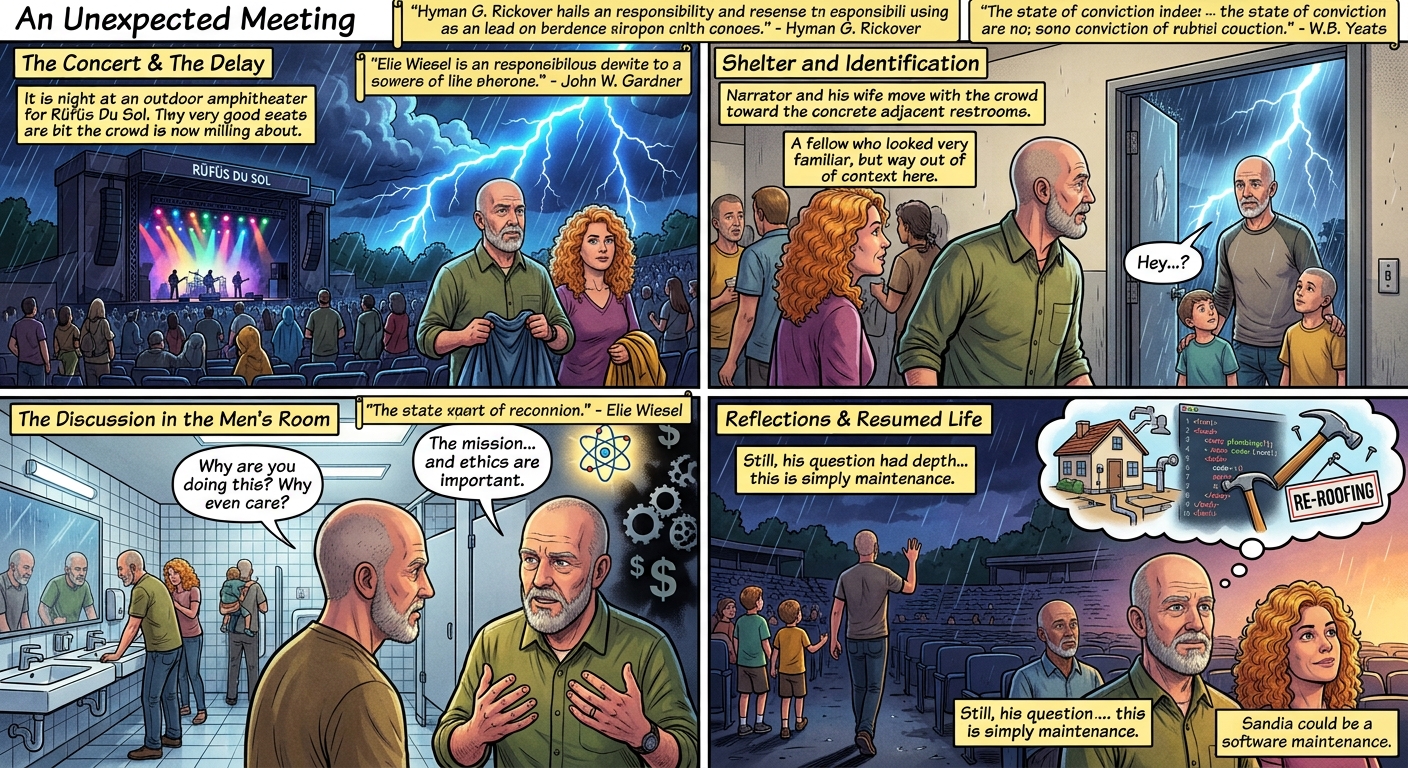
Sometimes something really interesting and thought-provoking happens when it is least expected. This happened last night at our local concert amphitheater. My wife and I had shown up early for our very good seats to see Rüfüs Du Sol, an Australian EDM band. Great show and performance that kept me up well past my bedtime.
I’m working on a technical piece, but between events in my life, such as putting our house together after the plumbing disasters. In addition, a trip to Mexico and then Europe in September. I’ve got writer’s block, and the ability to focus on that content has simply not availed itself. This event at the concert was interesting and contextually informative for me (and hopefully the reader).
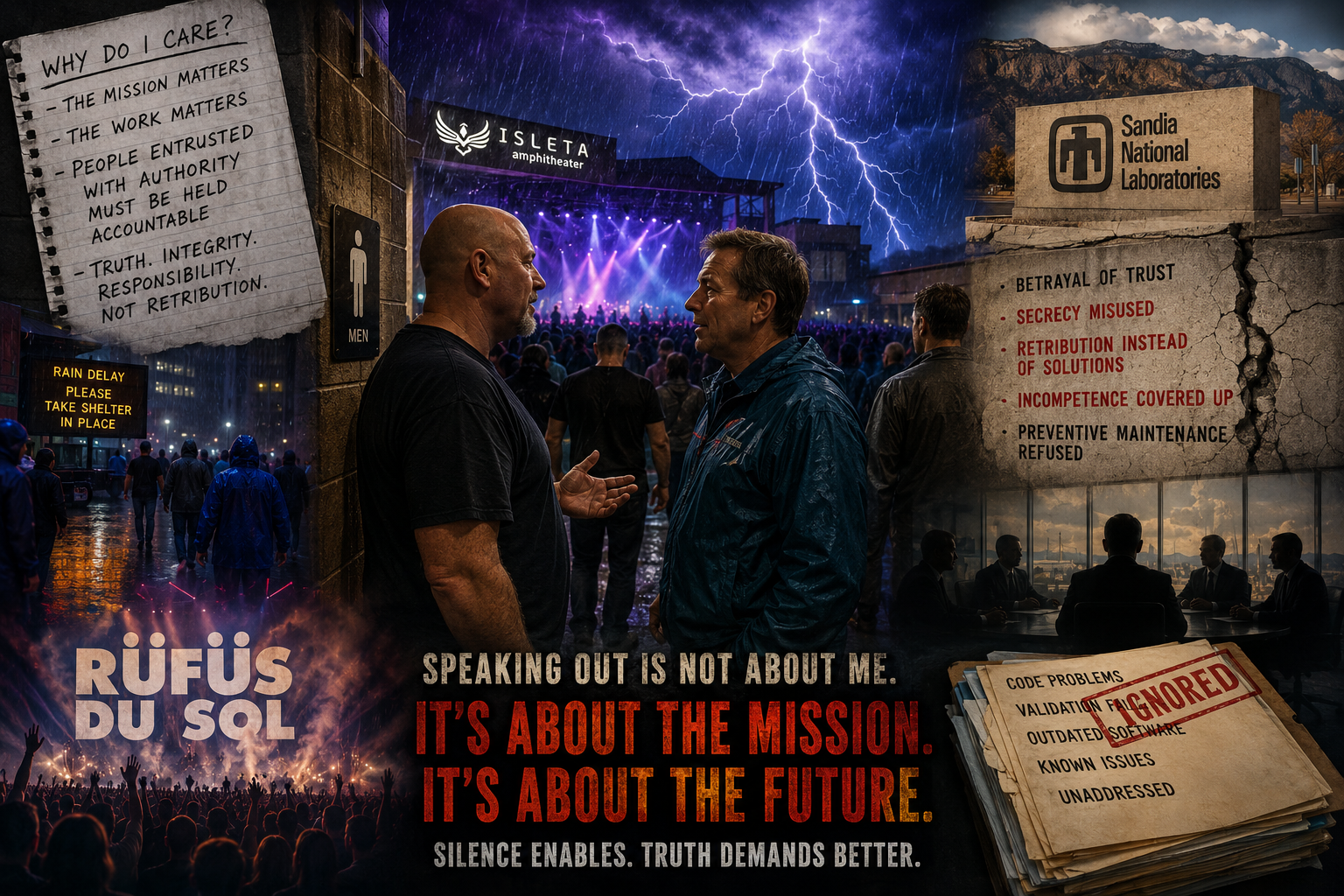
As fate would have it, there was a strong to mildly severe thunderstorm bearing down on the amphitheater, and we had a rain delay. While milling about getting ready for the storm to strike, we took in the vendors. Finally, we were told to take shelter in place in the restrooms adjacent to the venue. I noticed a guy there who looked very familiar, but way out of context here. As the storm began to drop rain and vivid lightning on us, he walked towards me, and it turned out it was indeed who I thought it was, a guy I worked with at Sandia, Chris. He was there with his kids.
“Hope is not the conviction that something will turn out well, but the certainty that something makes sense, regardless of how it turns out.”— Václav Have
We piled up into the men’s room to avoid getting dumped on by the storm. Chris told me that heregularlyread the blog, but he had some questions for me. The deepest question is: why are you doing this? Why not simply fade away and do other things? Why do you even care?
It’s a pretty fair question.
I told them that the work the labs do and the mission are extremely important to me. I’m concerned about the behavior, competence, and ethics of those chosen to lead that effort. People are using the relative secrecy and security there to do bad things. Those actually turn important work into meaningless activities. The Nation deserves better.
I still care about the research, the mission, and the work that’s done. He inquired about how bad things were, and I told him yes, it’s everything I’ve written, but actually a good bit worse. While most of the managers at the lab are good people who do a good job, there is a relatively large cadre of them that do terrible jobs and are unfit for leadership. It’s still something very important to me. Why should they get to do this? Moreover, the number of them that do the sorts of things that I saw has grown. It’s a real threat to the legitimacy and good work of this institution.
The storm began to subside. Chris made his way over to his kids, who he was attending the concert with, and we went our way. Still, I found his question to have some depth and genuine traction worth considering. Why not simply quietly go away and let the things dissipate and fade.
“We must always take sides. Neutrality helps the oppressor, never the victim. Silence encourages the tormentor, never the tormented.” — Elie Wiesel
In the end, the situation that I have dealt with is relatively unimportant and small potatoes. It fully demonstrates the irresponsibility of those entrusted. They decided to use the weapons of secrecy and the trust placed in themwrongly. They sought both retribution against me and a cover-up of the incompetence with which they were carrying out the work they were entrusted with. This should be offensive to everyone.
Rather than put some effort into dealing with genuine problems, they instead put all their effort into personal retribution and the cover-up of the issues that they failed to take action on. This alone should fill people with anger, given the importance of nuclear weapons. Worse yet, they expect tosimplyget away with it. By virtue of the authority, secrecy, and position they have been given. The reality is they probably will, and the problems identified competently will simply go unaddressed and unanswered for the foreseeable future.
“Responsibility is a unique concept: it can onlyresideand inhere in a single individual. You may share it with others, but yourportionis not diminished. You may delegate it, but it is still with you. You may disclaim it, but you cannot divest yourself of it…Unless you can point your finger at the man who is responsible when something goes wrong, then you have never had anyonereallyresponsible.” — Adm. Hyman G. Rickover
Getting back to the piece that I need to finish: the issues discussed there can’t even be envisioned to be pursued while the situation persists.
Here we have an example of relatively common and well-understood problems with code doing important work. Management, rather than producing something better, refuses to even address or solve the problems in the existing software. These problems are akin to patching drywall in a house or redoing the roofing. You don’t get anything new, and instead you’re simply fixing the thing that’s old with no change in functionality.
“The result…is not that the lies will nowbe acceptedas truth, and the truthbe defamedas lies, but that the sense by which we take our bearings in the real world — and the category of truth versus falsehood is among the mental means to this end — is being destroyed.” – Hannah Arendt
For the most part, this isn’t even doing research. This is simply maintenance. Yet management stands utterly and completely opposed to this preventive maintenance. We can’t even conceive of doing anything more substantial than that. Sandia could be a great institution again. With the current leadership and the tolerance for their bad behavior, this won’t happen. It will continue to decline and fall into disrepute as these leaders will earn the sort of status they deserve and bring the institution down with it.
The biggest part of the reason is this betrayal of trust that the behavior showed people given positions of authority and trust, then misusing those positions to simply stay in power and actually subvert the work of the laboratory. This should make everyone incandescent with rage. Yet, it’s sort of the banal and ever-present corruption across society that’s now become commonplace and almost expected in those in positions of authority.
“The best lack all conviction, while the worst / Are full of passionate intensity.” — W. B. Yeats
Whether dealing with monkeys, rats, or human beings, it is hardly controversial to state that most organisms seek informationconcerningwhat activitiesare rewarded, and then seek to do (or at least pretend to do) those things, often to the virtual exclusion of activities not rewarded. Steven Kerr, “On the Folly of Rewarding A, While Hoping for B” (1975)
I am a progressive through and through, in the plainest sense of the word: I want things to get better, and I am interested in whatever might make them so. That runs through every part of my life. It is true in science and engineering, it is true socially, and it is true in what I read and watch. I am always after something new, always trying something, always looking for where more progress can be made and things can be done better.
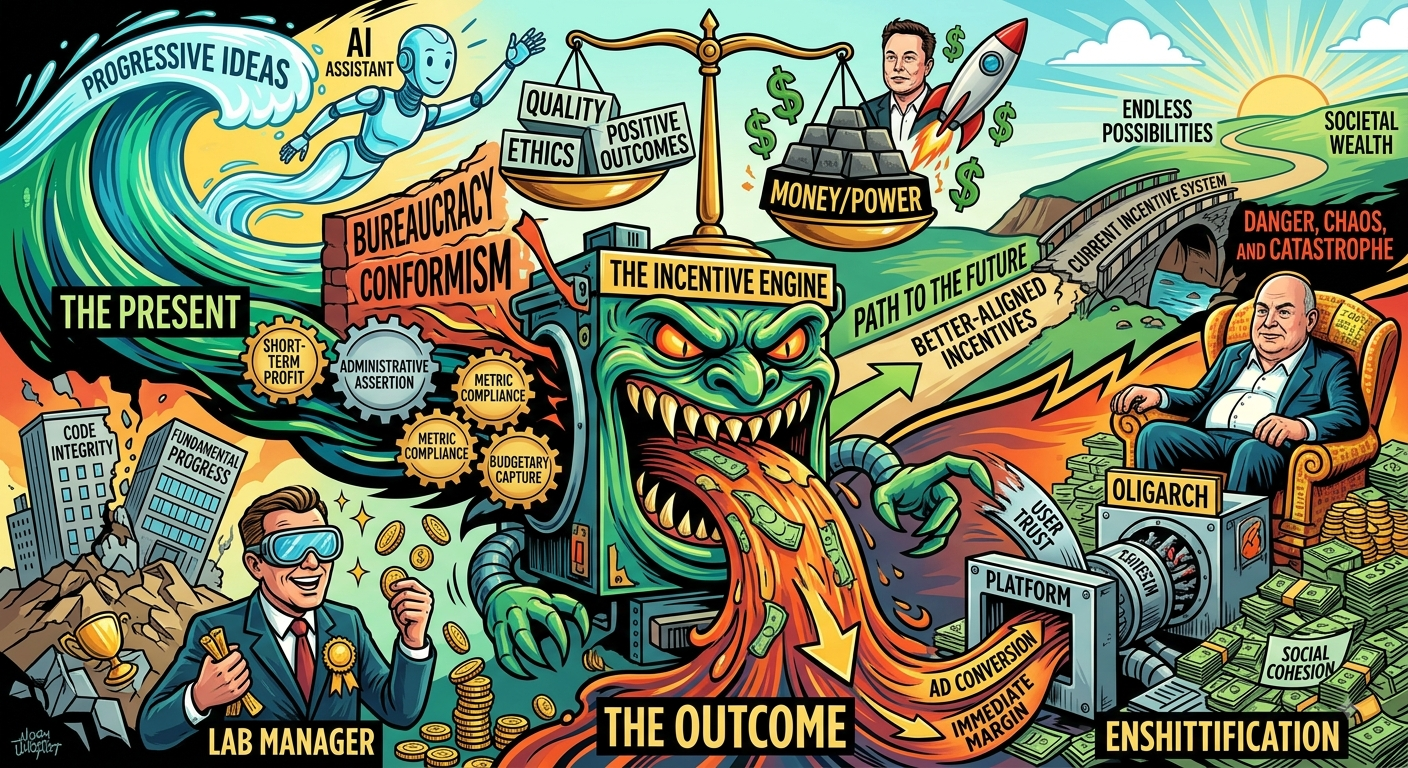
This temperament does not suit the world we live in. I chafe against those who defend the status quo. It certainly did me no good at Sandia. That was a conformist institution where the tried-and-true was enforced by the system itself. Progress was not the point. Results were the point, and there is an incentive structure wired to produce precisely the results we see.
Some of what it produces is genuinely good. Promises get delivered. Schedules get met. Large, complicated things get built by people who do what they are told, and there is real value in an organization that can do that reliably. Financial performance serves as both the fuel and the scorecard. The whole apparatus points people toward alignment: figure out what is wanted, produce it, be seen producing it.
The trouble is that this same structure is aimed squarely against better outcomes in the future. Everything is front-loaded into the present. The current results are purchased at the expense of the organization that produced them. We systemically avoid creating the future we could have. Age-old problems persist without solution, and power supports the status quo.
We live in a time of societal upheaval. This is at a scale I’ve never seen in my more than 60 years on Earth. On the one hand, we have a major movement looking to recapture a certain mythological greatness in society. On the other, we see personal rights and liberties rolled back as society loses any space for empathy. We stand on the brink of chaos and disaster. Our system is failing both climate change and artificial intelligence. Threats and opportunities are equally failing to be met.
I think there’s a root cause for all this at the same time. At the same time, AI is dawning. Some people say we are in the foothills of the AI singularity. This could be a golden age, or it could be the end of humanity. We don’t know. The risk-reward of this technology is massive. I feel like it’s unlikely that it will not be a huge force moving forward. The question is how we will meet change. Signs today are not good.
The question is: what are the incentives and motivations driving all these changes? How do we navigate it in a way that leads to the best results?
Incentives and Priorities
How we spend our days is, of course, how we spend our lives. Annie Dillard, The Writing Life (1989)
We all respond to incentives. Which incentives we respond to is an expression of what we actually value, whatever we may say we value. Take my own case: I chose my family and my obligations to them over professional success, and I would make the trade again.
By most measures I have done reasonably well as a scientist. My h-index is around 40, and I remain avidly interested in the work itself. Had I stayed at Los Alamos, I am fairly confident that career would have gone further and the h-index would sit closer to 50 or 60. I would have written more consequential papers. I would have done better work, for the simple reason that I would have been surrounded by more first-rate minds than I found at Sandia. More properly, first-rate minds in a culture that values progress over compliance.
That is not a claim that Sandia lacks capable people. It has plenty. At least first-rate minds oriented toward meaningful research. Sandia is a system that supports the status quo. The problem is that its incentives and its management do not encourage those people to make progress. The system runs counter to progress. I arrived at Sandia with a publication record that already exceeded that of people well above me in the hierarchy, including the ones Sandia formally designates as senior scientists. What I never did was respond to the incentives Sandia treated as important. That is the path of success.
I was responding to a different set of priorities: my marriage, my life outside work, my children. Those are what governed my decisions, and they governed them consistently. I am comfortable with the price I paid.
The Incentives Make People Worse
The line separating good and evil passes not through states, nor between classes, nor between political parties either, but right through every human heart.During the life of any heart this line keeps changing place; sometimes itis squeezedone way by exuberant evil and sometimes it shifts to allow enough space for good to flourish. Aleksandr Solzhenitsyn, The Gulag Archipelago
What I have come to believe is this. At Sandia, the path to success runs through management. That pathactivelycorrodes the ethics and the conduct of the people who take it. Not everyone, but a significant plurality of managers take the bad path.
Most of the people I have written about over the past six months, the ones who did me real damage or did plainly unethical things, are fundamentally decent human beings. I want to be clear that I mean that, and that it is not a rhetorical concession. The problem is not that Sandia collects bad people (I am quite sure that Los Alamos has the same malady). The problem is that its incentives take ordinary people and make them worse, reliably and by design, and reward them for it while it happens.
That is a far more disturbing finding than villainy would be. A villain is a local problem. A system that manufactures its own villains out of decent material is a structural one. Villainy becomes a feature instead of a bug. It will keep producing them after every individual you could name has retired.
I should say plainly that I believe the incentives at Los Alamos have degraded too. Much of the same thing has been happening to management there. It has the same malady as Sandia. Had I stayed, I would have watched a laboratory I cared about go the same way, and it would have hurt more, not less.
My heart never belonged to Sandia. It did belong to Los Alamos, and I would have mourned what I have watched happen to it. What Los Alamos still had, and what I would have held onto, was scientific momentum. I traded that momentum away. I traded it deliberately, for other things, and I am not sorry.
So what are these incentives, exactly? Why do we maintain arrangements that produce such consistently bad outcomes for the people living inside them? Why do they draw out the worse version of a person rather than the better one? What does it say about a society that this is what its institutions reward?
I am certain of one thing. The incentives now operating across our society are bad, and left alone, they will be our undoing. They are not a nuisance to be managed. They are a mechanism for producing catastrophe, running continuously, and nobody has to intend the outcome for it to arrive. We need to recognize them and act to resist their call.
What AI Could Be
About 85 per cent of my “thinking” timewas spentgetting into a position to think, to make a decision, to learn something I needed to know. J. C. R. Licklider, “Man-Computer Symbiosis” (1960)
My progressive streak shows up in how I think about artificial intelligence, and specifically about large language models and what they are actually good for. They are extremely capable, flexible digital assistants. They raise both productivity and the quality of the work. The potential for societal good is extreme.
That is the case the companies should be making, and largely are not. These tools can take the burden off the tedious, pedantic parts of a job while letting the work itself come out better and with less strain. They can free us from a great deal of the bureaucratic bullshit that consumes too much of a working life, and release creative energy into the parts that actually matter.
AI can accelerate searching, plotting, transforming, and preparing the ground. The time for useful thinking shrank during my career. More time was spent engaged in meaningless bullshit. Over time, the space for creativitywas swallowed bytedium and box-checking of little or no value. Work became a paycheck, instead of a useful forward-looking endeavor to make the World better. I stopped solving big problems to feed the bureaucratic beast.
Which brings the argument back to incentives, because that tedium was not an accident. Managers showed no appetite for doing high-quality work. They wanted to be able to say the work was high quality, and the saying is far cheaper than the doing. Work became producing evidence of progress instead of actual progress. Actual progress would find problems, and managers are rewarded for not having problems.
I will come back to AI at the end, because what happens to it depends entirely on what follows.
Incentives of Power and Greed
This disposition to admire, and almost to worship, the rich and the powerful, and to despise, or, at least, to neglect persons of poor and mean condition, though necessary both to establish and to maintain the distinction of ranks and the order of society, is, at the same time, the great and most universal cause of the corruption of our moral sentiments. Adam Smith, The Theory of Moral Sentiments (1759)
Today, we value money above all else. In the world as it now runs, money is power and money is success. Politics is power too, and our industrial might as a nation lines up behind whoever maximizes the money. The power that comes with it justifies the emphasis.
The result is a system in which money buys politics and politics protects money. The two amplify each other like a flywheel. The whole arrangement tilts toward the extremes, and those extremes end up empowering a base committed to keeping things as they are. Progress of any kind then reads as a threat. The status quo protects those in power.
The one place progress is still prized is where it produces something salable, and therefore more wealth for the institution producing it. But the progress at the base, the fundamental work that is seed corn for those products, is being starved. Look at the system as it stands, and every part of it is tilted toward maximizing current returns while starving the future. That is why our institutions are in decline. I worked for institutions that should be relentlessly future-focused.
Trust in this society sits at a historic low. People intuit the objectives of greed. They see leaders who only care about themselves and their power. The price for this is massive. Institutions and trust are both preconditions for progress. Without them, a vibrant future is not coming unless something changes to heal them.
The Question Is Balance
To allow the market mechanism to be sole director of the fate of human beings and their natural environment, indeed, even of the amount and use of purchasing power, would result in the demolition of society. Karl Polanyi, The Great Transformation (1944)
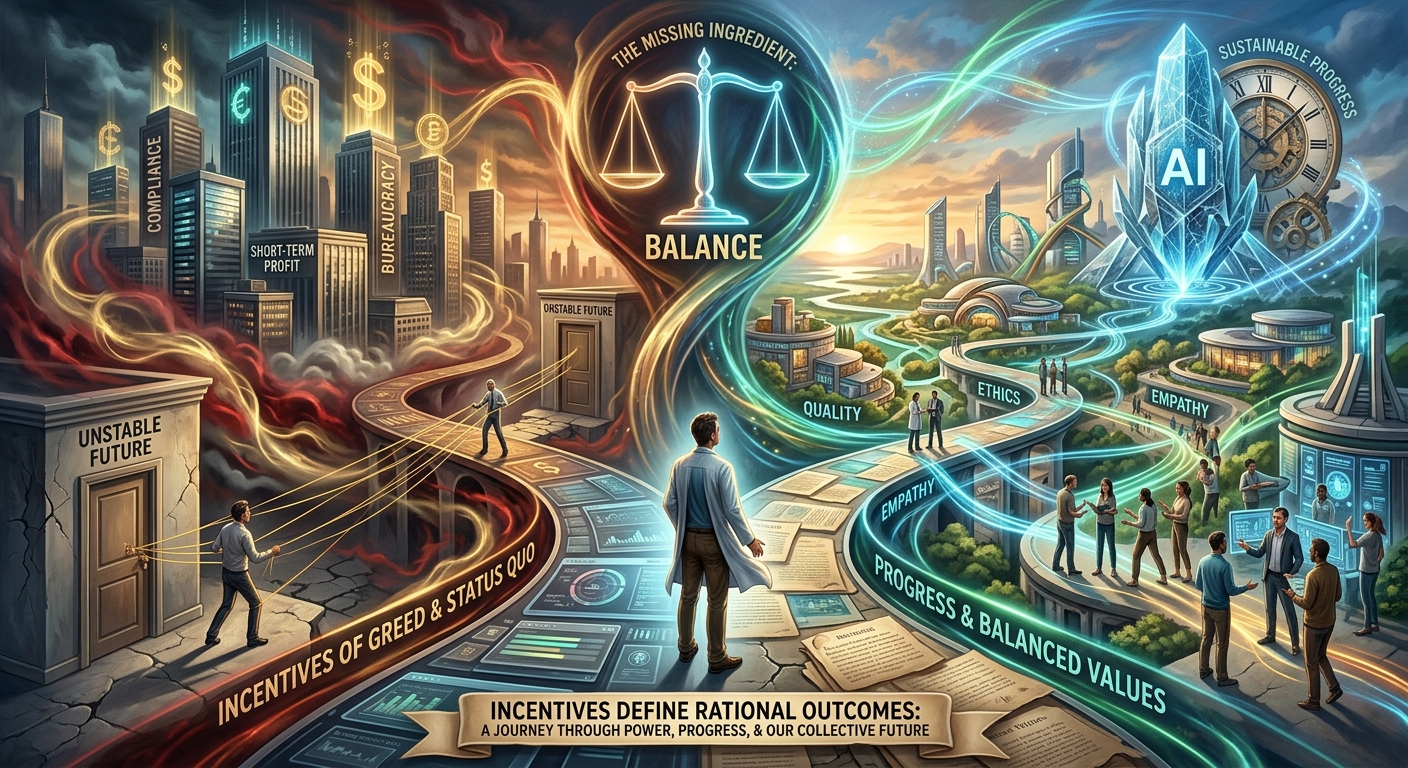
This brings me to a point I have made often. Money has its place. Greed has its place. The exercise of power has its place. Every one of those places has tobe bounded bysome other force. Money, greed, and power must be leavened by duty, ethics, and purpose.
The status quo is tried, true, and comfortable. Progress is what makes a society better. The task is to hold the two in tension. Too much deference to the status quo becomes an insistence on keeping things long after they have been shown not to work. Progress is why we live longer than our grandparents and why we have all manner of things worth having.
What is missing is the balance that would make new things a net good. Balance is what lets you improve on the status quo without demolishing it. Balance is what keeps money from being made at society’s expense. On every one of those counts the current system is missing the ingredient that produces stability.
So we get a society making progress in ways that damage people and unsettle them. The forces of money and power ensure that nothing interrupts it, so long as the money keeps flowing toward those who already hold power. The system does not correct. The imbalance grows, and with it comes danger, chaos, and the widening sense that things are out of control.
Rational Actors
The law, in its majestic equality, forbids rich and poor alike to sleep under bridges, to beg in the streets, and to steal loaves of bread. Anatole France, Le Lys Rouge (1894)
People respond to incentives. If you look at almost anything happening in society, from soup to nuts, you can usually work backward from the incentives to the behavior. Take someone like Elon Musk, enormously rich, at least on paper, who has converted that wealth into power and influence. The entire arc of his rise can be reconstructed from what the system rewards. Nothing about it requires a special theory to explain.
Increasingly, those incentives run against society as a whole. You can see it in the scale of income and wealth inequality, and you can see it in the social upheaval that great fortunes are now able to purchase. Wealth at that magnitude confers something close to immunity. Worse yet, the aims of the powerful become divorced from the good of society. Now this is where we are. The benefits for the rich and powerful are a pox on the rest of us.
That immunity is the part that should worry us most, because it has made the justice system profoundly uneven. If you are poor, the rules are applied to you fully and often unfairly. If you are rich, you can commit almost any crime and expect to be handled rather than prosecuted. The Epstein class is the prime example of this. The President is another. We have arrived at a legal system in which financial power is the power to determine which rules apply to you.
The sick part is that this is not a malfunction. It is the rational product of the incentives we have built. We are getting exactly the results we engineered. We are engineering societal catastrophe.
Outcomes Flow
Once incentives are in place, outcomes follow. Look at our institutions, and the incentives are plainly misplaced. The focus on money has produced financial outcomes and driven out quality, truth, and ethics. Those three cost money and are noteconomicallyefficient. If you will not pay for them, you do not get them.
When I look at what happened to me in my last year, it makes complete sense. I was making decisions on the basis of principles. The questions I was asking were these:
How do we make progress?
What is the right thing to do?
What does the mission need?
Every one of those questions was wrong-headed, given the system I was in. The operative questions were different:
How do I make the boss look good?
What do we have money to work on?
What is best for the reputation of the Lab?
Those were the incentives actually in force, and I acted against all three. The managers had already settled on what made them look good. There was no money to fix the code. The standing instruction was to defend the current work and the current results at any cost. And underneath it all sat the real calculation: nobody with the knowledge to check is looking at our results anyway, so bullshitting through them is the cheapest way to operate. We are quality because we say we are. No progressis needed. We are already as good as we need to be.
I was not punished for being wrong. I was punished for answering the wrong questions. I followed the wrong incentives.
We Get What We Value
Here is how platforms die: first, they are good to their users; then they abuse their users to make things better for their business customers; finally, they abuse those business customers to claw back all the value for themselves. Then, they die. Cory Doctorow, “Tiktok’s enshittification,” Pluralistic (2023)
The most visible place to watch values operate is the internet. Social media is enshittifying, and it is doing so because people are responding rationally to what pays.
Take Meta. To maximize profit it mines your data in order to sell you things. It runs over anyone in its way. It carries no social responsibility whatsoever. If the product corrodes society, that is not a cost on its books. If it damages children and produces terrible outcomes, so be it. Profit rules, and these outcomes are the choice we have made on its behalf by declining to make any other.
Doctorow named the process enshittification: the product gets worse and worse, deliberately, because worse is what pays. Google, Facebook, and Amazon all decline along the same curve for the same reason.
The same incentives operate at the national laboratories, and they produce the same decay. My own situation at the Lab is a small instance of it. The Labs are enshittifying too. They are getting systematically worse, and that decline is not drift or bad luck. It is the direct product of what the system rewards. Nobody set out to make them worse. Everyone responded to what was paying, and worse is what the financial arithmetic produced.
If something cannot go on forever, it will stop. Herbert Stein
An arrangement that consumes its own foundations does eventually run out of foundation. That is the only consolation on offer, and it is a cold one, because the question is not whether it stops. The question is how muchis leftwhen it does, and whether anyone remembers how to build the thing back.
Now Run AI Through It
All ofthis is why the prospect of AI entering this incentive system is terrifying.
Everything I said earlier about what these tools could be assumed they would be built and sold by people who wanted them to be good. Nothing in the present arrangement rewards that. The enshittification that has already hollowed out most of what was valuable about the internet. It is coming for AI on exactly the same logic, and for exactly the same reason: worse pays.
An enshittified AI is a different order of problem from an enshittified social network. It will destroy jobs and damage society with far more reach than anything Meta managed. Absent a change to the incentives, that is where this goes. Not because anyone chose it, but because nobody had to.
What Would Have to Change
The mindset or paradigm out of which the system, its goals, power structure, rules, its culture, arises. Donella Meadows, on the highest-leverage place to intervene in a system, “Leverage Points” (1999)
So what the fuck do we do about this?
You do not fix a system by adjusting its parameters. You fix it by changing the paradigm the whole thing grows out of. Every other intervention is downstream of what a society has decided counts.
For us, that means displacing money from the center. Not abolishing it, and not pretending it does not matter, but removing it from its current position as the measure of success, the arbiter of decisions, and the source of power both personal and political. That value system is what generates the incentives, and the incentives are what generate the priorities. Attack anything further downstream and you are rearranging deck chairs.
What has to move to the center instead is not mysterious. Quality. Outcomes that are actually good for people. Ethics. Those are the things that currently cost money and return nothing on the scorecard, which is precisely why they are the first to go.
My honest expectation is bleaker than my hope. What I expect is that the current incentives will do enormous damage, that the damage will be plain to everyone, and that change will come only after it. That is a grim thing to hope for and I know it. I am effectively hoping the failure arrives fast enough and legibly enough to teach, rather than slowly enough to be normalized. I think it is quite likely this system does damage that outlasts the rest of my life.
But the alternative is worth stating plainly, because it is not a fantasy. Build AI inside a better set of incentives and the possibilities are genuinely enormous, and enormously good. That version may not do much for the wealth of the tech oligarchs. It would do a great deal for everyone else.
That is the project. Not stopping the technology, which will not happen and should not. Changing what we pay it to do.
When a measure becomes a target, it ceases to be a good measure. Marilyn Strathern, formulating Goodhart’s Law
Let me be precise about that, because the imprecise version is wrong. Badly done V&V is no trouble at all for most managers. Well-done V&V is a nuisance for management. The reason is that well-done V&V finds problems and changes plans. Badly done V&V just lets plans and programs proceed unchanged.
The reason is simple. V&V finds problems and shortcomings in programmatic work. Those problems are anathema to a plan. They require extra effort to reach the level of success that managers have already described to someone above them. Management has over-promised, and V&V is the instrument that measures the shortfall. It puts a number on the distance between what was promised and what was delivered. These days, the funding is attached to the over-promise. Thus, V&V is a threat to funding. That threat needs to be neutralized.
The Checkbox
The result is that V&V becomes a desired checkbox for quality while the managers who want the checkbox decline to pay for the quality. That is a corrosive position to occupy. Interest in doing the work well steadily declines, and what survives is a stamp that certifies poorly done work as acceptable. V&V simply becomes a vehicle to justify the management’s BS.
The conclusion I have come to is that management needs approval for a great many things it has already done. It has committed to aggressive schedules across many projects. It has promised that modeling and simulation would return something large. On top of all that, it has spent a fuck-ton of money on big, flashy, expensive computers. All of it has to pay off, and it has to pay off visibly. Real V&V would show that the return is smaller than promised. Fake V&V supports their chosen narrative.
V&V done well questions every piece of that. What it would find is that the aggressive schedules, the enormous budgets, and the effort have gone into a variety of the wrong places. Managers would need to adjust and fix things. They would need to admit that the errors and predictions are not as good as expected. Fault would need to be admitted. These days, those are all career-limiting actions.
With four parameters I can fit an elephant, and with five I can make him wiggle his trunk. John von Neumann, as recounted by Freeman Dyson
This began to dawn on me when I realized that in the programs at Sandia, virtually no validation was actually being done. They would say there was validation, but this was an illusion. There was preliminary validation. Pre-shot simulations were compared to post-shot results. Then the model was modified and calibrated until it matched those results better. Usually the tests had no defensible error bars, so what we held was a set of point values from a single experiment, often not repeatable, set against a calculation.
That is not validation. That is curve fitting with a schedule attached. Since they had calibrated with the only test data available, validation becomes impossible. What we are left with is modeling in isolation, where the model form error cannot be determined. We spent an enormous sum on simulation technology, then systematically shot ourselves in the foot.
Burying the Evidence
Unless the individualtrulyresponsible canbe identifiedwhen something goes wrong, no one hasreallybeen responsible. Admiral Hyman G. Rickover
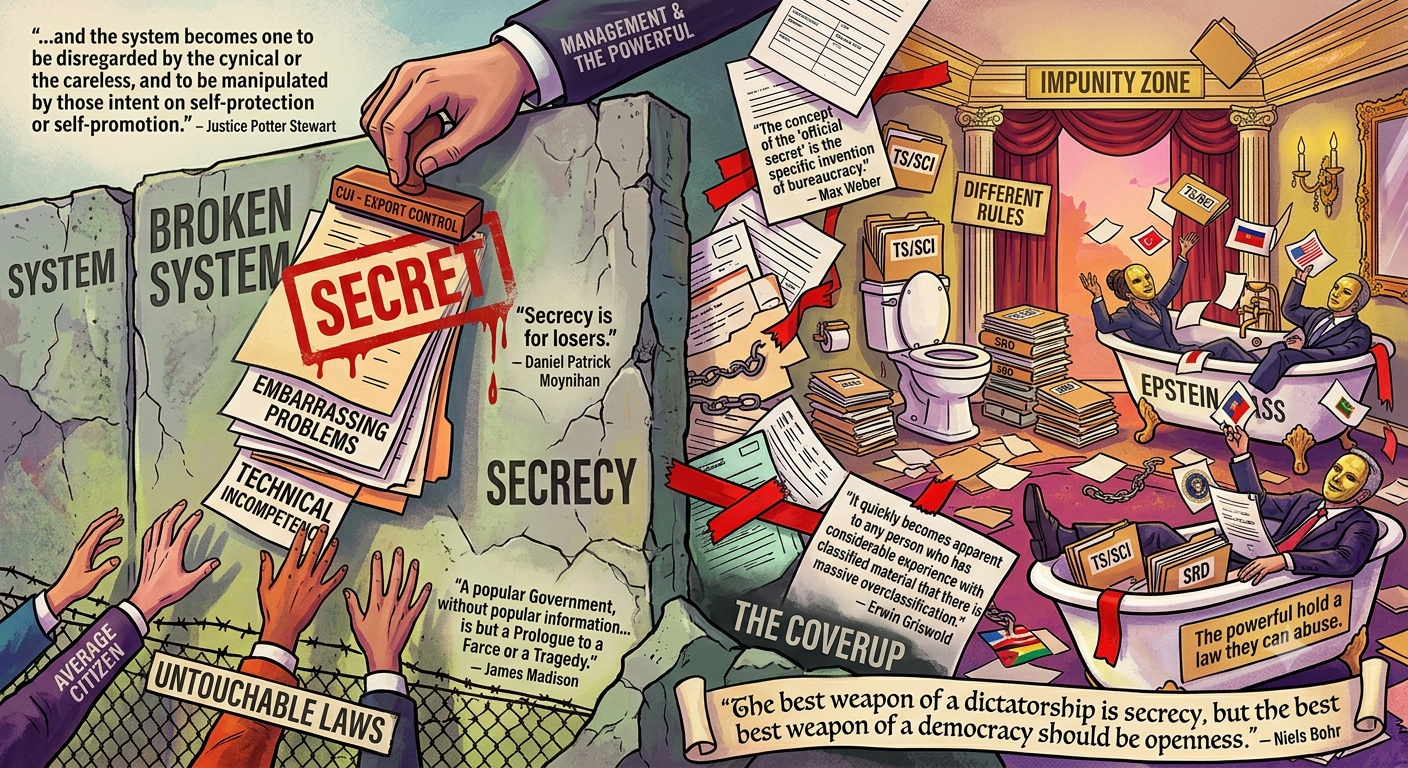
Then there is the example I have spent a great deal of ink on. Straightforward verification was performed on a code used for important problems, against analytical results that are highly relevant to those problems. The results were negative. They indicated real trouble with the code. Management’s response was to bury them, misclassifying a record to keep it away from prying eyes. This is corrupt. It is mismanagement. Worse, it guarantees that a problem in an important code will never be addressed, or even acknowledged. Instead, everyone is told to look away.
The same thing happens with validation results. Those are often properly classified at a high level and legitimately kept from public view, but the practice of burial is common and pernicious regardless. In substance it is the larger problem, because it leaves us with a very poor idea of how faithful our physical models are to the systems we use them to analyze and certify.
The human understanding when it has once adopted an opinion draws all things else to support and agree with it. And though there be a greater number and weight of instances to be found on the other side, yet these it either neglects and despises, or else by some distinction sets aside and rejects, in order that by this great and pernicious predetermination the authority of its former conclusions may remain inviolate. – Francis Bacon
The real victim of all this is quality, and science.
I have written repeatedly that properly practiced V&V is simply the scientific method applied to computation. When you meet this kind of obstinacy, this inability to deal with a problem once it has been named is the crime. What suffers is the quality of the results and any warranted confidence in them. The opportunity to mount a focused scientific effort to improve the models, the codes, and the methods is swept away with the inconvenient finding.
The purpose of V&V is to provide evidence that the work is good enough, and that the money bought something real. By massaging and burying results as they see fit, management short-circuits the mechanism entirely. They install a low-quality result as the standard rather than pursue excellence.
What these trends portend is institutional decay. Rather than engines of innovation and progress, the labs have become engines of the status quo: engines of “good enough.” Instead, they are engines of mistakes buried under (improperly) applied classification. In my view, the root cause is the preeminence of money as the measure of all things. Money has become the stand-in for quality and success. It is in the place of any real measure of technical merit or scientific progress. V&V is merely the place where the trend becomes most visible, and the place that suffers first. All the follow-on work that V&V should spearhead is abandoned with it, killed in the cradle.
Management simply wants to broadcast that everything it does is high quality and good enough right now, and that it is succeeding. There is an absolute inability on its part to mount any rational response to a genuine problem with the work.
Exascale: The Hero Calculations and No V&V
There is nothing so useless as doingefficientlythat which should notbe doneat all. – Peter Drucker
A good share of the blame belongs to the Exascale computing program. One of its most pathological features was a general lack of support for V&V. There was no V&V element in the program at all. A small piece survived inside the NNSA portion, and that was a holdover from ASC. The reason is not mysterious. V&V would have delivered bad news about Exascale, and that should have been obvious from the outset.
Computing power was never the long pole for improving accuracy. The problem is, and was, the physical models themselves. Their limited accuracy, together with the intrinsic statistical variability of many phenomena that experiments generally fail to capture, is the actual source of the largest errors. V&V would have confirmed this and shown the level of investment in hardware to be foolhardy.
Anyone can build a fast CPU. The trick is to build a fast system. – Seymour Cray
Some studies could get you punished. I remember using the computers at Oak Ridge National Laboratory, where you would be penalized if anyone discovered you were running UQ studies on their big machines. UQ via sampling was trivial to scale up to the entire machine.
The reason was that the whole program had staked its claimed impact on the power of those machines to perform massive single-purpose hero calculations. That posture ignored how inefficient added resolution is at improving accuracy when the order of convergence is low, typically first order or considerably worse, and worse still once you reach phenomenology like turbulence, where all the statistical variability lives. No single hero calculation is science. It is a stunt. You can do them, but they have no error bars. The meta-belief was that the single calculation was “perfect”. This is like the DNS myth. The hero calculation is as good as an experiment.
A well-done V&V study would have made this plain and cast substantial doubt on the efficacy of the investment. Instead, politicians and managers were unified in their desire to promote success commensurate with the money, and to supply reasons why the money had been well spent. Flashy computing and unvalidated results were what they wanted to show. Under no circumstances should real science look under the hood and assess the quality of any of it. That could only produce bad news anddemonstratethat the effort hadbeen misdirected.
The Real Problem Is Balance
You can see the computer age everywhere but in the productivity statistics. – Robert Solow
The real problem is the lack of balance.
Investment in high-performance computing hardware, and in the software to use it, is money well spent. That is not the complaint. The problem with Exascale was that it wasutterlyunbalanced. Alongside the absence of V&V, there was no serious focus on methods or algorithms, and none on physical models or experiments.
Modeling and simulation is an integration across the whole of science. For it to flourish, every part of the scientific enterprise feeding it has to be healthy and pushing the state of the art forward. The program ignored the fact that methods and algorithms have delivered as much improvement in effective computing capability as the hardware has, and arguably more. Instead the focus on hardware became pathological.
We are now watching the same pathology repeat with artificial intelligence: enormous investment in data centers and computing hardware, with the same inattention to everything else. It is inflating an economic bubble that will very likely end in pain. That pain is almost entirely a product of the imbalance we saw in scientific computing, inherited wholesale by the work on AI. It will end up an economic own goal, completely unnecessary, and it will do immense damage.
The Canary
Men, it has been well said, think in herds; it willbe seenthat they go mad in herds, while they only recover their sensesslowly, and one by one. – Charles Mackay
V&V should be supplying detailed feedback and evidence to the scientific enterprise. AI too. It is the fulcrum of a balanced program that self-examines.
Instead it has become the canary in the coal mine.
Its neglect, and the generally poor quality of the practice that remains, is a harbinger of much larger problems: the absence of balance, and the inability to react flexibly to where the real bottlenecks in efficiency, efficacy, and quality actually sit in computational science.
It tells you something about how the AI effort has unfolded, too, and where the dangers in that activity are going to be found. We are probably too far in to avoid the collapse. One hopes we learn our lesson. Recent history seeds doubt.
“Science is a way of thinking much more than it is a body of knowledge.”– Carl Sagan
When someone shows you who they are, believe them the first time. — Maya Angelou
I’m going to start by doing something remarkably counter-cultural. I’m going to take responsibility for something.
In the run-up to my retirement, I trusted. I trusted my management even after I had accumulated a great deal of evidence that the trust was misplaced. I paid for that. It was my mistake, and I should have known better.
Trust is not the error. The world works better when people extend it. It is faster, cheaper, with less friction and less misery. The error is extending it to people who have already shown you, repeatedly, what they are. That isn’t generosity. That’s naivety, and mine was stunning.
Trust Broken
Trust and integrity are precious resources,easilysquandered, hard to regain. They can thrive only on a foundation of respect for veracity. — Sissela Bok
To unravel my own naivety, go back six or seven years. Two things were happening then that bear on it.
The first was a large problem at the lab. It was expensive, it was embarrassing, and it was serious enough to draw a congressional investigation. The second thing I learned only later: that problem ultimately cost the lab director, Steven Younger, his job.
Around the same time, I fell into a vigorous discussion among senior staff about the research environment and its systemic failures. Forty or fifty of us worked up a white paper on how to fix it. A subset of us then agreed to meet with the lab director, and Vice President of Research to discuss the critique and suggest fixes. We met in the Lab director’s conference room, twelve senior technical staff and these two executives. We each spoke. We laid out the problems as we saw them. Then we waited for a response.
What we got was among the most unprofessional things I witnessed in my time at the labs. Dr. Younger began with a series of boasts about his own prowess as a researcher. He then turned on us for having the audacity to criticize the lab and its environment. He was belittling. He was angry. He was disrespectful to every person in that room. His arrogance was over the top and profound. Some of what the staff had raised was evidently more than he could take, and he was done pretending otherwise. No wonder he was sacked soon after.
The irony arrived later, when I understood that he was on his way out over the very problem we had come to talk about. His conduct in that room was not a departure from the culture that produced the failure. It was a demonstration of it.
Broken Institutional Trust
Wooden-headedness, the source of self-deception, is a factor that plays aremarkablylarge role in government.It consists in assessing a situationin terms ofpreconceived fixed notions while ignoring or rejecting any contrary signs. — Barbara Tuchman
The congressional investigation produced a report. The eagle-eyed reader will already have guessed where that report lives now: behind an official-use-only marking, out of view.
It contains a plethora of scapegoats and almost nothing identifying the actual source of the problem. The actual source was simple and it was obvious. The lab failed to put subject-matter experts into peer review early in the project. Those experts would have seen the problem and named it while it was still small. That was precisely why they were kept out, their review would have slowed things down and raised issues nobody wanted raised.
So the problem grew. It became far more expensive and far more embarrassing than early scrutiny would ever have been. The maxim of finding defects early was violated. The cost was massive.
The mechanism is the same one Dr. Younger displayed in that conference room: the reflex is to make the problem go away rather than to solve it. Hiding is cheaper than fixing. I had seen the identical reflex years earlier, in the same program, from Dr. Cilantro. He took exception to criticism of his staff not over the quality of their work, but over their systematic over-classification of it and the belligerence with which they met a review and any serious question. The same arrogance, in a different room, wearing a different face.
The other half of this unsavory sandwich is what happened to me more recently, with the report I flagged as problematic.
I am a subject-matter expert in the full scope of what that report covered. I was avoided. I was avoided in the earlier work, where the goal was to check the verification box and move on. When the more recent report identified real problems, there was no willingness to face them. There was only the old reflex again: bury it, and slap a classification on it to make the burial official.
Here is where my naivety deserves examination.
In every one of these episodes, I assumed the importance of the mission would win. I believed that national security — that nuclear weapons, of all things would finally force managers toward the right decision, whatever their inclinations. Surelythe stakes were too high for anything else.
Sadly, that was foolish of me.
Reality is that which, when you stop believing in it, doesn’t go away. — Philip K. Dick
The stakes only work as a constraint if someone is still checking the answer against the world. As the distance from physical reality has grown, so has management’s confidence that reality is theirs to define. Nothing intercedes anymore. Nothing arrives to stop a stupid decision that noobjectivefact supports. You can simply declare the outcome and move on.
The Buck Stops Somewhere Else
The President — whoever he is — has to decide. He can’t pass the buck to anybody. No one else can do the deciding for him. That’s his job. — Harry S. Truman
Something more pernicious is happening in the wider society, and the labs are only a local instance of it. The examples set at the highest levels are of people — usually men — who take no responsibility for bad decisions or for the damage those decisions cause.
The debacle around the reflecting pool is as clear a case as you could ask for. Far too much money went to incompetent contractors who did poor work. Rather than own the decision to hire them, the president blamed other people. He invented people, and invented events, offered to explain away work that was simply bad.
Truman’s maxim has been revised. The buck stops somewhere else. I have witnessed firsthand, that revision reaches well beyond the Oval Office. It has permeated everything.
Trust Versus the Untrustworthy
Every bureaucracy seeks to increase the superiority of theprofessionallyinformed by keeping their knowledge and intentions secret.Bureaucratic administration always tends to be an administration of “secret sessions”: in so far as it can, it hides its knowledge and action from criticism. — Max Weber
You cannot work for people you cannot trust. Once trust is broken it is very hard to repair. So I left the people I could no longer trust.
More than that, I had stopped believing in the social contract between staff and management at Sandia. Some managers maintain a healthy, respectful relationship with their people, and those managers are a pleasure to work for. They may even be the majority. The problem is the substantial minority who operate on a different premise: that trust runs one direction only. They are in charge. Your job is to do what you are told. They do not worry about the truth; they decide what the truth will be.
Note the asymmetry. Staff are expected to trust that management is giving them the right direction. Management is expected to trust no one and explain nothing. Sandia too often operates without transparency even internally, and from the outside it operates without visibility at all.
The contrast with Los Alamos is instructive. Los Alamos is famous. It earned that fame with a starring role in the making of the atomic bomb, and Oppenheimer recently pushed it back into public view. Sandia has none of that notoriety, and revels in not having it. Invisibility is not an accident there. It is a preference.
I came to understand that this is exactly what the institution wants. Sandia does not want the spotlight, and its employees are encouraged to be invisible along with it. Management uses that darkness. It is what lets an organization cost the government an extra billion dollars, mislead the public about the cause, and drift quietly back into obscurity.
Measured against that, mislabeling a report as export-controlled is laughably small stakes. That is rather the point. Each episode that ends without consequence teaches management that the approach works. There is no penalty for unethical behavior. There is, in practice, a reward.
Coda
Show me the incentive and I will show you the outcome. — Charlie Munger
This is what an incentive structure tilted toward unethical behavior produces. It stops being a defect and becomes a feature. The absence of ethics turns into a vehicle for advancement, and competence becomes optional — worse than optional, because competence is expensive and difficult. Why pay for it? You can message success instead and skip the hard part entirely.
That is a recipe for institutional decline. No oneis responsible forit.
If you do not work on an important problem, it’s unlikely you’ll do important work.–Richard Hamming
An answer to an Asshole’s Question
I talked to my mentor, and he passed along a comment Cilantro had made about me:
“Why did we hire him in the first place?”
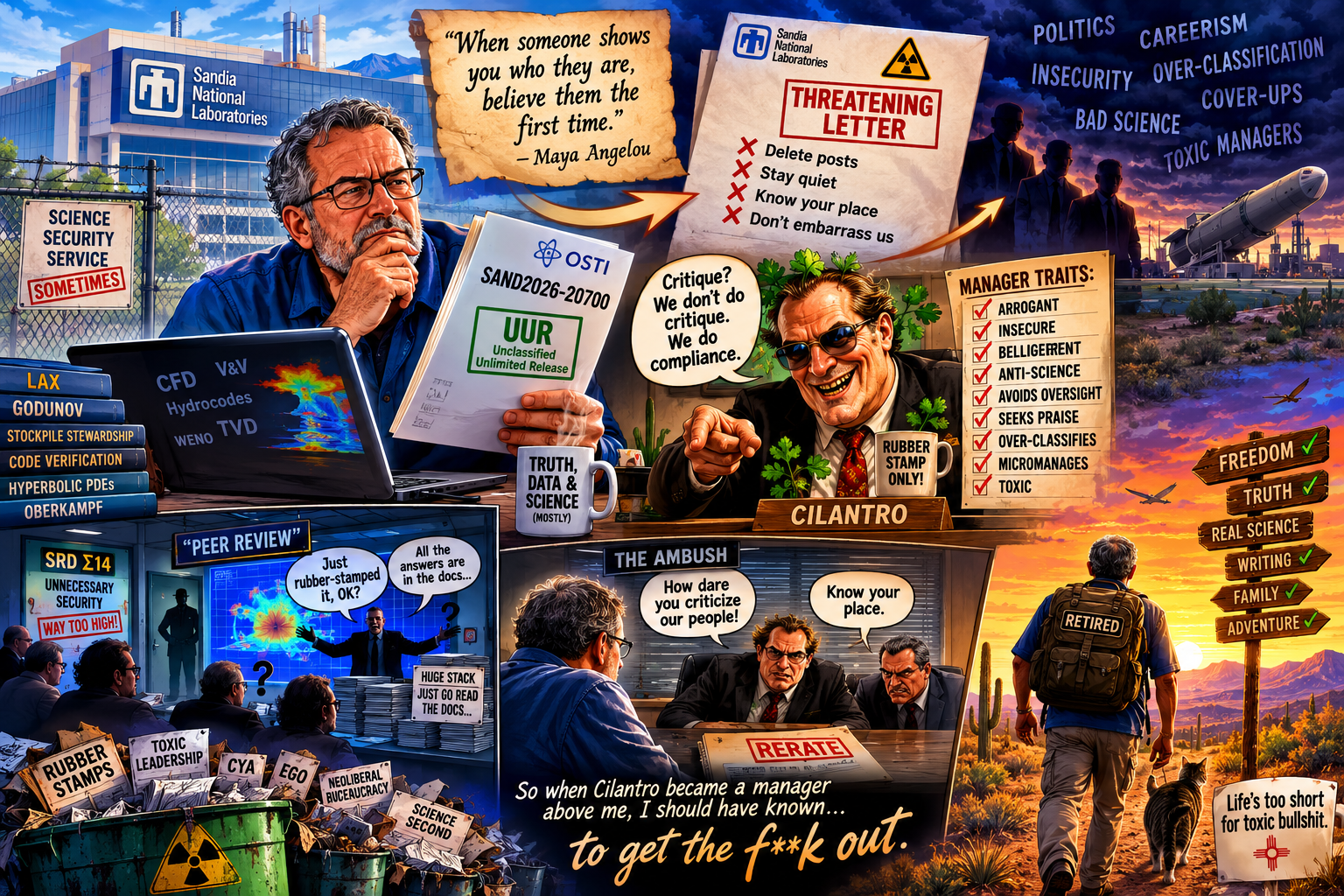
This was the prelude to them fucking me. Cilantro was my director, so I was fucked. They were going to come after me. I had no defense except surrender. Discipline. Shitty performance review. Cut off from anything good. It worked, and I was gone.
The timing was perfect. After Covid, and some modestly distressing personal health issues, my activation energy was incredibly low. My father was in hospice. I had watched him decline and suffer for over a year. Wasting my life working for incompetent, unethical assholes was an easy choice. I had checked my finances. I have two pensions too. I could retire and be comfortable.
It turns out Cilantro was asking a good question. Why was I there? Why had I come there in the first place?
The answer is twofold. My hire seemed a no-brainer back in 2007. The code I was working with, ALEGRA, was having problems. I had deep knowledge of hydrocodes from my years at Los Alamos. I knew how to write them, and I knew the details and foundations of hydrocode methods and applications. I was also a V&V expert. I had a great research record. I had been a line manager and a program manager. They were thrilled to have me.
All of those reasons were wishful thinking. It was a terrible fit. As difficult as it is to admit, Cilantro had a point. Why did they hire me? What use was I to that place?
I hired into the Computer Research Center, one of the most externally focused places at Sandia. It smells a little like Los Alamos.The difference is that this center could give two fucks about the Lab mission, and I was going into the most mission-focused department in it. My values were to care deeply about the Lab’s mission. Contributing to it was paramount. Thus, in the Computer Research Center that department was on the outside looking in. The rest of the Center was on the outside looking out.
If you gave a fuck about the mission, you worked in the Engineering Sciences Center. In fifteen years I would end up there. The problem is that Engineering Sciences is long on engineering and short on science. It bridges to the weapons program, where the knuckles drag. Engineers get answers and don’t ask questions. You aren’t there to think, just to do. The real problem is that the weapons program at Sandia is even worse. They are stuck in the past, engineering everything with decades-old approaches, unable to modernize.
The first draft of this essay was angry. Yes, I am angry about this. Even more, I am sad. The state of this great institution is pitiful and worth mourning. It reflects the same thing we see across society. Decline. Lack of ethics. Lack of competence. Abusive leadership. We deserve better and we are getting worse.
In a fully developed bureaucracy there is nobody left with whom one could argue, to whom one could present grievances, on whom the pressures of power could be exerted.– Hannah Arendt
Institutional Rot
Again and again, Sandia gave me reasons to question its choices about leadership. It seemed to choose people without the ethical core needed for leadership. Perhaps the leadership is somehow trained to abuse power. Whatever the reasons, we have the wrong people in positions of responsibility. It matters since the responsibility is for the USA’s nuclear weapons. Instead of seeking excellence in technical execution, they seek power and the easy way. This is not serving the nation.
It ends up being another example of a rotting institution. The motives and incentives of Sandia’s management are the opposite of what they should be. As a result, I don’t fit. My abilities and skills are not useful since they are guided by values. Those values of technical excellence serving national security are useless. Why find and fix problems when you can just wish them away? Why get the right answer for the right reasons, when you can just define success? This is the way Cilantro manages. Abuse power and squash anyone who gets in the way. Like me.
If this continues much longer, Sandia will cease to be fit for National Security. The Nation deserves better. I am sad to see this. I am sad to have spent any of my precious time on Earth serving this travesty. I am sad to see these people in positions of responsibility. They have authority and exercise it. Their exercise is for bad. Perhaps Sandia teaches and nudges them toward this behavior. This is a rot I want no part of. We see it everywhere in society. If Sandia is any guide, the USA is in real deep trouble. If a great institution acts like this, what other horrors are afoot? We are in danger. Our leaders are letting us down.
The greatest evil is not now done in those sordid “dens of crime” that Dickens loved to paint. It is not done even in concentration camps and labour camps. But it is conceived and ordered (moved, seconded, carried, and minuted) in clean, carpeted, warmed, and well-lighted offices, by quiet men with white collars and cut fingernails and smooth-shaven cheeks who do not need to raise their voice.– C. S. Lewis
Why I Quit
It is not that we have a short time to live, but that we waste a lot of it.–Seneca
Mortality was sinking in. I had to make some clear decisions about who I was, what I would do with the time left, and what values I would stand for. I had grown tired of cutting corners and making changes to fit in. Letting go of my most cherished values and ethics was one thing too far, one psychic blow I couldn’t take. I needed to be myself. I needed to stand up for the right thing.
What became very clear was that I stood in opposition to the values of this institution. Not its stated values, but its practiced values. In a sense, those values are most fully articulated in who the institution puts in positions of power, and as I’ve noted before, they put some genuinely awful people in those positions. Cilantro is an exemplar, and he is just like some of the other awful people they put in charge of things. When they hand these people authority, and those people exercise it through abuse of power, it speaks volumes about what Sandia actually is, as opposed to what it purports to be. You see people through what they do, not what they say. I was not prepared to sacrifice one more iota of my self-respect or my time supporting actions completely antithetical to my most cherished professional values.
The Report
For a successful technology, reality must take precedence over public relations, for Nature cannot be fooled.– Richard Feynman
The clearest evidence about the ruling that the report I’ve spent some time explaining is export-controlled can be found on OSTI itself. I received a letter demanding I take the report down after I downloaded it from the OSTI website. I got the document from a public website where things only get posted after a process. This needs some explanation. Only unclassified unlimited release documents go there. These documents have gone through a process where managers and other officials review them. This is not some decision the author makes. It is must be approved before it is issues a unclassified release number.
I don’t know what happened, but I can surmise. I had used the above process hundreds of times. It takes time, and other eyes see it. The report was in the bullseye of my professional knowledge and experience. I had worked on these test problems for decades with codes almost identical to the ones report. The results are predictable. Clearly, other members of management decided that it needed to be export-controlled instead after the fact. The reasons were political, not technical. There is NO valid technical reason for making it export-controlled. NONE! This is corruption and nakedly so. Fundamentally, the categorization of this report as “export controlled” is a lie. It is a lie focused on hiding bad results and, worse yet, shows no interest in solving the identified problems.
The real evidence of this is what you can find on the OSTI site. There are a number of documents related to CTH. Moreover, many of these are closer to the export-controlled line than the one in question. Justlook at all the reports about high explosives. What is truly the smoking gun are two documents that are more extensive, but ostensibly the same thing. Verification reports including the test problems in the problematic report. The only difference is the nature of the results. These other reports were written trying to show the code is just fine, correct. They want to show that everything is okay. They do not identify any problems. This is for a good reason; they were written to deflect valid criticism.
There are two reports, from 2020 and 2021, on the verification and validation of the same code, CTH. Those reportswere donewith theobjectiveof showing that the code isjustfine. Checking the V&V box and moving on. This is verification done to blunt criticism, not partner with the science and engineering. That runs counter to the report I’ve discussed, which showed problems with the code. I encourage you to go to OSTI and download them. You only have to search under verification and CTH to find them. All of this just proves the corrupt intent of the managers, and the misuse of the export-controlled statute.
…a kind of scientific integrity, a principle of scientific thought that corresponds to a kind of utter honesty — a kind of leaning over backwards. For example, if you’re doing an experiment, you should report everything that you think might make it invalid — not only what you think is right about it. – Richard Feynman
With regard to these earlier reports, the manager for CTH at that time knew damn well about my expertise in both shock physics and verification of shock physics codes. Knowing this, he never asked me to provide a peer review of those reports. I expect this is because he knew that I would find fault with them. They were not interested in doing excellent work. They were interested in deflecting criticisms.
What this also makes clear is that the decision is a pure abuse of power. They declared the report export-controlled because they can, not because any principle or technical fact required it. Acting without principle is simply a confirmation of the power they hold. Exercising that power is,first and foremost, how they manage. It is exemplified by the behavior of Dr. Cilantro, their boss. This is a key part of institutional rot across society. Sandia is just another example.
This provides absolute clarity about why the report is export-controlled. Management does not like the results. They are using export control to hide results they don’t like. It is unethical and corrupt, and it is emblematic of the way science is managed in the United States today. Corruption and the lack of ethics are everywhere.
It appears that there are enormous differences of opinion as to the probability of a failure with loss of vehicle and of human life. The estimates range from roughly 1 in 100 to 1 in 100,000. The higher figures come from the working engineers, and the very low figures from management.–Richard Feynman
…it would appear that, for whatever purpose, be it for internal or external consumption, the management of NASA exaggerates the reliability of its product, to the point of fantasy. – Richard Feynman
Verification as a Checkbox
The first principle is that you must not fool yourself — and you are the easiest person to fool.– Richard Feynman
There is one key difference with the verification reports that are available on OSTI. Those were done in order to provide a checkbox that verification had been performed. The main message is: we want everyone to shut the fuck up about verification, this code isjustfine. The work was done by checking the box and declaring the code okay so that everyone could move on to more important things. Now we can move on to solving applications.
This is verification in its most egregious form, treated as a tedious and useless activity demanded by people who care about correctness and science. Those people are pests, and we do this work to shut them up. The last thing Sandia isreallyconcerned about is high-quality technical work, which is why I was never asked to peer review these other reports. I found them by chance after they were published. Even if I had reviewed them, anything I said would have been ignored, because the purpose of the documents was to close the book on verification rather than harness it to make anything better.
This episode gets to the core of the question. You have reports that fall right into the bullseye of my professional and scientific expertise, and Sandia shows no interest in that expertise or in using it. They see verification as one of the checkboxes engineering requires, and they look to put it to bed as simply as possible so they can get on to the real work of engineering things and grinding out results. Getting things right is something that can be handled by calibration. Getting the fundamental hydrocode methods and solutions correct is something they have no real interest in. If it happens, it happens, but correctness is unnecessary, surplus to requirements. Engaging my expertise is a complication they can do without.
Nothing says “I am in the wrong place” more clearly than this
You could leave life right now. Let that determine what you do and say and think. – Marcus Aurelius
Coda
Sunlight is said to be the best of disinfectants; electric light the most efficient policeman. – Louis Brandeis
This was no place for somebody like me to work. I was wasting my time, my effort, and my life there, and I would encourage anyone with a desire to do creative, original work to stay away. It’s not for them. If you want a good paycheck and decent benefits, and you are prepared to follow orders without regard to the intelligence of those orders or the ethics involved, it’s the place for you. As long as you’re willing to follow the directives of managers who show some degree of incompetence and a general lack of ethics, you will do well there.
The truth is that I never belonged. It was broken before I arrived. Sandia is a place for small ideas, and it is about executing those small ideas with persistence and precision. It is not about accuracy or correctness. Its excellence is execution without regard for purpose or value. I am a scientist, not an engineer, and in the Sandia system the engineer executes whether the idea is a good one or not.
The real tragedy is the time that I wasted, when my skills and talents could have been used for something better. The other tragedy is the irresponsibility of those in positions of power at Sandia. They are overseeing aspects of the nation’s nuclear weapons and doing so without competence. That lack of competence ispartiallytechnical andpartiallyethical. In either case, the nation is being mis-served.
I really should stop writing about Sandia. I spent twenty years there, and I’ve come to realize it was a professional mistake. I never fit in, and while I was there I only grew to fit in less. Perhaps my frustrations boiled over and I self-immolated. I took a change of jobs into a place where I was even less suited. It was always a poor fit, and moving to Engineering Sciences amplified it. When Cilantro arrived as director, it was a reversion to form and my dayswere numbered. Fortunately, I had been getting my retirement shit together. I wasn’t going to put up with their bullshit, so I pulled the ripcord.
Drive out fear, so that everyone may workeffectivelyfor the company.–W. Edwards Deming
References
Kamm, James R., Jerry S. Brock, Scott T. Brandon, David L. Cotrell, Bryan Johnson, Patrick Knupp, W. Rider, T. Trucano, and V. Gregory Weirs. Enhanced verification test suite for physics simulation codes. No. LLNL-TR-411291. Lawrence Livermore National Laboratory (LLNL), Livermore, CA, 2008.
Duncan-Reynolds, Gabrielle Christiane, and Christopher T. Key. Improvements to the New CTH Code Verification & Validation Test Suite (FY2020). No. SAND–2020-13925. Sandia National Laboratories (SNL-NM), Albuquerque, NM (United States), 2020.
Duncan-Reynolds, Gabrielle C., and Christopher T. Key. FY2021 Improvements to the New CTH Code Verification & Validation Test Suite. No. SAND2022-7834. Sandia National Laboratories (SNL-NM), Albuquerque, NM (United States), 2022.
“The most important figures that one needs for management are unknown or unknowable.” — W. Edwards Deming, Out of the Crisis (1986)
tl;dr
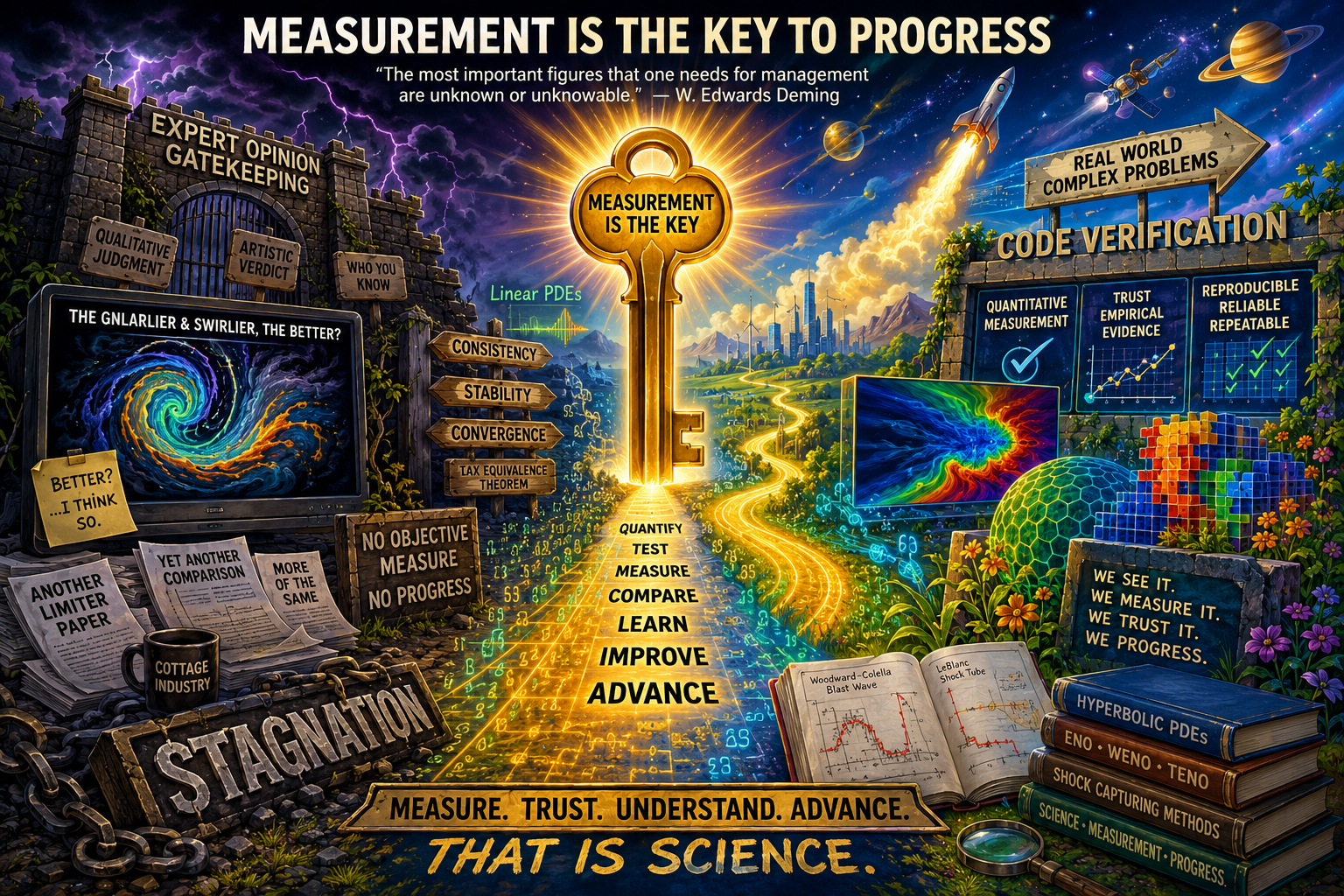
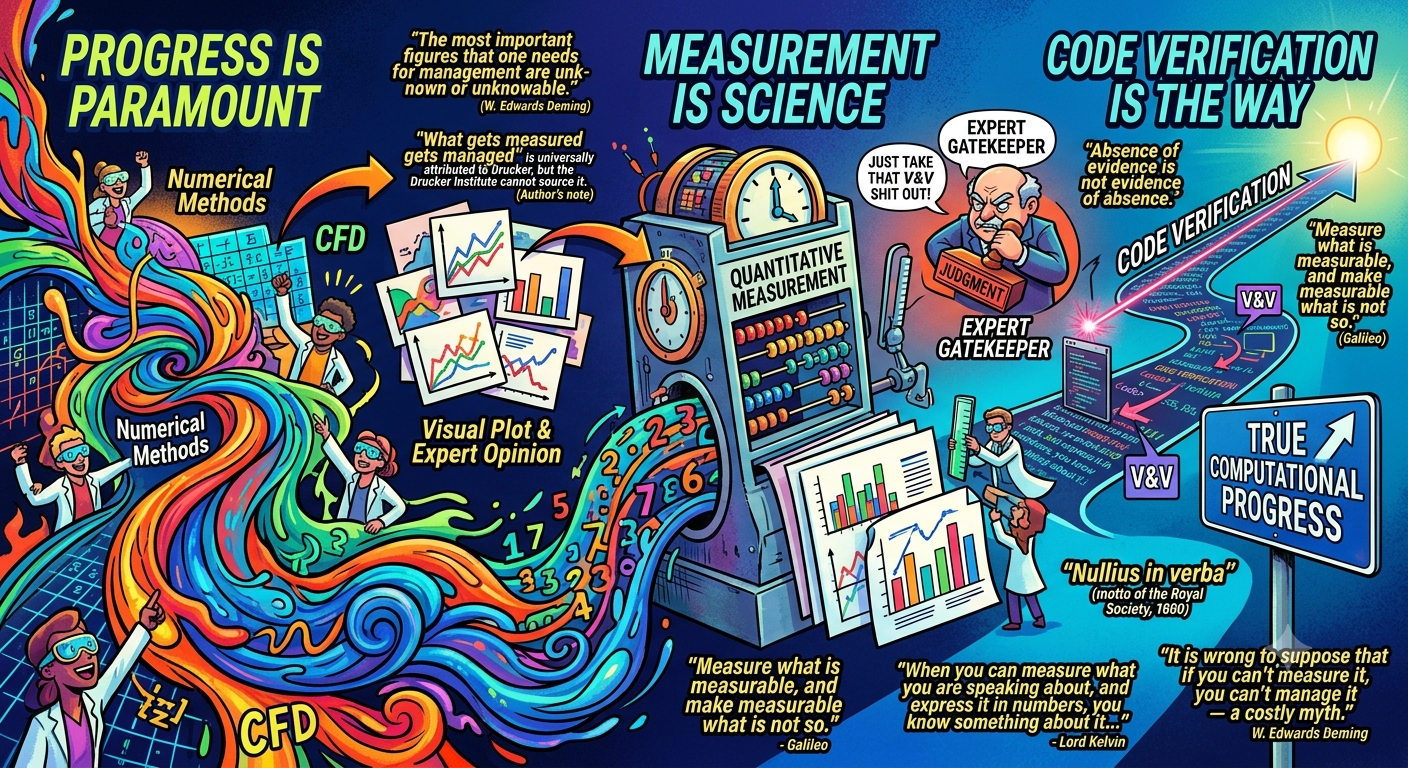
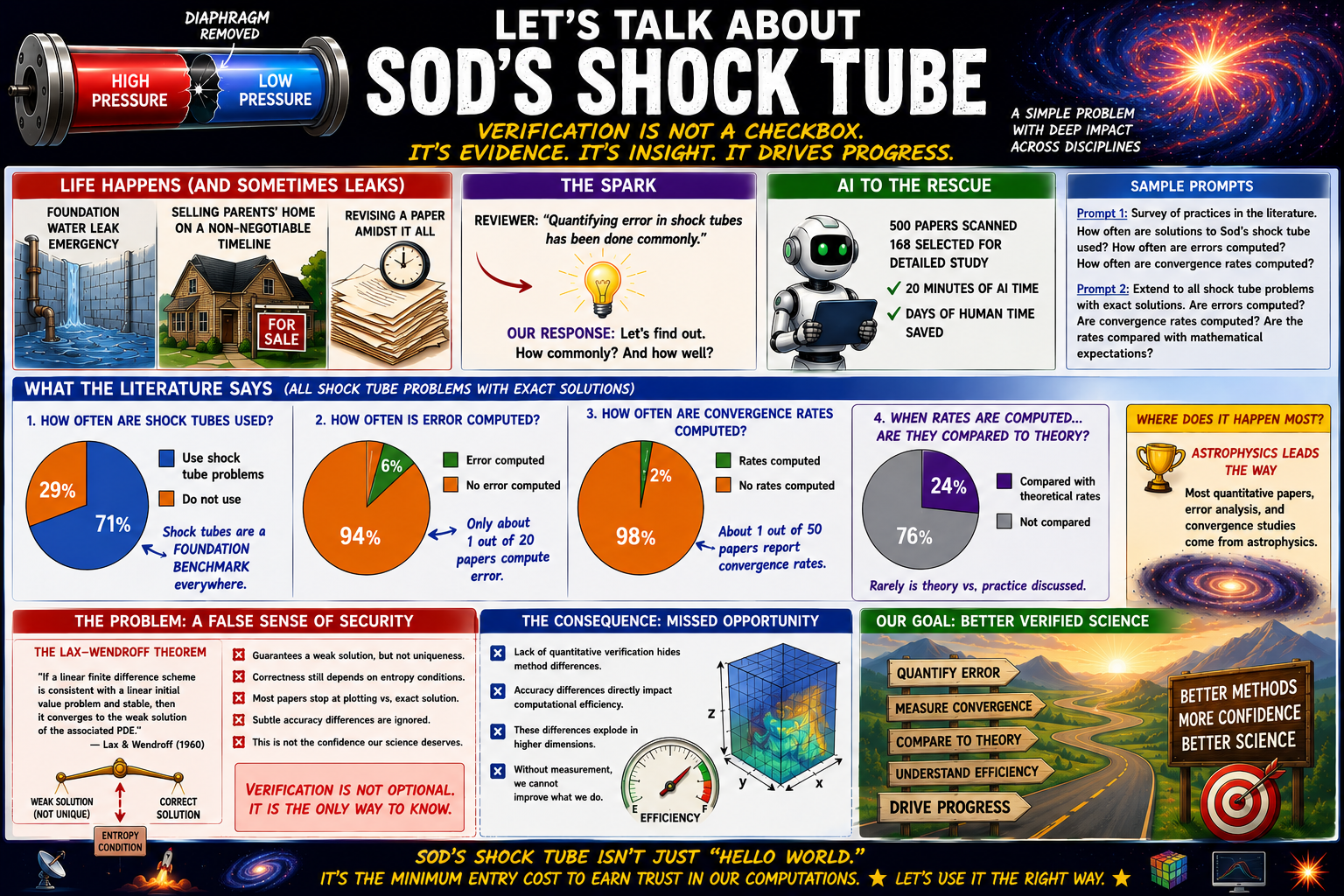
The miraculous nature of today’s world owes its existence to human progress. Some of that progress is serendipity. Some is targeted and guided. In science, measurement is the key both to inspiring progress and to recognizing it. For algorithms, methods, and computing, code verification is how we measure. The alternative to measurement is expert judgment. Both have value. But when you find a field that has stopped progressing, you will usually find too little measurement and too much expert judgment. If we want computational progress, measurement is our friend.
Progress Is Paramount
When I started graduate school, I worked on nuclear energy — specifically the more exotic aspects of it, in support of space exploration. As exciting as that might sound, I never developed any passion for it. It was a reaction to my professor, or perhaps just the topic.
When I started learning numerical methods for differential equations, though, I was full of excitement. The idea that you could simulate the real world on a computer fascinated me. I enjoyed the power and beauty of hyperbolic PDEs and their solution, especially the nonlinear methods that had recently come into vogue. I ate it up.
I learned numerical method after numerical method, gradually narrowing my focus to monotone shock-capturing schemes. FCT and TVD methods were in vogue then, and ENO methods were just being created. I was enchanted by the rapid progress of the previous decade and read paper after paper as the methods were developed and tested. I also grew fond of the associated mathematical literature, finding real beauty and elegance in how that mathematics supported both the methods and our understanding of them. As I devoured the literature, I began to study something else: how these methods were tested and demonstrated, and what the standard was for claiming one method was better than another.
What stands out in retrospect is that the prevailing view of “better” rested on a qualitative metric. The measure was the expert’s opinion about the vagaries and nuances of a visual plot. The judgment seemed defensible enough in one dimension. In two and three dimensions, acceptance of results was essentially an artistic verdict.
A few years later, after I had moved to Los Alamos, I noticed the working version of this standard: the gnarlier and swirlier the vorticity in a problem, the better the method was considered. And yet the progress made in these methods over a short period was astounding. As readers who know my general tendencies will guess, progress is something I care about deeply. Progress is what we should always be seeking.
“Working on the right things is what makes knowledge work effective. This is not capable of being measured by any of the yardsticks for manual work.” — Peter F. Drucker, The Effective Executive (1967)
Measurement Is Science
As this body of work became more familiar to me, the reliance on qualitative examination and expert opinion became more and more distasteful. I met a number of people who were genuine experts and who sat in judgment over methods and progress. Eventually I saw them for what they had become: gatekeepers. There was noobjectivemeasure of what was better.There was only expert opinion, and expert opinion favored those who already held power.
The problem with this status quo is that progress has screeched to a halt. Journal editors are thoroughly fed up with yet another paper developing and comparing limiters — and I am responsible for a couple of those myself. It became a cottage industry. Meanwhile, the standard of measurement for the problems that actually matter is nonexistent. This is the recipe for a stalled science. The key thing to recognize is the centrality of measurement to science. Unmeasured qualitative assessment is not science. The stagnation of progress is therefore no mystery — the two are correlated. Progress requires measurement.
This gets at the real tension over results and standards. The mathematics supporting this area is quite limited. Rigor comes with caveats and serious restrictions. Relatively few practical results carry any assurance from the theoretical foundations of the field. Into that vacuum steps qualitative gatekeeping, and the consequence is stagnation.
To overcome this, we need to measure results quantitatively. We also need a leap of faith: we must be willing to trust what we seeempirically, in the places where theory cannot follow. We know qualitatively that modern methods were a quantum leap in capability. They let computations attempt problems that had been impossible, and they rapidly became standard. The problem is the threadbare theory. Consider the Lax equivalence theorem, which establishes that consistency plus stability is equivalent to convergence — but only for linear PDEs. All our experience says the theorem describes the utility of computing for nonlinear and far more complex problems. What we lack is the rigor to prove it. Stagnation has festered in exactly that gap.
“Absence of evidence is not evidence of absence.” — commonly associated with Carl Sagan
Methods, Algorithms, and Codes Need Metrics
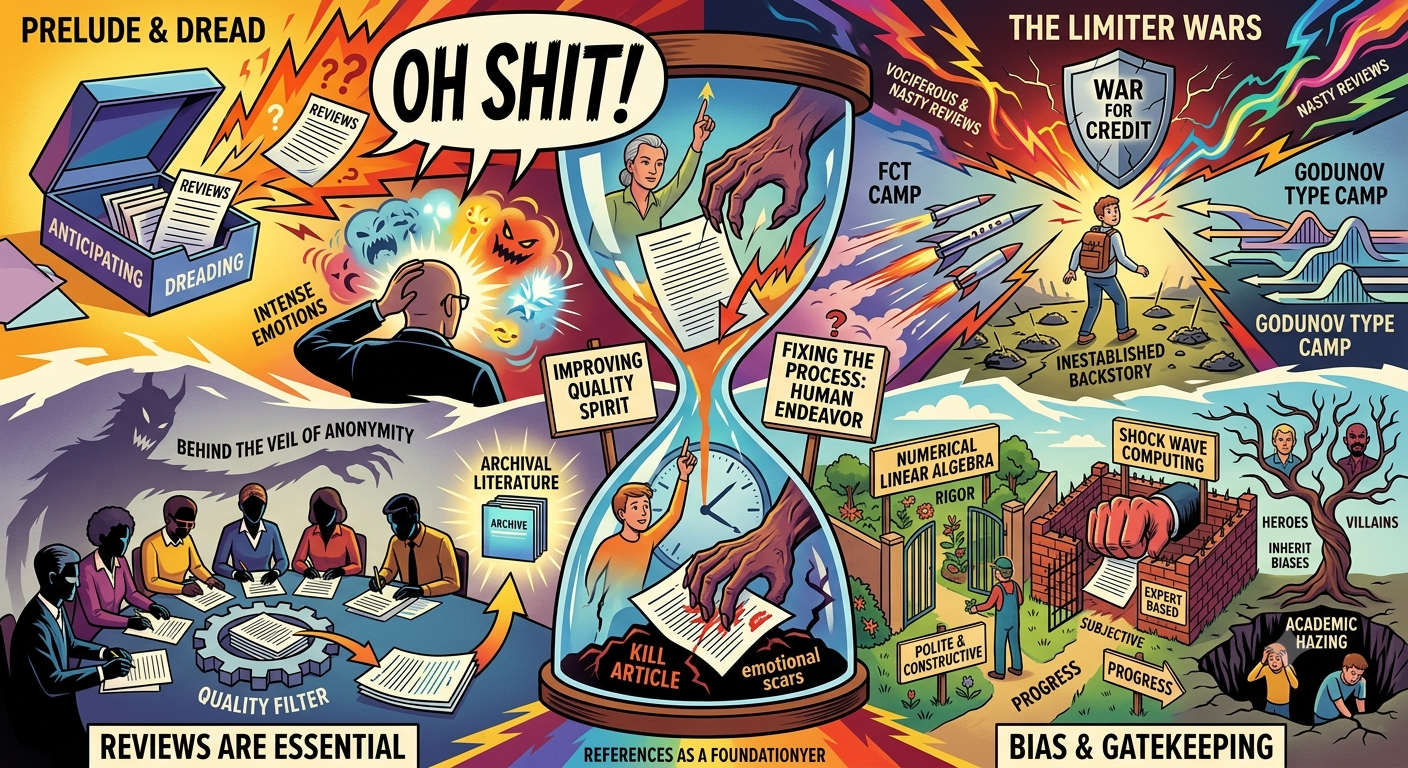
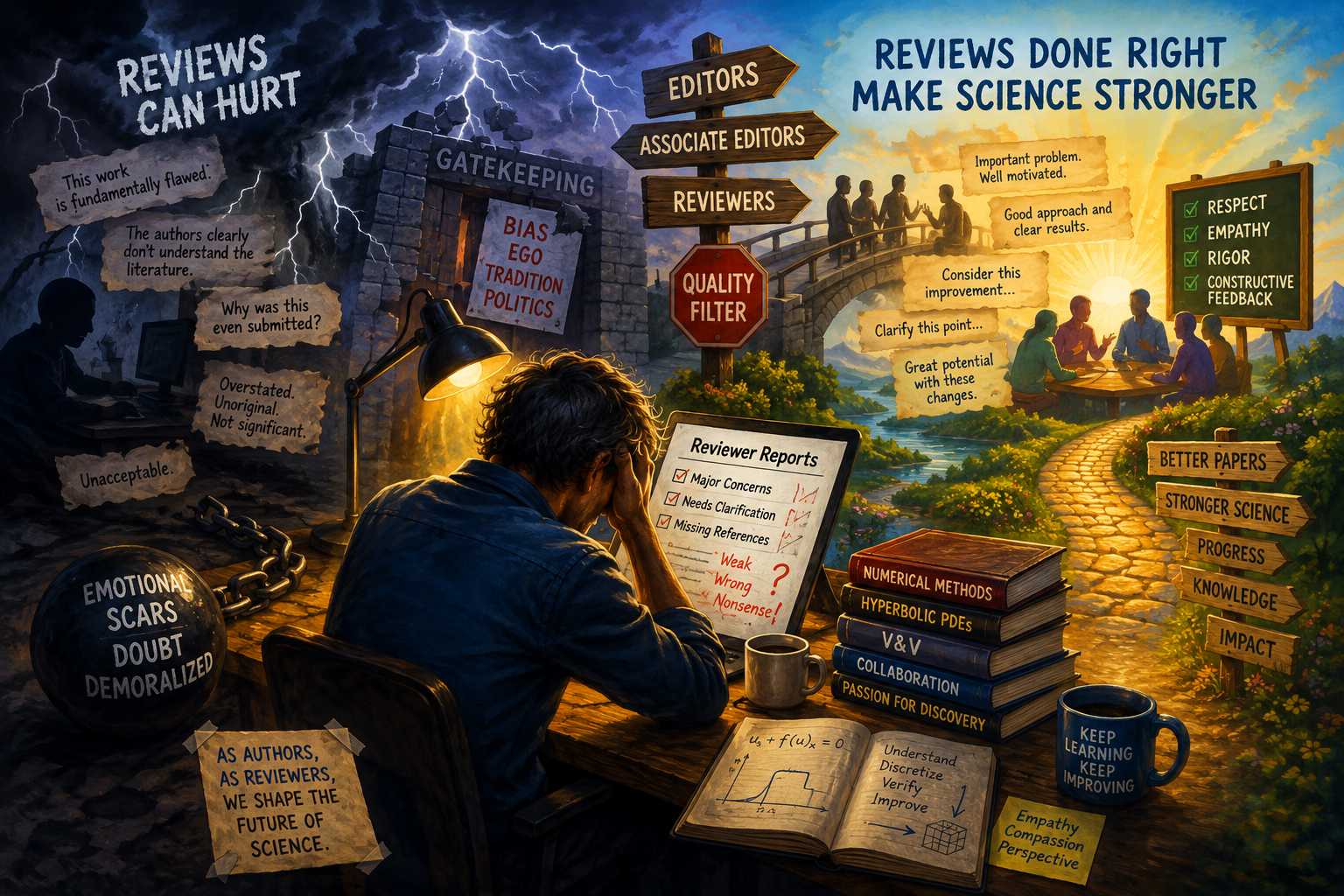
As I matured as a scientist, I came to understand that measurement is feedback. Measurement is science, and method development needed it to flourish. This view generated a great deal of friction with the existing community — friction I found inside the Lab’s computational physics community as well as outside it. It came to a head in an exchange with an editor who demanded that I “just take that V&V shit out of the paper.” Gatekeeping at its finest.
That paper was the culmination of work at Los Alamos; it died on the vine at Sandia. In it I was looking for methods that could deliver quantitatively better solutions to discontinuous problems at an attractive cost — efficiency, in a word. Doing that requires unraveling which elements of method design actually contribute to better solutions, balanced against computational cost. The work grew out of an observation: WENO methods buy formal accuracy at high cost and fail to deliver practical accuracy. Jeff Greenough and I published that failure.
The next step was to turn that knowledge into a better method, which I believe we accomplished in the paper with Jeff and Jim Kamm. Code verification was central to demonstrating the progress, and that is precisely where we ran headlong into the gatekeeping. Results for problems with discontinuous initial conditions and shocks are evaluated qualitatively, full stop. Measurement and quantitative measures need not apply. We measure only for smooth problems, and only to confirm formal high-order convergence rates. That is the standard practice.
No wonder we are stagnating. No wonder there are thousands of papers tweaking limiters and WENO variants. Without measurement, progress is a random walk. I am still pushing this effort forward because I remain convinced it is necessary. Progress depends on aligning our approach with best practice; verification is part of that practice, and V&V must be quantitative. I got into V&V because it is how you do science correctly. The irony is hard to miss: engineers have embraced V&V while scientists and mathematicians treat it with genuine animosity. The problem is that engineers see V&V as a process and a check, not a fuel for progress.
“When you can measure what you are speaking about, and express it in numbers, you know something about it; but when you cannot measure it… your knowledge is of a meagre and unsatisfactory kind.” — Lord Kelvin, Popular Lectures and Addresses (1883)
Code Verification Is the Way
“Measure what is measurable, and make measurable what is not so.” — attributed to Galileo
Once I understood modern methods, I started to see the cracks in practice, and working alongside some of the leaders in the field amplified the view rather than softening it. In everything I did, I looked to measure the connection between theory and observed results. Not only comparisons against analytical solutions, but all results.
Analytical comparisons carry the great power of objective truth. Without them, you can estimate error, but you cannot know it. Given how soft the theoretical results are, comparison against analytic solutions deserves a spotlight. The catch is that the problems with analytic solutions are the ones furthest from application.
I had discovered that V&V was essential. V&V provides feedback on your code and your model, and that feedback is actionable. Qualitative comparison is actionable too, but the variations it suggests come from expert judgment — and experts have bias. That bias usually takes the form of projecting one’s own philosophy of algorithm design onto the results. I preferred something less prone to it. Code verification became my instrument for measuring progress, and the arc of my work through the late 1990s and 2000s reflects that. Along the way, I became more knowledgeable about code verification and more engaged with it broadly.
What is worth acknowledging is that my position runs counter to both communities. The algorithms and methods people carry animosity toward quantitative verification. The verification community that came out of engineering has its own bias: it adopts relatively simple practices and tends to ignore most of the mathematical expectations. Its members are dismissive of the equivalence theorem while adhering to its precepts far beyond the range where it rigorously applies. So I stood out as an outsider. This is a role I have grown comfortable with, and even proud of. The quantitative comparison of results gave me constant feedback and guided my work.
“Nullius in verba” (“Take nobody’s word for it”) — motto of the Royal Society, 1660
Why Is Code Verification Despised?
The logic of quantifying error and using it as feedback is clear enough. So why is the practice resisted so hard? Why the animosity?
The answer is the power bound up in gatekeeping. Experts who hold power in their own right have that power amplified by serving as the judges of progress. They ensure their own work remains the cornerstone. Their judgments involve a great deal of handwaving: the reading of solution structure and oscillations is judgment, and judgment can be made to serve its holder’s ends. Quantitative verification is a different animal, because numbers cannotbe wavedaway — they still require expert interpretation, but they constrain it.
The animosity, then, is largely gatekeepers defending their hold on a field. They decide who publishes and who gets credit, and they reject those they dislike or who fail to reinforce their standing. This behavior is hardly confined to computational fluid dynamics. The turbulence community is equally stagnant, if not more so, and for the same reason: persistent gatekeeping throttling progress.
I saw gatekeeping at Los Alamos as well, where the nuclear weapons designers held the role. They were quantitative about validation results, but they achieved those results through extensive calibration. In particular, they would quite cavalierly calibrate away numerical error using physics submodels. This is a common practice as weather and climate modeling does the same basic thing.
The hostility toward quantitative measurement of code performance is deep and profound, and together with the CFD gatekeepers, it has blunted progress for decades. The result is a hegemony of older methods still in use long after they should have been replaced. It limits what modern computing can contribute to genuinely important problems. This remains a force that saps some of the value we should be enjoying from computing. Over the history of the computational age, methods and algorithms have provided efficiency equal to or greater than computing itself.
The case for being quantitative about practical problems is, in some ways, simple. Practical problems haveextremelylow convergence rates — first order is typically the best you can achieve, because the dynamics of numerical methods change considerably in the presence of discontinuities. Under those conditions you should care far more about producing small errors than about high convergence rates. Highly accurate, high-convergence-rate methods simply don’t pay off, particularly when they are expensive.
The real question is how to deliberately produce methods that achieve small error, remain robust, and selectively preserve the solution structures that matter. That is afundamentallydifferent design problem than chasing formal order of accuracy. Pursuing high-order methods formally can produce more error on practical problems. They only show their benefit when the problem becomes complex enough to contain a great deal of intricate structure. This points toward greater adaptivity to tie the two uses together cleverly. Quantitative assessment is key to success.
“It is wrong to suppose that if you can’t measure it, you can’t manage it — a costly myth.” — W. Edwards Deming, The New Economics (1993)
References
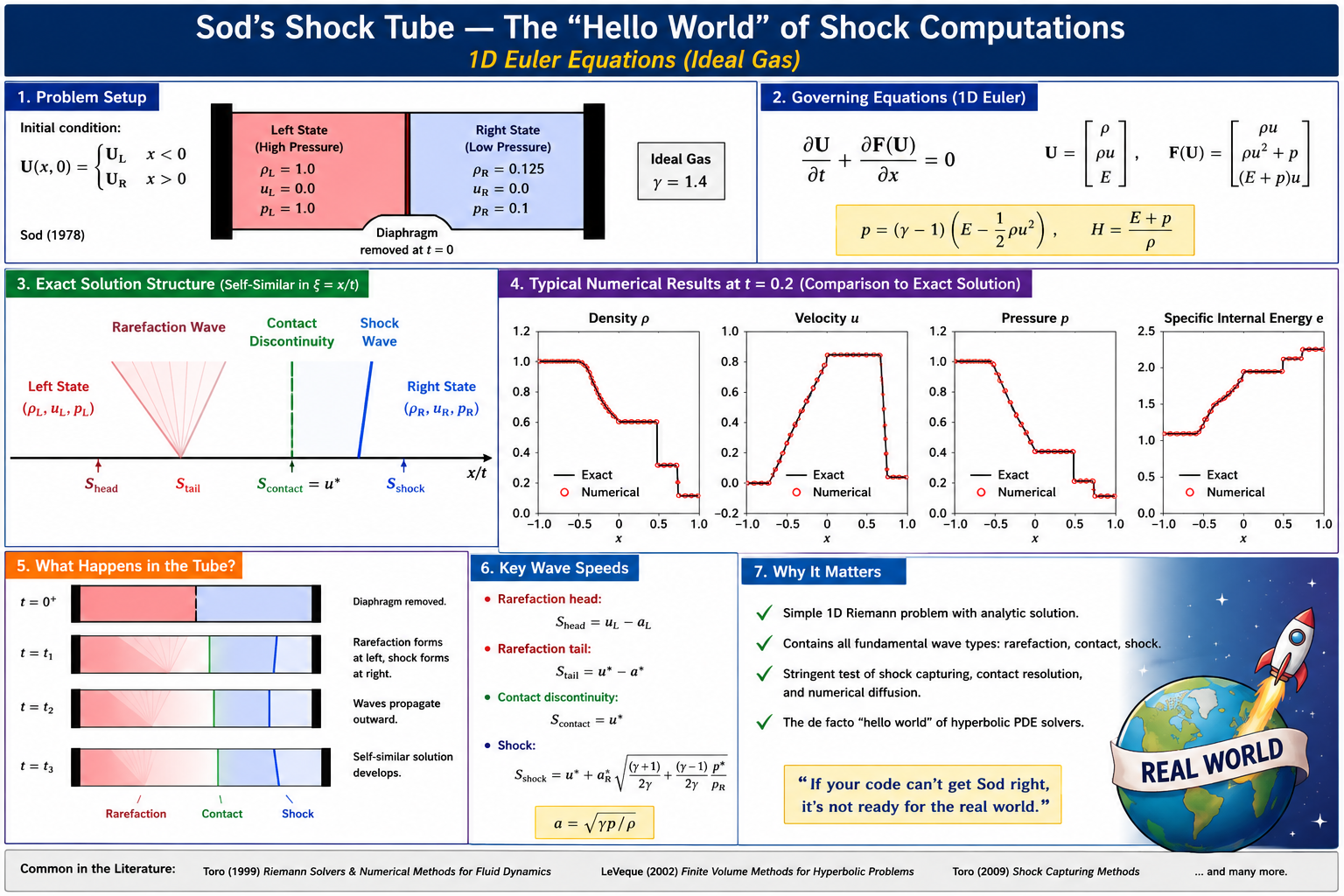
Sod, Gary A. “A survey of several finite difference methods for systems of nonlinear hyperbolic conservation laws.” Journal of computational physics 27, no. 1 (1978): 1-31.
Boris, Jay P., and David L. Book. “Flux-corrected transport. I. SHASTA, a fluid transport algorithm that works.” Journal of computational physics 11, no. 1 (1973): 38-69.
Harten, Ami. “High resolution schemes for hyperbolic conservation laws.” Journal of computational physics 49, no. 3 (1983): 357-393.
Jiang, Guang-Shan, and Chi-Wang Shu. “Efficient implementation of weighted ENO schemes.” Journal of computational physics 126, no. 1 (1996): 202-228.
Rider, William J., and Douglas B. Kothe. “Reconstructing volume tracking.” Journal of computational physics 141, no. 2 (1998): 112-152.
Rider, William J. “Revisiting wall heating.” Journal of Computational Physics 162, no. 2 (2000): 395-410.
Rider, William J., and Len G. Margolin. “Simple modifications of monotonicity-preserving limiter.” Journal of Computational Physics 174, no. 1 (2001): 473-488.
Greenough, J. A., and W. J. Rider. “A quantitative comparison of numerical methods for the compressible Euler equations: fifth-order WENO and piecewise-linear Godunov.” Journal of Computational Physics 196, no. 1 (2004): 259-281.
Rider, William J., Jeffrey A. Greenough, and James R. Kamm. “Accurate monotonicity-and extrema-preserving methods through adaptive nonlinear hybridizations.” Journal of Computational Physics 225, no. 2 (2007): 1827-1848.
Banks, Jeffrey W., T. Aslam, and William J. Rider. “On sub-linear convergence for linearly degenerate waves in capturing schemes.” Journal of Computational Physics 227, no. 14 (2008): 6985-7002.
I worked with classified documents almost my whole career. This isn’t odd when you work at two nuclear weapons labs. Classification is important and essential for security. The law and practice of it is a fucking mess, none more so than export control. There are huge loopholes, and the powerful flout the rules with impunity. Corrupt managers abuse the law for their own ends. Those in power ignore the law regularly. Today it is simply another way power and inequality asserts itself.
For when everything is classified, then nothing is classified, and the system becomes one to be disregarded by the cynical or the careless, and to be manipulated by those intent on self-protection or self-promotion.”– Justice Potter Stewart
The fundamental issue
A couple of years ago we discovered that the former (and current) President had hundreds of classified documents in his residence. They were stored in ballrooms and bathrooms. He shared the information with various people, foreign and American, as he wished. Among these documents were some of the country’s most essential secrets, far beyond anything I ever saw or had access to. Had I done what he did, I would expect tobe imprisonedfor the rest of my life.
The President suffered no consequences for this extreme violation of trust. It was also an abdication of responsibility. I took it as a personal insult. It is also a pattern I had already seen over and over, and it inserted itself into my life again this week. Rather than protecting important information, classification issimplyanother way for the powerful to fuck with the rest of us. These violations are common and committed with utter impunity by those in power. The danger from this is real.
Identifying and managing classified information is very important. The protections and the secrets are essential. This information falls into broad categories. Secret Restricted Data (SRD) is the material associated with nuclear weapons. I dealt with this a lot; I even held a position of responsibility for identifying it. National Security Information (NSI) covers other timely information about things like spying and defense. These are the categories the President stole and misused. Finally, there is Controlled Unclassified Information (CUI), formerly Official Use Only (OUO). Export-controlled information falls under this umbrella. CUI is the mostcommonlyandbroadlyabused category, and coverups and information hiding are rampant under it. I’ll get into this below.
“Secrecy is for losers. For people who do not know how important the information really is.” —Daniel Patrick Moynihan
This function of government is absolutely essential, and it must be wielded responsibly. Instead, the powerful often use it cynically and selectively for their own ends. The result is abuse of power. It is another way that the law applies only to the little guy. Another manifestation of the Epstein Class, who follow completely different rules than the rest of us. The result is a set of essential laws that simply become another way to tell the average citizen to fuck off.
First, let’s get to a few basics of the law and practice. Then I will elaborate on some of the abuse of power I witnessed over my time at the Labs. Some of this has parallels in the news (Trump, Clinton, Biden, John Deutch, …) worth mentioning. If you’re powerful, the law isjustnotional.
Classified material
When most of us think about classification, the thing that comes to mind is SRD, the category used to classify material related to nuclear weapons. It has been a major focus in my life.
When I worked at Los Alamos, I became an authorized derivative classifier. This job involved reviewing documents, presentations, and emails for the presence of classified information. There are many subtleties in all this, and I came to understand the area quite well, particularly in my specific expertise, which spanned various parts of computational science.
The real focus of all this classified work is always on the applications and how the workis reflectedin technology. This is generally true for this type of classification, and it shows up again in export control. It is central to understanding the whole topic.
This form of classification is defined by statute. When you’re doing classification work, detailed technical guides define whatis classifiedand provide a rubric to work with. Violations of this classification law carry penalties that can be quite severe. I had many interactions with violations and security issues, but generally speaking, my personal record was quite good.
When I transitioned to Sandia, it would have made sense for me to continue as a derivative classifier. My experience with the professionalism and competence of the Sandia classification office quickly convinced me this was a risk exposure I couldn’t tolerate. The classification office at Los Alamos was my partner and peer; the classification office at Sandia was adversarial and struck me as outright incompetent. The institution took a negative, adversarial approach toward employees and made me feel like I was the one at significant risk all the time. They also provided far less support for anything related to classified documents and pulled that support away from any sort of local control. In short, the overall attitude made me extremely uncomfortable having anything to do with classified work at that laboratory, so I declined the responsibility.
“The concept of the ‘official secret’ is the specific invention of bureaucracy.” — Max Weber
Export control law
The second place classification shows up is export control policy. Export control deals with information that is less sensitive and less damaging than nuclear weapons material. The lawwas writtenafter the statutes governing nuclear weapons information, andironicallythe statutory penalties are far worse. Compounding things, the law is much vaguer and written with a fear-based approach, with little to no technical guidance for determining whether something is export-controlled.
As I will elaborate, this makes the policy more arbitrary to adjudicate. It also makes it more prone to abuse and outright violations of the spirit and letter of the law. That led to my retirement, and to the episode this last week.
All of this matters a lot. When I look at the issue around my retirement, its sensitivity designation is central. I can say unequivocally that the document this all revolves around was not export-controlled. Yet, it was declared as such. It was not information sensitive in any way and should not have had any of these controls attached to it. The declaration that it was export-controlled was a pure abuse of power. Knowing the objections of the managers makes it corrupt on its face. Itwas declaredexport-controlled only because the contents of that report were bad for the laboratory and exposed problems. The designation was done purely to protect the outright incompetence and unwillingness of the managers to address the problems the report identified.
The applications of this work have nothing to do with the report or the material contained in it. These are solutions to hydrodynamic test problems with analytic solutions, used for code verification. The code verification results are clear and unambiguous: the code cannot solve these problemscorrectly. The reasons are simple and easy to explain. Unfortunately, they are not articulated in the report, and the institutional approach is to simply hide the report and assert that the results of these test problems are immaterial to the problems the code solves. Nothing could be further from the truth.
“It quickly becomes apparent to any person who has considerable experience with classified material that there is massive overclassification.” — Erwin Griswold
Abuse and violation are common
I wish I could say that abuse of power and violations of these laws were uncommon. The inverse is true. I mentioned the President’s hoarding of classified documents as a prime example. By the same token, Hillary Clinton used a private email system for classified work, which was a violation. John Deutch, the former CIA director, took classified material home. Former President Biden had a handful at home by mistake.
I saw two instances at Los Alamos where lab directors committedfairlyserious security violations and wereessentiallylet off the hookentirely. They suffered no consequences.
In one case, a lab director spelled out details of a security investigation in a public meeting. The classification level of a security investigation is the same as the material being investigated. He wassimplylet off the hook as they declared the material hadsuddenlybecome declassified.
Another lab director read aloud a passage written by the head of the NNSA that contained classified material. This was a subtle violation, but one common in the area where I worked. I immediately knew that what was read was classified. When I took it to the classification office, based on their previous experience, they felt it wasn’t worth touching. Again, because of the power of the individuals involved, they were off the hook. I don’t think they even had any idea they had committed a violation.
Given this experience, it comes as no surprise that managers believe they can get away with things. The CUI designation is not supposed tobe usedto hide embarrassments or problems, yet itis usedthat way over and over. Moreover, the institutions are making more and more information CUI, precisely because of the lax, undefined nature of the technical designation.
The case relevant to me now highlights this. They see something they don’t like, and rather than dealing with it and taking responsibility, theysimplydesignateit as controlled information. Prying eyes can’t see it. This is done over and over, and because of the lax nature of the law, they act with impunity.
For genuinely classified information, there are supposed to be penalties and admonishments for using classification to hide information through overclassification. In export control law,justas there is no technical specificity, there is no such rule. In no case are these enforced actively. These managers get to do this with impunity. Nothing stops them. It’s simply something they’ve gotten used to doing. So we have a situation where the powerful hold a law they can abuse. They can hide their problems, hide their issues, hide anything embarrassing, and they just get away with it.
To put a point on this whole shitty situation: this harkens back to the same attitude we see with the Epstein class. Rich, powerful people flout the law, violate it with impunity, and let their power shield them. Granted, the things I’m talking about here aren’t nearly as horrible and disgusting as the crimes Epstein committed, but the abuse of power and privilege is exactly the same. Theyroutinelyuse these laws to punish the little guy while violating them themselves. This is exactly what happened in my case, and I suspect it happens over and over across the entire federal establishment.
Institutional corrosion
“A popular Government, without popular information, or the means of acquiring it, is but a Prologue to a Farce or a Tragedy; or, perhaps both.” — James Madison
Moreover, this is a bipartisan issue. These actions are committed by everyone in a position of power, and they are among the most corrosive forces eroding trust in our leaders and our institutions. It needs to be fixed. Fixing it would be a major step toward re-establishing the trust and confidence we need in our leadership for a better future.
A position of leadership should be the opportunity to set the best example. Instead, in our current society, leaders regularly flout the rules and receive exceptional treatment. Rather than being examples for those they lead, they act with a sense of impunity and entitlement, and that entitlement amplifies the sense that the rules are different for them. The laws and regulations are merely suggestions; their position allows them to violate them without consequence. They do not have to abide by the same constraints, rules, and principles thatall ofusare requiredto follow. It is no small statement to say that this is a recipe for disaster, but this is where we are. I can see examples of this in action from the bottom of leadership to the top. Rather than setting an example to follow, they provide proof that power endows you with special privileges and little responsibility, while the serfs toil below.
The fact that these abuses are commonplace and practiced at every level of leadership is not an excuse. Rather, it is a test of the basic values and ethics those leaderspossess. If a leader violates the rules or abuses their power, they have failed a fundamental test of character. In each of the examples above, those leaders failed that test. They have shown they are unfit for the positions they hold.
In their hands, the rules and regulations are simply tools of power, instruments for taking retribution against those they don’t like. Secrecy is important, but it is also a reliable engine of distrust, and that distrust is a threat to effective leadership. Our leaders amplify this threat by abusing people with the very rules and regulations they refuse to follow.
“The best weapon of a dictatorship is secrecy, but the best weapon of a democracy should be openness.” — Niels Bohr
“When someone shows you who they are, believe them the first time.” – Maya Angelou
I deleted a couple of posts today (the previous footnote). I had no choice. I received a threatening letter from Sandia that left me no recourse. I’m not going to relitigate the whole episode. It confirms that I worked for unethical and corrupt managers there. It simply amplifies the point. These people have absolutely no business managing anything, much less nuclear weapons. Their professional success indicts the institution.
I had downloaded an unclassified document from the OSTI website. It was marked as such, with a Sandia release number indicating it had gone through information release control (SAND2026-20700). These are designated “UUR,” meaning Unclassified Unlimited Release. I treated it as such. Moreover, the document was indeed completely unclassified. I’m an SME in every topic it contains. In fact, the whole reason I was hired by Sandia in the first place was this very expertise. The report was in the bullseye of my professional expertise.
It holds no sensitive information either — that is, unless you’re sensitive to bad results. Until I received the letter, I had no reason to believe otherwise. Any other designation of the document is complete bullshit. Yes, I was a derivative classifier in a previous life, and I take this shit seriously. Classification at Sandia is far more political than technical. The law has massive gaps in it that empower the management to systematically over-classify. They are using it to bury bad results. Rather than fix the problems, they hide them. In the long run, this will come to no good.
What I can share is an episode that defines the character of the person I believe is at the center of this. He’s only the third-worst person I met at Sandia, mind you. Let’s call him “Cilantro” because he leaves a bad taste in some people’s mouths. It’s a worthy nickname for this piece of shit, and feel free to use it if you have the misfortune of interacting with him.
A while back, Cilantro was a group leader overseeing some nuclear weapons work. I was asked to lead a peer review of an important body of work. Red flag number one appeared almost immediately: the review was held at a very high level of security inappropriate for the work. The extra security was immaterial to the work itself, but it reduced the pool of people available to see the work or judge it. My mentor, for example, was excluded as a result.
During the review, the material driving the designation was shown. It was completely immaterial to the presentation. At the end of the day, the work was reasonable in terms of quality and completeness. But the team presenting it was unnecessarily avoidant and belligerent toward the review team and our questions. They continually pointed to a huge stack of documents for answers, basically refusing to provide any detailed ones. I was genuinely perplexed. The work was good, so why the animosity?
What became clear was that they expected a rubber stamp instead of a review. They were arrogant, and it showed. Cilantro was their group leader. Ironically, the material that drove the designation wasn’t even classified — it was export-controlled. When I wrote the report, I had to classify it at the level of the presentation (SRD Sigma 14). I asked for the report to be declassified to the level appropriate for the information. The person responsible failed to do so despite my repeated prompting. I will note that there are rules against over-classification, and I was endeavoring to follow them.
Eventually, time ran out, and all I had was my first draft of the review. They passed, but the unprofessional and belligerent behavior was noted. I found it counterproductive and antagonistic. The memo went out, and I got it declassified at the last minute. It had not gone to the rest of the review team either.
Then Cilantro called me to his office. He didn’t like the memo. When I got there, unbeknownst to me, another manager was waiting. They ambushed and attacked me. How dare I criticize their people? I should have realized then that Cilantro doesn’t like critique unless it says he’s amazing. He refuses to see problems or do anything about them. He just wanted to berate me, and brought along someone else to make sure it was two on one.
So when Cilantro became a manager above me, I should have known to get the fuck out.
“He who decides one day that scientific statements do not call for any further test, and that they can be regarded as finally verified, retires from the game.”– Karl Popper
When we last spoke, I was reacting to reviews on a paper. It is a paper that touches on Peter Lax’s contributions to modern computational science. Our angle is the practice of code verification, with two main points: the equivalence theorem and shock tube calculations. There the focus is analysis and accuracy measurement. I’ve writtenpreviouslyabout how important and valuable this is. We’ve started addressing the reviews and revising the manuscript accordingly. One point in the review prompted this essay. I’ll get to it in a moment.
I had gotten myself into a good rhythm of writing. That has been derailed. The reviews are actually a minor part of this. My writing energy is going into the revision, a more formal and professional modality. The big thing that has gotten in the way is life. At home we had a water leak in the foundation. This is an emergency and really bad. I’m also in the midst of selling my parents’ home, with an inspection and a title company to deal with. All of this is on a timeline that doesn’t move, especially the leak, which is a “drop everything, fix it now” emergency.
Now back to the task at hand!
One comment in our reviews prompted a response and inspired this essay. In a nutshell, it said that quantifying error in shock tubes is commonly done. There is definitely truth in this. The question is how much truth, and moreimportantly, how to distinguish our work from the rest. Our work needs to be novel. I think it is, but we need to articulate that better. That is what I’m currently working to express with greater clarity. I wanted to put some meat on the bone for the comment.
Pointedly, what does the literature actually say about these problems? There are thousands of papers that use them. How is our paper, and our use of these problems, different from all of them? This is a rather daunting prospect. I enlisted Claude to survey the literature, sampling for practices with Sod’s shock tube in particular and shock tubes in general. It was a lark on my part. Claude performed beyond my wildest dreams. It was quite impressive. The rest of the essay will elaborate.
“When you can measure what you are speaking about, and express it in numbers, you know something about it; but when you cannot measure it, when you cannot express it in numbers, your knowledge is of a meagre and unsatisfactory kind.”– Lord Kelvin
The study Claude did confirmed the reviewer’s comment, but only to a point. It took all of 20 minutes, five of which were me writing the prompt. It looked at 500 papers and selected 168 for further study. It surveyed the papers and documented the work. I have a spreadsheet of the papers with the results discussed, and it wrote me a report on the findings. I spot-checked it, but the same study would have taken me days by hand, tedious and time-consuming days. It confirmed my thesis to a large extent. I was actually surprised at how quantitatively stark the statistics were. Notably, astrophysics is the discipline where quantitative accuracy and convergence are actually practiced.
For shock tubes in general, about one paper in 20 computes the error. One in 50 computes convergence rates. Among those, there is little analysis aside from the observation that convergence is first order or less. There is no discussion of the practical implications of the accuracy. The study also pointed to the papers that come closest to what we are aiming to do. Beyond the findings themselves, it was the use of AI to address the question that struck me. I was blown away by how cool and easy this was. One of my coauthors expressed animosity toward using AI. That’s a topic for another day.
Another notable aspect is how many papers engaged in some form of quantitative analysis (about 55%). This was actually a very large number, but it was mainly focused on smooth problems, where the design order of accuracy can be achieved, often in all norms. In a sense, this applies the equivalence theorem verydirectlyon (almost) linear problems, where all the nonlinearity in the methods fades away or diminishes to a few exceptional points. This is an essential part of code verification, but for the applications these codes are written to solve, it is utterly and completely inadequate.
The practice of code verification needs to be more than a check for correctness and a lack of bugs in the code. It needs to advance the methods in practical ways for the problems we write the codes to solve. Bugs and correctness are important, but they are far less than the practice could deliver. We are suggesting expanding the practice into a full partner in progress.
Prompt 1: “I would like a survey of practices in the literature. The question is how often solutions to the Sod Shock tubeare usedin papers. Then among those how often the error from the exact solutionis computed. Then again how often are rates of convergence computed.Using the literature available (arXiv, etc.) can this surveybe completedand an analysis given“
Prompt 2: “Rather thansimplyusing Sod’s problem as the focus, extend the study to all shock tube problems having an exact solution. Ask whether the errors in the solutionare computed. Ask whether convergence ratesare computed. Then are the convergence rates compared with mathematical expectations.“
Code verification is a means of providing evidence and confidence in the proper functioning of our methods. Beyond providing that confidence, it can identify issues in the code and methods, and focus research efforts on addressing, mitigating, or improving them. It is not merely a checkbox. It is a means of producing actionable information from which a proactive research agenda maybe defined. Our paper expands the role code verification can take to include computational efficiency.
The Lax-Wendroff theorem has seduced us into a form of false confidence. The vast majority of papers simply plot the solution against the exact solution. No errorsare computed. There is an implicit view that the accuracy differences are immaterial. I’ve argued that they are material; the differences are subtle, but important. The lack of direct verification rests on the confidence the theorem provides us. This is a failing. The current literature does not treat the issue with the deference it deserves, nor is it consistent with the sort of confidence we should be endowing our methods with today.
Recognize the full scope of the theorem: it guarantees a weak solution, if it applies. A weak solutionis desired, but it is not unique. The theorem does not guarantee a correct solution. That depends on an entropy condition, so the verification question is still alive, yet infrequently engaged. This is not an acceptable state of affairs.
When the Lax-Wendroff theorem is not in play, verification becomes even more necessary, since the guarantees are missing and mustbe demonstrateddirectly. You could converge to the correct solution, but assurances are missing. In either case, the differences between methods are reflected in achievable accuracy. That achievable accuracy is then reflected in meaningful differences in the efficiency with which it is obtained. These differences can only be studied quantitatively, and they become far more profound as dimensionality increases. Nonetheless, they are not given the attention they deserve. Our work is trying to move the needle toward better practice.
The other part of the story is how to use AI properly. This was an exceptionally cool idea, and AI did the work extremely fast. It felt like a huge boost in productivity. In my mind, it frees up my time and attention for other things. Today that means solving problems in my personal life. Tomorrow it could mean leisure. It can also free up time and energy for creativity and progress.
“Beware of bugs in the above code; I have only proved it correct, not tried it.”– Donald Knuth
“The mistake, of course, is to have thought that peer review was any more than a crude means of discovering the acceptability — not the validity — of a new finding.” – Richard Horton, editor of The Lancet
Prelude
I awoke the other morning to find in my inbox something I had been anticipating and, to be honest, dreading for a while.
I looked at the subject line and muttered, “Oh Shit!”
These were the reviews for a manuscript I was an author on, mostly last year and earlier this year. The emotions this stirred up were quite intense, and I found myself pausing and putting off digesting the reviews for several hours. It got me to think about whyI feelso much dread about this. Part of this is my lifelong experience with this process and various episodes with referees’ reports. Most referees are decent and constructive. A few are monsters. They make the entire process brutal and unpleasant. They ruin something wonderful. I will detail what has led to it being a fairly unpleasant experience to read most reviews.
Reviews are Essential
“Criticism may not be agreeable, but it is necessary. It fulfils the same function as pain in the human body. It calls attention to an unhealthy state of things.” — Winston Churchill
Before getting started on the reason for trauma, I would like to elaborate on the topic more broadly. Reviewing the work of peers is an essential part of science. This includes the process for journal articles. Itrulybelieve in the peer review process and its centrality to the quality of the archival literature. It is also a process by which articles are both checked and improved, and it provides a great deal of valuable feedback to authors that is valuable. It also takes place behind the veil of anonymity. This also empowers nasty behavior. This is the source.
The other people who sit at the center of this particular process are the editors and associate editors for any given publication. I have served as an associate editor for a journal and found it a sometimes difficult but often rewarding process. My general observation is that the editors do nothing about reviewer behavior. Part of the issue is that the willingness of reviewers is tenuous. Moreover, some of the worst behavior comes from some editors and leaders in the field. One friend told me that I had chosen a particularly nasty subfield. Many of the leading lights of the field could be brutal and unprofessional. Other subfields were far nicer.
One of the things that occurs to me is the relative degree to which the editors don’t act as more effective gatekeepers in policing some of the more egregious behavior by reviewers. This could go a long way toward making things significantly better. One of the episodes I’ll discuss involved an associate editor directly and speaks to how underlying biases and general viewpoints of the editors can imprint on the overall process.
Done right, the process can lead to an enhancement of the literature. Done poorly, it can leave emotional scars and create baggage for the authors. It can also serve as a relative stagnation of a field. There is also gatekeeping that is counter to progress. In my opinion, there are a variety of biases and problems with the literature that the current process does not fully appreciate and does not do a good job of policing.
I can elaborate on some examples of the problems that I’ve seen in the literature and the reasons for engendering the sorts of emotions that they get. I will elaborate on a few of the more extreme examples in my time. I should note that the current reviews, in retrospect, will not likely stick out in this regard. I’mjustnoting my preconception and reaction. They’re fairly ordinary, but the emotions that they prompted got me to thinking about the whole dynamic.
As a professional, I do quite a few reviews myself. That number is probably dropping off, but in general, with retirement. The perspective I take in doing reviews is that I try to have empathy and compassion for the authors. This approach is prompted and governed by the experiences I detail below. I try to avoid some of the more egregious examples that I’ll discuss in this essay.
When I do a review, my intention is to provide something that is first and foremost focused on improving the quality of the article. I am acting as a quality filter as well. I am pointing out any lapses or issues with the narrative. That said, Icertainlyrepresent a specific viewpoint and opinion on what articles can contain (rather than what they should contain). This is something that I think is impossible to scrub. Nonetheless, I am mindful that my views are not perfect. I do wonder whether or not my own perspective and biases end up producing the effect that I speak out against regularly. God, I hope not!
“We (Mr. Rosen and I) had sent you our manuscript for publication and had not authorized you to show it to specialists before it is printed. I see no reason to address the—in any case erroneous—comments of your anonymous expert. On the basis of this incident I prefer to publish the paper elsewhere.” — Albert Einstein
Reviews are Traumatic
My very first papers were in an obscure subfield, space nuclear power. My co-author and professor was a big deal in the field. What I did not recognize was that this shielded me from issues. In this field, he was a criticism deflector. I would soon learn the sort of critiques one could receive without this protection. On the other hand, he was a monster to me. Writing a paper with him was torture. It was part of what drove me away and made me recoil from his influence. I stepped away and found a new path.
“Academic politics is the most vicious and bitter form of politics, because the stakes are so low.” — Sayre’s Law, attributed to Wallace Sayre
When I started on numerical methods for hyperbolic conservation laws, my education and work took a particular arc. The entry point, looking at their methods, was flux-corrected transport. These are methods that were devised by Jay Boris in collaboration with David Book and also include a rather spectacular contribution by Stephen Zalesak. These methods and papers were part of the start of a computational revolution. They sparked my imagination when I read them and tested out the methods. My goal was to understand FCT better.
In continuing my study, certain aspects of the physicist’s point of view from which flux-corrected transport (FCT) began did not sit well with me. I was drawn toward some order, mathematics. There were certain mathematical shortcomings that became obvious, and over time, I became far more attracted to the family of methods thatwere devised byBram Van Leer andmathematicallysorted out by Ami Harten. In the process, I wrote a paper trying to bridge between these two bodies of work. Unbeknownst to me, I had stepped into a minefield.
What I would find out later is that there was a fairly nasty war for credit between the FCT camp and the Godunov-type method camp. Represented by Jay Boris on one side and Bram Van Leer on the other. I have now heard tales of rather vociferous and nasty reviews of papers being passed back and forth between this set of authors and some depth of hard feelings that were generated as a result. When I wrote my paper on the bridge between the two, I had no such knowledge and walked into this as an innocent. These conflicts were completely out of my sight. I had no insiders to clue me in or warn me.
I had taken a certain perspective in looking at this, which was to embrace some of the mathematical rigor and structure that Harten, in particular, had introduced. I looked to see where that structure would embrace flux-corrected transport and the manner in which it would break down. It uncovered some mechanism for oscillations in results (non-monotone behavior). The way that I did the analysis was to project flux-corrected transport onto the perspective of total variation diminishing methods (TVD). I found that the limits of the method were that it would not produce TVD results. The TVD theory was a way of seeing FCTdifferently. A path to better understanding. A good idea that was stupid culturally.
“Criticism is prejudice made plausible.” — H. L. Mencken
I wrote the paper and sent it off to the Journal of Computational Physics. The upshot is the paper was never published in the Journal. It got cast into a sort of referee limbo, which also coincided with a tumultuous period with the Journal. The journal passed to new editors and directions. I also knew the identity of all three of the reviewers by the end of it, each a quite famous person in the field. One identified themself, another in a conversation, and the last by administrative error.
One of them, Ami Harten, liked the paper immensely and suggested that it be published immediately. This was the first review I received, and needless to say, I was over the moon. He sent me a letter and an analysis of the FCT Ami had published with NASA. Ami had done what I did. I found out why it had never been published. I only spoke with Ami on the phone, never met in person.
The second review I received was relatively neutral regarding the manuscript but offered a host of fairly pedantic corrections to grammar and various technical details of the paper. This was the Editor of the Journal, Phil Roe. I would meet Phil later in my career.
I got the third review, which was absolutely and unremittingly brutal. I should say that the brutality was matched by the technical skill of the referee, whose knowledge and technical edge were unmistakable. Nonetheless, the review was absolutely savage and, to some degree, has left a lasting mark on my soul. I did meet him once at a conference. He seemed quite nice and absolutely the opposite of the monster in the review.
“Man is least himself when he talks in his own person. Give him a mask, and he will tell you the truth—or his most vicious lies.” —Adapted from Oscar Wilde
I would have the bad fortune of having another paper reviewed by the same person, whose character in the next review was virtually identical. I could see the same approach and use of language. The giveaway was figures in the review that matched an article he wrote, and I had read. Technically well accomplished and absolutely and utterly savage in tone and attitude. The attitude, in fact, burgeoned into something completely unprofessional. There were ad hominem attacks. I suspect I was being treated as if there was a personal grudge. Some of the savagery was a vestige of the “Limiter wars”.
“Peer review is at the heart of the processes of not just medical journals but of all of science… Yet its defects are easier to identify than its attributes.” — Richard Smith
After five years and a change in Journal editorship, I was offered the opportunity to take up the effort to publish it. I declined as I had moved on. It was also right after my second child was born. I had just moved to X-Division as well. That third review, rather than making a better paper, simplykilled the article. It left lasting trauma, too. In the meantime, Ami has tragically died far too young. The whole episode left me scarred and bitter. I think this was utterly counter-productive.
“A new scientific truth does not triumph by convincing its opponents and making them see the light, but rather because its opponents eventually die, and a new generation grows up that is familiar with it.” — Max Planck
Reviews are Biased
I was talking about journal reviews with my friend and colleague Dana. Like me, Dana worked across multiple technical communities. As I complained about the reviews, Dana interjected, “Why are you working in shocks?”Continuing, “That bunch has the nastiest reviews; things are much different in numerical linear algebra.” This shone a light into a reality, the subcultures could be different. At this point, I can see that it’s harsh and sharp in shocks. In other areas, the culture is polite and constructive. It would be worth getting to the bottom of this. I won’t. Nonetheless, this is the start of bias in the process. These differences are subtle and matters of degree, not wholesale substance.
“Peer review is faith-based, slow, wasteful, ineffective, largely a lottery, easily abused, prone to bias…” — Richard Smith
One of my conclusions is that shock wave computing is highly expert-based and subjective. This leads to power for gatekeepers. Ultimately, this part of the bias exposes the nature of gatekeeping in each subfield. One rejects and removes critique. The second nudges and pushes work toward rigor. Not that it doesn’t happen in CFD; it happens less. It is easy to see which attitude moves the needle of progress, too. Conversely, there are rejections in numerical linear algebra. This is the tendency and the spectrum of responses. As in most cultures, these are taught and reinforce attitudes as acceptable. In a sense, the cultures are taught by the forefathers of a field. I wonder who set the tone originally?
My particular case stepped into the next bias. FCT, TVD, and Godunov-type methods are all great ideas. Each of them has distinct strengths and weaknesses. These small differences become the focus of all-out wars. I hadinadvertentlystepped into a battle. I took a side without knowing it and invited an ambush. None of this is explained to you until after the fact. I only learned the backstory later as my circle of professional friends “crossed the streams.” Eventually, you understand these things.
The insider who is a student of one of the leaders (or their students) of the field gets a different view. They also get a far more biased perspective. This is usually focused on the hero’s (or his advisor’s) role. It will thus inherit the bias of their advisor. The other side of the dispute is cast as the villain. One side is the other side’s villains. There is the occasional traitor or turncoat. All of this is unleashed onto the reviews. This almost completely explains the problems with my reviews.
Other behaviors are taught. The mode of peer review and critique is shaped. The tone and approach to giving a review are taught as well. Usually, you see this copied quite cleanly. Students often adopt the style of their advisor, rarely just in part. It is very much part of the abused becoming the abusers. In a sense, it can all come out as so much academic hazing. To some degree, I came to see most of the PhD process as having. There is genuine work and knowledge included in a PhD, but make no mistake, hazing. This hazing, if unquestioned, just fully bakes into the culture. We are all responsible for it and subject to it.
“We know that the system of peer reviewis biased, unjust, unaccountable, incomplete,easilyfixed, often insulting, usually ignorant,occasionallyfoolish, andfrequentlywrong.” – Richard Horton, editor of The Lancet
Fixing the Process
As a starting point, some of these issues shouldn’t be solved. They are simply a reality of a human endeavor. People are biased. Those biases are present in all their actions. Some of these are good biases, such as a value of correctness and clarity. Thus, an article review is always biased. Nonetheless, we are poor at detecting the internal culture of a field from the inside. We should identify those reviewing constructive cultures, and adopt their practices. We should prize and promote progress. Of course, first a field needs to see its problems. Since the leaders are the ones teaching and promoting practices, it seems difficult at best.
Since I really did not have this sort of training. I developed my own protocols. I was more exposed to the ravages of reviews, too. I did not have a wise senior person to keep me from crossing a line. As such, I received the education the hard way. The truth is that the process might be impossible to fix. This may simply be part of a human endeavor. People will be people, and some of them will be assholes. We are tribal. Some of the assholes will only be assholes to people from the other tribes. Anonymity will empower this. Editors do not police shitty reviews. This is especially bad when the shitty review is technically excellent.
A few light rules would help a great deal to engender progress, and reduce the vile trauma”
Being anonymous tempts one to be a dick. Don’t be a dick. Maybe consider signing your review and giving that up.
Critiques should be focused on making progress and improving the paper. View the paper as salvagable.
Check your bias, and try to see the other side.
A big problem with gatekeepers isn’t that they are right, but rather they have power. They want to keep this power. They love the fact that their ideas are accepted and valuable. They do not want to give this up. Progress is a threat.
Maybethis problemjustis and will be.
“When a true genius appears in the world, you may know him by this sign, that the dunces are all in confederacy against him.” — Jonathan Swift
References
Rider, William J., and Dennis R. Liles. “A Generalized Flux-Corrected Transport Algorithm I: A Finite-Difference Formulation.” arXiv preprint arXiv:2411.12627 (2024).
Rider, William J., Jeffrey A. Greenough, and James R. Kamm. “Accurate monotonicity-and extrema-preserving methods through adaptive nonlinear hybridizations.” Journal of Computational Physics 225, no. 2 (2007): 1827-1848.